“It was a wacky war”

2019-06-06 YogiBerraNavy

A well-circulated colourising of Yogi Berra’s formal Navy portrait.

Yogi Berra once gave a half-puckish beginning explanation as to how he became part of D-Day, World War II’s major Allied invasion of Europe from the Normandy beaches, as an eighteen-year-old Navy seaman. He made it sound like relief from boredom. As he so often did with his fabled Yogiisms, he had a knack for good humoured understatement.

Something still seems to be missing from America since Berra’s death almost four years ago, which was also more than a year and a half after his beloved wife, Carmen, preceded him. And there may be worse reasons to think about the Hall of Fame catcher and personality than remembering how he got himself aboard a Navy rocket boat in time to be part of D-Day.

Berra was a Yankee prospect playing for their Norfolk, Virginia farm in 1943. Norfolk also just so happened to be the headquarters of the Fifth Naval District. Which meant it was also the governing center of the Navy’s Atlantic Fleet. Which also meant Norfolk and nearby Newport News overrun with sailors and civilian defense workers, an estimated 750,000 of them in a pair of towns whose populations combined weren’t quite as large as that of the Bronx.

His biographer Allen Barra, in Yogi Berra: Eternal Yankee, has written that the lad’s first real problems in Norfolk were long lines at the movie houses he loved and trying to stretch his $90-a-month minor league salary. “I never got too hooked on cigarettes, because I couldn’t afford them,” he once said. “Maybe starvation kept me from getting cancer.”

Once, knowing his team’s two other catchers were ailing, Yogi launched a unique version of a strike, telling his manager he wasn’t well for lack of food and the ploy worked toward getting him a $5 a month raise. His mother, Paulina, helped by slipping him a few extra dollars in the mail with instructions not to tell his father. And Berra became popular enough on the Tars that one ardent fan, a lady, provided him a full hero sandwich of salami and provolone every Sunday game.

That sandwich, Barra wrote, “was for Yogi what spinach was for Popeye.” After he received the first such gift, he smashed twelve hits and drove in 23 runs in two games against Roanoke. (This was the doubleheader that prompted Carmen Berra to remember, “When I heard about the 23 RBI day, I figured he had a future.”) He played well enough to be able to think an equal or better 1944 would get him a Yankee call-up. “Yogi was looking forward to an explosive 1944,” Barra wrote. That’s a polite way to describe the one he got.

Berra knew only two things: 1) He’d be in military service soon. 2) He had no idea where. Told his draft papers were drawn back home in St. Louis, he asked for and got them sent to Norfolk. After the Tars played an exhibition game with the Norfolk Air Station (some of the Norfolk players included such Show men as pitchers Fred Hutchinson and Hugh Casey, outfielder Dom DiMaggio, and Yogi’s future Yankee teammate/fellow Hall of Famer Phil Rizzuto), he talked to a warrant officer at Norfolk’s Navy training station and took the man’s suggestion to enlist in the Navy.

When his boot camp in Maryland ended, his mother underwent surgery; he was allowed to be with her until she could return home. After that, Yogi went to Little Creek to train for the amphibious service. The routine otherwise was so hurry-up-and-wait that the kid relieved his boredom at the base movie theater and with the comic books he fell in love with. Then one night he was watching Boomtown, the Clark Gable-Spencer Tracy film, when the film suddenly stopped and the theater lights suddenly came back up.

Berra and all the other sailors in the theater were ordered to line up. Officers asked for volunteers—for rocket boat duty. None of the young swabbies had a clue about rocket boats but when someone called them rocket ships, Yogi perked up. The idea that volunteering in military service was tantamount to being very careful what you wish for hadn’t yet been programmed into his mental data base.

The boats, as Barra noted, “turned out to be small landing craft, LCSSs (Landing Craft Support Small), whose purpose was to spray rockets on the beach before troop landings. There were duller things to train for. Some of the men got the hint that they might be participating in a major troop landing, perhaps the invasion of Hitler’s Fortress Europe that the papers were always writing about.”

The sailors called the rocket boats big bathtubs. If you played with toy boats in the bath when you were a small child, try now to imagine having a bath with 48 rockets, one twin .50-caliber machine gun and two .30-caliber machine guns. The boats affirmed the aforementioned hints: their purpose in life was to hammer the Normandy beaches and clear the way for the troops’ landing crafts. Yogi and his fellows had a name for them: “The landing craft suicide squad.”

The rocket boatmen first went to Plymouth, England. Once again it seemed to be hurry up and wait. Three weeks after they arrived, though, Berra’s LCSS was attached to what was thought to be the smallest transport ship in the Coast Guard fleet, the USS Bayfield. It made for Normandy early on 4 June. The Bayfield carried six LCSSs. “Just before dawn, on the morning of June 6, 1944,” Barra wrote, “their rocket boat was lifted on the davits and lowered over the side and, in Yogi’s words, ‘expendable as hell, we headed in for Omaha Beach’.”

The LCSSs were the tiniest boats on the waters heading into firing position.

“It was scary,” Yogi would remember, “but really something to see. I was only eighteen, and I didn’t think anything could kill me. I didn’t know enough to be scared. I had my head up over the side of the boat all the time, looking around like it was the Fourth of July in Forest Park and after the fireworks we were going to go over and get some hot dogs and Cokes.”

Bless his innocent soul, Yogi probably had no idea how vulnerable the LCSSs were. The sides of those boats weren’t exactly thick. One errant enemy shell, especially one hitting any of the boats’ rockets, would have made not the Fourth of July hot dogs but them into duck soup. Berra’s peekings over the edges to see the show ended when his lieutenant advised him to put his head down if he had plans to keep it.

The LCSSs waited for their lead boat to fire a test and see if it reached the beach. If it did, the other boats would move in close. It did. And inimitably, Yogi described the boats moving in “closer than the hitter is to the left field [wall] at Fenway Park.” One and all of them began firing. “I couldn’t see all the bloodshed that they showed in the movie [Saving] Private Ryan,” he remembered years later, “but I did see a lot of guys drown.”

Berra’s and all the LCSSs did what they were sent to do. Well enough that by D-Day’s afternoon they could actually relax, though they were under orders to remain through 9 June for cover fire in the event the Nazis had ideas about the counterattack that never came.

They had more trouble from an anticipated storm smashing in on 8 June, battering the boats and even flipping Yogi’s over. Before that they had trouble through no fault of their own—a friendly fire incident. Three fighter planes appeared above and the LCSSs were under orders to shoot down anything flying below cloud level. The LCSSs fired and hit one plane. The pilot bailed and parachuted before the plane hit the drink. Yogi ordered his boatmates to keep him covered, expecting to hear a stream of German.

What he heard was a stream of English language swearing. The crew had shot down an American plane whose markings they couldn’t see in the murk of the storm. When the storm worsened, Berra’s boat flipped over. Try to resist the temptation to say that only Yogi Berra and his boat crew could survive D-Day just to get thatclose to drowning after the artillery stopped.

They hung on until they were rescued and returned to the Bayfield. A Nazi bomb fell near the ship but no serious damage occurred, according to Barra and others. Berra said later he was too tired to be scared. Years later, when he met D-Day’s mastermind, Gen. Dwight D. Eisenhower, he couldn’t bring himself to ask Eisenhower about the invasion. “I never talked about D-Day,” Yogi remembered. “It didn’t seem right, but now I wish I had.”

With good reason. Numerous sailors believed Eisenhower was aboard one of their ships on D-Day. This was because of Eisenhower’s soon-to-be-immortal radio message (You are about to embark on a great crusade) that was actually recorded at the 101st Airborne’s headquarters while watching the first Allied aircraft reach for the skies on that day. Even today, it sounds so clear that when you play it it sounds as though Ike’s telling it to you side by side as you’re about to hit the links.

Berra and his squadron got a break to rest at Portsmouth before going to Bizerte, the North African coastal town, and by 15 August 1944 he was part of the LCSS force hitting Marseilles and strafing hotels and other facilities co-opted by German forces. Berra’s boat was almost hit by mistake by a British shell that turned out to be a dud.

Berra himself got close enough to death when ships of the British Royal Navy behind the LCSSs fired at targets past the hotels and, while holding a rocket, one of his crew hollered to hit the deck. As he ducked under a gun mount, Yogi accidentally dropped the rocket. “It did not go off,” Barra wrote, “or you wouldn’t be reading this book.”

During a furious barrage, Berra got nicked by a bullet from a German machine gun before he manned his twin .50s and fired to cut down fleeing Nazis. As American troops landed, the locals swarmed the sailors with gifts and song. “It was a wacky war,” Yogi would remember. “A half hour after we were getting shot at by the Germans, the French were welcoming us.”

He rarely talked about his World War II experiences in the decades to follow. When he did so, even that provoked a little humour, as in the Los Angeles Times overhearing Berra talking to Hall of Fame pitcher Jim Palmer and Hall of Fame broadcaster Tim McCarver. Wrote the Times: “Yogi survived D-Day and George Steinbrenner, and all in forty years.”

He had to survive a more sensitive customer, though: his mother. After receiving a month’s leave for the Christmas holidays, Berra went home and showed his family his hard-earned decorations: a Distinguished Unit Citation, two battle stars, a European Theater of Operations ribbon, and a Good Conduct Medal.

Paulina Berra was already in tears as it was. Her boy also earned the Purple Heart when he was nicked by that Nazi bullet, but Yogi didn’t dare make the formal application for that medal. He figured that if Mama Berra knew what the Purple Heart really meant, she’d suffer a purple heart attack.
A survivor’s milestone

2019-04-30 CCSabathia

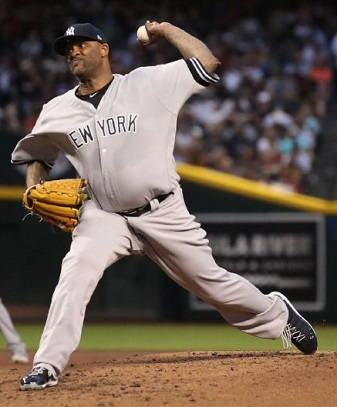
CC Sabathia about to release the changeup that turned into strikeout number 3,000 Monday night . . .

It didn’t happen before the home crowd. It didn’t have to. A Yankee fan made it very clear with the placard he hoisted: “I traveled over 3,000 miles to see CC Sabathia get his 3,000th K. NJ -> LA -> SF -> ARI.” But even the Chase Field audience couldn’t resist the loud standing O after Sabathia fooled Diamondbacks catcher John Ryan Murphy with a changeup in the bottom of the second.

Technically, Sabathia struck out the side to get there. He caught David Peralta leading off, looking at a sinkerball that didn’t sink too far in the low zone. He got Christian Walker to swing and miss on a cutter that wasn’t likely to threaten the stature of his former, Hall of Fame teammate Mariano Rivera.

Then Sabathia was rudely interrupted when a cutter that didn’t quite cut the way he probably hoped met former Met Wilmer Flores’s bat on its way over the left field fence, and Nick Ahmed followed up by doing whatever he could with a changeup and making it work enough to beat out an infield single.

Up came Murphy, a former Yankee who’d caught Sabathia in the past, a righthanded hitter with a little power of his own. Sabathia worked him inside to open, missing with the first pitch before he fouled off a pair. Then Sabathia went a little up in the zone and fouled that one off. That was a quartet of cutters. Then came the changeup taking a neat little dive under Murphy’s swinging bat head.

Sabathia seemed at first to be the only man in Chase Field who looked like it was just another day at the office. His Yankee catcher Gary Sanchez pumped a fist and clung to the milestone ball for dear life. The rest of his teammates swarmed him near the Yankee dugout while his wife and four children roared in the stands with the rest of the crowd. Sabathia made sure to get some hugs from his lady and his kids before letting his mates have at him.

“Count me in,” Sanchez told reporters after the game. “I was one of those that was super excited and happy and desperate for those three strikeouts. Once we were able to get those strikeouts I was able to relax a little bit. Exciting, exciting just understanding what the milestone is and I was just super excited.”

Count Sabathia in, too. The third lefthander in baseball history to cross the 3,000 threshold (after Hall of Famers Steve Carlton and Randy Johnson) came a long way, baby. “Since the end of last year, you coming up short 14 strikeouts . . . it’s the only thing I have been thinking about the last six months,” he told reporters. “So, actually to have it now be over it and I can just worry about the season and try to win games.”

The Yankees so resemble a M*A*S*H post-op ward these days that a lot of people worried how they’d go forward trying to win games, too. But, pun intended, they’ve bloody well done it. So much so that the comparably banged up Nationals in the National League East aren’t earning many sympathy points, which is a little unfair. Except that maybe even the Yankees are a little surprised that they still look like American League East beasts no matter how many key men are still in the ward.

“It was one of those things where it was kind of inevitable, but it’s not something we really talk about,” said manager Aaron Boone, whose own playing career included an exercise in futility against Sabathia: one hit, four strikeouts, and a .167/.167/.167 slash line.

“It was kind of wait and see, see how it happens and it obviously happened at the end of the inning, so we were able to congratulate him coming off the field and not take too big of a break in the game,” Boone continued. “It was kind of fitting that he was leading off the next inning. It’s something that we can really sit down and put things into perspective, you can look back on it as a really, really special accomplishment.”

Special may be a polite way to phrase it. There was a time when nobody thought he would make it far enough to land the milestone he landed Monday night. Including Sabathia himself.

He was a throwback, an innings-eater who thought nothing of going long distance (he led the majors in innings pitched twice with 241 innings or better) while pitching like a dominator, in Cleveland, in Milwaukee (he made the Brewers’ brief 2008 postseason trip possible almost by himself in the second half of that season), and in New York, turning his left arm into considerable money and looking like it was just a question of when, not if he’d get his own set of keys to Cooperstown.

Then Sabathia’s body began betraying him. Most of the betrayal came from his right knee, part of the leg on which he lands when he delivers, and it turned the big, bearish lefthander—never exactly the poster child for a classic male athlete’s physique to begin with (he always looked the way you’d imagine aging Babe Ruth to look if Ruth had remained a pitcher)—into a man whose workhorse days were history.

So were his days as a power pitcher. His once-formidable fastball and his stamina went AWOL. If he wanted to survive long enough to finish what he started, the $161 million free agency deal he signed with the Yankees in the first place, the one out of which he opted and turned into a little more money, Sabathia had to reinvent himself.

Especially after he shocked the game two days before the 2015 American League wild card game, when he went into manager Joe Girardi’s office in the Camden Yards visiting clubhouse and told him he would check into a Connecticut rehabilitation facility. He’d binged so badly during that set in Baltimore that he actually needed to detox first.

Sabathia remains in recovery. Meanwhile, to remake himself as a pitcher, he looked to the classics to do it, the old stereotype of the cleverly crafty lefthander who lived on something close enough to junk, developing a different kind of changeup, adding a cutter that cut just enough to keep him alive, and going to his slider a lot more often than before. He learned to live at the back end of the Yankee rotation and in the junkyard, he worked for his five or six innings’ work every few days, and he survived.

Then he underwent knee surgery this past offseason, not to mention an angioplasty, and he decided going in that 2019 would be the final season of his career. He also decided to enjoy every moment of it as best he could with whatever he had left in the tank. His days as a mound howitzer too far gone to kid himself, nailing number 3,000 testified to something better. His spirit.

The Diamondbacks to their credit didn’t mind the Yankees basking in the moment of Sabathia’s milestone. He’s the seventeenth pitcher to reach it, the first having been Hall of Famer Walter Johnson in July 1923 (the Indians’ Stan Coveleski was his milestone victim) and the last having been Hall of Famer John Smoltz when he punched out the Nationals’ Felipe Lopez in April 2008.

Murphy is a seven-year veteran who isn’t likely to find himself in Cesar Geronimo’s position. (We hope.) That center fielder for the Big Red Machine found himself a Number 3,000 twice before his career ended: Hall of Famer Bob Gibson rang him up for number 3,000 in July 1974—which made Gibson only the second man to cross the threshold—and Hall of Famer Nolan Ryan nailed him in July 1980.

Four more pitchers crossed the 3,000 threshold before Geronimo’s career ended: Hall of Famers Tom Seaver, Carlton, Ferguson Jenkins, and Don Sutton. Their milestone victims weren’t exactly fish cakes, either: in order, Keith Hernandez, Tim Wallach, Garry Templeton, and Alan Bannister. There’s one five-season streak of 3,000th-Ks (1980-84, with Ryan, Seaver, Carlton, Jenkins, and Sutton) and one four-season streak. (2005-08, with, in order, Hall of Famer Greg Maddux, not-yet Hall of Famer Curt Schilling, and Hall of Famers Pedro Martinez and Smoltz.)

“”I want to make sure that I say it loud and clear that if you’re a baseball fan, you have to appreciate what you saw,” said Diamondbacks manager Torey Lovullo. “You saw somebody that’s been going out there for a long time since he’s been 19 years old and he’s done it at a very high level every single year. There’s never really been a down turn. Maybe when I knew him a long time ago, he was more of a fireballer and now he’s learned how to pitch, and it’s fun to watch.”

“I’ve played against him for 12 years,” said Diamondbacks right fielder Adam Jones, who’d tangled with Sabathia on many a day as an Oriole, “and I can say that the competition against him is always A-1. You always know when you face him that the intensity is going to be high. He deserves everything that’s coming his way.”

Jones is well aware that Sabathia also belongs to a particularly exclusive club: the third black pitcher to punch out 3,000 hitters or more, with Gibson and Jenkins; and, the threesome are known as members of the so-called Black Aces, African-American pitchers credited with 20 or more wins in single seasons. (The founder, Brooklyn Dodger legend Don Newcombe, died earlier this year; the other members are Sam Jones, Mudcat Grant, Earl Wilson, Al Downing—the same Al Downing who surrendered Henry Aaron’s record-setting 715th lifetime home run—Vida Blue, J.R. Richard, Dwight Gooden, Dave Stewart, and Dontrelle Willis.)

Sabathia is, too. “Being a ‘Black Ace’ is something that I take very seriously,” he said. “So to be on that list as one of three guys with 3,000 strikeouts, it’s hard to grasp, it’s hard to think about it. But it’s cool to be on that list.”

He knows that since 2013 he hasn’t been the pitcher he was from 2001-2012. And he’s okay with it. Ever onward and upward. He nailed two more strikeouts before his Monday night was done, including Murphy the second time, yielded to the bullpen with two on and one out in the sixth.

But he couldn’t out-pitch Zack Greinke (strikeout victim number 3,001 if you’re scoring at home, by the way) and could only watch as his Yankees couldn’t overcome what finished as a 3-1 Diamondbacks win. Other than the Yankee loss, Sabathia has only one regret about the evening.

“When I actually got that [milestone strikeout], I didn’t want it to be Murph,” he said. “Me and him are really close, I’ve been knowing him his whole career.”

As much as he thought about it coming out of spring training, getting there was something else entirely. “That’s a hard one to grasp,’’ he said at a postgame press conference with his wife and children at his side. “There’ve been some great pitchers who played in this game, but being the third lefty is just incredible.”

When all else is done and said, Sabathia’s endurance could be called likewise.

On patriotism in its proper baseball place

2019-04-22 KateSmithCBS

Kate Smith at the height of her radio career.

The skirmish over the Yankees turning Kate Smith’s version of “God Bless America” off, until they can verify she wasn’t the racist a particular 1931 recording of hers has people today believing, should also have us thinking about things aside from dubious retroactive punishment for dubious retroactive charges of racism. Whether it does, of course, is something else again.

Let’s get this one out of the way: Kate Smith has never been a particular music interest of mine. My taste (and preference as the musician I just so happen to be, as a guitarist and lately, too, as a self-teaching vibraphonist) inclines far more to blues and jazz, and Smith was about as much of a blues or jazz singer as Miles Davis was a pan flute virtuoso.

When I wrote about the hoopla a couple of days ago I cited the television critic Tom Shales, who observed that kids who grew up hearing Smith “privately felt that this is what Mom would sound like, if only Mom could sing.” It prompted me to remember my own late mother singing in the shower and sounding as though being tickled on the soles of her bare feet while doing it, which is just about the way Smith’s voice sounds to me whenever I hear it.

As a concurrent lover of classic network radio from its infancy through the era’s commonly acknowledged death in 1962 (I have a personal collection of sixteen thousand plus surviving such radio shows), I’m aware of Smith’s popularity on the air, though little enough of her radio work seems to have survived the era in the way that such as Fibber McGee & Molly, Jack Benny, Lux Radio Theater, Suspense, and Gunsmoke have done. Those and more such survivals than you might believe allow the curious and the enthusiast alike to listen, learn, and, yes, stand athwart nostalgia, yelling “Art!”

But I’m also aware that Smith leveraged her own popularity during World War II to become one of radio’s most effective at delivering the goods when it came to promoting war bonds buying. She’s believed responsible for inspiring around six hundred million dollars worth of war bonds buying, never mind that no one has written a book addressing it specifically as compared to the delightful offering by Mickey Cohen (no relation to the mob legend), How Fibber McGee & Molly Won World War II.

Clearly Kate Smith has patriotic cred to burn. Just as clearly, the very idea of purging her signature recording of “God Bless America” from anywhere equals replacing Washington, Jefferson, (Theodore) Roosevelt, and Lincoln atop Mount Rushmore to an awful lot of people.

That the Yankees elect to think about it on the so far unverifiable ground that she was herself a racist—it’s based on her 1931 recording of “That’s Why Darkies Were Born,” a song known to have satirised racism—falls into place with the contemporary itch to punish and purge ancient disgraces regardless of whether the offender renounced or transcended them in later years.

Last year, in light of the still-festering take-the-knee protests upon sounding “The Star Spangled Banner” before football games, and the National Football League’s then-announced formal rule requiring players to stand for its playing, I wondered aloud whether “The Star Spangled Banner” and even “God Bless America” have been and still are so overdone before sports events as to render their meaning, well, meaningless.

2019-04-22 FredThomas.jpg

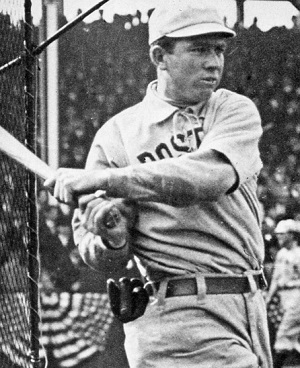
Fred Thomas, who knew about patriotism from the heart, not habit. Presumably he’s hitting here during the 1918 World Series.

Baseball itself actually has no formal rule covering either song’s playing, which is rather intriguing considering the whole thing started during a baseball game in the first place.

Specifically, it was during Game One of the 1918 World Series, with World War I on the threshold of its end and semicircular American flag bunting lining the fences in front of the field-level seats. A Navy band was present at the game. (It was common for military bands to offer music at sporting events in those years.) With or without a plan to do so, the band broke into “The Star Spangled Banner” during the seventh inning stretch.

Quite spontaneously, Red Sox third baseman Fred Thomas, himself on leave from the Navy to play in the Series, turned toward the flag in Comiskey Park (the Red Sox played the Cubs but it was thought the Cubs’ own playpen wasn’t big enough to accommodate Series fans) and saluted.

Thomas’s spontaneous gesture prompted players in both dugouts (including Babe Ruth, then a Red Sox pitcher and en route a six-hit shutout to open the Series) to salute likewise, and the ballpark crowd joined just as spontaneously. For the rest of the Series the song was played at the seventh-inning stretch. Gradually, other baseball teams and other teams in other sports leagues took it on, too.

All that before “The Star Spangled Banner” became America’s official national anthem. (It became so in—what do you know—1931.) The practise moved to playing the song before games continuing through the end of World War II and beyond, but only the NFL after the war ended made it mandatory before games.

“God Bless America” during the seventh inning stretch took hold in the wake of the 9/11 atrocity but has since receded to periodic playings, not the constant thing it was for a few years to follow. Baseball government never made it mandatory any more than it ever formally mandated “The Star Spangled Banner.”

Compulsory patriotism is empty patriotism. You probably don’t need me to tell you about those countries where patriotism was (and still is) enforced at actual or implicit gunpoint. Do you need me to remind you that there have been times enough in our own history where there’ve been those in the land of the free and the home of the brave who’ve favoured something as close to gunpoint patriotism as they could get away with?

I’d like to think the ridiculous Kate Smith kerfuffle might have been avoided if what I suggested last year might have come about: Knock it the hell off with playing “The Star Spangled Banner” before every last American sporting event all season long. And, for that matter, with “God Bless America” during the periodic seventh inning stretch. Save them for such days as Opening Day, games played on major national holidays (Memorial Day, the Fourth of July, Labour Day, etc.), the All-Star Game, and the first game of the World Series.

I’m not saying it lightly. To this day I’m charmed by the story Casey Stengel’s biographer Robert W. Creamer told “that I hope is true” (Creamer’s words): On his death bed, Stengel had a television broadcast of a game beginning in his room, and as “The Star Spangled Banner” began (as late as 1975 fans watching on television could hear and see the ballpark with it before game time) he slid out of bed, picked up the Mets cap he kept at bedside, put it over his heart, and muttered to himself, “I might as well do this one more time.”

But the charm in that is also that the Ol’ Perfesser did it spontaneously, from his heart, on the threshold of losing his battle with lymphatic cancer, and not because there was any edict requiring him to do so. Mandate it whether by formal edict or entrenched behaviour, and you reduce patriotism to habit. And patriotism—as Fred Thomas and his fellow 1918 World Series competitors understood without being told—is just too valuable and precious for that.

Pants on fire! McDougald didn’t kill Score’s career

0000 PantsOnFire03 HerbScore

The real story of Herb Score and Gil McDougald isn’t as simple as you might still think.

When Anthony Rizzo lined a base hit off Jameson Tallion’s head Monday, there must have been those who’ve watched baseball since before I was born who had two names in the center of their minds: Herb Score and Gil McDougald. As you might imagine they pop into those minds any time they’ve seen a pitcher drilled by a liner back to the box, in the head or otherwise.

Because, well, everybody knows that when McDougald, the Yankee jack-of-all-trades of the 1950s, caught hold of Score’s heater and drilled it right into the face of the Indians lefthander, that 7 May 1957 afternoon, that was it, kiss it goodbye for Score’s promising career. Right?

Wrong. Stop saying that, once and for all. Because that wasn’t quite it for the popular, talented pitcher who eventually became an even more popular Indians television broadcaster with a Yogi Berra-like flair for malaprops. (A classic: He makes the catch for the final out. And after three, the score, Cleveland 4 and the Indians 2.) And, a reputation as a gentleman who wouldn’t harm the proverbial fly.

“He’s such a nice guy,” one-time Indians third baseman Buddy Bell said of him, “that I’ll bet he makes the bed in his hotel when he wakes up in the morning.”

This is what is true: Until that afternoon, Herb Score was, essentially, Sandy Koufax before Koufax became Koufax. He’d just led the majors in strikeouts back-to-back, the 245 he punched out shattering Grover Cleveland Alexander’s record for a rookie pitcher and standing as the rookie record until Dwight Gooden broke it in 1984. His 9.7 strikeouts-per-nine rate led the majors, and he won the American League’s Rookie of the Year award pretty handily.

Score struck out 263 in 1956, again leading the majors as did his 9.5 strikeouts per nine and his 2.78 fielding-independent pitching rate. (ERA minus defense behind you.) He was also a 20-game winner in ’56. His rookie wins above a replacement-level player were 5.6, considered All-Star level or better; in ’56, he had 7.3, just shy of what WAR considered a Most Valuable Player-caliber season. He was an All-Star both those seasons, and his only blemishes seemed to be walks and wild pitches; he led the majors in the latter both years.

“Herb Score is the toughest pitcher I’ve faced,” Hall of Famer Mickey Mantle was quoted once as saying. “I just can’t hit him.” (Not entirely true: Mantle hit .250 against Score lifetime, with two homers, five runs batted in, and an .859 OPS.)

Score was in his fifth game of the 1957 season when McDougald’s liner flattened him. He had 39 strikeouts, a 9.8 strikeouts-per-nine rate, and a nifty 2.00 earned run average against his 2.50 FIP, not to mention 39 strikeouts in 36 innings.

2019-04-11 HerbScore02

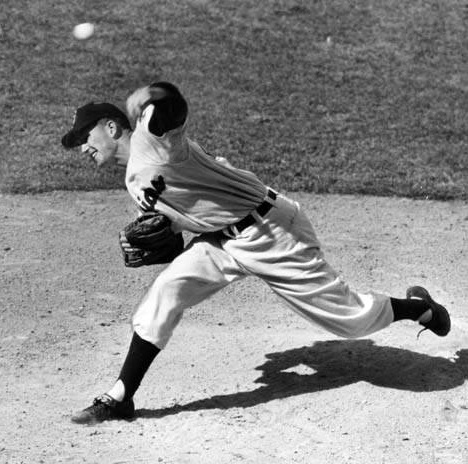
Score in motion, long before the fateful line drive . . .

Score was pitching in the top of the first and had just gotten rid of Hank Bauer on a ground out to third base when McDougald, playing shortstop that day, came up. On 2-2 he caught hold of a low fastball and drilled it, and Score hit the mound in a heap with his hands over his face after the ball ricocheted.

But every eye in Cleveland’s old Municipal Stadium (a.k.a. the Mistake on the Lake) was on the stricken Score. Indians outfielder Rocky Colavito, Score’s roommate and best friend, hustled in and slid his glove under Score’s head after Score turned in agony from his left side to his back.

Score was taken by ambulance to a hospital. Hall of Famer Bob Lemon relieved Score and finished the game, the Indians winning, 2-1, with Colavito himself pushing both Indian runs home: in the seventh, when his sacrifice bunt attempt turned into a throwing error to third allowing Vic Wertz to score the tying run (Bauer had an RBI single in the top of the seventh); and, in the eighth, when he worked out a bases-loaded walk.

McDougald finished the game, but couldn’t contain his grief, either.

“I heard the thud of the ball hitting his head,” he remembered in 1994, to New York Times columnist Ira Berkow, “and then saw him drop and lie there, bleeding, and I froze.  Someone hollered for me to run to first. When Score was taken off the field on a stretcher, I was sick to my stomach. I didn’t want to play anymore.”

Yankee manager Casey Stengel insisted McDougald stay in the game. McDougald obeyed his manager but added, “If Herb loses his eye, I’m quitting baseball.”

Score didn’t lose his eye as things turned out happily enough, but McDougald incurred a truckload of fan abuse over the liner, fans often yelling “Killer” at him when he batted during Yankee road games. Score wasn’t one of his judges, though. Indeed, when the two men met for the first time after Score’s hospitalisation, as Score himself told a reporter, “I talked to Gil and told him it was something that could happen to anyone. It’s just like a pitcher beaning a batter. He didn’t mean it.”

Score’s sister, Helen, was living in Florida at the time and didn’t know what happened to her brother until after the game ended and she returned home from her government job. “When I got home, a lady said my mother had been calling,” she told the Palm Beach Post in 2018. “I got in touch with her and Mom said, ‘It’s bad, but he’s got the finest doctors in the world and they will do everything that they can. You need to go down to the church and say your prayers for Herb, but more than that to pray for Gil McDougald. That man is a hurting man’.”

2019-04-11 HerbScoreGilMcDougald

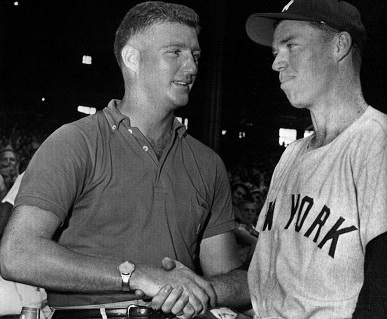
It wasn’t for publicity alone when Score shared this handshake with McDougald later in 1957.

McDougald tried to get updates from the hospital but personnel claimed they were ordered not to say a word to him or even to let him visit Score. (The only visitor Score was allowed, the Post said, was his fiancee, Nancy; the couple moved their planned 1957 wedding date up from October now that Score’s season was over.)

The versatile Yankee’s only reported solace came from Score’s mother, who told him likewise it wasn’t his fault. (A grateful McDougald visited Mrs. Score for years after their careers ended, whenever he was in Florida, the Post said.) But without losing his sight Score recovered and returned to the Indians in 1958.

After a pair of rough starts to open, he had a scoreless relief appearance to earn a save, then threw a shutout at the White Sox which included thirteen strikeouts, very much vintage Score. In his next game Score suffered a loss from an eight-and-a-third inning start in which he was tagged for three earned runs, but he suffered something a lot worse.

As Score himself would remember long after his career ended, it was a cold and wet night and he started feeling forearm soreness. In the seventh inning, he said, he bounced a pitch in front of home plate and his elbow flared on him.

Told he’d torn an elbow tendon, Score sat it out on doctor’s orders for thirty days, then took a relief turn against the Senators in Washington, where he’d first incurred the injury. The game started well, with Score striking out five of his first eight batters, until with two out in the ninth he “felt like someone stabbed me in my left arm.” He got a pop out to end the game on a lob of a pitch, but only pitched on and off the rest of 1958 hoping an off-season’s rest would resolve the elbow.

It didn’t. The theories began abounding; you can get the drift just from broadcaster Jimmy Dudley: “I still insist Herb never got over the effect of that blow to the eye. That would change anyone, and he changed his motion so he would protect his eye. I firmly believe that.”

Score firmly rejected that theory for the rest of his life. The evidence—you know, that pesky evidence—backs him completely. The elbow tendon tear, not the McDougald liner,  was the injury that ultimately finished him as a pitcher. His pitching motion changed trying to overcome any lingering elbow issue. Put down all the juicy speculations and lamentations and let Herb Score tell it himself:

Before I hurt my arm, I could go through an entire season and never scuff the toe plate [of his spiked shoe]. Later, I was ripping up a toe plate every game because I was dragging my foot . . . I couldn’t get out of the habit of dragging my foot, and that wrecked my entire motion to home plate . . . The reason my motion changed was because I hurt my elbow, and I overcompensated for it and ended up with some bad habits.

Score was never again the pitcher he was in 1955-56. After a very down 1959 and a 7.61 spring training ERA in 1960, there were those who believed the Indians gave him special coddling, including a few teammates, with only Rocky Colavito standing up for him.

Score actually had the infamous Colavito-for-Harvey Kuenn trade to thank for getting a trade of his own to a place he dearly wanted to go if the Indians’ infamous then-general manager, Frank Lane, wanted to be rid of him almost as badly as he wanted Colavito out of his sights. To the White Sox, whose manager Al Lopez was Score’s first Indians manager, and whom Score believed could help him get back on the right pitching track.

According to Terry Pluto, in The Curse of Rocky Colavitowhen Indians vice president Nate Dolin asked Score if he’d like to go to the White Sox, Score didn’t flinch:

I told him that it would be the best thing that could happen at this point in my career. Al Lopez had caught more games than anyone in major league history until Bob Boone broke his record . . . Al Lopez had had as much success with pitchers as any manager ever. I knew if anyone could help me, it was Al Lopez.

If it wasn’t for Dolin, Score and Lopez wouldn’t have their reunion. Lane was only too willing to deal Score—but not to Lopez, who’d resigned as the Indians manager after the 1956 season. Lopez accused the team’s management of not standing up for injury-addled third base star Al Rosen, who’d played through injuries down the stretch to furious booing from the stands and criticism in the press.

Pluto also wrote that Lane may have feared that Lopez could indeed revive Score, and that a revived Score could haunt the Indians for seasons to come. But in the heat over the Colavito trade, Dolin confronted Lane:

[Dolin] said something like, “If you have just one ounce of compassion in that bucket of venom you call a heart, you’ll send Herb to the White Sox.” Lane knew that because of the Colavito trade, Dolin still wanted to tear his limbs off and feed them to a family of hungry grizzlies.

For his part, Lane couldn’t let Score go to the White Sox without taking a gratuitous and  nasty slap at the clean-living, forthright pitcher:

Herb’s troubles are more psychological than physical. Maybe a change of scenery will help him. Lopez won’t be any more sympathetic toward Herb than [Indians manager Joe] Gordon was. But Herb will think he is and that may make a difference. Herb has a great imagination.

Colavito’s annual tangles with Lane over contracts, to say nothing of Colavito believing and telling the GM to his face that he was a proven liar (Pluto has cited chapter and verse), made him trade bait. But Score though there was another reason Lane was so anxious to be rid of the pair: “Part of it,” he said, “was that Lane believed ballplayers should be rowdy, hard-living, hard-drinking guys. But that wasn’t Rocky or myself.”

Lopez couldn’t help Score as things turned out, and Score spent the rest of his career between the White Sox and the minors until he bottomed out at Triple-A Indianapolis in 1963.

People asked me why I went to the minors to pitch. I still believed that my arm might come back. I was only thirty. I didn’t want to be sitting somewhere when I was sixty and wondering, ‘What if I had pitched one more year, would I have found it?’ Now I know. I have no doubts. I tried everything, and I pitched until they pretty much tore the uniform off my back.

The only place Herb Score sat at sixty was the same place where he began sitting in 1964, in the broadcast booth doing Indians games on television, until the end of the 1997 World Series. Voices of the Game author Curt Smith quoted a friend thus: “So what if he’s never been a Hall of Fame announcer? Look at it this way. Wouldn’t the city of Cleveland have turned somersaults over the last twenty years just to have ball clubs as decent as their announcer?”

Gil McDougald wouldn’t be quite the same player after the line drive, either. After a pair of very down seasons in 1959 and 1960, the Yankees left McDougald available for the expansion draft that created the second Washington Senators and the Los Angeles Angels. But McDougald elected to retire before that draft, exhausted, he said eventually, of the travel “and the attitude of the baseball people . . . they acted like they owned you and that they were giving you the moon and the stars.”

In fact, his own fate was hit by a line drive two years before his own nailed Score. McDougald was hit behind his left ear by a batting practise liner, in a genuine freak accident, as he eventually told Berkow, while he was behind a screen at second base talking to Yankee coach Frank Crosetti.

I saw a ball lying on the ground nearby and reached to pick it up, my head going just beyond the screen. Just then Bob Cerv hit a ball that hit me in the ear. I collapsed and everyone came running over. They carried me off the field, and I was out of action for a few games.

The doctors told me I’d be all right. Well, I wasn’t. The blow had broken a hearing tube. At first it just affected one ear, my left. One time I’m getting needled by some fan at third base, and I turned to [Phil] Rizzuto . . . and said, “Too bad I didn’t get hit in the right ear, then I wouldn’t have to hear this guy.”

A father of four, McDougald already had a dry cleaning business doing well. He eventually became Fordham University’s baseball head coach—until his right ear went deaf as well, ending his coaching career and forcing him to sell his dry cleaning and building maintenance business.

Berkow told McDougald’s story in 1994 with sad grace in “McDougald, Once a Quiet Yankee, Now Lives in Quiet World.” That, plus the happy followup Berkow wrote after McDougald underwent a successful cochlear implant to restore his hearing enough to allow him to function again, are collected in Berkow’s Summers in the Bronx: Attila the Hun and Other Yankee Stories.

If you think Herb Score spent the rest of his life lamenting what Gil McDougald didn’t take away from him, after all, think again, as Score told Pluto in 1993:

People tell me that I was unlucky. Me? Unlucky? I started with a great team in the Indians and played under a great manager in Al Lopez. Then I went from the field to the broadcasting booth at the age of thirty, and thirty years later I’m still doing the games. If you ask me, that’s not unlucky. That’s a guy who has been in the right place in the right time.

McDougald spent the last years of his life advocating for the hearing-impaired and for the manufacturer of his cochlear implant. After the implant surgery, during an office visit to the audiologist who programmed it after he healed from the procedure, with his wife and one of his children at his side, McDougald wept for joy.

As he told Berkow later, while his home bustled with children and the grandchildren “who came to see Grandpa hear,” as his wife put it, he found the words to describe the gift: “They’ve turned the music on.”

Score retired after the 1997 World Series. He survived a near-fatal 1998 road accident, but then suffered a stroke in 2002, and died in 2008. McDougald died of prostate cancer two years later.

A tale of two literary baseball seasons

2019-02-15 BrosnanBouton

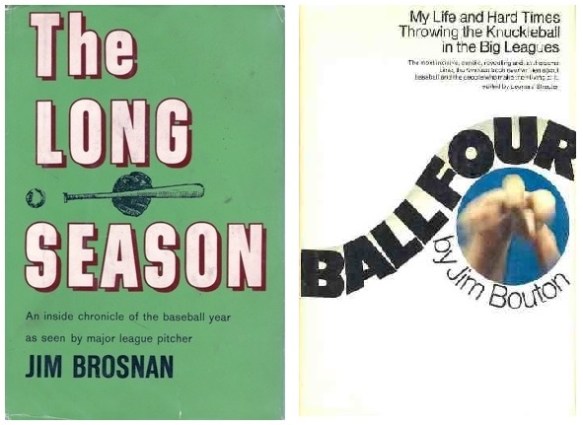
The books they said would subvert baseball. The game goes ever onward and the books never remain out of print. (So far.) Fifty years ago, Jim Bouton pitched his Ball Four season; ten years before that, Jim Brosnan pitched The Long Season.

The New York Public Library’s list of 20th century Books of the Century includes only one book pertaining to sports, Jim Bouton’s Ball Four. Yes, I was surprised, too, considering such volumes as Jim Brosnan’s The Long Season, anything by Roger Angell (one more time: he isn’t baseball’s Homer, Homer was ancient Greece’s Roger Angell), Roger Kahn’s The Boys of Summer, Bernard Malamud’s The Natural, Mark Harris’s Bang the Drum Slowly, and Arnold Hano’s A Day in the Bleachers, among others.

But there Bouton’s volume reposes, in a club to which also belong T.S. Eliot, James Joyce, William Faulkner, Virginia Woolf, Edith Wharton, Ralph Ellison, Jack Kerouac, John Dos Passos, Albert Camus, Agatha Christie, Grace Metalious, and Tom Wolfe. Before you retort that Bouton didn’t exactly write The Waste Land, Light in August, Invisible Man, On the Road, or The Bonfire of the Vanities, it’s only fair to say that Eliot, Faulkner, Ellison, Kerouac, and Wolfe never had to try sneaking a pitch past Carl Yastrzemski, Lou Brock, Harmon Killebrew, or Willie Mays, either.

Bouton was with the Astros when Ball Four was published in April 1970, after excerpts appeared in Look. To say it was received less than approvingly around baseball is to say Baltimore needed breathing treatments after the Mets flattened the Orioles four straight following a Game One loss in the 1969 World Series. “F@ck you, Shakespeare!” was Pete Rose’s review, hollered while Bouton had a rough relief outing against the Reds. All things to come considered, it was a wonder Rose knew Shakespeare wasn’t a brew served on tap at the ballpark.

This year is the fiftieth anniversary season of the one Bouton recorded for Ball Four and the sixtieth anniversary of the one animating Brosnan’s The Long Season. The books have their common ground and their distinctions, chief among the latter being that Bouton didn’t shy from detailing things even Brosnan, whose candor was considered jolting enough in its own time and place, didn’t dare to tread. If Brosnan even hinted at them, it was euphemistically. Bouton didn’t bother with euphemisms.

The two pitchers have something sadder in common, too. Brosnan suffered a stroke from which he was recovering when sepsis came manifest and caused his death in 2014 at 82, a year after his wife of 62 years died. Bouton, on the threshold of 80, suffered a stroke in 2012 that left him with cerebral amyloid angiopathy, a brain disease linked to dementia and compromised his ability to speak and write. Making it worse: the stroke occurred on the fifteenth anniversary of his daughter Laurie’s death in a New Jersey automobile accident.

Bouton’s wife, Paula Kurman, a speech therapist among other things (she has a Columbia University doctorate in interpersonal communications) who has worked with brain damaged children during her career, has worked with him carefully (“Together we make a whole person,” she once told a Society for American Baseball Research panel, to laughter that was sad as much as approving) and he has regained much of his speaking ability.

But he continues to struggle with what Kurman told Tyler Kepner of the New York Times was “a pothole syndrome: Things will seem smooth, his wit and vocabulary intact, and then there will be a sudden, unforeseen gap in his reasoning, or a concept he cannot quite grasp.”

Brosnan’s book was seeded two years before The Long Season‘s focus when he bumped into Sports Illustrated editor Bob Boyle. Having heard the bespectacled reliever had ideas about writing a book about major league baseball, Boyle suggested an article first “if something significant happens.” Brosnan turned in an essay about his trade from the Cubs to the Cardinals for veteran shortstop Alvin Dark, a trade one reporter described as the Cubs committing theft by trading “a mutt for a pedigreed pooch.”

“Loved it,” Boyle told Brosnan. “Why don’t you write a book about a whole season?” Two years later, that’s exactly what Brosnan did. He praised and needled in the same arch but honest tone, even if he did sanitize much of the vocabulary of the locker room or the dugout, as Bouton wouldn’t need to do a decade later. He showed the better and lesser sides of several players, but even his needles seemed not to come from malice aforethought.

Bouton was approached to do what became Ball Four by iconoclastic sports writer/editor Leonard Shecter, who’d previously written an in-depth profile of Bouton for Sport. Shecter proposed an in-season diary somewhat along Brosnan’s lines. “Funny you should mention that,” Bouton replied. “I’ve been taking notes.” During the 1969 season, Bouton would observe of his teammates, “My note-taking is beginning to make the natives restless.”

Brosnan offered no sense of wanting any kind of revenge for any kind of slight, in an era when players were too often slighted under a system that kept them, in essence, indentured servants. (One reviewer for the St. Louis Post-Dispatch wrote that Brosnan’s “pot shots,” such as they were, didn’t enrage fellow players “because ballplayers didn’t read; it was so out of character, or so he said.”) Bouton was often accused of trying to settle scores, particularly about the Yankees, his former team about whom he wrote and spoke extensively enough when the occasion suggested it. All Brosnan and Bouton did was try to show baseball and its players, coaches, managers, and administrators, as a too-human game played and run with too-human foibles, follies, and fantasias alike.

The devil was really in the details and even the language in Ball Four, from neither of which Bouton shied a single step. But both pitchers were accused of a kind of insider trading for fun and profit. “Brosnan has his say about many who may have, in times past, had their say about him,” wrote Bill Veeck of The Long Season, at a time Veeck still owned the White Sox. “This just doesn’t seem to come off so well, and tends to lessen the impact and enjoyment of his undeniably colorful material.” Presumably, Veeck took his own critique to heart when writing his own Veeck—as in Wreck, which did for baseball executives’ memoiring what Brosnan and later Bouton did for players’, and what Veeck did even further with his subsequent The Hustler’s Handbook.

“As an active player on a big-league team I had seemingly taken undue advantage by recording an insider’s viewpoint on what some professional baseball players were really like,” Brosnan wrote, after The Long Season and Pennant Race (his followup, about the 1961 Reds’ unexpected National League pennant winner) were republished on the latter’s season’s fortieth anniversary. “I had, moreover, violated the idolatrous image of big leaguers who had been previously portrayed as models of modesty, loyalty and sobriety — i.e., what they were really not like. Finally, I had actually written the book by myself, thus trampling upon the tradition that a player should hire a sportswriter to do the work. I was, on these accounts, a sneak and a snob and a scab.”

Bouton got the chance to address the hoopla around Ball Four in a followup book, I’m Glad You Didn’t Take it Personally (its jacket featured a baseball with a blackened eye drawn onto the hide) which was just as funny as Ball Four and sometimes a lot more poignant.  “I think it’s possible,” he wrote, “that you can view people as heroes and at the same time understand that they are people, too, imperfect, narrow sometimes, even not very good at what they do. I didn’t smash any heroes or ruin the game for anybody. You want heroes, you can have them. Heroes exist in the mind, anyway.”

Or, out of their minds, if you ponder one reaction to Ball Four. Before the Astros farmed Bouton out in 1970, Bouton discovered a burned copy of the book on the steps of the dugout, courtesy of the Padres. Even Brosnan’s and Veeck’s books avoided that kind of grotesquery.

The worst to happen to Brosnan after The Long Season and Pennant Race, not to mention other essays published in several other magazines, was the White Sox (to whom Brosnan was traded early in the 1963 season, long after Veeck sold the team) inserting a clause in his proposed 1964 contract barring him from writing for publication without prior team approval. Refusing to sign a contract with a clause like that in it, Brosnan retired after no other team took even a flyer on him, despite both Sports Illustrated and The Sporting News taking his side.

Bouton was either reviled as “a social leper” or a cancer on the game for having written and published Ball Four. Commissioner Bowie Kuhn actually tried to suppress the book, hauling Bouton into his office, demanding Bouton sign a statement saying it was all the pernicious work of his editor Shecter. Bouton probably had to restrain himself from telling Kuhn where to shove the statement when he wasn’t trying to restrain himself from laughing.

It was Dick Young of the New York Daily News who described Bouton as a social leper for writing Ball Four. When he ran into Bouton on an Astros visit to Shea Stadium, he said hello and, when Bouton needled him for talking to social lepers, Young replied, “Well, I’m glad you didn’t take it personally.” That reply gave Bouton the title of his followup book, in which he credited such overreactions in the sports press for doing almost the most to ensure Ball Four a best seller.

Both pitchers were witty, literate, and not even close to being thoroughgoing jocks. Brosnan made his way as a competent if mostly unspectacular relief pitcher and spot starter with a strong slider who had his moments. Bouton was a promising, hard throwing Yankee starting star, with a live fastball and a hard curve ball, until two seasons of overwork (1963 and 1964, and a whopping 520.2 innings over the two) left him with arm and shoulder trouble (it began a third of the way through 1964) that reduced him to marginal relief work and prompted him to make the knuckleball, which he’d thrown only as a change of pace previously, his bread and butter pitch.

Brosnan kept so many books in his locker that his 1961 Reds teammate, Hall of Famer Frank Robinson, nicknamed him the Professor. Bouton was no less literate or cerebral, though he may not have had a locker library equal to Brosnan’s, but his early ferocity as a competitor (he was once famous for his cap falling off his head as he delivered) inspired New York Post writer Maury Allen to nickname him Bulldog.

But Bouton may have put baseball into perspective even more than Brosnan did. Both pitchers were very aware of the worlds around them, and both wrote about the periodic spells of boredom, racial tensions, off-field skirt chasings, and self-doubts endemic in their professional baseball lives. Brosnan saved them for his books and articles; Bouton was less reluctant to speak his mind about things like politics, Vietnam, and civil rights when asked or when a conversation left him the opening.

Bouton bought even less into the still-lingering press representations of athletes as heroes. Teammates didn’t always hold with that or other things, like calling them out on it when they made mistakes that cost the Yankees games he pitched.

“After two or three years of playing with guys like [Mickey] Mantle and [Roger] Maris,” he wrote in I’m Glad You Didn’t Take It Personally, “I was no longer awed. I started to look at those guys as people and I didn’t like what I saw. They were fine as baseball heroes. As men they were not quite so successful. At the same time I guess I started to rub a lot of people the wrong way. Instead of being a funny rookie, I was a veteran wise guy. I reached the point where I would argue to support my opinion and that didn’t go down too well either.”

“He stands out,” Shecter wrote of Bouton in Sport, “because he is a decent young man in a game which does not recognize decency as valuable.” Much the same thing was said of Brosnan no matter what particular writers did or didn’t think of his two books.

Brosnan’s post baseball life including writing, advertising work (he’d done it in the offseasons of his pitching career), occasional sportscasting, and raising his family in the same Illinois home he bought with his wife, Anne, in 1956. (When they married, one local story’s headline, referencing his wife’s maiden name, said, “Pitcher Marries Pitcher.”)

Bouton became a sports anchor for New York ABC and then CBS before trying a baseball comeback in the White Sox system and then with the independent (some say notorious) Portland Mavericks, a comeback that ended with getting five starts for the Braves in late 1978. In one of those starts, Bouton squared off against Astros legend J.R. Richard, on the same night Richard broke the National League single-season strikeout record for righthanders, and pitched Richard to a draw. “The young flamethrower against the old junkballer,” Bouton wrote of the game.

A concoction Bouton and Mavericks teammate Rob Nelson invented in the bullpen, shredding gum into strands similar to chewing tobacco, became a hit as Big League Chew when they sold the idea to Wrigley. Bouton also continued writing, became a motivational speaker, and survived the collapse of his first marriage to meet and marry Kurman, blending two families, becoming founders and leaders of a recreational baseball league playing by 19th century rules, and becoming competition ballroom dancers. The Renaissance Bulldog.

The Washington Post‘s distinguished literary critic Jonathan Yardley wrote of The Long Season that it was literature about “[a]n ordinary season — life as it’s really lived — rather than an extraordinary one.” You could say, then, that Pennant Race was literature about an extraordinary season lived and played by ordinary men, if you don’t count Frank Robinson. Ball Four, which ran more temperatures higher up scales than Brosnan could claim, could be called an ordinary season lived and played by ordinary men. Recorded by a man whose extraordinary side was eroded by injuries.

Bouton may have hit the true key as to why all three books also unnerved baseball and its assorted establishments. “If Mickey Mantle had written Ball Four,” he later remembered, “it wouldn’t have been a big deal. A marginal relief pitcher on the Seattle Pilots had no business writing a book.” Likewise, if Robinson or Stan Musial had written The Long Season (Brosnan began 1959 with the Cardinals but was traded to the Reds midway) instead of a middle relief pitcher, it might not have proven a big deal.

Brosnan’s and Bouton’s books became baseball classics (as did Veeck—as in Wreck), and Ball Four also helped further expose the abuses heaped on players by front offices before the end of the reserve clause but probably caused no few of its younger readers to become sports journalists themselves. One suspects even now that Bouton’s revelations about the one-sided contract negotiations to which reserve era players were subject might have infuriated the purists more than his revelations about players’ sex drives, amphetamine indulgences, pranks, and feuds did.

Whenever one of Bouton’s former Ball Four-season teammates goes to his reward, Bouton is genuinely saddened. “I think he came, over the years, to love them,” Kurman told Kepner. “As each one died, he got really teary about it. He realized how deeply they were part of him.” (The Pilots, of course, were sold and moved to Milwaukee for the 1970 season, becoming the Brewers. Writing in Ball Four Plus Ball Five, a tenth-anniversary update, Bouton said, “The old Pilots are a ghost team, doomed forever to circumnavigate the globe in the pages of a book.”)

The Long Season remains “a cocky book, caustic and candid and, in a way, courageous, for Brosnan calls him like he sees them, doesn’t hesitate to name names, and employs ridicule like a stiletto,” as wrote Red Smith, arguably the best baseball writer in New York (then with the Herald-Tribune).

Ball Four‘s true success, wrote Roger Angell himself, “is Mr. Bouton himself, as a day-to-day observer, hard thinker, marvellous listener, comical critic, angry victim, and unabashed lover of a sport. What he has given us is a rare view of a highly complex public profession seen from the innermost side, along with an ironic and courageous mind. And, very likely, the funniest book of the year.”

And in the long, long, long wake of Brosnan’s and Bouton’s books, baseball hasn’t collapsed, the world hasn’t imploded, that Star Spangled Banner yet waves, and men and women of note or fame can be considered in all their human flaws, foibles, and fantasias, without being seen where appropriate as any less than heroes.