With a friend like Trump . . .

DonaldTrumpNewEnglandPatriots

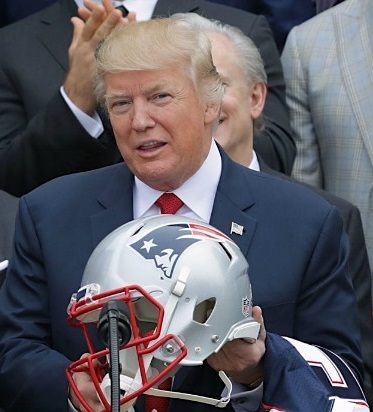
President Donald Trump, holding a New England Patriots helmet at the White House celebrating the Pats’ Super Bowl LIII victory. He managed to conflate a football beneficiary of the former Alabama coach running for the Senate with the man who coached the Pats’ American Football League ancestors, among others.

When last we had occasion to think of Donald Trump in sports terms having nothing to do with kneeling during the National Anthem, he attended Game Five of the last World Series in Nationals Park. He was booed rather lustily, with intermittent chants of “Lock him up!” punctuating the chorus.

The “lock him up!” chants returned in the seventh inning—not for President Tweety, but for home plate umpire Lance Barksdale, whose evening to that point was full of such dubious calls (including the fourth ball called a third strike on Nationals outfielder Victor Robles during the inning) that both Nationals and Houston Astros fans alike wanted him in the stockade.

Now, though, the president about whom “polarising” often feels high praise arouses the attention of Deadspin, the online sports publication. He arouses it by way of the campaign trail, on a conference call, supporting former longtime Auburn University football coach Tommy Tuberville’s campaign as Alabama’s newly-crowned Republican nominee to the U.S. Senate.

Trump wanted to praise Tuberville as the reason the University of Alabama hired a particular football coach, after the Auburn Tigers bushwhacked the Crimson Tide in six straight meetings between the two schools. Then, he wanted to praise that coach. Uh, oh. “Beat Alabama, like six in a row, but we won’t even mention that,” President Tweety began, starting with Tuberville. “As he said . . . because of that, maybe we got ‘em Lou Saban . . . And he’s great, Lou Saban, what a great job he’s done.”

Crimson Tide coach Nick Saban must be double-checking his records to be sure he didn’t change his name inadvertently, somewhere. And, to re-assure himself, with apologies to Mark Twain, that the reports of his death have indeed been exaggerated greatly. The National Football League and its long-ago-absorbed upstart competitor the American Football League would love to know how the real Lou Saban coached from beyond.

That real Lou Saban, as Deadspin couldn’t wait to remind anyone caring, coached in both American pro football leagues and in college football for a very long time. But not past 2002, after a decade of working at far lower than Division I programs.

The president who once denounced the late Sen. John McCain for having been captured as a prisoner of war during the Vietnam War (“I like people who weren’t captured”) and makes a fetish of “winning” (without stopping to think that one man’s “winning” is another’s self-immolation) chose quite a winner to conflate with Alabama’s incumbent football coach.

Saban, who may or may not be a second or more distant cousin to Nick, was a charter coach of the Boston Patriots, when the AFL was born in 1960. From there he enjoyed a sixteen-season career coaching in the AFL and—when his Denver Broncos moved with the merger—the NFL. He had three first-place finishes (coaching the Buffalo Bills, 1963-65) and two AFL championships. And that’s all, folks.

He had six winning seasons in sixteen coaching the pros. His final record as a pro football coach is 95-99-7. Except for his back-to-back AFL championships, Saban never led his teams past a single playoff win. He did get to return to the Bills in 1972, coaching the teams fabled for O.J. Simpson and the Electric Company offensive line, but they never got past second place or a single playoff loss, either. He resigned after a 2-3 start in 1976 and never coached in the NFL again.

But he did return to the college coaching lines, which he’d visited once in the middle of his pro coaching life (University of Maryland: 4-6 in 1966), and where his coaching career began for a single season in 1956. (Northwestern University: 0-8.) He coached the University of Miami to back-to-back losing seasons (1977-78) and Army (1979) to one losing season. His complete coaching record at the major schools: 15-35-2.

Saban left Miami in the middle of a row over three freshman players attacking a Jewish student in yarmulke while he walked toward a campus religious service. They carried him to Lake Osceola in the middle of the campus and threw him in. Having been off campus when the attack happened, Saban returned to learn of it and say, according to Bruce Feldman’s history of Miami football, “Getting thrown in the lake? Sounds like fun to me.”

After he left Army, Saban took a brief, curious career turn. He became one of George Steinbrenner’s “baseball people,” doing Steinbrenner (a personal friend) a favour and becoming president of the New York Yankees for 1981-82. Even allowing that Steinbrenner did love football, engaging a football lifer as a baseball president seemed along the line of hiring a furniture designer to develop vacuum cleaners.

If Saban had anything to say about some of the turmoil around those Yankees, there seems little enough record of it:

* Steinbrenner fired first-time manager Gene Michael in 1981, after Michael challenged The Boss to knock it off with the constant threats. Steinbrenner’s bid to mollify The Stick became a classic of Yankee panky: Why would you want to stay manager and be second-guessed by me when you can come up into the front office and be one of the second guessers?

* Steinbrenner burned through three managers in 1982: Hall of Fame pitcher Bob Lemon (who’d picked up Billy Martin’s pieces and led the Yankees to a World Series championship in 1978), Michael again, then Clyde King.

* Steinbrenner hired former Olympic hurdler Harrison Dilliard to help turn the Yankees into a speed team, an idea so hilarious as it was accompanied by continuous running drills in spring training that wags began calling the Yankees “the Bronx Burners.” (The experiment lived only slightly longer than some Yankee managers kept their jobs.)

The man who thought it sounded like fun for three of his Miami players to dunk a Jewish student in Lake Osceloa isn’t on record anywhere that I know of suggesting what fun Steinbrenner’s King of Hearts act in the south Bronx must have been for those on the wrong end of His Majesty’s scepter.

Lou Saban died at 87 in 2009, two years after Alabama hired Nick. He might not have had a real reputation as a long-term winner but he did have one as a teacher. He was also in no position to be the direct beneficiary of  Tuberville’s constant seawalling of the Crimson Tide. Alabama isn’t exactly renowned for hiring octogenarian head coaches. Nick Saban, on the other hand, has a long-term winning reputation in college football: a 248-65 record; three Bowl Championship Series wins; and, ten bowl game wins otherwise.

Deadspin offers the charitable suggestion that Trump might have conflated Saban with Lou Holtz, the Notre Dame coaching legend. Careful with that axe, Eugene: In some portions of the South, confusing or conflating a Crimson Tide coach with some Hoosier coach can provoke the same kind of tavern debate (if not brawl) as could be provoked in the northeast, formerly,  if you inadvertently confused or conflated Mookie Betts with Mookie Wilson.

Trump’s sports record is dubious at best, shall we say. When he hasn’t beaten his gums about kneeling National Anthem protesters (a subject for another time, for now), he’s been a football owner (in the failed United States Football League some say he destroyed in the first place), a less-than-knowledgeable advocate (speaking politely) of Pete Rose’s reinstatement to baseball and election to the Hall of Fame, and a public critic, equally less than knowledgeable, of Maximum Security’s rightful disqualification in the 2019 Kentucky Derby.

With an expert like that on his side, I’m not entirely sure that Tuberville—whose own college football coaching career was impressive enough (159-99 record; seven bowl wins)—needs adversaries.

The Yankeegate letter

2020-06-13 YankeeStadium

What further manner of extralegal sign-stealing Yankee panky might be brought in from the cold?

We’re about to learn the details of commissioner Rob Manfred’s 2017 written admonition to the New York Yankees about extralegal sign stealing. Federal judge Jed S. Rakoff has ordered the letter unsealed and submitted publicly and “minimally redacted” by both the Yankees and Major League Baseball no later than Monday. Very interesting.

That the Yankees used an illicit dugout telephone and may have used their own replay room reconnaissance on behalf of extralegal sign stealing in or before 2017 wasn’t exactly a baseball state secret, however often it was buried beneath the hooplas of Astrogate and Soxgate before the coronavirus turned most of that to one side.

The case involves the DraftKings fantasy baseball playing group suing MLB for fraud over the extralegal sign stealing scandals that jolted and discredited both the Houston Astros (2017-18) and the Boston Red Sox (2018). Rakoff ruled against DraftKings two months ago, but DraftKings thinks there was more in Manfred’s written Yankee spankee than both Manfred and the Empire Emeritus disclosed.

Beware the fool factor, though. Rakoff’s April ruling was comparable in its absurdity to Neville Chamberlain proclaiming peace in our time after agreeing to hand Hitler the Sudetenland 1938:

A sport that celebrates ‘stealing,’ even if only of a base, does not provide the perfect encouragement to scrupulous play. Nor can it be denied that an overweening desire to win may sometimes lead our heroes to employ forbidden substances on their (spit) balls, their (corked) bats, or even their (steroid-consuming) bodies. But as Frank Sinatra famously said to Grace Kelly (in the 1956 movie musical High Society), “There are rules about such things.”

As I couldn’t resist writing then, “The Chairman of the Board spoke to the future Princess of Monaco about love and war and what’s fair in both, not whether the Man of Steal* was really a shameless criminal for stealing as many bases as Robin Yount drove in runs. (1,406.)” Saying DraftKings didn’t have a case wasn’t the same thing as arguing choplogically that fantasy baseball players ought to go in with the presumption of guilt.

Remove for the moment the ongoing haggling over getting a major league baseball season underway at long enough last, the haggling provoked mostly by the owners trying to strong-arm the players into accepting a renege on their March agreement (full pro-rated player salaries, for openers) and the players saying, “We’ll just see about that.”

Absent all that, few baseball fans were unaffected by Astrogate and Soxgate. Fewer still were thrown more into internal turmoil than Astro fans and Red Sox fans faced with the actualities that their heroes, teams of excellence and (ahem) intelligence, who seemed to need extralegal espionage about as badly as the Flash needs a jet pack, were barely-apologetic high-tech cheaters.

Numerous players joined the fun in denouncing the Astro Intelligence Agency and the Rogue Sox Replay Room Reconnaissance Ring. No few of them were Yankees. Now the Yankees may or may not be exposed as going beyond a naughty extra dugout telephone or even their own replay room reconnaissance. No few in the social media swamp demand, too, that the hypocritical Yankees duct tape their mouths shut from this day forward.

So you thought the “what-about” style of rejoinder was limited to answering valid critiques of office holders with the comparable mischief or crimes committed by their predecessors. Must we be reminded continuously that mischief or crimes by one don’t justify those by a successor?

When I reviewed the second-edition publication of Paul Dickson’s The Hidden Language of Baseball: How Signs and Sign-Stealing Have Influenced the Course of Our National Pastime, I wrote that, just after the Rogue Sox were caught taking a bite out of an AppleWatch on behalf of espionage against the Yankees, a Yankee fan thought so well of sometimes beleaguered catcher Gary Sanchez that the fan decided to do Sanchez a huge favour at the plate. As Dickson told it:

[A] fan with a good view of the catcher and a strong set of lungs bellowed out information to . . . Sanchez while he was hitting in the eighth inning of his team’s game with the Tampa Bay Rays. Sanchez heard the voice, but so did Rays catcher Wilson Ramos and the home plate umpire, Dan Bellino, who pointed out the man to stadium security and had him removed from the stadium . . . “You could definitely hear the guy screaming, ‘Outside, outside,’ but you don’t know if it’s going to be a slider or a fastball,” Sanchez said afterward. “You got to stick to your plan, whatever plan you have, regardless of what people are screaming.”

Dickson couldn’t resist adding that that may have been the first time a fan was thrown out of the ballpark for sign stealing.

(Reminder: Sometimes fans blow the whistle on the spies. It happened in Wrigley Field in 1960, when bleacher fans caught Milwaukee Braves pitchers Bob Buhl and Joey Jay red-handed among them, training binoculars on the home plate area and relaying stolen signs to their hitters. Those fans tipped off the Cubs’ bullpen, who relayed the word to the dugout, that Buhl and Jay were jobbing them.)

We’ll know soon enough whether there is a genuine Yankeegate coverup on our hands above and beyond what we knew already about their illegal dugout phone and possible replay room reconnaissance. The Yankees would prefer the fuller disclosure of Manfred’s 2017 letter not happen, of course. Richard Nixon wasn’t exactly anxious to have the White House tapes disclosed fully, either.

“The plaintiff has no case anymore,” says a statement from Yankee attorney Jonathan Schiller to The Athletic, “and the court held that what MLB wrote in confidence was irrelevant to the court’s dismissal of the plaintiff’s case. Under established law, this supports the Yankees’ right to confidentiality required by the Commissioner of Baseball.”

This isn’t an instance of compelling public disclosure of scouting information. It’s not even an instance of compelling public disclosure of team financial value, never mind that fans can never help noticing player salaries are known publicly and to the last dollar but teams’ and their owners’ financials often seem to require extracurricular excavation.

Disheartened Astro and Red Sox fans would probably want nothing more than to know who else—aside from since-purged Astros manager A.J. Hinch, Astros bench coach-turned-Red Sox manager Alex Cora, former 2017 Astros DH-turned-New York Mets manager Carlos Beltran, and Rogue Sox replay room operator J.T. Watkins—availed themselves of those espionage operations.

Disheartened Yankee fans would probably want nothing less of their team, too. Every baseball fan probably wants to know that the line between on-field gamesmanship and off-field-based subterfuge won’t be crossed again any time soon.

The history books have long revealed those players, coaches, and managers who took up high tech cheating in their times. (It didn’t begin or end with the 1940 Tigers, the 1948 Indians, the 1951 Giants, or the 1961 Reds.) Do heartsick Astro, Red Sox, and Yankee fans really want to wait that long before knowing once and for all who was or wasn’t among their teams’ extralegal cheaters?

DraftKings may have no legs claiming deliberate fraud, but if the Astros and the Red Sox couldn’t escape disclosure Yankeegate shouldn’t be treated as a mere annoyance, either. Especially with the chance that, if nothing new might be exposed, everything known might be clarified further–and deeper. Might.


* – Hall of Famer Rickey Henderson.

The haunted Hideki Irabu

2020-04-22 HidekiIrabu

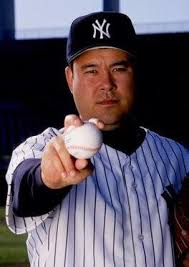
Hideki Irabu, too haunted to succeed—or live.

It took an unusual young man to forgive one of George Steinbrenner’s ugliest insults by giving The Boss a slightly unusual birthday present a few months later. If only Hideki Irabu’s sense of humour could have saved him from the lifelong haunting that finally ended in his 2011 suicide.

In a spring 1999 exhibition game, the righthanded pitcher failed to cover first base adequately on an infield play, and Steinbrenner denounced him as a “fat, pus-sy toad.” You don’t need me to tell you how that looked in cold print with the hyphen removed.

What you didn’t know, unless you read a jarring 2017 profile by Sports Illustrated‘s Ben Reiter, is that Irabu got a little good natured revenge a few months later. He sent Steinbrenner a birthday present: a large, mechanical toad delivering a rather pronounced ribbit when you punched a button. According to Reiter, The Boss appreciated it enough to keep it in his office for the rest of his life. (Steinbrenner died a year before Irabu’s suicide.)

Twenty years before Reiter’s profile, and 23 years ago today, the Yankees made a deal with the Padres to bring Irabu to the Bronx. The Yankees thought they were getting the anomalous “Japanese Nolan Ryan,” who threw white heat in contrast to most Japanese pitchers living purely on finesse. Neither the Yankees nor anybody else thought they were getting a walking, haunted, overly self-critical and self-analytical complexity who’d end up a suicide at 42.

A pitching star in Japan who chafed at the Japanese game’s continuing reserve system, who wanted only to decide his own future after a decade pitching in the Japan Pacific League, Irabu—whose purchase by the Padres roiled other American major league teams who wanted a shot at bidding for him—stood fast in his wish to play for nobody but the Yankees.

“Hideki and his agent are free to do and say whatever they want,” said then-Padres president Larry Lucchino, “but we will march ahead at our own pace.” Irabu and his agent Don Nomura said, “Company, halt!” Then, the Padres blinked. They sent Irabu, Jackie Boxobolts, and Jerry McJerryrig to the Yankees for Richie Rinkydink, Randy Matchbox, and three million bones.

That led to the creation of the posting system that has since allowed Japanese players without the required nine years for free agency to ask their teams to post them for bidding by MLB teams. Making Irabu a kind-of Nippon Professional Baseball equivalent to Curt Flood in the American major leagues.

But Irabu isn’t remembered that way half as often as he’s remembered for being the Japanese pitching virtuoso who self-dismantled during and after tortuous Show career. Even before he became an NPB fixture, Irabu’s was a life about which “complicated” doesn’t begin to fit.

Irabu didn’t insist on becoming a Yankee solely because he knew and respected the team’s history and larger-than-life image: as Reiter revealed, he believed that if he could succeed in a Yankee uniform his father—an American Air Force meteorologist, Steve Thompson, stationed in Okinawa, who’d met and dated a Japanese waitress and learned of his son when receiving word while in Vietnam—would have to find him.

Irabu’s mother birthed and raised him in Japan and, after marrying an Osakan restauranteur, told her son he’d been sired by an American who’d only seen him once after his birth. Only decades later would Irabu learn Thompson’s letters to his mother never reached them because they’d moved onward while Thompson was still in Vietnam.

Irabu’s mixed heritage, which happened to make him larger than other children as well as giving him brown hair and rounder eyes, didn’t go over well with other Japanese children who bullied him mercilessly. To Irabu, as Reiter revealed, baseball saved him from a life in the yakuza, the Japanese mafia, “which always found a way to use large, lost young men.”

His pitching talent made him the NPB’s top pitcher by 1997 at age 28. When Irabu insisted on having a say in his own American future and out-lasted the Padres into trading him to the Yankees, the Japanese media and his Japanese teammates accused him of disrespect. That was almost nothing compared to what hit the reserved righthander whose bulk hoisted a pair of sad-looking eyes but a smile that looked as though flashing it meant he’d defied someone a little too cheerfully.

When he arrived in New York, then-mayor Rudolph Giuliani helped shove curiosity and intrigue into hyperdrive hype. Giuliani presented Irabu a Tiffany apple and called his arrival symbolic of the American immigrant experience as a whole but that experience which often began in New York itself.

Irabu probably had no clue that American politicians were at least as talented as baseball people in forging unrealistic expectation.  When the pol in question was also the most unapologetically visible Yankee fan this side of George Constanza, Irabu would have had a better shot at getting away with the taking of Pelham 1-2-3—stark raving naked.

“Lay that upon the Japanese Nolan Ryan,” I wrote after Irabu’s 2011 suicide, “and anything short of a perfect game to open would have been considered a let down, if not the second coming of Pearl Harbour.”

The day after Guiliani handed him the Tiffany apple Irabu struck nine Tigers out in six-and-two-thirds. But he finished 1997, during which he had a turn in the minors, with a 7.09 ERA. The following spring he was considered “an out-of-shape bust,” as Reiter recalled it, nowhere more jarringly than in a Seinfeld series finale scene in which uber-fan Constanza bellowed, “How could you give 12 million dollars to Hideki Irabu?”

What nobody really knew was that Irabu’s surliness with the press and contrasting amiability in his clubhouse—upon his death, assorted teammates remembered his pleasantry and humour—disguised a still-young man still searching for a real home.

His battles with the Japanese press may have stemmed in part from being grilled, broiled, and basted by a press representing a home where he never felt accepted; his sense that America would never really accept him, either, was only partially thanks to the language barrier.

As a pitcher, as Reiter gleaned, Irabu was a constant self-questioner. The real source of his American lack of success probably rooted in his habit of constant change, from his exercise routines to his pitches and mechanics, even after his best outings. He also turned out to have a pronounced spiritual side, asking those few closest to him about faith and religion.

Reiter wrote that those few who were close to him knew what he really sought: a father figure and a place to belong. He thought he’d found the former in people like his agent Nomura, his translator George Rose, his fellow Yankee pitchers David Cone and David Wells, and even Steinbrenner; hence, the mechanical toad as the birthday present. The latter was even more tough. “There wasn’t a home for him,” Nomura told Reiter. “It’s almost like he was always at the visitors’ ballpark.

“There were so many different velocities—87, 89, 84, 95, 97,” Cone told Reiter about Irabu’s ability. “He was a big guy, strong, and you’d heard about the power—but it wasn’t all power. He seemed to have finesse as well . . . The day he pitched, we thought, Wow, if he’s on, he’s going to win the game for us. He could dominate an opposing lineup. That’s the way we saw him.”

Irabu was actually named the American League’s Pitcher of the Month twice, for May 1998 (he had a 1.44 ERA that month) and for July 1999. (4-0 with a 2.64 ERA.) The talent was clearly in place. (“When he was into it,” remembered longtime Yankee catcher Jorge Posada, “he threw the nastiest pitches in the league.”) It belonged to a still-young man who fought what proved an unwinnable war with himself.

Then Thompson finally sent his mother a note in spring 1999 and, after she revealed it to him, Irabu agreed to meet him. Though discovering they had much in common—including a pronounced taste for self-medicating through alcohol and a chain-smoking habit (Irabu was known to smoke half a cigarette between innings during his starts), and an equally pronounced stubbornness as children—Irabu couldn’t keep the connection.

Irabu accepted it when Thompson told him of those old, unanswered letters, but father and son couldn’t bond otherwise. A too-thick language wall, too much time past. “Irabu realized,” Reiter wrote, “that just as Thompson didn’t want anything from him, he didn’t want anything from Thompson.”

Thompson died of cancer at 81, five years after the suicide of the son he barely knew. Reiter wrote no one feeling remorse over Irabu’s suicide felt it deeper than Thompson did. His wife revealed to Reiter that he’d made and kept a photo album full of pictures of Irabu on the mound.

Two “uninspiring” seasons following a trade to the Montreal Expos, a brief comeback as a closer with the Rangers, a better comeback in the NPB a year after that, then a surprising two years’ trying in the American independent leagues, Irabu realised that baseball had given him up.

So did he. Whoever he really was.

The lawyer who worked with Nomura, Jean Afterman, told Reiter that Irabu “was fascinated by life. He was a kid philosophy major. He had a lot of questions about life. He had a lot of curiosity. He had a lot of, as we would say in this country, things to work out.”

When his professional baseball life finally ended, Reiter wrote, Irabu became obsessed with one thing despite trying a couple of businesses in southern California: baseball. He also sank further into depression, his former merely binge drinking becoming continuous and leading to a pair of unseemly arrests, as did his use of assorted antidepressants.

After his wife gathered their daughters and left him—they’d “become acculturated to American life,” the New York Times wrote, in ways he couldn’t and didn’t—Irabu seemed to lose whatever taste for life remained to him. “In the last year of his life, Irabu’s few remaining friends suspected that he was heavily medicated,” Reiter wrote.

The light had gone out of his eyes, they say. A rec-league teammate told police that Irabu had been despondent at a practice four days before his death—”I don’t want to live anymore,” he’d said—and he hadn’t been seen since the day after that. But no one thought to check on him until it was far too late.

A post-mortem search of his home turned up half a bottle of Paxil and two Ativan pills, the latter an antidepressant that’s believed tied to suicidal tendencies and even more dangerous when mixed with Irabu’s favourite self-medication, alcohol. His toxicology report showed he had three times the legal driving limit of alcohol in his system and Ativan in his liver when he hanged himself.

NBC Sports’s Craig Calcaterra wonders what if anything might have been different if Irabu had stayed with the Padres and not forced his trade to the Yankees despite its pioneering stature. Reiter wrote that tragedies aren’t as simple as toxicology reports, unexamined death wishes, or self-compromised talent.

They’re often deeper than even the pitcher who didn’t ask for the hype he was hit with and couldn’t live up to. The pitcher who spent his life seeking what was robbed from him originally. The pitcher who wanted one thing that the country where he grew up and first throve refused him but too much past denied him in the country he adopted.

More than anything or anyone, more than even the people who hyped him and then dismissed him when he couldn’t live up to it, he wanted and needed to know who Hideki Irabu really was.

Objections overruled

2020-01-05 DomingoGerman

Slapping his girl friend at CC Sabathia’s charity gala last fall means Domingo German won’t be pitching in Yankee pinstripes again until early June.

Domingo German’s 81-game suspension under baseball’s domestic violence policy is only the fourth longest such drydocking among players. Former Braves pitcher Hector Olivera beats him by a game in that regard, Phillies outfielder Odubel Herrera lost the final 85 games of 2019, and Padres pitcher Jose Torres lost 100 games in 2018.

None of which stopped the word “unprecedented” from circulating around it or some Yankee fans from screaming “We object!” To the suspension, not the act that provoked it. The general gravamen among that subset of Yankee fans is that, since German wasn’t hit with any criminal charges after all, he should therefore face nothing but spring training and the 2020 season. The general problem with that view is that there’s a major league policy in place saying oh no he shouldn’t.

The actual policy allows baseball’s commissioner to put a suspected player on administrative leave for up to seven days while investigating the accusation, and it covers domestic violence, sexual assault, and child abuse alike. There’s no minimum or maximum punishment involved formally, though the commissioner can suspend, reinstate, or defer judgment until after criminal proceedings are done.

Which means commissioner Rob Manfred was within his rights under the policy to suspend German even though the September 2019 incident in question—German was seen slapping his girl friend, who happens to be the mother one of his children, after a charity gala by retiring pitcher CC Sabathia—ended up not going to criminal charges. The incident itself was bad enough without the witnesses perhaps including someone from the commissioner’s office.

Likewise was Manfred within his rights to think as he seems to have done that further such incidents forward after, say, Addison Russell’s to get him a 40-game suspension (2018-19), or Roberto Osuna (75 games, 2018), or to Giants chief executive officer Larry Baer (almost four months last year), haven’t delivered the message yet that there are some things baseball as a franchise employer simply refuses to suffer gladly.

Formal legal criminal charges or no, neither the Major League Baseball Players Association nor the Yankees objected to German going on administrative leave from the day after his final 2019 mound appearance through the end of the postseason. Yahoo! Sports columnist Hannah Keyser says the team and the union aren’t expected to appeal the final suspension, either.

German’s suspension will take him out of the 2020 season’s first 63 games since it was made retroactive to the administrative leave onto which he was placed 19 September 2019. And while the pitcher’s missing the rest of the regular season and the entire postseason didn’t exactly help the Yankee cause, it tells you something when you fear those Yankee fans hollering against the suspension seem oblivious to its provocation.

One such response, specifically to Keyser’s column, went like this: “I have no objection to a player being suspended for domestic abuse. But I do object to it when a player was never even charged and there is no real proof that they did anything.” As if the point of witnesses having seen German slap his girl friend now equals, “It depends on what your definition of ‘witness’ is.”

It’s something comparable to saying no, you don’t object to a president of the United States being impeached for abuse of power, but yes, you object when he hasn’t been charged according to criminal law construct. Therefore, whether the House impeaching the president or baseball the employer enforcing its behavioural rules, they done you wrong, somehow. I say it that way because sports fans in their most extreme moments take certain things personally and regard them as crimes of another sort.

Let their team lose a key game down the stretch and they just about would treat it not as a hard loss but, rather, a bloody crime for which heads must roll. Let a pitcher surrender a potential game, set, and pennant-losing home run, and it’s not that the hitter was the better player in the moment but that the pitcher committed the heinous act of throwing the pitch that got bombed.

Those are bad enough. But when some Yankee or other fans all but demand baseball lighten up about suspending domestic abusers in such cases as don’t even go to court (German, fellow Yankee pitcher Aroldis Chapman in 2015, Russell) or become resolved without further ado in court (Osuna), they suggest an employer has no business disciplining an employee merely because his misbehaviour didn’t result in a court case at all, never mind a conviction or time behind bars.

The Astros fired assistant general manager Brandon Taubman, after almost a week worth of the team administration trying to cover up and smearing the reporter who revealed he’d thanked God they’d [fornicating] gotten Osuna within earshot of three female reporters one of whom wore a domestic violence awareness bracelet at the time. If a team can fire an executive over seeming to ignore if not applaud domestic violence, why can’t a team or baseball’s administration suspend someone for committing it?

It’s to baseball’s credit that it says domestic violence is intolerable among those who make the game their profession. And it should be thus elsewhere in sports, as said another respondent to Keyser’s column: “As a Dad, and yet a lifelong Yankee fan, I know domestic violence cannot and should not be tolerated. That is a given. Yet in other sports, the punishment seems to be somewhat less. Time for the other pro sports, or even college sports, to step up and take a stand also.”

All that’s accomplished by those Yankee fans saying baseball done them wrong by suspending German is to make their breed look even worse than they already look to a lot of baseball fans. A lifetime’s experience with the breed (I’m Bronx born, Bronx and Long Island bred, but a Met fan since the day they were born) informs that the main reason it’s uncomfortable to think nice things about the Yankees is their fans.

If the truest cliche about the Yankees is that they don’t like to lose, the truest about Yankee fans is that they think their heroes are entitled (underline that) to be in every postseason, if not to win every World Series, and that if they don’t get either it’s either grounds for a complete housecleaning or somebody else’s fault. But even that is bearable compared to the pockets of extremes that make even normal Yankee fans quake.

Last October came three grotesque examples from that small contingent of Yankee fans who travel first crass. Two happened in Game Three of the American League Championship Series. When Edwin Encarnacion was beaten on a slightly off-line throw forcing Astros first baseman Yuli Gurriel to a spinning sweep tag on Encarnacion’s shoulder, fans in Yankee Stadium’s right field stands threw debris on the field. When Yankee reliever Luis Cessa unintentionally hit Alex Bregman with an inside pitch, there was only too audible cheering.

The third, as Game Four was about to get underway, made those two resemble accidents. A group of Yankee fans above the visitors’ bullpen in left field taunted the Astros’ Game Four starter, Zack Greinke, over his known enough battle with anxiety and clinical depression, and the medications he’s prescribed to control those very real conditions. Rather diplomatically, Greinke said after the game that he didn’t hear the taunts, which makes them no less inexcusable.

Some of the taunts exposed the miscreants in question as further half-witted and baseball dumb, namely those taunting Donald Zachary Greinke for going by his middle name as many people do. Clearly they’d forgotten if they ever knew such Hall of Famers as Henry Louis Gehrig, James Hoyt Wilhelm, George Thomas Seaver, and Lynn Nolan Ryan, for openers. Not to mention a one-time Yankee prospect who ended up traded and beating them thrice in one World Series, one Selva Lewis Burdette, Jr.

Taunting Greinke concurrently over his mental illness and his preference to go by his middle name was merely grotesque. Objecting to German’s suspension, never mind that slapping his girl friend with witnesses present damaged her and cost the Yankees his arm the rest of the stretch, the postseason, and for two months plus to open 2020, knocks on the door of degeneracy.

The Yankees aren’t baseball’s only team with a contingent of fans about whom degeneracy applies. And more Yankee fans know and shiver over it than you might think. One such fan—he didn’t identify himself as such, but his avatar is a piece of an ancient tile identifying a Lexington Avenue subway station (the el train running behind Yankee Stadium just before ducking into a tunnel is known officially as a Lexington Avenue Express)—responded to Keyser and knocked the degeneracy contingent among his brethren over the center field fence:

MLB is not a court of law. It can discipline its employees and coaches how it sees fit with input from players union, who did not contest the suspension. If a player doesn’t like the ruling, find another place to play baseball.

There are also those who think baseball’s domestic abusers should be suspended longer, like for an entire season and postseason to follow. That’s not exactly unsound thinking.

Don Larsen, RIP: Elevated

2020-01-01 DonLarsen

Don Larsen, captured mid-delivery during his World Series perfect game.

The new year wasn’t a day old, and the million-to-one shot expired. The month of Sundays turned Mondays. The imperfect (unperfect) man who pitched a perfect game in the 1956 World Series lost his battle with esophegeal cancer at 90 on New Year’s Day. And Hall of Famer Yogi Berra got to take a flying leap into Don Larsen’s arms one more time, this time in the Elysian Fields.

From Joe Borden (of the pre-historic National Association) in 1875 through Justin Verlander at the near-last minute of the 2019 season, major league baseball pitchers including 35 Hall of Famers have thrown 303 no-hitters. That’s eleven percent of all no-hitters, including perfect games, thrown by Hall of Famers from John Montgomery Ward through Roy Halladay.

Baseball being a game that enables the modest or the miscast to become the immortal even for one day, Larsen was of a perfect piece on 8 October 1956. As his career shook out he was more and better of a relief pitcher than starting pitcher. He was tall, threw hard enough, but as Joe Posnanski described memorably, “[his] wildness on the mound fairly well represented his wildness off the field.”

“Larsen was the greatest drinker I’ve known,” said Hall of Famer Mickey Mantle once upon a time, Mantle being a man who knew great drinkers when he saw them having been one himself for too long. Larsen lived enough in the wild before he married in 1960 that his teammates nicknamed him Gooney Bird.

But the greatest drinker Mantle ever knew went to a no-windup delivery for Game Five and wound up flying into Series history singularly, remaining there to this day. The nearest anyone’s gotten to Larsen for postseason pitching perfection was Halladay, pitching a no-hitter in his first ever postseason assignment to open a division series in 2011—the same year in which Halladay pitched a regular-season perfect game.

Larsen hadn’t previewed his World Series grandeur quite so grandly: he was lifted from Game Two of the ’56 Series in the second inning, despite still being ahead five runs, and his relief Johnny Kucks surrendered all five tying runs—four unearned—on a bases-loaded single (Hall of Famer Pee Wee Reese) and a grand slam. (Hall of Famer Duke Snider.)

He steamed over the early hook regardless. Publicly, he told reporters he had “not a thing” to say after the early hook and the Yankee bullpen surrendering what turned into a 13-8 loss. But he was otherwise recorded as thinking oh, would he never again pitch for Casey Stengel even if the Ol’ Perfesser begged him. He kept that vow right up until the moment he saw the old traditional manner in which a pitcher was informed of his day’s starting assignment, a baseball resting comfortably enough in his shoe.

So the legend went. The reality may have been a little different. For one thing, Larsen himself admitted years later that if he’d been his manager he wouldn’t hand him the ball again any too soon, either. And Stengel told the press the day before Game Five that Larsen would be his man to get the ball rolling. Whether Larsen himself saw it is open to conjecture: he’d gone out on the town and tied on a big one the night before Game Five.

Stengel held no grudge against Larsen for his post-Game Two fuming, obviously, Larsen having two qualities the old man admired: 1) He’d beaten the Yankees twice in a 1954 during which he earned credit for only three pitching wins. 2) Stengel recognised a champion booze hawk when he, too, saw one.

“It was between Larsen and (Bob) Turley,” said the Perfesser. “We decided it would be better to have Turley in the bullpen today and tomorrow.” Turley, of course, ended up having one of the best seats in the house for what was to come. Larsen decided to go back to what he’d abandoned in Game Two, the no-windup delivery Stengel loved to encourage in those among his pitchers who experienced control issues.

As Posnanski puts it, the Dodgers entered Game Five with the same plan they had for Game Two: “Be patient and let Larsen blow himself up the way he had in Game 2. It was a reasonable strategy; indeed, it seemed nearly foolproof. Larsen, over his career, walked about as many batters he struck out. He lost more than he won. He did not let the rigors of baseball interfere much with his thirst for living.”

You know the ancient saying about the best-laid plans, right?

With absolutely no reason to think it was entirely possible, Larsen prior to Game Five had told a friend, who turned out to have been sportswriter Arthur Richman, that he had “one of those crazy feelings that I’m gonna pitch a no-hitter tomorrow.” Richman suggested a four-hitter would be plenty enough. “Nope,” Larsen’s said to have replied. “It’s gonna be a no-hitter, and I’m gonna use my ghoul ball to do it.”

Don’t ask. Larsen never explained it. Any more than anyone could explain how Game Five began in Yankee Stadium, with both Junior Gilliam and Reese looking at called strike threes to open before Snider lined out for the side. Or, how Larsen, always prone to the walk (his walks per nine lifetime: 4.2; his strikeouts per nine lifetime: 4.9; his strikeout-to-walk ratio lifetime: 1.17), surrendered not a one while striking out seven on the day, with only Hall of Famer Jackie Robinson plus outfielders Sandy Amoros and Carl Furillo avoiding the strikeout.

Larsen would have been the first to credit a couple of fielding jewels that kept the perfecto alive. Including but not limited to Robinson slashing a line drive off third baseman Andy Carey’s glove that deflected to shortstop Gil McDougald, who threw Robinson out by a fragment at first in the second inning. Or Mantle running Gil Hodges’s long fly down to the rear latitudes of left center field for a catch he later admitted to thinking he had an easier play on it than he turned out to have.

The Hodges fly, on a hanging slider, was “his one bad pitch” of the afternoon, Berra would remember. And Larsen had one more bullet to dodge immediately afterward. More like a rocket. Amoros hit one into the right field seats that sailed foul by anywhere from two to four to six inches, depending upon who told you the story. Otherwise, Larsen was so in command that he ran a three-ball count to only one hitter (Reese) all afternoon.

He was also calmly aware of what he’d done, more sanguine about it as the years went passing by. If you found his home phone number and wanted to talk a little baseball, he’d likely needle you the way he once needled New York Post writer Mike Vaccaro: “You want to talk about my year with the Orioles, right?”

Larsen’s career began with the Orioles, when they were still the St. Louis Browns. He became a Yankee in one of the strangest trades in baseball history—a seventeen-player swap in November 1954, that made Yankees out of Larsen, Turley, and future major league manager Darrell Johnson, among others. And, that made Orioles out of reliable platoon outfielder Gene Woodling and infielder Don Leppert, among others. He became an ex-Yankee in the 1959 trade with the Kansas City Athletics that made a Yankee out of Roger Maris and ex-Yankees out of Larsen, Hank Bauer, Norm Siebern, and the future Marvelous Marv Throneberry.

New York Daily News baseball writer Joe Trimble, Vaccaro records, was paralysed after Dodger pinch hitter Dale Mitchell struck out to send Yankee Stadium berserk and Berra leaping famously into Larsen’s arms in front of the mound when the perfecto was finished. Trimble couldn’t think of a single line to open his story. His eventual Spink Award-winning colleague Dick Young, himself bristling to finish a pair of stores related to the game, did it for him: “The unperfect man pitched a perfect game.”

“Mortal men get crushed by immortal deeds,” Thomas Boswell wrote about Roger Maris, who suffered unconscionable abuse for daring to break ruthsrecord in 1961, upon Maris’s death in 1985. Larsen was a mortal man who felt elevated by his immortal deed. “Sometimes, a week might go by when I don’t think about that game,” he once said. “But I don’t remember when it happened last.”

After his long enough pitching career ended, Larsen tried major league front office work and then liquor selling, neither of which agreed with him in the end, before going to work for a California paper company successfully. He even carried a little mojo from the game at assorted old-timers’ gatherings one of which turned rather explosive in its own right.

After Yogi Berra ended his longtime rift with George Steinbrenner, the Yankees gave him Yogi Berra Day in 1999—forty years after he’d gotten one as a player. Larsen and Berra remained lifelong friends, and on the second Yogi Day Larsen was invited to throw a ceremonial first pitch to his old battery mate. Then the interleague game against the Montreal Expos began. And David Cone, the former Met, beat the Expos with . . . a perfect game.

Larsen said later it was the only perfect game for which he’d been present from beginning to end since the one he threw in the ’56 World Series.

The wild Yankee settled himself in due course, of course. He and his wife, Corinne, were married six decades when he died; he found a pleasant life in Hayden Lake, Idaho; he never lost his zest for life despite the emptiness he experienced now and then after realising he was the last man standing from both the starting lineups of his perfect game and his last pre-Baltimore team of Browns.

“That carries a little weight by itself, but I’m just not sure how much,” he told an Idaho reporter two years ago. “The last one to go was Yogi in 2015. It’s lonesome when you get to the top.”

We may presume that once Yogi took that welcome-home flying leap into his arms on New Year’s Day, Larsen in the Elysian Fields won’t be entirely lonesome at the top anymore. But our island earth may be a little more lonesome for missing the million to one shot, the nice guy who lived fast enough, settled well enough, and for once in his otherwise ordinary baseball life did what couldn’t be done. And hasn’t been done since.