They were a little hard on the Bieber last night

Aaron Judge runs out the bomb he detonated off Shane Bieber on the fourth pitch of the game Tuesday night.

New York Yankees manager Aaron Boone is fond of saying his team can turn on a dime. He’d much rather they keep turning on the Cleveland Indians the way they did to open their American League wild card set. As a matter of fact, Boone’s wards were a little hard on the Bieber Tuesday night.

The Yankees and the Indians opened in Cleveland the same night the first debate between Donald Trump and Joe Biden went down. Depending upon where you peeked, the country had a hard time determining which wildfire was worse—the allegedly presidential debate, or the Yankees’ 12-3 demolition. The jury may be out until Election Day.

The Yankees could be seen as having had less time to prepare for Indians starter Shane Bieber than Trump and Biden had to face each other. They hadn’t faced the presumptive American League Cy Young Award winner all irregular season long, anywhere. They also went in having lost six of their last seven irregular season games and compiled an 11-18 road record.

Bieber had twelve season starts and faced four postseason teams—three of whom had winning records—seven times. Nobody took him long in any of his starts. Only once all year did he surrender a single run in the first or fifth innings. Nobody scored on his dollar at home all year.

Then the Yankees caught hold of him Tuesday night.

They needed only four straight fastballs to rip two runs out of him in the top of the first. American League batting champion D.J. LeMahieu saw a third straight fastball and lined a single to right field. Aaron Judge started his first plate appearance to follow seeing a fourth straight Bieber fastball. He finished it with that fastball, too, sending it over the right center field wall.

“We had a big, long hitter’s meeting,” Judge said after the game, “about all sticking to the same plan and just trying to work counts, get pitches to drive and I think, as a whole, we did that. That’s when this team is dangerous, when we go out there and we can just grind out at-bats. Any mistakes that are thrown up there, we hammer them.”

Bieber’s fastball sat so easily up or under in the zone to open that LeMahieu wouldn’t exactly call a three-pitch plate appearance a hard grind when pitch three sat right in the middle. Then the slender righthander who hadn’t surrendered a home run at home all irregular season long made the same mistake to Judge over the middle of the plate.

“The first inning didn’t go as planned,” said Bieber, showing a gift for understatement lacking too vividly in the presidential debate hall. “I wish I would have been with my off-speed stuff in the zone, and challenged those guys a little more. I forced myself into some bad situations and some bad counts on top of not having my best stuff and making mistakes. No excuses. It was not good.”

Neither was the rest of Bieber’s outing on a night Gerrit Cole struck out thirteen Indians in seven innings while walking nobody, had only one truly shaky inning (the third) and escaped with only an RBI double by Indians third baseman Jose Ramirez, then surrendered his only other run an inning after that, when left fielder Josh Naylor hit one over the right center field wall.

Cole otherwise looked even better than the guy who didn’t let five walks stop him from beating the Yankees in Game Four of last year’s American League Championship Series. The guy the Houston Astros let walk into free agency and right into the Yankees’ $324 million arms last winter.

In case you were wondering, only one pitcher before Cole ever struck out thirteen without walking a man in a postseason assignment—the late Hall of Famer Tom Seaver, in Game One of the 1973 National League Championship Series, and that was a game Seaver lost to the Cincinnati Reds, 2-1.

When he blew away the Indians’ middle infield, Francisco Lindor and Cesar Hernandez, on swinging strikeouts, before convincing Ramirez his only recourse was to pop one out to Torres behind shortstop, Cole let the Indians know early enough and often enough that they weren’t going to have a simple evening’s baseball to play.

Only nobody paid as much attention to Cole’s work or his marriage with postseason history as they might have paid if the Yankees hadn’t turned Bieber and a couple of Indians relievers into their personal batting practise pitchers.

They slapped Bieber for a single run in the third, two each in the fourth and the fifth. In order, it was AL home run champion Luke Voit doubling Aaron Hicks home with two out in the third, Brett Gardner doubling home Gleyber Torres and LeMahieu catching the Indian infield asleep with an infield RBI single pushing Gardner home in the fourth, and Torres with Gio Urshela aboard hitting one out in the fifth.

That was the 105th pitch of Bieber’s evening, corroborating Judge’s observation of the Yankee game plan at last. By that point, Bieber was probably itching to tell the Yankees what Biden told Trump during one of the president’s more insistent of his nightlong harangues, “Will you shut up, man?”

Interim manager Sandy Alomar, filling in for ailing Terry Francona, was kind enough to lift Bieber after that 105th pitch of the outing traveled from Torres’s bat to the bleachers. He didn’t tell the Yankees to shut up, man, on a night nobody could. But Alomar—whose guidance of the Indians into the postseason in the first place may actually get him Manager of the Year votes despite his interim status—did speak kindly of his still-young pitcher.

“Seems to be he was too excited,” Alomar said after the demolition ended at last. “He was the best pitcher in the American League this year. He had a bad game tonight.” That was like saying the Japanese navy had a bad set at Midway.

Even injury-hobbled Giancarlo Stanton joined in the fun. After striking out twice in four previous plate appearances on the night, the Yankee designated hitter squared off against reliever Cam Hill with one out in the top of the of the ninth and tore a 1-0 fastball—also arriving in the meatiest part of the zone—over the left center field fence.

The Yankee assault and battery almost wiped Chicago White Sox pitcher Lucas Giolito out of the day’s memory bank, thirty-four days after Giolito pitched a no-hitter the too-easy way against the Pittsburgh Pirates. He went into the top of the seventh threatening to become the only pitcher other than Hall of Famer Roy Halladay to pitch a regular-season no-hitter (that was Halladay’s perfect game) and a postseason no-no the same year.

Former Cardinal/Angel Tommy La Stella said not so fast leading off the bottom of the seventh in the Oakland Athletics’ ramshackle ballpark. With the White Sox up 3-0 already, La Stella took what he could get on a 2-2 service and snuck a base hit right through the middle.

Even playing without their best all-around player, Matt Chapman, the A’s made things a little too easy for Giolito and the White Sox. It only began when they were foolish enough to send lefthander Jesus Luzardo, young, gifted, but inconsistent, against a lineup so full of righthanded bats it’s a wonder the Oakland Coliseum didn’t list when they batted.

“Nothing against him,” said White Sox shortstop Tim Anderson when learning they’d face Luzardo, “but we have been doing good against lefties. I guess they haven’t done their homework so hopefully we can go out and continue to do what we’ve been doing against lefties.”

They did. They got six of their nine Game One hits off Luzardo and chased him in the fourth inning. In the third, they had Anderson on second with two out, Jose Abreu at the plate with a 2-0 count, first base open, and previous called strikeout victim James McCann on deck, and A’s manager Bob Melvin elected to let Luzardo keep pitching to Abreu.

Abreu elected to hit the next pitch, a fastball Luzardo intended to sail toward the outer edge of the plate but disobeyed orders and arrived smack dab in the middle. The ball disappeared smack dab over the left field fence. “Obviously,” Luzardo said post-game, “the guy’s an MVP-caliber type hitter, so you’ve got to be careful. I made a mistake. That’s not where I intended to put it.”

An inning before that, Luzardo intended to throw Adam Engel an 0-2 fastball up and in, and the ball disobeyed orders then, too. That disobedient ball went up, out, and into the bleachers.

It’s been that way for the Billy Beane-era A’s every time they reach the postseason. His A’s have been a second-guesser’s delight. This time, the second-guessers get to guess why Melvin insisted on starting Luzardo instead of rested righthander Mike Fiers against the starboard-hitting White Sox. Saying as the manager did that the White Sox hadn’t seen a lefty with Luzardo’s kind of stuff all year won’t fly half as far as Engel’s and Abreu’s home runs did.

This year’s bizarro-world postseason is barely a game old and the A’s and the Indians face elimination games Wednesday. So do the American League Central-winning Minnesota Twins after the 29-31 Houston Astros beat them 4-1 in Target Field Tuesday. So do the Buffalonto Blue Jays (third) after the AL East-winning Tampa Bay Rays edged them 3-1 in Tropicana Field.

The only solace for the A’s, the Twins, and the Jays is that none of them suffered anything close to the assault with deadly weapons the Indians suffered. Those three aren’t presumed to be half as cursed as the Indians—the last time the Indians won the World Series was during the Berlin Airlift.

With the same pairs playing Wednesday, plus the National League’s wild card sets beginning the same day, it’s to wonder only what further strange brews are liable to boil and which boils get lanced. At least there won’t be a presidential schoolyard argument to detract from the main events.
Tempered joy in Metsville

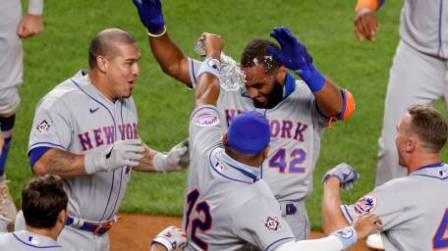
Amed Rosario (arms up) gets a hero’s welcome after his walkoff bomb finishes a doubleheader sweep of the Yankees Friday night. Crowning a pair of surreal days for these surreal Mets.

When hedge fund titan Steve Cohen first emerged as a potential buyer of the New York Mets, I had a little mad fun with that news because we have a couple of things in common. Not financially, of course; Cohen can hand out in tips about a million times what I’ll ever be required to pay in taxes. But we have our mutual grounds regardless.

We’re both Long Island boys who’ve been Met fans since the day they were born. We both made our baseball bones on the original troupe about which it’s fair to say they were baseball’s anticipation of Monty Python’s Flying Circus. We both grew up or (in my case) finished growing up (har har) in Long Island towns with pronounced Mob connections.

Cohen grew up in Great Neck, where there lives the opulent wedding/bar-mitzvah factory emporium (Leonard’s) at which Johnny Sack asked Tony Soprano to perform a hit, a request made just before Sack was carted back to prison from his daughter’s wedding. Bronx native though I am, I finished growing up (snort) in Long Beach, also the home of Don Vito Corleone in The Godfather.

Sorry, Mr. Cohen. My mob family’s Oscars can blow up your mob family’s Emmys.

But it looks at last as though Cohen will graduate from an eight percent stake to controlling ownership of the Mets, more or less as the last man standing. So that gives him more than one up, since the only piece of the Mets I own and can afford is a game hat.

Celebrity would-be buyers Alex Rodriguez, a former Yankee who actually grew up loving and hoping to play for the Mets one day (he actually had his chance, which either he or his then-agent blew like a ninth-inning Met lead), and his paramour Jennifer Lopez, pulled out of the bidding Friday. That may have been the first heavy sigh of relief from Met fans on the day.

Apparently, not even J-Rod could come up with quite the money needed to buy the Mets, whose incumbent Wilpon ownership has long enough been a two-man implosion machine. The J-Rod group would also have included one NFL owner (the Florida Panthers’ Vincent Viola), a BodyArmour founder (Michael Repole), and a WalMart e-Commerce U.S. wheel. (Chief executive officer Marc Lore.)

J-Rod said farwell to the bidding by observing they “submitted a fully funded offer at a record price for the team which was supported by binding debt commitments from JP Morgan and equity commitment letters from creditworthy partners.” The Athletic‘s Daniel Kaplan observes red flags:

[N]otable in the statement is a reference to debt and equity commitment letters from creditworthy partners. On the latter, equity commitment letters are different from money in the bank, and adding a lot of debt to a team that loses around $50 million per year, pre-COVID-19, is not a recipe upon which MLB may have looked fondly.

MLB isn’t “too keen on another [Derek] Jeter/Marlins where they had to scrape their last nickel to pay the purchase price,” a source close to MLB told The Athletic earlier this month, referring to the debt-heavy Marlins. “Especially for a major-market club that already has such large operating losses. Cohen’s checkbook is even more valuable in a COVID and post-COVID environment.”

Not that Kaplan missed red flags flying around Cohen himself, of course. Cohen’s former SAC Capital outfit copped to insider-trading charges and coughed up a record fine of $1.8 billion. Cohen himself wasn’t accused of wrongdoing, but in 2016 he had to agree to the Securities and Exchange Commission’s demand that he not manage the monies of outside investors for 24 months.

Just as problematic may be sex discrimination claims filed in Connecticut against Cohen’s Point72 Asset Management, which I noted myself during the week. Those don’t charge Cohen personally, but one filed in 2018 does, Kaplan writes, though he adds that later in 2018 “the parties voluntarily agreed to terminate the case and submit the case to arbitration, according to court filings.”

Buying an eight percent take in a major league franchise won’t place you under the proverbial microscope, but looking to become the controlling partner will. Baseball’s 23 other major league ownerships have to be edgy about welcoming to their often-dubious ranks a man whose history includes battles over financial crime and sex discrimination charges.

Fred Wilpon and his son, Jeff, haven’t been anywhere near such suspicions so far as anyone knows. They’ve been seen mostly as having been more dumb than dishonest regarding the Bernie Madoff scandal, in which they invested and took an extremely expensive bath. The same could be said for most of Madoff’s investors. But the fallout eventually amplified the Wilpons’ wounding flaws.

Their naivete about Madoff helped them leverage to make the notorious Bobby Bonilla deferred-compensation contract, compel them to pay a reported $29 million into the fund marked for compensating other Madoff victims, and force them “to borrow hundreds of millions more to cover debts they had made against their Madoff assets, [having] almost a major-league payroll’s worth of money due every year just in interest on those debts.”

In baseball terms, the Wilpons weren’t exactly geniuses, either. Before they bought out their original co-owner Nelson Doubleday, they tried to thwart a deal Doubleday wanted to make in the worst way possible. Lucky for them that wiser minds prevailed. That’s two wild cards, one pennant, and one World Series appearance—not to mention the post-9/11 shot heard ’round the world and a Mets hat atop his head—underwriting Mike Piazza’s Cooperstown plaque.

For every Piazza, Carlos Beltran, Carlos Delgado, Johan Santana, and Billy Wagner deal, the Wilpons blocked exponential other solid signings and tradings their baseball brain trusts recommended or signed off on deals and trades about which “dubious” could be considered a compliment.

When Cohen first stepped into the Mets’ controlling partnership picture last winter, I remembered the Wilpons also doing once what some thought could never be done. They made George Steinbrenner himself, the man who threw out the first manager of the year during the 1980s, resemble the epitome of benevolence, with their despicable 2008 execution of manager Willie Randolph, his pitching coach Rick Peterson, and his first base coach Tom Nieto.

The guillotines dropped on the trio after the struggling Mets traveled all the way west from New York to play the Los Angeles Angels in an interleague set and won the first of the set. At three in the morning. It must have been enough to make Randolph, a longtime Yankee fixture at second base, nostalgic for The Boss’s Malice in Wonderland fun house.

Red flags or no red flags, the news that J-Rod dropped out of the Mets’ bidding does indicate the Mets dodging at least one bullet, if what I noted during the week is true and Rodriguez was taking informal counsel from disgraced former Houston Astros general manager Jeff Luhnow. Taking baseball administration counsel from Luhnow is like seeking family counseling from Ma Barker.

The news may also have had an effect on the Mets otherwise.

On Thursday, the night before J-Rod pulled out of the Mets’ running, the Mets’ front office botched almost completely a stirring protest gesture against rogue police and racism, when the Mets and the Marlins observed a moment of silence on field before walking off the field postponing their game.

But come Friday, as MLB commemorated its pandemic-delayed Jackie Robinson Day, and—tragically—the actor (Chadwick Boseman) who played Robinson so powerfully in 42 lost his battle against colon cancer the same day, the Mets swept a doubleheader from the Yankees in the Bronx.

The sweep finished when Amed Rosario, pinch hitting for starting Mets shortstop Luis Guillorme, caught hold of a hanging slider from Yankee closer Aroldis Chapman with pinch-runner Billy Hamilton aboard and sent it into the left field seats. A Mets team who entered the twin bill as the Show’s worst for hitting with men in scoring position (.199) went 5-for-12 in that situation Friday.

Come Monday is the reported deadline for new Mets ownership bids. Joy in Metsville about the end of the Wilpon era is probably tempered by their wish that a saviour with cleaner hands might enter at the eleventh hour. Such a saviour will need five king’s ransoms to out-bid the Long Island boy who once paid for a single painting what the Mets will have paid stud pitcher Jacob deGrom for the entire length of his current contract.

The Mets have been many things in their 58-year life. Dull isn’t necessarily one of them.

A terrible anniversary

2020-08-17 CarlMays

Carl Mays, demonstrating his submarine-style delivery. This was once the most famous photograph of him. (National Baseball Library.)

Tomorrow we ought to win pretty easily. I can’t hit this man Mays, but the rest of the team sure can.
—Ray Chapman, Cleveland Indians shortstop, 15 August 1920.

On 20 September 1920, New York Yankee pitcher Carl Mays was scheduled to appear in traffic court on a speeding charge levied three weeks earlier. Mays didn’t appear, but a Yankee secretary named Charles McManus did on his behalf, entering his guilty plea and paying his $25 fine.

Events three days earlier, and a hundred years ago today, compelled Mays to stay out of sight for what proved a full week: the death of Cleveland Indians shortstop Ray Chapman, 29 years old, fifteen hours after a Mays pitch caught him in the head with a sickening crash leading off the top of the fifth in an overcast New York.

On the same day Mays was due in traffic court, a priest named the Rev. Dr. William A. Scullen presided over the Chapman funeral that crammed St. John’s Cathedral in Cleveland and backed up traffic and crowds outside the church. After commemorating Chapman’s skill, character, and faith, all of which made him beloved in Cleveland and liked around baseball, Scullen turned his attention to the pitcher whose service felled him.

May there be no hostility in any heart to the man who was the unfortunate occasion of his accident. He feels it more deeply than you, and no one regrets it as much as he. This great game we play, that is our national pastime, could not produce anybody who would willingly do a thing like that. Remember those would be the words of him who lies here. Do not hold any animosity.

The priest may have been too late for his words to have any impact on Mays’s behalf. Mays wasn’t exactly Mr. Popularity even before the tragedy. Even Chapman’s opponents testified to his sterling self. Even Mays’s teammates and managers often testified to his less-than-agreeable self.

The Indians weren’t the only team demanding a boycott of subsequent games in which Mays was scheduled to pitch. Yet their Hall of Fame player-manager Tris Speaker was the only member of the team not to sign a letter calling for such a boycott. Nothing could bring Chapman back, and Speaker wasn’t about join the chorus calling an accident murder.

A Kentucky-born, Missouri-raised son of a Methodist minister himself, Mays was known for a submarine-style delivery, an oft-remarked reputation for head-hunting on the mound, and a then-legal spitball at least as effective as the other pitches through which he lived mostly on ground balls.

A few years after the Chapman tragedy, Mays had so alienated Yankee manager Miller Huggins that Huggins used him sparingly until finally starting him against the Indians, of all people. On a day Mays didn’t have his best, the Indians jumped him for twenty hits, thirteen runs, and a 13-0 final. Asked why he wouldn’t change pitchers, Huggins didn’t flinch.

“He told me he needed lots of work,” the manager said, perhaps with a tiny sneer, “so I gave it to him.”

As likeable and respected as Chapman was, the shortstop was known concurrently for crowding the plate, which would have made him prone to a plunk even if a pitcher wasn’t trying to hit him. That didn’t stop only too many from stopping just short of calling for criminal charges against the suddenly hapless Mays.

One week after Chapman’s funeral, The Sporting News published an editorial that barely stopped short of calling Mays a murderer, while Mays continued to stay out of sight in the tragedy’s immediate aftermath:

Mays knows what all the world is saying. He can not dodge the finger of accusation by keeping himself from public view. Nor is it “hysteria,” as his defenders would charge, when critics everywhere remind us of frequent previous complaints against his style of pitching and recount the disputes it has caused on the ball field.

No one accuses Mays of a direct intent to injure any batter, living or dead, but there are few who do not feel that Mays took the chance and made the batter take the chance, and there are many who wag the head and say such a thing as has happened was bound to happen some day.

Mays stayed in seclusion for a week after the tragedy, while talk of boycotting games Mays was due to pitch crawled all around the Show. He talked only to a Manhattan prosecutor the day after Chapman died, according to both the Society for American Baseball Research and Mike Sowell’s The Pitch That Killed: The Story of Carl Mays, Ray Chapman, and the Pennant Race of 1920.

He thought at first that the pitch ricocheted off Chapman’s bat, fielding it properly and throwing to first for what he thought was an inning-opening out. Not quite. Chapman was down in a heap. The next day, a Yankee employee knocked on Mays’s apartment door. Sowell:

2020-08-17 RayChapman

Ray Chapman. (National Baseball Library.)

Mark Roth, one of the ballclub’s secretaries, did not bother to identify himself.

“Carl, I’ve got some bad news for you. Ray Chapman died at five o’clock this morning.”

The words hit Mays like a sledgehammer. He stood there stunned, then slowly shut the door in Roth’s face.

The next few hours were a blur to Mays. He did not know how long he sat in his apartment in a daze. Finally, he was jarred back to reality by the ringing of the telephone. It was a police inspector, offering his sympathy and a police guard if Mays felt one was needed to ensure his privacy. Mays accepted.

Later that day, a Yankee attorney, Frederick Grant, escorted Mays to a police station where he met an assistant Manhattan district attorney identified only by the surname Joyce.

“It was a little too close, and I saw Chapman duck his head in an effort to get out of the path of the ball,” Mays told the A.D.A. “He was too late, however, and a second later he fell to the grounds. It was the most regrettable incident of my career, and I would give anything if I could undo what has happened.”

When Mays returned home, Sowell learned, his wife told him she received two threatening telephone calls, one of which threatened that her husband would be shot when next he drove his car across a viaduct on 155th Street in the Bronx. When he returned to action and beat the Detroit Tigers, the fury continued apace.

Set the Chapman tragedy to one side for a few moments. Mays’s pitching record includes that he led the American League with fourteen hit batsmen in 1917, when he pitched for the Boston Red Sox. He hit eleven and ten in each of the next two seasons. You’d be hard pressed to suggest that Mays hadn’t earned a head-hunting reputation on that record alone. Even in a time when baseball players weren’t exactly renowned for couth.

But Mays never again hit batters in double figures in any season, hitting as many as nine in a season only once, and that was the year after the Chapman tragedy, when he also led the Show with 27 wins.  His final career total of hit batsmen was 89 in a fifteen-season major league career, and an average of seven per 162 games.

He isn’t even in the top 100 all-time drillers. (He’s tied at number 128.) Mays having committed the notorious hit batsman in Show history singles him out. (Two minor league players, Tom Burke and Johnny Dodge, died in 1906 and 1916, respectively, after being hit in the head by pitches. Those pitchers, Joe Yeager and Tom [Shotgun] Rogers, didn’t earn a fragment of Mays’s infamy.)

Mays wasn’t exactly an outlier among pitchers when he once said, “Any pitcher who permits a hitter to dig in on him is asking for trouble. I never deliberately tried to hit anyone in my life. I throw close just to keep the hitters loose up there.”

Chapman’s death shattered the Indians to a man—until it didn’t. Speaker swore the team would grind it out and win the pennant in his memory, the way they believed he wanted.

Abetted in no small part by the end collapse of the Chicago White Sox, when the Black Sox scandal graduated from rumour to explosive fact and eight White Sox were suspended by the team post haste, the Indians won the pennant and beat the Brooklyn Dodgers (then known as the Robins) in the World Series.

Absent Chapman’s death, Mays might have been remembered best as a tough pitcher who was lost for explaining why his personality rubbed enough people in baseball the wrong way. “When I first broke into baseball, I discovered that there seemed to be a feeling against me, even from the players on my own team,” he once said. “I always have wondered why I have encountered this antipathy from so many people wherever I have been. And I have never been able to explain it, even to myself.”

He didn’t always seem to think that questioning his managers’ intelligence or his teammates’ play behind him on rough days might have had a hand in it.

If you believe in karma’s bitchcraft, you should know that life after baseball wasn’t always kind to Mays. Sowell exhumed that he lost his life’s savings ($175,000) in the 1929 stock market crash and his wife to complications from an infection in 1934. That left him to raise his two children alone, until he met and married the former schoolteacher who came to him at first as his housekeeper.

But Mays also became a longtime baseball scout and teacher who mellowed as the years went by and who made a particular point of teaching his charges to play the game as safely as possible within reason.

The Chapman tragedy caused two major rules changes. Change one: the Show outlawed the spitball officially, while allowing pitchers already throwing the pitch (including Mays and, more famously, Hall of Famer Burleigh Grimes) to continue until their careers ended.

Change two: fresh, clean baseballs in play at all times. (Mays showed an umpire a scuff on the ball that hit Chapman as well as how wet the ball still might have been from light rain earlier that day, indicators that Chapman may not have picked up the flight of the ball until it was too late.)

Harry Lunte pinch-ran for Chapman played shortstop the rest of the game, which the Indians held on to win, 4-3. Then, a rookie named Joe Sewell, swearing to anyone who’d listen that he’d become the next Chapman, became the Indians’ regular shortstop—all the way to the Hall of Fame, after playing his final three seasons with the Yankees, of all people.

Mays had the credentials for the Hall of Fame when it was born in 1936, but he never made it. Not because of the Chapman tragedy, but—according to Sowell and numerous other researchers—because of suspicions never really proven that he’d tanked in the late innings of two 1921 World Series games didn’t dissipate easily. (Commissioner Kenesaw Mountain Landis actually investigated, hiring detectives as part of it, and found the suspicions to be just that.)

It didn’t stop Mays from going to his grave believing in his heart of hearts that Ray Chapman was the number one reason he was kept out of Cooperstown. Mays was elected to the Missouri Sports Hall of Fame in 2009; that Hall notes among other things that not only did Mays stay close to his roots but often brought grosses of used major league baseballs home to give to local children.

Mays picked himself up, dusted himself off, started all over again, and finished his pitching career with a kind of stubborn courage that might have been lacking in another pitcher who might also have caused such a tragedy without malice aforethought.

Yet when he told San Diego sportswriting legend Jack Murphy the Chapman tragedy wasn’t “on my conscience, it wasn’t my fault,” the sense was that Mays said it not because he believed it in the depth of his heart of hearts but because, from the same depth, he still couldn’t bear that a sickening accident caused a death that marked him for life.

Chapman actually planned to retire after the 1920 season, having married before the season started, and having planned to enter his father-in-law’s business. He was buried  in Cleveland’s Lake View Cemetery—four miles north of Calvary Cemetery, where his wife and daughter were buried eventually. A plaque in his memory now hangs on a wall in Progressive Field’s Heritage Park.

Mays finished raising his children before living an uncontroversial life to follow with his second wife, stubbornly continuing to hunt and fish despite age forcing him to walk with a cane due to arthritis and depriving him of some of his hearing.

Much as he loved his Missouri roots, Mays was buried next to his first wife in Portland, Oregon’s River View Cemetery. His headstone mentions not his baseball career but his military service in World War I. He once ran an Oregon baseball school whose students included a young Oregonian who became a Red Sox legend, shortstop/manager/coach Johnny Pesky.

Living well enough is usually the best revenge. But it’s also the next best thing to an absolution that’s only God’s to give when men and women can’t or won’t. That as well as the dozens of used Show baseballs and other kindnesses Mays gave children back home may help to brighten his memory. Even a little.

Ray Chapman didn’t deserve to die playing the game he loved. Carl Mays, who loved the game likewise, didn’t deserve to be stricken with the next worst thing to the mark of Cain for a terrible accident.

Horace Clarke, RIP: Not his fault

2020-08-11 HoraceClarke

Horace Clarke—the Yankees’ Lost Decade wasn’t even close to all his fault.

Arguably, the worst era in the history of the New York Yankees that had nothing to do with George Steinbrenner’s King-of-Hearts style of leadership was 1965-1974. Calling it the Yankees’ Lost Decade may be an understatement. Saying it proved that even the Yankees were only human, after all, doesn’t really fit comfortably, however true it was.

Calling it the Horace Clarke Era—after the good-field/no-hit second baseman who died 5 August at 81, from complications of Alzheimer’s disease—was patently unfair, too. It still is. Hall of Famer Joe DiMaggio said, famously, “I thank the good Lord for making me a Yankee.” There isn’t a jury on earth who’d rule Clarke out of line if he’d surrendered to the temptation to say, “Lord, you got a minute?”

The whole thing began when the Yankees, in one of baseball’s most devious double switches ever, fired manager Yogi Berra the day after they lost a thriller of a seven-game 1964 World Series to the St. Louis Cardinals. Days later, they hired Johnny Keane, who’d just beaten them in that Series.

Keane’s Cardinal skids were greased deviously during the season, before the Cardinals survived to win the pennant. He stunned owner Gussie Busch by handing Busch his resignation–at the presser Busch called to announce his re-hiring. Berra was likewise a victim of back-channel backstabbing whose execution was planned no matter how the season finished. Not even a 31-12 stretch to win the pennant could save him, despite Bill Veeck’s valedictory (in The Hustler’s Handbook):

Normally, you win a pennant when all your players have a good year together. The Yankees won it with all their players having bad years together . . . With all their difficulties, the Yankees did move on with that rush down the stretch. Unless I have been sadly misinformed by all those sensation-seeking columnists, the manager during that stretch run was Yogi Berra.

By 1964’s end the Yankee farm was practically a dust bowl. Owners Dan Topping and Del Webb, looking to sell, parched it along with other cost-cuttings to pump up Yankee profits and impress a likely buyer. The buyer turned out, somewhat controversially, to be the Columbia Broadcasting System during the ’64 season.

The few prospects the Yankee farm yielded between the end of the Casey Stengel era and the end of Berra’s 1964 would prove to be journeymen (Hal Reniff, Tom Tresh, Rollie Sheldon, Phil Linz, Pete Mikkelsen), injury-ruined (Tresh, Jim Bouton), inconsistent (Steve Hamilton, Bill Stafford), or talented but troubled and troublesome. (Joe Pepitone.)

The Yankee stars showed their age and then some. Hall of Famers Mickey Mantle and Whitey Ford probably should have retired after 1964. Roger Maris’s post-1962 injuries already began sapping his formidable power. Tony Kubek’s back would finish his career after the 1965 season. His double-play partner Bobby Richardson–overrated as an early-in-the-order man because he was an impossible strikeout–called it a career on his own after 1966 . . . and after only eight seasons as a regular.

If you needed an idea of just how badly shaped the post-Berra Yankees would become, you had only to look at Mel Stottlemyre, the August 1964 callup who proved one of the two Yankee heroes down that stretch. (Early September acquisition Pedro Ramos, a journeyman starter whom Berra put in the bullpen shrewdly, proved lights out in eleven key appearances including eight saves.)

Stottlemyre earned 20 wins in 1965 and 20 losses in 1966. He was the same pitcher in both seasons–1965 fielding-independent pitching: 3.24; 1966: 3.35–but he was somewhat lucky in 1965 (2.60 ERA) and very unlucky in 1966. (3.80.) He’d have a fine career, though well short of a Hall of Fame one, until a decade plus worth of throwing his trademark hard sinkerballs claimed their price in June 1974. Rotator cuff blown. Pitching career over.

Keane wouldn’t survive past an early 1966 stretch. Trying to bring a run-and-gun style of baseball to a team built for the big inning did him no favours. Houk–whose tenure as GM is described most politely as controversial (and almost illegal, when he tried breaking the rules to fine Bouton $100 a day for a contract holdout)–fired Keane that May and returned to the dugout, perhaps deciding he was miscast in the front office. When Keane died in January 1967, after taking a scouting job with the Angels, the Yankee toll taken on him left him looking a quarter century older than his 55 years.

Ford finally surrendered to his elbow and shoulder miseries and retired after 1967. Mantle finally did what he should have done three years earlier and called it a career in 1968. Maris wasn’t allowed such dignity; the Yankees unconscionably hid a wrist fracture’s actuality from him, then traded him to the Cardinals after 1966 despite his intentions to retire. (The Cardinals allowed Maris a dignified finish, playing for back-to-back pennant teams, and then a life as a successful Anheuser-Busch distributor.)

Veteran Elston Howard, Berra’s successor behind the plate, a late bloomer largely because of the Yankees’ old trepidations about bringing black players along, was traded to the Boston Red Sox during the 1967 stretch drive at age 38 but in position to mentor the youthfully remade Red Sox toward their surprise pennant.

Most of the few bright lights the 1965-74 Yankees really produced couldn’t and wouldn’t live up to the franchise’s legend. Owned by CBS from 1964-1973, the Yankees learned the hard way that when it came to running a baseball team the Tiffany Network was more like a costume jeweler.

Bobby Murcer was burdened by too much hype comparing him to Mantle (both from Oklahoma, both signed by the same scout, both with breathtaking power, both five-tool players) to make the team his with or without Mantle lingering. Fritz Peterson was a talented pitcher who battled to win despite finishing his career with the lowest old Yankee Stadium ERA (2.52) of any pitcher–including Ford. (He also ended his Yankee days controversially following the infamous “life swap” of wives and children with pitching teammate Mike Kekich.)

Roy White was a reliable outfielder and steady bat, but the ’65-’74 Yankees needed more around him to make his Tommy Henrich-like play mean anything. (The good news: the popular, respected White managed to last long enough to play on two Yankee World Series winners after the team was remade/remodeled back to greatness.)

Thurman Munson arrived behind the plate in 1969 and, soon enough, he’d anchor the Yankees’ return to greatness in the mid-to-late 1970s before his tragic 1979 death in a plane crash. Murcer would return from tours in San Francisco and Chicago to taste of postseason play in 1980 and 1981, before becoming a popular Yankee broadcaster.

And, then, there was Clarke.

A 1965 rookie, Clarke was the fourth major leaguer to hail from the Virgin Islands. (Outfielder Joe Christopher, pitcher Al McBean, and catcher Elmo Plaskett preceded him.) He was a second baseman with good soft hands, excellent range (he was consistently above his league’s average for fielding percentage and range factors), double-play deftness, and a futile bat. The classic old good-field/no-hit middle infielder.

He was also a genuinely nice guy in the bargain who never thought he’d been cursed to be a Yankee when being a Yankee was damn near like being a 1965-68 Met, though even he admitted to having days in which it seemed the devil was having a hearty laugh at his expense.

The Original Mets of 1962-64 were funny when they lost. How could they not, with Stengel managing them and schpritzing his triple-talking wit to shield them. With Abbott pitching to Costello. With Who the Hell’s on First, What the Hell’s on Second, You Don’t Want to Know’s on third, and You Don’t Even Want to Think About It at shortstop.

Sooner or later, of course, most running gags run their course. (Fibber McGee’s closet remains an outlier.) The post-Stengel Mets of 1965-68 were as funny when they lost as a screen window on a submarine. The 1965-74 Yankees weren’t even that funny, not on the field, anyway.

Just why the Yankees’ Lost Decade came to be called “The Horace Clarke Era” escapes me, and I was there, growing up in Long Beach, on Long Island, to see it. And, hear it, since broadcast legend Red Barber was part of the Yankee team until his execution at end of 1966 and–knowing of his years as the Brooklyn Dodgers’ anchor broadcaster–the only reason any Met fan had to listen to Yankee home games if the Mets weren’t on the air.*

Why single out the Virgin Islander who played second base like a gazelle but couldn’t hit with a telephone pole? Why him and not, say, modestly endowed catcher Jake Gibbs? Peterson’s retrospective book, When the Yankees Were On the Fritz: Revisiting the Horace Clarke Era, offered a suggestion from no less than Clarke himself.

[E]very time I hear “the Horace Clarke Era” I don’t know how to take it, but I think it is mostly because we were losing and I was a member of all those teams. I could understand fans, writers, and commentators were spoiled at being so successful for so long . . . But . . . I’m going to tell you something. While I was there, [writers] always targeted me, I was targeted more than anybody I think because I played just about every day. When I was traded to San Diego [in May 1974], a writer wrote, “You know, that guy wasn’t so bad after all.” Because he had gone to the record books and saw what I had done over those years.

Clarke knew his limits, at least at the plate. But he also believed he was blessed regardless. “I am happy, my friend,” Clarke told the New York Post‘s Mike Vaccaro in 2004. “I played major league baseball for parts of ten years, and I played in the magnificent city of New York, and as a child in St. Croix that was beyond dreams. Yes. I am a happy man.”

If he’d been a Cub (as Murcer eventually became for a spell), Clarke might have rivaled Hall of Famer Ernie Banks for thinking every day was beautiful enough to play two. Might.

Even a Clarke gets to stand with the immortals now and then. The second time, though, he might have chosen a little differently. On 30 September 1971, Clarke was the scheduled Yankee batter with two out and Joe Grzenda on the mound trying to save the Washington Senators’ final home game ever.

Knowing the Senators’s duplicitous owner Bob Short was about to hijack them to Texas (banners festooned with Short’s initials sometimes dominated in the stands), heartsick fans finally stormed the field, left it looking like the aftermath of a terrorist attack, and forced a forfeit before Grzenda (who died last year) got to throw even one pitch to Clarke.

Clarke made more pleasant history the previous season. Between 4 June and 2 July 1970, he busted up no-hit bids by three pitchers, Jim Rooker (Kansas City Royals), Sonny Siebert (Red Sox), and Joe Niekro (Detroit Tigers)–every one in the ninth inning. Call him “No-Hit No-Way Horace,” if you like.

In due course, Clarke became a baseball instructor for the official sports program of his native Virgin Islands and a Royals scout. “I was proud to be a Yankee,” he told Vaccaro. “I just played there at a difficult time for everyone. But I had a blast.”

Once upon a time, Hall of Fame manager Earl Weaver remembered managing pitcher/playboy Bo Belinsky in the Orioles’ minor league system. “Bo wasn’t no angel,” Weaver told a Belinsky biographer, “but I’ll tell you this, he wasn’t the worst guy I ever knew in baseball, either.”

Horace Clarke wasn’t a Hall of Famer on the best days of his life, but I’ll tell you this. Whatever went wrong with the Lost Decade Yankees, Clarke wasn’t even close to the main reason. May he have been shepherded to a sweet eternity in the Elysian Fields, where every soft-handed, rangy second baseman has a place with the Lord’s angels.
———————–
* On 22 September 1966, Yankee Stadium was practically empty as the Yankees faced the Chicago White Sox. Red Barber ordered a camera pan of the ballpark. When he was refused, Barber addressed his viewers: “I don’t know what the paid attendance is today, but whatever it is, it is the smallest crowd in the history of Yankee Stadium, and this crowd is the story, not the game.”

What Barber didn’t know at the moment was that one of the 413 present in the ballpark was CBS honcho Mike Burke, whom the network assigned to administer the Yankees, attending his first live Yankee game. Burke was made aware of Barber’s on-air remarks and forced the Hall of Fame broadcaster’s ouster at breakfast the following week.

The Ole Redhead retired as a full-time sportscaster after that.

Alfred Hitchcock presents Opening Night

AlfredHitchcockAt long enough last came Opening Day. Well, Opening Night. On which New York Yankees right fielder Aaron Judge nailed the COVID-19 delayed season’s first hit and his teammate Giancarlo Stanton nailed its first home run two batters later.

On which the Washington Nationals opened without a key element, outfielder Juan Soto, whose positive COVID-19 test result came back well enough before game time to make him a scratch.

Before that rain-shortened game even got started, the word came from the opposite coast that Clayton Kershaw was scratched from his Opening Night start thanks to a back problem sending him onto the injured list.

In Washington, the Nats’ co-ace Max Scherzer would have loved if Judge and Stanton were Thursday night scratches. They accounted for all Yankee runs in the 4-1 final shortened in the top of the sixth when the rains smashed in with the Yankees having first and third and one out.

In San Francisco, Los Angeles Dodgers rookie Dustin May pitched five innings to San Francisco Giants veteran Johnny Cueto’s four, both men leaving with a one-all tie, and the Dodgers’ new $396 million man Mookie Betts broke the tie scoring on an infield ground out in the top of the seventh.

Scherzer’s good news Thursday night: eleven strikeouts. His bad news: four walks and an inability to solve Judge and Stanton. Judge also doubled home Tyler Wade in the third and Stanton singled home Gio Urshela in the fifth. Remove Judge and Stanton from the Yankee lineup and the Nats’ Adam Eaton’s hefty solo home run in the bottom of the first would have been the game’s only score.

Betts singled with one out in the top of the seventh and called for the ball. Published reports indicate that ball plus the evening’s official lineup card now repose in his home. “It’s just a new chapter in life,” he told reporters after the 8-1 Dodgers win.

After he came home when Justin Turner grounded into a force out, Corey Seager’s grounder got Cody Bellinger caught in a rundown at the plate, but Enrique Hernandez singled home Turner and Seager (who’d taken second during the rundown), Joc Pederson and A.J. Pollock walked back-to-back to load the pads, Austin Barnes sent Hernandez home with an infield hit, and Max Muncy walked Pederson home.

And, on both coasts, all four teams figured out a solution to the issue of whether or not to take a knee for “The Star Spangled Banner” that might actually help more than hurt the too-easily outraged.

Abetted by a suggestion from Philadelphia Phillies outfielder Andrew McCutchen, the Yankees and the Nats lined up on the base lines holding a long, long, long black ribbon, standing apart enough for social distance, then took their knees before “The Star Spangled Banner” was played.

On the same suggestion, the Dodgers and the Giants held a similar long, black ribbon and took their knees before the anthem’s playing. In Washington, both the Yankees and the Nats rose from their knees while the anthem was played. In San Francisco, ten Giants including manager Gabe Kapler plus Betts on the Dodgers’ side stayed on their knees during the anthem, with Bellinger and Muncy putting hands on Betts’s shoulder as a gesture of support.

I went back on record Thursday saying that there are far worse ways than kneeling before a national anthem to protest something you think is dead wrong. Kneeling, as two Scientific American writers I cited remind us, is anything except disrespect.

“While we can’t know for sure, kneeling probably derives from a core principle in mammalian nonverbal behavior: make the body smaller and look up to show respect, esteem, and deference,” wrote psychologists Jeremy Adam Smith and Dacher Keltner in 2017.  “. . . Kneeling can also be a posture of mourning and sadness. It makes the one who kneels more vulnerable. In some situations, kneeling can be seen as a request for protection.”

I’ll ask again: Would you rather those outraged by rogue police doing murder against black or any people raise clenched fists, burn a flag on the field, or start a riot with or without looting and plundering in the bargain? Neither would I. But if only now-former football quarterback Colin Kaepernick had thought in the first place to take his original knee before the anthem played, would that have worked very differently for himself and the outraged?

Let me repeat, too, that you don’t have to subscribe to every last clause or every last impulse of the social justice warriors to agree that rogue police doing murder is not what the land of the free and the home of the brave was supposed to mean. Neither must you subscribe to the formal Black Lives Matter movement itself to agree that black lives and all lives don’t deserve to end when those entrusted to uphold the law break it instead.

Let me repeat further that it’d be far better for baseball to limit playing “The Star Spangled Banner” to before games on Opening Days, games played on significant national holidays, the All-Star Game, and Games One and (if it goes that far) Seven of the World Series. Not so much to cut back on the kneeling protests but to re-emphasise that patriotism compulsory is patriotism illusory.

Back on the field, Soto’s COVID-19 positive test approaching Opening Night shook the game up just enough to provoke serious questions as to how MLB is going to navigate even this truncated season without further medical issues. And, whether the most stringent health and safety protocols will keep more Sotos from turning up positive.

Other surrealities include the empty stands, other than cardboard cutouts of fans in the seats, and the canned crowd sounds at the ballparks. The coronavirus world tour already turned baseball into something between The Twilight Zone and the Mad Hatter’s tea party. Now that the season is underway at last, should we throw Alfred Hitchcock Presents into the mix?

At least neither Opening Night game went to extra innings, so we didn’t have to deal right off the bat with the free cookie on second base awarded each team to start its extra half-inning. The mischief that’ll inspire will just have to wait.

Funny thing, though, about that equally nefarious three-batter minimum for pitchers. Two Giants relievers faced the minimum in that five-run Dodger seventh before surrendering any runs. If bullpen preservation was part of it even if those two got pried, I can see already that this dumb rule isn’t going to end well for Kapler and other managers.

And, let’s be real, the PA people in charge of the piped-in sounds are only human, after all. Who’s going to be the first poor sap having to live down the accident of cranking up the wild cheering when the home team’s batter gets hit by a pitch?

On the other hand, it was easy enough to feel normal again once the Yankees and the Nats got underway . . . when home plate umpire Angel Hernandez began blowing pitch calls. Calling a few strikes balls and a few balls strikes? That’s about par for the course for him. So when’s that umpire accountability coming at last?

Before the game, Dr. Anthony Fauci—otherwise doing his best to battle a pandemic involving both a stubborn virus and a political (lack of) class that surely makes him wonder if he was really there when all this happened—threw out a ceremonial first pitch. Later, he was seen in the stands with his Nats-themed face mask off his face a spell. What’s up with that, Doc?

You’d love to say Fauci threw a perfect strike to Nats relief pitcher Sean Doolittle behind the plate, but you’d be lying like an office holder. Fauci’s delivery is described politely as resembling a man trying to compensate for a fractured upper arm. The ball sailed almost to the on-deck circle. Rumour has it that Hernandez called it a strike on the outside corner.