Baseball Tease Day

Rafael Devers

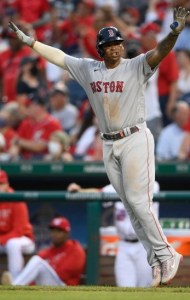
Wings and prayers—Rafael Devers’s tiebreaking two-run blast in the ninth Sunday punched the Red Sox’s ticket to the AL wild card game . . .

Crisis addicts of the world, unite. You won’t get the greatest possible fix for your addiction on what might have been Baseball Chaos Day. In fact, you’re getting a day off for reasonably good behaviour.

But at least you get four of the game’s most deeply storied franchises in the wild card games. That’s something, isn’t it?

If major league baseball fans must continue to bear with the thrills and chills of watching teams fight to the last breath to finish . . . in second place, at least you get to see the Cardinals host the Dodgers in the National League wild card game, and the Red Sox host the Yankees in the American League game. Right?

I know. I know. The crisis junkies among baseball’s fans were spoiling for that National League West tie between the Giants and the Dodgers. They wanted that four-way American League wild card tie so badly they could wrap themselves in it like frozen food in Reynolds Wrap.

The Blue Jays did their absolute best to make it happen when they parboiled the Orioles 12-4 Sunday afternoon. But the Mariners let them down by being unable to get past what was left of this year’s Angels.

Maybe we should have had a hint when Shohei Ohtani started the finish of his surrealistic individual season by hitting Mariners lefthander Tyler Anderson’s third pitch of the game about twelve rows into the right field seats.

Home run number 46, RBI number 100, for the guy who also finishes 2021 with a 3.18 ERA and a 10.8 strikeout-per-nine rate on the mound. If you can’t win it, just start playing spoiler. Ohtani’s surreal season could have finished a lot worse than becoming the Angels’ must-see-television in the injury-created absence of their all-universe Mike Trout.

The Mariners let themselves down, too, after a surprise season of playing slightly over their own heads to get thatclose to postseason-opening mayhem. Those were real tears in young outfielder Jarred Kelenic’s eyes as well as veteran third baseman Kyle Seager’s, when their run came one port short in losing two of three to the Angels over the weekend.

“It wasn’t a team where we were just more talented than the other team every single day,” said Seager postgame, after what may yet prove his last game as a Mariner, “but you had a group that just collectively played together and they collectively tried to win every single night.”

Trouble was, the Nationals couldn’t keep the Red Sox down despite opening an early 5-1 lead against them in Nationals Park. They couldn’t stop Red Sox third baseman Rafael Devers from hitting a hefty solo home run to open the top of the fourth and a five-all-tiebreaking two-run shot in the top of the ninth—with former National Kyle Schwarber, who’d reached on an inning-opening infield error—aboard ahead of him.

But two years after the Nats’ staggering World Series win, at least they could bask a little in the home crowd’s applause for possibly-retiring first baseman Ryan Zimmerman, the last truly Original Nat, the franchise’s first first-round draftee to play in their silks after moving from Montreal, when lifted from the game after the seventh. Even the Red Sox joined the applause unapologetically. Aretha Franklin used to spell that r-e-s-p-e-c-t.

Meanwhile, the American League East champion Rays battled the Yankees scoreless until the ninth. The Yankees even flashed something resembling past glories when third baseman Gio Urshela channeled his inner Derek Jeter in the sixth, chasing Austin Meadows’s foul pop 126 feet from an overshift position and catching it on the track, before he fell in a heap onto an empty spot on the Rays’ dugout bench.

But after Rays starter Michael Wacha pitched one-hit ball over five innings and the Yankees threw six pitchers at the Rays, Aaron Judge—the towering, snaggle-toothed, boyish-looking face of the Yankees—picked the right spot to deliver the first walk-off winner of his major league career.

With Rays reliever Andrew Kittredge freshly installed, after Josh Fleming allowed second and third with one out, Judge ripped a liner off Kittredge’s glove toward second, Tyler Wade dove home ahead of a throw from Rays second baseman Brandon Lowe. Thus the Yankees ducked a coming day’s chaos. “I wouldn’t say we exhaled,” Judge said of it postgame. “We still have work to do.”

Meanwhile, in San Francisco, the Padres’ second-half implosion finished when they all but rolled over and played dead for most of an 11-4 loss to the Giants. Enabling the Giants to become the first in Show ever to win their 107th regular season game while clinching a title on the regular season’s final regular day. Leaving the Dodgers, 10-3 assassins over the NL Central-winning Brewers, to deal with the Cardinals in the league’s wild card game.

That ages-old blood feud between the Giants and the Dodgers would just have to wait for a possible showdown in a National League division series, assuming the Dodgers get past a Cardinals aggregation that managed to do what enough teams couldn’t this year—shake off a few serious injuries and a few tough spells to get to at least the postseason’s entry game.

The Padres made life just a little too simple for the Giants Sunday afternoon. They had no answer for Giants starter Logan Webb—who struck out eight and, at the plate, threw in a line drive, insult-to-injury two-run homer in the fifth—until they finally chased him with three straight base hits in the eighth.

Entering the season it sometimes seemed as if the Padres were anointed the lords of the National League West by default and the Giants were anointed lucky to survive the races at all. But while growing pains, internal dissensions, key pitching injuries, and manager Jayce Tingler’s exposure as an inconsistent in-game thinker came more vivid as the Padres season went deeper, the Giants surprised just about the entire baseball world with their ability to hang with the Dodgers and take it literally to the last day.

Veteran or largely-veteran teams don’t work anymore, right? Baseball’s for the young, right? Letting the kids play means the veterans can’t romp, right? The Giants would like a few words with you. Their veterans played up and had just as much fun as the kiddie corps. And the Giants took their remarkable season right down to the wire to beat the Dodgers out for the title by one game.

“I think we all knew at the beginning of the season, or even dating back to the beginning of spring training, what the projections are and what the industry sort of thought of us as a club,” said Giants manager Gabe Kapler, who’d finally figured out what he couldn’t in Philadelphia—analytics hoists and supports you going in, but you’d better marry that to what’s in front of you inning by inning if you want to get the full job done.

“What I realized,” he continued, “is there are some intangibles that those projections and viewpoints failed to take into consideration.” There’s never a thing wrong with having the most possible information to open a game, but when it’s married unsuccessfully to the moments to come while you play, the offspring is usually disaster.

The Giants, the Brewers, the AL Central-winning White Sox, the Astros, and the NL East-winning Braves have to wait to begin their postseason dances. It’s both poetic and problematic that the party begins with the Olde Towne Team hosting the Empire Emeritus in a win-or-be-gone wild card game.

Poetic because of that similarly ages-old Yankee-Red Sox blood feud. Problematic because of . . . that ages-old feud having its script flipped in this century.

Go ahead and point to all those pennants and World Series rings, Yankee fan. You’ve only got one of those rings to show in the 21st Century. You may have the upper hand in division triumphs but that smothering Yankee dominance is just so 20th Century now. That’s the Red Sox sitting with four 21st Century World Series rings now.

If there’s one other thing by which the Yankees hold an edge over the Red Sox this time around, it’s a fan base that clings to “To err is human, to forgive cannot be Yankee policy” like a religious catechism. Calling for the manager’s perp walk and summary execution after a tough loss? Yankee manager Aaron Boone gets it after a tough inning as often as not.

The man who did what no Yankee manager before him could—lead his teams to back-to-back 100-wins-or-more seasons in his first two on the bridge—and has a .601 winning percentage as a Yankee manager must feel fortunate that his boss’s name is Hal, not George Steinbrenner. Hal Steinbrenner doesn’t have his father’s notorious hair trigger. It’s saved New York’s sanitation corps from barrels worth of washing blood from the streets around the House That Ruthless Built.

Maybe their own long-enough and disastrous enough history has finally given Red Sox Nation what some people thought would have been impossible to fathom—the patience of Job—compared to their counterparts turning to the south Bronx. The AL wild card game hasn’t been played yet, of course, but you don’t exactly hear Red Sox fans saying, to themselves and aloud, “OK, when’s it going to happen” and mean disaster over delight before the game actually begins.

Those two fan bases get only one day’s worth of living on the edge. If the Dodgers treat the Cardinals’ grand old man Adam Wainwright like target practise in the NL wild card game, the Dodger-Giant rivalry gets three games minimum, five maximum to go nuclear.

If the Cardinals treat the Dodgers’ cleverly imported grand old man Max (The Knife) Scherzer rudely, Giantland and Cardinal Country get to relive the 2014 disaster—disaster for the Cardinals, that is. This time, though, the Cardinals won’t have Mike Matheny on the bridge to decide The Book was more important than The Moment. Mike Schildt won’t risk paying through the feathers by allowing a Giant pennant to sail into the crowd atop Levi’s Landing behind right field. I think.

It’s enough to make you feel almost sorry for the White Sox facing the Astros in an American League division series. Even their first postseason meeting since the 2005 World Series the White Sox swept—that was before the Astros were traded to the American League, of course—doesn’t have half the blood boil potential. I think.

Baseball Chaos Day? Sunday’s regular season finales amounted more to Baseball Tease Time. It was fun to watch—but it was hell to pay. But as Hall of Fame scribe Jayson Stark would say, because . . . baseball!

No bunts about it

Joey Gallo

This is the way to bunt—not wasting an out to move runners who aren’t as likely to score from there as you think,  but for a base hit . . . especially when you’re handed enough free real estate to build the Ponderosa upon. Pushing a man on third home? Gravy.

If it isn’t in the textbooks yet, it should be. And it was executed by a man considered far and wide enough as maybe the single most classic avatar of the big bomb/big strikeout/ big nothing-much-else hitter seen, often incorrectly, as the typical major league hitter of today.

With the Rays putting a now-classic defensive overshift to the right side, and Giancarlo Stanton on third with one out in the ninth, lefthanded Yankee bombardier-or-bust Joey Gallo faced Rays reliever Andrew Kittredge. The split second Kittredge began to throw the ball, Gallo dropped out of his power stance and showed bunt.

He put the bat on the ball. It shot hopping up the third base line, onto and through that entire unoccupied expanse of yummy free real estate, pushing Stanton home and threatening to leave the American League East-champion Rays with an omelette on their faces en route a potential last-minute loss.

Gallo’s sneak attack cut a Yankee deficit exactly in half, to 4-2. Gio Urshela singled to right almost at once, Brett Gardner singled Gallo home, and it looked for the moment like the Yankees would hang on a little more firmly in the wild card race if they could push just two more in.

Not quite. Kittredge ironed up and struck out Gary Sanchez and Rougned Odor (that little stinker) back to back for the side and for the hard-secured 4-3 Rays win. With the Red Sox holding on to beat the Nationals in Washington, 4-2, the Yankee advantage for the first American League wild card fell back to one over the Red Sox.

But Gallo struck a blow on behalf of every baseball watcher and analyst who’s fed up to the proverbial teeth with the yammering from the Old Fart Contingency demanding what just about amounts to a return to dead-ball baseball. The contingency that forgets, assuming it ever really understood in the first place, that under customary circumstances sacrifice. bunts. waste. outs.

Especially when you’re up against the number one scoring team in the league.

You’d only think that the out-wasting sac bunt would do your team a big favour by pushing a runner or two forward and making it easier to score. But you really have to watch the game more closely to see the actuality. Keith Law (in Smart Baseball) saw it, tabled it, and probably ran a few temperatures up the scale.

There are six common scenarios in which you’d see a sac bunt. Here they are, with the actual result and value, the probability or scoring at least one run or more before the bunt, and the probability of scoring at least one run or more after that bunt. (I’ve indicated it with RP.) Law’s tabulation comes from the 2015 season, but it’s generally applicable—give or take a percentage of a percentage point—in just about any season:

Bunt Situation Pre-bunt RP Post-bunt RP Better/Worse Off?
Man on first, 0 out 0.50 0.45 Worse
Man on first, 1 out 0.36 0.26 Worse
Man on second, 0 out 0.66 0.67 Push
Man on second, 1 out 0.45 0.27 Worse
Men on first and second, 0 out 0.65 0.70 Better
Men on first and second, 1 out 0.45 0.26 Worse

Think about that. Six possible sacrifice bunt situations and four of the six leave a team worse off, one leaves them better off, and one is pick ’em at best. With the best case scenario being a sac bunt with first and second and nobody out.

Gallo wasn’t batting in any of those situations Friday night. He had a man on third with one out—and absolutely no Rays infielder on the left side of second base. The third base ump or the Yankee third base coach each had a better chance of fielding Gallo’s sneaky squirt than any Ray did. The Cartwright boys could have built the Ponderosa with room to spare.

One showing of video from the play says, and I quote, “Joey Gallo singles on a bunt ground ball to third baseman Yandy Diaz. Giancarlo Stanton scores.” It would be accurate if Diaz was actually playing third base proper in the moment.

Diaz was in a fourth-outfielder array for the shift. Second baseman Joey Wendle came running over from about half a mile beyond second base, unable to do anything more than watch the ball pass the infield grass and the infield dirt on the third base side, before he finally caught up to it on the extremely short left field grass. The Feds had an easier time nailing Al Capone than Diaz would have had nailing Gallo at first.

It would have been sweet justice if the Yankees had followed up properly and done right by their too-often-shortfalling import bombardier. (They acquired Gallo from the Rangers at the trade deadline.) And it’s not as though Gallo is exactly virginal with such a play.

He’s done it before. A few times. One was a near-equal to the beauty he nudged Friday night: on 25 April, leading off the bottom of the second, against the Athletics. This time it was Kendall Graveman on the mound and Gallo facing the first pitch of the inning.

Again, Gallo dropped out of his normal stance the moment Graveman actually began to throw. Again, he pushed a bunt the other way, even slower and closer to the third base line. Graveman scampered to get the ball sliding almost onto the line but couldn’t throw Gallo out in time. (The Rangers didn’t score in the inning but went on to win, 4-2.)

Now, Gallo could have tried swinging for the Grand Concourse against Kittredge. He’s only faced him once and made an out; it’s not as though Kittredge owned a particularly fat file against him. But he saw Stanton on third, the entire left side about as crowded as a desert, and a chance to sneak shrink the Yankee deficit by half in a game the Yankees absolutely had to win.

It wasn’t Gallo’s fault the Yankees got only one run to follow his ploy RBI. But it should open the eyes of every batter and manager despairing of reducing the overshifts to periodic elements rather than semi-permanent table options.

The only thing wrong with Gallo’s kind of bunt is that more of those batters and managers don’t think of it more often. But, boy, they’ll still think about wasting outs with those mostly futile sacrifice bunts now and then. You tell me what’s wrong with that picture.

On a sober anniversary

New York Mets, New York Yankees

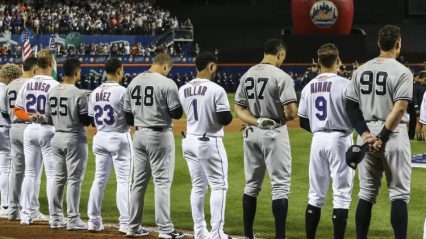
Honouring the murdered and the fallen who tried to save them during the original 9/11 atrocity at the World Trade Center, the Mets and the Yankees stood shoulder-to-shoulder before Saturday night’s game. Shown left to right here: Pete Alonso, Gleyber Torres, Javier Baez, Anthony Rizzo, Jonathan Villar, Giancarlo Stanton, Brandon Nimmo (still on the injured list), and Aaron Judge.

Members of the 2001 Mets, including Hall of Famer Mike Piazza, escorted various groups of first responders onto and around the field Saturday night. The Citi Field audience cheered loud and long, not just for those Mets but for those first responders who survived or whose comrades were lost in the 11 September 2001 atrocity upon the World Trade Center.

Several of today’s Yankees and Mets—wearing assorted New York first-responder hats, this time with the blessing of baseball’s government—lined up intermingled on the baseline and came close enough to tears. The Mets wore the same non-pinstriped home whites the team wore in 2001, complete with “9-11-2001” embroidered on the right sleeve, but this time with a  black-shadowed version of their “New York” traveling letters across the chest.

After a moment of silence in honour of those murdered in the WTC attacks,  and those who died trying to rescue the attacked, the New York City Cops & Kids Choir sang “The Star Spangled Banner” in a striking balance of chorale, section, and soloist. The cheer at the finish amounted as much to a prayer that a country now fragmented in enough ways might yet un-fragment once again in enough ways, as it did the performance that truly honoured the dead.

The Fox Sports telecast cut to a special anniversary video story, recalling the moment New York can never forget, ten days after baseball ended its self-imposed hiatus following the original atrocities—Piazza blasting what proved a game-winning, two-run homer in the bottom of the eighth, in old Shea Stadium, off Braves reliever Steve Karsay, off the second tier of a television camera stand behind the center field fence.

Then, the Mets’ and Yankees’ 2001 managers, Bobby Valentine and Hall of Famer Joe Torre, threw ceremonial first pitches to the plate, after Valentine puckishly ran back onto the mound to toe the rubber. That was a very far cry from Valentine having led his 2001 Mets in running rescue-and-recovery efforts outside old Shea Stadium itself—and having fear of further danger, as he’s acknowledged often since—after the WTC attacks.

After a commercial break—including a stunning montage of a young lady named Rowen Emerson Jones playing “God Bless America” on her violin, at various New York spots including the Brooklyn Bridge and a 9/11 memorial—it was time at last to set sober reflection and ceremony to one side, play baseball, and grip the Citi Field crowd until the last out of an 8-7 Yankee win.

On baseball terms, the Mets’ home crowd would have loved to have back the awkward should-have-been double play finisher second baseman Javier Baez—hurrying the throw to first—sent airmail past first baseman Pete Alonso that allowed the eighth Yankee run in the top of the eighth in the first place.

This was an interleague game whose sole significance otherwise rested solely in the now-faint postseason hopes of both the Mets in the National League East and the Yankees in the American League East. Had it not been for 9/11’s twentieth anniversary, the bigger baseball news of the night might have been Brewers pitchers Corbin Burnes and Josh Hader collaborating on a major league record ninth no-hitter of the season in their 3-0 win over the Indians—now the first team to be no-hit three times in a season.

The Yankees and the Mets exchanged single-hit halves of the first inning off their starting pitchers, Corey Kluber for the Yankees and Taijuan Walker for the Mets. The baseball fun really began in the top of the second, when the Yankees battered Walker for a pair of two-run homers (catcher Kyle Higashioka, center fielder Brett Gardner), a solo bomb (Aaron Judge, right after Gardner), and a too-early 5-0 lead.

Aaron Judge

Judge led the Yankee attack with two home runs Saturday night.

The Mets got right back into the game in the bottom of the inning. Second baseman Javier Baez, one of the notorious Thumb Bunch, waited out a leadoff four-pitch walk and stole second while left fielder Jeff McNeil struck out swinging. Then a second Thumb Buncher, Kevin Pillar, drove Baez home with a liner just inside the left field line, before catcher James McCann—who’s seen as one of the Mets’ more dubious free agency signings ordinarily—hit a drive that eluding a leaping Judge at the right field wall into an RBI triple. Walker himself followed with a line single to right sending McCann home effortlessly.

From there, Walker overcame his own wounding flaw, trouble commanding his fastball, and retired each the next thirteen Yankees he faced. Along the way, Baez turned on a Kluber service with two out in the bottom of the third and ripped it on a fast high line into the lower left field seats to pull the Mets back to within a run.

Kluber endured through four innings before Yankee manager Aaron Boone opened his bullpen and brought Lucas Luetge in to work the bottom of the fifth. The good news for the Yankees: Luetge shook off a one-out base hit by Mets right fielder Michael Conforto, shot through unoccupied shortstop territory on the defensive shift, to get rid of Alonso on a fly to the back of right field and Baez on a bullet liner Yankee third baseman Gio Urshela speared in a somewhat spinning crouch for the side.

The bad news for the Yankees was Luetge opening the Mets’ half of the sixth by walking McNeil on four straight pitches. Exit Luetge, enter Chad Green in a double switch sending Tyler Wade to play third base. Unfortunately, enter three baseballs thrown onto the field in right by unknown Citi Field idiots, followed by another couple of jackasses running onto the field but taken down swiftly enough by stadium security.

The unruly delay knocked Pillar out of his batting rhythm and into a swinging strikeout. But it didn’t stop McCann from turning on a 1-1 service and driving it into the left field seats, yanking the Mets into a 6-4 lead and inspiring one fan adjacent to the broadcast booth to holler, “Rock ’em! Sock ’em!” Those who remembered Piazza’s 2001 blast hoped against hope that another Met catcher’s bomb would prove the winner on the actual 9/11 anniversary, instead of in the first Mets home game back after baseball’s self-imposed September 2001 break.

The Mets had one more run in them in the bottom of the seventh, when with two outs and Clay Holmes on the mound for the Yankees, Baez chopped one off the plate up toward third, with Wade having a tough throw to make and Baez beating it by a hair as a few television replays plus the umpires’ review showed. McNeil singled him to third, Pillar singled him home with a liner to left, and it looked as though the Mets had an insurance run.

Seth Lugo had relieved Walker and thrown a spotless top of the sixth, and now Trevor May took over for the seventh. Oops. Gardner opened with a base hit through the hole at second, and Judge hit a parabolic punt sailing above the top of the stadium roof but landing halfway up the left field seats to tie the game at six. Yankee left fielder Giancarlo Stanton chased May with a long single, and Aaron Loup took the mound for the Mets.

It looked like Loup would have a simple gig when he got rid of Yankee first baseman Anthony Rizzo in a hurry on a fly out that nudged Conforto back almost to the track in right. Shortstop Gleyber Torres smashed one hard enough on the ground to short that his Mets counterpart Francisco Lindor couldn’t handle properly and got ruled a base hit.

Luke Voit pinch hit for Holmes. He grounded one to short on a very weird hop, but this time Lindor snapped it up at once and threw to second to get Torres. Baez in his rush to end the inning threw flatfoot off his right leg, mid-pivot, and the ball sailed over and past Alonso, enabling Stanton’s pinch runner Andrew Velasquez to score the eighth Yankee run.

The blameless Loup promptly struck Higashioka swinging on four pitches, but the Mets couldn’t cash in the two-out baserunner they got when Lindor wrung Yankee reliever Albert Abreu for a full-count walk. After another delay from another idiot running on the field—Hall of Fame pitcher/Fox Sports analyst John Smoltz wondered aloud, and appropriately, why people pick even evenings of sober commemoration for their “look at me!” moments—Conforto wrung Abreu for another walk.

Up to the plate came Alonso, the Met everyone in the ballpark wanted in this situation. He gave it his best shot, too. On 1-1 he hit one high and deep to center field, but he’d connected just on the underside of the ball, enough to give the Yankees a momentary jolt but not enough to keep Gardner from catching it on the edge of the track.

Veteran Mets relief pickup Brad Hand rid himself of Wade (ground out to second), Yankee second baseman D.J. LeMahieu (identical ground out to second), and Gardner (foul tip swinging strikeout) in the top of the ninth. But Mets pinch-hitter J.D. Davis’s one-out ground-rule double wasn’t enough in the bottom. He took third when strike three escaped Higashioka but the Yankee catcher recovered the ball soon enough to keep Pillar from taking first by just a step.

Then McCann gave one a ride out to right. It wasn’t enough of a ride. Judge snapped the ball into his glove to end the game, snapping a low for the Yankees in which they’d entered Saturday night having lost seven straight and—how cruel the irony—nine of eleven.

In baseball terms, the win put the Yankees into a tie with the Blue Jays for the second AL wild card, the Blue Jays having taken a doubleheader from the hapless Orioles. The loss kept the Mets five behind the Braves in the NL East and four behind the Reds and the Padres—both defeated earlier Saturday—for the second NL wild card.

In spiritual terms, the full Citi Field house, the pre-game ceremonies, and the shoulder-to-shoulder interweaving of Mets and Yankees on the baseline during those ceremonies reminded people of the better sides of New York City. The sides that show recovery and perseverance with little more than just basic effort of the heart. Even commemorating the anniversary of an atrocity that—who could have predicted—killed fewer people than were reported to have died Friday alone from COVID-19-related illness.

Maybe sports don’t really heal, but maybe something like a baseball game relieves the sting of certain atrocities, pestilences, and sorrows for just a little while.

But to the idiots throwing balls on the field, running onto the field, and even booing the 7 Line Army—that particular group of orange-shirted, die-hard Met fans—for refusing to partake of the still-idiotic Wave in the seventh inning (if the 1980s call demanding it back, let them have it back, unapologetically), three words: Go to hell.

Entering 9/11’s anniversary losing . . . 9/11

Gary Sanchez, Jonathan Villar

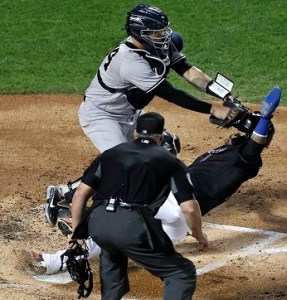
Sanchez’s bail-and-reach tag attempt on Jonathan Villar only started the Mets’ scoring Friday night.

Even if you hate everything Yankee because it’s everything Yankee, this is the kind of cruel symbolism to which the Empire Emeritus didn’t deserve to awaken on the twentieth anniversary of the 9/11 atrocities. Even the Yankees didn’t deserve to awaken on 9/11 having lost . . . 9/11, if you look at it one way.

If all you know of Friday night’s game against the crosstown Mets in Citi Field is the line score, it looks on the surface as though the Mets pasted the Yankees 10-3, even with three errors charged to the visitors.

But if you saw the game itself, you know the Mets did benefit from more than a little inadvertent Yankee generosity.

“Just a poor performance, period,” said Aaron Boone, the Yankee manager for whose head Yankee fans have called since, oh, the first Yankee loss of the season. That’s the painful reality of wearing the fabled Yankee pinstripes.

Of all the cliches around the Yankees and their fans, the truest is that they don’t like to lose. Of all the sub-cliches to that, the truest is, alas, “To err is human; to forgive must not become Yankee policy.” If one loss draws calls for heads to roll, nine losses in eleven games probably calls for public executions.

“It’s a bit of a broken record,” Boone said, speaking of the game itself even though he could have been speaking about Yankee fans and their expectations and demands. “We got to keep grinding at it. We got to keep working at it and we will, and trust that it will turn, but it’s obviously going to take everyone and, obviously, that starts with me and making sure we’re ready to roll.”

The Yankees seemed to get a roll going early Friday night, with Brett Gardner scoring on Aaron Judge’s ground out up the middle to second in the top of the first and Joey Gallo—the trade deadline import from Texas, who walks a ton, hits home runs a ton when he hits them, and does little else otherwise—hitting Mets starter Tylor Megill’s first one-out service into the right center field seats in the second.

In between, in the bottom of the first, the Mets offered up a leadoff single (Jonathan Villar), a one-out single up the pipe (Michael Conforto), and a two-out RBI single (Javier Baez, one of the Thumb Bunch) off Yankee starter Jordan Montgomery. The trouble on that hit was Gallo throwing home almost perfectly from left field but Yankee catcher Gary Sanchez bailing on the throw that had Villar a dead duck twenty feet from the plate.

It took a replay review to confirm it: plate umpire Ted Barrett’s initial out call was overturned. Inexplicably, Sanchez stood, bailed backward just enough, and reached up on the play, letting Villar get his foot on the plate before Sanchez got the tag on his helmet.

“He got in between Gary’s legs,” Montgomery said postgame. “It was unfortunate.” Alas, it’s par for the course for the hapless Sanchez this season. Only Baltimore’s Pedro Severino has been as bad behind the dish as Sanchez—each is worth -8 defensive runs saved, the worst mark in the American League.

Still, Gallo’s go-ahead bomb in the second gave the Yankees every right to think they’d hold the Mets off yet. They just didn’t bargain upon their own further misbehaviour starting in the bottom of the third.

Villar opened again with a base hit. Montgomery walked Thumb Buncher Francisco Lindor to set up first and second, then wild pitched that pair of Mets to third and second before walking Pete Alonso to send Villar home with the tying run. Then Baez whacked a feeble grounder up toward third. Uh, oh. Yankee third baseman Gio Urshela picked the ball slickly enough as he hit the ground sliding, but he threw it past Sanchez enabling Lindor to score.

Then Jeff McNeil, spotting the Yankee infield playing a little too deep, dropped a bunt past the mound on the second base side, catching every Yankee around the infield by surprise enough that Conforto came home unopposed. Kevin Pillar of the Thumb Bunch sent Gallo back to the track to haul down his sacrifice fly making the proceedings 5-2, Mets, and counting.

One busted double-steal bid later, McNeil taking second but Baez thrown out at third, Mets catcher James McCann, not exactly one of their more threatening hitters, sent a line double bouncing into the left field corner to score McNeil with the fifth Met run of the frame. Lucky for Montgomery that his next batter was a guaranteed out—even after opening Magill with two balls before striking him out swinging on three straight to follow.

And if the Yankees weren’t able to find bullpen relief for Montgomery just yet, the Mets thought nothing of making his night miserable even further in the fourth. With one out, Lindor going the other way kind of snuck a home run past the right field foul pole. Then the Yankees went to the pen, but an infield hit and a fly out later off Joely Rodriguez, Baez bounced an RBI double off the right center field fence. Making it 8-2, Mets.

The Yankees were mostly futile against Megill (ten strikeouts in seven innings) and the Mets’ defense from the second forward. But they weren’t finished being generous to the crosstown rivals. With the bases full of Mets in the seventh—after a one-out single (Baez) and back-to-back plunks (on McNeil and Pillar)—Yankee reliever Michael King fed McCann a ball that had inning-ending double play stamped on it.

Uh, oh, again. Yankee second baseman D.J. LeMahieu picked it and shoveled it perfectly to shortstop Gleyber Torres on the run. But Torres threw on about two stories above first baseman Anthony Rizzo’s glove, and home came the two plunk victims unmolested. By the time Rizzo whacked his own leadoff bomb in the top of the ninth, likewise sneaking it inside the foul pole, there were few real thoughts of any Yankee comeback.

Mets reliever Yennsy Diaz made sure those few thoughts disappeared swiftly enough from there with two swift air outs, before Sanchez tried to battle him from an 0-2 count: two balls, a foul, ball three, and then the game-ending fly out to deep right.

“It gives me all the confidence in the world,” Megill said post-game, “just to throw the ball over the plate in a way and attack hitters more confidently knowing I have, I guess, room for mistakes pitching. The offense killed it today. It’s awesome, they’ve been playing really well.” The Empire Emeritus went 0-for-5 with runners in scoring position and stranded four on the night, including Gardner after a two-out single in the third when the Yankees still had that 2-1 lead.

The Mets needed only Diaz and Heath Hembree before him out of the pen Friday night. They’ll need all pen hands on deck the rest of the weekend. Especially if the Yankees are only too conscious of losing 9/11 entering the twentieth anniversary of those atrocities.

Dear Joe and Jane New York Fan . . .

Jeff McNeil, Michael Conforto

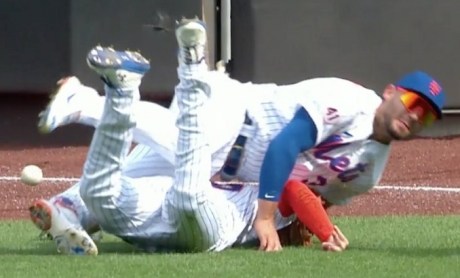
Jeff McNeil (bottom) and Michael Conforto crash attempting to catch a shallow outfield pop fly. The ball plus Mets first baseman Pete Alonso eluded injury on the play, which allowed two Marlins runs to score. The Mets’ 2021 season may be beyond repair. So may their fans.

This may or may not shock you gentle readers (all six of you, if that many), but I’ve never once booed at any professional baseball game—major, minor, or independent league. Not even over what seems to some an obvious lack of hustle . . . which may not be all that obvious, after all.

I don’t really know what’s inside the heads of any particular professional baseball player in any particular moment. For the boo-birds in any ballpark, never mind Citi Field, I have news for you: neither. do. you. Until or unless a player speaks about the moment in question, you don’t know any more than me.

Except that I’m reasonably enough aware that I’m not going to just haul off and boo the poor guy, or rip him ten new ones in these pages. If it seems that everyone else in the park is booing, I’m not going to join in that kind of fun.

I’m not in his position. I played ball when I was growing up but I wasn’t good enough to even think about trying out for the junior high or high school teams. By the time I got to the former, I couldn’t hit a fair ball unless the foul line ran straight across the rear point of home plate, and I couldn’t throw a strike unless the zone began on the batter’s derriere.

So my career was really over a year or so before I was bar mitzvahed. If you don’t count the day I got into a game in summer camp and ran the bases as though I had a process server on my tail (and a lead run to score, after stealing second and barreling around third on a base hit), from that point forward I engaged my love of the game purely as a fan. And, in due course, as a writer, too.

Watching as many baseball games as I can since, I know that I didn’t throw a pitch meant to miss a bat but launched into orbit.

I didn’t scamper over to pick off a hard grounder expecting that my throw to start a double play would escape the next infielder. I didn’t set myself up to take a throw at first base only to see the throw shoot past where I could snap the mitt around it. I didn’t dive into the hole reaching for a line drive I knew I could catch only to see the ball miss my glove by the fraction of a fraction.

I didn’t amble over reaching down for a ground ball that hit an unexpected rut, stone, clump of dirt, or other anomaly on the field and skip past me, either.

I didn’t see a delicious pitch coming my way at the plate—knowing in minus one second that I could rip it through any given infielder, drive any given outfielder to climbing the wall, or send it into the path of an oncoming airplane—then put the best swing I could put on that pitch and miss it by a hair’s breadth because, in that moment, that pitch was better than my swing.

Or, if you prefer, I didn’t connect with that delicious pitch, drive it to the farthest reach of the outfield, knowing up the first base line I had a shot at putting a number on the scoreboard, then seeing an outfielder take a flying leap and snatch it for an out the split second before it might have fallen behind the fence. Or, rip it like a cruise missile headed through the hole for the outfield only to see an infielder take a flying leap and snatch it as if he had a vacuum cleaner hose for an arm.

None of those things ever happened to me on a professional baseball field. Guess what, Joe and Jane Fan—they didn’t happen to you, either.

You sit there in the stands, expecting millionaires to play to perfection a game that by its very design remains the proverbial game of seventy percent failure. You forget, assuming you ever really knew, that a million-dollar salary conferred upon a professional baseball player isn’t going to turn Clark Kent into Superman.

It’s bad enough in places like Boston, Chicago, and Philadelphia, three cities that know occasional triumph and protracted despair, sometimes self-inflicted and sometimes the net result of outrageous malfortune. But New York? Listen up.

Joe and Jane New York Fan, you had reasons to take baseball success in the 20th or the 21st Centuries for granted, never mind that—in the 21st—the Red Sox have it over the Yankees. (The Olde Towne Team in Century 21: four World Series championships. The Empire Emeritus: count it—one.) But one of your native sons now pronounces, with no fear of contradiction that can stick or escape perjury charges, that you are spoiled rotten. To the Big Apple core.

Between the formerly imperial Yankees, the long-gone Dodgers and Giants, and the occasionally triumphant but otherwise tragicomic Mets, you have 68 pennants and 38 World Series championships since 1901. Now the bad news: only two of those pennants and one of those World Series championships have come in the 21st Century. A little humility might be in order.

But no. To err is human, to forgive is not New York policy. Don’t even think about it: I was alive to see you booing even the heroic among your baseball favourites. I’m old enough to remember how often you acted upon that malarkey that Mickey Mantle—Hall of Famer, ranked by Baseball Reference the number four center fielder, ever—should have been “better.”

I’m old enough to remember you booing (and maybe wanting to beat) the living snot out of Roger Maris for daring to challenge the Sacred Babe one fine season—aided and abetted by a brain-damaged baseball commissioner (who just so happened to have been a Ruth ghostwriter once upon a not-so-fine time) and a sportswriter who could be bought by obsequity if not dollars.

I’m old enough to remember you accepting and adoring the embryonic Mets on the ground that they were inept enough from birth to make baseball seem human again after all those decades of Yankee, Dodger, and Giant success. They had Who the Hell’s on first, What the Hell’s on second, You Didn’t Want to Know on third, and You Didn’t Even Want to Think About It at shortstop. With the Three Stooges in the outfield, the Four Marx Brothers on the bench, the Keystone Kops in the bullpen, and Buster Keaton pitching to Charlie Chaplin.

Then the Mets made a tragic mistake. They turned eight years old, the age at which children enter third or fourth grade. And at age eight, three months after Neil Armstrong stepped onto the moon, they won the pennant and the World Series. Oops. Pinocchio, you’re a real boy now.

“Now, it is all different,” wrote Leonard Shecter, then Jim Bouton’s Ball Four editor and writing in The New York Times, as those Mets approached the Promised Land, in an essay expanded subsequently into Once Upon the Polo Grounds.

Casey Stengel is gone. The players, who try no harder than the old Mets, succeed more often and as a result are indistinguishable from baseball players all over. There is stuffiness in the front office. There is great concern about unimportant things. [The manager not long ago suggested to a newspaperman that he need not have blabbed in the public prints that the Mets scored their winning run on a bunt.] And, worst of all, when the Mets lose, there is nothing funny about it at all.

I’m old enough to have watched Joe and Jane Yankee Fan turn tail when the machinations of a former regime—selling the team to a broadcast network that knew as much about baseball as the Beatles knew about quantum physics—left the Yankees aged, injured, parched, and chock full of journeymen for the better part of a lost decade.

But I’m also old enough to remember how right Shecter proved to be, sort of. Now, I sat often enough in Shea Stadium hearing fellow Joe and Jane Met Fan fuming, booing, hissing, and bellowing—unless the game was a 27-0 shutout and the pitchers retired 27 men straight on 27 pitched balls.

Joe and Jane Yankee Fan’s haughty imperialism was bad enough. Now Joe and Jane Met Fan, too, behaved as though a two-game losing streak was grounds for the firing squad? As though a harsh loss on an enemy game-winning hit was grounds to put the pitcher into the electric chair? As though nothing short of the pennant every year would do?

God opposes the proud but gives grace to the humble,” said the apostle Peter. Joe and Jane Met Fan, whose team had evoked that very precept at the end of its first nine seasons, replied, “Who is this fool, and which team traded him for a bag of broken bats?” Those occasional pennants and another World Series title since did little enough to remind Joe and Jane Met Fan of the proverb: “When pride comes, then comes disgrace.”

Don’t get me started about how often the post-Boss Yankees have fallen into slumps and Joe and Jane Yankee Fan suddenly felt nostalgic (What would George do?!?) for the owner who used to throw out the first manager of the season over such slumps—even in early April—and sicced a street-hustling low-life on his Hall of Fame outfielder’s trail.

(What would George do? He’d execute the coaching staff, the trainers, and the clubhouse staff, trade the entire roster for that of the Pittsburgh Pirates, and make the Taliban resemble Alphonse and Gaston. Then he’d really get mad.)

Now the Mets, who looked deceptively powerful enough, until the beginning of August, have found their injuries and inconsistencies catching up to them. Joe and Jane Met Fan have no further patience for excavating core causes than the barracuda bereft of his third square of the day. To the boo birds whose loyalty makes the fair-weather friend resemble the man or woman of all seasons, a few Mets had the answer.

They had it a lot sooner than it exploded into headlines, heavings, and harangues after Sunday. As retaliatory gestures go, emphatic thumbs-downs aren’t exactly the same as flipping the bird, fuming to reporters, or turning fire hoses onto the box seats. Only nobody really paid them much mind until a few of the culprits—Javier Baez, Francisco Lindor, Kevin Pillar—came right out and said it: You want to boo us when we come up short, we’ll “boo” you when we get back on the track.

They had only upended the longtime, lugubrious compact that says Joe and Jane Fan can abuse the professional athlete to his or her heart’s content and the athlete has no choice but to take every last piece of crap dished out. Whether it’s booing in the stands; or, brickbats, slanders, and, yes, even threats against the lives of themselves or their families aboard social media.

But I’ll say it again: Joe and Jane Fan would shiver, quake, or run home to Mommy and Daddy at the very thought that they might go to work tomorrow morning with 55,000 people waiting to see them perform their tasks and boo them upon the first mistake or mishap on the job. Not to mention about five million other people, maybe, watching on television or the Internet, or listening on the radio. Wait till those observers climb all over them and they even think about climbing back. Watch and listen to their bosses. (Who might have had, too, prepared denunciations in their pockets ready to deploy.)

Joe and Jane New York Fan make their historic counterparts in Boston (On my tombstone, it will say: “Cause of death: Boston Red Sox”—Cleveland Amory, critic), Chicago (Wait till next year!—a banner hoisted in Wrigley Field once . . . when the first pitch of the season was being thrown), and Philadelphia (Those people would boo at a funeral—Bo Belinsky, a 1965 Phillie) seem the epitome of empathetic reason.

Joe and Jane New York Fan forget that their sports city is Goliath. That there have been and remain everyone else aching to take their Yankees and Mets down, a hundred stories if need be. That now and then, though lately now more than then, a kid with a slingshot comes along and does just that. Either that, or their Yankees and Mets can be and often have been equivalent to the cobra finding its own mongoose.

To all other baseball fans in danger of becoming spoiled rotten likewise—this includes you, Joe and Jane Dodger fan (since 1901: twelve pennants, six World Series titles) and Joe and Jane Cardinal fan (since 1901: nineteen pennants, eleven World Series titles)—this native son of New York would say two things:

Thing One: Contrary to popular misconception, baseball players are not androids or automatons, and the down side to loving a game is the irrevocable law that somebody has to lose. (And stop treating baseball injuries as evidence of “fragility” or moral failures.)

Thing Two: Study Joe and Jane New York Fan, behave the complete opposite, and you will do well in reducing your likelihoods of ulcer, high blood pressure, stroke, or heart failure.

If you don’t, and you find your earnestly struggling heroes discovering more creative ways to prove you can dish it out but you can’t take it, either, you can’t say nobody warned you.

“Before a downfall the heart is haughty, but humility comes before honor,” says another proverb. Baseball players are reminded the hard way, daily. (This ain’t football—we do this every day.—Earl Weaver, Hall of Fame manager.) Joe and Jane New York Fan need to learn, and re-learn, the hard way, daily.