Bud Harrelson, RIP: Don’t back down

Bud Harrelson

Perhaps unfairly, Bud Harrelson is remembered less for solid shortstop play than for getting plowed into an NLCS brawl by Pete Rose.

God rest her soul, my paternal grandmother (herself a victim of Alzheimer’s) called her favourite Met “my little cream puff.” The reference was to Bud Harrelson’s not-so-tall or large dimensions, surely. Hall of Famer Yogi Berra, a longtime Mets coach and their manager for three and two-third seasons, merely called him Shorty.

The only Met in uniform for both their World Series triumphs (as their starting shortstop in 1969, as their third base coach in 1986) was anything but a cream puff on the field. “Buddy was 150 pounds soaking wet,” his Hall of Fame teammate and best friend Tom Seaver remembered three decades later, “but he wouldn’t back down from anyone.”

Not even from Pete Rose, who plowed him moments after Harrelson threw on to first to finish a 3-6-3 double play in Game Three of the 1973 National League Championship Series. Not even from umpire Augie Donatelli in the World Series to follow, Donatelli calling him out at home despite Oakland catcher Ray Fosse seeming to miss the tag and provoking a wild Met argument around the plate.

And not even from Alzheimer’s disease, with which Harrelson was diagnosed in 2016 and against which he fought a bold fight until his death at 79 Thursday morning. Some of the obituaries that followed lasted several paragraphs before mentioning the Rose play and the infamous bench-and-bullpen-clearing brawl that erupted. Some of them lasted only several syllables. It almost figured.

Rose entered Game Three of the set between the Mets and the Reds steaming over Harrelson’s post-mortem following Mets righthander Jon Matlack’s Game Two two-hit shutout. It wasn’t braggadoccio by any means. The .236-lifetime-hitting Harrelson’s grit was matched by his wit. He observed Matlack had “made the Reds look like me out there” at the plate, adding only that he thought, “It looked like they were swinging from their heels.”

That doesn’t seem normally to be an observation that would steam a team, not even a Big Red Machine. Indeed, as New York Post columnist Mike Vaccaro observes, most of the Reds weren’t interested when Rose tried to use Harrelson’s benign remarks as the equivalent of what we call today bulletin-board fodder.

The most “printable” of Rose’s post-mortem replies, in Vaccaro’s word, was, “What’s Harrelson, a [fornicating] batting coach?” Hall of Famer Joe Morgan even warned Harrelson during pre-Game Three practises that one more such remark would get him punched out, and Rose was going to get him at second if given the opportunity. Some of the Big Red Machine weren’t exactly renowned for a sense of humour about themselves.

So, come the Game Three top of the fifth, Morgan tapped one toward Mets first baseman John Milner, who threw to Harrelson to get Rose (a one-out single up the middle) by ten plus feet for one before Harrelson winged it back to Milner to get Morgan for the two. The next thing anyone knew, Rose had plowed and thrown an elbow at Harrelson and the pair were up and swinging.

“When he hit me after I had already thrown the ball I got mad,” Harrelson once remembered. “And we had a little match. He just kinda lifted me up and laid me down to sleep and it was all over.” It wasn’t all over that quickly, alas. To say all hell broke loose in Shea Stadium after Mets third baseman Wayne Garrett hustled over to try protecting Harrelson would be to call a prison riot a debate.

The less-than-willing Reds had little choice but to back their impetuous star. After order was restored at last, Rose took his position in left field and that portion of the Shea crowd let him have a shower of debris that included a glass bottle near his head. It got so out of hand that the Reds’ Hall of Fame manager Sparky Anderson pulled his team off the field. (“Pete Rose has done too much for baseball to die in left field,” the ever locquacious Anderson said postgame.)

A forfeit to the Reds was threatened. Under National League president Chub Feeney’s urging, Berra led Seaver plus Hall of Famer Willie Mays and outfielders Rusty Staub and Cleon Jones to plead for peace in the stands. Order was restored and the Mets finished what they started, a 9-2 Game Three win and a five-game triumph over the Reds for the pennant.

Rose didn’t hold a grudge for very long. Handed the Good Guy Award by the New York contingency of the Baseball Writers Association of America the following January—the long since disgraced and banished Rose was one of the game’s great notebook fillers during his playing days—Rose accepted it . . . from Harrelson himself.

“I want the world to know,” Harrelson cracked as he presented Rose the award, “that I hit him with my best punch. I hit him right in the fist with my eye.” In due course, Rose returned the favour, signing a photograph of the fight, “Thank you, Buddy, for making me famous.”

In some ways, Harrelson was responsible for the Mets making it to that postseason in the first place. He missed significant regular season time with an injury and the Mets slumped almost coincidentally. But when he returned to action the Mets—with or without a little firing up from relief pitcher Tug McGraw’s “You gotta believe!” holler, aimed sarcastically at first (at a pep talk by general manager M. Donald Grant)—ground their way from the basement to the National League East title that September.

“You had Seaver, who was the greatest pitcher I ever saw,” Rose told Vaccaro in 2008,  “and you had great hitters like Cleon Jones and Tommie Agee, and later Rusty [Staub] and Milner. But the heart and soul of that team—ask anyone who played against them—was Bud Harrelson.”

Harrelson’s weak bat was offset by his sure-handed play at shortstop; he averaged turning  57 double plays a season in his twelve prime seasons from 1967-1978, even missing significant time to injuries. He also retired being worth +34 defensive runs above his league average, retroactively leading the National League’s shortstops with a +17 1971.

He roomed with Seaver for the entire time they were Mets together, having first met in AAA-level ball in the Met system. “We were perfect roommates,” Harrelson remembered in his memoir, Turning Two. “Tom did all the reading and I did all the talking.”

After finishing his playing career with two seasons in Philadelphia (where Rose was a teammate) and one in Arlington, Harrelson returned to the Mets and soon became their third base coach. That was Harrelson giving Ray Knight a pat and running down the third base line with him as Knight scored, after Mookie Wilson’s grounder skipped through hapless Bill Buckner’s feet, to finish the Game Six comeback win that sent the Mets toward their 1986 World Series conquest.

Later, when Davey Johnson was finally cashiered as the Mets’ manager 42 games into the 1990 season, Harrelson took the bridge and helmed the Mets to a 71-49 record the rest of the way, good for a second-place NL East finish. The following season, enough of the 1980s Mets’ contending core players were gone and suspicions arose that Harrelson was just the dugout figurehead while bench coach Doc Edwards called the shots.

The Mets went 74-80 under Harrelson, toward a fifth-place NL East finish, before he executed before the season’s final week. There were those who thought Harrelson’s problem was trying to manage like a pal more than a leader. Harrelson himself said, candidly enough, “If the public wanted a manager with vast experience, I wasn’t it . . . If they wanted somebody who would grow with the organization, I think that was me.”

1969 Mets

Harrelson (far left) traveled with a few 1969 Mets teammates plus After the Miracle co-author Erik Sherman (center rear) for a final visit in California with Hall of Fame teammate Tom Seaver (front right). Joining them: pitcher Jerry Koosman (second from left), outfielder/After the Miracle author Art Shamsky (second from right, rear), and outfielder Ron Swoboda (far right rear). Seaver was stricken with Lewy Body dementia; Harrelson, with Alzheimer’s. (Photo posted to Xtwitter by Erik Sherman.)

In due course, Harrelson helped bring minor league baseball to Long Island as the co-owner, senior vice president, and first base coach of the Long Island Ducks. He even managed the Atlantic Leaguers to a first place tie in their maiden season. Then, come 2016, after a few incidents first attributed to aging’s mere memory lapses, Harrelson and his former wife, Kim Battaglia, got the fateful diagnosis.

Battaglia remained his close friend and primary caretaker. Harrelson was part of the contingent of 1969 Mets—organised by outfielder Art Shamsky, also including pitcher Jerry Koosman and outfielder Ron Swoboda—who trekked to California for a final visit with Lewy Body dementia-stricken Seaver at his vineyard a year later. The journey was recorded by Shamsky with Erik Sherman (who accompanied the group) in After the Miracle. (Seaver, alas, died in 2020.)

The former Mrs. Harrelson urged Shamsky to have voluminous photographs taken to help Harrelson remember the trip. Harrelson himself admitted to Sherman that he’d begun writing numerous notes to himself to help him fight the Alzheimer’s memory robbery. He also described co-owning and promoting the Ducks as “the best thing I’ve ever done in baseball,” indicating his displeasure that the now-former Wilpon ownership was not always kind to himself and too many other former Met stars.

Harrelson and his former wife even joined and became active with the Alzheimer’s Foundation after making his diagnosis public in 2018. “I want people to know you can live with this and that a lot of people have it,” he said. “It could be worse.”

When traveling with Koosman, Shamsky, Sherman, and Swoboda for that final Seaver visit, Harrelson had nothing but praise for his former wife (“She’s the best ex-wife I ever had”) who urged him on. “She’ll call me and go, ‘You know you have to go to the doctor. Our son T.J. can bring you’,” said the twice-divorced father of five. “Married, we just didn’t gel after awhile. But I still love her and give her hugs. Kim doesn’t have to do what she does, but I appreciate it.”

Perhaps not quite as deeply as she and his children appreciated Harrelson’s grace under fire as he fought the insidious disease that finally claimed him. The scrapper who didn’t let Pete Rose intimidate him became the elder who didn’t let a medical murderer intimidate him.

Now Harrelson can be serene and happy in the Elysian Fields with his old roomie pal Seaver, his old skippers Berra and Gil Hodges, and too many other 1969 and 1973 Mets who preceded him there. Maybe Grandma Gertie will elbow her way out there to shake his hand, and maybe Harrelson can give her a wink and a “Your little cream puff, huh?”

Billy Eppler and the invisible injured list

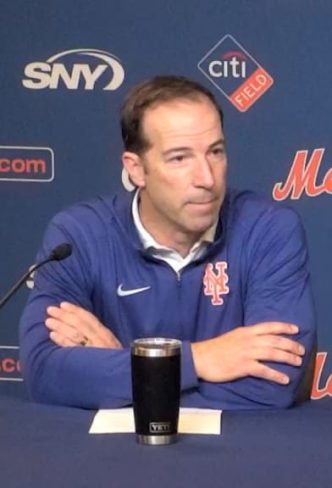
Billy Eppler

Billy Eppler leaves the Mets to hunt a new GM, while MLB investigates his use/misuse/abuse of the so-called phantom injured list.

Something is further amiss in the milieu of the Mets than just the sunken season that compelled manager Buck Showalter’s scapegoating. It may not be limited to the Mets alone, but with general manager Billy Eppler resigning—possibly before he, too, might have been shown the door—it’s the Mets drawing the headlines on it.

First, it came forth that Eppler all but strong-armed Showalter into continuing to write Daniel Vogelbach’s name into the lineup, against just about every piece of evidence saying Vogelbach didn’t truly belong there. Then, it came forth that Eppler was under baseball government investigation over what’s known as the phantom injured list.

Even with the medical advances of this century, it’s bad enough that (you guessed it) baseball medicine could still be tried by jury for malpractise. The phantom injured list—basically, placing underperforming players on it to keep them out of the lineup, while still paying them and granting their major league service time, though possibly denying them certain incentive-based chances—could be called another kind of malpractise.

That would be the kind that calls honest competition into further question that such things as tanking have it already. The kind that compels some baseball people—former Phillies manager Joe Girardi, notoriously enough—to admit they’re not always forthcoming about real injuries the better to keep valuable intelligence out of opposition sights. Never mind that teams can usually tell when the other guys have a likely wounded warrior.

The Mets had 28 real IL placements in 2023. This didn’t even make the Mets the Show’s worst such infirmary roll: the Giants, who dumped manager Gabe Kapler for being unable to maneuver a dubious roster built by president of baseball operations Farhan Zaidi, had 46 IL members. Right ahead of the Reds’ 45 and the Angels’ 42.

By contrast, the healthiest reported 2023 teams were the postseason-reaching Astros (14), the postseason-missing Guardians (17), the postseason-missing Mariners (18), and the postseason-reaching Diamondbacks (also 18).

Teams are supposed to provide medical documentation and approval when they place players on the injured list. The New York Post broke the news that, when MLB investigators informed the Mets that Eppler was being probed over the phantom IL, Eppler elected to resign rather than “potentially become a distraction” as new PBO David Stearns settles into his new job.

“Stashing healthy players on the IL can aid a team competitively,” the Post said, in an article under the joint bylines of Mike Puma, Joel Sherman, Jon Heyman, and Mark W. Sanchez. “Designating healthy players as injured can enable clubs to keep those players under team control rather than risk losing them to other organizations.”

A day before that story broke, Puma reported that Showalter and Eppler clashed over Vogelbach. Showalter likes to use the DH slot as breathers for his position players but also didn’t like Vogelbach’s skill set limits. None of which seemed to matter to Eppler, who continued insisting that the lefthand-swinging Vogelbach remain the DH against righthanded pitching.

It’s one thing to allow a less than perfect physical specimen a place in the lineup at all, but it’s something else to let him stay there if he can’t deliver. Physically, Vogelbach can be described politely as making Babe Ruth resemble Mike Schmidt. His most apparent skill set, his on-base ability, shown well after the Mets acquired him from the Pirates before 2022’s trade deadline, disappeared drastically enough amidst the 2023 Mets’ dissipation.

But Vogelbach lacked power and didn’t hit consistently enough with or without power to convince Showalter he belonged in the Mets’ lineup, no matter how gifted he is at working out walks. His bulk also made him less than mobile enough that playing him at first base or elsewhere could have been considered giving aid and comfort to the opposing lineup.

Fair disclosure: At 6’4″, I once packed 325 pounds. I’ve since lost in the neighbourhood of fifty pounds, striking to return my weight to 225. I empathise with Vogelbach in that regard. But I haven’t played baseball since age 15, when I discovered the hard way I wasn’t any kind of good at it anymore.* And I’m not the guy a GM forced a manager to put in the lineup.

At points in the season’s first half, where the Mets’ more formidable plate presences struggled, Vogelbach’s presence in the lineup looked even more suspicious. There were thoughts public and private that the Mets might move Vogelbach at the 2023 trade deadline, but Puma says when the move didn’t happen Showalter began “questioning openly” why Vogelbach was still a Met.

“Not only was Vogelbach still on the team,” Puma wrote, “but (a) source indicated the manager was told by Eppler to keep him in the starting lineup.” For what purpose? For Eppler to save face over dealing for Vogelbach in the first place?

Marry that to MLB investigating Eppler’s use, misuse, or abuse of the phantom IL, and maybe, just maybe, you have a prospective case of Eppler resigning before Stearns—who’d first said he looked forward to working with him—might be forced to throw him out on his none-too-ample derriere.

Just what the Mets didn’t need now. They hired Eppler in the first place after interim GM Zack Scott was charged with DUI. Scott replaced Jared Porter, after Porter was exposed as having sent sexually explicit text messages to a female reporter. The Mets have to be hoping Eppler’s eventual successor comes at minimum and remains scandal free.

That may prove child’s play compared to the issue that finally compelled Eppler to show himself the door out. It will not do, either, for anyone to confine their curiosity about phantom IL use and abuse to trying to determine who blew the whistle on Eppler. Maybe it’s time to look at all teams and the phantom IL, not the Mets alone.

Maybe it’s long past time that baseball’s entire medical culture was given a full and proper investigation. For the sake of player health, and for the sake of honest competition. And in that order.

—————————————————————————————————-

* At 15, I discovered I couldn’t hit fair unless the foul line ran perpendicular to the back point of home plate. I’ve had long enough legs but you need more than that to run. Even if I could hit one fair, it would have taken me longer than Bartolo Colon to run the bases if I hit one out. Without hitting one out, I could have been the guy who’d get thrown out at first from the bullpen.

A Stork hopes for delivery of pension redress

George Theodore

Just keeping this issue in the forefront is the best thing . . . Eventually, somebody who really has the power may say hey, I didn’t realise this was happening, let’s do something about it . . . Hopefully something can happen.”—George (The Stork) Theodore, a 1973 pennant-winning Met, shown here in 2016. (University of Utah photo.)

His major league playing career lasted 105 games, thanks largely to a 1973 outfield collision that resulted in a serious hip injury. But George (The Stork) Theodore remains a favourite among longtime Met fans and the organisation itself, invited to both the farewell of Shea Stadium and the opening of Citi Field, and invited to commemorations of the 1973 Mets’ pennant winner.

That was then: The 6’4″ Theodore endeared himself to fans with hustle when he got playing time, plus signing autographs amiably and talking to the sporting press with far more than mere boilerplate.

This is now: The Stork is a retired elementary school counselor, with a bachelor’s degree in psychology and master’s degree in social work, who’s been honoured for that work more than once, including an Educator of the Year award from the South Salt Lake Chamber of Commerce plus an Excel Teacher of the Year award.

“I was going to do that a few years. I was actually trained in medical social work,” said the 76-year-old former outfielder/first baseman, by phone from his Utah home, this week. “Then I found out that it was really my calling, and I enjoyed it, working with the young children in elementary school, and ended up with a career of 38 years there in the public schools.” About his awards as an educator, “I was honored at that, and humbled, because I didn’t feel I was any better than a lot of my compatriots.”

Drafted by the Mets in 1969, Theodore was a member of the ’73 pennant winner who had two World Series plate appearances, which he still calls “not bad” for a man who says he was on the Mets’ postseason roster mostly as a designated team cheerleader. But the Stork wishes only that the game he loved would favour himself and over five hundred more remaining players with short major league careers who played prior to 1980—and continue going without major league pensions.

He’s been interviewed often in the years since his playing career ended, but the pension issue isn’t always raised at those times. “It’s in a minor way,” he said of that subject, “but the interviews are basically about the ’73 team, though we try to sneak in something about the pension issue there.”

The issue, of course, is that when baseball’s owners and the Major League Baseball Players Association re-aligned the game’s player pension plan in 1980, they changed the vesting times to 43 days’ major league service time to qualify for full pensions and a single day’s service time to qualify for health benefits—but excluded such players as Theodore whose pre-1980 careers fell short of the former four-year vesting requirement.

Ask whether he could isolate whom among that year’s player representatives voted to exclude himself and his fellows—from each team’s player rep to then-league reps Steve Rogers (Expos pitcher, for the National League) and the late Sal Bando (Brewers third baseman, for the American League)—and Theodore isn’t entirely sure.

“I know they were kind of in a hurry to get [pension realignment] done to avoid a strike,” he said. “And I know that [original Players Association executive director] Marvin Miller—who was really the backbone of our union, getting all the wonderful things—was really disappointed that, as he looked back, that he didn’t pull in those people before and include them in that 1980 bargaining.”

The sole redress Theodore and the others have received since has been a stipend negotiated by the late Players Association executive director Michael Weiner with then-commissioner Bud Selig—$625 per 43-day service period, up to $10,000 a year before taxes. That amount was hiked fifteen percent as part of the 2021-22 owners’ lockout settlement. But the recipients still can’t pass those monies on to their families upon their deaths.

Had Weiner not died of brain cancer in 2013, would he have been able to go forward from the 2011 stipend deal to get something more? “That’s a good question,” Theodore  answered. “The whole system is not one of legality, but one of ethics. Baseball didn’t turn out to be what it is now just on it’s own. It’s been a slow, steady, building block process. And every player who played was a part of that.”

The Players Association formed originally to address pension issues in 1954. Its annual revenues now are believed to be $56.8 million. MLB’s annual revenues reached a reported $10.5 billion in 2022. Both the owners and the players kick into the players’ pension fund.

If those numbers are accurate, they add up to $10,556,800,000 per year. The union and the owners could agree to grant the remaining 500+ frozen-out, pre-1980 short-career players full pension status—based on their 43-day major league service periods—without going broke by a far longer shot than anything Shohei Ohtani can hit over the fence.

“I was just happy to be playing baseball and excited to get any opportunities,” Theodore said of his career. “I was one of the last people drafted.” [In 1969, round 31; one of the very few drafted out of the University of Utah.] “And so I knew my career was always in jeopardy. I knew many of my friends who signed at the same time, they’d have a bad week or two and they were gone.”

Because of that, he said, he wasn’t involved directly in Players Association actions, and credits A Bitter Cup of Coffee author Douglas Gladstone for helping to make him and numerous others of his short-term peers aware of the pension shortcoming.

Several pre-1980 short-termers have said they believe they were frozen out of the realignment because they were seen mostly as September callups. But most of the surviving 500+ either made teams out of spring training at least once or saw major league action in months prior to any September. Theodore himself made the Mets out of spring training in 1973.

The Stork was considered a strong defender with a good throwing arm and league-average range. “I was a fast runner, too,” he said. But the lack of game action didn’t bode well for his improvement as a major league hitter despite having recording solid batting marks in the minors. He had a splendid .817 OPS to show for his minor league seasons and posted a .972 OPS between A level and AA ball in 1971.

“I needed to play in order to be like that,” Theodore said. “Like many young players, playing once or twice a week, you don’t get your reflexes that you need.”

Deployed mostly as a left fielder in the majors, Theodore swears his better position was first base, where he played in eighteen major league games including twelve starts. “But we had John Milner there,” he said, “and Ed Kranepool, too. First base was really where I think I was the most effective because of my size and range. I could prevent bad throws just by stretching out.”

Still, Theodore became a fan favourite. “I always appreciated that,” he said. “I just know that I tried to give my best any time I played. Whether it would end up that way or not. And I responded to the fans, too. I enjoyed meeting fans and giving autographs. It was all new to me and I enjoyed every minute of it.”

His nickname didn’t hurt, either. Minor league teammate Jim Gosger—once with the Red Sox; an original Seattle Pilot;, and, very briefly, a 1969 Met when he completed an earlier trade (he didn’t make their postseason roster), before moving to two more teams and returning for brief spells with the ’73-’74 Mets—hung it on him. Theodore denies the longtime story that Gosger came up with the nickname when seeing the tall man holding a teammate’s baby.

“But he did call me the Stork, somehow” he said, chuckling. “I’m not sure why he decided on that nickname, but it stuck, and it endeared me to a lot of people.”

George Theodore

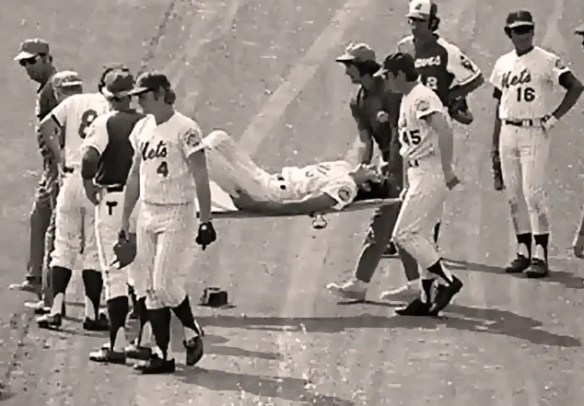
Theodore was carried off the field on a stretcher after a hip-dislocating collision with center fielder Don Hahn on 7 July 1973. Surrounding are (left to right) manager Yogi Berra (8), right fielder Rusty Staub (4), relief pitcher Tug McGraw (45), and second baseman Felix Millan (16). Braves center fielder Dusty Baker (12) looked on in concern.

But whatever further progress the Stork might have made ran into a thunderous obstruction on 7 July 1973. Atlanta’s Ralph Garr whacked a seventh-inning drive toward which Theodore and his close friend, Mets center fielder Don Hahn, converged in left center . . . and collided violently. Theodore suffered a dislocated hip while Garr ran out what proved an inside-the-park two-run homer, and missed most of the rest of the season.

Call it a classic Mets example of no good deed going unpunished. An inning earlier, Theodore led off with a walk, took second on a sacrifice bunt, and scored the game-tying run when Hahn doubled deep to left. The collision and Garr’s inside-the-parker in the seventh put the Braves up 5-3 (they’d scored on an RBI single just before Garr batted); the Braves eventually won, 9-8, in a game that changed leads twice more before it finished.

Theodore said he might have matured into a solid major leaguer had it not been for that injury, but he remains grateful that the Mets put him on their 1973 postseason roster. The ’73 Mets were an injury-riddled team until key regulars returned for the September drive that ended—under relief pitcher Tug McGraw’s rallying cry “You gotta believe!”—with them winning the National League East and then the National League Championship Series from the Reds.

George Theodore

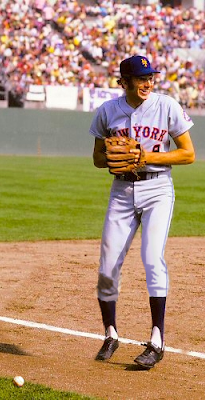
The Stork, tall and happy as a Met.

In the World Series, which the Athletics won in seven games, Theodore pinch-hit for Mets pitcher Ray Sadecki in Game Two in Oakland and grounded out to shortstop. In Game Four in New York, with the Mets up 6-1 (it proved the final score), Theodore was sent out to play left field in Cleon Jones’s stead for the top of the eighth, but he popped out to third base to end the bottom of the inning. Those were his only appearances that postseason.

“They didn’t have to do that,” he said of being on the postseason roster. “I hadn’t played for three months and I was more or less a cheerleader and emotional support for the team, until the World Series. Then all of a sudden I’m called to pinch hit and went into the outfield in another game.

“It’s funny how fate works,” the Stork continued. “Not playing for that long, and I felt very comfortable there. And then I went in for Cleon Jones, who was sick most of the game and throwing up out in left field, and it’s 35 degrees, I think. And [A’s third baseman] Sal Bando, hits a line drive out to left center field, and somehow I reacted and went and snagged that ball. It’s just kind of a surreal, you wonder, just who’s helping you make these moves.”

His days as a major league Met ended in 1974 (he’d retire after a 1975 at their Tidewater AAA farm), but that year handed him another kind of gift: he met a Met fan from Queens named Sabrina, who eventually became his wife and a Salt Lake City elementary school teacher.

Theodore cherishes his memories with the Mets, especially having as a teammate Hall of Famer Willie Mays in his final major league season until nagging injuries and age finally wore him down for good. And he cherishes likewise that Met fans still remember and appreciate him. But like his fellow pre-1980, short-career players, the Stork wishes only that some way, somehow, baseball will redress their pension shortfall more fully.

“We’re now in our 70s and 80s and maybe 90s, some players,” he said. “Just keeping this issue in the forefront is the best thing . . . Eventually, somebody who really has the power may say hey, I didn’t realise this was happening, let’s do something about it . . . Hopefully something can happen. If nothing more, the [Weiner-Selig] annuities can be increased. It’s amazing that we got the annuity in many ways.”

It would be more amazing if baseball awakened wide enough to understand Theodore and his fellow pre-1980, short-career players were frozen out of proper pensions wrongly in that 1980 re-alignment. At least as amazing as Theodore’s 1973 Mets turned out to be.

Pity poor Framber Valdez . . .

Framber Valdez

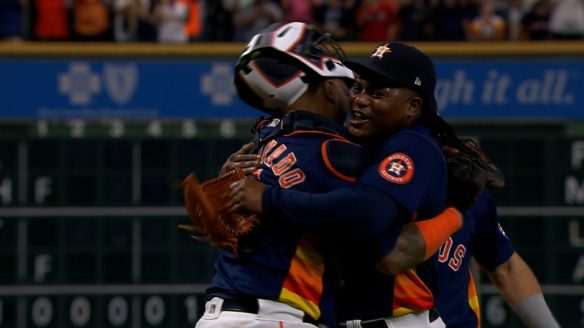
Framber Valdez gets a bear hug from his catcher Martin Maldonado after throwing a no-hitter at the Guardians Tuesday night.

What does it say that, on the day the Astros re-acquired the last man to throw a no-hitter in their silks, their struggling All-Star pitcher shakes off whatever it was prompting him to surrender fifteen earned runs over his past fifteen innings’ work to throw a no-hitter? The Astros may not be the only ones who’d like the answer.

But there it was. One minute, the Astros pulled the proverbial trigger on bringing future Hall of Famer Justin Verlander back. The next, after the trade deadline passed at 6 p.m. Eastern time Tuesday, Framber Valdez kept the Guardians hitless—with more than a little help from his friends—in a 2-0 win both of which Astro runs scored in the bottom of the third.

Verlander came home from the Mets in exchange for a pair of good-looking outfield prospects out of a farm system that was considered more than a little parched by any objective standard. Following their trade of fellow future Hall of Famer (and former Detroit rotation mate) Max Scherzer for a delicious Rangers prospect, the Mets actually looked smart in their unexpected circumstances.

“They did what they had to do, and I’m sure it wasn’t an easy call,” writes Smart Baseball author/Athletic analyst Keith Law, “but the Mets traded away six players from their big-league roster, including three pitchers all age 38 and up who either were heading for free agency or just unlikely to be that much help to the team in 2024 . . . ”

Dealing Justin Verlander and Max Scherzer—while paying enough of their salaries to return three solid prospects in Luisangel Acuña (No. 58 on my midseason top 60), Drew Gilbert (a first-round pick last year), and Ryan Clifford—are the kinds of moves more teams that have spent big only to fall short of contention should be making. And let’s give the Mets some credit for spreading the wealth around by sending one of those starters to Texas and the other to Houston.

I won’t pretend that that’s going to placate today’s generation of Met fans. You know. The generation that pronounces a season lost over one bad inning in early April. But Law is absolutely right. Especially with the coming off-season and, not merely to buy time, the pack of pitching free agents coming to within their glandular budget.

Particularly, a certain unicorn to whom the Angels held on for an (admittedly) outside postseason shot before he enters the market. The unicorn who’s both one of the best pitchers in the American League and a bona fide threat to Aaron Judge’s barely-year-old AL single-season home run record.

The Astros needed Verlander back more than anyone would have predicted when the season began. They’d just won a World Series and looked as though saying goodbye to a (controversial enough) era when they let the freshly-crowned Cy Young Award winner—the only baseball senior citizen ever to land one in his first year back from late-career Tommy John survery—walk into free agency.

But then they lost Lance McCullers, Jr., Luis Garcia, and José Urquidy to the injured list. Then, the Mets’s season went from World Series expectations to the landfill. Even as Verlander shook off early struggles and injury to round back into something resembling his old self (he has a 1.49 ERA over his last seven starts), it wasn’t enough to save this year’s Mets.

So the Mets elected to look 2023 reality in the eye and say time to start repairs. They dealt Scherzer to the Rangers after he delivered seven solid against his old team, the Nationals, en route the Mets taking three of four from the equally moribund Nats. When Scherzer asked the front office what the plan was, and learned it was moving on from deals expiring this year or next, he waived his no-trade clause and let the Mets move him onward.

The Astros are nipping at the Rangers in the AL West. The two teams square off themselves in a three-game set in early September. Tell me you won’t think it must-see television to see JV versus Max the Knife at least once in that set. Even if they’re not exactly young men anymore, they may yet have enough left in their tanks to have the eyes of all baseball upon them, especially with the AL West still at stake there.

It’s kind of a shame that Valdez picked Tuesday to pitch his jewel. Verlander back to Houston; St. Louis’s Jack Flaherty getting a fresh start in AL East-leading Baltimore (where he might get fixed enough to command a nice free agency pay day this coming winter);  the Cardinals otherwise reviving their own testy farm system without surrendering Nolan Arenado or Paul Goldschmidt.

Those were just too big to leave room. As were the Yankees even in inertia. They made no move other than landing middle relief pitcher Kenyan Middletown because they couldn’t realistically do a blessed thing. What they could move was either inconsistent or overpriced; what they could or might have brought in wouldn’t have been enough, even with Gerrit Cole at the head of the AL’s ERA pack and Judge back from his toe fracture.

You think today’s Met fan has the patience of a Nile crocodile? Don’t get me started on Yankee fans. From generation to generation, their credo is that a season lacking a postseason is illegitimate. For the generations since their last World Series win, the merest shortfall is enough to cause them to demand, “What would George do?”

The answer to that question is not what Yankee fan wants to hear anymore. They’d really rather have the late Boss’s tyranny and mutation back than what they have now. Never mind how it turned the 1980s Yankees into a basket case. Peace and quiet isn’t an option if the Yankees aren’t at the top of the AL East. Doesn’t it sound perverse to say a team with a winning record at this writing is also a basket case?

But there Valdez was, on the Minute Maid Park mound, striking seven out, letting his defenders take care of about 81 percent of the outs he needed otherwise, while Kyle Tucker took care of the game’s scoring with a two-run single in the bottom of the third.

Valdez stood at the top of the pitching heap Tuesday, and the trade deadline with all its attendant sidebars left him a hero without decoration. Even if Verlander’s first move on his arrival back with the Astros might be to congratulate him and welcome him to a unique club.

Sixteen no-hitters (four of which were combined, one of which was thrown by Hall of Famer Nolan Ryan) have been thrown by Colt .45s/Astros pitchers since their 1962 birth. From Don Nottebart (vs. the Phillies, 1963) through Valdez. That’s the most of any expansion franchise so far.

Valdez has a unique set of bragging rights while he’s at it. It took 61 years for an Astro  lefthander to do it. He can also say he’s the only man in baseball history, so far as anyone knows, to throw a no-hitter on deadline day, after the deadline hour passed but while the analysis and debates over the deals went hollering apace. The poor guy.

Season lost, Scherzer gone

Max Scherzer

Scherzer waived his no-trade clause to go from the deflating Mets to the AL West-leading Rangers.

The contemporary Mets fan, to whom a season is usually lost over one terrible inning in early to mid-April, sees Max Scherzer speaking without boilerplate about talking to the front office regarding, stop, hey, what’s that plan, after the Mets traded solid relief pitcher David Robertson to the Marlins for a prime-looking prospect. And, is barely amused.

Then, they see the three-time Cy Young Award-winning future Hall of Famer traded within a day or so to the American League West-leading Rangers, for a more prime-looking prospect. They are somewhere between dryly amused and snarkily contemptuous. Not to mention terribly inattentive or misinformed.

Nobody questions that age has begun to catch up to the righthander. Assorted small injuries plus lingering issues with his back and his side did a little too much to keep him from resembling his vintage self. One moment, Scherzer did a plausible impression of what he once was. The next, he did a plausible impression of a piñata.

There are some who see this year’s 9-4 won-lost record and say, so there! There are others who see this year’s 4.01 ERA and 4.73 fielding-independent pitching rate (FIP) and see a man whose youth and prime may not be visible in the rear view mirror anymore.

When the Mets traded Robertson a few days ago, Scherzer didn’t hold back. He was neither nasty nor snarky about saying it was time for him to talk to the Mets’ front office about the rest of the season and just who projected what. But, first, he was honest enough to begin with a sober assessment of the Mets’ deflating season thus far.

“[O]bviously, we put ourselves in this position,” he said. “We haven’t played well enough as a team. I’ve had a hand in that for why we’re in the position that we’re at. Can’t get mad at anybody but yourself, but it stinks.”

Then he went forward: “You have to talk to the brass. You have to understand what they see, what they’re going to do. That’s the best I can tell you. I told you I wasn’t going to comment on this until [owner] Steve [Cohen] was going to sell. We traded Robertson. Now we need to have a conversation.”

That was after Scherzer looked a little like the old Max the Knife against his old team, the Nationals: striking seven out in seven innings, scattering six hits one of which was a solo home run, and the Mets rewarding him with a 5-1 win, not to mention their seventh win in eleven games. But still.

Some Met fans think the front office elected to punt on third down, metaphorically speaking. Others think that, when Scherzer said they “needed to have a conversation,” it might have meant a conversation about Texas being the next destination for Scherzer himself.

If that involved Scherzer agreeing to go from the sinking Mets to a division-leading troop of Rangers in return for a prize prospect who turns out to be Ronald Acuña, Jr.’s promising brother, it probably took less than we think (even allowing the time) for Scherzer to say yes to one more active, not passive pennant race.

Scherzer had to waive his no-trade clause and exercise his contract’s 2024 opt-in to make the deal. Luisangel Acuña is a middle infielder and center fielder with a live bat (if not always as powerful as big brother’s) who can hit pitching from both sides readily, and wheels to burn on the bases. (42 stolen bases in 82 games; an .894 stolen base percentage.) Most known analyses of him say his challenge is to harness his aggressiveness.

The prime issue for Scherzer at 38 is staying healthy and avoiding home runs. His 1.9 home runs per nine this season are a career high. Yet, his tenure as a Met overall hasn’t exactly been a wash. His Met totals include a 3.02 ERA, a 3.52 FIP, and a 1.02 walks/hits per inning pitched rate. And, a 10.05 strikeouts-per nine rate with a 5.54 strikeout-to-walk ratio.

But they also include his having run out of fuel in Game One of last year’s National League wild card series, battered for four home runs that accounted for all the Padres scoring in a 7-1 loss.

“If [Scherzer] can limit the long ball and stay healthy,” observes The Athletic‘s Brittany Ghiroli, “he should help the Rangers fend off the Astro in the AL West and avoid the wild-card round. What’s more, his competitive personality and postseason experience could rub off on his new teammates.”

He’ll join a Rangers rotation that took a hit when former Met superpitcher Jacob deGrom went down to Tommy John surgery, but resuscitated itself via Nathan Eovaldi and Dane Dunning. He’ll be backed by a bullpen anchored by Will Smith. And a roster hitting .274. So far.

Mets players said goodbye to Scherzer Saturday night, during a rain delay before a game against the Nats that ended in an 11-6 Nats win. Surely they also started wondering what else and who else after Max the Knife could be talked into waiving his no-trade clause. They might have cast eyes first upon Justin Verlander, who’s showing his age as well, but who shook an early injury to look a little better than his old Detroit rotation mate this year.

“It’s not a certainty that Verlander will be traded,” say Athletic writers Will Sammon and Tim Britton, “but the Scherzer deal offered a blueprint of what to expect should the Mets decide to unload their other top starter. Verlander has performed better than Scherzer and, in theory, should net a better prospect.

“However, Verlander also has a no-trade clause in addition to being under contract for 2024 with a vesting option for 2025. It’s also unknown whether the Scherzer trade made Verlander feel any different about playing for the Mets.” Not to mention whether reported serious interest from the Dodgers, the Rangers, and Verlander’s old team in Houston might compel him to revisit his feelings.

The Mets barely said goodbye to Scherzer when Sports Illustrated reported they were in, quote, deep talks with the Astros about bringing back the future Hall of Famer who won an unlikely Cy Young Award in their silks last year but signed with the Mets as an offseason free agent. Unlikely because Verlander’s the oldest pitcher to win the prize after returning from late-career Tommy John surgery.

As with Scherzer, the Mets will likely demand a choice prospect or two (or even three) while the Astros will likely insist the Mets help them pay for Verlander’s return, including his 2025 vesting option. As the Rangers did with Max the Knife, the Astros may not be averse to helping the Mets continue their farm replenishment and remake for the privilege of one more term with JV.

There’s just one problem with that idea, from the Houston side, encunciated by Three Inning Fan podcaster Kelly Franco Throop: “[T]hey have nothing to give: they are considered to have one of the worst farm systems in the game.”

So much for providing a delicious pickle in the AL West, the two who once headed the Tigers’ rotation together going against each other to help decide that division. As of this morning, the Astros were only a game behind the Rangers in the division and in a dead heat with the Blue Jays for AL wild card number one.

The Mets may have pushed the plunger on a 2023 that was getting away from them through too much fault of their own, but all is not necessarily lost. There’s 2024 toward which to gaze.

There’s also a very outside chance that losing their best reliever and one of their better starters sticks the ginger into their tails. They’re “only” seven back in the National League wild card race. But a Met fan since the day they were born says, “Anything can happen (and often enough does).” Today’s patience-of-a-Nile-crocodile Met fan says, “This year’s been next year since the end of spring training.”

Playing the trade deadline period for prime prospects is a win-win, too. Either they become better than useful Mets soon enough, or they provide fodder for a bigger/better deal or three down the road.

Even if all they’ve sacrificed yet is Max the Knife and their best relief pitcher, the Mets are still in position to bring a certain front line starting pitcher into the ranks for a longer period and potentially better results. The unicorn who now wears Angels silks, threatens Aaron Judge’s AL single-season home run record while he’s at it, and becomes a free agent after this season.

On this much the lifelong Met fan and the contemporary Met fan can agree: The Mets are many things. Dull isn’t one of them.