2023 HOF BBWAA ballot: Two problematic newcomers . . .

Carlos Beltrán

Beltrán got to retire a World Series winner, returning to the Astros for 2017 . . . but he turned out a co-mastermind of Astrogate. Will that damage his Hall of Fame chances?

This is the dilemna: The one genuine, should-be Hall of Fame lock among the newcomers on the Baseball Writers Association of America’s 2023 ballot is also the first major figure from the Astrogate cheating scandal to arrive upon a such a ballot.

With Barry Bonds (actual or alleged performance-enhancing substances), Roger Clemens (see Bonds), and Curt Schilling (vile public commentaries since his retirement, despite his overwhelming Hall case) out of their BBWAA eligibility and now in the hands of the Contemporary Era Committee, it didn’t mean controversy left the BBWAA voters with those three. This new candidate by himself makes up for the loss, unfortunately.

There’s another new candidate among many on the ballot. This one might have had a Hall of Fame career if not for a series of injuries on the field that made him a very unfair pariah. His name is Jacoby Ellsbury. We’ll discuss him in due course, after first addressing . . .

The Newcomers: Carlos Beltrán

Before the exposure of the Astro Intelligence Agency’s illegal, off-field-based, electronic sign-stealing operation of 2017-18, Carlos Beltrán figured to have ended his playing career (as the Astros’ 2017 designated hitter) looking forward to accepting a plaque in Cooperstown. That and managing in the major leagues.

The number-nine center fielder of all time (according to Baseball-Reference via Jay Jaffe) who’d been respected as a student of the game and managerial material in the making found himself having to yield the bridge of the Mets (for whom he’d once starred as a player)—before he had the chance even to manage a spring training exhibition.

Though Commissioner Rob Manfred handed all 2017-18 Astro players immunity from discipline in return for spilling AIA deets, Beltrán was the only player Manfred singled out by name in his Astrogate report. It was Beltrán who suggested the Astros needed to “upgrade” from mere replay room reconnaissance, prompting then-bench coach Alex Cora to arrange the long-infamous real-time camera feed to an extra clubhouse monitor for sign deciphering and the long-infamous trash can transmissions.

That was despite Manfred’s September 2017 warning against using replay room reconnaissance and other such off-field chicanery, after the Red Sox (eventually using their own Rogue Sox Replay Room Reconnaissance in 2018 regardless) and the Yankees were caught trying a few tricks from the dugouts.

Beltrán landed the Mets’ managing job twelve days before Ken Rosenthal and Evan Drellich (in The Athletic) dropped the first full Astrogate revelation in November 2019. Within 72 hours of Manfred’s January 2020 report, all three incumbent managers named in the Rosenthal-Drellich exposure—Beltrán, Cora (who managed the 2018 Red Sox to a World Series championship), and the Astros’ A.J. Hinch (who acted feebly at best when catching onto his AIA cheaters)—were out.

Hinch was fired by Astros owner Jim Crane in hand with general manager Jeff Luhnow, but after sitting out his Manfred-imposed season’s suspension and some very contrite interviews, he found new life on the Tigers’ bridge. Cora sat out his Manfred-imposed season’s suspension, gave a few interviews in which he expressed genuine remorse for his Astrogate role, and was brought back to manage the Red Sox.

Beltrán said little about his Astrogate culpability until he returned to baseball as an analyst for the Yankees’ YES cable television network in April. There, he owned up in an interview with YES colleague Michael Kay:

Looking back now—yes, we did cross the line. I made my statement about what happened in 2017, and I apologized . . . This happened in such an organic way for ourselves. We all did what we did. Looking back today, we were wrong. I wish I would have asked more questions about what we were doing, I wish the organization would have said to us, “What you guys are doing, we need to stop this.” Nobody really said anything—we’re winning.

Obviously, Beltrán either didn’t know or chose not to know that “the organisation” as headed by Luhnow was in it up to its kishkes, having deployed the Codebreaker sign-stealing algorithim despite its creator’s warning that it was legal to use only before or after games but not during.

Had Astrogate never happened, Beltrán would have been a very likely first-ballot Hall of Famer. He played twenty seasons, and his peak with the Royals, the Astros (the first time, helping them reach a postseason with his second-half term there), the Mets (helping them to the 2006 postseason), and the Cardinals (two postseasons) was All-Star caliber or better. (He was actually a nine-time All-Star.)

He earned 67.6 wins above replacement-level (WAR) from his first full Kansas City season through the second of two with the Cardinals. That was despite missing significant time due to injuries in his final Met seasons. And his value wasn’t strictly in his bat, though my Real Batting Average metric (total bases + walks + intentional walks + sacrifice flies + hit by pitches, divided by total plate appearances) shows him not far off the middle of the Hall of Fame center field pack that played in the post-World War II/post-integration/night-ball era:

HOF CF PA TB BB IBB SF HBP RBA
Mickey Mantle 9907 4511 1733 148 47 13 .651
Willie Mays 12496 6066 1464 214 91 44 .631
Ken Griffey, Jr. 11304 5271 1312 246 102 81 .620
Duke Snider 8237 3865 971 154 54* 21 .615
Larry Doby 6299 2621 871 60 39* 38 .576
Carlos Beltrán 11031 4751 1084 104 110 51 .553
Andre Dawson 10769 4787 589 143 118 111 .534
Kirby Puckett 7831 3453 450 85 58 56 .524
Richie Ashburn 9736 3196 1198 40 30* 43 .463
HOF AVG .574

Now, however, marry it to Beltrán’s defensive prowess. He’s the number seven center fielder all-time for run prevention above his league average with +104. He was rangy, smart on the fielding lanes, and was a top of the line reader of batted balls from his position before Father Time finally began to exact a penalty.

Until Astrogate, of course, Beltrán had only one genuine black mark against him, especially so far as Met fans were concerned: frozen solid by an Adam Wainwright curve ball for strike three called—with the bases loaded, the Mets down two runs, and the pennant on the line in the bottom of the ninth, in Game Seven of the 2006 National League Championship Series.

You know something? It happens. Even to Hall of Famers. Beltrán wasn’t the first superstar to get himself tied up at the last minute of that critical a postseason set, and he won’t be the last. That’s not enough to damage a man’s Hall case. No eleventh-hour shortfall should have been. Not even for Babe Ruth.

You want to continue condeming Beltrán for that? How about The Big Fella getting himself caught stealing on a likely busted run-and-hit play to end the 1926 World Series in the Cardinals’ favour—with Bob Meusel at the plate and Hall of Famer Lou Gehrig on deck?

How about Willie McCovey—with second and third, two out, and the Giants down only 1-0—hitting a howitzer shot speared by Bobby Richardson to end the 1962 Series in the Yankees’ favour instead of sending the tying and maybe winning runs home?

How about Carl Yastrzemski fouling out with two out and the Red Sox down a single run to end the 1975 Series in the Reds’ favour?

How about Mariano Rivera surrendering a Series-losing base hit to Luis Gonzalez in 2001 or—after Dave Roberts stole second off a leadoff walk—an RBI single to Bill Mueller to tie the game at four when the Yankees were only three outs from a 2004 ALCS sweep?

None of those fatalities kept Ruth, McCovey, Yastrzemski, or The Mariano out of Cooperstown when their time eventually came. Getting frozen solid by a great pitch shouldn’t keep Beltrán out, either.

But it’s entirely realistic to suggest that, had Beltrán not gotten himself into the thick of the 21st Century’s worst major league cheating scandal, in his final season as a player, he’d probably be looking at unvarnished, uncontroversial first-ballot Hall of Fame election. Right now, we don’t know how many Hall-voting BBWAA writers will hold it against him enough to make him wait a ballot or three. Or more.

The Newcomers: The Saddest of them All

The rest of the newcomers had their moments but didn’t turn them into Cooperstown cases. A lot of them looked like potential Hall of Famers at first, too. Maybe the saddest of them all is . . .

Jacoby Ellsbury (CF)—Was there any 2010s sight sadder than Ellsbury—whose 2007 cup of coffee turned into shining in that Red Sox-winning World Series—taken down piece by piece by injuries? There was, in fact. It was the sight and sound of Yankee fans battering him mercilessly and witlessly over yet another injury doing nothing worse than playing the game.

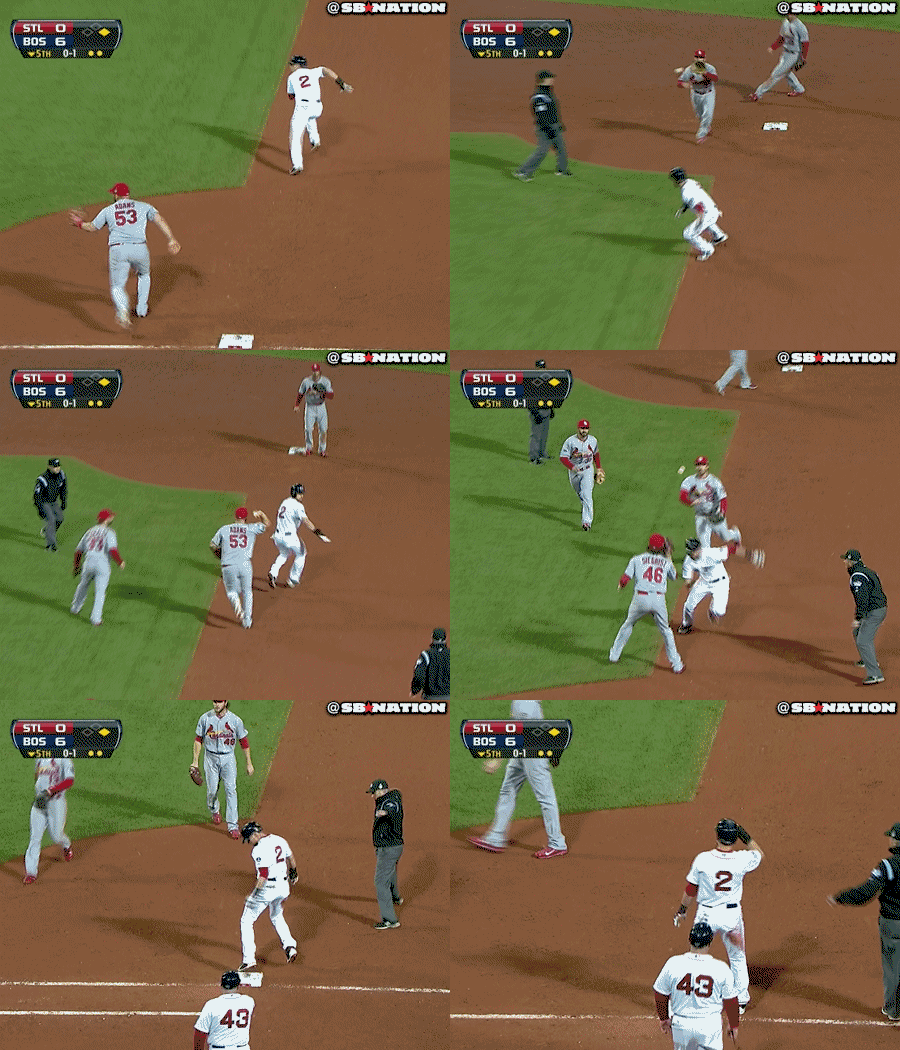
The injuries compromised him in Boston and made him an unfair pariah in the Bronx. He had Hall of Fame talent: some power, above-average center field defense, and a knack for turning baserunning into guerrila warfare. Especially the day he scored on a wild pitch—from second base. Especially in Game Six of the 2013 World Series.
Jacoby Ellsbury

Jacoby Ellsbury toying with the Cardinals as he thwarts a rundown in Game Six of the 2013 World Series. He made them resemble a quartet of wolves outsmarted by a flea.

The first of Navajo descent (his mother) to play major league baseball, Ellsbury was treated unfairly by fans and perhaps a teammate or three on the grounds that his injuries, and his sensible enough need to recover fully before playing again, equaled a character flaw. They derided him unfairly as a fragile goldbrick. They tried to make him feel as though injuries incurred in honest competitioin equaled weakness.

It got bad enough that, when one of Ellsbury’s four children was born on the Fourth of July 2019, and the proud father announced it on Instagram, he was attacked mercilessly by the worst of the Twitter twits and other social media mongrels. The guy who helped the Red Sox win a pair of World Series rings before leaving as a free agent could have been in traction and the worst Yankee fans would have accused him of staging it.

Once upon a time, Ellsbury broke the Red Sox’s consecutive-game errorless streak record. He hit four doubles and stole a base in the ’07 Series and looked on the way to becoming one of the all-time Red Sox greats.

Then, in April 2010, he crashed into a human earth mover named Adrián Beltré (himself a future Hall of Famer) at third base. He suffered four hairline rib fractures on the play, came back too soon, saw a thoracic specialist who recommended more rest and rehab, rejoined the Red Sox that August . . . and re-injured the ribs on another play against the Rangers later the same month.

More injuries followed often enough. Then Ellsbury, fed up with whisperings that he took “too long” to recover from them, elected to walk as a free agent without so much as a quick glance back at the Red Sox. In Year One as a Yankee, he played the way Jacoby Ellsbury at his healthiest could play. (He led the American League with a 22.7 power-speed number.)

From an essay I wrote when the Yankees finally released him in 2019 (for using a rehab facility outside the organisation—without their permission, as if a man injured so often didn’t know himself what might be best for him) . . .

2015—Right knee sprain on 20 May; out two months, rest of the season nothing to brag about, unfortunately. 

2016—Uninjured but production falling further, including his lowest total stolen bases to that point during a healthy season.

2017—Smashed his head against the center field wall while making a highlight-reel catch. Concussion. Missed 29 games and lost his center field job to Aaron Hicks, but somehow managed to break Pete Rose’s career record for reaching base on catcher’s interference, doing it for the thirtieth time on 11 September, which also happened to be his 34th birthday.

2018—Strained his right oblique at spring training’s beginning. Turned up in April’s beginning with a torn hip labrum. Missed the entire season (and underwent surgery in August) because of it.

2019—Started the season on the injured list with a foot injury; also turned up with plantar fasciitis in the foot (the same injury plus knee issues that reduced Albert Pujols as an Angel to a barely replacement-level designated hitter) and another shoulder injury. Took until September for the Yankees to admit Ellsbury was lost for the year.

I repeat further what I wrote then: Not one of those injuries was caused by anything other than playing the game or performing other baseball-related activity. Remember that before you continue condemning Ellsbury the man or the Yankees as a team over him. 

“Some people give their bodies to science. I gave mine to baseball,” said long-ago Met (and Giant, Expo, and Cardinal) Ron Hunt. Ellsbury did likewise. It cheated him out of a Hall of Fame case, and it made too many fans believe he was no better than a gunsmith running weapons to Russia against Ukraine.

Ellsbury didn’t become a Yankee because he believed his previous injuries really began draining the talent that was once as electric as a generator. He didn’t wear the pinstripes believing he’d become an orthopedic experiment. He isn’t owed a plaque in Cooperstown,  either. But he’s certainly owed more than a handful of apologies.


* The sacrifice fly wasn’t made an official statistic until the 1954 season. Several of the Hall of Famers listed in the RBA table played a third or more of their seasons prior to the rule coming on line. How to overcome that hole?

I tinkered with a few ideas until I tripped over a best-case scenario. I took those players’ numbers of recorded sacrifice flies and divided them by the number of seasons they played under the rule. Then, I took that result and multiplied it by the number of Show seasons they actually played.

The formula is sacrifice flies (SF) divided by sacrifice fly-rule seasons (SRS), multiplied by total MLB seasons. It shows an estimate of the sacrifice flies they might have been expected to hit if the rule was in place their entire careers.
2023 BBWAA Hall ballot: Jones, Rolen return and belong

Anticipating the arrival of my 2023 Hall of Fame ballot from the Internet Baseball Writers Association of America (yes, it’s merely ceremonial, but still), the Baseball Writers Association Hall ballot has been released. There are two players returning on the ballot who belong in Cooperstown absolutely, no further questions asked.

Tomorrow: the newcomers. Wednesday: the rest of the returning class. Now, the two returning guys who deserve their plaques post haste, especially the center fielder who killed the most runs of all.

Andruw Jones

Andruw Jones

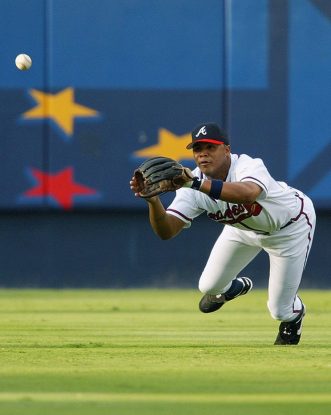
This is the single most run-preventive center fielder who ever played major league baseball. His name is Andruw Jones. His uniform front should have read Electrolux. He belongs in Cooperstown.

I’m pretty sure people still have a near-impossible time reconciling Jones’s too-staggering decline phase to his peak through age 29. It started with his final, injury-marred Atlanta season, and continued so profoundly in Los Angeles that he became indifferent enough to be a sad punch line before he was finally bought out of his deal.

But that peak should still be enough to make Jones a Hall of Famer.

He wasn’t just a Hall-level hitter before those later-career health issues. But he was way off the proverbial charts as a run-preventive center fielder. He had a great throwing arm, a genius for finding sure routes to balls despite his habitual shallow positioning, and both elevated him where it mattered the most—not just in the highlight reels, either, though he had more than enough of those.

Jones retired with the second-most defensive runs saved above his league average for any player at any position—only Hall of Fame third baseman Brooks Robinson’s +293 out-rank Jones’s +253. Jones is also +80 ahead of Hall of Famer Willie Mays among center  fielders, incidentally. Don’t be silly. I’m not calling Jones a better player than Mays, or even Hall of Famer Ken Griffey, Jr. They were just too much better all-around to kid yourself. (Baseball-Reference [via Jay Jaffe] ranks Jones number 11 among major league center fielders.)

I am saying, however, that taken strictly for his defense Jones was the most run-preventive defensive center fielder who ever played major league baseball. But Jones all-around at his peak was remarkable enough. For his twelve Atlanta seasons, my Real Batting Average metric (RBA: total bases + walks + intentional walks + sacrifice flies + hit by pitches, divided by total plate appearances) shows Jones’s peak value as more than worthy of a plaque:

Peak RBA PA TB BB IBB SF HBP RBA
Andruw Jones 7276 3185 717 65 62 83 .565

His career value at the plate wasn’t damaged quite as much as you remember by that terrible post-Atlanta decline phase, either. In fact, his career RBA is a) only nine points lower than his peak; and, b) higher than three other Hall center fielders who played in the post-World War II/post-integration/night-ball era:

HOF CF PA TB BB IBB SF HBP RBA
Mickey Mantle 9907 4511 1733 148 47 13 .651
Willie Mays 12496 6066 1464 214 91 44 .631
Ken Griffey, Jr. 11304 5271 1312 246 102 81 .620
Duke Snider 8237 3865 971 154 54* 21 .615
Larry Doby 6299 2621 871 60 39* 38 .576
Andruw Jones 8664 3690 891 69 71 97 .556
Andre Dawson 10769 4787 589 143 118 111 .534
Kirby Puckett 7831 3453 450 85 58 56 .524
Richie Ashburn 9736 3196 1198 40 30* 43 .463
HOF AVERAGE .574

Measure him by wins above replacement-level player (WAR), and Jones’s seven-year peak WAR is above that of the average Hall of Fame center fielder. There are plenty of mostly or solely peak-value Hall of Famers in Cooperstown; they only begin with Dizzy Dean and Sandy Koufax. 

Jones’s Hall of Fame teammate, Chipper Jones, wasn’t just blowing smoke when he said upon his own induction that if you wanted to beat the 1996-2007 Braves “you had to go through the Jones boys, too.” That’s the way Hall of Famers play the game. And if the Hall now gives more value to defense than in the past, Jones assuredly deserves the honour even more.

Scott Rolen

Scott Rolen

This is a Hall of Fame third baseman. His name is Scott Rolen. He shouldn’t have to wait for an Era Committee to enshrine him.

Once more, with ten times the feeling: It wasn’t Rolen’s fault that he was villified and sullied during his early seasons in Philadelphia. He just wasn’t the kind of guy the Phillies’ front office of the time loved, influenced heavily enough by the like of Loud Larry Bowa and Drill Sgt. Dallas Green.

Rolen was soft spoken, he let his prep and his play do his talking, and he didn’t blow up the nearest inanimate objects when a swing missed or a play faltered or a game was lost. You hear a lot of lip service to let’s just get ’em tomorrow. Rolen lived it. If he’d been a fighter pilot, Rolen would have earned a rep as the classic maintain-an-even-strain type. The Right Stuff.

That front office misread Rolen as indifferent, if not unrealistic. (Rolen went into his walk year in 2002 unsatisfied that the Phillies then were committed to building a consistently-winning team and spurned a $140 million offer because he wasn’t convinced of it.) Even if every teammate he had knew better. He hustled himself into injuries and that only added to the sullying, in Philadelphia and in St. Louis, where he ran afoul of Tony La Russa despite playing his usual kind of hard and delivering performances that helped the Cardinals to a few postseasons and a World Series ring.

Rolen fumed over La Russa souring on him for being injured in honest competition. If only he could have then-Brewers manager Ned Yost for a skipper. Yost called him “the perfect baseball player. It’s his tenacity, his preparation, the way he plays. He tries to do everything fundamentally sound. And he puts the team first—there’s no fanfare with him.”

Then-Cardinals GM John Mozeliak came publicly to regret trading Rolen to the Blue Jays. Former Cardinals GM Walt Jocketty caught wind that Rolen wanted to play closer to home   and pried him out of the Jays for the Reds. Rolen helped the Reds to a couple of postseasons, too.

Rolen wasn’t the hitter Hall of Fame third baseman Chipper Jones was, but Jones wasn’t the defender Rolen was, either. Not by about ten country miles. Rolen won eight Gold Gloves and they weren’t by reputation alone. Only Robinson and Hall of Famer Mike Schmidt have more such awards at third base.

Rolen had eleven seasons averaging ten or more runs saved at third and three in which he averaged twenty or more. His 140 defensive runs above league average are tied for sixth among third basemen all time. Preferring to leave it on the field and at the plate without starving for publicity or acting like the star he did his best not to present himself being may have been Rolen’s number one career problem.

But would you believe that Rolen is ahead of five postwar/post-integration/night-ball Hall of Fame third basemen at the plate, according to RBA? That those he passes include George Brett? See for yourself:

HOF 3B PA TB BB IBB SF HBP RBA
Mike Schmidt 10062 4404 1507 201 108 79 .626
Chipper Jones 10614 4755 1512 177 97 18 .618
Eddie Mathews 10100 4349 1444 142 58 26 .596
Scott Rolen 8518 3628 899 57 93 127 .564
George Brett 11625 5044 1096 229 120 33 .561
Ron Santo 9397 3779 1108 94 94 38 .544
Wade Boggs 10740 4064 1412 180 96 23 .538
Paul Molitor 12167 4854 1094 100 109 47 .510
Brooks Robinson 11782 4270 860 120 114 53 .458
HOF AVG .557

Baseball-Reference (via Jay Jaffe) rates Rolen the number ten third baseman ever. His Hall candidacy gets more traction year by year. (He shot through the 60 percent line last year, in fact.) He deserves a plaque in Cooperstown, and he shouldn’t have to wait for an Era Committee to get it.

Note: Some of the foregoing has been published previously.

Enough, already

Pete Rose

Pete Rose, shown before a Reds game in Great American Ballpark in 2018. His letter to commissioner Rob Manfred should receive a single-word answer.

Last Friday, TMZ revealed Pete Rose sent a letter to commissioner Rob Manfred four days earlier. Just how TMZ obtained the letter is open to speculation. Some might suspect someone in Manfred’s office leaked it; some might suspect Rose himself. Neither suspicion is implausible.

If you’re inclined toward charitable thought, Rose’s letter is a letter of apology, an acknowledgement of accountability, a plea for forgiveness from a man who’s been punished enough via the opprobrium he still receives as baseball’s most prominent exile.

But if you temper charity with realism, it’s yet another example of what The Athletic‘s Ken Rosenthal describes as words ringing hollow from a man who can’t get out of his own way. A man who still doesn’t get it. A man whose most stubborn remaining partisans still don’t get it, either.

“[F]or Rose,” Rosenthal writes, “untrustworthy behaviour is nothing new.

He spent the first fourteen years of his ban denying that he bet on baseball, including in his 1989 autobiography, Pete Rose: My Story. He served five months in prison in 1990 for filing false income tax returns. A secret meeting in Milwaukee with former commissioner Bud Selig in 2002, during which he admitted betting on baseball as a manager for the first time, also apparently went awry. News of the meeting leaked, and Rose promptly followed it with an appearance at a sports book in Las Vegas.

Two years later, Rose released a second autobiography, My Prison Without Bars, as the Hall of Fame prepared to induct two new members, Dennis Eckersley and Paul Molitor. Rose said the timing wasn’t his fault. Nothing is ever his fault . . .

For all Manfred knows, he could reinstate Rose and then be subjected to some other bombshell. Rose has admitted to betting on baseball only after his playing career ended. But in June 2015, ESPN obtained copies of betting records from 1986 that provided the first written corroboration Rose had gambled on games as the Reds’ player-manager. It’s always something.

In August, the proof that it’s always something reared grotesquely enough after Manfred agreed to allow Rose to take part in the Phillies’ commemoration of their 1980 World Series title. Rose made it far less about that 1980 team and far more about himself.

It took nothing more than Philadelphia Inquirer reporter Alex Coffey doing nothing worse than her job, asking Rose whether his presence—considering that only the statute of limitations kept him from facing consequences over an early-1970s extramarital affair with a teenage girl—thus sent a negative message to women. Saying he wasn’t at Citizens Bank Park to talk about that, Rose added, “It was 55 years ago, babe.”

“Put aside for one moment (and only one) the message Rose’s cavalier dismissal and term of address to Coffey,” I wrote then. “Consider that his presence Sunday sent a negative message to women and men as well as baseball. For a few grotesque moments the Phillies looked like a team that couldn’t have cared less about anything beyond a cocktail of nostalgic self-celebration and the ballpark gate.”

That’s the Rose effect. He makes it all about him. In the same moment, he can and often does make it impossible to look for what he insisted to Manfred should be sought and kept under full focus.

That’s the man who hired on as a baseball predictions analyst for online sports betting site UpickTrade last year and told a presser, “For those people who are worried about the Hall of Fame, you’ve got to remember I got suspended in 1989. That’s 32 years ago. I’m not going to live the rest of my life worried about going to baseball’s Hall of Fame.” (Suspended?)

Until he is, that is. “Despite my many mistakes,” Rose wrote to Manfred now, “I am so proud of what I accomplished as a baseball player—I am the Hit King and it is my dream to be considered for the Hall of Fame. Like all of us, I believe in accountability. I am 81 years old and know that I have been held accountable and that I hold myself accountable. I write now to ask for another chance.”

A man who hung around as a player above and beyond his actual shelf life on behalf of the self-elevating pursuit of Ty Cobb’s career hits record is only slightly more hubristic than the teams enabling him to do it regardless of his actual on-field value. The publicity factor overrode the honest competition factor often enough then and still does, often enough.

Hubris often leads to tunnel vision. It did for Rose. He couldn’t (wouldn’t?) get that he could have retired right after that 1980 Phillies world championship with a no-questions-asked Hall of Fame case even if it meant falling short of Cobb by about 632 hits. There were people (including Rose himself, sometimes) who believed he had some preternatural entitlement to pass Cobb despite his actual playing value.

Rose’s wins above replacement-level [WAR] from his rookie 1963 in Cincinnati to his 1983 World Series ring with Philadelphia: 80.4. Rose’s WAR from 1981-86, when he finally surrendered to Father Time and took himself out of the Reds lineup to stay: -0.8.*

Rose being a Hit King shouldn’t make a single bit of difference to Manfred. Not now, not ever. Rose’s pride in his playing accomplishments shouldn’t make a single bit of difference. Nor, for that matter, should any of MLB’s promotional deals with this or that online legal gambling operation. (Don’t go there, Roseophiles: Gambling isn’t the only legal activity for which your employers can discipline or fire you for indulging on the job. Just ask anyone who ever lost a job for showing up high as a kite, wired up the kazoo, or bombed out of his or her trees.)

There’s only one thing Manfred should consider. It’s called Rule 21(d). The rule against betting on baseball. The rule that makes no distinction between whether you bet on or against your team. The rule that calls for permanent, not “lifetime” banishment. The rule that prompted the Hall of Fame itself—faced with the prospect of Rose’s election despite his MLB-mandated punishment—to enact its own rule barring those on baseball’s permanently ineligible list from standing for election on any Hall ballot.

Rose “can continue pleading to Manfred, appealing to public sympathy. But Rose, to borrow a term from horse racing, one of his favorite sports, is getting left at the gate,” Rosenthal writes. “His race for Cooperstown remains permanently stalled, and it’s no one’s fault but his own.”

Accordingly, the commissioner’s sole answer to Rose now and forever should be, “No.” As for any and everyone else, the answer now and forever should be, but probably won’t be, Enough, already.

——————————————————————————————————

* By contrast, Hall of Famers Henry Aaron, Nolan Ryan, and Cal Ripken, Jr. pulled up on the positive side of the WAR ledger when they broke revered career records. Aaron, the year he broke Babe Ruth’s career home run record: 2.1. Ryan, the year he broke Hall of Famer Walter Johnson’s career strikeout record: 2.6. Ripken, the year he broke Hall of Famer Lou Gehrig’s consecutive games played streak: 3.9.

Come to think of it, when Ryan threw a bullet past Hall of Famer Rickey Henderson to record lifetime strikeout number 5,000—with then-commissioner A. Bartlett Giamatti in the ballpark itching to pump his fist celebrating the milestone—he was having an All-Star caliber 5.1 WAR season in the bargain.

Ryan, of course, was an outlier even among outliers, a point forgotten often enough and conveniently enough by the ill-informed who insist on comparing pitchers since to him and wondering why simply no one has his one-of-a-kind endurance. 

Bruce Sutter, RIP: Like skipping a rock

Hall of Fame relief pitcher Bruce Sutter with the Cardinals en route their 1982 World Series winner.

“It’s unhittable,” said Hall of Fame manager Dick Williams about Hall of Fame relief pitcher Bruce Sutter’s split-finger fastball, “unless he hangs it, and he never does. It’s worse than trying to hit a knuckleball.” Another Hall of Fame manager, Whitey Herzog, has said that Sutter would never have become injured if he’d remained a Cardinal.

Sutter, who died of cancer Thursday at 69, became a Cardinal in the first place, in 1980, because the Cubs with whom he’d arisen to become a groundbreaking relief pitcher in the first place got caught flatfoot, when the combination of salary arbitration and free agency smashed into a grave if unintended error by longtime owner Phil Wrigley.

The elder Wrigley’s mistake, according to Peter Golenbock in Wrigleyville: A Magical History Tour of the Chicago Cubs, was leaving half his estate to his wife, Helen, whose own death meant the Wrigley estate being taxed heavily twice and leaving son William III, who’d inherited the Cubs, strapped for running the team until or unless he could sell it.

In due course, Bill Wrigley’s financial picture would wreak havoc enough on the Cubs. Sutter himself would remember (to Golenbock) the Cubs having a good team or two followed by a disgruntled team full of veterans who came over from established winners and not liking the Cubs’ post-’79 decline.

About 1979, too, the husky righthander remembered, “That was the year . . . we lost a game to the [Phillies], 23-22. You’re going to ask who gave up the last run, aren’t you? It was a Mike Schmidt home run—off me.” Hitting his second bomb of the day, the Hall of Fame third baseman conked one off Sutter and up the left center field bleachers with two out in the top of the ninth. The Cubs—whose own bombardier Dave Kingman hit three out (one onto a Waveland Avenue porch while he was at it)—went down in order in the bottom against former Big Red Machine relief star Rawly Eastwick.

Sutter learned the split-finger fastball from a minor league coach named Fred Martin and rode it to a 2.33 fielding-independent pitching rate, a 3.42 strikeout-to-walk rate, and a 1.05 walks/hits per inning pitched rate as a Cub. He won the National League’s Cy Young Award for 1979 while he was at it. Then he won a $700,000 salary for 1980 in arbitration.

The only relief pitcher never to have started a major league game when inducted into the Hall of Fame in 2006, Sutter found himself one of the 1980 Cubs’ few leading lights, with a 2.64 ERA and a league-leading 28 saves. He also found himself a Cardinal after that season, after the Cubs under Wrigley’s financial distresses couldn’t pull the trigger on a longer-term deal with deferrable money.

Enter Herzog, who’d only coveted Sutter for half the time Sutter pitched for the Cubs. Only too acutely aware of what happens to even great teams without shutdown relief—he’d been purged as the Royals’ manager after front office disputes trying to get them better relief pitching, before All-Star reliever Dan Quisenberry came into his own—the White Rat, doubling as general manager, brought Sutter to St. Louis for Leon Durham and Ken Reitz plus a spare part named Ty Waller.

Sutter delivered in St. Louis—he nailed down Game Seven of the Cardinals’ 1982 World Series triumph— in large part because Herzog and his then-pitching coach Mike Roarke knew even more than the Cubs how to manage a pitcher whose money pitch just so happened to put arms and shoulders in danger if not handled properly. “[N]obody knew [Sutter’s] motion better than Mike Roarke,”  Herzog wrote in You’re Missin’ a Great Game:

I knew Bruce had to come back behind his ear, then straight over the top, with his delivery. He threw that nasty split-finger pitch, which made the ball look like a rock skipping on water—tough to pick up, let alone hit—but it puts a violent torque on the arm. When you think of the guys who live by that pitch . . . how many had a couple of great years, then dropped off the map?

. . . Well . . . Roarke and I were watching Sutter throw in [spring training] and I saw he was coming kind of three-quarters, bringing the ball out to the side and across. I said, “Holy moly, Mike, he’s all out of whack!” We got right on his ass about it, and he straightened it out. No harm, No foul. Bruce saved a lot of games for us; we saved him more damage than anybody knows.

You know what? If he’d stayed with the Cardinals, Bruce would never have gotten hurt.

Sutter left the Cardinals as a free agent after the 1984 season. Owner Gussie Busch decided to share the top decision making with two Anheuser-Busch leaders, Fred Kuhlmann and Lou Sussman, and they weren’t exactly as amenable to Herzog as Busch himself was, according to Golenbock’s The Spirit of St. Louis.

Herzog swore the pair “jerked” Sutter around over a no-trade clause; second baseman Tommy Herr swore Sussman angered Sutter during their talks. “Bruce wanted to stay in St. Louis,” remembered Herr.

I don’t think the money was that big of a deal. It became more of a personality conflict. Lou Sussman was handling the negotiations for the Cardinals. At some point, Lou rubbed Bruce the wrong way, and Bruce just said, “The heck with it. I’m going somewhere else.” Bruce did it just to spite Lou. And that was unfortunate, because we felt Bruce was just such a weapon for us.

Bruce Sutter

Before the beard: a portrait of the artist as a young Cub . . .

Braves owner Ted Turner showed Sutter a pile of money.` (Six years, $10 million, guaranteed contract.) But Turner couldn’t show Sutter a staff that knew how to manage his workload and keep him from letting his delivery and his bullpen warmups (he was warmed up far less judiciously in Atlanta than in St. Louis) wreck his shoulder at last.

He suffered inflammation in the final third of August 1985 plus a pinched nerve, the injury that almost kept him buried in the minors in the beginning, before Martin taught him the splitter. He would never be the same pitcher again. Had he not fallen under the Braves’ then-dubious care, Sutter’s percentage of inherited runs to score would have ended below 30 percent, splendid work for any relief pitcher.

He may have seen his career collapse in Atlanta, but the Pennsylvania native found Georgia life agreeable enough to stay there with his wife, Jayme, and their three sons. He was the only player inducted into the Hall of Fame in 2006 by way of the writers’ vote, an appropriate position considering how he’d helped to change his baseball craft.

His Hall of Fame teammate Ozzie Smith and Hall of Fame Reds catcher Johnny Bench needled him wearing fake, long gray beards as they escorted him to the podium. Sutter made hitters fear the beard from the bullpen long before anyone heard of one-time Giants bullpen stopper Brian Wilson, but he struggled to stay composed addressing and thanking his wife during his acceptance speech.

We were together through the minor leagues, through the major leagues, and now the Hall of Fame. I love you very much, I appreciate everything you have done and continue to do. I wouldn’t be here without you. I know we have some challenges to face in our future, but we’ll do ’em as we always have, together.

Their marriage was a love that endured almost as long as his love for baseball. So did several friendships Sutter made during his career, such as now-Hall of Fame teammate Jim Kaat, who ended his career as a Cardinal while Sutter anchored their bullpen.

“I feel like a brother passed away,” Kaat told a reporter. “I knew Bruce deeper than just about any other teammate. We spent a lot of time together, and as happens when your careers end, you go your separate ways. But we stayed in touch and considered each other great friends.”

The particular challenge didn’t scare Sutter. Whether throwing that rock-skipping splitter past fellow Hall of Famers out of the bullpen (let the record show that except for two homers each, Mike Schmidt and Willie Stargell, to name two, couldn’t hit him with a warehouse door), or making a half-century marriage raising three sons and becoming beloved grandparents to six in an often self-immolating world, there was no challenge to which Sutter seemed  allergic.

“Heaven needed a big time save,” tweeted longtime baseball analyst Dinn Mann. “Marvelous pitcher, even better person,” tweeted USA Today columnist Bob Nightengale. Baseball will miss him on earth only slightly less than his family will.

A little wit, a lot of reflection at the Hall of Fame

Hall of Fame Induction

Sunday at Cooperstown. Back, left to right: Hall of Fame president Josh Rawitch holding pitcher/catcher Bud Fowler’s plaque; pitcher Jim Kaat; outfielder Tony Oliva; designated hitter/first baseman David Ortiz. Front, left to right: Irene Hodges for her father, first baseman/manager Gil; Dr. Angela Terry for her uncle, first baseman/manager/coach/scout Buck O’Neil; Sharon Miñoso for her late husband, outfielder Minnie.

They had as many people turn up at the Hall of Fame’s induction ceremonies Sunday as fill Fenway Park for a sellout Red Sox home game. And the man who brought enough of those Fenway crowds to their feet in the years the Red Sox finally buried the accursed Curse and hammered the coffin shut twice more gave them more.

And he didn’t even think about hollering, at whatever the choice point might have been, This is our [fornicating] Hall of Fame! either.

The only thing wrong with David Ortiz’s induction speech is that his fellow inductees Minnie Miñoso and Buck O’Neil weren’t still alive on earth to see and maybe raise. But those two men who loved the game as deeply as Ortiz does surely looked upon the stage from their Elysian Fields roosts and hollered camino a seguir—way to go.

With the “Papi! Papi!” chants pouring forth well before he took the podium, it would have been tempting for the first Hall of Fame designated hitter to get there on the first ballot to fall all the way into his public persona as a big, laugh-hunting, laugh-indulging eternal kid. He let some of it come forth. But for the most part he stayed on the side not always accounted for when his name comes up.

The side of soul.

Ortiz felt as reflective and as emotional as anything else after his daughter Alexandra, a college music student, opened the proceedings with a stirring singing of “The Star-Spangled Banner.” He also had a country to thank, the United States, for “welcoming me with open arms since I was practically a child, and giving me the opportunity to develop and fulfill all my dreams and then some more.”

Under ordinary circumstances, that would have been Hall of Fame boilerplate. Out of Ortiz’s usually garrulous mouth, it was as heartfelt and honest as when he thanked his family for standing by their man during the career that brought him to this point—even his wife, Tiffany, despite the couple’s separation last December.

If Big Papi indulged any of his wit he used it simply to segue into the next thanks, the next acknowledgements, whether to the coaches and evaluators who encouraged and mentored him, the teammates who engaged him, the managers who didn’t let him let any slump swallow him alive, the family who braced him, the country that embraced him.

There were times you thought Ortiz’s voice might crack from emotion, but—just as he didn’t flinch when swinging big with postseason advances or World Series rings on the line; just as he didn’t flinch achieving a .947 OPS in 85 postseason games that would have been half a career season for lesser men (his World Series OPS of 1.372 is a jaw-dropper, too)—he didn’t let himself flinch now.

“I’m always joking around, I’m always being me,” he told a news conference after the induction. But you had the whole planet, the whole nation watching you and you have to deliver a message, especially the way life is going these days. You want to deliver a positive message, the words, that people can understand that we need to stay together, we need to be more humble, we need to be sharing love, that’s what we need. Because a lot of bad things are happening nowadays.”

A lot of bad things happened to keep Miñoso from entering the Show before his cup of coffee with the Indians at 25 and his full rookie season at 27. (Eight games with the Indians before being traded to the White Sox in a three-team, seven-player deal.) He did for black Latinos what Jackie Robinson did for African-Americans and he let his effervescent personality diffuse bigots and engage teammates as well as he played.

But a lot of good things might have come forth Sunday afternoon if Miñoso could have lived to accept his plaque. The man who once said his last dream in the game he loved was to make it to Cooperstown (he died in 2015) would have made the crowd his own just the way Ortiz did. “As Minnie would say,” his widow, Sharon, told the gathering, “‘Thank you, my friend, from the bottom of my heart’.”

So would O’Neil, maybe the only one among Sunday’s Hall inductees—including Miñoso’s successor Cuban-born star Tony Oliva—who could have made Miñoso resemble a clinical depressive.

I once wrote that getting O’Neil to shut up about baseball (and it holds about life, too, if you’ve ever read the book he wrote [I Was Right on Time] or the best written about him [The Soul of Baseball]) was like taking the alto sax out of Charlie Parker’s mouth. (“People feel sorry for me? Man! I heard Charlie Parker!” he once said.) The only problem anyone would have had with him Sunday would have been holding him back.

After he was spurned for the Hall by a single vote in 2006, O’Neil graciously accepted the invitation to introduce seventeen Negro Leagues inductees, a few months before his death. He even got all the Hall of Famers on the podium and the crowd on the lawn to sing with him, “The greatest thing in all my life is loving you.”

His niece, Dr. Angela Terry, may have joked that she got to accept her uncle’s plaque because she holds the longest membership in the AARP, but she nailed home gently and firmly that Uncle John (as she called him throughout) belonged above and beyond his splendid Negro Leagues playing and managing stats, above and beyond his scouting, coaching, and mentoring after.

Which he does. What Pete Rose only thinks he is, O’Neil was: the best ambassador baseball had before he was taken home to the Elysian Fields. You could imagine O’Neil ending his induction speech the way he ended his memoir: “I think it’s about time to close the book on this book before I start boring you. Besides, I’ve got a game to go to. I just might see for the first time the next Josh Gibson or Satchel Paige.”

Hall of Famer Dave Winfield inducted Bud Fowler, considered the first black man to play professional baseball prior to the imposition of the disgraceful colour line. It seemed fitting since Fowler himself was a Cooperstown-area native. “There was something magical about this game that caught his eye and imagination,” Winfield said, “so much so that he’d spend the rest of his life playing and managing this game.”

He pitched, caught, ducked and eluded the game’s racists, and created the black barnstorm teams that led to the formal creation of the Negro Leagues in the first place. A rib injury led in due course to his premature death, but Fowler’s impact on the game was literally nationwide. The time’s conditions and the advent of the colour line compelled Fowler to play and oversee the game in the minors in almost all states—while he worked as a barber on the side, something he learned from his father, to supplement what he earned in the game.

Tony Oliva remembered his own pre-Castro Cuban youth as he looked out around the Hall of Fame lawn and crowd. “I’m looking to the left, I’m looking to the right, and it is bringing memories,” the longtime Twins bat virtuoso and righ fielder told them. “This place right here looks like my home in Cuba, where my father built a field where the young kids were able to play baseball. Exactly like.”

His Twins teammate, lefthanded pitcher Jim Kaat, remembered taking his father’s advice and spurning a $25,000 bonus from the White Sox—it would have kept him on the parent club bench two years under the bonus rule of the time—to take a lesser $4000 bonus from the ancient Washington Senators (on the threshold of moving to Minnesota) so he could be seasoned right.

Haans Kaat wanted his son to learn the professional game properly. (In case you wonder about such things, Kaat’s induction makes for two Dutch-stock former Twins in Cooperstown, joining Bert Blyleven.)

“My dad made $72 a week in 1957,” Kaat told the crowd after accepting his plaque. “You can do the math, figure out what he sacrificed so his son could start his career at the right level.” And, highlight it by pitching his best baseball when someone else was having a career year while outlasting Hall of Famer Sandy Koufax in Game Two of the 1965 World Series—the only time Koufax would come up short in that seven-game set.

Remembering another father was a little different for Irene Hodges. When her father, Gil, died of a second heart attack in 1972, Jackie Robinson said through his grief, “Gil was always a calming presence. I always thought I’d be the first [of the “Boys of Summer” Brooklyn Dodgers] to go.”

“Nothing was more important to my dad than giving Jackie all of his support,” she said Sunday afternoon, accepting her father’s plaque. “We were like family with the Robinsons. Jackie’s kids played in our house, and we played in theirs. My dad was not only teammates with Jackie, but they were family. My father made everyone comfortable and accepting of Jackie when he came to the big leagues.”

He did it for Japanese children, too, even in Okinawa where he earned a Bronze Star. “During his time in Okinawa,” his daughter said, “he would befriend the Japanese children who were so frightened by the American soldiers. My father would gather the children from the village, along with his fellow Marines, and teach them baseball. He gave them some joy back in their life that the war had robbed them of.”

That was the same elemental decency that provoked Brooklyn not to boo but to warm up even more to the quiet first baseman, the National League’s best of the 1950s, when he fell into a ferocious batting slump starting in the 1952 World Series—so much so that even a priest who wasn’t of Hodges’s own church ended a Sunday mass saying, “It’s too hot for a sermon, so everyone just say a prayer for Gil Hodges.”

Hodges’ experience with Robinson surely played into how well prepared he kept his 1969 Mets as their manager, after learning on the job with the expansion Senators from 1963-67. Injuries and growing pains kept those Mets from repeating their miracle feat while Hodges managed them. But he remained a firm but engaged boss who loved to teach or re-teach, gave players room to vent privately when need be.

He kept everyone from the merest spare part to the most obvious Hall of Famer in waiting ready to go when needed. He never denounced the injured as quitters and, whenever the tough love was needed, he did it behind closed doors and not in the press.

On Sunday afternoon, Hodges’s daughter re-introduced her father to baseball in a near-perfect bookend to the outsized bombardier who kept himself in check enough to make it about the game to which he’d contributed an outsize share of grandeur when he swung, swayed, and put a city sickened by atrocity on his back.

“If my story can remind you of anything,” Ortiz said, “let it remind you that when you believe in someone, you can change their world; you can change their future.” A man who believes that is a man Hodges, Miñoso, and O’Neil would have loved playing with or coaching in another time, another place, even as Kaat and Oliva had chances to mentor him in his earliest seasons.

This was their [fornicating] Hall of Fame.