Brooks Robinson, RIP: Swept up to the Elysian Fields

Brooks Robinson

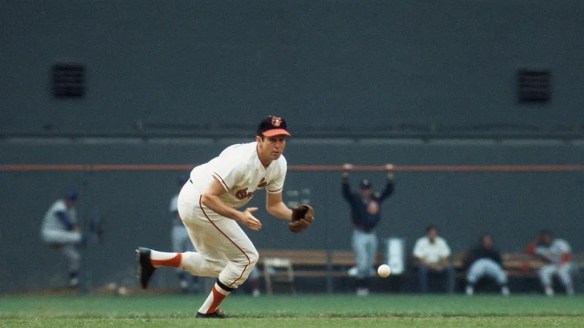
Nothing got past The Hoover too often in two decades at third base.

When Hall of Fame third baseman Brooks Robinson celebrated his 83rd birthday, I couldn’t resist having a little mad fun with his nickname, actual or reputed. Commonly known as the Human Vacuum Cleaner, I recalled longtime Washington Post writer Thomas Boswell calling him The Hoover.

Considering how he beat, swept, and cleaned at third base for two decades, I thought Boswell had it more dead on. So did Reds first baseman Lee May during the 1970 World Series. May first called Robinson—who died at 86 on Tuesday—the Human Vacuum Cleaner at that time. Then, May asked, right away, “Where do they plug Mr. Hoover in?”

Anyway, I thought of other great fielders at third and otherwise. Almost none of them were quite on Robinson’s plane. (“I’m beginning to see Brooks in my sleep,” lamented Reds manager Sparky Anderson during that Series. “I’m afraid if I drop this paper plate, he’ll pick it up on one hop and throw me out at first.”) But they were some of the best their positions ever hosted.

Fellow Hall of Famer Mike Schmidt combined breathtaking power at the plate with his own kind of sweeping and cleaning at third. Considering that plus his sculpted physique, I thought that, for him, it could only be the classic Electrolux, the sleek tank vacuums of 1924-2004.

You couldn’t possibly top The Wizard of Oz for Ozzie Smith at shortstop, but I tried. For him, I designated Aero-Dyne, the model name of Hoover’s first tank-style vacuum cleaner. Nor could you possibly top Graig Nettles’s actual nickname, Puff the Magic Dragon, and I was kind enough not to try. But for others, I came up with things like these:

The Constellation—Roberto Clemente. Hoover’s once-famous, Saturn-shaped canister, born as a swivel-top in 1951, seems to fit Clemente since it often seemed that his ways of running balls down and cutting baserunners down did emanate from somewhere beyond this galaxy.

The Courier—Andruw Jones. That machine was Sunbeam’s brilliant 1966 idea of stuffing vacuum cleaner works into what resembled a Samsonite hard-shell suitcase. Jones traveled so many routes so well becoming baseball’s all-time run-preventive center fielder that you could only think of him as the Courier delivering messages of doom to opposition swingers and runners.

The ElectrikBroom—Keith Hernandez. Mex was as sculpted at first as Schmidt was at third. As vacuum cleaners went, the classic Regina ElectrikBroom was the Bounty paper towel of its time: the quicker picker upper. That was Hernandez at first base.

Eureka—Ken Griffey, Jr. Tell me you saw him turn center field into his personal playground and making spectacular catches without thinking, “Eureka!” 

The Hoover Junior—Mark Belanger. Robinson’s longtime partner at shortstop and the second most run-preventive player at his position ever behind The Wiz. The only reason he won’t be in the Hall of Fame is because he couldn’t hit if you held his family for ransom.

The Kirby—Kirby Puckett. Should be bloody obvious. 

The Premier—Johnny Bench. Should be self explanatory if you saw him behind the plate. (After watching Robinson’s third base mastery against his team in that 1970 Series, Bench quipped of his MVP award, “If he wanted the [MVP prize] car that badly, we’d have given it to him.”)

The Roto-Matic—Clete Boyer. That Yankee third base acrobat moved around so much cutting balls off at the third base pass you could have mistaken him for the swiveling hose atop Eureka’s canister cleaner of the same name.

The Royal—Curt Flood. The king of defensive center fielders when Mays began to show his age. (Maybe it should have been a wet-dry vac, since it was said so often that three-quarters of the earth is covered with water and the rest was covered by Flood.)

The Swivel-Top—Willie Mays. That General Electric canister of the early 1950s boasted of giving you “reach-easy” cleaning, and Mays was nothing if not the reach-easy center fielder of his time.

There was more to Robinson, of course, than just his third base hoovering. There was the decency that enabled this white son of Little Rock, Arkansas, to welcome African-American son of Oakland, California by way of Beaumont, Texas Frank Robinson, upon the latter’s controversial trade out of Cincinnati after the 1965 season. “Frank,” Brooks said, “you’re exactly what we need.”
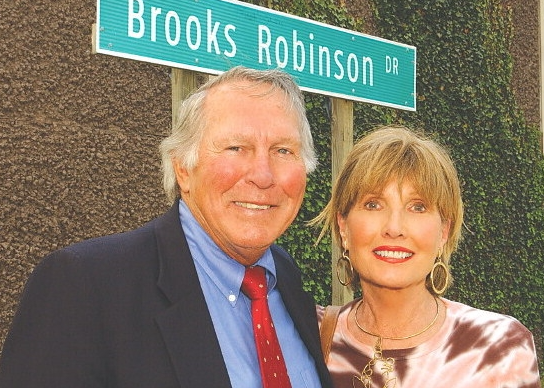
Brooks & Connie Robinson

Brooks Robinson and his wife, Connie, at the dedication of Brooks Robinson Dr. in Pikesville, Maryland, just off the Baltimore Beltway, in 2007. The Hoover and the stewardess whose feet he swept her off aboard a 1959 flight to Boston were married 63 years.

There were the eighteen All-Star Games, the sixteen straight Gold Gloves, the 1964 American League Most Valuable Player award, the 1970 World Series MVP. (Forgotten amidst the beating, sweeping, and cleaning at third base that Series: The Hoover hit a whopping .429 with his plate demolition including two home runs.)

There were the 39.1 defensive wins above replacement level (WAR) and the 105 OPS+, making Robinson one of only two players ever to have 30+ dWAR and an OPS+ over 100. The other? Fellow Hall of Famer Cal Ripken, Jr.

There was the end of his career, the final two seasons when the Orioles essentially carried him despite his diminution at the plate and his age-reduced range at third—simply because a) they thought so well of him as a man, and b) they knew he needed the money. Bad. And he wouldn’t in position to benefit from the advent of free agency.

He was broke and in debt thanks to his off-season sporting goods business. Not because he made mistakes but because he was taken advantage of. “At every turn,” Boswell wrote (in The Heart of the Order), “Robinson’s flaw had been an excess of generosity.”

How could he send a sporting goods bill to a Little League team that was long overdue in paying for its gloves? He’d keep anybody on the cuff forever. Said Robinson’s old friend Ron Hansen [one-time Orioles middle infielder], “He just couldn’t say no.” As creditors dunned him and massive publicity exposed his plight, Robinson answered every question, took all the blame (including plenty that wasn’t his), and refused to declare bankruptcy. He was determined to pay back every cent. With great embarrassment, he returned tens of thousands of dollars that fans spontaneously sent him in the mail to soften his fall.

When the Orioles gave him a Thanks Brooks Day upon his 1977 retirement, the master of ceremonies was Associated Press writer Gordon Beard. “Around here,” he said, “people don’t name candy bars after Brooks Robinson. They name their children after him.”

This was the fellow who’d autograph anything proffered—including, it’s been said, a pet rock and a bra. A fellow who so appreciated what he was able to do for a living for his first two decades of adulthood that, when the end came nigh, he could only be grateful for having been there at all.

“Every player I’ve ever managed,” cantankerous Orioles manager Earl Weaver told Boswell, “blamed me at the end, not himself. They all ripped me and said they weren’t washed up. All except Brooks. He never said one word and he had more clout in Baltimore than all of them. He never did anything except with class. He made the end easier for everybody.”

Robinson in retirement climbed out of his financial hole well enough, becoming a popular localised Orioles broadcaster in the 1980s with a flair for candid and perceptive analysis even when it meant being critical. If he lacked anything in those years, it was ambition. He never sought to manage in baseball and he never sought a national audience on the air, but he did have partial ownership of a pair of minor league teams for a time.

The Orioles have retired only six uniform numbers and one is Robinson’s number 5. His statue looms inside Camden Yards, where the Orioles and the Nationals observed a moment of silence before Tuesday night’s game, lined up outside their dugouts, in respect. The American League East-leading Orioles beat the Nats, 1-0.

Robinson also served as chairman of the Major League Baseball Players Alumni Association’s board of directors. If there’s any single blemish on his resumé, it’s that he didn’t move the group toward helping to gain redress for pre-1980 short-career players frozen out of the 1980 pension re-alignment. “He dropped the ball, says A Bitter Cup of Coffee author Douglas Gladstone. “He never went to bat for them, many of whom were his teammates.”

In recent years, the first-ballot Hall of Famer dealt with health issues such as prostate cancer (he 32 radiation treatments), a subsequent followup surgery, and a fall that hospitalised him with a shoulder fracture in 2012. He also became an Orioles special advisor, insisting that it be tied to community events. He was quoted as telling owner John Angelos he’d do anything except make baseball decisions: “That’s passed me by, if you want to know the truth.”

The only love deeper than baseball in Robinson’s life was his wife, Connie, whom he met in 1959 aboard an Orioles flight to Boston when she was a stewardess on board. (They married in 1960.) When he auctioned off his volume of remaining memorabilia (My children, they have everything they ever wanted from my collection), the proceeds went to a foundation the couple established for worthy Baltimore causes, a Baltimore adopted son to the end.

Now The Hoover will beat, sweep, and clean the Elysian Fields. He might even pick up a paper plate and throw Sparky Anderson out at first.

Riding the pine tar

George Brett

“I told [my kids] you better never make me this mad, and they never did.”—Hall of Fame third baseman George Brett.

The single most infamous moment in Hall of Famer George Brett’s career ended up becoming a tool in his fatherhood kit. “Showed it to my kids a whole bunch of times when they were young,” Brett told ESPN writer William Weinbaum in Cooperstown, where Brett spent the weekend including for the induction of Hall of Famers Fred McGriff and Scott Rolen.

“I wanted to see the look on their faces when I got mad,” Brett said of that day, forty years ago Monday, “and I told them you better never make me this mad, and they never did.”

One look at Dad’s face, bulging eyes and expanding mouth as he stormed from the dugout, seemingnly determined to amputate umpire Tim McClelland’s limbs if not his head, and the three children under Brett’s jurisdiction (he married in 1992, before his final season as a major league player) should have had no further doubt.

24 July 1983. Yankee Stadium. The Yankees and the Royals not exactly on friendly terms. Top of the ninth, two out, Brett’s Royals down a run, Royals infielder U.L. Washington on first, and Brett’s fellow Hall of Famer Goose Gossage on the mound in relief of Dale Murray. Knowing Gossage wouldn’t throw him anything but fastballs, Brett sat on one and drove it about seven or eight rows up the right field seats.

Brett barely finished rounding the bases when Yankee manager Billy Martin, a man who never missed an opportunity to deploy the rule book when it would work to his advantage above and beyond the actuality of a game, hustled out of the Yankee dugout demanding Brett’s bat be checked.

The Yankees noticed Brett’s bat had a visible excess of pine tar before the game, we learned in due course. Martin, typically, elected not to say or do something about it until or unless Brett did noticeably game-altering damage swinging it, as he did in the top of the ninth. After Martin asked rookie umpire McClelland to check the bat, McClelland and the umps confabbed, examined, confabbed more, laid the bat across the seventeen-inch width of the plate . . .

While talking to teammate Frank White in the dugout, awaiting the final call, Brett said he’d never before heard of too much pine tar, notwithstanding teammate John Mayberry checked for it in a 1975 game but ultimately surviving an Angels protest. But the usually jovial Brett knew just what he would do if McClelland and company ruled against his bat and thus his go-ahead home run. It wouldn’t be a parliamentary debate.

“I go, ‘Well, if they call me out for using too much pine tar, I’ll run out and kill one of those SOBs’,” he remembered telling White.

They called him out for using too much pine tar. Brett charged up from and out of the dugout like a bull who’d been shot with an amphetamine dart, resembling a man determined to part McClelland from his arms, legs, head, and any other extremity within reach. It took several teammates plus Royals manager Dick Howser and umpire Joe Brinkman to keep Brett from dismembering McClelland.

“I looked like a madman coming out,” Brett admitted to Weinbaum.

I think everything kind of got a little more dramatic than it should have. Because Joe Brinkman got behind me and started pulling me back, and I was trying to get away and he had a chokehold on me and just pulling me backwards and backwards and I was just trying to get free from him. I wasn’t going after Tim McClelland. I mean, as Timmy would always say, “George, what were you gonna do to me? I’m 6’5″, I’ve got shin guards on, I’ve got a bat in one hand, a mask in the other. What are you gonna do to me?” I said, “Timmy, I was just going to come out and yell at you, I wasn’t going to hit you. You would’ve kicked my ass.”

George Brett, Gaylord Perry

Fellow Hall of Famer Perry (right) advised Brett to stop using the infamous bat—because it was too valuable. It’s reposed in the Hall of Fame since 1987.

Brett’s Hall of Fame teammate, pitcher Gaylord Perry, a man who knew something about suspect substances (hee, hee), managed to get the bat away from the umps and into the Royals dugout striking for the clubhouse, until Yankee Stadium security retrieved the bat to submit to the American League offices. (This, children, was the time when the leagues weren’t yet placed under MLB’s direct, one-size-fits-all administration.)

Brett was ruled out over the bat. The Yankees won the game officially. Not so fast. AL president Lee MacPhail received the Royals’ appeal, ruled that the bat didn’t violate the pine tar rule’s actual intent (which was to keep baseballs from getting dirtier), and ordered the game continued in New York—on an off-day for both teams otherwise, 18 August. En route a Royals trip to Baltimore for a set against the Orioles.

“I was kicked out of the game,” Brett said, obviously over his raging bull charge and plunge after the nullified homer.

I was still gonna go to the [suspended] game, but [Howser] said don’t even go the stadium, it’ll be a circus. So me and the son of [actor] Don Ameche, Larry—he was a TWA rep, we always chartered TWA jets back then—we went to some restaurant in New Jersey, an Italian restaurant, and watched the game on a little ten-inch TV. And went back to the airport, the guys had to go there after finishing the game, and next thing you know we were flying to Baltimore.

The Royals and the Yankees re-convened from the point of Brett’s homer. Royals designated hitter Hal McRae faced Yankee pitcher George Frazier, himself familiar with actual or alleged foreign substances. (I don’t use foreign substances. Everything I use is made in the U.S. of A.) McRae struck out for the side. Then, the Royals’ often underrated closer, Dan Quisenberry, got two straight fly outs and a ground out to finish what was started almost a month earlier.

Brett continued using the bat until Perry advised him it was too valuable to risk damage. He sold the bat to fabled collector Barry Halper for $25,000—until he had a change of heart and refunded Halper’s money. The bat has reposed in the Hall of Fame since 1987. “Goose and I have had a lot of laughs over it since he got into the Hall of Fame,” Brett told Weinbaum.

Before a 2018 game celebrating their fiftieth season of life, the Royals handed out a Brett bobblehead showing him springing forth bent on manslaughter upon the home run nullification. Brett told Weinbaum a Royals A-level minor league affiliate saw and raised to make him, arguably, the first player depicted on a bobble-arm figurine—his arms waving as wildly as they did when he charged for McClelland.

Three years before the infamous pine tar homer, Brett was known concurrently as one of the American League’s great hitters (he nearly hit .400 that season) and, unfortunately, a man stricken by a pain in the ass after the Royals finally waxed the Yankees in an American League Championship Series: internal and external hemorrhoids.

Brett had to put up with crude jokes throughout that World Series, which the Royals lost to the Phillies (and his Hall of Fame third base contemporary, Mike Schmidt), but he tuned them out. The pine tar game knocked that onto its butt rather immortally.

“Seriously,” he told Weinbaum, “what would you rather be remembered for? Hitting a home run off Goose Gossage in the ninth inning to win a ballgame, or being the guy with hemorrhoids in the World Series?”

I think I’ll sit on that awhile.

Two modest stars enter Cooperstown

Fred McGriff, Scott Rolen

Fred McGriff and Scott Rolen proudly displayed their Hall of Fame plaques after Sunday’s induction ceremony.

When the Yankees’ (shall we say) mercurial then-owner, George Steinbrenner, faced likely suspension over his campaign to smear his Hall of Fame right fielder Dave Winfield, George F. Will pondered whether then-commissioner Fay Vincent should marshal enough consensus to force Steinbrenner to sell the team. Will even imagined vetting a jury to empanel hearing a court case over it.

“Here is a pretty judicial pickle,” Will wrote parenthetically. “Imagine trying to assemble an impartial jury of New Yorkers to hear Steinbrenner’s case. ‘Tell the court, Mr. Prospective Juror, do you have any strong opinions about the owner who masterminded the trade of Fred McGriff from the Yankees to the Blue Jays in exchange for a couple of no-names? Stop snarling, Prospective Juror’.”

Come Sunday afternoon, that same Fred McGriff stood on the Cooperstown stage accepting his Hall of Fame plaque. Elected to the Hall by the Contemporary Baseball Era Committee, the Crime Dog didn’t exactly keep the Yankees high on his gratitude list, though the trade that might have had a prospective New York juror snarling could have been called the trade that launched him to where he now stood.

“I’d like to welcome everyone here from Atlanta to San Diego, Toronto, my hometown of Tampa Bay and everywhere in between. Thank you for showing up,” said the tall first baseman who became baseball’s first and so far only man to hit 30+ home runs in a season for five different teams. (And, the first Hall of Famer whose plaque mentions OPS.)

It is awesome to be here accepting this honor. What a blessing from the man upstairs. Beautiful weather. You can’t beat it. I’m so grateful to be going into the Baseball Hall of Fame alongside a guy like Scott Rolen who played the game the right way. A true professional. I want to thank the many living legends sitting behind me. I’m humbled and honored to be standing in front of you. And now to be part of this fraternity alongside you—just some great individuals behind me.

In one way, no player ever had a later-in-life baptism of fire to equal McGriff’s. It wasn’t enough that his career tended to be buried beneath the ramped-up batting stats of both the era of actual/alleged performance-enhancing substances (McGriff was never a suspect) and new ballparks that over-embraced hitting. No. He had to play his first game for the Braves under, shall we say, fiery conditions, after his fire-sale trade from the Padres:

I was nursing an injury when the trade happened. So I drove to Atlanta, I left Tampa at noon. I didn’t expect to play. But when I got to the ballpark, there is my name in the lineup. I was sweating. But I believe the man upstairs bought me some time when a food heat lamp caught on fire.


The start of the game was delayed two hours, long enough for me to get some more treatment. And I felt a little bit better. I started the game. And I tied it up in the sixth inning with the home run. The next day, I hit two home runs. And that Braves team caught on fire. We ended up catching the Giants after being ten games out of first place at the time to trade, and we won the division.

Two years later, McGriff and those relentless Braves teams of the 1990s won their only World Series rings. The Crime Dog did splendidly for a fellow who’d been cut from his high school baseball team once upon a time.

Both McGriff and Rolen had reason to wonder if they might ever get to Cooperstown as other than paying guests. Rolen may have thought about it just a little bit less.

“At no point in my lifetime did it ever occurred to me that I’d be standing on this stage,” the third baseman with a live bat and an Electrolux way at third said early, nodding to the Baseball Writers Association of America who elected him in January. “But I’m glad it occurred to you, because this is unbelievably special.”

(Asked whether Rolen could play shortstop, his one-time Phillies manager Terry Francona replied, referring to his broad range at third, “He’s playing it!”)

A two-sport star in his native Indiana, before beginning his baseball career, Rolen remembered learing something from his father after a particularly trying basketball mini-camp. “After day one, I told Dad that I had a minor problem . . . that I need advice with. And his answer (was), ‘OK’.”

“Well, Dad. I can’t handle the ball. I can’t shoot. I’m completely out of basketball shape. And everybody in the entire gym, including the coach, is better than me.’ And his answer?”

“OK.”

“What do you mean, ‘OK?’”

“Well, what are you going to do, Scotty?”

“Well, that’s what I’m asking you, Dad.”

“Well, how the hell do I know? You say you can’t dribble. You can’t shoot. You’re out of shape. And you’re completely overmatched. You told me what you can’t do? What can you do?”

“I guess I can rebound.”

“OK.”

“I can play defense.”

“OK.”

“I can dive for loose balls. Doesn’t appear that the guys are playing too hard up here. I could outhustle, outwork and beat everybody up and down the floor.”

“OK.”

And then here came the words of wisdom: “Well, do that then.”

It turns out that, “Well, do that then,” carried me into the minor leagues and gave me a simple mindset that I would never allow myself to be unprepared or outworked. “Well, do that then” put me onto this stage today.

The man who won a World Series ring as a key element of the 2006 Cardinals finished by doing something he’d done from the moment his parents first made the trek to see him play a major league game. He tipped his cap to them. Then, it was a Phillies cap. Sunday, it was a Hall of Fame cap. The number ten third baseman of all time never forgot.

“This is baseball’s biggest honor,” McGriff said. “This is like icing on a cake. You see, my goal was simply to make it to the big leagues. And I exceeded every expectation that I could ever imagine and then some. It is a great feeling getting recognized for your hard work.”

“I’m grateful for this grand gesture,” said Rolen, one of only four third basemen ever to hit 300+ home runs, steal 100+ bases, and hit 500+ doubles. (The others: Hall of Famers George Brett and Chipper Jones, plus Hall of Famer in waiting Adrián Beltré.) “I have an overwhelming respect and intend to represent these (Hall of Famers) behind me and this legendary Hall with the integrity on which it was built.”

McGriff and Rolen have something else in common aside from forging a new friendship. McGriff got the last laugh on a capricious Yankee owner who thought he could afford to lose the Crime Dog’s budding self. Rolen got the last laugh on a Phillies regime that allowed him to be viewed unfairly as indifferent while also letting him take unfair abuse when he challenged their willingness to build and sustain winning teams.

McGriff’s Hall plaque shows him wearing a blank cap atop his smiling, mustachoed face, and it reposes next to Negro Leagues legend/longtime Cubs coach/scout/baseball’s arguable finest ambassador, Buck O’Neil. Rolen’s plaque reposes next to Red Sox/postseason legend David Ortiz, showing him in a Cardinals cap, looking as determined as he was holding third base down almost two decades, resembling if anyone music legend Neil Young.

Both Rolen and McGriff heeded when their bodies began telling them it was time to go. Thus, one particular Young lyric stands forward, when thinking of them compared to those greats who, in Thomas Boswell’s words, “torture their teams, their fans, and themselves, playing for years past their prime, for the checks and the cheers”:

It’s better to burn out/than to fade away.

Despite McGriff’s bald pate and Rolen’s thinning one, they both look as though they could still play nine innings in a tough pennant race. But they spared us and themselves the tortuous long fade away. McGriff and Rolen finally stood on the Cooperstown podium Sunday, inspiring and accepting cheers at least as edifying as those incurred by a timely hit, a long home run, a tough play at first, an impossible play at third.

Concussions killed Mauer’s career, not his Cooperstown case

Joe Mauer

Mauer’s critics, not Mauer, should be shamed for willfully ignoring what concussions did to end his catching life and, in time, his playing career.

Scott Rolen’s election to the Hall of Fame triggered almost immediate discussions about next year’s likely Hall of Fame class. Social media being what it is, as opposed to what we wish it became, Rolen’s election also triggered an unfathomable outpouring of bile against one of three deserving Hall of Famers who make their first appearances on the writers’ ballots toward 2023’s end.

Adrián Beltré is a Hall of Fame lock. Not just because he’s a paid-in-full member of the 3,000 hit club but because he has 93.5 wins above replacement-level player (WAR) and he’s the number-two third baseman ever in terms of run prevention: Beltré’s 168 defensive runs above his league average is second all-time to Hall of Fame Brooks Robinson. (Baseball Reference rates Beltré the number four all-around third baseman.)

Chase Utley deserves a plaque in Cooperstown, too, even if his lack of black ink might be blinding. He wasn’t an overwhelming hitter, but he was a run machine once he reached base, including being worth 45 runs as a baserunner and worth another 25 runs due to his ability to avoid double plays. He’s also fourth for run prevention at second base (+141 runs, behind only (in ascending order) Hall of Famers Bid McPhee, Joe Gordon, and Bill Mazeroski.

And, then, there’s Joe Mauer. The number seven catcher all-time according to Baseball Reference. Uh-oh.

“I’ve never seen fans of a team hate an all-time great of their own the way some Twins fans do Mauer, tweeted The Cooperstown Casebook author Jay Jaffe. “They’re just so convinced he gave them a raw deal for that contract.” As in, the eight-year, $184 million contract extension he signed with the Twins in March 2010. As in, before the injury that ultimately put paid to his life as a catcher, then a ballplayer period.

It’s as though a man whose baseball profession had already led him to knee and leg issues committed some grave capital crime when, in August 2013, Mauer took a hard foul tip off his face mask. It caused a concussion that soon caused the Twins to pull him out from behind the plate and move him to first base—a position left largely vacant when they traded Justin Morneau to the Pirates a year before Mauer’s concussion.

Morneau, who suffered a concussion on a baserunning play the year Mauer signed that yummy contract extension, and who would suffer a second concussion on another diving play after he’d signed with the Rockies for 2014. One concussed first baseman eventually replaced by a concussed catcher who’d never again be the player he’d been prior to August 2013.

The guy with a reputation as a baseball gym rat who played the game with a commitment and a steadiness that caused some people to mistake him for emotionlessness spent the rest of that contract extension doing his level best to play despite things like the balance issues and light sensitivities that now made hitting a challenge and fielding a battle.

The Twins’ struggles around Mauer’s had far less to do with Mauer’s and more to do with its ownership seeming to impose a de facto spending cap the rest of Mauer’s career, including major league salaries and minor league development. But the native son, the franchise face, was too simple a target to resist, as the injured often are.

As if Mauer hadn’t battled enough at the plate following 2013, in May 2018 he suffered a second one after he dove chasing a foul ball and injured his neck. Concussion symptoms kicked in a few days later. They didn’t just impact him on the field, either. His wife, Maddie, told The Athletic they were no treat for him at home with two young twin daughters to raise, either. (The story was published as she was about to give birth to their third child, a son.)

“It’s not quiet at our house and they don’t understand why dad wants it to be quiet or be in a different room or have the lights off,” Mrs. Mauer said.

Our girls had been born about a month prior (to the 2013 concussion). Both of these times it does put things into perspective that you’re dealing with these symptoms at work, but you’re dealing with them at home just as much. I think that’s something he may not have talked about as much publicly, but it was a difficult challenge to be going through concussion-like symptoms with children.

“The neck [injury] is an easy one to take care of,” Twins trainer Tony Leo told The Athletic for the same story. “We can fix that. But the concussion had all these ebbs and flows going up and down.”

I think people don’t appreciate how much it impacts you on a day-to-day basis with just simple things like getting out of bed. Am I going to feel OK? Am I going to have a headache? Am I going to have ringing in my ears? Am I going to feel nauseous? Am I going to be able to see all right? When I turn on the lamp next to my bed, is that light going to cause me to start having a headache? Am I going to be too agitated and upset at my kids when it’s not their fault, but just because of all the sensations going on.

Everything starts compounding and adding to the anxiety you’re going through when you’re trying to minimize all these distractions and trying to allow the brain to heal. Little things trigger big symptoms, which cause you to doubt whether you’re healing or not. It’s really hard to remove yourself from everything let alone when you’re in the clubhouse with music, all the lights we have, TVs, people. You have the same thing at home with the day-to-day living that . . . We get focused on the baseball. I get focused on getting them back on the field for the game. But how do you start minimizing everything else in life that’s bothering you, especially with kids who just want to be around dad?

Maybe instead of soaking Mauer in a phlegm-and-bile bath because of what his head refused to let his body do at the level it once did during five of the eight years of that contract extension, the idiot brigades might consider what it took for Mauer to continue playing at all, at any level. After they consider that, perhaps miraculously, it actually didn’t compromise his Hall of Fame case.

As a catcher, Mauer—unusually tall for a backstop at 6’5″—was easy to overrate while he played. I made that mistake once myself. I’m not making that mistake again. I’m going to show you where Mauer will sit among Hall of Fame catchers who played in the post-World War II/post-integration/night-ball era, according to my Real Batting Average (RBA) metric. (Total bases + walks + intentional walks + sacrifice flies + hit by pitches, divided by total plate appearances.)

Catchers PA TB BB IBB SF HBP RBA
Mike Piazza 7745 3768 759 146 45 30 .613
Roy Campanella 4815 2101 533 113 50* 30 .587
Joe Mauer (as C) 3943 1640 478 79 35 13 .569
Johnny Bench 8674 3644 891 135 90 19 .551
Yogi Berra 8359 3643 704 91 95* 52 .549
Carlton Fisk 9853 3999 849 105 79 143 .525
Ted Simmons 9685 3793 855 188 100 39 .514
Gary Carter 9019 3497 848 106 99 68 .512
Ivan Rodriguez 10270 4451 513 67 76 58 .503
HOF C AVG .547

You’re not seeing things. Among that group of Hall of Fame catchers, Mauer is number three—eighteen points ahead of Johnny Bench, and twenty points ahead of Yogi Berra, the two men considered the greatest all-around catchers who ever played the game. (You might care to know, too, that as a catcher Mauer had 62 more walks than strikeouts at the plate.) He was also a highly-regarded pitch framer behind the plate who was worth 65 defensive runs above average for his entire life there.

Mauer retired in 2018 because he decided at last that family life without further health compromise was more important than his itch to compete. (The Twins retired his uniform number 7 the following season.) “Experiencing a concussion looks different for everyone,” he said in his formal retirement letter to Twins fans, “but my personal experience forced me to look beyond baseball at what is best for me as a husband and father.”

Instead of shaming Mauer because they don’t get what two concussions did to his Twins life under that contract extension, the idiot brigades should marvel that those two serious, life-and-career-altering injuries didn’t compromise his case as a Hall of Fame catcher in waiting, and even admire him for having the will to try playing on in spite of them. And, for deciding that being a husband and father was more important than playing the game he loved.

But that might ask too many people to surrender their ongoing and erroneous belief that injuries incurred in real competition equal weakness at best, thievery at worst, and character flaws somewhere in there, too. “I am done with a lot of things,” Jaffe also tweeted, “but especially done arguing about Mauer with Twins fans who don’t understand the impact of the concussions on his career.” As of this sentence, so am I.

Rolen rolls into Cooperstown at last

Scott Rolen

A big enough bat at the plate . . .

When Scott Rolen was in his absolute prime, Sports Illustrated said of him, among other things, that he “could have played shortstop with more range than Cal Ripken.” When he was with the Cardinals following his somewhat unfairly contentious departure from Philadelphia, the St. Louis Post-Dispatch asked where Rolen ranked among his era’s third basemen, then answered: the best at the moment.

Rolen’s overdue election to the Hall of Fame Tuesday still inspired carping enough among the philistines who think it was just another case of defining the Hall down. Maybe he wasn’t charismatic. He certainly wasn’t the cheerleading or the self-promoting type. But he was just as SI‘s Tom Verducci described him in 2004, “a no-nonsense star who does it all.”

That’s practically what they said about legendary Tigers second baseman and Hall of Famer Charlie Gehringer, too. He was so no-nonsense he was nicknamed the Mechanical Man. Rolen was many things at the plate and in the field. Merely mechanical wasn’t among them.

“Rolen played with an all-out intensity,” wrote The Cooperstown Casebook author Jay Jaffe, “sacrificing his body in the name of stopping balls from getting through the left side of the infield . . . and he more than held his own with the bat as well, routinely accompanying his 25–30 homers a year with strong on-base percentages.”

This son of Indiana schoolteachers did little more than let his preparation and his play do most of his talking. It’s worth repeating further that he didn’t blow up the nearest inanimate objects when a swing missed, a play faltered, or a game was lost. He played to win, but he lived what most confer lip service upon: let’s get ’em tomorrow. I say it again: if Rolen was a fighter pilot, he’d have earned a reputation as the classic maintain-an-even-strain type. The Right Stuff.

He has the numbers to support it, too, at the plate and in the field, where he knew what he was doing with a bat in his hand and didn’t sacrifice his body at third base or on the bases for naught. Once, he dropped into a slide into second base that wasn’t aggressive or out of line but so forceful that he flipped Royals second baseman Tony Graffanino and knocked shortstop Gerónimo Berroa down. Observed Verducci, “[It was] like a bowling ball picking up a 2-5 combination for the spare.”

“Berroa had this look on his face,” said Cardinals pitcher Matt Morris to Verducci, “like, I didn’t even hear the train whistle!”

First, let’s review Rolen one more time according to my Real Batting Average (RBA) metric: total bases + walks + intentional walks + sacrifice flies + hit by pitches, divided by total plate appearances. This table shows where he stands among all Hall of Fame third basemen who played in the post-World War II/post-integration/night-ball era:

HOF 3B PA TB BB IBB SF HBP RBA
Mike Schmidt 10062 4404 1507 201 108 79 .626
Chipper Jones 10614 4755 1512 177 97 18 .618
Eddie Mathews 10100 4349 1444 142 58 26 .596
Scott Rolen 8518 3628 899 57 93 127 .564
George Brett 11625 5044 1096 229 120 33 .561
Ron Santo 9397 3779 1108 94 94 38 .544
Wade Boggs 10740 4064 1412 180 96 23 .538
Paul Molitor 12167 4854 1094 100 109 47 .510
Brooks Robinson 11782 4270 860 120 114 53 .458
HOF AVG .557

You see it right. RBA has Rolen as the number-four offensive third baseman of the group and seven points ahead of the average RBA for such Hall third basemen. You can do an awful lot worse than to say you weren’t quite as great a batter as Mike Schmidt, Chipper Jones, and Eddie Mathews. But you can’t exactly carp when you shook out slightly better at the plate than George Brett, Ron Santo, Wade Boggs, Paul Molitor, and Brooks Robinson.

Scott Rolen

. . . and an Electrolux at third base.

Now, let’s put Rolen at third base. Only one of those Hall of Famers has more defensive runs above his league average than Rolen does (+140) above his—Robinson (+293). And, only two of them join him among the top 24—Schmidt (+129) and Boggs (+95). The eye test told you that Rolen was willing to throw himself under a train to make a play at third. It also told you what the meds confirmed in due course, that injuries were going to grind him into a harsh decline phase, as happened after his last solid St. Louis season.

“[He’s] the perfect baseball player,” then-Brewers manager Ned Yost said of him not long after he reached the Cardinals in the first place. “It’s his tenacity, his preparation, the way he plays. He tries to do everything fundamentally sound. And he puts the team first—there’s no fanfare with him.”

Maybe the Phillies should have had Yost to lean upon instead of Larry Bowa (manager) and Dallas Green (advisor) during Rolen’s first six-and-a-half major league seasons. Green especially dismissed him in 2001 as “satisfied with being a so-so player. He’s not a great player. In his mind, he probably thinks he’s doing OK, but the fans in Philadelphia know otherwise. I think he can be greater, but his personality won’t let him.”

That was at a point when Rolen struggled at the plate though he was making plenty of plays at third base. Rolen finished that season with a splendid enough .876 OPS and the second of his eight Gold Gloves. His personality won’t let him. Again, the misinterpretation of Rolen’s even strain as indifference.

Call it a classic case of not knowing what you had until he and you were both gone, but Bowa offered a far different assessment upon Rolen’s Cooperstown election. “To be honest with you,” Bowa told MLB-TV, “I thought he should have gotten in a few years ago. I was very happy for him.”

This guy is the ultimate professional, played the game the right way. As a manager, as a coach, you looked at guys like that, very few mental mistakes, always on top of his game. Played the game as hard as you could play for nine innings. There was really nothing Scott couldn’t do on the baseball field. He was a hitting machine, he drove in runs, hit lots of doubles, unbelievable third baseman. He had a tremendous pair of hands, a great arm. If he didn’t play a game, it was because he had an injury or something like that. This guy posted every day. His work ethic, off the charts. This guy was a tremendous baseball player.

That’s the manager who ripped Rolen a few new ones and demanded then-Phillies GM Ed Wade trade him, after Rolen called out the Phillies’ penny-pinching anticipating the arrival of Citizens Bank Park. “Fans deserve a better commitment than this ownership is giving them,” Rolen told then-ESPN writer Jayson Stark. “I’m tired of empty promises. I’m tired of waiting for a new stadium, for the sun to shine.”

In St. Louis, Rolen found a home and three postseason trips including a World Series ring, yet he ran afoul of manager Tony La Russa, who soured on him for—the horror!—injuries he incurred during honest competition on the field. Then-GM John Mozeliak eventually traded him to the Blue Jays, a deal Mozeliak came to regret by his own admission.

When former Cardinals GM Walt Jocketty landed in Cincinnati and discovered Rolen wanted to play closer to home, he didn’t hesitate to wrest him from the Jays onto the Reds. He helped those Reds to a couple of postseasons while he was at it—even after a brain-scrambling concussion and lower back issues.

If you should happen to be traveling through Smithville, Indiana, you may come upon a facility known as Camp Emma Lou. It’s a retreat built by the Enis Furley Foundation, created by Rolen and his wife Niki in 1999, aimed at children and their families struggling with illness, hardship, and other issues and giving them expenses-paid weekend retreats. The foundation and the camp are named for two of Rolen’s dogs.

That’s also the current Indiana University director of baseball player development, who got the call from the Hall and granted a request from his son immediately following a call to his parents with the news. “[I]t’s about thirty degrees here, supposed to snow twelve inches,” he told a reporter, “but there we were, about fifteen minutes after the call, in the driveway having a catch. I’ll remember that forever.”

It’s not every son who gets to have a catch with a freshly-minted Hall of Fame father.