Freeman frees the Braves to await their NLCS opponent

Freddie Freeman

Jubilant Freddie Freeman approaches the plate to finish the eighth-inning bomb that held up to win the NLDS for the Braves Tuesday night.

Maybe it didn’t have quite the last-split-second hair raising quotient that the Red Sox’s final two American League division series wins had. But it wasn’t any less dramatic for Freddie Freeman and his Braves in winning their National League division series Tuesday.

Freeman’s eighth-inning tiebreaking home run off Brewers relief ace Josh Hader turned out the finishing blow in a set during which both teams scored as many runs in the first three games as they ended up scoring in Game Four alone.

What made the bomb so luminous, too, was that it was only the second time in the whole 145-year history of the franchise that any Brave delivered what proved a postseason series-winning hit in the eighth or later. It took one season shy of three decades for Freeman’s homer to join Francisco Cabrera’s National League Championship Series-winning base hit. (The fabled Sid Bream mad-broken-bodied-dash.)

“I’ve had a lot of cool moments in my career,” Freeman said postgame, “but so far I think that’s going to top them right there. But hopefully that’s not the last cool one.” Right now, nobody’s willing to bet too heavily against either Freeman or his Braves. Yet.

You heard all season long about this or that team being wracked by injuries and surrealities? Few had to compensate as heavily as the Braves did. Too many teams losing their number-two franchise player, one of their best young pitchers, and a reliable other power bat might have collapsed like a blimp.

The Braves lost Ronald Acuna, Jr. thanks to a torn ACL making a play in center field. They lost Mike Soroko after his Achilles tendon blew out in May—after nine months’ rehab following its initial 2020 tear. They looked as though their season had paid put to hit without once seeing .500.

They lost Marcell Ozuna when the outfielder/bombardier was arrested for domestic violence in July—charged first with felonious aggravated assault and attempted strangulation, charges reduced to misdemeanor simple assault and battery, on administrative leave through the end of the Braves’ season, after he entered a diversion program.

When Acuna went down, and the Braves more or less sputtered into and past the All-Star break, general manager Alex Anthopoulos made his first move, bringing former Dodger Joc Pederson aboard from the Cubs in exchange for a minor league prospect.

That was Pederson pinch hitting for Braves reliever Luke Jackson in the Game One eighth and hitting a solo home run off Brewers reliever Adrian Houser for the only Braves run in the only series loss. That was also Pederson in Game Three, pinch hitting for Braves starter Ian Anderson, facing Houser again, and launching the three-run homer that proved the only Game Three scoring.

Houser may start seeing Pederson in his sleep. The Braves just want to keep seeing him mash. Even if he got the Game Four start as his reward and had to settle for pushing home the first of the two runs that tied things at four with a ground out to second base.

Freeman thinks landing Pederson merely began the Braves’ reversal. “When Alex went out and got Joc,” he said, “it brought a sense of energy that it just showed us that they still believed in us, to go add at the deadline.” Which is exactly what Anthopolous did. He nailed three 30 July trades to bring Jorge Soler from the Royals, Adam Duvall from the Marlins, and Eddie Rosario from the Guardians-to-be.

The NL East wasn’t a powerful division to begin with. But the longtime-leading Mets imploded, the Nationals hit the reset button, and the Phillies proved just short of being able to hold on. In Atlanta, as proverbially and poetically as feasible, that which didn’t destroy the Braves only made them stronger.

They went 36-19 to finish the regular season, including a too-simple-seeming sweep of the Phillies opening the final week to keep them from finishing what they threatened awhile to do and overthrow the Braves. They even shook off Soler’s COVID diagnosis entering the postseason. Now they’ve dispatched a Brewers team that won seven more regular-season games to lead an only slightly stronger NL Central.

They’re waiting to see who’ll be the last men standing between the Dodgers and the Giants, after the Dodgers tied that division series in Los Angeles Tuesday night in an all-Dodgers/all-the-time 7-2 win.

The game was a still-manageable 2-0 Dodger lead, with the Giants compelled to a bullpen game against a short-rested but deadly effective Walker Buehler, when Mookie Betts checked in in the fourth against Jarlin Garcia—after Buehler himself led off by reaching on an infield error.

“It’s not something we want to do all the time,” said Buehler about going on only three days rest, “but I felt that if things didn’t go our way [in the third game], I would feel really weird not pitching a game that we could lose a series.”

He didn’t have to worry. Until he surrendered a leadoff single to Evan Longoria and a one-out walk to Steven Duggar in the fifth, Buehler pitched stoutly and had to shake only one previous first-and-second spot of trouble away in the second. He even had the Giants slightly flummoxed when he went to his changeup a little more often than they were accustomed to seeing from him.

When the Mookie Monster parked an 0-1 pitch into the right center field bleachers, it suddenly seemed a question not of whether but by how big the Dodgers would take the game. An inning later, Betts sent Cody Bellinger home with a sacrifice fly deep to left center field. But Dodger catcher Will Smith—just call him the Fresh Prince of Dodger Stadium—squared off against Giants reliever Jake McGee with Corey Seager aboard (leadoff line single) and hit the first pitch over the left center field fence.

The Giants looked so overmatched in Game Four that their only two runs scored on ground outs, one with the bases loaded. That was Evan Longoria scoring on Darin Ruf’s grounder to second. The other was Brandon Crawford coming home in the eighth when Kris Bryant grounded one to the hole at third.

Buehler’s short-rest deliverance plus the Dodgers’ bats ensured Julio Urias on regular rest starting Game Five against Logan Webb in San Francisco Thursday. For the Braves, that’s going to be very must-see television. Which is what it already was on the left coast and elsewhere.

For the Brewers, it’s a too-early winter vacation after their pitching virtuosity proved futile against the disappearance of their bats. Christian Yelich’s back injury-abetted struggles continued in the division series, and while the Braves didn’t exactly bring the walls crumbling down the Brewers hit a measly .192 in the set—32 points below the Braves.

They did get beaten in the end when the Braves’ best batter launched against their best pitcher in the Game Four eighth. Starting Eric Lauer for Game Four because ace Corbin Burnes said he wasn’t feeling one hundred percent proved a mistake, and so did manager Craig Counsell not bringing Brandon Woodruff in earlier in higher-leverage.

But then here’s where the Brewers’ best bats fell too short. Avisail Garcia? Eight strikeouts, only two hard-hit balls, and two singles in fifteen at-bats. Kolten Wong? Five strikeouts, likewise only two hard-hit balls, and one single in fifteen at-bats. Willy Adames? Five hits in seventeen at-bats—four singles and a double, plus nine strikeouts and only three balls hit hard.

That’s why the Brewers pitched the division series like Hall of Famers—their three starters Burnes, Woodruff, and Luis Peralta showed a collective 1.56 ERA and 0.92 walks/hits per inning pitched rate, not to mention nineteen strikeouts in 17.1 innings pitched—but the Braves still took them out sweeping three after a Game One Brewers win.

“The vibe is the best that we ever had in this series,” Adames said before Game Four. “Today, the guys, I guess they woke up in a great mood. They came with energy. And I feel today we had the best vibe that we’ve had so far this series so far.”

The trouble was that the Brewers went in with the best vibes but the Braves played them as if they were jazz vibes legend Milt Jackson hammering out another virtuoso chorus of “Bags’ Groove.” Now the Braves wait to see who gets bagged in San Francisco Thursday night.
The Dodgers give the Giants a Game Two Belli-ache

Cody Bellinger

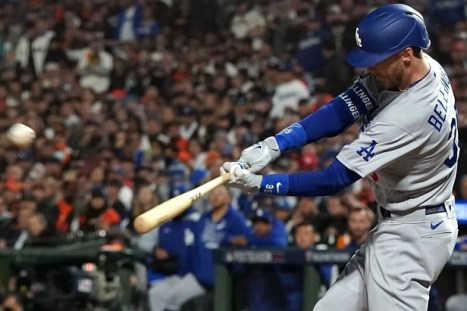
Cody Bellinger, hitting the Game Two-breaking two-run double in the sixth inning Saturday night.

If Cody Bellinger is finally, reasonably healing from everything that turned his regular season to waste, the timing couldn’t be better. For his Dodgers, and for himself.

First, he set up Chris Taylor’s wild card game-winning two run homer with a sharp theft of second base last Tuesday. Now, in division series Game Two, Bellinger started putting the game out of the Giants’ reach Saturday night with a sixth-inning, two-run double off Giants reliever Dominic Leone.

On a night that the Dodgers’ bats re-awakened following their half-asleep Game One loss in San Francisco—even starting pitcher Julio Urias managed to join the fun—Bellinger wasn’t exactly the most prolific Dodger at the plate, just the most important one.

With Trea Turner on second after a leadoff double lined down the third base line, and Will Smith walking his way aboard for first and second, Giants manager Gabe Kapler lifted his starting pitcher Kevin Gausman for Leone. Leone walked Taylor in part because plate umpire Angel Hernandez—what a surprise—called what should have been strike three ball three, on a pitch that hit the upper outside corner squarely enough.

Bellinger checked in at the plate next. With the kind of struggling regular season he had, he wasn’t about to look the proverbial gift horse in the proverbial mouth. He drove Leone’s first service to the back of center field, bounding off the wall, sending Turner and Smith home with Taylor having to stop at third.

Leone barely had time to regroup from that blow when A.J. Pollock lined his next pitch into left to send Taylor and Bellinger home while he bellyflopped his way into second safely for the double. Leone got the final two outs getting Urias’s pinch hitter Gavin Lux to ground out to second and Mookie Betts to fly out to center, but the four-run sixth held up toward the 9-2 Dodger win.

Pollock and Taylor collaborated on the Dodgers’ first run of the game in the top of the second, Taylor lining a one-out double into the gap in left center and Pollock going from 2-0 to a free pass to enable Gausman to get rid of Urias the easy way. Except that Urias refused to cooperate.

Something of an outlier among pitchers at the plate (he actually hit .203 in the regular season, 93 points above pitchers at the plate overall), Urias lined one to right to send Taylor home with the first Dodger run. Betts then lined a base hit to left to send Pollock home for the 2-0 Dodger lead.

Except for Donovan Solano’s one-out sacrifice fly in the bottom of the second, and Brandon Crawford singling home late-game entry Lamonte Wade, Jr. in the bottom of the sixth, the Giants had no answer for the Dodgers’ revival at the plate Saturday night.

The Dodgers weren’t about to provide the Giants answers, either. As if to slam a pair of exclamation points down on the salient point, Smith hit reliever Zack Littell’s first pitch of the top of the eighth into a voluptuous parabola that landed a few rows into the left field seats, and pinch-hitter Matt Beaty (for Dodger reliever Corey Knebel) plus Corey Seager added a pair of RBI singles before the inning expired.

But even though Bellinger struck out three times otherwise, that game-breaking two-run double in the sixth trained most eyes back upon him. He looked at last like the 2019 National League Most Valuable Player again, not like the guy who had everyone not looking deep thinking he spent this season sinking into oblivion with a ten-ton weight strapped to his ankle.

All season long, Bellinger tried to remake his swing to use the entire field while his body refused to cooperate. He’d had shoulder surgery last off-season, after injuring the shoulder first fielding several grounders and then celebrating his home run in Game Seven of last year’s National League Championship Series. Then, he missed the first eight weeks of this season after a leg fracture when he was spiked on a play at first base.

He also suffered a hamstring injury and, in September, a non-displacing rib fracture when he collided with Lux on a play in the outfield.

If you don’t think batterings like that can drain a fellow at the plate, you probably haven’t tried playing professional baseball. Bellinger’s tenacity in trying to play through or around those injuries is as admirable as the reality of his futility at the plate before healing completely from those injuries is deplorable.

Especially when the shoulder continued putting limits on his swing, opposing pitchers saw and exploited the resultant inability to catch up to rising fastballs or reach diver-down breaking balls, and Bellinger’s confidence eroded little by little as the season went forward.

Whether manager Dave Roberts was worse continuing to run him up there than Bellinger was in being so stubborn, despite the shoulder not recovering completely from that off-season surgery, it told you how deep this year’s Dodgers really are that they won 106 regular season games despite Bellinger’s injury-driven deflation.

Now, Bellinger could stand on second base in the sixth with a look akin to the many he had after big hits in his MVP season. Now, Roberts could laugh his fool head off trying to explain it postgame: “Mentally, I don’t see how it could hurt him. There can only be upside. He’s wanted to use the big part of the field, and for him to get rewarded was huge. I think there was a big weight lifted off his shoulders.”

If pun was intended, it wasn’t exactly the smartest or cleverest. It was difficult not to think that Bellinger should have had more extended recovery from that shoulder surgery, taken a somewhat extended spring training, and returned in May at fullest possible strength.

It was between sorrowful and infuriating to see Bellinger playing through the short recovery and subsequent injuries and listening to the witless writing him off as just another slumper who suddenly didn’t know what he was doing.

He’s not quite out of the wilderness yet. But watching him drive that Game Two-breaking double gave you almost as much hope as it seems to have given him. “I feel 100 percent, you know?” he said postgame. “I don’t know how my body is, but I feel really good.”

What he did Saturday night was enough to leave the Giants nursing a serious Belli-ache and the Dodgers feeling even better about moving the series tied at one to Dodger Stadium for Game Three.

Even if they might wonder privately which Max Scherzer will turn up on the mound. Will that someone be Max the Knife? Will he be the tired veteran who surrendered ten runs in his final two regular-season starts, before fighting on fumes to pitch one-run, four-and-a-third innings’ baseball in the wild card game? The answer comes Monday.

Hold Cash accountable for the right reason

Blake Snell (center) leaving the mound. Cash should answer for bringing Anderson in, not taking Snell out.

I didn’t want to go here now. I thought I’d taken care of that two essays ago. But since it seems the mob won’t let go, I guess I’ll have to. Even if I have an audience of ten. So I’m going there: Lifting Blake Snell was not the biggest mistake Tampa Bay Rays manager Kevin Cash made in World Series Game Six Tuesday night.

He lifted the right pitcher but relieved him with the wrong pitcher. That’s what turned the Rays’ early 1-0 lead—on Randy Arozarena’s one-out-in-the-first smash into the right field seats—into the 3-1 Series-losing defeat.

If you are one of my ten readers, you’ve already read it, so bear with me just in case there’s an eleventh reader lurking. Snell was dealing through five full. The cards began getting just a little shaky in the bottom of the sixth, and it’s not as though Snell hasn’t been there before.

Over his entire career, Snell has been the way, oh, just about every starting pitcher worthy of the job has been: He’s easier to hit the third time around the order than he is the first. Makes no sense without the numbers? Here we go again:

Blake Snell Around the Order BA OBP SLG OPS
First Time .205 .280 .312 .592
Second Time .234 .316 .396 .711
Third Time .247 .329 .413 .742

Snell opened the bottom of the sixth getting Los Angeles Dodgers left fielder A.J. Pollock to pop out to short right center field, with Rays second baseman Brandon Lowe ambling out for the catch. Then, on 1-1, Snell hung a slider in the middle for Dodger catcher Austin Barnes to line off the middle into center for a base hit. But he’d started Barnes with a fastball that was slower than his peak speed just a couple of innings earlier.

Remember: Snell finished his evening with nine strikeouts, an awful lot of swing-and-misses, and having struck out the side in the first and the third. He also hadn’t gotten past the sixth inning all year long. And his third-time-around-the-order numbers, analyst Eno Sarris reminds us (just in case we’d known before), are 23 percent worse than the league average for starting pitchers.

And looming on deck as he dealt with and lost Barnes was Mookie Betts.

The Mookie Monster. The guy everyone else is still screaming struck out twice against Snell earlier in the evening and only hit .200 against lefthanders this year. This truncated, irregular-season year. (Which is why his mere 64 plate appearances against lefthanders this year don’t really mean all that much.) Betts is also the guy who hits .297 with an .888 OPS against lefthanders lifetime. It’s practically even-up in the splits with his numbers against righthanded pitchers: .302/.897.

Since the commentators during Game Six made such a point of mentioning it, it’s only right to mention it here, too: From his years with the Boston Red Sox, Betts had the most direct experience of any Dodger against Snell. Here’s the part they didn’t mention so far as I knew in the moment: Betts hit .304 with a .370 on-base percentage against Snell lifetime entering this postseason.

Cash wanted a righthander to match up with the righthanded Betts, even with Betts’s near-even split. He had righthander Nick Anderson up and throwing as Snell started the sixth. He was hoping for a return engagement by the Anderson who was lights out in nineteen irregular season gigs (0.55 ERA; 1.35 fielding-independent pitching rate; 0.49 walks/hits per inning pitched rate; 26 strikeouts and no walks in sixteen innings). Not to mention the Anderson who struck six Yankees out in four and two thirds division series innings.

He got, instead, the Anderson whose American League Championship Series ERA was a ghastly 8.31 while striking nobody out, walking three, and surrendering seven hits; and, whose postseason total entering Tuesday night was a 6.75 ERA and a 1.88 WHIP.

Cash should have thought sooner and better of Ryan Thompson, the rookie who’d been lights out in six ALCS and World Series games with his 1.93 postseason ERA (and zero ERA in the Series) and 1.18 postseason WHIP (and 0.38 Series WHIP), and who’d worked a one-walk, one-strikeout, fifteen-pitch ninth in Game Five two nights earlier. If not Thompson, then Diego Castillo would have been a viable option even with his 3.38 Series ERA, but Thompson really was Cash’s best hand among the Rays’ righthanded bulls.

Maybe you should listen, too, to Anderson himself. “Workload, 2020 season, the whole thing is just crazy, honestly,” he told reporters post-Game Six. “Not having a normal routine, lifting, the season, everything — it’s been crazy. I didn’t feel as good as I would have liked to, but it’s the big leagues; you’re not going to feel good every time. I was still confident. It wasn’t the situation, it wasn’t being in the World Series or anything like that. Not a lot of gas.”

Anderson himself admitting he wasn’t feeling a hundred percent or maybe even seventy-five percent. Cash read Snell properly as Snell began tiring but he read Anderson not at all. Thompson wasn’t even a Game Six rumour, never mind a topic.

The screamers roasting Cash for hooking the hot hand didn’t stop think about the hotter hand. Not in the moment, not when Betts ripped a double down the left field line, not when Anderson wild-pitched Barnes home with Series MVP Corey Seager at the plate, and not when Betts slid home ahead of a throw down from first on Seager’s hopping ground out.

Please, let’s not go there again about “heart” and “character” and “fortitude.” Do you really want to be reminded how often men and teams stand and play proud, with all the heart, character, and fortitude you can ask for, and then some . . . and still get sunk crossing the Jordan to the Promised Land?

Do you still really want to let Snell hang in there to face the Mookie Monster? The net result might tell you yes, but the deepest and most objective look says no. Cash’s mistake was Anderson. Lucy, that and only that is where the manager and his front-office overseers got some splainin’ to do.

The Boys of Pandemic Summer

The Mookie Monster, after hitting his eight-inning Game Six blast.

They don’t have to say “wait till next year!” for the eighth straight year. Crowning a season that once threatened not to hit the field at all, the Los Angeles Dodgers have reached the Promised Land—for the first time since the near-end of the Reagan Administration.

They threw several mountains off their shoulders while Tampa Bay Rays manager Kevin Cash, whose club fought the Dodgers gamely and exuberantly, assumes one that may or may not take three decades plus shake away. No, it’s not exactly the one you think it is.

But first, the credit where due. To the Dodger bullpen whole and Julio Urias especially for turning the Rays off Tuesday night, after Randy Arozarena—the rookie whose season was delayed fighting COVID-19, who arose first in September, then made this postseason his personal possession—hit the first pitch of his one-out, top-of-the-first plate appearance the other way into the right field seats.

Credit Mookie Betts—Mr. Everything, whom the Boston Red Sox decided they could ill-afford, for reasons that may make sense in worlds of flight and fancy but not necessarily on the third stone from the sun—with seizing the moment once Cash made his right-to-wrong move in the bottom of the sixth, doubling to set up second and third—for Austin Barnes to come home on a wild pitch and Betts to have third with eventual Series MVP Corey Seager at the plate.

And, with running home like a thief ahead of Rays first baseman Ji-Man Choi—the guy who split and leaped his way into whatever Tampa Bay hearts still beat—throwing down the line on Seager’s hopping ground out up that line.

Credit the Mookie Monster again with leading off the bottom of the eighth by catching hold of Rays reliever Pete Fairbanks’s 0-2 slider hanging just enough under the middle of the zone and hanging it over the center field fence.

Credit Urias, the seventh pitcher on the night of the running of the Dodger bulls, with two and a third’s closing relief so spotless the young man would have a future making and advertising disinfectant if he didn’t have such a splendid one as a major league pitcher.

Now hold the Rays responsible for spending too much of this Wild Series forgetting how to hit with runners in scoring position, including and especially their 0-for-4 and leaving six men aboard total in Game Six.

And, now hold Cash to account for the bottom of the sixth.

Yes, his lefthanded starter Blake Snell was dealing big through five and a third. Including two hits, no walks, and nine strikeouts that including striking out the side in the first and the third. Yes, Snell looked none the worse for wear opening the sixth getting A.J. Pollock to pop out on the inning’s first pitch and surrendering a followup base hit to Barnes.

Remember what you were taught about looks not being everything? Snell’s entire career shows he’s less effective by a considerable distance when he faces a batting order the third time around. The first time, they other guys have hit .205 against him. The second time, they hit .234. The third? They’ve hit .247. The OPSes against him are .592 the first go-round, .711 the second, and .742 the third.

Betts may have hit only a .200./313/.218 against lefthanders in 2020, but for his career he hits .297 against them with an .888 OPS. Want to know the difference when he hits against righthanded pitching? Five points in the batting average, nine in the OPS. You may not have known those things off the bat, but Cash probably did. He probably also knew that Betts—the Dodger with the most previous experience facing Snell—hit .304 with a .370 OBP against the lefthander prior to this postseason.

With Betts scheduled next following the Barnes single, and Seager right behind Betts, Cash didn’t want Snell getting murdered on the spot at his most historically vulnerable if he could help it. No matter how good Snell looked getting to this point. Even Snell knows it through his obvious disappointment at being hooked.

“I felt good,” the lefty said postgame. “I did everything I could to prove my case to stay out there, and then for us to lose, it sucks. I want to win, and I want to win the World Series, and for us to lose, it just sucks. I am not going to question him. He’s a helluva manager, so I am not going to question him. And I can only look forward to what I am going to accomplish this offseason. But we came up short, and the only thing I can focus on is what I can be better at next year.”

The real problem wasn’t Cash hooking Snell but whom he had ready to follow. If he wanted the righthander-to-righthander match with Betts possibly feeling a little too familiar with Snell by this moment in a World Series elimination game, Nick Anderson—who’d been lights out on the irregular season but vulnerable enough this postseason (6.75 ERA, 1.88 walks/hits per inning pitched rate entering Game Six)—wasn’t his best choice.

Cash would have been better served with Ryan Thompson, who’d worked an efficient ninth in the Rays’ Game Five loss and who hadn’t surrendered a single run in three appearances and two and two thirds innings Series work entering Game Six. But Thompson didn’t seem to be a rumour, never mind a topic Tuesday night.

Sometimes you throw the book into the fireplace. Sometimes you stay with it. Sometimes you make the right move and get blown up. Sometimes you make only half the right move. Lifting Snell was the right half. Prepping and bringing Anderson in showed only too clearly how the wrong half died.

Yes, I regret the decision because it didn’t work out. I thought the thought process was right,” Cash said postgame, knowing he’ll be second-guessed for it for the rest of his life and then some. “I totally respect and understand the questions that come with it. Blake gave us every opportunity to win. He was outstanding. They’re not easy decisions . . . Didn’t want Mookie or Seager seeing Blake a third time. There was no set plan. As much as people think, there’s no set plan.”

It was only half right.

And it wasn’t even close to the worst managing decision any postseason ever saw. It wasn’t Charlie Dressen picking fastballing Ralph Branca over curve balling Carl Erskine with fastball-hitting Bobby Thomson checking in at the plate and the 1951 pennant playoff on the line. It wasn’t Tommy Lasorda deciding it was safe to pitch to Jack Clark with first base open and the Dodgers one out from forcing the 1985 National League Championship Series to a seventh game.

What was all right was the Dodgers in their triumph exorcising eight previous seasons in which their regular-season, National League West-owning dominance got cut off at the postseason pass every time, including back-to-back World Series losses that began to make even those among themselves and their fans who don’t believe in extraterrestrial trickeries begin wondering if they were . . . you know . . .

No. Let’s not go there. Not now. Let’s stay with the current program. With Hall of Famer to be Clayton Kershaw pitching like a Hall of Famer this postseason, his manager making bloody well sure he couldn’t be left in a position to get blown up after stout effort, and savouring that brief postgame spell of heavy, hard breathing relief before joining the party.

With the entire team’s pick-up/dust-off/start-over approach to Game Five after that Three Stooges-meet-Hitchcock Game Four loss at the eleventh-last second in the eleventh hour. With the exuberant Betts and Seager leading the Dodger packs at the plate and stolid Justin Turner keeping them glued, focused, and ready to rumble.

With Betts, period, hell bent to cross the Jordan after the Dodgers dealt for him and David Price in February. “I was traded for to help get us over the hump,” Betts told reporters, “so I used that as my fuel.” He put whatever was left of the Rays’ fire out with gasoline, is all. Seager may have won the Series MVP award. Betts probably made himself the Series MVP in hearts and minds.

Now let’s hold Turner to account for a phenomenal mistake when the Dodgers finally crossed the Jordan.

He had to be lifted from the game in the eighth inning when the Dodgers got word he’d tested COVID-19 positive Tuesday, after a prior test on Monday’s off day proved inconclusive. Assorted officials league and team asked him to isolate himself for prudence and safety sake. Turner wasn’t going to let a little thing like a COVID-19 positive keep him from the party.

Not brilliant. Hadn’t baseball put itself through enough contortions from the sublime to the ridiculous to get anything resembling a season in at all? How brilliant did it look for one of the Dodgers’ signature leaders to come out that irresponsibly and possibly put an entire band of world champions and their families at risk?

How brilliant, too, would it have been if the Rays somehow found one more dose of eleventh-hour unreality and forced a Game Seven—would Turner’s action have delayed that for who knows how long until the rest of the Dodgers plus the Rays tested clean? Remember the irregular season, when even single positive COVID-19 tests meant for postponements.

Remember, too, as The Athletic‘s Ken Rosenthal and other commentators do, that enough with the Dodgers are higher risk. Manager Dave Roberts has survived cancer; relief pitcher Kenley Jansen—who fought and beat COVID-19 in July—has a heart condition; at least one Dodger player has a pregnant wife.

Dear Lord, wasn’t it hard enough for the Boys of Pandemic Summer even in a pandemically-truncated irregular season to get back to the Promised Land at long enough last without that? Nobody forgets Turner the longest-tenured Dodger who isn’t Kershaw or Jansen, Turner who played on six previously-frustrating NL West champions. But tenure usually carries responsibility with status.

The Dodgers’ ancestors of 1955, winning at last what proved the only World Series triumph Brooklyn would ever know, had nothing on this. This may be the first time in the long, glory-to-surreality-and-back history of the World Series, in which the winners needed as many prayers after they returned to the Promised Land at last as they did in the three decades plus it took them to get there.

A calm, objective look at the Mookie Monster

Mookie Betts about to take a low-five from third base coach Dino Ebel after his sixth-inning Game One bomb.

The Mookie Monster is catching more than a few waves of adulation and hype lately. Making three National League Championship Series-altering or sustaining catches in the final three games, then doing something even Babe Ruth never achieved in a single World Series game, does that for you.

“He does things on a baseball field that not many people can do,” says Game One winning pitcher Clayton Kershaw, “and he does it very consistently, which I think separates him from other guys.”

On Tuesday  night, Betts let a couple of other Dodgers take the defensive spotlight gladly in return for drawing one walk, stealing two bases, and hitting a home run. Ruth drew three walks, off one of which he stole second and third, in Game Two of the 1921 World Series.

This Series is only one game old, and Betts hit as many home runs Tuesday night as Ruth hit in the entire ’21 Series—one. No, we’re not comparing Mookie Betts to Babe Ruth just yet, other than to say he has something else in common with the Bambino.

Betts, too, is a former Boston Red Sox star. Betts was traded away while Red Sox Nation was still seeing him in prime time; Ruth was sold before Red Sox fans got to see his complete transition to full-time position playing and his two prime periods—in a very different game—of 1920-24 and 1926-31. And Red Sox Nation isn’t the only baseball outpost still wondering just what the Red Sox were thinking when dealing Betts.

The Ruthian mythology held for too long that then-Red Sox owner Harry Frazee dumped Ruth purely to finance his musical hit No, No, Nanette. (How a 1919 sale finances a 1925 stage production should have escaped thinking people.) Frazee did need money, but not for one of his theatrical productions. He also didn’t need the headaches that came with Ruth, behaving even then like a law unto himself.

Fast forward a century. A very different Red Sox ownership is about as financially challenged as the Saudi royal family. They’re facing Betts hitting free agency after the 2020 season and making little apparent effort to sign him. Betts himself spoke often enough about pondering his market value in that 2020 free agency class. The Red Sox didn’t want to lose him for nothing in return.

Fair enough. But why the Red Sox made no effort to keep their arguable franchise face will be debated at least as long as the old and discredited Curse of the Bambino endured. No matter what the Red Sox didn’t do otherwise last winter to keep the team from collapsing to the basement even in a pandemic-altered year, the Olde Towne Team isn’t likely to go even half as long before its next World Series triumph as they did between selling Ruth and 2004.

“The Red Sox’s payroll issues were not inconsequential,” writes The Athletic‘s Ken Rosenthal, never mind that allowing that the Red Sox doing nothing to re-tool their pitching staff probably did as much to sink them as trading Betts. “The team needed to infuse young talent. But every rational argument club officials make pales in comparison to the importance of keeping a homegrown star, a franchise player, a role model for your organization and a potential Hall of Famer.”

Their loss is the Dodgers’ gain, even if the Red Sox did get some decent young talent in return and rid themselves, while they were at it, of the rest of David Price’s contract before Price’s decline added further miseries. Betts already had a taste of World Series conquest in 2018, even though he didn’t hit well at all while playing solid defense that postseason.

“He does all the little things right,” said Dodgers center fielder Cody Bellinger to Rosenthal, Bellinger having delivered a couple of key postseason hits and defensive gems himself. “You can really learn from that when a guy’s that good and wants to win and continues to do the small things that go unnoticed by a lot of people. It’s really special.”

The guy Betts is being compared to most now hasn’t even gotten more than one quick postseason taste in his rookie season. The Los Angeles Angels aren’t exactly in the poorhouse financially. They’re in the poorhouse in baseball terms, though, since they seem almost terminally unable to build a team their franchise player and the game’s best all around, still, can be proud of.

Once the Mookie Monster cranked his act into overdrive starting in NLCS Game Five, the concurrent subject became Mike Trout, his lack of postseason credentials, and even why Trout is therefore an overrated hype. The foolishness there only begins with the roll of Hall of Famers who either never got to strut in the postseason, came up too short when they got several chances, but still shook out as their generations’ best.

It only continues with ignoring that Trout wasn’t responsible for such ultimately backfiring moves as the Albert Pujols contract—which became an albatross mostly because of Pujols’s injury issues impacting his once-unshakable plate discipline—and the utter failure to develop credible pitching on both ends of the game. That may or may not have only begun with doing little to nothing to keep Zack Greinke beyond his second-half 2012 rental.

Trout’s loyalty to the organisation that brought him forward is nothing but admirable in a business for which loyalty is and has always been a disposable commodity. The only difference between pre- and post-free agency “loyalty” is that pre-free agency teams were under no such obligation and liberal to the point of libertine when it came to “loyalty” to most of their players.

A guy doesn’t sign an extension equivalent to the economy of a small country if he thinks he’s been done dirty off the field. Even nice-guy Trout has his limits, though. He said not too subtly this year that he’s tired of the Angels losing. But when the game’s all-universe player says he’s fed up with falling short and shorter, will the Angels listen at last?

The show Betts is putting on this postseason is as staggering as the 99 Cent Store-budget Tampa Bay Rays bumping, grinding, flying, and diving their way to the American League’s best irregular season record and into the World Series in the first place. But if Betts’s partisans really want to go there with the Trout comparisons, well, you asked for it.

Betts has seven seasons in the Show. Here they are next to Trout’s first seven. First, looking conventionally:

First Seven Seasons BA OBP SLG OPS OPS+
Mookie Betts .301 .373 .522 .895 135
Mike Trout .310 .420 .579 1.000 178

Well, I tried to warn you. And, in absolute fairness, Betts’s line is astonishing for a leadoff hitter, which I’ll take a different crack at shortly.

Now—sorry, can’t resist—look at the pair using my Real Batting Average metric, which I think gives you the complete look at a player at the plate. (It also does what the traditional batting average fails to do: treats hits as they should be treated, not treating all hits as having equal value—which they don’t.) Total bases + walks + intentional walks + sacrifice flies + hit by pitches, divided by total plate appearances:

Real Batting Average PA TB BB IBB SF HBP RBA
Mookie Betts 3875 1786 395 26 33 21 .583
Mike Trout 2012-2018 4538 2171 684 86 43 63 .671

Again, Betts has a remarkable profile for a leadoff hitter. But granted that distinction versus a guy who bats second much of the time and third almost as much of the time, the Mookie Monster isn’t quite the Millville Meteor just yet. (Since you went there: Betts does have a Most Valuable Player award—to Trout’s three that should have been four.)

On the other hand, it might be a lot more prudent and accurate to compare Betts to the first seven seasons of another leadoff man of certain renown.

Real Batting Average PA TB BB IBB SF HBP RBA
Mookie Betts 3875 1786 395 26 33 21 .583
Renowned Leadoff Man 4445 1639 674 24 20 23 .535

The leadoff man of certain renown is Hall of Famer Rickey Henderson. Did you figure for even one milli-second that there but for the grace of his life of crime on the bases would Henderson come up short of Betts? That the Mookie Monster in his first seven seasons is actually better at the plate than the Man of Steal?

Maybe you didn’t before, but you ought to now. Especially since Betts has a slightly better knowledge than Henderson of what to do when his bat takes unexpected time off and becomes a one-man version of the Rays’ collection of aerialists, acrobats, high-wire walkers, and tumblers.

It’s enough to make the Dodgers’ spanking new $396 million man the biggest bargain of the year. Just don’t ask Betts. All he’s ready to do is tell you the most important thing he did in Game One, and it wasn’t the jolt he hit the other way that landed in the right field seats in the bottom of the sixth. For him, it was the double steal that led to him scoring on an offline throw from first base an inning earlier.

“I think it just kept the line moving,” he told reporters. “It was a good play there, and I’ve gotta give credit to the hitters that came up after for driving in runs and keeping constant pressure. It just showed that we don’t have to hit home runs to be successful.”

Not even when it’s the aggregation that led the National League in bombs this irregular season and last full season. It ought to make for one hell of a World Series show going forward.