Minor league contraction loses home

20190411_193442

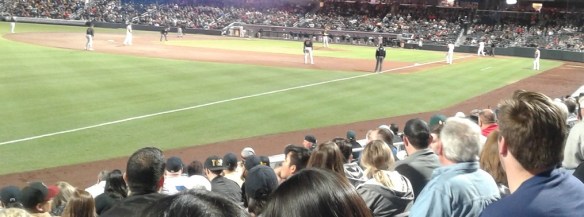
Las Vegas Ballpark, 11 April 2019, taken by the author while watching a game between the Sacramento River Cats and the Las Vegas Aviators.

Minor league baseball is an apprenticeship rough as often as ready for professional baseball players, coaches, and managers alike. But for fans it’s a pleasure that still evokes simplicity and the absence of the country’s and the world’s cacophonies and calamities.

I’ve had that pleasure numerous times in my sixty-four years. I’ve had it seeing the Omaha Royals (long since re-named the Storm Chasers) in the 1980s; the Scranton/Wilkes-Barre Red Barons (known since 2007 as the SWB Yankees) in the early 1990s; the now-defunct Fullerton Flyers (in Goodwin Field, on the campus of Cal State Fullerton) in the Aughts; and, since 2009, the Las Vegas 51s-turned-Aviators, first in creaky Cashman Field and, as of this year, in spanking new Las Vegas Ballpark.

You watch a game and its pleasures and pangs and remind yourself now and then that you’re seeing guys do something that afternoon or evening that mean the fateful phone call bringing them up to the Show. You think to yourself that, God and His servant Stengel willing, there just might be a future Hall of Famer on that field, on that mound, at that plate.

You think that a win for your team would be wonderful fun but it won’t grant them a place in the Elysian Fields’ honour roll of eternal grand champions. But neither do you think that, when your team loses, it means what it meant to too many a Phillie, a Cub, or a Red Sox fan for too many generations—“They came for our fathers, and now the sons of bitches are coming for us.”

Chattanooga, Tennessee baseball fans have had those pleasures since the year (1909) the Hudson Motor Car Company was born. A fan contest named the team the Lookouts, after adjacent Lookout Mountain. Hudson died in 1957. The Lookouts and 41 more of minor league baseball’s 160 teams may die like Hudson (the Cars film series notwithstanding) after next season if the Show has its way.

If you saw or heard about plans to exterminate those teams and you were unamused by the prospect, as many are, you may not be happy knowing the plot was another Astros brainchild. I didn’t know that, either, until I had a gander at Bill Madden in the New York Daily News, who wrote of it last Friday morning with the same lack of amusement.

Baseball commissioner Rob Manfred showed major league owners the plan “a few months ago,” Madden wrote, with the approving vote unanimous. Madden wrote that  the idea was conceived by Astros general manager Jeff Luhnow and supported swiftly enough by two teams whose general managers once worked under Luhnow in Houston: the Brewers (Mike Elias) and the Orioles (David Stearns).

Brilliant. Not only are the Astros at the core of a scandal involving unlawful high-tech, electronic, from-off-the-field cheating, they’re at the bottom of a plan to vaporise 26 percent of grass roots baseball in four short-season rookie- and A-level leagues (the New York-Penn League, the Appalachian League, the Northwest League, and the Pioneer League) and several more at the A and AA levels.

“The rest of the [major league] teams,” Madden wrote, “apparently just said ‘OK’ without any discussion of the ramifications of such a drastic attack on the minor leagues and all these communities across the country.”

The Astros themselves stepped ahead of that particular curve after their 2017 World Series triumph, cutting their minor league affliated teams from nine to seven with the elimination of one of two Dominican Summer League affiliates and their Greenville (Tennessee) Astros in the Appalachian League.

Aside from those mentioned, these are the teams on the hit list:

Appalachian League (Rookie, advanced)—Bluefield Blue Jays, Bristol Pirates, Burlington Royals, Danville Braves, Elizabethton Twins, Greeneville Reds, Johnson City Cardinals, Kingsport Mets, Princeton Rays.

California League (A, advanced)—Lancaster Jethawks.

Carolina League (advanced A)—Frederick Keys.

Florida State League (advanced A)—Daytona Tortugas, Florida Fire Frogs.

Midwest League (A, full season)—Burlington Bees, Clinton LumberKings, Quad Cities River Bandits.

New York-Penn League (A, short season)—Auburn Doubledays, Batavia Muckdogs, Connecticut Tigers, Lowell Spinners, Mahoning Valley Scrappers, State College Spikes, Staten Island Yankees, Vermont Lake Monsters, Williamsport Crosscutters.

Northwest League (A, short season)—Salem-Keizer Volcanoes, Tri-City Dust Devils.

Pioneer League (Rookie, advances)—Billings Mustangs, Grand Junction Rockies, Great Falls Voyagers, Idaho Falls Chukars, Missoula PaddleHeads, Ogden Raptors, Orem Owlz, Rocky Mountain Vibes.

Southern League (AA)—Jackson Generals.

South Atlantic League (A, full season)—Hagerstown Suns, Lexington Legends, West Virginia Power.

Madden wrote that that, according to calculations from minor league baseball itself, would amount to disappearing over two thousand combined years of minor league baseball history. Peabody and Sherman never bypassed that much of the world’s doings and undoings on their Waybac Machine travels.

What made the Astros think about it in the first place? Analytics. The very thing that helped turn them from also-rans to the powerhouse they are. They’ve exposed the side of analytics that its critics abhor and makes even supporters of sabermetrics (like me) cringe. I can find no better description than that from Field of Schemes writer Neil deMause:

As the Astros execs’ thinking went, advanced analytics (i.e., grading players based on such things as using high-speed cameras to measure body mechanics) could replace watching young players play actual baseball, saving the trouble of having to pay so many of them to do so. (Not that this is a huge expense — an entire single-A roster can be had for about $600,000 a year—but again, the Astros are all about exploiting every advantage.) And . . . why should they have to compete against teams like the New York Yankees whose owners were willing to keep minor league teams stacked up like cordwood?

The common good of the game is seen too often as making money for it. Now comes a curlicue once the reserve of science fiction, the common good of the game reduced to applied science and reducing the volume of actual baseball games. This isn’t exactly what Hall of Fame manager John McGraw had in mind when he rhapsodised about “scientific baseball.”

Applying advanced analysis toward helping players improve their games and thus teams improve their competitive standings is one thing. So is applying it sabermetrically toward giving you, Joe and Jane Fan, the most complete possible view of players and games you didn’t get to see. (Ponder: 2,430 major league baseball games are played every season. Maybe five times that many are played in the minors now.)

But they won’t tell you about the people playing those games. They won’t tell you why baseball isn’t really a game of seventy percent failure (seek and ye shall find, I promise you) and, most important, why some baseball players know how to shake away their shortfalls and others don’t. Lessons learned or re-learned in the minor leagues, most of the time.

Minor league crowds are a far more accepting, far less judgmental lot than Show audiences tend to be. And you may also think, above and beyond the game you watch on the field, that the guys on those teams are learning things other than the play itself. Things like why some minor league teachers miss when it comes to teaching players what minor league fans usually understand, that failure isn’t mortal sin.

A minor league team that doesn’t teach those things in hand with the play of the game is a minor league team that gets overhauled, not contracted. And when they don’t teach those things, it means disaster in the Show, where to err is human but to forgive isn’t always Joe and Jane Fan’s (or Journalist’s) policy.

Do you remember Calvin Schiraldi? Once a Met, then a Red Sox. Promising relief pitcher. Came back up late 1986 as the Sox’s bullpen stopper. Imploded fatefully in the World Series. Hung with the no-heart label.

When Mike Sowell wrote One Pitch Away: The Players’ Stories of the 1986 LCS and World Series, one of the players Schiraldi, as textbook a case of self-punishment for failure as you can find from his time. Sowell probably should have won some sort of prize for getting Schiraldi to talk at all, considering the former righthander liked reporters as much as Donald Trump likes criticism.

Sowell got Schiraldi to own up to his wounding flaw, the one flaw above all that kept him from sustained pitching success: “I liked it when I did well. But when I did bad, I took more things to heart than just blowing games off. I mean, if you lose, I took it to heart. Or, if I blew a save for a starter, I took it to heart. That’s probably what hurt me the most.”

That wasn’t exactly uncommon knowledge before Sowell. But it came second hand, so far as I knew. Months after that 1986 Series ended, Thomas Boswell ultimately revealed there was one Red Sox determined not to let Schiraldi sink himself after an earlier playoff loss. “It’s Schiraldi who got so down on himself that it worried me,” said fellow Red Sox (and fellow ex-Met) reliever Joe Sambito. “After he lost . . . I told him, ‘Calvin, you’re the best we have. Put it out of your mind. You can be the hero tomorrow.’ And he was.”

Sambito referred to Schiraldi’s blown save in Game Four of the ’86 ALCS against the Angels. The following night, Schiraldi nailed the extra-inning save set up when ill-fated Donnie Moore—whose eventual suicide came from far more than just one unforgiven (by Angel fans or himself) game failure—surrendered a tying two-run homer to Dave Henderson when the Angels were a strike away from going to the Series.

With the Red Sox an out from winning Game Six and the ’86 Series, Schiraldi gave up three softly-hit Mets singles in a row, the third of which brought the Mets to within a run of tying. Schiraldi was lifted for Bob Stanley. Stanley threw the wild pitch that should have been ruled a passed ball to let the tying run score. And then came the grounder heard ’round the world, skipping through Bill Buckner’s ankle-ruined legs to score the winning Met run. “So what happened after Schiraldi’s defeat in [World Series] Game Six?” Boswell wrote the following February in spring training.

He came back the next day ready to redeem himself. And it rained. He had a day to sit in a New York hotel room and think. When Schiraldi took the mound in the seventh inning of the seventh game, score tied, he was a wreck. Ray Knight, the first batter, hit a home run.

Things like that usually get tended, treated, and re-tended and re-treated in the minors, before you get to the Show—if you get there. Bad enough that Schiraldi’s minor league coaches may have missed them. Things like that are beyond the pay grade of the most deft analyst, technician, or applied scientist, on the Astros’ or any other baseball organisation staff. If the ’86 Red Sox were that advanced, they still couldn’t have saved Schiraldi from himself.

Maybe that’s why Ken Giles went from outstanding closer to 2017 World Series failure to wreck and to Toronto during the following season. The Astros could and probably did give him every analytical edge possible to take to the mound. When Corey Seager, Justin Turner, and Cody Bellinger ruined him in World Series Game Four to break a one-all tie in the ninth, Giles was shattered.

And, maybe alone, no matter that no less than George Springer sprang to his defense after the game. “This game’s hard. They’re not out there trying to fail,” Springer said after that game. “I hope [manager A.J. Hinch] keeps giving ’em the ball. I have the utmost confidence in them, and I’m glad they’re on my team.” Springer might have but Hinch didn’t. Giles was never seen again in that Series.

The following season, a couple of bad outings turned into a couple of bad meltdowns and Giles’s trade to the Blue Jays (for, controversially, Roberto Osuna), where he regrouped and posted an enviable 2019 despite a couple of injuries.

Don’t make the mistake of saying the pressure of the games or the postseason themselves got to either Giles or Schiraldi. Young men who don’t get taught or re-taught that failing in a game isn’t a mortal sin beat themselves no matter whether it’s a season opening series or the World Series.

Maybe Henderson was onto something when he once said, “This is a game. It’s not life and death. It should be fun.” Hell, he’d had to remind himself in that very ALCS Game Six: earlier, before his dramatic bomb, he tried snagging Bobby Grich’s fly with a flying leap, but the ball tipped off his glove and over the center field fence for a two-run homer.

Henderson wasn’t really the superstar he appeared for brief moments in that postseason; he was a useful journeyman in a respectable fourteen-season major league career. But he endured precisely because he knew failure didn’t have to be the end of the world as he knew it. And just maybe the easygoing Hendu got the proper reinforcement on that approach in the minors.

If you think that’s just a voice from the grave (Henderson died of a heart attack two months after a kidney transplant in 2015), maybe you’ll listen to Casey Mize, 2018’s number one draft pick overall. “I think failure is part of it and needs to be part of it,” said Mize—after throwing eight shutout innings at the Bowie Bay Sox for the Erie Sea Wolves (AA, Tigers affiliate)—about player development. “I see positives in being forced to fail.”

The minors aren’t anywhere near perfect. There’ll always be those players who don’t advance for assorted reasons and those reasons don’t all include analytic failure. There are injuries that curtail careers, there are boundless external issues, and there are mindsets that let the sense of fun die too soon when they realise professional baseball is the serious work of play.

One of the issues believed to be animating the contraction plan is ballpark conditions. As in, ballparks not up to major league standards. As in, the distinct whiff of potential litigation from minor league towns where taxpayers got the bill for upgrading the parks or building new ones entirely. But as Madden observed, if so many minor league parks aren’t up to snuff, why did the Show let the Cubs and the Pirates play a regular-season game in Williamsport last year? And why would they let the Red Sox and the Orioles do likewise next year?

Another may well be minor league conditions. The Show’s spinning, as Madden calls it, includes that the contraction plan is also aimed at “improv[ing] ‘wellness’ for the minor leaguers in terms of travel and living conditions,” though noticeably not in terms of their salaries, which should be redressed.

Many of the teams targeted for contraction, Madden added, “are grass roots baseball towns where most of baseball’s biggest stars passed through (and developed a forever fan base) on their way to the majors.”

An official from one of the teams in the Pioneer League, where most of the teams are in Montana, Idaho, and Wyoming, put it to me this way: “This is the only way people in these towns can see baseball. They can’t afford to drive a thousand miles to Seattle. And you’re talking about young fans . . . You take their teams away and baseball has lost them forever.

Dodger pitcher Walker Buehler thinks one key minor league issue is too many players there. “At any affiliate, there are three players who have a chance to play in the majors,” he told FiveThirtyEight. “The rest of the players are there so they so they can play. I don’t think that’s fair. You are preying on their dreams.”

It may not be as simple a scenario as Buehler seems to think, that minor league teams and their major league overseers prey on too many dreams unlikely to come true. And speaking of dreams, the Show has a plan for those minor league owners who lose their teams if the contraction plan flies: what it calls a Dream League, an independent league operated by the Show at minimal cost.

Madden, however, noticed a big problem with that idea:

In addition to stadium maintenance and taxes which they’re already paying, the cost of players, managers, coaches, trainers, and equipment people’s salaries and workers comp insurance would now all fall on the owners—between $350,000-$450,000 per year. When it was pointed out by minor league negotiators there was no way these minor league owners, after losing all the equity in their teams, could then afford to own a “Dream League” team, the MLB response was: “Well, they didn’t pay all that much for their teams in the first place, so it’s only paper money.” Tell that to David Glass, who bought the Kansas City Royals in 2000 for $96 million and recently sold them for $1 billion. Or as one minor league negotiator told me: “I guess that means it’s OK they should be punished for being good business operators.”

They and their fans will be punished just by losing their teams at all. Bristol, Tennessee has been in business in the minors since the sinking of the Lusitania. (1918.) Assorted South Atlantic Leagues (known colloquially as the Sally Leagues) have existed since Hoover Dam. (1936, though the dam was born as Boulder Dam.)

The Jackson Generals were once known as the Memphis Chicks—born with the Southern Association in the year (1901) New York became first in the nation to mandate license plates and the American League declared itself a major league; producing the Southern Association’s one-armed league Most Valuable Player, Pete Gray, in 1944.

That’s just a peek at the history that stands to be lost, in hand with the pleasures of baseball itself on the field, for millions of fans who can’t reach the Show except on television or radio or the Internet.

“Baseball is quintessentially American,” wrote A. Bartlett Giamatti before he became a baseball official himself,

in the way it tells us that much as you travel and far as you go, out to the green frontier, the purpose is to get home, back to where the others are, the pioneer ever striving to come back to the common place. A nation of migrants always, for all their wandering, remembers what every immigrant never forgets: that you may leave home but if you forget where home is, you are truly lost and without hope.

The Show’s minor league contraction can be taken, then, as evidence that those who run it forget where home is for millions of fans, and that it takes more than scoring runs to come home.
Labour Day looks and lamentations

2019-09-02 WashingtonNationals

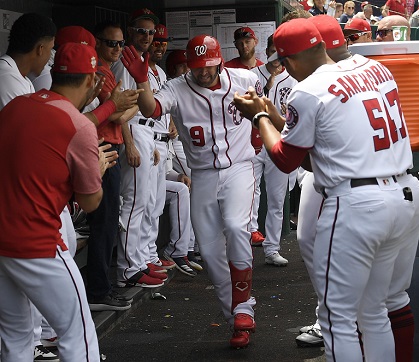
Brian Dozier (9) has a feature spot in the Nationals’ dugout dancing. But can baseball’s version of Dance Fever dance themselves into the postseason?

Maybe you did figure on things like this coming. Maybe you didn’t. But it might still be fun to consider them anyway. Prowling around early morning on Labour Day, you can discover, among other things recent past and present:

Looks Aren’t Everything Dept.—Phillies catcher J.T. Realmuto looking as though someone spiked his Raisin Bran with castor oil as he arrived at the mound and saw the bullpen gate open. Realmuto calls it poor timing, and we’ll take his word for it, but the Phillies’ bullpen isn’t exactly disaster free.

Mercy, Mercy, Me Dept.—You really want a mercy rule after Dodgers catcher Russell Martin threw the final inning of a blowout shutout? According to the irreplaceable Jayson Stark, no position player turned that trick since 1917.

Merciless Dept.—Royals shortstop Alex Gordon started a game as the cleanup hitter and finished it pitching two innings. The previous men to start a game hitting cleanup and end up pitching more than one inning in the same game? Ted Williams (1940) and Babe Ruth (1919). Gordon has bragging rights on Martin and a passel of other pitching position players now.

The Basement Tapes Dept.—Six teams came into September with excellent chances of finishing 35 games or more out of first place in their divisions. Two have better chances than that of finishing 40+ games out of first. And one (the Royals) stands to finish 35+ games out of first in the American League Central without being in last place.

But six that far out of first never happened before in the divisional play era. And, according to Stark, it only happened twice before that: in 1906, when the Cubs won 116 games; and, in 1954, when the Indians won 111. (And, when the Yankees won 103—but finished second.)

Houston, We Have No Problem Dept.—The Astros have their third straight American League West title pretty much in the safe deposit box. There’s only one good reason for them to keep grinding aside from their comparatively simple schedule the rest of the way: home field advantage in the American League Championship Series.

The other American League guys who rival the Astros for the greatest ratio of 2019 success to injured list crowding, the Yankees, also rival the Astros for gorging on home cooking: At this writing, the Astros are 51-17 in Minute Maid Park and the Yankees are 49-20 in the House That Ruthless Built.

And only one team since the advent of the wild card has played .700+ lights-out at home without winning a League Championship Series: the 2001 Mariners.

Bronx Bombing Dept.—When it was time to awaken on Labour Day, the Yankees needed one more ninth-inning home run to become baseball’s first. team. ever. to get at least twenty homers on a season in every inning, first through ninth.

Strike The Stage Dept.—With Justin Verlander throwing a fourteen-strikeout no-hitter Sunday, the Astros got closer to setting a precedent: they could finish the season as baseball’s first. team. ever. whose pitching staff will lead the game in strikeouts and whose hitters will finish dead last in striking out.

St. Elsewhere Dept., Continued—Looks like I wasn’t kidding about the Yankees being the American League East’s best and baseball’s version of a M*A*S*H post-op section. Gio Ursehla hitting the injured list with a groin injury Friday made for the 29th Yankee to go to the infirmary this year, breaking the record of 28 by the Dodgers three years ago. Paging Dr. Westphall . . .

Twin City Rockers Dept.—Maybe the Twins can bomb their way to the American League Central title. They’re now baseball’s most prolific single-season smashers with 268 clearing the fences, passing last year’s Yankees. And they’ve also re-gained a five-and-a-half game lead over the Indians as of this morning, with the Indians both a half game behind for the first AL wild card and only a half game ahead for the second card.

It Ain’t Over Until It’s Over Dept.—The Braves went 19-9 in August including an 11-2 finish to the month. The National League East is still theirs to lose right now. But could they lose it? They could, theoretically—to the Nationals. You know. The guys who were among those left for dead before 23 May.

But since 23 May, according to The Athletic, the Nats have a better record (58-27) than the Braves (56-31) and have thus been baseball’s best team since that date. Unfortunately, that 19-31 season opening counts, too. And guess who get to play each other for seven games early this new month?

By the way, the Nats since the All-Star break are 30-16 and the Braves are 30-17. If there’s a time for the NL East leaders to be overthrown, it starts with a four-game set in Sun Trust Park 5 September and could continue with three in Nationals Park starting—wait for it!—Friday the 13th.

The Nats may have the slightly tougher tuneup for the first set, though: the Mets haven’t looked as good in the last two weeks as they did coming out of the All-Star break, but they’re not exactly pushovers just yet, either. And the Nats get to tune up for the Braves against the Mets at home before hitting the road. The Braves get a two-game tune up against the Blue Jays before greeting the Nats.

Too Little, Too Late Dept.—Unless they have a not-too-likely third wind in them, the Mets’ season may be cooked. They were 24-10 after the break and before they swept the Indians last month; they’re 2-7 since, thanks to a sweep by the Braves, in games they could have won, and thanks to a followup sweep by a Cubs club that sometimes hasn’t looked quite as good or at least as consistent as their record.

The Mets had to prove they could hang with the big boys after fashioning that staggering post-break run against mostly the also-rans and the never-woulds. But getting swept by the Braves at a moment when they could have turned the NL East at last into the dogfight everyone predicted out of spring training hurt. So did the followup sweep by the Cubs. They’re four out for the second wild card. Their postseason hope is slimmer than a thread.

Taking two of three from the Phillies in Citizens Bank Park this weekend wasn’t exactly meaningless, but they get three with the Nats in D.C. this week and another set with the Phillies at home this coming weekend. And even if their post-break record is 29-17 (one less win than the Braves), and almost wholly dependent upon how everyone else still in the picture does, this is crunch time for the Mets, whose postseason odds still sit at a seven percent chance at the postseason. This makes or breaks them.

Monsters of the Midwest Dept.—The Cardinals’ self-resurrection makes life even more interesting for the Cubs, who now sit in the second NL wild card spot and only three games behind the Cardinals for the NL Central. And other than two sets to come against the Cardinals, the Cubs have as cream puff a schedule to come as you could ask. The worst the Cardinals seem to face the rest of the stretch is a set with the Nationals starting 16 September.

So at least one and possibly both the sets to come against each other could find both the Cardinals and the Cubs in duel-to-the-death mode. But don’t rule out the spoiler factors to come, either. Pride still counts for plenty among the also-rans who’d like nothing better than to be the ones who make life miserable, or at least more challenging than it ought to be, for the big boys.

Brief Candles Dept.Who says Astros strongman Yordan Alvarez can’t walk home for the year with the American League’s Rookie of the Year award? Only 62 games, you say? It isn’t exactly unprecedented. I can name you a Hall of Famer who won a Rookie of the Year award despite playing in only (count them) 52 games the year he copped the prize: Willie McCovey, 1959.

Aside from which, Alvarez is liable to play in just about all the Astros’ remaining regular season games, giving him possibly 85 games. Ryan Howard copped an ROY playing 88. So if the Rookie of the Year should be the guy who does some of the most unheard-of things you ever heard of among rooks, Alvarez ought to have the award in the bank the same way it looks as though the Mets’ Pete Alonso does in the National League.

It’s just a shame in that regard that the Astros have a great chance of reaching the World Series and the Mets need the rest of the league to drop dead to get there, just about. Because the idea of Alonso and Alvarez tangling in a Series with their rookie credentials and plate firepower would be . . . forget must-see TV. It’d be damn-well-better-see TV.

He’s the Greatest Dancer Dept.—Remember the Sister Sledge disco hit of that name? If they gave that award out in baseball, this year’s Nats—those Dancing Fools, those  Tighten-Uppers, those Dance Fevered, who turn dugout celebrations into Arthur Murray clinics and Nationals Park into the Land of a Thousand Dances—would win the prize without even a sliver of competition.

But if they get to the postseason, would the Nats think of doing the Stroll for their on-field victory celebrations? Why the hell not?

On patriotism in its proper baseball place

2019-04-22 KateSmithCBS

Kate Smith at the height of her radio career.

The skirmish over the Yankees turning Kate Smith’s version of “God Bless America” off, until they can verify she wasn’t the racist a particular 1931 recording of hers has people today believing, should also have us thinking about things aside from dubious retroactive punishment for dubious retroactive charges of racism. Whether it does, of course, is something else again.

Let’s get this one out of the way: Kate Smith has never been a particular music interest of mine. My taste (and preference as the musician I just so happen to be, as a guitarist and lately, too, as a self-teaching vibraphonist) inclines far more to blues and jazz, and Smith was about as much of a blues or jazz singer as Miles Davis was a pan flute virtuoso.

When I wrote about the hoopla a couple of days ago I cited the television critic Tom Shales, who observed that kids who grew up hearing Smith “privately felt that this is what Mom would sound like, if only Mom could sing.” It prompted me to remember my own late mother singing in the shower and sounding as though being tickled on the soles of her bare feet while doing it, which is just about the way Smith’s voice sounds to me whenever I hear it.

As a concurrent lover of classic network radio from its infancy through the era’s commonly acknowledged death in 1962 (I have a personal collection of sixteen thousand plus surviving such radio shows), I’m aware of Smith’s popularity on the air, though little enough of her radio work seems to have survived the era in the way that such as Fibber McGee & Molly, Jack Benny, Lux Radio Theater, Suspense, and Gunsmoke have done. Those and more such survivals than you might believe allow the curious and the enthusiast alike to listen, learn, and, yes, stand athwart nostalgia, yelling “Art!”

But I’m also aware that Smith leveraged her own popularity during World War II to become one of radio’s most effective at delivering the goods when it came to promoting war bonds buying. She’s believed responsible for inspiring around six hundred million dollars worth of war bonds buying, never mind that no one has written a book addressing it specifically as compared to the delightful offering by Mickey Cohen (no relation to the mob legend), How Fibber McGee & Molly Won World War II.

Clearly Kate Smith has patriotic cred to burn. Just as clearly, the very idea of purging her signature recording of “God Bless America” from anywhere equals replacing Washington, Jefferson, (Theodore) Roosevelt, and Lincoln atop Mount Rushmore to an awful lot of people.

That the Yankees elect to think about it on the so far unverifiable ground that she was herself a racist—it’s based on her 1931 recording of “That’s Why Darkies Were Born,” a song known to have satirised racism—falls into place with the contemporary itch to punish and purge ancient disgraces regardless of whether the offender renounced or transcended them in later years.

Last year, in light of the still-festering take-the-knee protests upon sounding “The Star Spangled Banner” before football games, and the National Football League’s then-announced formal rule requiring players to stand for its playing, I wondered aloud whether “The Star Spangled Banner” and even “God Bless America” have been and still are so overdone before sports events as to render their meaning, well, meaningless.

2019-04-22 FredThomas.jpg

Fred Thomas, who knew about patriotism from the heart, not habit. Presumably he’s hitting here during the 1918 World Series.

Baseball itself actually has no formal rule covering either song’s playing, which is rather intriguing considering the whole thing started during a baseball game in the first place.

Specifically, it was during Game One of the 1918 World Series, with World War I on the threshold of its end and semicircular American flag bunting lining the fences in front of the field-level seats. A Navy band was present at the game. (It was common for military bands to offer music at sporting events in those years.) With or without a plan to do so, the band broke into “The Star Spangled Banner” during the seventh inning stretch.

Quite spontaneously, Red Sox third baseman Fred Thomas, himself on leave from the Navy to play in the Series, turned toward the flag in Comiskey Park (the Red Sox played the Cubs but it was thought the Cubs’ own playpen wasn’t big enough to accommodate Series fans) and saluted.

Thomas’s spontaneous gesture prompted players in both dugouts (including Babe Ruth, then a Red Sox pitcher and en route a six-hit shutout to open the Series) to salute likewise, and the ballpark crowd joined just as spontaneously. For the rest of the Series the song was played at the seventh-inning stretch. Gradually, other baseball teams and other teams in other sports leagues took it on, too.

All that before “The Star Spangled Banner” became America’s official national anthem. (It became so in—what do you know—1931.) The practise moved to playing the song before games continuing through the end of World War II and beyond, but only the NFL after the war ended made it mandatory before games.

“God Bless America” during the seventh inning stretch took hold in the wake of the 9/11 atrocity but has since receded to periodic playings, not the constant thing it was for a few years to follow. Baseball government never made it mandatory any more than it ever formally mandated “The Star Spangled Banner.”

Compulsory patriotism is empty patriotism. You probably don’t need me to tell you about those countries where patriotism was (and still is) enforced at actual or implicit gunpoint. Do you need me to remind you that there have been times enough in our own history where there’ve been those in the land of the free and the home of the brave who’ve favoured something as close to gunpoint patriotism as they could get away with?

I’d like to think the ridiculous Kate Smith kerfuffle might have been avoided if what I suggested last year might have come about: Knock it the hell off with playing “The Star Spangled Banner” before every last American sporting event all season long. And, for that matter, with “God Bless America” during the periodic seventh inning stretch. Save them for such days as Opening Day, games played on major national holidays (Memorial Day, the Fourth of July, Labour Day, etc.), the All-Star Game, and the first game of the World Series.

I’m not saying it lightly. To this day I’m charmed by the story Casey Stengel’s biographer Robert W. Creamer told “that I hope is true” (Creamer’s words): On his death bed, Stengel had a television broadcast of a game beginning in his room, and as “The Star Spangled Banner” began (as late as 1975 fans watching on television could hear and see the ballpark with it before game time) he slid out of bed, picked up the Mets cap he kept at bedside, put it over his heart, and muttered to himself, “I might as well do this one more time.”

But the charm in that is also that the Ol’ Perfesser did it spontaneously, from his heart, on the threshold of losing his battle with lymphatic cancer, and not because there was any edict requiring him to do so. Mandate it whether by formal edict or entrenched behaviour, and you reduce patriotism to habit. And patriotism—as Fred Thomas and his fellow 1918 World Series competitors understood without being told—is just too valuable and precious for that.

The first annual Karl Ehrhardt Prize for Extinguished Baseball Trolling

PhilliesUseLifebuoy02

My phutile attempt to imagine how the 1930s Phillies’ Lifebuoy endorsement was, shall we say, augmented editorially by a disgruntled fan . . .

Once upon a time, the Phillies played in a ballpark shaped more or less like a sardine can, with the field looking as though shoehorned into a gymnasium. The place was called Baker Bowl, and the high aluminum right field wall once bore a team endorsement for a deodorant soap. With the Phillies not exactly being National League oppressors at the time, a particularly disgruntled fan managed to add to the ad’s slogan, making it read, “The Phillies Use Lifebuoy . . . and they STILL stink!

In the same decade (the 1930s), the Dodgers earned their legendary nickname the Bums, thanks to a cabbie asking a passenger, “How did our bums do today?” The passenger was  legendary New York World Telegram cartoonist Willard Mullin; the exchange inspired Mullin’s fabled remake of Emmett Kelly, Sr.’s “Weary Willie” hobo into the eternal representation of the Dodgers. The Bums were bums enough that one angry fan took his paint to Ebbets Field’s occupancy law sign, making it read, “Occupancy by more than 35,000 unlawful. And unlikely.”

You thought fan trolling began when Yankee fans trolled Curt Schilling during the 2001 World Series, after he alluded somewhat sarcastically to the Stadium’s “mystique and aura” to be greeted with, “Mystique and Aura. Appearing Nightly?” When George Steinbrenner’s worst of the 1980s inspired a Yankee Banner Day parade winner wearing a monk’s hooded cassock and hanging a sign saying FORGIVE HIM, FATHER, FOR HE KNOWS NOT WHAT HE DOES from the Grim Reaper’s scythe? When Red Sox fans began chanting “Darr-yllll! Darr-yllll!” at a certain Mets outfielder who wasn’t exactly breaking the neighbourhood on the Boston leg of the 1986 World Series? When assorted Cub fans at Wrigley Field whipped up placards saying WAIT ‘TILL NEXT YEAR—on Opening Day when the season’s first pitch was thrown? When seven Original Met fans greeted the Dodgers’ first return visit to New York by unfurling, in perfect sequence, from an upper deck rail, seven window shades spelling out:

2018-12-30 OMalleyGoHome

Yes, it’s another futile artist’s conception.

When done properly, with genuine wit, and without truly frothing malice, fan trolling is as much fun as a game-ending home run—or, if your team faces the bases loaded, a full count on the enemy hitter, the winning run at first base, and nobody out, your heroes turn a game-ending triple play. (Yes, it’s happened, though not with the bases loaded. The first victims, what a surprise, were the Mets, who ran themselves into one in August 2009, and unassisted yet, when Jeff Francoeur—batting with first and second—lined to Phillies second baseman Eric Bruntlett, who stepped on second and tagged the runner advancing from first in a near flash. Obviously the Mets needed Lifebuoy.)

Even Dodger fans enjoyed a sad chuckle when, with the Cardinals about to push the Dodgers out of a postseason and now-traded Yasiel Puig at the plate, a Busch Stadium fan held up a placard hailing, “Dodgers win? When Puigs fly!” The late Karl Ehrhardt would have been proud. So would the ancient Dodgers Sym-Phony Band, whose atonal racket charmed Ebbets Field fans and the Dodgers alike. Especially when they’d play “Three Blind Mice” after close calls went against the Dodgers. (The humourless umps actually tried getting injunctions against that and also against Ebbets Field organist Gladys Gooding for similar musical crimes against their dignity.) Or, trailing an enemy pitcher knocked out of the box, the Sym-Phony bass drummer would beat his drum to the pitcher’s steps back to the dugout, where taking his seat in the dugout (if he didn’t go to the clubhouse first) received a loud SPLAT! of bass drum and cymbal in unison.

DodgersSymPhonyBand

Troll over, Beethoven!

Karl Ehrhardt was the fabled Sign Man at Shea Stadium for a very long time (1964-1981), assembling handsome, colourfully-lettered, sometimes made-on-the-spot signs to address plays or situations. His parents moved their family from Germany to Brooklyn when he was six; he grew up a Dodger fan and became a commercial graphic artist by profession. He was known to bring as many as sixty of his reputed 1,200 signs to a given game, picking them according to whom the Mets would play and what he thought was likeliest to happen in a game, and he rarely misstepped.

KarlEhrhardt

Karl Ehrhardt.

A favourite was one of his greetings to an enemy pitcher who’d just been knocked out of the box: LEAVING SO SOON? (An alternate: Y’ALL COME BACK NOW, HEAR?) To an enemy pitcher walking a Met hitter intentionally: CHICKEN. To the Orioles with the Mets three outs from their miracle 1969 World Series conquest: BYE, BYE, BIRDIES! To any Cub foolish enough to argue with the umps over a close call going to the Mets: BACK TO YOUR CAVE, BEAR! (When the Orioles argued a close infield play during the Series, it was BACK TO YOUR NEST, BIRD!) After a win over the Cardinals, it was likely to be 5 AND 20 REDBIRDS BAKED IN A PIE!

When Athletics owner Charlie Finley tried to remove hapless second baseman Mike Andrews from the 1973 World Series roster, after two Game Two misplays in Oakland helped the Mets win in extra innings, Ehrhardt was more than prepared. Sure enough, there was an Oakland field miscue in the bottom of the first in Game Three. Up went the Ehrhardt sign: YOU’RE FIRED! (No, we don’t know whether Donald Trump was among the stadium crowd that afternoon.)

But he also knew how to let his own heroes have it when they were playing less than heroically. HE’S HOT TONIGHT! worked either for a Met on a streak or a Met in a slump. IT’S ALIVE! usually greeted a Met breaking out of a slump or a customarily weak hitter reaching base. JOSE, CAN YOU SEE? usually greeted any player named Jose, Met or opponent, who’d struck out. (It started with Jose Cardenal.) Clearly the man who had those plus KONG! and THE KING OF SWING! ready for one of Dave Kingman’s orbital home runs, ORANGE CRUSH! for big hits by Rusty (Le Grande Orange) Staub, and THEY SAID IT COULDN’T BE DONE! for the Miracle Mets’ first parade down New York’s Canyon of Heroes, deserves enduring recognition.

Ehrhardt’s days in the Shea third base field boxes ended after he became fed up with the team’s seemingly willful dissipation in the mid-to-late 1970s, with then-boss M. Donald Grant a particular target for having screwed the Tom Seaver pooch. WELCOME TO GRANT’S TOMB was probably the mildest of Ehrhardt’s trolls to the front office. Once a concurrent fixture at Mets team functions, Ehrhardt’s zaps made him persona non grata there, and, as he eventually said, “They turned their back on me so I turned my back on them.” But a later Met administration convinced him to return for the team’s 40th anniversary, a one-off appearance for which he shocked Met fans by hoisting THE SIGNMAN LIVES! before returning to his private life until his death in 2008.

Fans so often turn trolling into an art worthy of Fred Allen, Groucho Marx, Gracie Allen, Flip Wilson, Jack Benny, George Carlin, P.J. O’Rourke, and Jokey Smurf. But so do those involved with baseball professionally—as anyone can tell you who saw Roger McDowell bomb Mets first base coach Bill Robinson with a time-delayed hotfoot, or Joey Votto trolling road fans by chasing down foul grounders as if they were potential double play balls before they could become fan souvenirs. If the Yankees had beaten the Red Sox in this year’s American League division series, Aaron Judge would be the most powerful contender for the troll awards, thanks to his zapping the Red Sox as he left Fenway Park for the series move to the Bronx by playing “New York, New York” on his boom box.

Except that the Red Sox dumped the Yankees quickly and without a loss in the Stadium. No less than former Yankee star Mark Teixiera reminded Judge what happens when you awaken a sleeping giant. Even MLB itself, whose social media staffers know a thing or two about symbolism, couldn’t resist hitting the Yankees where it hurt on Twitter:

LadyLibertyRedSox

Having been unable to exhume the actual identity of the staffer whose genius it was to create that impossible to top fashion statement, we’ll just have to settle for giving  Throneberry Fields Forever’s first annual Karl Ehrhardt Prize for Extinguished Trolling thus:

2018KarlEhrhardtPrize

Give us your tired, your poor, your huddled Yankee fans yearning to breathe, period; the wretched refuseniks of the steaming Stadium. Send these, those homeless, Series-ringless-this-time-round to me. And lift your braying ears before the House That Ruthless Built!