NLCS Game Three: “Be really stubborn in there”

Jackson Chourio

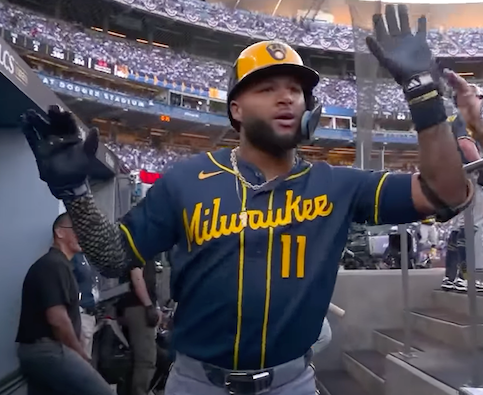
Chourio accepts his props for hitting Game Three’s first pitch into the bleachers Thursday night.

After his Dodgers lost National League Championship Series Game One by a measly 2-1 score, Mookie Betts said they needed to start playing Dodger baseball, “whatever Dodger baseball is.” Then, they lost Game Two a little more decisively, 7-4.

Now, you might not really want to know what they’re thinking. Not after the Brewers knocked them into the NLCS hole 0-3, with Wednesday night’s quite emphatic 6-2 Game Three win.

The Damndodgers are on the brink of winter vacation without a World Series berth to show for being 2026 baseball’s . . . second-winningest team. For being even-up with the Brewers prior to this NLCS, going 8-2 in their last regular season ten and going 15-5 in their last regular season twenty and going 20-10 in their last regular season thirty.

Oops. The Brewers went 22-8 in their last regular season thirty. They also went 4-3 against the Dodgers in their regular season series against each other. The Brewers team OPS was .743 to the Dodgers’s .762, a -19 point difference. Their team fielding-independent pitching (fourth in Show this year) showed the Dodgers (second in Show) only four points lower.

In other words, there wasn’t that much reason to assume the Damndodgers—those money-throwing monstrosities who can’t possibly have anything else such as scouting, player development, analytics, brains, and guts to make them NL West champions thirteen of the last fourteen seasons—were that far superior to these saintly scrappers out of the Milwaukee bargain houses.

Well, now. The Family Dollars are on the threshold of going to the Big Dance. All they have to do is take one more from the Cartiers. Difficult, but not impossible.

If the Dodgers find a way to batter the Brewers in Game Four Thursday night, the Brewers could always elect to make sacrificial lambs of relievers they haven’t yet deployed, comfortable knowing they have Jacob Misiorowski to ride in Game Five. Les Mis, plus their usual case of off-off-off-off-Broadway anti-stars. Even if it’s a Misiorowski-Tarik Skubal rematch.

Misiorowski to one side, how many people outside the burg that made beer ubiquitous could name one of the Brewers’s current cadre of characters not named Les Mis, Christian Yelich, Jackson Chourio, or William (Kid Brother of Willson) Contreras, before this postseason began?

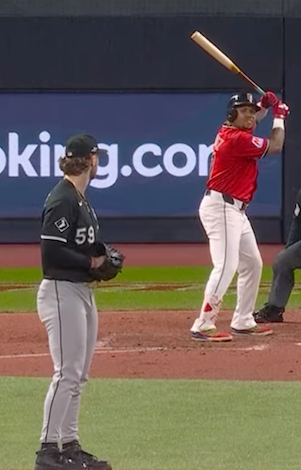
Chourio merely renewed his name recognition Thursday night. All the left fielder had to do was exactly what he did in Dodger Stadium, hit Game Three’s first pitch the other way and over the right center field fence.* With one swing, he renewed his prospects of becoming the second Jackson behind a certain Hall of Famer to be thought of as any type of Mr. October.

“I was still putting my batting gloves on to get ready,” said Brewers first baseman Jake Bauers, who batted fifth in the lineup Thursday. “I just saw the ball flying, and I knew he got it. It kind of set the tone for the day and let everyone know that we’re here to win this game.”

There’d be two more bombs to come later in the game, from two of the Brewers’s heretofore-unknown soldier contingency. From Bauers, hitting a two-run homer in the seventh, then from center fielder Garrett Mitchell, following almost immediately with a solo blast landing not far from Bauers’s bomb.

So where did this power originate? Isn’t that anything but the Brewers’s usual game of scrape, fleck, hunt, and peck?
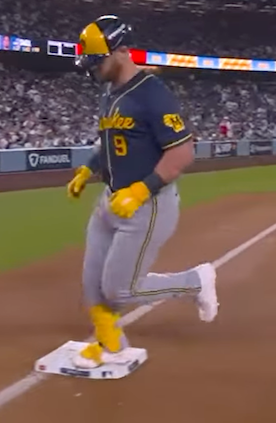
Jake Bauers

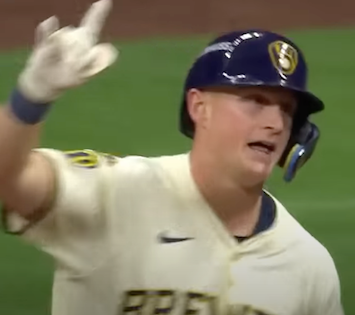
Bauers rounding third off his eleventh-pitch two-run homer.

“It’s funny,,” said outfielder Sal Frelick postgame. “We are hitting some homers, but that’s not the approach at the plate. It’s just: apply pressure, apply pressure. I think by applying pressure, we’re able to dictate that pace of play. It’s not result-oriented, it’s just at-bat oriented. It doesn’t matter if you get out, get on, strike out, whatever. Just take a chunk of the pitcher with you and establish playing that way.”

They’d take their chunks out of Dodgers starting pitcher Blake Snell in due course. First, they had to navigate the lefthander shutting them out for five innings to follow Chourio’s rude introduction. Other than a one-out walk (Mitchell) and base hit to left (rookie shortstop Cooper Pratt) in the second, Snell looked as though he’d filed ownership papers on the guys too many still underrate.

Brewers starter Robert Gasser (now, there’s a name for a pitcher, even if his fastball isn’t the type to be called a gasser) was almost as good as Snell before turning it over to the bullpen. He pitched five solid and survived the Dodgers putting their leadoff men aboard three times and coming up scoreless.

At first, it looked as though manager Pat Murphy played the wrong hand. Abner Uribe, heretofore one of the Brewers’s more effective relievers, had his first truly shaky postseason outing in the sixth: walk (left fielder Teoscar Hernández), walk (right fielder Kyle Tucker), swinging strikeout (pinch hitter Max Muncy), walk (still-ailing designated hitter Shohei Ohtani), two-run double (catcher Will Smith). Forcing Murphy to reach for DL Hall to keep the deficit to 1-2.

Come the top of the seventh, though, the Brewers made Dodgers manager Dave Roberts pay for forgetting Snell’s career-long vulnerability: going the third time around the enemy lineup. Already leaving himself vulnerable by switching parts of his better defense out of the game, Roberts’s forgetfulness may yet prove a key reason why the Dodgers don’t three-peat, if they don’t.

Snell walked DH Andrew Vaughn after a seven pitch battle to open. With Christian Yelich pinch running, the lefthander fought the portside-swinging Bauers epically, through ten pitches. On the full-count eleventh pitch, Yelich took off as though a police cruiser bore  down upon him . . . and Bauers hit the pitch into the right field bleachers.

That overthrew the not-quite-secure Dodger lead by a run. Mitchell checked in, took ball one, then drove one not far from where Bauers’s blast landed. Ending Snell’s evening two batters too late, leaving Evan Phillips to come in and get three outs to contain the damage.

Unfortunately for the Dodgers, that containment lasted only long enough for Roki Sasaki to surrender back-to-back one-out eighth-inning singles to second baseman Brice Turang and catcher Contreras. Roberts brought Justin Wrobleski in for Yelich. Wrobleski put Yelich in the hole 0-2 before throwing a ball off the plate and Smith’s mitt, enabling Turang to score.

It almost felt as though the Brewers rubbed it in a little in the ninth. Pratt singled with one out, stole second with two out and third baseman Joey Ortiz at the plate, then came home with the sixth and final run when Ortiz punched a bast hit. Walk the line? They’ll walk, single, punch, slash, grind, and bomb the line. Whatever it takes.

“Murph says it, Murph preaches it, Murph expects it. Ball-strike them, get good pitches to hit,” said Vaughn post-game. “If [the pitcher’s] not going to give you anything, walk to first base. Be really stubborn in there, and that’s going to help us win ballgames.”

“Not swinging at crap” is the way Pratt put it. Roberts isn’t that blunt, but he all but agreed with the freshman shortstop.

“They’re taking better at-bats than they did last year,” said Roberts, recalling the Dodgers’s sweeping the Brewers in last year’s NLCS. “Their ball-in-play averages, gosh dang, it’s got to be .400. When they put the ball in play, it’s a hit. They’re also slugging, which they didn’t do last year. Those are good combos.”

Good, stubborn combos. The kind that win postseason games. Postseason series, even.

* As analyst Jessica Brand pointed out, it’s the first game-opening, first-pitch, first-batter bomb in Brewers history. Chourio hit a first-pitch, first-inning homer in NLCS Game Two last year, but it was the bottom of the first.
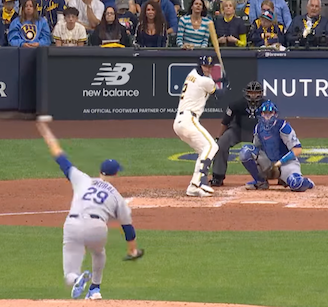
 

NLCS Game One: A Damndodger hole

Brice Turang, Tarik Skubal

Brice Turang about to send Tarik Skubal’s unsinking sinker into the bullpen Sunday night . . .

When the National League Championship Series opened Sunday night, guess what didn’t happen? The big spending blue whale didn’t devour the anchovies hosting them in the somewhat foggy Milwaukee pond. American Family Field hoisted baseball’s best (the home team) and second-best (the visitors) records this season.

The visiting Damndodgers and the hosting Brewers even got to throw their best pitchers at each other. How often do you get a defending Cy Young Award winner against the guy likely to win one this time around? Forget that a moment. This was going to be shades of Sandy Koufax v. Whitey Ford. Wasn’t it?

Not quite. Not this time. Neither Jacob Misiorowski nor Tarik Skubal dominated the way their previous notices showed them capable of doing. They were good enough. Not great enough. Certainly not overpowering or dominant enough.

Oh sure, Les Mis hit 101+ mph on the gun more than a few times—44 such pitches, in fact—just the way he’s supposed to do. And the Damndodgers went in hell bent on refusing to let those bullets beat them. Those bullets got only an 18.5 percent miss rate; 21.7 percent less than on the regular season.

Skubal went two-thirds of an inning further than Misiorowski and struck out two more. But he was pried for a pair of runs to his counterpart’s one. The bullpens went to work from there. And the 2-1 lead the NL Central-champion Brewers wrestled out of the NL West-champion Damndodgers stuck for the Game One win.

Until game time, of course, you could hear everyone across the great divides moaning that the Damndodgers were going to do it again. They were going to prove yet again that money talks. Talks, divides, and conquers. Weren’t they?

This was, of course, the beginning of a rematch between last year’s NLCS combatants. That was then: The Damndodgers led every inning but one. (And, got thatclose to losing the World Series in seven.) This was Sunday night: The Damndodgers led in only two innings.

So quit assuming they’re going to throw the Brewers out of the running like the sheriff running the town drunk off. These Brewers are going to make the Damndodgers work for it. They might even make the Damndodgers go home for the winter early enough to cause questions, doubts, and recriminations enough. Might.

When Shohei Ohtani and his still-balky inflamed left knee checked in at the plate leading off the second with no score yet, couldn’t you just hear the groaning that the only thing the Damndodgers did moving him to the cleanup spot was delay the inevitable?

Well, the only man in the house splitting the heavens or threatening the opposite hemisphere Sunday night was Brewers second baseman Brice Turang. He opened the bottom of the fourth ahead of Skubal, 2-0, when he caught hold of a sinker meant to go inside, which didn’t get that far in, and which didn’t have all that much sink. Turang sunk it behind the left center field fence, right into the Brewers’s bullpen, tying the game at one each.

Two innings earlier, Ohtani took care of what proved the lone Damndodger run of the night when he let Misiorowski walk him on four pitches none of which arrived where he likes to hit. Then, he came around to score on one line drive hit to right (Teoscar Hernández) and another base hit through the hole at second (Andy Pages).

Go ahead and say it. Say that you think the Damndodgers were damn lucky to catch Les Mis on an off night. How off? Jayson Stark (The Athletic) dug it up: During the regular season, the opposition hit a mere .174 off the Misiorowski heater. On Sunday night, they hit .500 off it.

Go ahead and say it. Say that you think the Brewers might have been lucky that the Damndodgers couldn’t do a thing with anything else Misiorowski threw. Remember: He’s got breaking balls that dance the way people once did on Soul Train. He kept the Damndodgers to 1-for-8 when throwing his curve ball, cutter, and slider, two of which got turned into inning-ending double plays.

Skubal lasted only a little bit longer, until he walked Garrett Mitchell to open the Milwaukee fifth, surrendered a Cooper Pratt bunt to the right side pushing Mitchell to second base, then surrendered a first-pitch, tie-breaking single through the hole at shortstop from Luis Lara, a rookie whose calling card until Game One was sterling defense—enough to be worth eleven defensive runs saved above the National League average.

So Misiorowski vs. Skubal didn’t quite live up to its advance publicity? News flash: the heavily hyped duels sometimes don’t. They played baseball other than the joust that wasn’t Sunday night.

“He’s going to be fine,” said Brewers manager Pat Murphy of Skubal. “I’m sure he’s going to be able to feed his family and be a great dad. He can lose tonight, and he’ll be fine.”

Both sides threw strong-enough bullpens at each other once the big arms were done for the evening. Almost.

The Brewers handed themselves a grand opportunity for insurance damage in the bottom of the eighth. Jackson Chourio—their knight of the earlier postseason rounds—opened with a base hit and chased Damndodger reliever Even Phillips, who’d struck the side out in the seventh. Against Tanner Scott, the Brewers bunted Chourio to second (Turang), accepted a walk on the house (Willson Contreras), then a strikeout-following second wak on the house (Andrew Vaughn) to load the pads.

Who bunts that soon after hitting a big bomb? “Not shocking at all,” said Turang of seeing a bunt sign from his third base coach. “To me, it was almost like if he would have told me to hit, I would have been like, I’m gonna bunt—because I just know the situation in the game is calling me to bunt there.”

That’s one kind of dangerous-enough risk. Unless you’re bunting for base hits, something the Brewers did extremely well this season, surrendering an out to move a runner who has (yes, you can look it up) less enough than a fifty percent chance of scoring after the bunt than he had before it, is not normally smart baseball.

But Scott’s kind of risk-taking usually invites a team to teach the risking opponent a little lesson in foolishness, no matter what time of game it might be. The only lesson Mitchell taught this time was how to waste a gift that should have kept on giving, when he grounded out to Betts at short for the side and the strand.

Then it was Trevor Megill’s turn to come out of the Brewers pen and . . . channel his inner Craig Kimbrel. Not the good side, either.

In a scene Cardiac Craig might know only too well, Megill got two quick outs. Then, the fun began. He walked Tucker on a full count and pinch hitter Josue De Paola on 3-1 with Betts looming on deck.

The regular season wasn’t a typical Betts season. It’s been a couple of years since he had one of those, and it’s entirely possible that age (he’s 33) might be creeping up on him at long enough last. But he’s still Mookie Betts, he still posted a .950 OPS on the year with men on first and second at all, and he still posted a 1.039 OPS with men on first and second and two out.

He picked the wrong time to face Megill when the latter decided he’d had enough of being the new Craig Kimbrel. Megill got Betts to fly out to the track in right to end it. And, like Kimbrel on one too many occasions since 2018, Megill still got a save credit for squirming out of a jam entirely of his own making.

“You try to get them to play from behind, to get them out of their game,” said Damndodgers manager Dave Roberts. “You’ve got to be sound fundamentally to not give them extra outs. Yeah, they’re very consistent in how they play the game, and that’s a credit to all those guys.”

“We should play Dodger baseball,” Betts said. “Whatever Dodger baseball is, that’s what we should do. We should not try to play Milwaukee Brewers baseball.” Whatever Dodger baseball is?

Interesting post mortem, that. As pesky, spunky, and insistent as they are, the Brewers couldn’t have gotten that far into Dodger heads already. Could they?

Cleveland rocked, and so should the LCSes

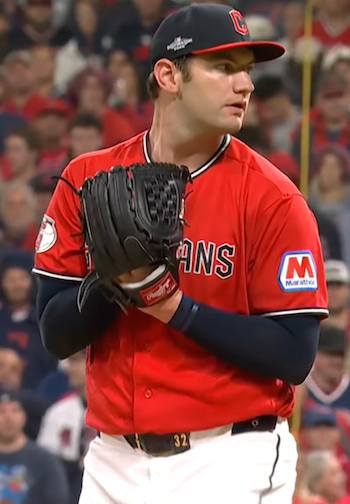
Gavin Williams

Gavin Williams (with 12) tied Charles Nagy’s Cleveland franchise single-game postseason strikeout record.

Unfortunately, there are some things even a pope can’t bring about. Whatever the Holy See’s divine pull, even he couldn’t deliver the White Sox from the hands of their adversaries. The hands or, in the case of the Guardians, the arms.

By the way, that’s the American League Central-winning Guardians. That means that this year’s American and National League Championship Series will be played strictly by teams who finished the regular season in first place.

So take that, Commissioner Pepperwinkle and your claque, you suggesting the shorter regular season, further diluted (sorry, expanded) postseason with best-of-seven division series, and letting the higher-seeded teams choose their victims (sorry, opponents) in the wild card and division series rounds.

Take that, baseball government spokesman Glen Caplin, and while you’re at it, take your formal statement and shove it:

A shorter regular season unlocks making October even better for our fans—with fewer weekday afternoon games, a longer Division Series, and more opportunities to see the game’s best pitchers on the biggest stage. And allowing the top seeds to select their opponents in the first two rounds would create compelling storylines, intensify existing rivalries, and create new ones.

The pre-LCS is long enough as it is now. We’ve just been through 25 games and, if each set had gone the distance, we could have been through 32. That’s before adding a minimum of eight and maximum of fourteen to come, which would have us at 46 games all postseason long. And what did it all mean this time around?

So far, it’s meant that the cream rose, for the most part. Three out of the four League Championship Series combatants finished one through three overall on the season: the NL Central-winning Brewers (103-59), the NL West-winning Damndodgers (100-62, and yes people do make it sound one word when they say it), and the AL East-winning Rays (98-64).

The Guardians won the AL Central as baseball’s eleventh-best team. Five out of the six teams standing between them and the now-gone NL East champion Braves (94-68) made it into the postseason but got dispatched early enough and, in one or two cases, in utter embarrassment enough.

What was the fun of the Yankees shoving the Red Sox to one side and out of the action in two straight in their wild card series just to turn up even more futile getting swept away by the Rays? What was the fun of the Padres shoving the Cubs to one side and out of the action in two straight only to get bumped off by the Brewers in four?

Chicago had enough heartache when the Cubs got pushed away. Now they have to handle the White Sox, who had an even more charming tale of resurrection following three straight 100+ loss seasons, getting overthrown after it looked early enough and often enough as though they just might overmatch the Guardians.

Savour it, Guards fans. Your heroes are going to their second ALCS in three seasons. Two years ago, the Yankees shoved them away in five. They won’t have things simple against the Rays this time around. But they’re liable to make it fun regardless.

Not that it was simple getting here. The Guards got wrestled down 2-0 to start this division series, and in their own house. Then the set moved to Rate Field, the house where the White Sox delivered a storybook resurrection this season, then flattened what was left of injured and aging Houston in the wild card round.

You thought the White Sox got a bit rude in the Guards’s house? The Guards shifted from scoring a mere three across division series Games One and Two to scoring four in the top of the Game Three third alone. They shifted from resembling the team over which the White Sox might step into overthrowing them twice in Rate Field and once in their own joint.

This time, it wasn’t a higher-scoring huff. This time, the only scoring the Guards needed was José Ramírez, in the bottom of the fourth and with Steven Kwan aboard on a leadoff single, hitting one over the right field fence. Their pitching—which struck a record 21 White Sox out—took care of the rest. (What a way to bookend their season: as my friend Jessica Brand pointed out, the White Sox opened 2026 by getting punched out 20 times in a game by the Brewers’s pitching staff.)

Sean Burke, José Ramírez

José Ramírez about to hit Sean Burke for the two-run homer that was all the Guards needed on a record-making night for their pitching staff.

Everybody wondered if Guardians starter Gavin Williams would be running on empty, or at least down to his final drops, after his Game Four-ending shutout relief inning. We should all have such depleted tanks. He took a no-hitter into the sixth, including twelve strikeouts (tying Charles Nagy for a Cleveland franchise postseason game record) and striking out the side twice, before he threw a breaking ball errant enough to hit White Sox shortstop Colson Montgomery on the foot to open.

Chicago would love to have many innings back over the city’s postseason history. The sixth Saturday night would have to rank among the top five at least. From the Montgomery plunk, the White Sox went to a two-out base hit from Kyle Teel before Williams’s evening finally ended with a bases-loading walk to Miguel Vargas—with lefthand-hitting first baseman Munetaka Murekami due up and Guards manager Stephen Vogt bringing lefthander Erik Sabrowski in to pitch.

Maybe Murakami would overcome his weakness against portside pitching this time, when the White Sox’s season depended the most upon it? Not quite. Sabrowski struck him out swinging. The best threat of the White Sox’s night evaporated just like that. The Pope watching from his Vatican roost must have been reminded that even he has only so much divine influence.

The Guards needed nothing more than further bullpen bulls Hunter Gaddis and (coming in with one out and a man on first in the eighth) Cade Smith to keep the White Sox pinned. Smith even paid tribute to Williams’s effort by striking the side out in the bottom of the ninth to finish it.

In one way, the outcome didn’t matter: Except for the Damndodgers, the LCSes will be fought by the lower budget corps. The Damndodgers lost their season series to the Brewers, 3-4. The Guardians, with the number 29 player payroll of 2026, fought the number 26 White Sox to get to the ALCS. Where they’ll meet the number 27 payroll Rays.

Never mind that saying the Damndodgers do it with dollars alone is a willfully ignorant lie.

There’s no earthly reason to believe the Brewers will be NLCS pushovers. Not with Jacob Misiorowski starting Game One. And no, Les Mis does not live by fastball alone, even if his is faster and better controlled than Nolan Ryan’s. He’s got a cutter, a slider, and a curve ball, any and all of which can dance like Fred and Ginger and beat, sweep, and clean you like a Hoover.

There’s no earthly reason to believe the Dodgers are invincible despite winning the two previous World Series. (Remember how the Blue Jays got thatclose to winning last year but for old man Miguel Rojas? Commissioner Pepperwinkle hopes you forgot.) Not even with Tarik Skubal starting Game One. Maybe Sku and Les Mis fight to a draw and turn things over to the bulls. Maybe the Brewers start praying their bulls aren’t full of bull. Maybe.

There’s also no earthly reason to believe the ALCS will be a crashing bore. If the Guards keep pitching the way they manhandled the White Sox, assuming their arms and/or shoulders don’t resign their commissions, they stand a chance against a Rays team that figured out how to build a dominant, all-elements team from the Family Dollar clearance shelves.

So the Empire Emeritus and the Olde Towne Team aren’t there? Except for entitlement-drunk Yankee fans who still think the World Series is illegitimate without them (and who still think, erroneously, that only the ghost of George Steinbrenner can “restore” them), who cares? Except for entitlement-longing Red Sox fans who think they’ve earned the right to a fifth Series title this century (they already lead the century with four), who cares?

The Lords of Baseball will cast their longing eyes upon the proceedings, misread the forest, misinterpret the trees, and ignore those among their ranks who lack the up-and-down development, discipline, and intelligence of those now playing for pennants.

Must I remind you that big payrolls (read: $200 million or higher) did the Mets and the Blue Jays no seasonal favours? That they didn’t keep the Yankees, the Phillies, the Red Sox, the Padres, the Cubs, the Braves, and the Astros from early postseason exits?

The Lords, and the fans and writers who think only money determines who takes the next lease to the Promised Land, insist that what you’re seeing coming out of Tampa Bay, Milwaukee, and Cleveland is three flukes, two of whom stand to be used as toothpicks by the big blue whale out of Los Angeles.

Meanwhile, if the Dodgers do get thwarted, the wailing will start swiftly enough over how difficult-to-impossible it is to win more than two straight World Series anymore.

Too many people can never be satisfied. Those who can be will now enjoy a pair of likely to be splendid LCSes and a just-as-likely to be splendid World Series.

Who has the next-to-last-laugh now?

Kyle Tucker

Kyle Tucker’s seventh-inning strikeout seemed to take what remained of the Cubs’ wind away Saturday night. (TBS television capture.)

“It’s really the only inning you could talk about,” lamented Cubs manager Craig Counsell about the top of the sixth, after National League division series Game Five. “We just didn’t do much.

“We had six base runners. You’re going to have to hit homers to have any runs scoring in scenarios like that,” Counsell continued. “They pitched very well. I mean, they pitched super well and we didn’t.”

“They” were the Brewers, whom Counsell used to manage, until he reached managerial free agency and the Cubs decided to dump David Ross for no reason better than that Counsell became available. Cubs president of baseball operations Jed Hoyer admitted as much earlier this month.

Two second-place National League Central finishes and one division series loss later, Cub fans could be forgiven if they think it’s been karma for the manner in which Ross was vaporised. The Brewers won Game Five, 3-1, with 90 percent pitching depth, five percent unusual slugging, and maybe five percent karma-the-bitch.

Until, that is, they review the seventh inning in American Family Field Saturday night. First and second, nobody out, and Kyle Tucker—the man for whom the Cubs traded three to the Astros last December, in perhaps the signature moment that explains why they made that trade—coming to the plate.

He faced Aaron Ashby, the nephew of former major league pitcher Andy Ashby, and possibly the best relief pitcher on the Brewers staff. (Regular season: 2.16 ERA; 2.70 fielding-independent pitching rate.) His Cubs were down only 2-1. He got ahead of Ashby three balls, no strikes. Michael Busch (leadoff single) and Nico Hoerner (hit by a pitch) leaned away from second and first itching for a reason to take off.

The odds were in favour of them getting that reason momentarily. Tucker had spent the first three games of the division series as a singles hitter, but in Game Four he finally unloaded, blasting a leadoff home run in the bottom of the seventh. Maybe, despite an early strikeout and a subsequent ground out Saturday night, Tucker’s power strokes were back from the fixit shop.

Big maybe. Ashby pumped a pair of bullets Nolan Ryan himself might have applauded. Tucker swung through both of them.

Then Brewers manager Pat Murphy brought rookie righthander Chad Patrick into the game. Patrick, a righthander with seven minor league seasons behind him and not one Show appearance until the Brewers called him up from AAA Nashville for this year. He got Seiya Suzuki—who’d tied the game at one in the top of the second, when he answered William Contreras’s first-inning solo home run with a bomb of his own against Jacob Misiorowski—to drive one to left that found Jackson Chourio’s glove. He dropped strike three called in on Ian Happ.

Not one Cub came home in that inning or the rest of the way. The Brewers added one more in the seventh, when Brice Turang took Cub reliever Andrew Kitteredge over the right center field fence.

“I was looking up at the heavens to Bob Uecker,” said Brewers general manager Matt Arnold, referencing the beloved late Hall of Fame broadcaster and wit, who’d become as much a face of the Brewers as any player in their history until his passing last January. “Like, during the game, I’m like, ‘Bob, we need you’.”

“I must be in the front row,” Uecker must have said from his roost in the Elysian Fields.

He must have. This team had baseball’s best regular season record this year but entered the division series with a string of failure to get past their first postseason stages for five out of the previous six seasons. They were still recovering from their former closer Devin Williams, now a reliever and frequent hate object (by their own fans) for the Yankees, serving a pitch Mets first baseman Pete Alonso demolished like a munitions expert in the deciding wild card series game last year.

This time, they had to recover from the Cubs, their next-door-state rivals, coming back from a 2-0 game deficit.

This time, they made it. So far.

They have a National League Championship Series date with the Dodgers. They secured the date doing what enough people thought they couldn’t do if it meant paying the ransoms for their kidnapped families: slug. Contreras and Turang were joined by Andrew Vaughn in the fourth, blasting a full-count service from Collin Rea into the left field seats.

They even did it with men who weren’t even topics on last year’s team. Vaughn and Patrick were joined in that club by Misiorowski, who relieved Game Five’s opening closer Trevor Megill, surrendered only Suzuki’s second-inning smash, but otherwise worked spotlessly for his four innings. In what turned out a bullpen battle, the Brewers pen was just that much more efficient than the Cubs pen, which also deployed one starter (Rea) among a group of bulls.

Andrew Vaughn

Vaughn running out his fourth-inning bomb. (TBS television capture.)

And, boy, is the deal that brought Vaughn from the pathetic White Sox to the Brewers looking better every hour. It happened when the Brewers elected to move Aaron Civale from the starting rotation to the bullpen, and Civale responded with a spoken desire to play somewhere else if that was the case. Be careful what you wish for, was the answer . . . and Civale went from a contender to a basement dweller just like that, in early June, with Vaughn—once a first-round draft pick, demoted to the farm a month earlier—coming aboard.

Therein lies a distinction between these Brewers and the Cubs they just turned aside. The Brewers don’t have Cub money, but they don’t let that stop them from constant upgrade searching when necessary. The Cubs have Cub money.  But they’d rather undergo root canal without anesthetic than spend it. And they lack the Brewers’s bargain basement ingenuity. They haven’t yet figured out that you don’t have to shop at the Magnificent Mile all the time. You can find amazing upgrades at Lots 4 Less.

How will these Brewers be perceived going into an NLCS against those Dodgers? Contradictorily, of course. The Brewers swept the Dodgers in their regular-season series, 6-0. But there’ll be more than enough who think the Dodgers will still be the overdogs. Even if the Dodgers’ NLCS ticket was stamped by a horror of a throwing error by Phillies relief pitcher Orion Kerkering in Game Four of their division series.

But how will these Cubs be perceived going into winter vacation? Not too favourably, after all, one fears. The top of their lineup acquitted themselves well enough, particularly Busch with three of his four division series hits clearing the fences and Nico Hoerner with his hits in each game and his team-leading .476 postseason on-base percentage. But the bottom of the lineup disappeared. The collective slash line of the Cubs’ bottom five? .120/.215/.205.

And they’re likely enough to move forward without Tucker, who becomes a free agent and who’s perceived widely enough as thinking about moving on. Even if this usually un-expressive fellow who prefers to let his game do his talking calls it “an honour” to play with this group of Cubs.

That group of Cubs needs a small, not major bullpen remake, and they need to romance and re-sign Tucker, whom they could and should have extended during the second half of the season. But maybe the Cubs need a front-office overhaul, too. The kind that brings in persuaders who can convince the Ricketts family that it’s time to open the purse strings but think about trying Lots 4 Less after that one Magnificent Mile splurge.

Finishing with their best regular-season record since 2018 shouldn’t be enough. Three straight second-place NL Central finishes shouldn’t be enough. But maybe watching the Brewers go forth and tangle honourably with the ogres of the National League West will give these Cubs—and their ownership that’s as endowed as Mercedes-Benz but prefers to drive indiscriminately off the Chicago Auto Warehouse lot—more than a little pause.

The Brewers couldn’t care less for now. They’re enjoying their first postseason series clincher since 2018, the year they shoved the Rockies aside in a division series sweep. And if they wanted any further incentive, they got it from cynics and Cub fans alike who snarked that they hadn’t won a postseason series yet as they took the Cubs on. As if their round-one bye meant squat.

So who has the next-to-last laugh now?

Once upon a time, the early rock and roll era included a novelty hit, “Beep Beep,” in which a little Nash Rambler (I always presumed it to be the anti-classic, two-seat Metropolitan) went tire-to-tire with a Cadillac in a daring little race. The Brewers are the Nash Rambler about to go tire-to-tire with the Dodgers’ Cadillacs.

And, unlike “Beep Beep’s” challenger, they know how to get themselves out of second gear.

The new Yankee bats are barrels of fun

Baseball Bugs

Contrary to social media bleating, this is NOT one of the new Yankee bats . . .

They resemble elongated bowling pins upon first glance, those new and legal Yankee bats, perhaps the kind that would be spotted on a bowling lane . . . built for Paul Bunyan. Don’t laugh. Wielding those curious new bats among their regular lumber on Saturday against the Brewers, the Yankees resembled a gaggle of Bunyans at the plate. It began (ahem) right off the bat against former Yankee Néstor Cortés.

Three pitches. Three long enough solo home runs.Two outs later, another solo smash. That was just in the bottom of the first, against the guy they traded to make a Yankee out of postseason Brewers victim Devin Williams.

OK, let’s get more detailed. After the Brewers did nothing with a one-out walk to Christian Yelich from newly-minted Yankee starter Max Fried in the top of the first, Paul Goldschmidt—erstwhile Diamondback and Cardinal, now manning first base for the Yankees and leading off, of all things—watched a first-pitch, four-seam fastball travel well enough into his wheelhouse to drive it to the rear end of the bullpen in left center field.

One pitch, one bomb, one run.

Newly-minted Yankee Cody Bellinger—erstwhile Dodger and Cub, who hasn’t really been the same since a shoulder injury during the Dodgers’ 2020 run to the World Series title—watched another first-pitch, four-seam fastball rising in the middle of the zone, but not high enough that he couldn’t yank it into the right center field seats about six rows past the bullpen wall.

Two pitches, two bombs, two runs.

Aaron Judge—the Yankees’ bona-fide Bunyan, all 6’7″ of him, beginning his tenth season in the sacred pinstripes—watched Cortés switch things up a little, having learned the hard way abour first-pitch fastballs not always obeying orders. The lefthander opened with a cutter. It got even more into Judge’s wheelhouse than that fastball got into Goldschmidt’s. And it disappeared into the left center field seats.

Three pitches. Three bombs. Three runs. Who knew the Yankees were just getting warmed up? (And, did Goldschmidt feel even a small kind of déjà vu all over again, since he’d once hit three out against the Brewers by himself, as a Cardinal?)

Cortés then showed the Brewers what they thought they’d traded for when he struck (All That) Jazz Chisholm, Jr. out looking and got Anthony Volpe to ground out right back to the mound. Up stepped Austin Wells, who’d opened the Yankee season with the first known leadoff bomb ever hit by any major league catcher last Thursday.

Wells was kind enough to wait until Cortés opened up with a pair of cutters off the inside part of the plate for a 2-0 count before Cortés threw him a fastball and he drove it over the left center field fence. It took back-to-back walks and a called punchout on Trent Grisham to stop the bleeding. The tourniquet proved unable to contain it for very long.

From there, after Fried almost handed the Brewers a quick enough tie on the house, what with a one-out hit batsman, an RBI single, a run scoring on an infield error, another base hit, and a run scoring when Fried threw Yelich’s grounder offline, the Yankees had more treats in store.

They began with Volpe, who turned out to have been the inspiration for the new elongated bowling-pin bat. Yankee fans watching the broadcast on television got the skinny from broadcast institution Michael Kay when Chisholm batted in the first:

The Yankee front office, the analytics department, did a study on Anthony Volpe, and every single ball it seemed like he hit on the label. He didn’t hit any on the barrel, so they had bats made up where they moved a lot of the wood into the label, so the harder part of the bat is going to actually strike the ball. It’ll allow you to wait a little bit longer.

Anthony Volpe

. . . but this is, in the hands of the man whose plate performances got the Yankee brain trusts—oh! the hor-ror!—thinking. (Volpe rewarded them by hitting one of the nine Yankee bombs against the Brewers Saturday.)

The woofing and warping began aboard social media (cheaters! cheaters!) until someone, who knows whom, slipped into the bellowing the fine and legitimate point that the rule book doesn’t quite outlaw such bats. I give you Rule 3.02: The bat shall be a smooth, round stick not more than 2.61 inches in diameter at the thickest part and not more than 42 inches in length. The bat shall be one piece of solid wood. You might note that it says nothing about just where the thickest allowance must be.

You might also note that there do remain baseball traditions immune to change. Suspecting the Yankees of crime is one of them. But you don’t have to be a Yankee cultist to wonder why it was (and is) that nobody else thought of creating such bats within the rules before the Yankees got the a-ha!

You might also note, further, that Cortés wasn’t exactly unfamiliar to the Yankees, since he’d been one of them fo five of the past six seasons. “Nestor (had) been here for years,” said Judge postgame. “He’s one of the best lefty pitchers in the game. He’s going to go out there and throw strikes and attack you. We just tried to go out there and be aggressive in our zone. Goldy and Belli, they were aggressive and got things going there. This place was rocking once I got up there.”

So. When Volpe batted the secone timd in the bottom of the second, he had Judge and Chisholm aboard and two out. This time, he waited until he had a full count before swinging and hammering a Cortés cutter over the left field fence. Now the game was 7-3, Yankees. And the party wasn’t even close to being over.

Fried survived a miniature jam in the top of the third, but Cortés didn’t survive walking Yankee designated hitter Jasson Domínguez to open the bottom. Connor Thomas came in to pitch. Grisham singled Domínguez to second, Thomas plunked Goldschmidt, Bellinger beat out an infield hit to send Domínguez home and load the pillows for Judge—who sliced salami on a 2-1 up-and-in cutter.

Then Chisholm wrung his way up from a few fouls to hit a 1-2 service into the right field seats. Making it 13-3, Yankees, which turned to 16-4 (erstwhile Phillie Rhys Hoskins poked an RBI single in the top of the fourth) in the bottom of the fourth, when Bellinger sent Grisham home on a sacrifice fly after Goldschmidt doubled him to third, but Judge followed with a two-run homer over the center field fence.

Judge’s third major league three-bomb day and his first since 2023. Eight home runs on the day for the Yankees so far, tying a franchise record they’d break when pinch-hitter Oswald Peraza hammered Brewers reliever Chad Patrick for a one-out, two-run homer in the bottom of the seventh. Making it 20-6 (the Brewers scored two in the sixth); the Brewers had at least an RBI double (Jake Bauers) and a two-run homer (Brice Turang) in them before the carnage finally ended.

“You think you’ve seen it all in baseball,” said Brewers manager Pat Murphy postgame, “and you haven’t because we saw it today—three pitches, three homers. Usually, you wake up from that. You go, ‘Wow. God. That can’t ever happen.’ It just did.”

The game was so disastrous for the Brewers that Murphy finally sent Bauers forth to pitch the bottom of the eighth, hoping to spare his pitching staff any further humiliation. The first baseman didn’t do any worse on the mound than the real pitchers, either. He shook off a two-out hit batsman and followup walk with a pop out for the side. He’d even gotten Judge to fly out in the eighth, an inning after Judge’s bid for a four-bomb day came up short enough in the sixth that he settled for a double.

He had to settle for becoming the fourth Yankee ever to have three three-bomb days, joining Hall of Famers Lou Gehrig (he had four of them) and Joe DiMaggio, plus third baseman Álex Rodríguez. “Anytime you get mentioned with those guys and what they’ve done in the game, and the careers they’ve had,” Judge said postgame, “it’s pretty special.”

Not that the Yankees were perfect on the day. Their five errors, which weren’t half as disastrous as their Game Five fifth inning in the World Series, hung Fried with four unearned runs among the six he did surrender on the day. Still.

“What a performance,” Yankee manager Aaron Boone summed up. “Kind of a weird, crazy game.” Kind of a crazy way to describe a massacre, too.