Ohtani gets his lucre and his wish

Shohei Ohtani

Shohei Ohtani signs with the Dodgers for a decade, $700 million, and the thing he wants most—better chances to win. Angel fans mourn the absolute waste of the game’s most transcendent talent.

It was almost to laugh. Within an hour of the news breaking and confirmed that Shohei Ohtani signed at last, and with the Dodgers, yet, there also came the news that some Angel fans began holding burnings of one or another kind of Ohtani merchandise. It was to laugh that you wouldn’t weep, of course.

Set aside what Ohtani signed for for the moment. Yes, it’s ten years and $700 million. It’s also no opt-out clauses in the deal. It’s also Ohtani himself deferring a considerable pile of that guaranteed money the better to enable the Dodgers to continue sustaining excellence via the farm and the market.

Now, consider the abject stupidity of the Angels and some of their fans. You want to burn Ohtani merch because, as a legitimate, lawful free agent, he signed elsewhere at all? Never mind with the beasts just up the freeway? Be my guest—and stand exposed as the fools you are.

The fools who’d rather turn Ohtani merch into burnt ashes than demand better of the team that let him walk with nothing of value in return—while going for broke elsewhere at the trade deadline only to unload two of the pieces they did acquire by way of the waiver wire at September’s beginning . . . just after Ohtani’s elbow took him off the mound for the season without sitting him down as a designated hitter.

The fools who’d rather have kept Ohtani bound to a team whose administration seems clueless about the point that you need a viable team around them to enable Ohtani and whatever might be left of future Hall of Famer Mike Trout to play for chances at championships. The point that one or two players do not a championship contender make, no matter how overendowed in ability and execution they’ve been.

You want to make Ohtani an example instead of holding Angels owner Arte Moreno and his trained seals in the front office accountable for thinking the box office is the thing and if you just so happen to win it’s mere gravy? Be my guest again. And stand exposed further.

For so long as he’s owned the Angels Moreno’s marketing background, the business in which he earned his fortune, has dominated what the Angels put on the field. Whether what they put on the field could play competent or cohesive baseball up and down the lineup seemed secondary to having what George Steinbrenner used to call “name guys who put fannies in the seats.”

It was bad enough that the Angels unearthed the transcendent Trout and saw him build a jaw-dropping Hall of Fame case in his first nine seasons before the injury bug bit into him in too much earnest over the past four. It was worse that Trout showed his loyalty to the team that discovered him and turned him loose on the field by signing a glandular extension only to have too many people wondering if he hadn’t lost his marble for it.

It was worse that Trout got to play with Ohtani, himself an injury bug victim for a couple of years following his Rookie of the Year season, and formed a tandem of transcendence (when Trout could play) that proved nothing more than a two-man supershow in the middle of a sad-sack sideshow.

“Ohtani has said he wanted to win,” writes The Athletic‘s Andy McCullough.

The Dodgers have won their division in ten of the past eleven seasons and tallied more than one hundred victories in five of the past six full seasons . . . [Ohtani] has been never part of a team with a front office capable of regularly rebuilding a pitching staff with excellent results, as Andrew Friedman has often done. And he has never played for an ownership consortium like Mark Walter’s Guggenheim group, who have been willing to invest in facilities, infrastructure and ancillary considerations.

That’s putting things politely. The hottest item at last season’s trade deadline was whether the Angels would wake up, wise up, and trade him for legitimate return value on the field and in the organisation at last. No chance.

Now it’s possible that Trout will return healthy, play like something close enough to the Trout who punched his Cooperstown ticket, stir up speculation on whether the Angels finally deal him to a contender with rich return to offer, and find himself still bound and gagged to an owner who’s willing to invest in his box office alone.

Quit the hemming and hawing over Ohtani’s deal raising an unconscionable ceiling for the free agents to follow him in the current market. Instead of bellowing over the big bad Dodgers handing him what amounts to a Delta Quadrant kingdom plus safe passage through the Cardassian Empire and ownership of Ferengi Enterprises, try bellowing over other owners’ too-entrenched refusal to invest and build in the major league product and the organisation behind it.

The Red Sox unloading Babe Ruth to the Yankees was nothing like this. Then, believe it or not, the Red Sox thought they were unloading a problem child to help relieve their owner’s financial stresses, not all of which was tied to his concurrent theatrical production operation. The Ruth sale helped temporarily.

Ohtani, anything but a problem child, was allowed to walk into free agency eyes wide shut on the part of the Angels. It was perverse fun, too, watching the sports press get their proverbial panties into twists trying to figure out what was in Ohtani’s heart of hearts while he and his agent played things close enough to the vest. I couldn’t resist joining the fun for a moment, outlining a top ten list of what Ohtani was really thinking, feeling, wanting . . .
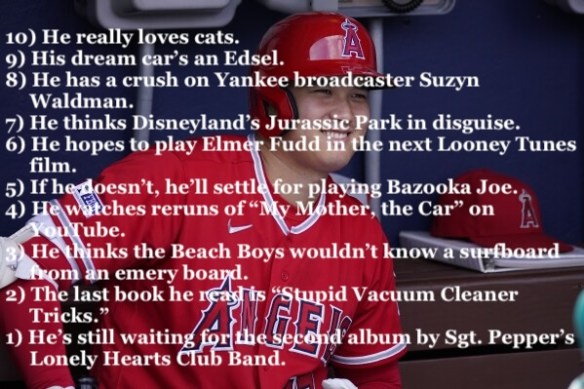
When Dodger manager Dave Roberts admitted the Dodgers talked to Ohtani and he’d have loved nothing more than to see Ohtani in Dodger silks, panties into twists turned nuclear, they thought Roberts’s honesty might have killed any deal in gestation. So much for that idea.

Too often with Trout injured Ohtani had to provide most of the Angels’ offense. Joining the Dodgers that burden is lifted. He can swing the bat comfortably and not believe every one of nine innings of baseball is on his shoulders. When he recovers from elbow surgery and takes the mound again in 2025, Ohtani has good reason to believe the Dodgers will have remodeled the starting rotation whose dissipation cost them this past postseason.

He didn’t have one millionth of a prayer of seeing that happen if he elected to re-sign with the Angels. Being a guy who makes baseball fun again is one thing. Coming home after yet another losing or short-of-the-postseason season proved something else.

So go ahead, some of you Angel fans. Burn his jerseys, blow up his bobbleheads, use his photos and posters for fish wrap if you must. You’re going to look almost as foolish for it as your team’s owner has looked for having resources unfettered and brains inoperable the entire time Ohtani wore Angels red. Almost.

Angel fans who don’t have coconut juice for brains began flocking to Angel Stadium to mourn within two hours of Ohtani himself scooping the world by announcing his Dodgers deal on Instagram. A crane already began stripping Ohtani’s mural from the side of the stadium. Fans slipped into the stadium’s team store to snap up Ohtani merch before it would disappear forever.

They came to mourn.

And one fan, Sebastian Romero, lifted a page from the books of long-suffering Athletics fans whose owner has stripped the team of credibility only to wrest approval for hijacking them to Las Vegas. Outside the stadium, Romero held up a sign before the Ohtani mural behind him was stripped, as photographed by Athletic writer Sam Blum:

As Blum noted so mournfully, Ohtani’s past three seasons have been three of the greatest the game has ever seen from a single player, on both sides of the ball, yet, with the Angels going 77-85, 73-89 and 73-89. What a waste of Ohtani hitting 124 home runs and striking out 542 batters worth two unanimous Most Valuable Player awards over that span.

A young man of few words for the press, Ohtani is on record as saying that, much as he loved the Angels, “More than that, I want to win. That’s the biggest thing for me. So, I’ll leave it at that.” Nobody can say the Angels weren’t warned. Nobody can say the Dodgers lack the resources or the brains to make that wish come true, either.

Now, I wonder. When Ohtani meets Clayton Kershaw as a Dodger for the first time, will he begin the conversation by saying, “About that All-Star Game pickoff, buddy . . . ?”

Frank Howard, RIP: The gentlest giant

Frank Howard

“Sometimes,” said a minor leaguer whom the Bunyanesque bombardier managed, “I think he’s too good for this game.” About Frank Howard, now gone, the gentlest giant of them all.

All of a sudden there’s a pall overhead. The one Washington Senator above all who didn’t want to move to Texas to become a Ranger has gone to the Elysian Fields at 87. The gentlest giant. The guy whose nickname Capital Punishment was as much a misnomer as The Killer was attached to his contemporary Harmon Killebrew.

Frank Howard. The behemoth whose home runs were conversation pieces long before that phrase was attached to the blasts hit by the likes of Dick Allen, Dave Kingman, Mike Schmidt, Darryl Strawberry, Albert Pujols, and Shohei Ohtani.

The third of six Ohio Howard children who had scouts bird-dogging him in the mid-to-late 1950s offering six-figure bonuses but who insisted that the money be divided as $100,000 for himself and $8,000 toward a new home for his parents, a condition only the Dodgers were willing to heed.

The 6’8″ galoot who became a Senator in the first place because of Sandy Koufax.

Howard had come forth as a Dodger who had that intergalactic power at the plate matched only by an inconsistency or three. The National League’s 1960 Rookie of the Year could break a game open with one swing but chased too many balls out of the strike zone. The giant with a fine throwing arm who moved too slow for an outfielder.

The guy who had enough trouble being the first Frank Howard without shaking off enough early career hype that sometimes called him the next Babe Ruth. The guy who assessed himself to Sports Illustrated too realistically despite a 1963 World Series performance that included a 450-foot home run off Whitey Ford en route the Dodgers’ sweep:

I have the God-given talents of strength and leverage. I realize that I can never be a great ballplayer because a great ballplayer must be able to do five things well: run, field, throw, hit and hit with power. I am mediocre in four of those—but I can hit with power. I have a chance to be a good ballplayer. I work on my fielding all the time, but in the last two years I feel that I have gotten worse as a fielder. My greatest fear was being on the bases, and I still worry about it. I’m afraid to get picked off. I’m afraid to make a mistake on the bases, and I have made them again and again, but here I feel myself getting better.

Howard ended up asking Dodger general manager Buzzie Bavasi for a trade after the 1964 season. As things happened, Bavasi was also hunting a solid lefthanded pitcher to plug in any spaces left by the possibility that Koufax—who’d been shut down for the year in August 1964, and diagnosed publicly with an arthritic pitching elbow (it turned out that was for public consumption)—would only be able to pitch once a week if at all.

Bavasi sent Howard plus infielder Ken McMullen and pitchers Phil Ortega and Pete Richert to the Second Nats in exchange for lefthanded pitcher Claude Osteen, infielder John Kennedy, and $100,000. Osteen became the reliable number three starter behind Hall of Famers Koufax and Don Drysdale; the Dodgers won the next two National League pennants plus the 1965 World Series.

Howard settled for becoming a marquee attraction in the nation’s capital. His old Dodger teammate Gil Hodges managed the Senators, convinced Howard to try a slight uppercut in his swing that might stop him hitting hard grounders, and turned him loose to become one of the American League’s power kings after shaking off two initial Washington seasons disrupted by injuries here and inconsistency there.

Then came the Year of the Pitcher (1968)—and Howard’s leading the entire Show with 44 home runs and a .550 slugging percentage, not to mention 330 total bases. He’d hit 48 out in 1969 (with another Show-leading 340 total bases) and 44 out in 1970. A new Senators manager finally convinced him to stop swinging at pitches that didn’t look hittable, which hiked his walk totals and gave him the plate discipline he wished aloud he’d learned a decade earlier. A manager named Ted Williams.

(“Somebody’s getting him out,” snorted Seattle Pilots manager Joe [Ol’ Shitfuck] Schultz during a meeting to discuss how to pitch Howard. “The bastard’s only hitting .306.”)

Howard also moved from the outfield to first base as often as not, and while he was no defensive virtuoso his bat continued to thrill fans and terrorise pitchers. When Alvin Dark managed the Indians, he had a habit of switching his bullet-throwing lefthander Sudden Sam McDowell and an infielder during Howard’s plate appearances (Howard tended to kill McDowell) and then back after Howard was done.

Later, as a minor league manager, Howard was legendary for his generosity with the kids he managed whom he knew barely earned peanuts. Stories abounded of Howard stopping the team bus out of nowhere and ducking into a truck stop or a package store, whipping out his money clip, and buying cases of brewskis. (He made a considerable fortune owning a few choice Wisconsin shopping centers.)

Profiling him while managing the Spokane Indians (then a Brewers farm team) in 1976, Thomas Boswell quoted one of his talks to his minor league charges:

Boys, in this game you never play as long as you want to or as well as you want to. And sooner than any of you thinks, your day will come to get that pink slip that says, “Released.” When they pull those shades, they pull ’em for a lifetime. When it’s over, no one can bring it back for you. It’s a short road we run in this business, so run hard.

That from the man who lamented near the end of his own playing career, “By the time you learn to play this game properly, you can’t play anymore.” (“We lead the league,” Spokane third baseman Tom Bianco told Boswell, “in hustle, rules, and meetings. We even had a meeting after a rainout to go over the rain.”)

He left the Spokane bridge for a shot at major league managing. He had the Padres for two years; he had the Mets for one. “The players took advantage of him,” then-Padres general manager Jack McKeon said when they fired him. “Frank just couldn’t stop being nice.”

A man like that becomes a Washington institution even after his playing career ends and he relocates to northern Virginia and keeps in touch with the city that embraced him like a son and brother. He becomes one of three men to be cast in bronze outside Nationals Park, even though he never played for this franchise of Nats, joining Hall of Famers Walter Johnson (representing the ancient Senators) and Josh Gibson (representing the Homestead Grays who played much of their time in D.C.).

He might even leave Washington with a memory they’d never forget amidst a small closet full of Hondo hammers. With Bob Short shamelessly hijacking the team to Texas after the 1971 season, Howard came up to hit in the sixth inning of the Senators’ final game, against the Yankees. Leading off against Mike Kekich in the bottom of the sixth, Howard swung on 2-1 and planted one to the back of the bullpen behind the left field fence.

“I just wish the owners of the American League could see this, the ones who voted 10 to 2 to move this club out of Washington,” said Senators radio broadcaster Ron Menchine as Howard came down the line to cross the plate.

He comes out again. . . Hondo threw his helmet into the stands, a souvenir of the big guy’s finest hour in Washington . . . The crowd screaming for Howard to come out again . . . and here he comes again!! . . .  A tremendous display of the enthusiasm of Washington fans for Frank Howard . . . Hondo loves Washington as much as the fans love him. It’s 5-2 . . .

The Senators took a lead to the top of the ninth and asked Joe Grzenda to close it out. He got two quick ground outs right back to himself. Then the heartsick RFK Stadium crowd that was restless all day long finally burst. They poured onto the field with Yankee second baseman Horace Clarke at the plate and rioted. The umpires finally called a forfeit to the Yankees. The stadium resembled the aftermath of a terrorist attack.

Howard hit the final Senators home run and the first Rangers home park home run, which also happened to be the first major league hit to be nailed in old Arlington Stadium. But he had no illusions. “A guy just does the best he can,” he told SI. “We’re aware you can’t peddle a poor product to the public. It’s nice to think that these people’s first memory of major league baseball might be my home run, but I really hope that their memory is the win.”

He never lost his baseball introspection even as he never lost his love affair with fans who sought him out long after his last swing, his last shot to the Delta Quadrant. “When people look back on their careers, they say they wouldn’t change a thing. I would have,” he once said. “I would have made the adjustments. I would have given myself the chance to put up big numbers.”

Divorced from his first wife, he remarried happily in 1991. Howard left more than long ball memories. He had family and friends to love and remember. He left behind memories of a man who was so personable, gentle, and generous, that one of his Spokane players could and did say, “Sometimes I think he’s too good for this game.”

More than “sometimes.”

Snakes alive!

Arizona Diamondbacks

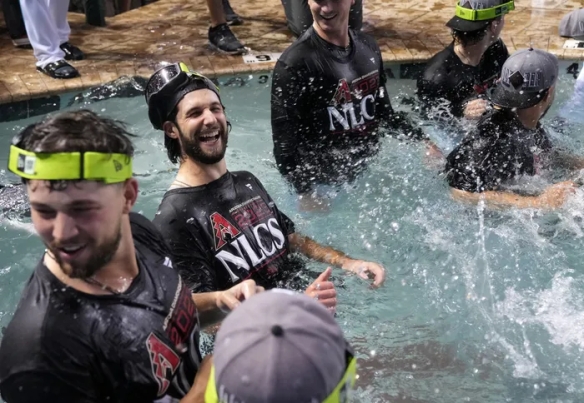
Assorted Diamondbacks take a victory dip in the Chase Field pool after they swept the Dodgers in their NLDS Wednesday.

This may actually be the worst Dodger takedown of all time. They’ve suffered legendary takedowns as much as legendary triumphs in their storied history, but this one may actually out-rank all the others.

Worse than the day the Philadelphia Whiz Kids’ veteran Dick Sisler ruined them on the season’s final day after Cal Abrams couldn’t score from first to keep the pennant-losing game out of an extra inning.

Worse than the day Bobby Thomson ruined Ralph Branca after a second-half Giants surge from thirteen games back through the lens of Leo Durocher’s telescopic from-the-clubhouse sign-stealing.

Worse than the day a still-not-himself Sandy Koufax couldn’t hold the Giants off in another pre-division play, three-game pennant playoff deciding game. Worse than the week the Orioles swept them in a World Series.

Worse than the day Tommy Lasorda let Tom Niedenfuer pitch to Jack (the Ripper) Clark with first base open and the Dodgers an out from forcing a seventh National League Championship Series game. Worse than back-to-back World Series losses in 2017-2018.

Never before were the Dodgers swept out of a postseason set in which all three Dodgers starting pitchers including a future Hall of Famer combined to pitch four and two thirds innings.

And never before had any team surrendered four postseason home runs in a single inning until Lance Lynn, the husky righthander who was the Dodgers’ key trade deadline pitching pickup, but who surrendered a Show-leading 44 home runs all regular season long, went to work for the third inning of their National League division series Game Three.

Geraldo Perdomo, Diamondbacks shortstop—leadoff home run. Ketel Marte, Diamondbacks second baseman, an out later—home run. Christian Walker, Diamondbacks first baseman, an out after that—home run. Gabriel Moreno, Diamondbacks catcher, following Walker, and after a long drive ruled just foul—home run.

None of baseball’s classic slugging teams ever did in any postseason what the Snakes did in that inning. Not the Ruth-Gehrig Yankees. Not the Foxx-Simmons-Grove Athletics. Not the DiMaggio-Berra-Mantle Yankees. Not the Boys of Summer Dodgers. Not the Mantle-Maris Yankees. Not the Swingin’ As or the Big Red Machine. Not the Pittsburgh Lumber Company, Harvey’s Wallbangers, or the Bash Brothers A’s.

“I’m a fan, too,” said Diamondbacks manager Torey Lovullo, after his Snakes banked the 4-2 win, the division series sweep, and a date with either the Phillies or the Braves in the National League Championship Series, “and I was looking at it thinking, what in the world is happening here?”

So were the Dodgers. Maybe all series long, never mind in the third inning Wednesday night.

“You look at the game, the series, they outplayed us, and there’s no other spin to it,” said manager Dave Roberts. “As far as our clubhouse, it’s just a lot of disappointment.”

As far as the Diamondbacks clubhouse, this team of rising youth, veterans who’ve been called “quirky” among other things, role players, and about as much star power yet as a cactus plant, has arrived. They slipped into the postseason via the wild card system after an 84-win season, swept the Brewers out of the wild card series, then dismantled a Dodger team full of stars who’d usually dismantled them while owning the National League West for most of a previous decade.

And they couldn’t have cared less about the financial power behind that Dodger star power, either. “We shouldn’t be worried about what their payroll is or who they’ve got over there,” said Snakes outfielder Alek Thomas after Game Three. “We’re just worried about what’s right in here in this clubhouse. You saw that this series.”

“They kept punching us in the face,” lamented Dodgers utility man Enrique Hernandez, “and we weren’t able to get back up.”

Just when did the Diamondbacks and their fans really start believing they might have more than a few lessons to teach the pitching-compromised Dodgers (three injured starters, a fourth on administrative leave over domestic violence charges) and the country this time around?

Was it when they bludgeoned six runs out of a possibly still-ailing and finally out of fuel Clayton Kershaw in the Game One first?

Was it when they pried three Game Two first-inning runs out of Bobby Miller, the Dodger rookie who’d looked promising enough over the regular season but now looked as though he was in enough over his 24-year-old head?

Was it after Lynn actually spent the first two Game Three innings on cruise control despite a pair of second-inning hits, before Perdomo hit a 2-1 meatball over the right center field fence, Marte hit a 1-0 service into the right field seats, Walker hit a 3-1 meatball into the left field seats, and Moreno hit a full-count hanging slider into the left center field seats to end Lynn’s night?

Was it when the Diamondbacks’ bullpen, formerly cause for plenty of alarm, left the torches behind long enough to surrender only four of the six series-long Dodger runs?

The Dodger bullpen did what their starters couldn’t do and kept them alive and within reach in the final two games. But their big bats couldn’t do anything, either. Mookie Betts and Freddie Freeman may have posted Most Valuable Player-style regular seasons, but after fueling the Dodgers lineup all year long they went 1-for-21 together in the division series.

“I know for sure I did absolutely nothing to help us win,” Betts acknowledged. It was the first postseason series of his entire career in which the Mookie Monster went hitless.

“It doesn’t feel real,” Diamondbacks rookie star Corbin Carroll said after Game Three ended. This is a team with whom the Dodgers had their regular season way from 2021-2023, the Dodgers going 38-13 against them over the span.

But the division-series beatdown they laid upon the Dodgers was real enough. And it’ll feel even more real to the Dodgers as they face a winter whose number one mandate will be figuring out how to turn their regular-season dominance into anything other than postseason submission.

NLDS Games One: The Atlanta Chop Slop, the Los Angeles funeral parlour

Truist Park

Trash talk? Have at it. Trash the field over a call going against you? What was this, Braves fan?

Neither the Dodgers nor the Phillies expected simple National League division series this time around. Not with both teams coming in with what some call patchwork pitching. But one came out looking better in their Game One while the other came out looking like the remnant of a nuclear attack.

The Phillies and their pitching managed to keep the Atlanta threshing machine from threshing Saturday afternoon, winning 3-0. Starting with a first-inning nuking of future Hall of Famer Clayton Kershaw, the Diamondbacks laid waste to the Dodgers Saturday night, 11-2. On the arms of big enough bats and a starting pitcher who was usually close enough to Dodger batting practise.

Letting starter Ranger Suárez go no more than three and two thirds, knowing they’d have a day off between Games One and Two, the Phillies went to a bullpen game, essentially. And that bullpen finished what Suárez started, shutting the Braves out over the remaining five and a third. The Braves who hit a record 307 home runs on the regular season looked as though they had paper towel tubes for bats.

None more glaring than the founding father of the 40/70 club. Ronald Acuña, Jr. went 0-for-3 with a walk, and his evening’s futility included an embarrassing called strikeout in the fifth, when—with first and third and one out—the second Phillies reliever of the evening, Seranthony Domínguez, planted a fastball right on the low inside corner.

Small wonder that Braves manager Brian Snitker could and did say, postgame, “I think it was more their pitching than our hitting.” Indeed.

Braves starter Spencer Strider pitched boldly enough, striking eight out and scattering five hits in seven innings’ work. But the Phillies still pried two runs out of him, both with Bryce Harper the big factor. First, Strider threw wild enough trying to pick Harper off first in the top of the fourth, enabling Bryson Stott to single him home with the first run. Then, Strider threw Harper enough of a meatball to disappear into the Chop House seats behind right field with one out in the top of the sixth.

“Strider, man, he’s one of the best in the game. You know he’s going to come at you and throw his best at you,” Harper said postgame. “So just trying to get a pitch over and was able to get the slider up and do some damage.”

Except for Acuña’s surprising silence, and the eighth-inning catcher’s interference call with J.T. Realmuto at the plate and the Phillies with the bases loaded, enabling the third Phillie run home, the Braves at least looked stronger in Game One defeat than the Dodgers did. Even Strider, who became the first postseason pitcher ever to lose twice against a team against whom he’s well undefeated in the regular season.

The Diamondbacks didn’t let Clayton Kershaw—all 35 years old of him, with possible lingering shoulder issues plus eight days of rest leaving him with little enough to offer—get out of the first alive. Their 35-year-old journeyman starter Merrill Kelly, who didn’t turn up in the Show until age 30 in the first place, manhandled them for six and a third after the Snakes bit Kershaw deep in the first.

For the regular season’s final two months, with a 2.23 ERA over eight starts, Kershaw seemed to tell age and his shoulder alike where to stuff it. Then Kershaw took the ball Saturday night. What’s the saying about too much rest being as hazardous to a pitcher as too little rest can be?

Ketel Marte opened with a double to the back of left center field, and Corbin Carroll began showing why he’s in the Rookie of the Year conversation with a prompte RBI single. Tommy Pham—the same Tommy Pham who called out the lack of work ethic among second-tier Mets teammates with whom he played before the trade deadline—rapped a short single to left for first and second.

Then Christian Walker, a veteran first baseman who hadn’t been anything much special before 2022, hit one so far to the back of the left field bleachers some wondered how the ball didn’t leave the ballpark structure. Just like that, Dodger Stadium resembled a funeral parlour. And, just like that, Kershaw resembled the corpse for whom the audience came to mourn.

A ground out by Lourdes Gurriel, Jr. and a walk to Alek Thomas later, Evan Longoria sent Thomas all the way home with a double to deep center field, hammering the final nails into Kershaw’s coffin.

“Embarrassing,” the lefthander said postgame. “You just feel like you let everybody down. The guys, a whole organization, that looked to you to pitch well in Game One. It’s just embarrassing, really. So I just feel like I let everybody down. It’s a tough way to start the postseason. Obviously, we still have a chance at this thing, but that wasn’t the way it should’ve started for me.”

Kershaw’s postseason history is a direct contrast to the regular-season career that guarantees him a place in Cooperstown. Until Saturday night, enough of that sad history came by way of leaving him in too long or by circumstances above and beyond his control.

Entering Game One with a 5.49 ERA against the Dodgers lifetime but a 7.03 ERA against them when pitching in Dodger Stadium, Kelly pitched six and a third shutout innings before turning it over to a bullpen that kept the Dodgers to one hit. The bad news: the hit was a two-run triple by Will Smith off Miguel Castro. The good news: The Snakes could afford such generosity by then, since it cut an 11-0 lead by a measly two runs.

Kelly’s keys included forgetting how the Dodgers treated him like a piñata in regular season play. “I’m watching our guys beat up on one of the best pitchers that we’ve ever seen in our lives and watching them do it in the first game I’ve ever pitched in the playoffs,” he said postgame. “I felt if I gave those games any attention I was going out there behind the eight-ball before I even stepped on the mound.”

This time, Kelly went out there with a six-run cushion, then saw it padded to nine by a three-run second including Carroll leading off against Dodger reliever Emmet Sheehan with a drive into the right field bleachers. Kelly was now comfortable enough that he could have pitched from a high-backed leather office chair and incurred no damage.

The only thing that should have and apparently did embarrass the Braves was the Truist Park crowd throwing drinks onto the field after catcher Sean Murphy’s mitt grazed Realmuto’s bat by a thin hair. You could hear it on replays that didn’t exactly show it too clearly, but Murphy’s lack of challenging the call affirmed it.

Trea Turner—who started a spectacular double play with Acuña (leadoff walk) on third to end the bottom of the eighth, diving left for Ozzie Albies’s ground smash and backhanding to second baseman Stott—scored on the interference. The rain of drinks into the outfield annoyed both the Braves and their manager.

“There’s no excuse for that,” Snitker snapped postgame. “It’s scary because those water bottles, when they come, they’re like grenades. It could really seriously injure one of our players.”

That’s what the miscreants don’t stop to think about. Against a team whose fan base is usually considered one of the worst in the game. (Remember the Philadelphia wedding: the clergyman pronounces the happy couple husband and wife before telling the gathering, “You may now boo the bride.”) Be better, Braves fans.

Only the silence in Dodger Stadium following the Diamondbacks’ early and often abuse of Kershaw and Sheehan kept the big National League division series headlines elsewhere from reading, “Chop Slop.”

“Extremely disappointing?” How about unacceptable?

Julio Urías

A second domestic violence case and administrative leave for the Dodgers’ lefthander.

Sitting thirteen games in first place would be heaven for any baseball team. Perhaps not so much now for the National League West’s Dodgers, who must feel since Labour Day weekend as though someone signed a deal with the devil and the devil came to collect with usurious interest.

A 24-5 August shot them that far ahead of the divisional pack. A 1-5 September beginning is usually the kind that such a team flicks away like a nuisance of a mosquito. It’s what they learned after beating the NL East ogres from Atlanta on Sunday, thwarting a sweep, that must have the Dodgers feeling as though no good deeds go unpunished.

On the same night they beat the Braves, Los Angeles Exposition Park police arrested the Dodgers’ lefthanded pitcher Julio Urías on “suspicion of felony corporal injury on a spouse.” Released on a $50,000 bond, Urías has a court date on 27 September. In the interim, his scheduled start against the Marlins in Miami Thursday is a non-starter.

“We are aware of an incident involving Julio Urías,” the Dodgers Xtweeted in a formal statement on Labour Day itself. “While we attempt to learn all the facts, he will not be traveling with the team. The organization has no further comment at this time.” It’s not the first time the Dodgers have been there with Urías, who was arrested four years ago over a physical incident with a woman in a shopping center parking lot.

But then, Urías faced no formal charges when the victim in question subsequently told authorities she had fallen, yet baseball’s government elected to suspend him twenty days while it investigated that incident.

This time, Urías could face a far longer suspension. And, the end of his days as a Dodger. And in that order. TMZ has reported “multiple sources” say Urías shoved “a woman” against a fence at BMO Stadium in Los Angeles, with stadium workers breaking it up, before the pair got into a car “where we’re told things once again got heated.”

“Which shows that he was, once again, content to be violent towards a woman in front of thousands of strangers,” wrote Craig Calcaterra in Cup of Coffee Thursday. “That says a lot, frankly. I mean, if you’re willing to be violent like that in front of others, imagine what you’re doing in private.”

Urías was placed on administrative leave by MLB Wednesday. He was due to hit the free agency market during the coming off-season. His 2023 season hasn’t exactly been top of the line, but he might still have commanded a handsome payday based on his overall track record. A record that includes leading the National League last year with his 2.16 earned run average. And, that he sealed the Dodgers’ first World Series triumph since the Reagan Administration, crowning two and a third innings’ spotless relief when he struck Tampa Bay’s Willy Adames out on three pitches to finish Game Six of the 2020 Series.

It’s difficult to picture the Dodgers wanting Urías back with what amounts to a spousal battery charge against him. It took long enough, of course, but the Dodgers cut ties with Trevor Bauer over his too-well-detailed sexual violence after his precedent-setting suspension was lifted last winter.

Maybe, just maybe, no MLB team will be willing to take the chance with a guy having two such cases on his resumé, unless Urías makes a truly contrite, above-and-beyond, verifiable commitment away from domestic violence.

But the further bad news has been the boilerplate language emitted in the immediate wake of the Urías arrest. “Obviously, extremely disappointing development,” said Dodgers general manager Andrew Friedman. “It’s just an extremely unfortunate circumstance for everyone,” said manager Dave Roberts.

Extremely disappointing? Extremely unfortunate? How about unacceptable? How about speaking unambiguous, plain language against treating women like punching bags?

How about the Dodgers remembering how they flinched over consummating a deal for Aroldis Chapman from the Reds after learning Chapman was involved in a domestic violence dispute, even one that didn’t end in his arrest?

How about remembering that, in his 2019 case and suspension, Urías’s formal statement was 169 words worth of nothingburger other than those which caused some to infer he was sorry-not sorry that he hadn’t actually bruised the woman in question when he shoved her to the ground?

How about remembering what Bauer put them through and proclaiming bluntly that physically abusing a woman can’t be tolerated in the Dodger organisation or anywhere else? How about the Dodgers reminding themselves that, both in 2019 and last Sunday, Urías was accused of attacking a woman in public places?

Then they could worry about what losing Urías does to their already-compromised starting rotation depth. (Tony Gonsolin and Dustin May: season-ending surgeries. Future Hall of Famer Clayton Kershaw: working his way back from shoulder issues, he surrendered a pair of home runs and three earned runs against the Marlins Tuesday, leaving Chris Taylor to re-tie the game at three with a homer before Dodger reliever Ryan Yarbrough surrendered three more on a pair of bombs for the 6-3 Dodger loss.)

They didn’t have to wait for the deeper details to come forth to take an unmistakeable stand. They didn’t even have to wait for MLB to put Urías under administrative leave Wednesday to say what their formal statement said thereupon: We do not condone or excuse any acts of domestic violence.

The Yankees are fabled among many things for a sign above the doorway from the Yankee Stadium clubhouse to the dugout, quoting Hall of Famer Joe DiMaggio’s speech on a day in his honour in the late 1940s: “I thank the Good Lord for making me a Yankee.” Maybe the Dodgers and all other teams in baseball should hang one saying, We will not condone or excuse domestic violence.

And mean it.