Hernández Hideaway

LosAngeles Dodgers

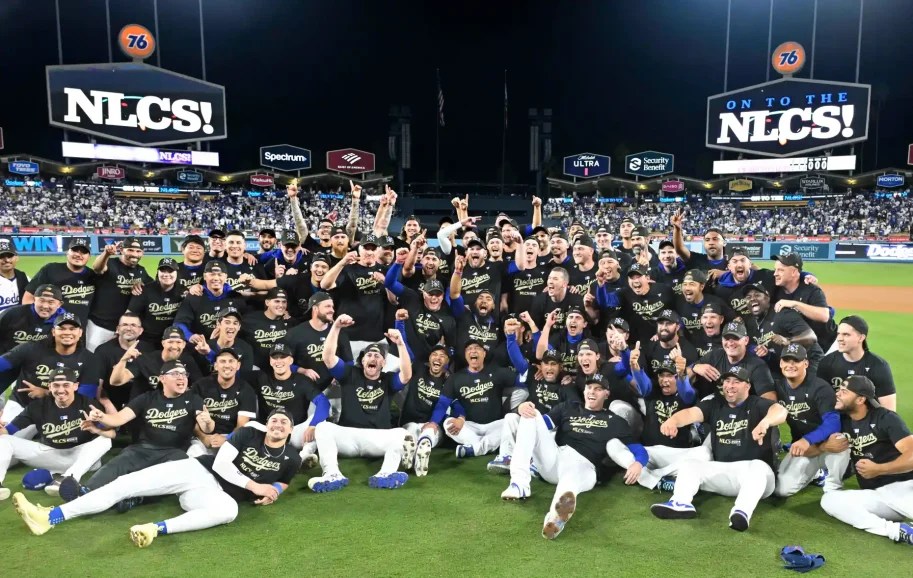
Ahead for the Dodgers: playing the Mets for the NL pennant.

They had a starting rotation most of which belonged in post-op. But the Dodgers are going to the National League Championship Series.

They had Shohei Ohtani, maybe the National League’s 2024 Most Valuable Player winner in waiting (though Francisco Lindor has a powerful claim), hitting a hefty home run in the first division series game but nothing much after. And they’re going to the NLCS.

They had Freddie Freeman, trying to play despite not giving a rolled ankle sufficient healing time, as close to plain ineffective as he’s ever been at any time in a brilliant career so far. And they’re still going to the NLCS.

Their starting picture so belonged in an orthopedic journal that they went to a Game Four bullpen game. And they’re still going to the NLCS.

They surrendered three homers to Padres superman Fernando Tatis, Jr. (two in Game Two, one in Game Three). And they’re still going to the NLCS.

They lost the sason series to the Pads and didn’t look quite as good on paper coming into the now-done division series. They’re still going to the NLCS.

They scored only two runs Friday night. But those were more than enough to send them to the NLCS.

The Dodgers did it with resilience. They did it with that eight-man bullpen game in the hostile arterials of Petco Park and the pen going lights out otherwise, to where the Dodgers were somehow able to shut the Padres out over the final 24 innings of the set.

They coaxed a magnificent Game Five start out of Yoshi Yamamoto, who turned a five-inning shutout over to that pen, where a mere four relievers were needed to finish what he started. On the first MLB postseason night featuring two Japanese-born starting pitchers, Yu Darvish was brilliant for the Padres over seven, except for two blemishes, and Yamamoto was better over five for the Dodgers.

But the Dodgers had to turn Dodger Stadium into Hernández Hideaway to get there, too, Friday night.

First, Kiké Hernández—back with the Dodgers for a second homecoming year after a detour to Boston, where he’d had a pocketful of postseason heroics for the Red Sox—punished Padres starter Yu Darvish with two outs in the bottom of the second, sending Darvish’s first service halfway up the left field bleachers.

Five innings later, Teoscar Hernández—a first-year Dodger after a tour taking him to Houston, Toronto, and Seattle, whose hefty grand slam pulled the Dodgers to within a run of the Padres in Game Three but only that—didn’t need full pillows. With one out, he hit Darvish’s 2-1 service to the same real estate his fellow Hernández reached.

Padres third baseman and slugger Manny Machado had perhaps the best post mortem from anyone in their silks: “We didn’t hit and score some runs. They did a tremendous job on the other side, on the pitching side. You have to give credit where it’s due. We just couldn’t string along hits. We had some opportunities, we couldn’t [push] through, and we fell short.”

That from a representative of the regular-season offense that threshed, of the team whose starting rotation could and often did dominate, and whose bullpen was one of baseball’s deepest of the year. The Dodgers said, essentially, in Kiké Hernández’s shameless postgame phrase, “[Fornicate] ’em all.”

“What was it,” said third baseman Max Muncy, “80 percent of the f—ing experts said we were going to lose? F— those guys. We know who we are. We’re the f—ing best team in baseball, and we’re out there to prove it.”

That won’t be as easy as they think. Awaiting the Dodgers are the Mets, who picked themselves up from the May scrap heap, rumbled their way to the postseason and through the first two rounds, have a lot more starting pitching depth (and lack of injury), a lineup with more depth than suspected going in, and (big “and”) they’re known lately for leaving bullpens wasted.

Both teams have their issues. The Mets need Pete Alonso to stay in the zone he’s rediscovered this postseason and closer Edwin Díaz to return all the way to form as he hinted in his last outing against the Phillies.

The Dodgers need length from at least two or three starters if they don’t want to tax that bullpen into letting the Mets do what they’ve done best this time around—make the final three innings their personal marquee stage. They also need Mookie Betts to continue becoming the Mookie Monster again after his slumpbusting bombs against the Padres.

This forthcoming NLCS does promise to see two teams throwing the proverbial kitchen sinks at each other as best they can with what they have. Whoever wins it stands to become a heavy World Series favourite.

“I’m the one probably most surprised . . . “

Shohei Ohtani

Ohtani takes one of his curtain calls from the Miami audience Thursday evening.

If you absolutely must become baseball’s first 50/50 man, as in 50+ home runs and 50+ stolen bases in a single season, you couldn’t pay for any more earth-moving way to do it than Shohei Ohtani found Thursday evening.

A 6-for-6 day at the plate. As many runs batted in in one game as his Dodgers teammate Freddie Freeman has so far in all September. Three RBI hits serving as just the overture to both Ohtani’s history-making suite and the Dodgers smothering the hapless Marlins, 20-4, in the Fish’s own tank.

Theft number 50 after a first-inning double and theft number 51 after the second-inning RBI single. A two-run double in the third ruined only by Ohtani getting himself thrown out trying to stretch it into a triple.

Almost exactly the way Hall of Famer in waiting Albert Pujols demolished the Rangers after the sixth inning in Game Three of the 2011 World Series (three bombs: one each in the seventh, eighth, and ninth innings), Ohtani’s real mayhem began in the sixth:

A man on second and one out in the sixth, Ohtani sent an 0-1 slider into the second deck behind right center field. It made him only the second Dodger behind Shawn Green to hit 49 in a season. Second and third off a wild pitch and two out in the seventh, Ohtani hit one the opposite way into the left field bullpen. That founded the 50/50 Club and earned him a loud curtain call in a road ballpark.

First and second and two out in the ninth, Ohtani slammed the best possible exclamation point upon the proceedings when he drove a high meatball from a sacrificial lamb (read: Marlins position player, Vidal Bruján) well into the upper deck behind right field. With another curtain call to follow.

“To be honest,” Ohtani told a television interviewer through an interpreter post-game, “I’m the one probably most surprised. I have no idea where this came from, but I’m glad that I performed well today.”

The loanDepot Park audience in Miami didn’t have much to root for from their own lack of heroes this year (the Marlins have already been eliminated from the postseason mathematically), so it didn’t cost them anything but netted them plenty of respect to hand history their day’s loudest ovations.

If you’re my age, you can compare it to the day the usually unapologetic rooters of the early Mets suddenly turned on their anti-heroes on that fine 1964 Father’s Day in Shea Stadium, when Hall of Fame pitcher Jim Bunning threatened to pitch the first perfect game in the 20th Century National League. When Bunning finished what he started, he was hit with a wild standing O and an invitation to appear on The Ed Sullivan Show.

Credit Marlins manager Skip Schumaker, whose ten-year major league playing career included one season (2013) with the Dodgers, for looking into the teeth of the hurricane demolishing his club, with Ohtani potentially carrying number 50 in his bat, seeing second and third and two outs in the seventh, electing not to put Ohtani aboard to give the Fish a better survival chance with aging Kevin Kiermaier—whose bat is now as useless as his glovework remains a study—due to hit behind him.

“If it was a tight game, one run lead or we’re down one,” the manager said postgame, “I probably put him on. Down that many runs [nine], that’s a bad move baseball-wise, karma-wise, baseball god-wise. You go after him to see if you can get him out. I think out of respect for the game, we were going to go after him. He hit the home run. That’s just part of the deal.”

“A lot of us actually looked at the opposing dugout and I think a lot of the coaches were telling Skip, ‘Hey, we should walk him right here’,” said Dodger third baseman Max Muncy, who’d scored on Ohtani’s early single and final home run. “I’ve always loved Skip. When he was the first base coach in San Diego, I always talked to him. I heard all guys love to play for him. For him to do that, that’s awesome.”

“The game was certainly out of hand,” said Dodger manager Dave Roberts. “Guys got their starters out and then to take that potential moment away from the fans, Shohei himself, Skip understood that. It was bigger than that and I’ve got nothing for respect for that.”

Kiermaier striking out to end that seventh merely amplified the magnanimity of what Schumaker refused to do. A team out of any pennant race has a lot more for which to apologise to their fans than trying to stop the unstoppable force on a night he’s making history on its dollars. And leading his team to a National League West division clinch while he’s at it.

Ohtani previously entered the rareified 40/40 club by hitting a grand slam. This was different. This was a night the Dodgers used the Marlins for target practise and Ohtani proved to have the most ammunition to expend. Even MLB officials were in on the act, swapping out regulation game baseballs for pre-authenticated balls before Ohtani batted in the seventh.

When he turned Mike Baumann’s curve ball into history, those officials scurried to siphon as much memorabilia as they could carry away from Ohtani, perhaps leaving observers to ask only how they’d managed to miss his uniform belt, undershirt, and jock strap.

It isn’t every day that a player has a ten-RBI, six-hits, five extra-base hits, three home runs, two stolen bases day. No player had done all of those over a career, according to OptaSTATS. Not Babe Ruth or Lou Gehrig, not Ted Williams or Stan Musial, not Mickey Mantle or Willie Mays, not Henry Aaron or Roberto Clemente, not Dick Allen or Mike Schmidt, not Barry Bonds or Ken Griffey, Jr.

Ohtani did all five in a single day.

“With this game of baseball, it was a win for Major League Baseball,” said Roberts. “I know people all over the globe were watching this game and we’re excited to see that they got a chance to witness history.”

Roberts and Schumaker understood what too many forget, including among those who administer the game, but which longtime New York Times baseball writer George Vecsey got, watching then-commissioner A. Bartlett Giamatti getting it, too, when Giamatti almost gave in and pumped his fist watching Hall of Fame pitcher Nolan Ryan ring up his 5,000th lifetime strikeout at Hall of Fame outfielder/base larcenist Rickey Henderson’s expense: “baseball is about rooting, about caring.”

Nowhere was that more evident than when Ohtani popped out of the visitors’ dugout to take one of a couple of curtain calls after his blasts. A young fan on the other side of the side rail, holding a sign up just above the rail, but level with Ohtani’s face:

I SKIPPED MATH
TO WATCH
HISTORY.
OHTANI 50/50.

If I’m that boy’s English teacher, I give extra credit for the school-age pun of the season.

“I loved every challenge of playing third base”

Adrián Beltré

He hit home runs on one knee, he was a human highlight reel at third base. Welcome to Cooperstown!

Of all the stories that abounded this weekend about Adrián Beltré, on the threshold of his induction into the Hall of Fame, there’s one which may be forgotten except by Angel fans left (as almost usual) to ponder what might have been. It’s the story of the Angels pursuing Beltré as a free agent after he spent five often injury-plagued seasons in Seattle.

Essentially, Angels owner Arte Moreno wanted Beltré in the proverbial worst way possible, after the Dodgers who reared him were willing to let him escape to the Mariners in free agency—despite Beltré having just led the Show with 48 home runs in 2004—because then-owner Frank McCourt didn’t want to pay what the Mariners ultimately did.

Beltré went from the Mariners to the Red Sox on a one-year, prove-it kind of deal. When that lone Boston season ended in October 2010, Moreno kept Beltré in his sights. But nothing the Angels presented Beltré impressed him enough to sign with them. He opted to sign with the Rangers instead. Moreno was so unamused he ordered his then-general manager Tony Reagins to deal for Blue Jays outfielder/slugger Vernon Wells.

Well. The Angels learned the hard way (don’t they always?) that Wells was damaged goods. The fellow they sent the Jays to get him, bat-first catcher Mike Napoli, would join Beltré for a hard-earned trip to a World Series that would break their hearts, before moving on to help Cleveland to a pennant and the Red Sox to the 2018 World Series triumph.

Meanwhile, before leaving Seattle for a one-year, show-us deal with the Red Sox, Beltré by his own admission finally learned he could have a shipload of fun playing baseball without losing the focus, the discipline, or the outlying durability that were going to make him a Hall of Famer in the first place. With the Rangers, he finished his ascent into what Baseball-Reference calls the number four all-around third baseman ever and, concurrently, built and secured a reputation as a team-first Fun Guy.

Nail his 3,000th lifetime major league hit? Party time—for the whole team and then some. “After he got 3,000 hits he had a party,” says Rangers in-game reporter Emily Jones to The Athletic‘s Britt Ghiroli and Chad Jennings. “It was like our clubhouse moved to this place. Every clubbie. Every trainer. Every massage therapist. He was extremely inclusive.”

“He was the oldest guy on the field,” says his former Rangers teammate Elvis Andrus, “but acted like the youngest.”

Beltre’s fun-loving rep went hand in glove with being a veteran clubhouse leader to whom even his manager often deferred. “If he stared at you some kind of way,” says Ron Washington, now managing the Angels but then managing the Rangers, “you knew he meant business. A couple of times, I got off my perch to go get (on a player). He would stop me and say, ‘Let me get it, skip’.’

“I saw him chew veterans,” says one-time Rangers batting coach Dave Magadan, “like they were 19-year-old rookies.”

But he also never forgot teammates, even after he retired. Lots of players can make their teammates go with the flow during arduous seasons. Beltré made them friends. Even if he might chew them out one day, he’d re-cement the friendship side by asking, “You know why I did that, right?”

Former Rangers teammate Mitch Moreland remembers taking a group of later Athletics teammates to a Seattle restaurant to which Beltré had taken a host of Rangers once upon a time. “I called (Beltré) and I was like, ‘Hey, what was the guy’s name at Metropolitan? I’m going to take the boys there’.”

He goes, “Oh, I got you.” So, he called the guy up, set it up. I took the whole team over there, we ate, and I got ready to get the bill, and Adrián had picked it up. For the Oakland A’s. After he was retired.

What of the once-familiar running gag involving Beltré’s real distaste for having his head touched and teammates—usually spearheaded by Andrus—going to great lengths to touch it and get away with it? “I still do,” Andrus says. “He still doesn’t like it. That’s what I am going to try to do at Cooperstown . . . I need to touch his head. I need to touch his head while he’s talking!”

He didn’t get anywhere close to that. Hall of Famer David Ortiz did, right smack at the podium.

But no matter. The third baseman who declined a grand farewell tour didn’t need any further validation for his place in the Hall of Fame. Those who do, however, should marry his 27.0 defensive wins above replacement level player (WAR) to his Real Batting Average (total bases + walks + intentional walks + sacrifice flies + hit by pitches, divided by total plate appearances) among Hall third basemen whose careers were in the post-World War II/post-integration/night-ball era:

HOF 3B PA TB BB IBB SF HBP RBA
Mike Schmidt 10062 4404 1507 201 108 79 .626
Chipper Jones 10614 4755 1512 177 97 18 .618
Eddie Mathews 10100 4349 1444 142 58 26 .596
Scott Rolen 8518 3628 899 57 93 127 .564
George Brett 11625 5044 1096 229 120 33 .561
Ron Santo 9397 3779 1108 94 94 38 .544
Wade Boggs 10740 4064 1412 180 96 23 .538
Adrián Beltré 12130 5309 848 112 103 97 .533
Paul Molitor 12167 4854 1094 100 109 47 .510
Brooks Robinson 11782 4270 860 120 114 53 .458
HOF AVG .555

He’s not higher there because a) he drew far less unintentional walks than most of the men on that list; and, b) that aforementioned durability led him to playing through injuries insanely enough to cause him a few so-so seasons that pulled his numbers down somewhat. But as a defensive third baseman he’s the second-most run-preventive player (+168) who ever worked that real estate . . . a mere 125 behind a guy named Robinson.

“I loved every challenge of playing third base,” said the first third baseman in Show history to nail 400+ home runs and 3000+ hits. “I was hooked. Those hot shots, slow ground balls, double plays, I couldn’t get enough of them.” Come Sunday, the Cooperstown gathering almost couldn’t get enough of Beltré, either.

An ESPN writer gets religion . . .

Shohei Ohtani

Hitting the first of his thirteen Dodger home runs to date, Ohtani’s overall plate value may force the Dodgers to think of him as a one-way player—at the plate, exclusively. May. And one ESPN writer thinks it’s not a terrible thought at all.

Some of us have dared to ponder long enough whether Shohei Ohtani’s two-way viability was all that viable in the long term. Well, now. At least one ESPN writer asks and answers the same question. Sort of.

“Like [Babe] Ruth in the late 1910s, Othani might be getting so good with the bat it no longer makes sense to deal with the complications of a two-way act,” writes Bradford Doolittle.

Would Ohtani be open to giving up pitching at some point if the Dodgers ask? It’s the 21st-century version of the Babe Ruth Problem that confronted the Red Sox long ago. But if the team ever does make that request, it will be because a franchise that employs a small army of analysts has untangled some very complicated math around the decision.

Thanks to his recovery from a second Tommy John surgery performed late last year, Ohtani on the mound is a non-starter this year. Ohtani purely at the plate, as the Dodgers’ designated hitter, is something else entirely. Emphasis on something else: As of this morning, he leads the entire Show with a .646 slugging percentage, a 1.069 OPS (his on-base percentage is a solid gold .425), and 128 total bases. He also leads the National League with his 200 OPS+.

Shall we look at Ohtani’s 2024 thus far according to my Real Batting Average (RBA) metric? (Total bases + walks + intentional walks + sacrifice flies + hit by pitches, divided by total plate appearances. P.S. Ohtani as of this morning led the entire Show with his .356 traditional batting average and his 69 hits, too.)

2024 through 5/22 PA TB BB IBB SF HBP RBA
Shohei Ohtani 226 128 24 0 2 1 .686

WARriors may care to note that Ohtani’s 3.2 through this morning is behind only his Dodgers teammate Mookie Betts and a shade ahead of the Cubs’ import pitching star Shota Imanaga’s 3.0. (Imanaga is knocking the league on its can on the mound: he leads the NL with a 2.21 fielding-independent pitching rate [FIP] and leads the entire Show with an absolutely extraterrestrial 497 ERA+ so far this year, not to mention his 0.84 ERA.)

Doolittle runs down the prospects of Ohtani coming off the mound to stay and reasons why the Dodgers might want to make the move: his sick seasonal stats to date, his improved overall batting metrics, his increase in line drive hitting, even career high baserunning figures.

But it takes Doolittle a good while before he notes the injury that keeps Ohtani at the plate alone this year. And he almost brushes it to one side in order to address what he calls “the biggest consideration of all.” That would be, as he sees it:

To what extent is Ohtani’s current leap at the plate a byproduct of not having to worry about pitching? And how much better might he be doing, if that were at all possible, if he didn’t have to worry about rehabbing another pitching injury? Could his baserunning value be maintained or enhanced if he didn’t have to consider mound work?

A lot of people, myself included, wondered just how viable Ohtani’s two-way baseball life would prove in the long term. Enough of us who did so nearly had our heads handed to us. Three years ago, it happened to Ahead of the Curve author Brian Kenny, co-hosting MLB Now (MLB Network), courtesy of New York Post writer Joel Sherman, who co-hosted that day.

Kenny suggested the Angels should think of limiting Ohtani to one or the other full-time role, pitcher or designated hitter/occasional outfielder. Sherman demanded to know why. Kenny replied, “One could damage the other.” Oops. “So,” Sherman rejoined, “you would like one of the fifteen to twenty best starting pitchers in baseball to stop starting because you’re worried about something that could happen?”

Well, something that could have happened, did happen.

It’s kept Ohtani off the mound since last August, but that’s all, folks. That’s not wonderful news for the rest of the league’s pitchers, but it’s certainly wonderful news for a Dodger team sitting seven games up in the National League West while leading the entire Show in team total bases and team OPS and the NL in home runs, team slugging, and team batting bases on balls.

Once upon a time, Babe Ruth himself, the only other man to play even one season (1919) as both a starting pitcher and full-time (130 games) slugger/outfielder, thought the idea of continuing in that tandem role wasn’t too realistic even for him.

“I don’t think a man can pitch in his regular turn, and play every other game at some other position, and keep that pace year after year,” said Ruth in 1918, when he started twenty games for the Red Sox and played part-time (95 games) as a slugging outfielder. “I can do it this season all right, and not feel it, for I am young and strong and don’t mind the work. But I wouldn’t guarantee to do it for many seasons.”

Ruth had to be dragged kicking and screaming somewhat into the idea that his number-one value was and would be at the plate. But once he joined the Yankees he never again tried to be a pitcher, except for five games spread between 1920-21, 1930, and 1933. From 1920 through 1934, of course, you could say (with apologies to Casey Stengel) that Ruth was rather splendid in his line of full-time outfield work. Even if he was far more valuable at the plate (transdimensional in his time) than in the outfield (roughly league average).

It wouldn’t be untoward if the Dodgers began to think Ohtani might want to ponder Ruth’s 1918 remarks and take them seriously for the sake of his longer term baseball health. He already proved he could do the two-way job at a breathtaking level, not to mention doing it that way longer than Ruth actually did.

If the Dodgers are worried about the box office, they shouldn’t. Ohtani at the plate is still more than enough gate attraction. He’s liable to stay that way for a good number of years further. One way to ensure that as well as his real value in a pennant race just might be to keep him off the mound from now on.

Carl Erskine, RIP: From Jackie to Jimmy

Roy Campanella, Jackie Robinson, Carl Erskine.

Carl Erskine (right) congratulated by Hall of Famers Roy Campanella (left) and Jackie Robinson (center) after he no-hit the Giants in 1956.

If you consider The Boys of Summer as author Roger Kahn did, the 1952-53 Brooklyn Dodgers he covered for the New York Herald-Tribune, Carl Erskine was the last Boy standing. Which may have surprised him as much as anyone else.

If you consider them to include Brooklyn’s only World Series winners from 1955, Erskine’s death at 97 Tuesday leaves Hall of Famer Sandy Koufax (a bonus rookie on that team who didn’t appear in that Series) the last Boy standing. It almost seems sadly appropriate.

Erskine’s fourteen strikeouts in Game Three of the 1953 World Series stood as a Series record until Koufax broke it with fifteen punchouts in Game One of the 1963 Series. “Don’t worry, Dad,” one of Erskine’s sons said to his father after they finished watching the game on television. “You still hold the record for righthanders.” (He did until Hall of Famer Bob Gibson broke both him and Koufax in the 1968 Series.)

Either way, Erskine’s long and exemplary life doesn’t prevent mourning. A good pitcher who was a better man no longer lives and walks among us.

“He was a calming influence on a team with many superstars and personalities,” said former Dodger owner Peter O’Malley, whose father Walter owned the team from 1950-1979. “But getting credit was not Carl and that is what made him beloved.” No, that only began to delineate what made Erskine beloved.

The Hoosier righthander known for the kind of big, overhand curve ball Koufax himself would develop and surpass from the left side, Erskine grew up in Anderson devoid of prejudice and was a boyhood friend of eventual Negro Leagues baseball player and Harlem Globetrotters basketball player Jumpin’ Johnny Wilson.

Joining the Dodgers a year after Hall of Famer Jackie Robinson broke the major league colour barrier, Erskine was approached by Robinson, who asked, “Hey, Erskine, how come you don’t have a problem with this black and white thing?” Erskine mentioned his friendship with Wilson, saying, “I didn’t know he was black. He was my buddy. And so I don’t have a problem.”

Over two decades later, Erskine told Kahn for the latter’s fabled book, “Jumpin’ Johnny Wilson ate maybe as many meals at my home as he did at his own. With a background like that, the Robinson experience simply was no problem.”

Remembering further, Erskine also beamed when tellling Kahn of the welcome he got when the Dodgers brought him up from their Fort Worth (TX) farm in July 1948. “The team is in Pittsburgh,” he said. “I walk into the Forbes Field dressing room carrying my duffel bag.”

Just inside the door Jackie Robinson comes over, sticks out his hand, and says, “After I hit against you in spring training, I knew you’d be up here. I didn’t know when, but I knew it would happen. Welcome” . . .

. . . Man, I’d have been grateful if anyone had said “Hello.” And to get this not just from any ballplayer but from Jackie Robinson . . . I pitched that day and won in relief.

Known colloquially as Oisk by Brooklyn fans, Erskine was managed first by Burt Shotton. And Shotton made a grave mistake. During a start against the Cubs, Erskine suffered a torn shoulder muscle. He finished the game but awoke the following morning unable to lift his arm. He started next against the Phillies and could barely lift his arm after five innings.

“Why, son, you’re pitching a shutout,” Erskine remembered Shotton telling him then. “Now you go right ahead out there. If you get in any trouble, we’ll take care of that.” Erskine went on and again couldn’t lift his arm the following morning. “I did a lot of damage to my shoulder in those two starts,” he remembered to Bums author Peter Golenbock, “and I began then to have really, really severe arm problems, and it plagued me my whole career.”

Carl & Jimmy Erskine

Father and son beam as Jimmy Erskine displays his Spirit of the Special Olympics award, known to be the SO’s highest honour for a participating athlete. His father liked to hold up a World Series ring and one of Jimmy’s SO gold medals during personal appearances and ask, “Which of these means more?”

Somehow, Erskine managed to pitch two no-hitters (1953, 1956) and get credit for two wins in eleven World Series games between 1949 and 1956. “I’m very pleased and fortunate that I was not finished after I hurt my arm,” he told Golenbock, after admitting his retirement two years after the Dodgers moved to Los Angeles was for just that reason at last. “But occasionally it would cross my mind, I wonder if I had not hurt my arm, how good could I have been?”

Soon after Erskine retired as a pitcher, his fourth child was born. Jimmy Erskine was a Down’s syndrome baby (they called it mongolism in those years, alas) and everyone in the Erskine orbit, practically, urged Erskine and his wife, Betty, to have the boy institutionalised. The Erskines said, “Not so fast.” They determined, in Kahn’s words, “to make Jimmy Erskine as fully human as a (Down’s child) can become.”

At that time, Down’s children had an average life expectancy of ten years. Jimmy Erskine said, essentially, “That’s what you think.” Thanks to his parents and the Special Olympics, in which he participated for decades to follow, he lived 63 years, even coming to work in the restaurant business before his death last November. His parents and his three older siblings made sure people saw him as part of their family, taking him on normal outings to the supermarket, church, and restaurants.

His father worked in insurance and then as a bank president and an Anderson College baseball coach. But his father also plunged deeply into the Special Olympics among other advocacies for the developmentally disabled. One of Erskine’s friends became Special Olympics founder Eunice Kennedy Shriver. Jimmy’s parents also created the Carl and Betty Erskine Society to raise money for the Special Olympics.

Those who watched him pitch may have believed at times that his shoulder issues kept him from a Hall of Fame career, but Erskine arrived in Cooperstown regardless. His Special Olympics work and advocacy for the disabled helped earn him the Buck O’Neil Lifetime Achievement Award at last year’s Hall ceremonies.

Erskine had a habit when speaking in public of hoisting his 1955 World Series ring, then hoisting one of the gold medals his son won as a Special Olympian. “You tell me which is the greater achievement?” he’d say. “Which of these means more?”

I’ll answer that personally. I’m the father of a developmentally-disabled son thanks to babyhood deafness (which cleared in due course) leaving him speech-language impaired. Bryan is an avid baseball fan and a near-rabid Los Angeles Angels fan, and he now works as a restaurant shift lead. He also played softball for the Southern California team in the 2018 Special Olympics in Seattle. He whacked a home run in his first-ever national SO plate appearance, and his team earned the silver medal. The only one who could have been more proud than him was (and remains) his father.

And I’ll still take that over any World Series title won by any major league baseball team, even any major league team that won one playing in the New York sunlight or under the New York stars. May Carl and Jimmy Erskine’s Elysian Fields reunion have been even more joyous than any of the times they shared on this island earth.