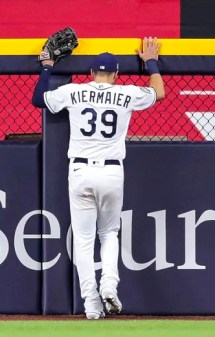
“Eventually, we’ll get some bounces”

Rays center fielder Kevin Kiermaier after watching Austin Barnes’s Game Three home run land on the other side of the fence Friday night.

All of a sudden, the Tampa Bay Rays look as human as an American League East champion can look. With two Los Angeles Dodgers manhandlings against them and a few too many vulnerabilities brought further into the light, they don’t even look like a World Series team going into Game Four.

Their vaunted bullpen and its deft management? Invisible in Games One and Three. Manager Kevin Cash almost inexplicably left them out of those games until it was too late to keep veteran starting pitchers Tyler Glasnow and Charlie Morton from being riddled.

Their penchant for hitting only when it’s timely? They’re 5-for-18 with runners in scoring position all Series long. They’re 4-9 in the two games they lost and 1-for-9 in the game they won. Figure that if you can.

The Rays better figure it and fix it fast enough, unless they’d like Game Five to be their elimination game—with Game One winner/maestro Clayton Kershaw scheduled to start—if they can’t solve Julio Urias and the Dodger pen in Game Four.

Morton admitted he was off his game starting Game Three. “I think I could have done a better job of slowing it down a little bit, especially early,” said the veteran righthander Friday night. “I just never got into a groove. I never really felt comfortable out there, which, even in playoff games, I’m able to eventually get there if I don’t have it early, and I just never did. Just combine that with who [the Dodgers] are with the bats and it made for a rough night.”

The Rays bumped, ground, nudged, bopped, and snuck their way through all three previous postseason sets, in two of which they needed to go the distance, and in an American League Championship Series they were in danger of blowing after shoving their way to a 3-0 series-opening lead.

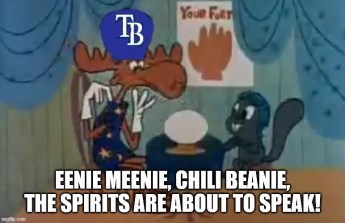
At the end of that Game Three the Rays resembled a club of flying squirrels. At the end of this Game Three they barely resembled Bullwinkle J. Moose.
They’d previously manhandled the AL East, never mind being aided and abetted by the Boston Red Sox’s complete collapse and the Baltimore Orioles’s inability to sustain the success of a 12-8 record by 15 August. They even had a deceptive 8-2 irregular season against that beastly Empire Emeritus.

Cash planned to stack his Game Four lineup with four righthanded hitters at the top against the lefthanded Urias and seven overall. The top four would be Yandy Diaz (first baseman), Randy Arozarena (designated hitter), Mike Brosseau (third base), and Manuel Margot (left field).

Pay attention: Diaz and Margot are the most deceptively-prolific World Series hitters between both teams. Both have .400 Series batting averages and .900+ Series OPSes. They’re also carrying the emptiest .400 averages you’ll see. Diaz has a walk, no extra base hits, and no runs driven in. Margot has one extra base hit, three walks, five strikeouts, one walk, and three runs scored. More men on base ahead of them, please, Rays.

And Arozarena, whose home run hitting has been setting records and raising rackets, has one problem with his postseason power—only four of his eight home runs all postseason long either tied a game or put the Rays ahead. The deeper the postseason’s gone, the fewer fastballs the fastball-flogging Arozarena’s seen.

The only decent one he saw in Game Two took a long flight—with the Rays five runs behind and an out from the loss. The rookie’s being exploited for his inexperience at forcing pitchers to throw him something hittable or turning on any breaking ball with any considerable hang time in the zone.

Tying Nelson Cruz, Carlos Beltran, and Barry Bonds with eight bombs in a single postseason, or passing Derek Jeter for hits by a rookie in a single postseason (23), is well and good. But Arozarena knows what means more. “What really means more is the win,” he told the Tampa Bay Times, “to hopefully get some victories for the team.”

Lefthanded swinging second baseman Brandon Lowe will bat behind Margot. Everyone who thought his two-bomb/three-steak Game Two meant his horrific preceding postseason slump was history got disabused for the time being in Game Three. He went 0-for-4 with three strikeouts, including one in the sixth with Meadows aboard on a base hit. His lone contact out was a fly to not too deep right for the second out of the ninth.

“We seem to be a much better club when we get early leads,” said Cash after Game Three. “Whatever we can do to get some runs early.” The Series bears him out so far. They scored first in Game Two and won. The Dodgers scored first in Games One and Three and won.

“There’s nothing left,” said Morton, “but to show up [Saturday] and bounce back.”

“Guys have been hitting the ball hard lately,” the manager said. They did in Game Three—when Walker Buehler wasn’t striking them out from here to eternity. “The luck hasn’t been there, but that’s all part of it. We have to stay consistent and put our work in. Eventually we’ll get some bounces.”

Eenie-meenie, chili-beanie, the spirits are about to speak!

Eventually had better pull up to the Game Four docks for the Rays Saturday night. Otherwise, it’s going to be the sad song these Dodgers sang for seven consecutive postseasons previous: “Eventually, we’ll win a World Series.”  The roof will be open at Globe Life Field. The Rays can’t afford to let it fall in.

A 2-1 Dodger advantage feels more like 3-1

At any angle, from any view, Walker Buehler overpowered the Rays Friday night.

“They’re more of a manufacturing team than a pure slugging team like Atlanta might be,” said Walker Buehler, the Los Angeles Dodgers’ Game Three starting pitcher, before he actually went out and pitched against the Tampa Bay Rays. “You never know what lineup you get. We’re trying to figure out what they may do against you and work off that.”

Buehler then went out and hung a “Closed for Repairs” sign outside the manufacturers’ plant. The Rays don’t exactly have all the time in the world to put the repair crews to work.

The fixings will probably begin with otherwise stout Rays starter Charlie Morton. The same guy who flattend his old buddies from Houston to help the Rays win the pennant in the first place. The Dodgers slashed five runs on seven hits out of Morton in four and a third innings while Buehler refused to let the Rays catch hold of his full-zone fastballs or force him to work off-speed. Making it feel as though the eventual 6-2 final was a lot worse than a four-run deficit usually is.

Buehler does that when he’s on. He even takes a no-hitter into the fifth when need be. With one slightly off-the-charts outing the righthander suddenly turned the World Series from anyone’s to win to the Rays’s to lose. The Dodgers’ 2-1 Series advantage felt more like 3-1 when it finally ended.

“That might be the best I’ve ever seen his stuff,” said his catcher Austin Barnes after the game.

Buehler didn’t just expose the Rays’ continuing postseason flaw of striking out when they can’t and don’t make contact. The Rays have now done what no postseason team in history has accomplished, striking out 180 times.

They also have 113 hits, making them the only postseason team in history to hit 67 fewer times than they’ve struck out. In the middle of that, they went ten straight games—Game Four of their division series through Game Two of this World Series—with more strikeouts than hits.

Buehler’s thirteen punchouts also left the Rays striking out nine times or more in ten straight postseason games and a twelfth postseason game this time in which they struck out ten times or more. And, with thirteen hitters getting K’ed three times or more in single games.

“It’s like . . . people always say, ‘Why don’t they just hit the ball the other way when they shift?’” said Rays manager Kevin Cash Friday postgame. He laughed like Figaro, that he might not weep. “It’s hard enough just to hit the ball.” Against Buehler, whose three hits surrendered seemed like momentary lapses into generosity, it was impossible enough.

Against Morton, alas, with his fastballs not finding their intended destinations and his breaking balls left a little too readily over the plate, for a change, he might have been fortunate that seven hits were all the Dodgers could get. Begging the question as to why Cash, who normally thinks nothing of such moves when he smells trouble, left him in as long as he did this time around.

Sure Cash thought nothing of hooking Morton in Game Seven of the American League Championship Series at the first sign of trouble in the top of the sixth. And the world went bonkers over that. Since when does a manager that fearless not get his bullpen working and his man the hell out of there when he’s in the hole 3-0 with two out but two on in the third—the first of whom got there as a hit batsman off the foot?

All three of the Dodgers’ hits have come with two strikes,” tweeted ESPN’s Jeff Passan after the third. “And all three have been on pitches Charlie Morton left over the plate. Dodgers lead, 3-0, and they’re doing it against a pitcher whose opponents hit .170/.207/.284 vs. him with two strikes this year.

The Dodgers now have 87 runs this postseason. Fifty of them have come with two outs. “There’s two outs, but you can still build an inning, not giving away at-bats,” says the Mookie Monster, one of four Dodgers to knock in at least a run with two outs Friday night. “That’s the recipe. That’s how you win a World Series.”

I’m always fascinated by Kevin Cash’s pitching decisions,” tweeted The Athletic‘s Jayson Stark after the fourth inning. “Last Saturday, Charlie Morton had 66 pitches and a 2-hit shutout in the 6th – and Cash took him out. Tonight, he was down 5-0 with 78 pitches through the 4th – and got left in. Much quicker hook when Cash has a lead.”

Much harder for Cash to get away with bass-ackwards thinking, too. Not a single Rays bull poked his nose out of his stall before and after Max Muncy lined a two-run single to center. It took until the fifth—after Dodger catcher Austin Barnes dropped his safety-squeeze RBI bunt and Mookie Betts’s full-count, followup RBI single made it 5-0 in the fourth—before the Rays bullpen gate finally swung open.

Did you guess what happened from there right? If not, here it is: Four Rays relievers kept the Dodgers to a single run and three hits in their four and two-thirds innings work. They walked only two and struck out four. In other words, the Rays’ bullpen did what the Rays’ bullpen normally does. They just started four and a third innings too late Friday night.

It doesn’t discredit the Dodgers’ hitters to suggest Cash might have let them break into the house—only beginning with Justin Turner’s one-out, high line home run in the top of the first—and steal all the jewels and cash they could carry. The only thing the Dodgers swiped once Cash finally reached for the armed guards was Barnes catching hold of a John Curtiss slider that didn’t slide as far under the middle as it was supposed to slide and sending it over the center field fence in the top of the sixth.

Get the feeling the Dodgers are turning brand-new Globe Life Field into Dodger Stadium II? They’re not just pitching as though it’s their own vacation home, but they’ve hit one more home run in sixteen postseason games there than the Texas Rangers hit in thirty irregular season games in their brand new house.

Delayed security is not the best idea when you’re up against a Buehler who’s hell bent on making sure nobody got into the Dodgers’ house except Manuel Margot with a one-out double and Willy Adames with a two-out RBI double in the bottom of the fifth.

“Being a big-game pitcher and really succeeding on this stage, there’s only a few guys currently and throughout history,” said Dodgers manager Dave Roberts postgame. “He’s in some really elite company, and I’m just happy he’s wearing a Dodger uniform.”

With Friday night’s flush and the prospect of facing Buehler in Game Seven if the Series goes that far, the Rays would prefer he wear a police, fire, or military uniform right now. Those they can handle. Buehler they couldn’t. When he finished the fifth his lifetime postseason ERA stood at 2.34 and his 2020 postseason ERA alone stood at 1.88. And his streak of nine straight postseason gigs with a minimum six strikeouts and two runs allowed or less became the longest in Show history while he was at it.

“I think the more you do these things the calmer you get,” said Buehler postgame. Not about any records but just about pitching up when you’re striking for the Promised Land. “I don’t want to keep harping on it, but I enjoy doing this. And I feel good in these spots.”

As for World Series games pitched with ten or more punchouts, no walks, and no bombs surrendered, Buehler became only the eighth pitcher to have one. The previous Magnificent Seven: Sandy Koufax (1965), Bob Gibson (1968), Tom Seaver (1973), Randy Johnson (2001), Roger Clemens (2001), Cliff Lee (2009), and Adam Wainwright (2013).

Tampa Bay left fielder Randy Arozarena hit an excuse-us solo homer off Dodger closer Kenley Jansen with two out in the ninth. He’s now hit as many home runs in this postseason (eight) as he did when he was finally past his COVID-19 bout and saddled up for what was left of the irregular season. He also set postseason records with what’s now 52 total bases and 23 postseason hits as a rookie.

Turner had to settle merely for his first postseason bomb since 2017 and for tying Hall of Famer Duke Snider on the Dodgers’ postseason homer list with his eleventh. Barnes also slipped into the record books. Only one man previously had ever homered and squeezed a run home in the same Series game, and that was more than half a century ago.

We take you back to Hector (What a Pair of Hands) Lopez, New York Yankees outfielder, off Cincinnati Reds pitcher Bob Purkey in the deciding 1961 Series Game Five. Barnes is thus the only catcher ever to turn the single Series game bomb-squeeze trick. Roll over Bill Dickey, and tell Yogi Berra the news.

If only Arozarena’s bombings had better timers. Only four of his eight postseason bombs so far have either tied a game or given the Rays a lead. The rook whose 1.340 OPS in the first three rounds widened as many eyes as his home runs has a mere .885 OPS in the Series thus far.

The Rays overall are only hitting a .206/.250/.381 Series slash. They’ve actually struck out at the plate six fewer times than the Dodgers, but they’ve been out-hit by five, out-homered by three, and out-scored by seven. With Morton’s ghastly 10.38 Game Three ERA and Game One starter Tyler Glasnow’s grotesque 12.46, you have to remove them to find the Rays otherwise with a 2.10 Series ERA. Remove Dylan Floro and Dustin May from the Game Two equation, and the Dodgers otherwise have a 2.20 Series ERA thus far.

Timing is everything in this Series. The Rays’ inability to find theirs at the plate against Buehler and Clayton Kershaw, the Dodgers’ finding and finer tuning theirs against Morton and Glasnow, and Cash’s timing off twice on charging his bulls, are three major reasons why the Dodgers holding a 2-1 Series lead feels more like a 3-1 lead going into Saturday night.

This is what the Dodgers saved Julio Urias for. You may have heard a little chirping after he didn’t appear even in a bullpen stir during Game Two, when the Dodgers couldn’t beat the Rays at their own bullpen game. They’d better hope he isn’t too well rested; he hasn’t pitched since he closed out NLCS Game Seven with three shutdown innings last Saturday. And he’s going up against a by-necessity Rays bullpen game with Ryan Yarbrough possibly opening and possibly going three.

That’s the game the Rays usually master. Now it’s the mastery they need desperately enough.

The Blake and Brandon Show

Blake Snell, meet Sandy Koufax.

Realistically, the Tampa Bay Rays didn’t have to come into World Series Game Two wearing hazmat gear Wednesday night. Losing Game One didn’t mean rolling over and playing dead for the Los Angeles Dodgers no matter how formidable the Dodgers looked winning.

Especially on a comparative off night for the Mookie Monster, an on-night and then some for slumping Rays second baseman Brandon Lowe blasting his way out of the funk, an off-night for the Dodgers’ bullpen, and an off-the-charts night for Rays starting pitcher Blake Snell concurrent to a kind of typical night for the Rays’ bullpen.

All of which collaborated on a Series-leveling 6-4 Rays win in Globe Life Field that inspired the pandemically-mandated sparse live human crowd to make enough noise that they sounded like 111,000 instead of the approximate 11,000. Didn’t  that sound refreshing after an irregular season full of cardboard cutouts in the seats and canned noise in the ballparks?

Snell, the tall lefthander who sometimes resembles a tree waving in the heavy wind when he delivers, made World Series history in Game Two. He became only the second pitcher ever to pitch four no-hit innings with eight or more strikeouts in a Series game. He joins a Hall of Fame lefthander named Sandy Koufax, who did it in Game One of the 1963 Series. Rather splendid company to join.

What else did Snell have in common with Koufax? Going four and two-thirds innings before surrendering their first hits and staked concurrently to a 5-0 lead.

Koufax struck Hall of Famer Mickey Mantle out and got Roger Maris to pop out behind the plate. Then, he surrendered three straight singles before striking Hector Lopez out pinch-hitting for Hall of Famer Whitey Ford. This being 1963, the days of wine and roses, and nobody thinking pitchers threw inhuman pitch volumes, Koufax went all the way, struck a then-Series-record fifteen out, and probably threw about 160-180 pitches or so before he was finished.

Snell got Cody Belllinger to ground out to third baseman Joey Wendle behind shortstop in an infield shift and struck A.J. Pollock out swinging on one of his biting sliders. Then, he walked Enrique Hernandez, threw a 2-1 pitch to Chris Taylor that disappeared over the right field fence, walked Mookie Betts, and surrendered a base hit to Corey Seager on a hanging slider.

This being 2020, the days of whine and coronavirus, and especially about thirty times more smarts about pitching and what individual arms and bodies will or won’t allow, Rays manager Kevin Cash remembered his usual script and got Snell out of there in favour of Nick Anderson.  Anderson struck Justin Turner out after starting behind 2-0 for the side.

And more than somewhere in this favoured land, the sun is shining bright, the band is playing somewhere, even in isolation. But the old-school grumps fume not just over the “early” lift of Snell—whose 88 pitches in four and two thirds a) might have been 189 pitches if he’d gone nine in theory; and, b) were less efficient than Clayton Kershaw throwing ten less in an inning and a third more in Game One—but the “early” arrival of Anderson.

Isn’t he the actual or alleged closer? Who the eff brings his closer in in the goddam fifth? An older grump, to whom purists were as anathematic as bunts when it came to trying to, you know, win, has your answer.

Casey Stengel thought absolutely nothing of reaching for fresh pitchers as early as needed if the other guys got ornery enough. He did it with Joe Page to send that skintight 1949 pennant race to the absolute final day; he did it with Bob Turley in Game Seven of the 1958 World Series. “Casey’s reasoning,” his biographer Robert W. Creamer recorded, about that’ 49 game when Allie Reynolds walked his way into third-inning trouble before surrendering an RBI hit, “was that it was a ninth-inning situation. He needed a stopper, right now.”

Just ask Buck Showalter and Mike Matheny. Showalter blew a trip to a 2016 American League division series and Matheny lost a 2014 National League pennant because you were “supposed” to save your closer for the “save” situation. Even if he’s damn well the best pitcher on your staff that year.  Edwin Encarnacion’s Toronto Blue Jays and Travis Ishikawa’s San Francisco Giants would still like to thank Showalter and Matheny for going by The Book.

Koufax got off a lot more easily than Snell. Taylor’s blast made Game Two’s score the same as Koufax’s final score, 5-2. The ’63 Dodgers staked Koufax’s lead in the second inning with a double, two singles, and a three-run homer (John Roseboro), and in the third with an RBI single.

STATS Perform records that Snell was the 62nd pitcher in World Series history to take a no-hitter into the fifth and only the second who didn’t make it out. The first? Ralph Branca,  in 1947 Series Game One. After four no-hit innings of his own, the Brooklyn righthander got pricked by Hall of Famer Joe DiMaggio with a leadoff single. Then it was walk, hit batsman, two-run double (by Johnny Lindell), walk, and day over for Branca as the Yankees went on to win.

The Rays Wednesday night had Snell in the black right out of the chute, especially against this year’s collection of Dodgers who make a normal point of abusing lefthanded pitching to the point of human rights violations. They had a .990 team OPS and one home run every 14.7 at-bats entering Game Two.

Tighten your slack, dial long distance.

Lowe picked an even better moment to break himself out of the horrific postseason batting slump that belied his standing as possibly the Rays’ best irregular season hitter. He batted with one out in the top of the first, got himself into a juicy 3-1 count against the Dodgers’ rookie opener Tony Gonsolin, and hit one over the center field fence.

If Dodgers manager Dave Roberts’s plan was to get two innings out of Gonsolin, the Rays reminded him of the best-laid plans that go to waste in the second. Manuel Margot walked on five pitches, stole second with Joey Wendle at the plate, tagged to third on Wendle’s deep center field fly out, and Roberts went to the pen sooner than probably planned.

Dylan Floro escaped trouble the hard way. Margot running on contact when Willy Adames grounded one to short was a dead pigeon at the plate. Floro really dodged trouble when Adames took off for second as ball three to Kevin Kiermaier went down and well enough away, heaving heavy relief when Seager kept the tag on Adames as he came off the base in his slide and the initial safe call was overturned.

Floro held fort in the third with a lot of help from Seager, who threw Kiermaier out on a grounder and caught Mike Zunino’s pop back in shallow left field. Roberts played the matches then and brought lefty Victor Gonzalez to take care of lefthanded Rays designated hitter Austin Meadows, who popped the first pitch to shallow left where Turner and Seager ambled out to short left but Seager raced past Turner for the catch.

The Rays struck again in the fourth. A one-out walk to Randy Arozarena, whose home run bat seems to have cooled off considerably over the first two Series games, and a force out at second thanks to Dodger second baseman Enrique Hernandez bobbling Ji-Man Choi’s first-pitch grounder. Roberts lifted Gonzalez for rookie Dustin May, and Margot more or less snuck one through the open right side away from the infield shift for a base hit.

But there was nothing sneaky about Wendle banging a two-run double past Betts and off the right center field wall. Then Lowe wrecked May and the Dodgers again in the fifth. With two outs, and Joe Kelly throwing in the Dodger bullpen, Meadows lined a long line single to right center and Lowe launched an 0-2 fastball off the top of the left field fence and gone.

The middle infielder carrying a grotesque 6-for-56/19-strikeout slump into Game Two couldn’t have broken out of that mire better if he’d sent three line drives right down Dodger throats. “Yeah, those felt really good,” he told reporters post-game. “It felt great to kind of get back and contribute to the team. They’ve been doing so well for the past month. It felt really good to get back and actually start doing stuff again.”

“Lowe” in his case rhymes with “wow,” which is what his bombs induced out of teammates and spectators alike. All he had to do to fix himself was touch base with his longtime hitting counselor Hunter Bledsoe and heed Bledsoe’s reminder to take the slack out of his batter’s box posture.

“The reason Brandon has a cool moment like this is because of the fact that he’s unwilling not to,” Bledsoe himself told ESPN’s Jeff Passan. “People can pout. They can blame. He just works, man. And at the end of the day, regardless of what happens, it’s a hard game. And you can trust in that. It might not be on the time schedule we want, but eventually it will pay off.”

Wendle’s sixth-inning sacrifice fly off Kelly provided the sixth Rays run. Dodger catcher Will Smith made it 6-3 when he rocked Anderson for a one-out launch over the left field fence in the bottom of the sixth. Seager spoiled Pete Fairbanks’s otherwise fine relief outing with a leadoff blast in the bottom of the seventh. But Rays lefthander Aaron Loup cleaned up with two outs the second of which caught Bellinger, of all people, looking at strike three just above the dead middle of the plate.

Loup got the first two outs of the ninth without breaking a sweat. He struck late-game entry Edwin Rios out and retired late-game Dodger catcher Austin Barnes on a fly out to left. Then Cash went to Diego Castillo and Taylor looked at two strikes before swinging for strike three and the game. Did you know this was the first time a relief pitcher ever nailed a one-out World Series save coming into the ninth with two outs and nobody on?

Dodger fans spent a lot of the evening wondering why Roberts didn’t open with Julio Urias. That’ll be Urias completely fresh to start Game Four, after Walker Buehler starts against Charlie Morton in Game Three. Roberts has had his blindspots during his postseason managing life but he’s not entirely addlepated.

Before anyone else gets any more ornery about Cash lifting Snell in the fifth, listen to Snell himself. “I’m not gonna be mad at Cash. He’s got to manage. I’ve got to play,” he said post-game. “But I know I have to do things better, to make it harder for him to come out and pull me. I made it easy there with the walk, the homer and then the walk. You know, you can’t blame him for that. He’s trying to win a World Series game.”

If Cash ends up having to try winning a Game Six, that’ll be Snell fresh and ready to go. That’ll also be Roberts and the Dodgers likely, for now, to face a choice between opening with Gonsolin or with May. Think about that, too.

A calm, objective look at the Mookie Monster

Mookie Betts about to take a low-five from third base coach Dino Ebel after his sixth-inning Game One bomb.

The Mookie Monster is catching more than a few waves of adulation and hype lately. Making three National League Championship Series-altering or sustaining catches in the final three games, then doing something even Babe Ruth never achieved in a single World Series game, does that for you.

“He does things on a baseball field that not many people can do,” says Game One winning pitcher Clayton Kershaw, “and he does it very consistently, which I think separates him from other guys.”

On Tuesday  night, Betts let a couple of other Dodgers take the defensive spotlight gladly in return for drawing one walk, stealing two bases, and hitting a home run. Ruth drew three walks, off one of which he stole second and third, in Game Two of the 1921 World Series.

This Series is only one game old, and Betts hit as many home runs Tuesday night as Ruth hit in the entire ’21 Series—one. No, we’re not comparing Mookie Betts to Babe Ruth just yet, other than to say he has something else in common with the Bambino.

Betts, too, is a former Boston Red Sox star. Betts was traded away while Red Sox Nation was still seeing him in prime time; Ruth was sold before Red Sox fans got to see his complete transition to full-time position playing and his two prime periods—in a very different game—of 1920-24 and 1926-31. And Red Sox Nation isn’t the only baseball outpost still wondering just what the Red Sox were thinking when dealing Betts.

The Ruthian mythology held for too long that then-Red Sox owner Harry Frazee dumped Ruth purely to finance his musical hit No, No, Nanette. (How a 1919 sale finances a 1925 stage production should have escaped thinking people.) Frazee did need money, but not for one of his theatrical productions. He also didn’t need the headaches that came with Ruth, behaving even then like a law unto himself.

Fast forward a century. A very different Red Sox ownership is about as financially challenged as the Saudi royal family. They’re facing Betts hitting free agency after the 2020 season and making little apparent effort to sign him. Betts himself spoke often enough about pondering his market value in that 2020 free agency class. The Red Sox didn’t want to lose him for nothing in return.

Fair enough. But why the Red Sox made no effort to keep their arguable franchise face will be debated at least as long as the old and discredited Curse of the Bambino endured. No matter what the Red Sox didn’t do otherwise last winter to keep the team from collapsing to the basement even in a pandemic-altered year, the Olde Towne Team isn’t likely to go even half as long before its next World Series triumph as they did between selling Ruth and 2004.

“The Red Sox’s payroll issues were not inconsequential,” writes The Athletic‘s Ken Rosenthal, never mind that allowing that the Red Sox doing nothing to re-tool their pitching staff probably did as much to sink them as trading Betts. “The team needed to infuse young talent. But every rational argument club officials make pales in comparison to the importance of keeping a homegrown star, a franchise player, a role model for your organization and a potential Hall of Famer.”

Their loss is the Dodgers’ gain, even if the Red Sox did get some decent young talent in return and rid themselves, while they were at it, of the rest of David Price’s contract before Price’s decline added further miseries. Betts already had a taste of World Series conquest in 2018, even though he didn’t hit well at all while playing solid defense that postseason.

“He does all the little things right,” said Dodgers center fielder Cody Bellinger to Rosenthal, Bellinger having delivered a couple of key postseason hits and defensive gems himself. “You can really learn from that when a guy’s that good and wants to win and continues to do the small things that go unnoticed by a lot of people. It’s really special.”

The guy Betts is being compared to most now hasn’t even gotten more than one quick postseason taste in his rookie season. The Los Angeles Angels aren’t exactly in the poorhouse financially. They’re in the poorhouse in baseball terms, though, since they seem almost terminally unable to build a team their franchise player and the game’s best all around, still, can be proud of.

Once the Mookie Monster cranked his act into overdrive starting in NLCS Game Five, the concurrent subject became Mike Trout, his lack of postseason credentials, and even why Trout is therefore an overrated hype. The foolishness there only begins with the roll of Hall of Famers who either never got to strut in the postseason, came up too short when they got several chances, but still shook out as their generations’ best.

It only continues with ignoring that Trout wasn’t responsible for such ultimately backfiring moves as the Albert Pujols contract—which became an albatross mostly because of Pujols’s injury issues impacting his once-unshakable plate discipline—and the utter failure to develop credible pitching on both ends of the game. That may or may not have only begun with doing little to nothing to keep Zack Greinke beyond his second-half 2012 rental.

Trout’s loyalty to the organisation that brought him forward is nothing but admirable in a business for which loyalty is and has always been a disposable commodity. The only difference between pre- and post-free agency “loyalty” is that pre-free agency teams were under no such obligation and liberal to the point of libertine when it came to “loyalty” to most of their players.

A guy doesn’t sign an extension equivalent to the economy of a small country if he thinks he’s been done dirty off the field. Even nice-guy Trout has his limits, though. He said not too subtly this year that he’s tired of the Angels losing. But when the game’s all-universe player says he’s fed up with falling short and shorter, will the Angels listen at last?

The show Betts is putting on this postseason is as staggering as the 99 Cent Store-budget Tampa Bay Rays bumping, grinding, flying, and diving their way to the American League’s best irregular season record and into the World Series in the first place. But if Betts’s partisans really want to go there with the Trout comparisons, well, you asked for it.

Betts has seven seasons in the Show. Here they are next to Trout’s first seven. First, looking conventionally:

First Seven Seasons BA OBP SLG OPS OPS+
Mookie Betts .301 .373 .522 .895 135
Mike Trout .310 .420 .579 1.000 178

Well, I tried to warn you. And, in absolute fairness, Betts’s line is astonishing for a leadoff hitter, which I’ll take a different crack at shortly.

Now—sorry, can’t resist—look at the pair using my Real Batting Average metric, which I think gives you the complete look at a player at the plate. (It also does what the traditional batting average fails to do: treats hits as they should be treated, not treating all hits as having equal value—which they don’t.) Total bases + walks + intentional walks + sacrifice flies + hit by pitches, divided by total plate appearances:

Real Batting Average PA TB BB IBB SF HBP RBA
Mookie Betts 3875 1786 395 26 33 21 .583
Mike Trout 2012-2018 4538 2171 684 86 43 63 .671

Again, Betts has a remarkable profile for a leadoff hitter. But granted that distinction versus a guy who bats second much of the time and third almost as much of the time, the Mookie Monster isn’t quite the Millville Meteor just yet. (Since you went there: Betts does have a Most Valuable Player award—to Trout’s three that should have been four.)

On the other hand, it might be a lot more prudent and accurate to compare Betts to the first seven seasons of another leadoff man of certain renown.

Real Batting Average PA TB BB IBB SF HBP RBA
Mookie Betts 3875 1786 395 26 33 21 .583
Renowned Leadoff Man 4445 1639 674 24 20 23 .535

The leadoff man of certain renown is Hall of Famer Rickey Henderson. Did you figure for even one milli-second that there but for the grace of his life of crime on the bases would Henderson come up short of Betts? That the Mookie Monster in his first seven seasons is actually better at the plate than the Man of Steal?

Maybe you didn’t before, but you ought to now. Especially since Betts has a slightly better knowledge than Henderson of what to do when his bat takes unexpected time off and becomes a one-man version of the Rays’ collection of aerialists, acrobats, high-wire walkers, and tumblers.

It’s enough to make the Dodgers’ spanking new $396 million man the biggest bargain of the year. Just don’t ask Betts. All he’s ready to do is tell you the most important thing he did in Game One, and it wasn’t the jolt he hit the other way that landed in the right field seats in the bottom of the sixth. For him, it was the double steal that led to him scoring on an offline throw from first base an inning earlier.

“I think it just kept the line moving,” he told reporters. “It was a good play there, and I’ve gotta give credit to the hitters that came up after for driving in runs and keeping constant pressure. It just showed that we don’t have to hit home runs to be successful.”

Not even when it’s the aggregation that led the National League in bombs this irregular season and last full season. It ought to make for one hell of a World Series show going forward.

The Rays off script, the Dodgers on top

Clayton Kershaw opened the 2020 World Series with more than a flourish.

Somehow, no matter what the pandemic threw down in baseball’s way, we managed to arrive at the World Series. Somehow, the game’s 99 Cent Store from Tampa Bay bumped, pole vaulted, and sky dove to a Series against the game’s Amazon from Los Angeles.

In Globe Life Field, the brand-new playpen of the Texas Rangers. Where the turf is artificial, the roof makes it resemble the hangar for a Boeing 747, and you can just can all the hoo-ha about the wonders of a neutral-site World Series.

The Dodgers entered with a sort-of home field advantage.They’ve been playing at Globe Life from their National League division series forward. With the pandemic-inspired divisional geography schedule on the irregular season, the Rays never got to play the Rangers even once.

They’ve been been playing there from their division series forward. With the pandemic-inspired divisional geography schedule this irregular season, the Rays never got to play the Rangers even once. And the Dodgers sure took advantage of that inadvertent home-field advantage of a sort Tuesday night.

They waited out a hard labouring Rays starter Tyler Glasnow, aided and abetted by Rays manager Kevin Cash forgetting his well-tested plot, then flipped their merry-go-round to cruising speed from the fourth through the sixth innings, and beat the Rays in Game One, 8-3.

Clayton Kershaw did more than his share starting for the Dodgers. With the continuing questions about his overall postseason life of bad fortune, Kershaw brought the best of his new self to bear, his sliders out-numbering his fastballs, striking out eight through six and getting nineteen misses on 38 swings against him for the highest single-game whiff rate of his entire major league life.

“Kershaw was dealing,” Cash said postgame. “You see why he’s going to the Hall of Fame one day.”

What nobody could see clearly was why Cash pushed his luck with Glasnow labouring to survive, his eight strikeouts negated by six walks—including the leadoff pass to Max Muncy opening the bottom of the fourth to start the Dodgers’ fun—and with only a 2-1 deficit against him when he came out of it.

Will Smith grounded Muncy to second almost right then and there. But Cody Bellinger—the man who rang the Atlanta Braves bell so resoundingly in the seventh National League Championship Series game—hit the first pitch into the Dodger bullpen in right center field. After walking Chris Taylor to follow and wild-pitching Taylor to second, Glasnow was lucky to escape with his and the Rays’ lives on a pair of back-to-back strikeouts.

That’s where Cash moved against his own successfully established grain. The Rays live and prosper on not letting the other guys get third cracks at their pitchers and thus keeping their pitchers from falling into position to fail or get failed. They play that game better than most and rolled the American League’s best irregular season record for their trouble.

Cash withstood the alarms blasted after he lifted Charlie Morton in American League Championship Series Game Seven after five and two-thirds efficient innings when trouble brewed with the Rays up 3-0. The move aligned perfectly to the Rays’ usual M.O. and it paid off with a pennant.

On Tuesday night, though, he left Glasnow in for the fifth despite 107 pitches to that point. With Ryan Yarbrough throwing in the Rays bullpen, Glasnow walked Mookie Betts on four straight balls following an opening strike. Over the past three seasons including a 34-start span, Glasnow had only thrown 100 pitches or more in a game three times, and Tuesday night wasn’t exactly one of his prime outings.

Cash still didn’t make a move after the walk to Betts. Room enough for the Dodgers to boot the merry-go-round. Glasnow walked Corey Seager after Betts stole second without a throw on a low pitch. He struck Justin Turner out, somehow—except that Betts and Seager delivered a near-textbook double steal.

Then Max Muncy bounced one right to Rays first baseman Yandy Diaz. Diaz threw home. This was supposed to be one of those plays the Rays’ usually larger-than-life defense executes with an arm missing and half asleep. Except that Diaz’s throw arrived up the third base line and Betts slid into the plate while Seager took third and Muncy stood safe at first.

“The at-bat with Muncy right there,” Cash said post-game, “just was hoping it felt like [Glasnow] was the best guy to get a strikeout.” Not on a night when only 58 of Glasnow’s 117 total pitches were strikes. Glasnow himself acknowledged trying to rush things a little too much in the beginning, but once he adjusted that he thought his mechanics were off.

“I have to execute pitches better and hold runners better,” he said, admitting the latter is probably his weakest attribute. “Later in the game, I wasn’t really able to throw anything for a strike except the heater. I think the changeup, I probably should have thrown that a little bit more . . . That curve ball, later on, I really didn’t have much feel for it.”

Smith knocked Seager home and Muncy to third with a jam-shot single to center. Finally Cash brought in Yarbrough, a good relief pitcher but a young man whose career to date includes that he’s vulnerable pitching with one out and rare (for him) inherited runners but better when he starts an inning clean.

The lefthander got rid of the lefthanded Bellinger on a pop up to third, but righthanded Chris Taylor lined Muncy home with a clean single to left and pinch-hitter Enrique Hernandez sent Smith home by shooting a base hit between short and third.

Yarbrough escaped with no further damage. Cash sent Josh Fleming out for the sixth. The Mookie Monster sent his first pitch into the right field seats. An infield pop out later, Turner and Muncy doubled back-to-back. Fleming didn’t surrender another run through his next two innings worth of work but that came under the too-familiar heading of taking one for the team.

Not that the Rays left things uninteresting on their end. They chased Kershaw’s relief Dylan Floro with one out in the seventh. Manuel Margot singled right through the middle infielders and Joey Wendle drove on to left center that Bellinger gave a great chase until the ball hit off the heel of his glove, setting the Rays up with second and third.

Then Cash sent Ji-Man Choi to bat for Willy Adames. Dodger manager Dave Roberts brought in lefthander Victor Gonzalez to face the lefthanded Choi. Cash pulled Choi for division series hero Mike Brosseau. And Brosseau lined Margot home with a single to right with Wendle stopping at third. He didn’t stay long. Kevin Kiermaier—whose fifth-inning solo home run was his first hit since being hit by a pitch in ALCS Game Three—lined a single to right to send Wendle home.

It was the final Rays homecoming of the night, but it almost wasn’t. Rays catcher Mike Zunino lined a missile right through the box that Gonzalez snatched just sticking his glove to his right, the ball’s force spinning him right into position to throw and double up Brosseau scrambling back to second. A hair off line or the glove missing by a hair and that missile might have been an RBI single with the Rays still swinging. Might.

The Rays tried to flip their own merry-go-round switch and the Dodgers succeeded in throwing a stick into the motor belt, with Pedro Baez and Joe Kelly finishing up throwing the spotless final two innings.

It was also a night to make history. Kershaw nailed his 201st lifetime postseason strikeout, moving him into second place behind his fellow likely Hall of Famer-to-be Justin Verlander. Betts became the first player in World Series history to homer, steal, and score twice in the same Series game. Cash became the first Little League World Series player to manage in the World Series when he grew up.

“It’s great to get the Series going with a win,” said Kershaw to reporters after the game. “That’s the biggest thing, for us, is to get going. Get that first game—it’s always important to get that first game of a series. Just for me, personally, it’s awesome, you get to pitch well and get a win in a World Series. Like I said, I’m just thankful for another opportunity.”

Bellinger going deep looked like a man who shook off the shoulder dislocation his NLCS bombing brought when it happened during the dugout celebration. He took no chances this time.”I said it before the game,” he told reporters post-game. “If I hit one today, I’m not touching anyone’s arm. I’m going straight foot.”

Since he hit the first Dodger bomb of the Series, Bellinger got to lead the first such dance. Appropriately. And you thought last year’s World Series champion Dancing Nationals knew how to bust moves and cut rugs.