Bauer isn’t quite off the hook at last

Trevor Bauer

He may not face prospects of prison, but Trevor Bauer—shown in the visitors’ dugout at San Francisco’s Oracle Park—isn’t quite off the whole hook yet.

Please note very carefully the language of the Los Angeles County District Attorney’s Office when announcing Trevor Bauer won’t face criminal charges in the sexual assault/domestic violence case that cost him half the 2021 season. “After a thorough review of all the available evidence,” the statement says, “including the civil restraining order proceedings, witness statements and the physical evidence, the People are unable to prove the relevant charges beyond a reasonable doubt.”

Those words mean Bauer simply won’t face a criminal prosecution, never mind that he doesn’t face the prospect of time behind bars. Those words don’t say the evidence is false as much as they say getting a criminal conviction at trial would be tougher than hitting an outside slider over the center field fence. But Bauer isn’t off the hook entirely, so far as the law and the courts are concerned.

He’s off the criminal hook, but the victim who obtained a temporary restraining order against him last June could still decide to hit back with a civil lawsuit. Such has happened in cases far more grave. Over a quarter century ago, a botched criminal murder trial didn’t prevent the family of one of O.J. Simpson’s victims from suing him and winning.

So far as Major League Baseball is concerned, Bauer could still face serious discipline from commissioner Rob Manfred, who isn’t bound by a lack of criminal charges from exercising baseball’s domestic violence policies and punishments. Neither are the Dodgers.

They may have said formally that they won’t comment publicly until MLB’s investigation is done, but it doesn’t mean they can’t cut ties with him when it’s done. They can terminate Bauer’s deal if he “fail[ed], refuse[d] or neglect[ed] to conform his personal conduct to the standards of good citizenship and good sportsmanship or to keep himself in first-class physical condition or to obey the club’s training rules.”

When Los Angeles County Superior Court Judge Dianna Gould-Saltman lifted the original temporary restraining order, last August, you may remember, she ruled that Bauer’s victim was “not ambiguous about wanting rough sex in [their] . . . first encounter and wanting rougher sex in the second encounter.” But the victim was anything except ambiguous when testifying in court that she drew a line, in effect, between agreed-upon rough sex and unwanted assault.

I say again that you wish only that Gould-Saltman explained how the victim was supposed to keep making her boundaries clear, or to stop Bauer from crossing them further, when she was in dreamland after Bauer choked her unconscious with her own hair in the first place.

Bauer’s legal beagles mulcted inconsistencies from her then that spoke, as former NBC Sports analyst Craig Calcaterra wrote for Cup of Coffee at the time, “to secondary and surrounding matters—how she reacted to the assault—and not at all to the assault itself . . . What Bauer’s attorneys did not do at all was discredit the central claim that he assaulted her in horrible ways.”

Maybe that makes it harder for the accuser to recover any money from him in a civil suit. Maybe that makes a prosecutor less likely to bring a criminal claim against Bauer for fear of the case being difficult. But the central truth of this entire affair—the stuff that Major League Baseball will look to regarding Bauer’s behavior, irrespective of whether charges are brought—points pretty clearly to Bauer doing exactly what his accuser said he did. Everything else is secondary.

After 12 hours of testimony, his accuser said, under oath, “I did not consent to bruises all over my body that sent me to the hospital and having that done to me while I was unconscious.” There was zero evidence presented which explained how those bruises appeared in a way that was benign or refuted the idea that the woman was unconscious when Bauer inflicted them. That, in my mind, is all that matters.

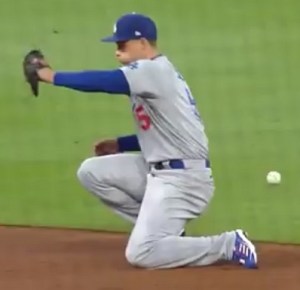
While baseball nation grappled with the Bauer ramifications, the Nationals found themselves facing a domestic violence issue when infielder Starlin Castro faced domestic violence charges but wasn’t yet suspended or even placed on “administrative leave.” Nats general manager Mike Rizzo made it as plain as a line single when talking to reporters then: “The process is the process. You asked the question, ‘Do I plan on having Starlin Castro back?’ and I said I do not plan on having him back.”

Rizzo even held a meeting with his players and laid down the law: “it’s unacceptable and it’s zero tolerance here and I don’t care how good of a player you are, it’s zero tolerance and we’re just not going to put up with it.” And they didn’t. The moment Castro was hit with a thirty-day suspension, the Nats said publicly they’d release him the moment his suspension ended. On 3 September they made good on that promise.

Nobody says the Dodgers are thrilled over Bauer’s misbehaviours, but it’s hard to forget team president Stan Kasten telling reporters what he advised manager Dave Roberts after Bauer was put on the first of his renewed administrative leaves last July: “I told him they’re going to talk about Trevor Bauer. Just say, ‘Can we please talk about foreign substances?'” That got nothing but a terrible look for the Dodgers and a public rebuke from Manfred.

The Dodgers haven’t yet said whether domestic violence is zero tolerance, they’re just not going to put up with it, they do not plan on having Bauer back, and as soon as they know whether Bauer will receive a full MLB suspension—whether it’s retroactive to time served on administrative leave or new time to serve—they’ll prepare his release for the moment the suspension officially expires.

Maybe it was easier for the Nats because Castro was almost at the end of a two-year deal when he got drydocked. Bauer is in the middle of a three-year deal, signed when the worst the Dodgers knew of him was that he was a mere misogynist. The Dodgers are on the hook for $32 million in 2022 and 2023 each, unless Bauer opts out at the end of the 2022 season and elects free agency. But Rizzo still looked far more decisive, and sounded far more emphatic, than the Dodgers have done so far.

“[Y]ou’ve heard me say it a million times, that [we prefer] you read about our guys in the Sports section and not the other sections,” Rizzo said amidst the Castro flap. “And this time we failed. I’m responsible for the players that I put on our roster and on the field.” That’s called owning it emphatically, and doing something about it decisively.

Businesses with or without public transmission can and do discipline employees often enough over off-the-job misconduct that won’t necessarily put them behind bars and isn’t half as grotesque, never mind abusive and injurious. There’s no such thing as an absolute, God-given “right” to particular employment in a particular business or profession.

A predilection for consensual rough sex is one thing. Each to his and her own. But punching an unconsious woman in the poontang and bruising her enough to require hospital attention, while she’s in no position to say yes, no, stop, or don’t-even-think-about-it, isn’t just unaligned to being a good citizen or sportsman. It’s unaligned to being human.
NLCS Game Five: Dead men make tales

Chris Taylor

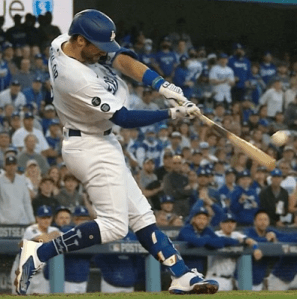
Taylor starts the Dodger party in the bottom of the second Thursday night, hitting the first of his three bombs on the evening off Max Fried’s fastball down the chute. (TBS screen capture.)

Memorandum to: Boston Red Sox; Minute Maid Park, Houston. Subject: How to return from the dead.

Dear Red Sox: Pay attention to what the Dodgers did Thursday night. It isn’t the only way to keep postseason elimination outside the door. But it was as profound and unlikely as the night was long.

You’ve certainly got the firepower capable of doing together what Chris Taylor did almost by himself to the Braves all the live long night. You’ve got the mind over matter power to coax your bullpen back to reasonable efficiency. You’ve got the defense that’s capable of turning prospective Astro hits into definitive Astro outs.

You’re also needing two straight triumphs on the road to return from the dead to the World Series. It’ll be no simpler for you to do that than it will for the Dodgers in Atlanta. But it’s not impossible, either. Impossible is in the eye of the beholder. You proved that winning the 2018 American League Championship Series against the Astros, remember?

Just like Dodger manager Dave Roberts, who isn’t quite the tactical conqueror or strategic genius your Alex Cora happens to be, you haven’t quit believing in the impossible just yet. Have you?

Hopefully not, because you Red Sox know better than I know that anything can happen in baseball—and usually does. All you have to do is be as certain as mere human men can be that, when anything happens, it’s you making it happen, not you to whom it happens.

If Taylor can yank himself even further onto the high plateau to hit three insane home runs all by himself during an 11-2 blowout of the Braves, you Red Sox have a collection of bats who need only provide one burst of power each, preferably with someone on base ahead of him.

Hopefully, you won’t have to sacrifice a key pitching arm to save and continue your season. It might have been curtains for the Dodgers when their National League Championship Series Game Five opener Joe Kelly had to leave the game with a biceps strain in the top of the first, while in the middle of pitching to Austin Riley.

Suddenly the lack of genuine snap to Kelly’s bread-and-butter curve balls in the inning, one of which Freddie Freeman smashed into the right center field bleachers for a two-run homer, made sickening sense.

Kelly’s gone for the rest of the postseason, however long it lasts for the Dodgers. Roberts pulled six pitching rabbits out of his hat after Kelly went down, and they pitched eight and a thirds worth of three-hit, nine-strikeout, no-walk shutout relief. Taylor did most of the rest of the work for him.

You Red Sox may have such postseason supermen as Kike Hernandez to send to the plate, but you’re smart enough not to count on him alone to run roughshod over the Astros in their house. Roberts didn’t exactly plan that Taylor should be responsible for 55 percent of the Dodger runs Thursday night.

He merely leaned forward and enjoyed it with the rest of Dodger Stadium’s throng and the millions in front of the telly, the radio, or the Internet. He enjoyed the Dodger batters stretching their plate appearances, going the other way when need be, refusing to see the Braves’ pitches as incoming carnivores. He sure as hell loved the power, too.

Dodgers left fielder A.J. Pollock started the fun when he hit Braves starter Max Fried’s second pitch of the bottom of the second over the left field fence. Old Albert Pujols, starting at first base because he still has a useful bat against lefthanded pitchers, slipped a base hit to left immediately. Immediately after that, Taylor Tonight went on the air.

Fried started Taylor with a fastball right down the chute. And Taylor started the blowout by driving it clean to the rear end of the Dodger bullpen in left.

One inning later, with one out, Pollock lined a single to left with one out, Pujols cued a single the other way into right, and Taylor flared one into short center, beyond the reach of onrushing Braves shortstop Ozzie Albies and incoming Braves center fielder Adam Duvall, to single Pollock home.

Two innings after that, a leadoff walk to Will Smith turned into Pollock dialing Area Code 6-4-3. But Pujols hung in to work a full count walk out of Fried, which walked Fried out of the game in favour of Braves reliever Chris Martin. For having the audacity to start Taylor off with two strikes, Martin’s reward was his head on the proverbial plate. Also known the unsinking sinker getting sunk into the right center field bleachers.

Dylan Lee took over for the Braves in the sixth and made the Dodgers behave themselves despite Corey Seager’s two-out single, and Lee even kept the Dodgers on time out for the first two outs of the bottom of the seventh. Then he ran into Taylor. He ran Taylor to 2-2. But then Lee somehow hung a changeup, and Taylor hung it into the left field bleachers.

The Dodgers abusing yet another Braves reliever, Jacob Webb, for three in the eighth—Trea Turner singling Mookie Betts home with nobody out; Pollock sending a three-run homer into the left center field bleachers—seemed as though they were saying, “Who died and named Taylor in his will to have all the fun tonight?”

Who also died and left in his will that the Dodgers were particularly vulnerable to lefthanded pitchers? They’d gone 4-for-40 against Braves portsiders entering Game Five . . . and carved Fried up like a Halloween pumpkin going 8-for-21 before his evening ended mercifully enough.

“At the end of the day, it’s playoff baseball,” said Fried, who denied calmly that pitching playoff baseball in front of his home folks from Santa Monica (TBS broadcasters observed he’d left sixty game passes for them) got to him worse than the Dodgers did. “It’s a really good team that won a lot of games, and you’ve got to be on top of your game. Unfortunately, I wasn’t as sharp as I needed to be.”

The guy who sent the Dodgers past the National League wild card game in the first place with his eleventh-minute two-run homer didn’t need anything but to remind one and all it don’t mean a thing if it ain’t got that swing, or three of them. Some Dodger fans think that RBI single in the third only proved that Taylor’s only human, after all.

Jackie Robinson. Duke Snider. Roy Campanella. Gil Hodges. Frank Howard. Steve Garvey. Ron Cey. Pedro Guerrero. Mike Piazza. Shawn Green. None of those Dodger bombers of legend—and there are four Hall of Famers in the lot—ever hit three into the seats or beyond in a single postseason game.

What do Hall of Famers Willie Mays, Stan Musial, and Cal Ripken, Jr. have in common? They hit three postseason homers at all . . . one each: Mays, 1971 NLCS; Musial, 1944 World Series; Ripken, 1997 ALCS. It must be humbling to think you did more in one postseason game than three of the game’s all-time greatest did in their postseason lives.

What do Hall of Famers Babe Ruth, Reggie Jackson, and George Brett have in common? They each hit three bombs in one postseason game and Ruth did it twice—but none of those three did it the way Taylor did, going 4-for-5 with six runs batted in in those games. One other man hitting three out in one postseason game ever did the same four-fer with six steaks: Taylor’s teammate Pujols.

And none of the above on the postseason three-bomb game did it in a game their teams absolutely had to win if they weren’t in the mood to be home in time to deck the halls and yards for Halloween. Or, to leave their teams standing as the only such team to win seven consecutive win-or-be-dead postseason games.

Taylor had one spell of three homers in a single week this year before he partied hearty Thursday night. He went 8-for-72 over the regular season’s final five weeks—and now stands 9-for-17 in this NLCS alone, including his Thursday night 4-for-5.

“The highlights,” Pujols said of Taylor postgame, “are going to be there the rest of his life. That’s something you’re going to share forever.”

“The only thing that excites him, I’ve seen, is he likes to have a beer,” Pollock said of Taylor. “He gets excited about that, a beer with the boys, and then he loves watching surfing. Maybe the three home runs today might have spiked his adrenaline, but probably not. Most likely just the beer and watching surfing.”

So, naturally, a beer-loving surfer dude who battled with a balky neck down the stretch does in a little over two weeks what nobody else has done in an entire career—namely, walk one postseason game off with a home run and then hit three in a postseason elimination game. Let’s go surfin’ now, come on on safari with me.

The only thing the Dodgers have to do now is sweep the Braves back in Atlanta. As the man once said on the radio, it ain’t easy, Clyde. Writing the Braves off this year has proven an exercise in presumptuousness so far.

Remember that, Red Sox. You, too, have been written off often enough this year. You may not have a Taylor in your midst, but the foot you’re said to have in the grave isn’t as far beneath its surface line as you think.

“You name it, we have to do it,” Cora has said approaching ALCS Game Six.

Meaning Nathan Eovaldi gotta Eovaldi when he starts Game Six. Meaning Kike Hernandez can’t take another night off at the plate the way he did, somewhat surprisingly, in Game Five. Meaning the Schwarbinator gotta Schwarbinate, and shake off his Games Four and Five plate absences.

Meaning, too, that the bullpen gotta bullpen, especially if you get to Game Seven and Nick Pivetta, Garrett Whitlock, and Tanner Houck are recalibrated fully, critical when the pen’s depth is still under compromise. (And closer Matt Barnes is still injured and among the missing.)

Meaning Xander Bogaerts has to get his bat back to where his glove at shortstop mostly remains, top of the line or close enough. Meaning the next time you pinch hit Bobby Dalbec and Travis Shaw, make sure they’re not carrying pool noodles to the plate.

Nobody has to make Chris Taylor’s kind of history Friday night, Red Sox. But your manager’s right. You name it, you have to do it. Whatever it takes to win twice in a row. The Astros won’t make it easy for you. But you didn’t get here the easy way, this time, anyway.

You have nothing to lose but your season. You have a pennant to win. Red Sox of all shapes, sizes, swings, and slings, unite.

Laz call finishes Super Tuesday

Jason Castro

What should have been strike three, side retired, game tied in the top of the ninth in Boston Tuesday night . . .

One game’s eighth inning was topped only by another game’s ninth. One team returning from the near-threshold of a too-early winter vacation was topped by another team returning from the threshold of a 3-1 series hole. One earthquake on the West Cost topped by one hurricane in the northeast.

Could anything to come be any more earth-moving or element-splitting than National League Championship Series Game Three and American League Championship Series Game Four?

Well, that may depend among other things upon who’s calling balls and strikes in either set’s remaining games. Because the rule book third strike that should have been called in the top of the ninth in Fenway Park didn’t send the Red Sox tied to the bottom of the ninth with yet another chance to walk off a postseason win.

Reality check. There were bad pitch calls in both NLCS Game Three and ALCS Game Four. Against all sides. There didn’t seem any particular favour or blessing bestowed particularly upon the Braves and the Dodgers out west or the Astros and the Red Sox back east.

When Laz Diaz called ball two on what even Ray Charles would have seen was strike three to Astros catcher Jason Castro, side retired, it might not necessarily have opened the door to that fresh Red Sox walkoff win. But they should have had the chance to try. Or at least to send the game to extra innings.

Red Sox pitcher Nathan Eovaldi, who’d pitched well enough in Game Two and should now have retired the side in Game Four’s top of the ninth, admitted postgame he thought he’d nailed the punchout. “I thought it was a strike,” the stout righthander said, “but again, I’m in the moment. I’m trying to make my pitches. I’m attacking the zone.”

Castro hinted that he, too, thought he was frozen alive in his own postgame comment. “Where that pitch started,” he said, “I didn’t think it was one I could pull the trigger on. It was a ball, then I was able to move on to the next pitch.”

He moved on to foul the next pitch off, rap a single the other way to right field sending Carlos Correa (leadoff double) home with the tiebreaking run, and leave the vault open for a walk and Eovaldi’s exit in favour of Red Sox reliever Martin Perez. The vault stayed unguarded for a three-run double (Michael Brantley), a free pass (to Alex Bregman), two RBI singles (Yordan Alvarez and Correa batting the second time in the inning), another RBI single (Kyle Tucker), and an inning-ending fly out (Yuli Gurriel).

The Red Sox and the Astros kept things to a 2-1 Red Sox lead until Jose Altuve tied it with a home run in the top of the eighth. Neither team hit particularly well against either Red Sox starter Nick Pivetta or each other’s bullpens until then. The Red Sox also led the entire Show in comeback wins on the regular season.

They didn’t have any similar self-resurrection in them in the bottom of the ninth.

Astros reliever Ryan Pressly surrendered a pair of two-out singles (Kike Hernandez, Rafael Devers), saw Castro let a pitch escape into a passed ball setting up second and third with two outs—a situation in which the Red Sox are customarily dangerous—but strike Xander Bogaerts out swinging for the 9-2 Astros win and ALCS tie.

Diaz blew 23 pitch calls Tuesday night, according to ESPN Stats & Info and cited by ESPN columnist Jeff Passan. He blew twelve thrown by Red Sox pitchers and eleven thrown by Astros pitchers. “[T]he one everyone— at least everyone in Boston—is going to remember,” Passan said soberly, “is the Nathan Eovaldi curve.”

“Good teams adjust to the ump,” snorted a followup tweeter. We’ll assume that tweeter couldn’t care less about getting it right by, you know, the actual rule book, even when a side should have been retired or when championships or progress toward them are on the line squarely enough.

To think that the Dodgers thought they’d stolen the day’s headlines, in Dodger Stadium far earlier, when they spent most of NLCS Game Three missing no opportunities to miss opportunities, until—standing five outs from season over—Cody Belllinger hit a three-run homer, before a base hit and a ground out set the table for Mookie Betts’s tiebreaking and ultimately game-winning RBI double.

And, for Kenley Jansen to strike out the side in the top of the ninth to secure the 6-5 Dodger win.

“it’s just hard to imagine a bigger hit,” said Dodgers manager Dave Roberts postgame about Bellinger turning on Braves reliever Luke Jackson’s high fastball and sending it into the right center field bleachers.

Just like that, the Dodgers taking the early 2-0 lead on (stop me if you heard this after Game Two) Corey Seager’s first-inning two-run homer, the Braves tearing Dodger starter Walker Buehler apart for four runs in the top of the fourth, then the Braves tacking a fifth run onto the board against reliever Ryan Bickford in the top of the fifth, seemed a pleasant memory. Even if the Braves still have a 2-1 NLCS lead.

“Does this feel like a dagger?” Jackson asked postgame. Then, he answered. “No. This is just, you know, a speed bump.” Ordinary speed bumps in ordinary roads don’t destroy undercarriages as broadly as Bellinger and Betts destroyed the Braves Tuesday afternoon.

To hear Bellinger say it, it’s just hard to imagine a tougher hit. “Yeah, it’s not a hitter’s pitch right there,” he said postgame. “But in the moment, whatever happened, I saw it and I just tried to put the barrel on it and continue to pass the baton.” He passed the baton, all right, and Chris Taylor swung it for a followup single to chase Jackson in favour of Jesse Chavez.

There’s a story in and of itself. Chavez warmed up but finally sat back down in the Braves bullpen three times earlier in the game, before he was up and throwing in the eighth yet again. He probably threw the equivalent of a quality start’s worth of pitches in all four warmup. He managed to induce the second Dodger out on pinch hitter Matt Beatty’s grounder.

He lived long enough for the Mookie Monster to split the right center field gap on the first pitch, sending Taylor home with the sixth hard-won Dodger run of the day. If you can tell me what’s brilliant about warming up and sitting down a pitcher three times before warming him up yet again, then bringing him in as gassed as the day is long, you’re a better manperson than I.

Well before Eovaldi threw the third strike that wasn’t, longtime Boston Globe scribe turned MLB Network analyst Peter Gammons tweeted, “the best interests of baseball does not not include Laz Diaz theoretically trying to call balks and strikes in post- season.” Grammatical flaw and malaprop to one side, Diaz didn’t try even theoretically but failed factually 23 times.

Jerry Meals wasn’t exactly a virtuoso behind the plate so far as both the Braves and the Dodgers were concerned. But he didn’t blow the third strike that should have retired a side with a League Championship Series game tied to the bottom of the ninth, either.

“I don’t know how he did it,” said Correa of Castro finally singling him home with the tiebreaker, “but I admire that. Because I will tell you I wouldn’t be able to do that. Sitting down for that long and then going out there facing a guy throwing 100 in crunch time? That’s special.”

All Correa left out was the should-have-been side-retiring third strike that wasn’t. If the Red Sox don’t forget their now-lost home field advantage and dust themselves off to go on and take the set and the pennant, it might become the most infamous third strike that wasn’t in New England history. If not beyond.

The bullet bites the Dodgers

Corey Seager

Seager couldn’t stop the unstoppable smash hit in the bottom of the ninth.

It didn’t cost anyone a World Series they were one strike away from winning. It didn’t cost anyone a pennant. It was only Game Two of the National League Championship Series, and one team has a 2-0 disadvantage that actually can be overcome and overthrown in a best-of-seven set.

Corey Seager’s inability to stop Eddie Rosario’s two-out smash up the pipe in the bottom of the ninth Sunday night, and thus stop Dansby Swanson from scoring the winning Braves run, stands to be a candidate for the worst individual moment in Dodger postseason history. Unless the Dodgers can perform that overthrow.

How many years have you mused how readily one player can go from hero to goat in the same game—if not the same inning? But how often does it happen in a game—and a set so far—in which his team seems to see men in scoring position as allergies above opportunities?

Twice on Sunday, Seager played the hero, once in the top of the first and once in the bottom of the ninth. Within minutes of the second play, he stood shriven and the Dodgers stood halfway toward the end of their season, and all he’d been asked to do in that harrowing moment, in effect, was to try what amounted to catching a speeding bullet with his teeth.

Seager opened the Dodger scoring in the top of the first with Mookie Betts aboard on a jam-shot pop single to shallow left. He turned on Braves starter Ian Anderson’s first service and hammered it over the right center field wall. In two blinks he put Anderson and the Braves into a 2-0 hole.

In a four-all tie in the bottom of the ninth, Seager hustled from defensive shift positioning well behind second base to take Dodger reliever Brusdar Graterol’s slighly offline throw to second to erase pinch-runner Cristian Pache on Swanson’s would-have-been sacrifice bunt. That’s the way to make the Braves waste a precious offensive out even worse.

After Braves center field double-switch insertion Guillermo Heredia grounded out to push Swanson to second, Dodger manager Dave Roberts lifted Graterol for Kenley Jansen, with Rosario checking in at the plate having a 3-for-4 night and counting.

A ground out pushed Swanson to second, Graterol was lifted for Kenley Jansen with Rosario coming up, having gone 3-for-4 thus far—and having scored the Braves’ third run when third base coach Ron Washington waved him home daringly on an eighth-inning Ozzie Albies base hit, diving behind the plate just eluding Dodger catcher Will Smith’s tag.

All Jansen did now was throw Rosario one nice little cutter heading for the inside part of the plate. All Rosario did was fire it right back up the pipe at a reported 105.4 miles per hour. Seager had little choice behind second but to turn down to his right to try backhanding the bullet. It blasted off his downstretched glove and into shallow center field.

Swanson shot home with the winner in a 5-4 Braves win, the second walk-off-winning run in two NLCS games for these Braves, who must be feeling as though they’re living charmed lives so far. The bullet bit Seager and the Dodgers. With 32 teeth.

But if you’re going to pound the goat horns into Seager’s forehead, or even demand Dodger manager Dave Roberts’ immediate execution over one or two of his pitching decisions, you really should consider this:

How come the team that led this year’s National League in runs scored, and had a team .806 OPS with runners in scoring position, couldn’t go better than 2-for-18 with four walks and a hit batsman in 24 chances to get runs home so far in this set?

How come the two hits each came from Chris Taylor, with one of them a Game Two bloop misplayed by Heredia into a tiebreaking two-run double in the top of the seventh? Where have all the other Dodger bats been when they manage to get somebody on second base or beyond?

Go ahead and second-guess Roberts’ pitching moves all day long if you must. Argue as you must how foolish it was to send Max Scherzer out to start when Scherzer by his own postgame admission had a dead arm going in.

When Roberts lifted Scherzer for Alex Vesia in the fifth, this time there was no objection from the gassed marksman. Max the Knife was probably lucky that the worst damage in four and a third innings was former Dodger Joc Pederson—now a Brave, by way of the Cubs’ trade deadline fire sale—hitting a two-run homer well above the Chop Shop behind Truist Park’s right field seats in the third.

Argue as you must, too, that Roberts’ real weakness handling his pitching staff isn’t so much playing it by any analytical script as it is relying far too heavily on the more highly-revered members of his pitching staff, instead of paying close attention to which arms have which hot hands regardless of star power.

This time, it was using his 20 game-winning starter Julio Urias in an oft-familiar role—moving him between postseason starting and relieving, a role he’s normally thrived in performing—only to see it backfire spectacularly enough in the Braves’ two-run, re-tying eighth.

Argue as you must that Roberts could well have Graterol for the seventh—after Joe Kelly got rid of the Braves in order in the sixth—and saved Blake Treinen and Jansen to start clean eighth and ninth innings. Or, that he could have given Graterol the night off and used  Treinen and Jansen over the final three innings to divide the last nine outs between them. Or, that he could have brought lefthanded Justin Bruihl in to handle the lefthanded Braves due to swing in the eighth.

Roberts said postgame that in weighing every option the lefthanded Urias was the best arm he had to bring in for the eighth. There’s nothing but positive when you reach for what you think is the best available arm when there’s a two-run lead to protect. That’s what a smart manager does. But even Urias is only human, not Superman.

Sometimes, even in the worst possible moment, the other guys are just a little bit better. The goat hunters too often like to forget that when they’re prowling for a head onto which to plant the horns.

Roberts is no stranger to calculated gambling. If the Urias gambit worked, he’d have resembled a Stengelian genius. When he said postgame that the postseason is the time of year when “careful” isn’t an option, he was dead right. “Careful” wasn’t exactly an option for the Braves, either, when Washington waved Rosario home and left room for Game One walkoff conqueror Austin Riley to send an RBI double to the back of center field.

Since the Braves managed to stand the Urias gambit onto its own head with a little risk taking of their own, it may force Roberts into even deeper such gambling, since Urias was originally his projected Game Four starter but now may be compromised going into that game if he’s still on the slate.

But offer succor to Seager, not sulfuric acid. The Braves didn’t walk Game Two off because Seager did what he wasn’t supposed to do or what he knew better than to do. He’d done his level best to send his team toward a win as the game opened. He’d done his level best to keep them alive and toward extra innings.

Now, Seager did his level best again to keep his team alive but failed to stop the unstoppable bullet. The Dodgers have nine Game Two goats to hold to account. Those batters who couldn’t and didn’t hit with six more Dodgers in scoring position after Seager’s homer and before Taylor’s double.

There’s a reason a smash hit is called a smash hit. Often as not, it’s just too unstoppable.

When getting it right means the worst message to kids

Wilmer Flores, Will Smith, Doug Eddings

Wilmer Flores—representing the potential Giants’ winning run—checking his swing Thursday night. On appeal from plate umpire Doug Eddings (far right), the check swing was denied by first base umpire Gabe Morales and thus strike three ended the NLDS and the Giant’s season. Some think such robbery sends the “best” message to kids.

Social media isn’t exactly renowned as the exclusive domain of the learned. But when you see something such as I’m going to quote—I won’t embarrass the source by identifying him, though I know him well enough to know that he ought to know better—you tremble for your country when you remind yourself that God may be just but humans may be willfully ignorant.

The gentleman in question responded to “The Strike Heard ‘Round the World,” my account of NLDS Game Five and the shamefully needless way it ended. With Wilmer Flores’s check swing ruled a strike, erroneously, by first-base umpire Gabe Morales on appeal. With Flores robbed of a chance to persevere against Max Scherzer, despite his weak career papers against Max the Knife.

With the potential tying run on first for the Giants and himself representing the potential winning run, Flores should have had the chance to try before it was game over. He was denied improperly. My correspondent says, essentially, so what? “So what” works as a classic jazz exercise by Miles Davis. Not proper baseball analysis.

What the players do is human, what the broadcasters do is human,” said the gentleman in question, being a former baseball broadcaster himself.

[S]o the umpires do human things, smart or stupid. players and fans have to live with it. we’re sending the worst kind of message to our kids. Kids need to know that rotten calls will be made against them and they can’t plead for a review because there won’t be any.

Oh. So one of championship baseball’s most important jobs is to send the best kind of messages to kids. Got it. Very well, I surrender.

Let’s talk, indeed, about the Worst Kind of Messages We Send Kids when an umpire makes a mistake on what might be the final out of a postseason set’s final game, offers at least a mildly coherent explanation, then allows his crew chief to elaborate when asked further with, “Yeah, no, we, yeah, yeah, he doesn’t want to say.”

It tells me that the adults in the room who won’t stand for it when the kids dissemble upon being caught with their hands in the cookie jar or the liquor cabinet haven’t got that strong a leg to stand upon. I’d clean up betting that that’s what the kids in the room figure out, too.

Let’s talk, indeed, about the Worst Kind of Messages We Send Kids when the adults in the room decide, basically, yeah, we’re being rotten sonsabitches. But tough toenails, kids, that’s the way it is. This isn’t up for debate. We’re the mommies and daddies, that’s why. Because we said so, that’s why.

It tells me the adults in the room have no eyes to see. The kids in the room gather that their parents drink deep of power and parch themselves of prudence. They see might making right regardless of justification, in one or a hundred instances. They see authority with unsound foundation.

Let’s talk, indeed, about the Worst Kind of Messages We Send Kids when we tell them review isn’t an option. It tells me the adults in the room know three things about the country in which their game was born, nurtured, and grown in the first place: jack, diddley, and squat. Baseball’s government may lack in the complete range of reviewable acts, but baseball’s country’s government actually consecrated the right to review.

This nation’s founders consecrated a Bill of Rights that mandates, among other things, the right to petition for a redress of grievances. Such grievances are usually (though not exclusively; reference Congressional committee hearings) presented and argued before—what do you know—a Supreme Court. Never mind for the moment that given Supreme Court panels can seem as judicially tyrannic as umpires who are, after all, baseball’s most immediate arbiters.

But the Supreme Court has also overturned its own rulings frequently enough, unless higher authority—you know, the legislative branch, and the president, and in that order—writes and signs laws accordingly. The Supreme Court blew the Dred Scott decision? (It emanated first in the same city from which Curt Flood fired the Second Shot Heard ‘Round the World.) Abraham Lincoln’s Emancipation Proclamation plus the Thirteenth and Fourteenth Amendments took care of that blown call. That’s just one example.

By the way, federal judges up to and including even Supreme Court justices can be impeached. (Sixteen have been, including Supreme Court Justice Samuel Chase.) Baseball’s government hasn’t yet designed or imposed genuine umpire accountability. The better umpires in the game are compromised by their lessers.

Those concerned more with the Best Kind of Messages We Send Kids than with getting things right in championship or championship-aspirant games should ponder something else. Why might it be that ordinary, everyday enterprises impose accountability on their people, from the most obscure warehouse people to the highest-stationed boardroom people—but baseball can’t impose accountability on the arbiters who can, and often do, make, break, or compromise a game?

You want to send the Best Kind of Message to Kids? How about telling them that an improper lack of redress for check swings meant we’ll never know whether Wilmer Flores would have risen to the occasion of a 1-2 count, in a postseason series-deciding game, and overcome his career-long futility against Max Scherzer to keep the Giants’ now-ended season alive?

How about telling them the reason we’ll never know is because Flores was robbed of the chance to try once more at least?

Saying umpires make mistakes because they’re only human is one thing. Saying baseball shouldn’t do its best to correct and prevent key mistakes in-game—especially with a championship or an advance toward one on the line—is pitiful. Saying baseball shouldn’t do it because it would Send the Worst Kind of Messages to Kids, which is patent nonsense, should leave you at minimum with no credibility as a baseball commentator.