“We’re going to roll the dice and see what happens”

Lucas Giolito

The Angels hope Lucas Giolito fortifies their rotation (and Reynaldo López relieves the bullpen) for one more postseason run before Shohei Ohtani moves on. How sound are the hopes?

The good news is just as The Athletic‘s Tim Britton exhumed: two teams in the past ten years went into the trade deadline approach as buyers and ended up winning the pennant. One was the 2015 Mets; the other, last year’s Phillies.

The bad news is that this is still the Angels about whom we’re about to talk.

Maybe nobody was terribly surprised when the Angels let it be known Wednesday that they weren’t going to move unicorn Shohei Ohtani this deadline, either. But while baseball world wrapped around that, general manager Perry Minasian heeded owner Arte Moreno’s mandate and went in for a continuing potential postseason run.

The best available starting pitcher on the market who wasn’t named Ohtani is now an Angel. So is a relief pitcher who could provide a little breathing room for a bullpen not necessarily one of the American League’s most reliable.

White Sox teammates Lucas Giolito (RHP) and Reynaldo López (RHP) came west in exchange for the top two prospects in a farm system that isn’t overloaded with highly-attractive prospects otherwise. Giolito gives the Angels a reliable rotation workhorse to augment Ohtani. What López gives them out of the bullpen depends almost entirely on him.

That was last year: López was one of the stingiest relievers in the business, with a 1.93 fielding-independent pitching rate (FIP) showing his 2.76 ERA indicated a bit of hard luck. This has been this year: His 11.1 strikeout-to-walk ratio is undercut by walking over twice as many this year (4.7 per nine) as last (1.5), but . . . in his final five White Sox gigs before the trade, López struck eleven out in six innings while walking only three.

If that indicates returning to his 2022 form, the Angels will take it.

Giolito, of course, is a mid-rotation man at best, his 2020 no-hitter—the only no-no in White Sox history in which a pitcher struck ten or more batters out (he struck thirteen out)—notwithstanding. He does have a 3.12 strikeout-to-walk ratio this season, but he’s striking out shy of ten per nine but walking a shade over three per nine, almost exactly his career rates.

Pulling catcher Edgar Quero and projected reliever Ky Bush (LHP) in exchange is a plus for the White Sox, who’ve re-entered rebuilding after their last re-set didn’t quite get them where they wanted to go. They’re also hoisting pitchers Lance Lynn and Joe Kelly on the market hoping for another couple of reasonable prospects.

But did the Angels really do themselves such a big favour? Can they really iron up for one more postseason push while their unicorn (Ohtani) and their soon-to-be-returning veteran future Hall of Famer (Mike Trout) remain together? The smudge on the Angels has long enough been that they lacked what was needed behind those two to make their two greatest generational players, ever, postseason champions.

The deal for Giolito and López can prove to be either the jumpstart or the sugar in the fuel tank. Ask Britton, and his lack of optimism might prove alarming:

On the eve of the German invasion of Belgium in 1914, the Baron de Bassompierre summed up the feelings of his fellow Belgians: “If we are to be crushed,” he said, “let us be crushed gloriously.”

That’s the animating principle behind the Angels’ decisions on Wednesday night. Backed into a corner best described somewhere between “suboptimal” and “downright impossible” by a years-long inability to win with two transcendent stars, the Halos have decided to make one last stand with Ohtani.

His Athletic colleague Andy McCullough isn’t all terribly optimistic, either:

The phrase “moral hazard” comes to mind when considering the Angels emptying an already threadbare farm system on this quixotic quest for a wild-card spot this autumn. But you know what two other words come to mind? “Shohei” and “Ohtani.” Which leads to a different phrase: “moral obligation.” At least until October, the Angels plan to employ Ohtani, and Moreno has decided to maximize his franchise’s postseason chances, however remote. So the window is right here, right now, consequences be damned.

And so it is that the Angels shipped out two of their best prospects — an admittedly low bar — for Giolito, a mid-rotation starter who looks bound for some regression, and López, a reliever with a 4.29 ERA. As Britton mentioned, Giolito was the best pure rental starter on the market. He may benefit from leaving the White Sox, where little has gone well during the past two seasons. Even so, Giolito’s peripheral markers — all the knobs on Baseball Savant that were red in 2021 but blue in 2023 — are alarming. The Angels might have bought the dip. But, hey, when you’re a buyer, you buy what you can. López’s strikeout numbers have jumped in 2023 but so has his walk rate. He’s a reliever. Who knows if it’ll work out.

But, look, they decided to go for it. This is what going for it looks like. It’s going to be a heck of a ride.

Well, they said the California bullet train was going to be a heck of a ride, too. Until it wasn’t. We may yet end up trying to decide which was the bigger California boondoggle: the bullet train, or this and the past few years of Angels baseball.

That seems like a harsh thing to say about a team that’s won seven of their last nine games and now sits seven games out of first in the AL West, and four out of the final AL wild card slot, with the Red Sox and the Yankees just ahead of them there. But Minasian says of the Giolito-López acquisition that the Angels are “going to roll the dice and see what happens.”

They’re hoping to roll boxcars on two pitching rentals, while refusing yet again to let their extremely marketable unicorn bring back the prospects they need badly to begin re-seeding a farm whose drought won’t be saved by weeks of rain storms. And all three become free agents at season’s end.

Most of the Angels’ existence under the Moreno regime has equaled shooting craps. And, more often than not, crapping out.
Moreno won’t trade Ohtani? Let it be on his head

Shohei Ohtani

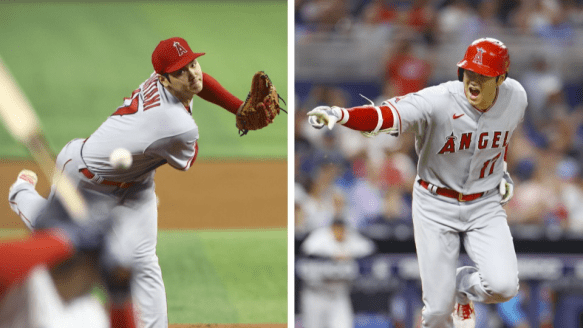
Shohei Ohtani could bring back a trade deadline haul that might push the Angels (and their trading partner, depending) into the postseason at last. But it would serve their owner right for failing to deal him and then letting him walk as a free agent bringing back . . . nothing.

Unless there is something festering in the deep background that nobody can expose, I have a contrarian thought for everyone insisting Angels owner Arte Moreno absolutely must trade Shohei Ohtani. I ask only that you save your ammunition until you read whole.

If Moreno’s that insistent upon keeping Ohtani until that very day when he becomes a free agent for the first time after the season ends, let him.

If Moreno insists upon remaining the kind of owner whose sense of marketing is more acute to the tenth power than his sense of baseball and of his team’s true competitiveness, let him.

If Moreno is that bent upon receiving nothing in return for Ohtani by letting him walk this coming winter, rather than receive the kind of value whose terms his baseball people can all but dictate, considering the prize Ohtani is, let him.

It would serve him right, even if it might serve long-enough-suffering Angel fans not so right.

Remember, this is the owner who was “exploring options” to sell the Angels almost a year ago. When that news broke, the sigh of relief from Angel fans could be felt from the Newport Beach coast to the farthest-planted lighthouse in Maine.

Moreno even let it slip that he had a pair of offers that would have eclipsed what Steve Cohen paid to buy the Mets. The problem was, Moreno let that slip this past March, when he also announced he simply couldn’t bear to part with the Angels just yet. Not while there was (ahem) “unfinished business” to tend.

“[We] feel we can make a positive impact on the future of the team and the fan experience,” he said in a formal statement when announcing his sale plans were done for who knew how long. “This offseason we committed to a franchise record player payroll and still want to accomplish our goal of bringing a World Series championship back to our fans. We are excited about this next chapter of Angels baseball.”

As of this morning, the Angels had gone from a season-opening 18-14 to a dead-even 48-48. The last time they had a four-or-more-games-over-.500 standing was when they were nine games over following a two-out-of-three winning stand against the Royals in mid-June. They’ve been 7-15 since.

The culprits have been the usual ones for this team—inconsistent pitching by one and all not named Ohtani; inconsistent hitting by one and all not named Ohtani (or Mike Trout); and, a near-consistent parade of patients for the injured list. Somehow, the Angels are four and a half games back in the American League wild card race, and nine out of first in the AL West.

That’s close enough for a major trade deadline deal to maybe make a difference, for the wild card hunt if not the division hunt. Right now, the biggest deal of deadline season could be Ohtani for whatever prime enough talent he’ll bring back, even if the acquiring team knows he might be just a rental for the rest of the way. (Even if that means a division, a pennant, maybe even a World Series ring.)

For a contending team loaded in surplus, that rental could still mean a deep postseason dive. For the Angels, it might mean surviving into the postseason, even through the back door, but just enough to give Ohtani (and Trout) a taste of postseason action neither has been granted to see since Ohtani became an Angel in the first place.

No, Ohtani won’t return a whole qualified starting rotation, a whole bullpen full of more than bull, or an entire additional lineup of Ohtanis (or Trouts). But he would return pieces solid enough to keep the Angels in this race and maybe, just maybe, a race or two to come.

“Ohtani is a once in a lifetime player, and moving off of him is akin to trading Babe Ruth,” writes Deadspin‘s Sean Beckwith. “You hold onto that kind of talent for as long as possible, and hope for the best.” And that last part, Beckwith knows, is the most problematic part:

Considering “hoping for the best” is the Angels’ entire organizational strategy — it’s why they’re in this current predicament — they will inevitably be crippled by indecision, or disillusioned by the “LA” on the hat, and stand semi-firm that Ohtani will stand by them.

This is, of course, an asinine strategy, and antithetical to the thinking of front offices, and sports media. The pleas for trade destination slideshows are being heeded everywhere you click, and all the big market teams are tallying their assets to see how much they could offer in a trade, because [general manager Perry] Minasian said he’s not going to trade Ohtani if they’re still in contention.

The thing is, contention is subjective, and four-and-a-half games back of the final wild card spot is more than enough for the Angels to grasp onto the belief that Shohei Ohtani will stay regardless of no tangible reason to do so.

It’s more than enough, too, to prevent Moreno—an owner who thought (erroneously) that his life’s success in marketing qualified him as a baseball man, when it only meant he could put (the old George Steinbrenner creed) “name guys who put fannies in the seats” on the field first and worry about rhyme, reason, cohesion, and performance (an awful lot of which his own capriciousness obstructed) second—from doing the sensible thing. Or, from letting Minasian do the sensible thing.

So let him cling to Ohtani until the two-way unicorn’s Angels deal expires this winter. Let him get less than nothing in return for the unicorn if that’s the way he wants it. Ohtani has been at least as sensational a baseball talent as Mike Trout was before the injuries became a near-annual thing for him. He (and Trout) deserve better than to be kept prisoners to merely hoping for the best.

Let Moreno explain why clinging to his unicorn to the very last was more important than letting his unicorn bring back what just might have pushed the Angels into their first postseason since they were swept out of a division series by the Royals, in the first of Mike Trout’s three Most Valuable Player Award seasons. Nine years ago, if you’re scoring at home.

That explanation should prove the funniest and saddest monologue since the Marvelous Mrs. Maisel first wandered onto the stage of a fleabag nightclub to schpritz about her husband dumping her for his secretary. Mrs. Maisel got laughs and a brilliant career out of it. It would serve Moreno right to get nothing back for the unicorn to whom he sold an illusion.

Smash, slash, and smother

Mike Trout, Brandon Drury

Trout accepts congrats from Drury after his leadoff blast in the third—unaware that Drury would hit the next pitch out and Matt Thaiss would hit the next pitch after that out, opening the thirteen-run third-inning carnage against the Rockies Saturday night.

Saturday night was one night the Angels could well afford Shohei Ohtani having an off night. One RBI single in seven plate appearances might be cause for small alarm ordinarily. But who the hell needed Ohtani, on a night that the Angels dropped a 25-1 avalanche atop the walking-wounded Rockies in Coors Field?

The Rockies went into the game knowing they’ll miss right fielder Charlie Blackmon another few weeks, hitting the injured list with a broken right hand, after he tried playing through it following the hand having been hit by a pitch in Kansas City. They were already missing Kris Bryant with a heel injury. Not to mention three key starting pitchers including Germán Márquez and Antonio Senzatela.

But nobody saw Saturday’s kind disaster coming when the Angels opened a 2-0 lead after two full innings.

They spent the second inning nailing a pair of back-to-back base hits before Rockies starter Chase Anderson plunked Angels right fielder Mickey Moniak on 0-2 to load the pads, and David Fletcher slashed a two-run single on the first pitch—all with nobody out.

Anderson looked rehorsed after he induced a double play grounder and caught Ohtani himself looking at a full-count third strike. You’ll find fewer more grave instances of looks being deceiving than what the Angels did to him in the top of the third.

It only began with future Hall of Famer Mike Trout leading off by hitting a 1-0 pitch over the center field fence, then with Brandon Drury hitting Anderson’s very next pitch over the left center field fence, and then with Matt Thaiss hitting Anderson’s very next pitch over the right field fence.

Three pitches. Three thumps. To think the fun was just beginning for an Angels team whose past few seasons have been anything but in the end.

Not even the most cynical observer of the thin-aired yard known as Coors Field expected what happened after Thaiss completed his circuit around the bases, and after Anderson walked a man, induced a force out at second, surrendered a base hit, and induced a pop out around the infield:

* Taylor Ward singling home new Angel toy Eduardo Escobar, acquired from the Mets a day or so earlier and going 2-for-4 in his Angels premiere.

* Ohtani singling Moniak home and sending Anderson out of the game in favour of Matt Carasiti.

* Trout walking to re-load the pads.

* Drury sending a two-run single up the pipe.

* Thaiss walking to re-set first and second.

* Hunter Renfroe yanking a bases-clearing double, one of his team-leading five hits on the night.

* Esobar singling Renfroe home.

* Moniak sending a two-run homer over the right center field fence.

The third-inning carnage ended only when Carasiti got Fletcher to ground out right back to the mound. And wouldn’t you know that at least one Twitter twit harrumphed about the injustice of it all after Moniak connected: “21st-century MLB, taken to its most absurd extreme. This is one example of why I can’t get that excited about homers, anymore.”

Not even over three straight to open an inning in which only five of the thirteen runs scoring in the frame scored by way of home runs and half the hits were singles? Not even over five runs scoring off singles and three off a double? Not even ten of the thirteen Angel runs of the inning coming home with two outs?

You want to harrumph about something, harrumph about why the Rockies were caught woefully unprepared and left two relievers in to take fifteen for the team. Not just the six Carasiti surrendered of his own as well as adding two to Anderson’s jacket, but poor Nick Davis starting in the top of the fourth.

The Angels slapped him silly for eight runs on seven hits including back-to-back one-out RBI singles followed by an RBI double, another bases-loading walk, a two-run double, and Fletcher hitting a three-run homer. Then Davis got Ward to ground out and struck Ohtani out swinging to stop that inning’s carnage.

Davis survived a pair of two-out singles in the fifth. I confess—I couldn’t resist tweeting at that point: “With apologies to the Roaring Twenties, after five it’s Angels 23, Rockies skiddoo.”

The Rockies’ righthander wasn’t quite so lucky in the sixth, but he might have felt just a small hand of fortune: the worst the Angels did to him in that inning was a double (Moniak) and a single (Fletcher) to open the inning with first and third, before the Angels’ 24th run scored on a force out at second.

That would be the same way the Angels got their 25th and final run of the night two innings later, with Karl Kauffmann on the mound for the Rockies. The only thing spoiling the Angels’ smothering shutout would be Rockies center fielder Brenton Doyle leading the bottom of the eighth off with a 1-0 drive over the center field fence off Angels reliever Kolton Ingram.

Just days earlier, the Angels were humiliated by back-to-back shutouts courtesy of the Dodgers. Now, they ended Saturday night setting a franchise record for runs in a single game—a franchise record they broke by one, having scored 24 against the  Blue Jays in an August 1979 game. They also became the first in Show in the modern era to score twenty or more runs in a two-inning span.

All that on a night when the only Angels not to get any hits were one pinch hitter and two mid-to-late game insertions. And, when they secured themselves in second place in the American League West—six games behind the division-leading Rangers.

“Today,” said Moniak postgame, “was just one of those days, where everyone was feeling good and we were getting the right pitches to hit.” That may yet qualify as the understatement of the season.

The former Dark Knight, retiring with grace

Matt Harvey

Matt Harvey, young, a Met, and a Dark Knight.

Few baseball surges of the 2010s were as electrifying as Matt Harvey’s. Few baseball shrinkages were almost that electrifying. And, after a few years of trying and getting not even close to back to where he once belonged, Harvey elected to call it a career Friday.

The former Dark Knight, who’d provoked Mets fans to declare “Happy Harvey Day!” on the days he started, announced his retirement on Instagram. “With all the amazing memories came a lot of injuries and tough times,” the 34-year-old righthander wrote.

The realization that those amazingly powerful moments that make me thrive as a pitcher and help my teammates and city win are no longer possible. Believe me I wish I could have done more and brought more of those amazing moments back to life. I have to say this is my time to say thank you, and goodbye.

Asking Harvey to retire with no regrets would be asking him to be superhuman. That’s an ask he can’t possibly satisfy. He’d tried that earlier and too often in his career, on the mound and off it, and he nearly fried himself alive trying.

In the Show, Harvey was last seen trying a comeback with the Orioles two years ago. He started with three shutout innings followed by a dicey fourth in his first Oriole start. He went on to post for the season a modest 4.60 fielding-independent pitching (FIP) rate, a ghastly 6.27 earned run average, a 2.57 strikeout-to-walk rate, a 1.54 walks/hits-per-inning pitched rate (WHIP), and was hittable for 11.3 hits per nine innings.

That was double the transcontinental distance from his staggering second Mets season, 2013, when he led the Show with a 2.01 FIP, posting an 0.97 WHIP and a 6.16 K/BB rate, good enough to finish fourth in the National League’s Cy Young Award voting.

Those were the days when Harvey embraced New York and its white-hot heat as ardently as the city embraced him. “To the fans, most importantly the NY Mets fans: you made a dream come true for me,” he wrote in his retirement post. “A dream I never could have thought to be true. Who would have thought a kid from Mystic, [Connecticut] would be able to play in the greatest city in the world, his hometown. You are forever embedded in my heart.”

He’s had worse than that embedded in his heart. Harvey’s early ability to pitch like an executioner on the mound was equaled only by his ability to find and dwell among the demimonde as though it had his name on it.

He electrified the country when he started the 2013 All-Star Game and—having to shake off a leadoff double from future Hall of Famer Mike Trout followed by hitting Robinson Canó with a pitch—struck three out in two innings’ work and surrendering not a single run. (The American League went on to win, 3-0.)

He missed 2014 recovering from Tommy John surgery, but he electrified the country further when he all but ordered his manager Terry Collins to leave him in to pitch the ninth in Game Five of the 2015 World Series.

Uh-oh. Collins went with Harvey’s heart while misreading his fuel tank. He walked Kansas City’s Lorenzo Cain to open, then surrendered Eric Hosmer’s RBI double. Then Collins lifted him for Jeurys Familia. Two ground outs, one of which provoked Hosmer’s daring dash home while Mets first baseman Lucas Duda threw what should have been an easy double play ball offline to the plate (Hosmer would have been dead on arrival if the throw was accurate), tied a game the Royals won with a five-run twelfth as the rest of the Mets bullpen lost its wheels.

The Royals had bypassed Harvey in the 2010 draft. The guy they took instead, infielder Christian Colón, sent what proved the Series-winning run home. “I still have nightmares over that,” Harvey would tell the New York Post about the game. “One thing I’m most angry about is not getting it done.”

He’d have better reason to be angry the following season: he was hit with thoracic outlet syndrome in July 2016 and gone for the season. And, never again the same pitcher. TOS occurs when blood vessels and/or nerves between your collarbone and your first rib compress. That causes shoulder and neck pain and finger numbness.

“I had TOS,” Harvey’s former fellow Mets pitcher Dillon Gee once said. “I know how much that sucks. It definitely changes you. You start trying to tinker with things. It’s not natural anymore. You start being robot-ish. You start not trying to hurt one area and totally hurt another area. Your whole body is out of whack.”

Harvey’s body wasn’t the only thing going out of whack. Between TOS and a 2017 season interrupted nastily by another shoulder injury, Harvey melted down almost completely. The mound no longer elevated him; the city’s bright lights and demimonde no longer seemed to comfort him entirely.

Very publicly, he found himself dropped by a Brazilian supermodel with whom he thought a real romance was seeded—until she elected to return to her former beau, an NFL wide receiver, leaving a glittering party with the man. That was the night before he showed up late for a game against the Marlins claiming a migraine that was translated to mean a hangover.

Harvry had had such a big-timing attitude prior that now, when he needed empathy, aid, and comfort most, he had none. A year later, after refusing to try it out of the bullpen, perhaps out of stubborn lingering pride, Harvey’s days as a Met ended in a trade to the Reds. “Besides life on his fastball and bite on his slider, you know what was missing with Matt Harvey?” asked Joel Sherman of the New York Post after the deal. The answer:

Compassion. There was no empathy from a teammate or member of management for Harvey’s plight. They wanted him to rebound and do well, but that was about the team and their own selfish desire for success.

Matt Harvey

Humbled, Harvey pitched respectably for the Reds following his trade from the Mets. But he couldn’t reimagine his form successfully in stops at Anaheim, the Oakland system, Kansas City and Baltimore (above). 

Tom Verducci, the Sports Illustrated writer who first handed Harvey the Dark Knight nickname (picking up on Harvey’s boyhood love of Batman), advised one and all that Harvey’s taste for New York’s night life wasn’t the reason he’d collapsed on the mound. “The truth is, for all the times he wound up in the tabloids other than the sports section, Harvey failed because his arm failed him,” Verducci began.

. . . His arm likely failed him because of how he threw a baseball. And when his arm failed him, he knew no other way. He couldn’t pitch without an A-plus fastball, he couldn’t embrace using a bullpen role as a way back, and he couldn’t believe in himself again.

. . . The Mets cut Harvey because his once-fearsome fastball became the almost exact definition of a mediocre fastball (MLB averages: 92.7 mph, 2,261 rpm). Because he couldn’t find another way to get hitters out, because he could not change his mechanics and because he could not buy into the bullpen, the Mets could not keep sending [him] out to the mound as a starter.

The decline in his stuff was obvious. And there was no way his fastball was coming back with the way he throws.

As a Red, Harvey finished his walk year into free agency with a respectable if unspectacular enough performance that the Angels were willing to take an $11 million flyer on him for 2019. He lasted long enough to be designated for assignment that July. The Athletics signed him but he never saw Show action. The Royals took a chance on him for pan-damn-ically shortened 2020.

A free agent again, the Orioles took a chance on Harvey for 2021. He re-signed with the organisation for 2022 but he spent the season at three minor league levels around a sixty-day suspension after testifying in the Eric Kay trial that he’d used painkillers provided by Kay while with the Angels.

Kay was tried, convicted, and sentenced to 22 years in federal prison, having been the man who provided the drugs that killed popular Angels pitcher Tyler Skaggs. On the stand, Harvey admitted he’d given Skaggs (who was likely addicted to painkillers following early-career Tommy John surgery and subsequent other injuries), a few Percocets, perhaps unaware of the depth of Skaggs’s addiction. He didn’t shrink from it, he didn’t try to excuse it.

Harvey pitched in this year’s World Baseball Classic—for Italy, posting a 1.29 ERA in two starts before Team Italy lost to Japan and eventual WBC most valuable player Shohei Ohtani in the quarterfinals. It tempted him to try one more major league comeback. But it was just a temptation. Maybe the most important temptation Harvey resisted. He got to leave the mound permanently on a very high plane, at any level.

(For the record, his Team Italy manager, Hall of Fame catcher Mike Piazza, saluted Harvey upon his retirement announcement: “Look forward to teeing it up with you man..I want to Thank You for your awesome effort in the @WBCBaseball, You’re a warrior on the bump.”)

Back in 2020, he offered the Post something few who knew him as a Met might have accused him of having: introspection. “There are a lot of things I’d do differently,” he began, “but I don’t like to live with regret.”

There were just things I didn’t know at the time. Now, obviously, I’ve struggled the last few years. And what I know now is how much time and effort it takes to stay at the top of your game. I wouldn’t say my work ethic was bad whatsoever, but when you’re young, it’s not like you feel invincible, but when everything is going so well, you don’t know what it takes to stay on the field. It’s definitely more time consuming and takes more concentration.

Too many sports party boys don’t learn until their sports say goodbye to them first. Harvey learned soon enough, if sadly enough, that the party doesn’t always end on your terms. The Dark Knight who crashed and burned off the mound while his body betrayed him on it became something far more important before he retired: a man.

Albie Pearson, RIP: Little big man

Albie Pearson

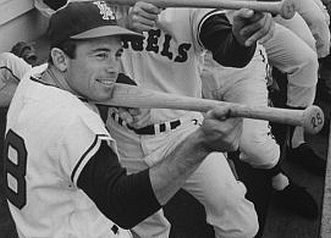
Albie Pearson having a little fun with teammates in the Angels’ dugout.

“I never have the satisfaction of looking an umpire in the eye, I’m forever signing autographs for kids taller than I am, and human skyscrapers like Norm Zauchin and Jim Lemon of our club make me feel like a midget when they walk by but, hand me a bat and let me step into the box, and I’m as good as the next guy—some of ’em, at least.” Thus said 5’5″ outfielder Albie Pearson, then with the ancient Washington Senators, in the Chicago Tribune in 1958, the year he was named the American League’s Rookie of the Year.

He proved a man far bigger than his physical lack of stature.

Pearson died 21 February at 88. He’s remembered far better for his tenure as one of the original Los Angeles/California Angels, picked in the American League’s first expansion draft. In fact, in a couple of ways he evoked the Biblical admonition that the last shall be the first.

The Senators swapped him to the Orioles and Pearson had an up and down life between Baltimore and the Orioles’ farm system. Then he heard the Angels were being created in his native southern California. He wrote to the new team’s general manager, Fred Haney, asking to be drafted. Haney granted his wish—as the thirtieth and final player to be chosen.

When the new Angels played their first official game, against Pearson’s former Orioles mates as things worked out, Pearson drew the new team’s first walk and scored its first run, coming home after Ted Kluszewski, the former Reds muscleman, hit the new team’s first official home run with two out in the top of the first. Kluszewski would hit the second official Angels home run an inning later.

“When my kids say grace,” the devout Pearson told Sports Illustrated for a 1963 profile (“The Littlest Angel”), “they say, ‘Dear Lord, bless this food, bless Mommy and Daddy and please help the Angels win and help Daddy get a hit. Amen.”

I’m a firm believer in the Bible and the Ten Commandments. I try to live by them without making myself obnoxious. I live my life as an example and I’m not ashamed of it. I want to be careful I don’t ruin my image as the little guy’s idol. I get letters from mothers telling me how proud they are of me because they haven’t seen my picture in a cigarette ad. I’m no prude and I don’t knock ballplayers who smoke or drink. I, too, live my life to the fullest, but I do it in a different way. There is something inside of me other than the shell going out and playing baseball. I’m kidded and goaded by the guys to get me in spots unbecoming to the way I believe. The person that puts his standards very high has to be careful. Everybody to his own life. I don’t try to push mine, but I’ll talk to anyone who’s interested in what I’m digging. I admit there are very few.

Sometimes, Pearson got goaded into unbecoming spots through no fault of the guys’ own—sort of. Early in 1963, Pearson asked to room with Bo Belinsky, the lefthanded pitcher who became the Angels’ sex symbol the previous season. (“I thought maybe I could get him in bed early,” Pearson cracked.) According to Belinsky biographer Maury Allen, Pearson and Belinsky shared only one thing that might, maybe, be considered a vice. Each man drove a candy-apple red Cadillac convertible. And it led to a hilarious mishap.

At the time, Belinsky’s collection of girlfriends included an Asian lady named Zenida who caught up to him not long after his once-fabled 1962 rookie no-hitter. She decided to wait for Belinsky in the player parking lot, perched atop what she thought was Belinsky’s Cadillac. Oops. “Here comes Albie out of the park with his wife,” Belinsky told Allen.

He’s walking toward the car. He sees Zenida sitting on the car, her (cheongsam) dress up to her ass, her legs twitching all over the place. She’s halfway across the parking lot and can’t really see who it is, so she’s waving because she knows it’s a ballplayer with a broad coming out of the players’ entrance and who could it be but me? When Albie gets a little closer she stops waving, but by that time it’s too late. Albie is white as a ghost and his wife is just pissed.

As roommates, Belinsky and Pearson weren’t exactly soul mates. Pearson ultimately switched to room on the road with another pitcher, Don Lee. “I tried not to disturb him,” Lee told SI. “He’s small and he burns up a lot of energy, so I know how important sleep is to him. Albie was no trouble. If he got noisy I just stuffed him in a drawer.”

Pearson developed a sound sense of humour about his lack of height early. Nicknamed the Littlest Angel, Pearson looked anything but little in 1963, his All-Star season. He had a .402 on-base percentage, a .304 hitting average (I’ll explain shortly), and though the National League won the All-Star Game Pearson started a tying rally in the third inning with a double off Cardinals pitcher Larry Jackson, coming home when Red Sox third baseman Frank Malzone singled him in with one out, before Twins catcher Earl Battey singled Malzone home to tie the game at three. (The final: 5-3, NL.)

Pearson’s Real Batting Average (total bases + walks + intentional walks + sacrifice flies + hit by pitches, divided by total plate appearances) for 1963 was a respectable .484. He wasn’t a power hitter but he was a tough strikeout: he finished his major league career with 282 fewer strikeouts than walks. Self-aware almost to a fault, Pearson was more than content to exercise his abilities as they were and not as he might have wished them secretly to have been.

“I never was a star and I never will be,” he told SI. “I fit on the field now but it wasn’t always that way. Once–well, I wasn’t taken as a freak, but it was, ‘He’s there, he’s not going to hurt you.’ If I can be an adequate ballplayer there’ll always be a place for me. I’ll do the very best I can but comes the time there’s someone better.”

Albie & Helen Pearson

Albie and Helen Pearson at Father’s Heart Ranch, which they devoted to abused and abandoned pre-teen boys with the same commitment it took to raise five children of their own. (Orange County Register photo.)

He couldn’t stick consistently as a regular as often as not. Then, during spring training 1966, he ruptured two discs in his back on a hard slide. He got into two regular season games after he recovered, that July, but elected to sit the rest of the season out and retire after it. His back plus the Lord told him to do it.

He made his way after baseball as the part owner of Mighty Mite, a company making adhesive grips for sports equipment. In 1972 he became an ordained minister in the Baptist Church. He started a southern California youth foundation aimed at keeping children far away from drugs and another non-profit aimed to train ministers and pastors for setting up churches and orphanages in South America and Africa.

By 1997, Pearson and his wife, Helen—parents of five, eventual grandparents of seventeen and great-grandparents of sixteen—sold their California home to create Father’s Heart Ranch in Desert Hot Springs, a home for abused, neglected, and abandoned boys between ages six and twelve. The facility included both a Little League baseball team and a Pop Warner football team. The companion Father’s Heart International also provided food to four thousand Zambian children left orphaned when their parents died of AIDS.

That’s the man about whom one anonymous pitcher huffed, “He don’t drink, he don’t smoke, he don’t fool around. You can’t trust that kind.” Whose smile was so incessant he was once told “to get a couple more coats of shellac on his teeth.” Whose third base coach on the Angels, Rocky Bridges, observed, “I think he’ll be an archaeological find.”

“When you see a life changed,” Pearson told the Orange County Register in 2011, before he was scheduled to throw a ceremonial first pitch in Angel Stadium, “it’s worth everything compared to getting a base hit or winning a game.”

The littlest Angel wasn’t so little, after all.

This essay was published originally by Sports-Central.