“I loved every challenge of playing third base”

Adrián Beltré

He hit home runs on one knee, he was a human highlight reel at third base. Welcome to Cooperstown!

Of all the stories that abounded this weekend about Adrián Beltré, on the threshold of his induction into the Hall of Fame, there’s one which may be forgotten except by Angel fans left (as almost usual) to ponder what might have been. It’s the story of the Angels pursuing Beltré as a free agent after he spent five often injury-plagued seasons in Seattle.

Essentially, Angels owner Arte Moreno wanted Beltré in the proverbial worst way possible, after the Dodgers who reared him were willing to let him escape to the Mariners in free agency—despite Beltré having just led the Show with 48 home runs in 2004—because then-owner Frank McCourt didn’t want to pay what the Mariners ultimately did.

Beltré went from the Mariners to the Red Sox on a one-year, prove-it kind of deal. When that lone Boston season ended in October 2010, Moreno kept Beltré in his sights. But nothing the Angels presented Beltré impressed him enough to sign with them. He opted to sign with the Rangers instead. Moreno was so unamused he ordered his then-general manager Tony Reagins to deal for Blue Jays outfielder/slugger Vernon Wells.

Well. The Angels learned the hard way (don’t they always?) that Wells was damaged goods. The fellow they sent the Jays to get him, bat-first catcher Mike Napoli, would join Beltré for a hard-earned trip to a World Series that would break their hearts, before moving on to help Cleveland to a pennant and the Red Sox to the 2018 World Series triumph.

Meanwhile, before leaving Seattle for a one-year, show-us deal with the Red Sox, Beltré by his own admission finally learned he could have a shipload of fun playing baseball without losing the focus, the discipline, or the outlying durability that were going to make him a Hall of Famer in the first place. With the Rangers, he finished his ascent into what Baseball-Reference calls the number four all-around third baseman ever and, concurrently, built and secured a reputation as a team-first Fun Guy.

Nail his 3,000th lifetime major league hit? Party time—for the whole team and then some. “After he got 3,000 hits he had a party,” says Rangers in-game reporter Emily Jones to The Athletic‘s Britt Ghiroli and Chad Jennings. “It was like our clubhouse moved to this place. Every clubbie. Every trainer. Every massage therapist. He was extremely inclusive.”

“He was the oldest guy on the field,” says his former Rangers teammate Elvis Andrus, “but acted like the youngest.”

Beltre’s fun-loving rep went hand in glove with being a veteran clubhouse leader to whom even his manager often deferred. “If he stared at you some kind of way,” says Ron Washington, now managing the Angels but then managing the Rangers, “you knew he meant business. A couple of times, I got off my perch to go get (on a player). He would stop me and say, ‘Let me get it, skip’.’

“I saw him chew veterans,” says one-time Rangers batting coach Dave Magadan, “like they were 19-year-old rookies.”

But he also never forgot teammates, even after he retired. Lots of players can make their teammates go with the flow during arduous seasons. Beltré made them friends. Even if he might chew them out one day, he’d re-cement the friendship side by asking, “You know why I did that, right?”

Former Rangers teammate Mitch Moreland remembers taking a group of later Athletics teammates to a Seattle restaurant to which Beltré had taken a host of Rangers once upon a time. “I called (Beltré) and I was like, ‘Hey, what was the guy’s name at Metropolitan? I’m going to take the boys there’.”

He goes, “Oh, I got you.” So, he called the guy up, set it up. I took the whole team over there, we ate, and I got ready to get the bill, and Adrián had picked it up. For the Oakland A’s. After he was retired.

What of the once-familiar running gag involving Beltré’s real distaste for having his head touched and teammates—usually spearheaded by Andrus—going to great lengths to touch it and get away with it? “I still do,” Andrus says. “He still doesn’t like it. That’s what I am going to try to do at Cooperstown . . . I need to touch his head. I need to touch his head while he’s talking!”

He didn’t get anywhere close to that. Hall of Famer David Ortiz did, right smack at the podium.

But no matter. The third baseman who declined a grand farewell tour didn’t need any further validation for his place in the Hall of Fame. Those who do, however, should marry his 27.0 defensive wins above replacement level player (WAR) to his Real Batting Average (total bases + walks + intentional walks + sacrifice flies + hit by pitches, divided by total plate appearances) among Hall third basemen whose careers were in the post-World War II/post-integration/night-ball era:

HOF 3B PA TB BB IBB SF HBP RBA
Mike Schmidt 10062 4404 1507 201 108 79 .626
Chipper Jones 10614 4755 1512 177 97 18 .618
Eddie Mathews 10100 4349 1444 142 58 26 .596
Scott Rolen 8518 3628 899 57 93 127 .564
George Brett 11625 5044 1096 229 120 33 .561
Ron Santo 9397 3779 1108 94 94 38 .544
Wade Boggs 10740 4064 1412 180 96 23 .538
Adrián Beltré 12130 5309 848 112 103 97 .533
Paul Molitor 12167 4854 1094 100 109 47 .510
Brooks Robinson 11782 4270 860 120 114 53 .458
HOF AVG .555

He’s not higher there because a) he drew far less unintentional walks than most of the men on that list; and, b) that aforementioned durability led him to playing through injuries insanely enough to cause him a few so-so seasons that pulled his numbers down somewhat. But as a defensive third baseman he’s the second-most run-preventive player (+168) who ever worked that real estate . . . a mere 125 behind a guy named Robinson.

“I loved every challenge of playing third base,” said the first third baseman in Show history to nail 400+ home runs and 3000+ hits. “I was hooked. Those hot shots, slow ground balls, double plays, I couldn’t get enough of them.” Come Sunday, the Cooperstown gathering almost couldn’t get enough of Beltré, either.
The Angels star in “Forever Framber”

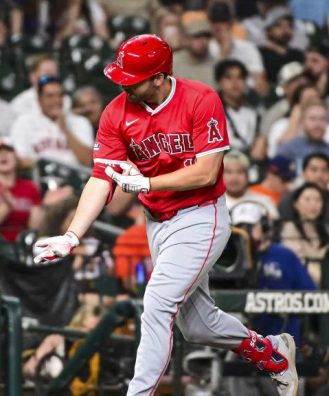
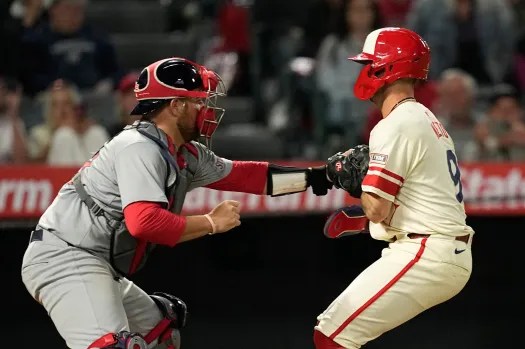
Nolan Schanuel

Nolan Schanuel crosses the plate after starting the Angels’ fifth-inning demolition of Framber Valdez Monday.

Framber Valdez started looking a little shaky in the fourth inning Monday. The good news was his Astros supporting him with a 4-1 lead against the Angels and padding it to 6-1 in the bottom of the fourth. The bad news was the top of the fifth.

It wasn’t just that the Angels blasted seven runs in that half inning. It was Astros manager Joe Espada leaving Valdez in to take a beating like that in the first place. Especially considering Espada’s postgame valedictory after the Angels finished what they finally started, a 9-7 win for their fourth win in five games.

“He just kind of was lost,” Espada told reporters postgame. “Started leaving some pitches in the heart of the plate and they put some really good swings on them. “His stuff was really good . . . just that fifth inning he kind of lost the feel for the zone.”

Valdez didn’t look too good in the fourth, either. After more or less cruising through the first three, he threw thirteen pitches only five of which looked genuinely good. He may have been fortunate that the Angels got only two singles in the inning while otherwise grounding into a force out and whacking into an inning-ending double play.

But after Astros left fielder Mauricio Dubón hit a two-run homer off Angels starter Reid Detmers in the bottom of the fourth to set that short-lived 6-1 Astros lead, the Angels went to work almost at once in the top of the fifth, when designated hitter Willie Calhoun smacked a two-strike single to right.

They weren’t exactly looking to detonate bombs. Nobody overswung, nobody tried to turn into a B-2 pilot. But sometimes you can just swing sensibly and discover you’ve a) still got some serious munitions in your bat; and, b) a pitcher who’s throwing you cannonballs without gunpowder behind them.

Valdez walked shortstop Zach Neto on a full count and struck second baseman Kyren Paris out to follow. Up stepped first baseman Nolan Schanuel, and Valdez hung a changeup that got hung into the right field seats. With one swing the Angels cut the Astros’ lead to two.

After a ground out right back to the box, Valdez was all over the place working to left fielder Tyler Ward before Ward finally singled up the pipe. He hung another changeup, sort of, to center fielder Kevin Pillar (he whom the Angels found in the junkyard after Mike Trout went down with a knee injury), and was lucky Pillar could only turn it into a single to left.

Espada still didn’t seem to have a bullpen option at the ready. He’d pay for it with Valdez’s next two pitches. Angels catcher Logan O’Hoppe saw a curve ball hanging deliciously enough to send well into the Crawford Boxes, and right fielder Jo Adell sent a hanging sinker the other way into the right field seats almost immediately to follow.

Just like that, the RBI single by Astros catcher Yainer Díaz and three-run homer by second base mainstay José Altuve in the bottom of the second to stake that early 4-1 lead became pleasant memories for Minute Maid Park fans and just a nuisance of mosquitoes agains which the Angels opened seven cans of Raid in the fifth.

“Things got out of hand there,” Valdez said postgame. “The game started off well and sometimes things happened.”

Unlike Valdez’s previous start, which came a day after the Astros practically emptied the bullpen following Ronel Blanco’s ejection (and subsequent suspension) for sticky stuff in the glove, and which saw Valdez take his team deep en route a 3-0 win, the Astro pen wasn’t exactly taxed for Monday.

But no relief was seen until the top of the sixth, with Rafael Montero taking over. He got a rude hello when Neto caught hold of a rising fastball and sent it to the Boxes. That was all the scoring for the Angels and all they really needed, despite some Astro friskiness in the ninth.

Adell may have broken the Astro spirit to stay for the game when he took off running after Díaz’s leadoff drive to right and took a flying leap to steal a homer from Díaz before he hit the fence padding. “He’s growing in front of your face,” said Angels manager Ron Washington postgame. “That was a big-time play and that play right there may have saved the game.”

It might have, considering Dubón singling to follow and Kyle Tucker driving him home with a base hit an out later. But Angels reliever Carlos Estevez held on despite walking Yordan Alvarez to get Alex Bregman—the veteran third baseman who was usually capable with first and second and two out, able to win it with one swing, until this year (.125/.125/.125 slash in this situation)—to fly out to not-too-deep center for the game.

The Angels set a new precedent at Espada’s and Valdez’s expense, too: this was the first time in the Angels’ history that four players 25 or under cleared the fences in the same game.

“I didn’t realize it until after the fact,” O’Hoppe told reporters. “None of us have said it out loud, but I feel like all of us internally had been waiting for a moment like that for a little while.”

“They’re growing up,” Washington observed. “They’re starting to figure things out. They really didn’t try to do too much and they ended up doing a lot. And that’s what it’s about.” Don’t look now, but they’re 7-6 in their past thirteen games including the four-of-five sealed Monday.

Maybe that thinking brings further unforeseen reward. Especially when the other guys’ manager doesn’t have an immediate bullpen answer for a starter who’s begun losing his stuff clearly enough. The Angels won’t get that lucky that often, but maybe continuing to think less-brings-more begins making their own luck.

A murder-suicide squeeze?

Pedro Pagés, Zach Neto

Cardinals catcher Pedro Pagés (left) must have pitied Angels shortstop Zach Neto caught cold on the suicide squeeze that wasn’t on Tuesday . . .

Ron Washington must have returned to managing with the idea that the job credentials now require he be in shape enough to throw players under the proverbial bus. Even if it wasn’t their fault his orders couldn’t be executed without at least one fatality.

The Angels manager who called for a bases-loaded suicide squeeze Tuesday had only one thought after Luis Guillorme tried to obey orders on a pitch you’d have required a door for making contact: It was all Guillorme’s fault.

Cardinals reliever JoJo Romero couldn’t find the strike zone with a search party. It took the lefthander a full count to strike the Angels’ eighth-inning leadoff man Jo Adell out. Zach Neto went to a full count before doubling down the right field line, before Romero walked Kyren Paris and Nolan Schanuel to set up the ducks on the pond.

Lefthanded-hitting Guillorme at the plate and Neto on third were given their suicide squeeze orders on a 1-1 count. Romero went into his delivery and Guillorme squared to bunt with Neto charging down the line for home. Except the pitch was well out of Guillorme’s reach, and Neto was a dead man.

Guillorme hadn’t been an Angel for a full week. Washington’s postgame comments must have made him feel as though the nearest available cave wasn’t deep enough for him to hide. “He didn’t do the job,” the manager said. “It wasn’t anything I did wrong. He didn’t do the job. I would have rather went to the ninth inning with a 6-6 lead than gone to the ninth inning the way we did.”

Aside from the brain fart that let Washington speak of a 6-6 lead, he was even more wrong about the erratic Romero: “Wild? He was throwing the ball in the strike zone,” the manager insisted. “Why are you making excuses? He was throwing the ball in the strike zone. (Guillorme) did not get the bunt down. Period.”

I’ve watched the video several times. Romero’s slider went at least two full feet or better outside the zone. Unless Washington thought Guillorme had heretofore untapped diving talent—or looked in the moment like the late behemoth Frank Howard (all 6’7″ and airplane-like arm span of him)—the only way Guillorme might have reached that pitch would have been to throw his bat toward it.

The ball was outside far enough that, even if Guillorme could have gotten the farthest end of his bat on it the ball might have ticked foul, forcing Neto back to third. In that instance, any element of surprise (perhaps the key element in executing a suicide squeeze) would have dissipated likewise. Of course, with the way Romero was throwing Guillorme might have gone from there to draw the game-tying bases-loaded walk, but we’ll never know now.

It’s only fair to say Washington’s intentions were the best. He had lefthander-vs.-lefthander with the bases loaded. He had his man facing a pitcher whose money pitch, a sinkerball, might have been ideal for dropping a suicide squeeze bunt if the pitch came to the plate in the zone. He was trying to avoid a rally-killing, inning-ending double play.

Now it’s even money who was further out of the zone, Romero and his pitches or Washington and his vision. All that’s left to determine is whether Washington turned the play into baseball’s first known murder-suicide squeeze.

With Neto heading home full speed ahead, any thought of Guillorme laying off the pitch was futile. Cardinals catcher Pedro Pagés had set up for a pitch toward the outside corner and was thus in decent position to snare a ball going as far out of the zone as Romero’s pitch went. He had only to hop up to his left and lay his mitt in front of the ball to take it. It looked almost as though Pagés pitied Neto when he stopped the Angels shortstop cold with the sorry-about-that tag.

Four pitches later—you guessed it, another Romero full count—Guillorme struck out swinging to finish the rally killing. The veteran the Angels picked up in a trade with the Braves earlier this month still took one for his manager after the Cardinals banked the 7-6 win. “He made a good pitch. What else can you say?” Guillorme said of Romero. “I tried to get the bat on it. But he made a good pitch.”

It was made good only because Guillorme tried to reach the unreachable. In further fairness it was only the exclamation point on a day when the Angels were as attractive in the field as ten head of cattle with mad cow disease.

Second inning: Angels starting pitcher Reid Detmers wild-pitched Cardinals right fielder Dylan Carson home, before third baseman Cole Tucker threw home wildly off a ground ball, enabling Cardinals second basman Nolan Gorman to score.

Third inning: Detmers let Cardinals first baseman Paul Goldschmidt and designated hitter Alec Burleson pull off a double steal with Carson at the plate. The pair of them had one stolen base between them all year until then and weren’t exactly road runners to begin with. Detmers ended up walking Carson and striking Gorman out, but then he fed Pagés a meatball good enough for Pagés to bag his first major league hit—a three-run double.

The Angels fought their way back, somehow, especially when their catcher Logan O’Hoppe blasted Cardinals starter Sonny Gray for a three-run homer in the fourth and left fielder Taylor Ward send Schanuel home with a sacrifice fly in the fifth. Burleson wrecked the five-all tie with a two-run homer off Angels reliever Amir Garrett in the top of the seventh, but Kevin Pillar—he whom the Angels picked up at the junkyard after Mike Trout went down with his knee injury—pulled the Angels back to within a run with a two-out RBI single.

That set up the 7-6 score Washington wanted Guillorme to close back up with the suicide squeeze. The one Guillorme couldn’t execute on a pitch impossible to reach. The one that prompted Washington to throw Guillorme so far under the proverbial bus he might actually have passed below another bus behind it before coming to a skidding stop.

It’s the same sad song . . .

Mike Trout

Another season, another unwanted injury for a star-crossed star.

Once upon a time, when cooler heads actually found a hearing in the Angels’ front office, the idea was floated to talk Mike Trout into moving out of center field and into one of the less demanding outfield positions. Maybe even moving him toward designated hitting for the majority of his time in due course, went a reasonable concurrent thought.

With Trout then coming away from some injury-disrupted seasons, they talked about it during the owners’ lockout of 2021-22. They planned to talk to Trout about it when the lockout ended. They didn’t bank on then-manager Joe Maddon blabbing about it to reporters before they had the chance to present it to Trout.

Idea killed before it could spend its first hour out of its crib. Maddon’s execution orders may have been written right there, awaiting only one false move on the season to stamp them irrevocably.

The guillotine blade dropped after those 2022 Angels went from a deceptive 27-17 start to a twelve-game losing streak. And, after Maddon ordered an intentional walk to the Rangers’ Corey Seager with the bases loaded and the Angels down. Just as inexplicably, the Angels overthrew a wider deficit to win that game at the witching hour. It wasn’t enough to save Maddon’s rep or his kishkes.

But the busted Trout plan probably did make it a matter of when and not if the Angels would purge Maddon. The plan might also have kept Trout from inflicting any further great risk upon a body that simply refuses to cooperate with its owner’s iron will.

We may never know whether a leftfielder named Mike Trout or a right fielder named Mike Trout would have managed to avoid some of what bedeviled him from that point forward. 2022: Five weeks on the injured list with a back issue that might yet bear the potential of putting paid to his career. Last season: Hamate bone fracture in July, one game in August, season lost otherwise.

Now we have a spectre that’s only too familiar to baseball world as a whole and Angel fans in particular: Trout on the injured list, about to undergo surgery for a torn meniscus in his knee. Expected to be out anywhere from eight to twelve weeks. Exactly what triggered the tear isn’t quite known, but we do know that Trout felt it go while walking back to the Angels’ dugout.

Even though he said, “It’s just frustrating. But we’ll get through it,” we can’t really know the precise thoughts and feeling that poured into his heart and mind when he noticed the tear and resigned himself to yet another injured list term. If he’s telling himself, “This is getting to be more ridiculous than a contemporary presidential campaign,” there isn’t a jury on earth that would convict him of warped thinking.

Until that injury, Trout spent the season’s first month doing whatever he could to prove he still had what made him both the single most outstanding player of the 2010s and, concurrently, the number five all-around center fielder who ever played the game.

His hitting average was an anemic .220 and pulled his lifetime number down to .299, but even at this writing he leads the Show with ten home runs, while exactly half his 24 hits have been for extra bases. He’s even stolen six bases, something he’d said he wanted to return to doing after letting that side of his run-making game expire after 2019.

According to my Real Batting Average metric (total bases + walks + intentional walks + sacrifice flies + hit by pitches), Trout was actually batting .611 before his knee said not-so-fast. Little by little, piece by piece, he put himself back together into a semblance of his 2010s self when disaster decided it was time to speak up. Again.

For his first eight full seasons, Trout’s ability to post wasn’t even a topic. He’d averaged 145 games a year over the eight, and he did things the best players do in their fantasies. After the pan-damn-ically short 2020, his body became an orthopedic experiment. And all he’d ever done wrong was play the game firmly.

He’s also been loyal to a fault to an organisation administered like the Mad Hatter’s tea party, overseen and often overlorded by an owner whose fortune came from marketing but who hasn’t yet figured truly that marketing doesn’t build winning baseball teams.

The Angels had two generational talents, Trout and Shohei Ohtani. The latter took the first available hike as a free agent. The former insists he wants to be around when the Angels return to a winning culture and even a postseason or two. But the Angels’ administration still hasn’t figured out how to restore that culture. And, may not for the rest of Trout’s career—however long his body allows him to have one.

Trout could retire this instant and his Hall of Fame plaque would be prepared for his first-ballot election. That might still outrage fans who still cling to the idiocy that injuries are signs of moral turpitude and character weakness. Those fans should be dismissed.

“It’s not as though he has a singular chronic issue,” writes The Athletic‘s Sam Blum. “They’re all independent of each other, and seemingly haven’t impacted him beyond the duration of their individual recoveries. But they add up to the same problem: an all-time legend who can now no longer stay on the field.”

Trout is still good enough that, as FiveThirtyEight says, “the cost to the Angels of losing him for only a couple of months would be on par with season-ending injuries suffered by other star players.” Indeed.

Almost promptly, the Angels signed veteran Kevin Pillar as a fourth outfielder. Once a good center field defender, he’d be behind Mickey Moniak now despite Moniak’s modest bat. Pillar cleared waivers after the White Sox designated him for assignment. He’s considered good in the clubhouse and has a relationship with Angels manager Ron Washington from Atlanta, where Pillar played last year while Washington was the Braves’ third base coach.

Pillar will cost the Angels nothing more than a prorated major league minimum salary. That’s the least of their losses. Losing Trout—again—costs them something no dollars can replace. But imagine what it’s costing Trout in his mind and heart. Again.

Anthony Rendon, only human

Anthony Rendon

Rendon admitting he places family and faith ahead of baseball didn’t go over well with those who think nothing’s more important than that big game, that long season.

Let’s admit it. We often wish all baseball players were of the same mind as Hall of Famer Willie Stargell. Asked once during a particularly arduous road trip, Pops replied, “The umpire doesn’t say, ‘Work ball.’ I asked to be a ballplayer.” We often wish every player on the planet was as romantic about the game as us.

We swear we’d be the ones who’d tolerate everything around the game for the privilege of playing it professionally because, you know, if we’re making in even ten years what Donald Trump was fined in his New York fraud case we’d damn well better be ready to tolerate it.

We swear we’d come through in the clutch, we swear we wouldn’t have blown that play, we swear we would put those pain in the you-know-what writers in their place, we swear we would play through injuries and not sit it out when our team needs us to win that big game, we swear we wouldn’t let anything or anyone get in the way of . . .

We are full of it. And most of us won’t admit that we’re full of it.

That’s why so many of us were ready to have Anthony Rendon hung by his shorthairs from the top of southern California’s tallest lamppost for saying outright that baseball doesn’t quite command his priorities ahead of his family and his spiritual faith. You’d think Rendon had just admitted to painting graffiti on the Washington Monument.

The third baseman who once made a pros-and-cons list about playing the game is a decade older now. “It’s a lot different now,” he told The Athletic‘s Sam Blum on Monday.

I’m married. I have four kids. My priorities have changed since I was in my early twenties. So definitely my perspective on baseball has been more skewed . . . It’s never been a top priority for me. This is a job. I do this to make a living. My faith, my family, come first before this job.

If you choose to see him as just expressing some bitterness about the game, Rendon’s certainly earned the right. Since he signed a seven-year, $245 million free-agency contract with the Angels, after he factored big in the Nationals’ first World Series conquest, Rendon’s baseball life has been battered by injuries.

After his first Angel season, in pan-damn-ically truncated 2020, his 2021 only began with a groin strain and a ten-day injured list spell. He incurred a knee contusion and a hamstring strain, and that was before his season ended early thanks to right hip surgery.

His 2022, which featured hitting one out lefthanded for the first time in his Show career (and during Reid Detmers’s no-hitter, yet), ended in June with surgery on his right wrist. 2023? Left leg injury, not to mention a tibia fracture he swore was diagnosed at first as another contusion.

You can rest confident in the knowledge that nobody signs up to play professional baseball looking to spend as much time on the injured list as Rendon has spent since becoming an Angel. But if you’d been paying attention close enough since his Washington years, Monday wasn’t the first time Rendon ever denied baseball über alles, either.

“I want to be known as the Christian baseball player,” he told the Baptist Press in 2018. “I’m still trying to grow into that. But at the end, I want to be more ‘Christian’ than ‘baseball player’.” Nobody was ready to arrange his execution then. Maybe finishing eleventh in that year’s MVP voting and leading the National League with 42 doubles, not to mention posting a .909 OPS and 137 OPS+ had something to do with that.

Guess you’re just not supposed to talk that way after four years of a filthy lucrative seven-year contract have been spent on the injured list and you’ve only been able to play an average 52 games a year over the four.

“[A]ny job, no matter how hard you worked for it, how much you wanted it, how much you love it, is still a job,” writes Deadspin‘s Julie DiCaro. “Baseball is no different.”

Sure, players get winters off, their offices are pastoral cathedrals, and they get paid millions to play a child’s game. But they still have to go (almost) every day from mid-February to September, in nagging injuries and in health, when things are going great and when they aren’t. They have bosses, performance expectations, long stretches away from their families, and, especially on days when things go south, a scrum of reporters standing around their lockers, waiting to ask them exactly why things went so poorly.

. . . [W]hy is it that, in almost any other profession, saying one’s job is their top priority is thought of as cold, heartless, anti-family, and some kind of Cat’s Cradle tragedy, unless the person saying it is a pro-athlete? You’re supposed to say your family is a bigger priority than your job, unless your job is to entertain the masses. Then you’d better kick your wife to the curb during childbirth because we need your bat in the five-hole.

Baseball history should remind us that Yankee legend Thurman Munson died at 32 trying to split the difference. He bought and was learning to fly a Cessna jet that may have been above his pay grade operationally because he wanted to spend more time with his wife and children in their native Ohio during Yankee homestands.

Some ballplayers wouldn’t let themselves think of marriage and family until after their playing careers ended. Some of those, of course, preferred the swinging bachelor’s life, but others sensed that being professional baseball players might not really be conducive to happy home lives. Some marry sports-oriented women, many don’t. It’s not for us to judge what the heart embraces.

I remember a player who learned the hard way. If you’re my age, the name Steve Kemp might register. He was a solid ballplayer, an above-average hitter and a hustling outfielder with the Tigers and the White Sox, who enjoyed his first and only free agency payday when he signed with the Yankees for 1983. Five years, $5.45 million, big money that year.

Whoops. An early shoulder injury on a basepath collision; then, after rebounding following a sluggish first third of the year thanks to the injury, hit in the eye by a line drive during batting practise. Facial fracture, vision and depth perception loss, never the same player again. The Yankees eventually dealt him to the Pirates, willing to take him because of his determination, in a deal making Yankees out of Dale Berra and (especially) Jay Buhner.

Kemp lost more than that, alas. He made a jarring admission to Peter Golenbock, author of The Forever Boys: The Bittersweet World of Major League Baseball as Seen Through the Eyes of the Men Who Played One More Time. He was so single-minded about the game from boyhood forward that it cost him his marriage.

“He learned,” Golenbock wrote of Kemp’s days playing college ball, “that if he selfishly, myopically concentrated on his own needs—excelling at the game—he would succeed in life.” Not quite. “[T]he one part of your life that seems to get cut out is family,” Kemp said. “That’s wrong, totally wrong.”

You’re on the road, and your family wants to come, and you say, ‘Fine, but I’m not going to go out with you. You get up on your own and go. I have to sleep in.’ And I looked at myself as being very selfish. I look back, and I see it cause a lot of problems for me. I learned it, but too late. Baseball was the most important thing.

Steve Kemp

Kemp was so singleminded making baseball his priority that it cost him his family, once upon a time.

When Kemp’s playing career ended in 1988 after spells in the minors (and a fleeting sixteen games with the Rangers), he returned home to California to discover his wife asking for a divorce. The divorce happened in 1989.

“We were the American family with two beautiful, intelligent children,” he said. “It was a very good situation that was thrown out the door. A lot of people were saddened when our family split up. Now I’m saying to myself, I realise there are more important things in life than baseball.”

Kemp went on to play for the St. Petersburg Pelicans in the short-lived Senior Professional Baseball Association (1989-90). He did it for love of the game and to help take the sting out of his divorce, not necessarily in that order. He dealt with injuries, fought his own perfectionism, and mid-season asked for two days off—to take his two visiting children to Disney World. Owner Jim Morley granted them even if manager Bobby Tolan wasn’t thrilled.

“You can be bitter and negative,” he told Golenbock, “or you can try to get the most out of a situation, to learn from your mistakes. I’m trying to change myself so that I can enjoy life. I know that I have a long way to go, but before I never gave. Now I’m trying to give. That’s the important thing.”

“Mindful of how much he lost,” Golenbock wrote, “[Kemp] took his kids to Disney World for two days instead of insisting that baseball come first. He knew that Bobby Tolan would be angry, that his teammates wouldn’t understand, but it didn’t matter anymore. The happiness of his kids, that’s what counted most. The Pelicans would be there when he got back.”

It’s not as unreasonable as Rendon’s critics might think to surmise that he knows already that there are more important things in life than baseball. No matter how much or how deeply anyone loves the game, no matter how much fans who don’t know him as a human being would prefer to incinerate him for admitting it.

Maybe he doesn’t want to let the game consume, fracture, or divorce him, the way it did Steve Kemp and who knows how many other players about whom we know little beyond what they did on the field or said to the press.*

Rendon’s done nothing more evil than admit that baseball players are human beings, after all. Maybe those attacking him since it hit the press running can’t bear that. Because they’re supposed to be infallible, indestructible, dream-affirming, life-denying. That’s their job, the attackers seem to say. We don’t want to know you’re only human.

————————————-

* Steve Kemp ended his professional playing days when the SPBA folded. He returned to southern California and became both a part-time salesman for a golf accessory firm and an annual participant in Tigers fantasy camps.