Starting postseason life with two bangs

Royce Lewis

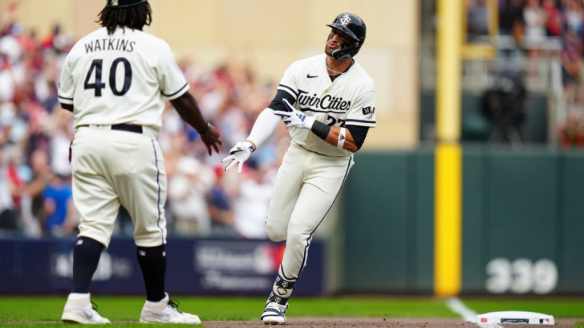
Sometimes things line up too perfectly to pass up on those opportunities.—Royce Lewis, here rounding third off the second of his AL wild card series-opening home runs Tuesday.

Children who grow up with dreams of baseball have numerous supporting fantasies. Rest assured, once they realise they can play the game well, they dream of making the Show. Many of them then dream of going number one in the draft, with or without the glandular signing bonus. Many of those dream of going number one, making the Show, then making the postseason for the first time and making . . .

Waves? Big splashes? Broken precedents? All the above? Ask Royce Lewis, the Twins’ infielder who slotted as the team’s designated hitter for Game One of their wild card set against the Blue Jays Tuesday. The same guy who hit grand slams in back-to-back games against the Guardians in July.

He faced formidable Blue Jays starter Kevin Gausman in the bottom of the first with one out and Edouard Julien aboard (leadoff walk). He worked the count full. Then, he turned on a pitch in the middle of the inside part of the plate, and it sailed on a high line into the left field seats. Game One wasn’t ten minutes old, and Lewis put the Twins up 2-0.

Two somewhat quiet innings later, Lewis checked in against Gausman again. This time, he opened the inning. This time, he didn’t wait for the count to get full. This time, Gausman’s 3-1 service came right down the pipe. This time, the ball took a flight the opposite way, banging off the top of the right field wall, making it 3-0, Twins, turning Target Field temporarily into the world’s largest outdoor nuthouse.

Two plate appearances. Two swings. Two bombs. There have been 58 number-one draft picks since Rick Monday went number one to the then-Kansas City Athletics in 1965. There have been a number of big boppers among them. Only three of those number-ones became Hall of Famers. (Harold Baines, Ken Griffey, Jr., Chipper Jones.) Four, if you count Hall of Famer-in-waiting Joe Mauer.

Not a one of them began any postseason life they had with even one home run, never mind two, never mind hitting the first bomb of any postseason, never mind being responsible for every run scored in their team’s postseason series-opening win, which the Twins won 3-1. The lone Toronto run: Kevin Kiermaier singling Bo Bichette home in the top of the sixth.

“That’s a God thing,” Lewis said postgame. “I’m just blessed to be part of it. It felt like I was blacked out the whole game. My heart was racing.” He keeps blacking out like that and the Twins have an excellent chance of going places other than home prematurely this postseason.

Wherever Lewis’s career goes from here, he’s got bragging rights forever on every fellow member of the Number One Club. He also has the honour of being the man most responsible for ending the Twins’ most peculiar negative achievement, stopping their postseason game losing streak at eighteen. Not to mention only the third player ever, regardless of draft position, to open his postseason life with a first-inning home run, joining Evan Longoria (Rays, 2008) and one-time Twins favourite Gary Gaetti (the eventual 1987 World Series winners).

Eighteen straight postseason games lost over nineteen years, under three different managers and with several franchise icons in the mix, from Mauer to Johan Santana to Torii Hunter to Byron Buxton. It took a guy whose first couple of seasons in the Twins’ fatigues have been disrupted rudely by injuries and who was freshly recovered from a hamstring injury to step up Tuesday and bring his demolition kit to the park with him.

“We just wanted to put an end to something that was very unfortunate to our beloved fans,” said Twins starting pitcher Pablo Lopez, who pitched five and two-thirds strong innings before Kiermaier’s steak single ended his day. “Our fans have been so great to us—they support us, they root for us no matter the situation. It felt right. The way I see it now, we have a new streak going.”

“I thought the place was going to split open and melt,” said Twins manager Rocco Baldelli—who has a pair of postseason home runs on his own resumé, including in the 2008 World Series for the Rays. “Honestly. It was out of this universe out there on the field. The fans took over the game. They helped us win today.”

The Twins’ fielders took over when the fans didn’t. There was center fielder Michael Taylor stealing a prospective game-tying double from Matt Chapman with a flying leap against the fence in the top of the second. There was, especially, Kiermaier’s chopper in the fourth, sneaking away from onrushing Twins third baseman Jorge Polanco.

Bichette on the run from second thought he had a shot at scoring. Plantaar fasciitis-addled shortstop Carlos Correa thought otherwise. He yanked himself running to his right, picked the ball barehand as Bichette headed down the third base line, threw off balance, and managed somehow to get the diving Bichette out by about the full length of a catcher.

“If you like watching the biggest players making the biggest plays in the biggest games,” Baldelli said, “then you should go watch that play. It was fantastic.”

Lewis had the fantastic franchise wrapped up in the first and the third, though.

“Some people believe in fate,” he said. “Some people believe that the things we do today drive what we do tomorrow. But sometimes things line up too perfectly to pass up on those opportunities.”

He had two pitches line up just that perfectly as ironclad evidence.

“Whatever it takes to win”

Kike Hernandez (center, hatless) surrounded by Red Sox teammates after his walk-off sacrifice fly sealed their trip to the American League Championship Series.

Well, the Rays only thought their rather decisive first-game win in this now-concluded American League division series meant the beginning of another deep postseason trip. Who knew it would prove to be just the last win of the year for the American League’s winningest regular season team?

Come to think of it, a lot of people only thought the Red Sox’s apparent disarray in enough of the regular season, including their final home set while the Yankees swept them, and in losing two of three to the Orioles before sweeping the also-ran re-tooling Nationals to finish the schedule?

The Rays won the AL East decisively, and with the best regular-season record in franchise history. The Red Sox had to wrestle their way into the wild card game before beating the Yankees in a game featuring the sort of thing happening to the Empire Emeritus that used to mean surrealistic disaster for the Olde Towne Team.

Lovely way to send the Yankees home, many must have thought, but oh, are they going to feel it when the Rays get hold of them.

The only thing the Red Sox must feel now is that their postseason work has only just begun. But if the ways they shook off that Game One 5-0 loss to take the next three from the Rays are any indication, they’re about as up to the task as any formerly buffeted team awaiting their American League Championship Series opponent can be.

They live by the team play motto to such a fare-thee-well that you can suggest any given one will sacrifice for the good of the team—which makes it so appropriate that they finally won this division series with . . . a sacrifice fly.

Lose a 2-0 top of the first Game Two lead to a grand salami in the bottom of that inning? “No panic,” said manager Alex Cora. No panic—and allow only one more Tampa Bay run while turning that quick-as-you-please 5-2 deficit into a 14-6 blowout.

Lose a 6-2 Game Three lead on an eighth-inning leadoff homer by Rays rookie star Wander Franco and a two-out RBI double by not-too-young Rays rookie star Randy Arozarena, then have to ride a Phillies throwaway named Nick Pivetta for four extra innings? No sweat—just let Christian Vazquez rip a one-out two-run homer into the Green Monster seats in the bottom of the thirteenth and win, 6-4.

Blow a 5-0 Game Four lead off a five-run third crowned by Rafael Devers sending a three-run homer over Fenway Park’s second-highest wall and into the center field seats? We do this kinda stuff to them all through the picture. Just let Kike Hernandez say thank you to the nice Rays for not putting him on to load the bases for an any place/any time/extra-innings ticket double play—by banging the game and set-winning sacrifice fly short of the left center field track.

“I mean, here we are surprising everybody but ourselves,” said Hernandez post-game, once he escaped drowning in the Red Sox celebration. “We knew in spring training we had the team to make it this far and here we are.”

Well, the Red Sox did lead the entire Show in comeback wins during the regular season. They also managed a rather impressive .591 winning percentage in one-run games. But they also suffered a 12-16 August that wasn’t necessarily as disastrous as some other Augusts by some other teams this year. (Hello, Mess—er, Mets.) Between injuries, COVID-19 illnesses, and assorted other mishaps. nobody else seemed to remember if they knew what Hernandez said the Red Sox knew last spring.

Surprising everybody but themselves? Sure. Let’s buy into that despite the Red Sox trailing in three of these four division series games. Let’s buy into that despite the Red Sox having to win twice in their final plate appearances. Let’s buy into that despite an ankle-compromised designated hitter, a second baseman getting his first daily plate appearances in around three months, and pulling a hutch of rabbits out of their hats.

Well, guess what? You’ve probably bought into more improbabilities than those in your lives as baseball fans, observers, writers. If you speculated on the Red Sox’s apparent pitching goulash out-pitching the Rays’ more obvious pitching depth going in? You ought to think about buying lottery tickets in every state that offers them.

If you bought into Garrett Whitlock, a find on the Rule 5 minor league draft heap, pitching no-hit, no-run relief for the final two Game Four innings and becoming the Red Sox’s highest-leverage bullpen bull, forget the lottery? You ought to be investing on Wall Street. You can’t lose. Yet.

If you bought into Jordan Luplow doubling and scoring in the fifth, Franco abusing Red Sox reliever Tanner Houck for a two-run homer in the sixth, and Kevin Kiermaier whacked an RBI double ahead of Arozarena whacking a two-run double to tie things at five in the eighth? You ought to seed the advent of Jetsons-style flying cars.

But if you bought into Game Three hero Vazquez leading off the Red Sox ninth with a base hit, Christian Arroyo sneaking a sacrifice bunt to the short right of the first base line, pinch hitter Travis Shaw slow bouncing a tough hopper toward third that wouldn’t get him in time at first, then taking second on defensive indifference with Hernandez at the plate? That’s beyond my pay grade, too.

Why didn’t Cash put Hernandez on with one out? He wasn’t really about to load the pads for Devers and be forced to prayer that he could get away with it. Devers already had three hits on the night. With the winning run already ninety fee from scoring, putting Hernandez aboard would have meant only the possibility of having put the insult-adding-to-injury run on base.

So Cash trusted his reliever J.P. Feyereisen to take care of Hernandez. The first pitch tied Hernandez up by sailing up and in tight on the Red Sox center fielder. The next pitch sailed into Austin Meadows’s glove in left center, too far back to keep pinch-runner Danny Santana from sailing home with the Red Sox’s ALCS tickets punched.

“It was quick,” Feyereisen said postgame, and he could have been talking the series as well as the end of Game Four. “I think that’s one of the main things when we sat down, like, ‘Wow, I didn’t think it was gonna be over this quickly’. We felt good. We played some good games. You come in here, especially with this atmosphere with these [Fenway] crowds and two walk-off wins, that’s tough.”

What was even more tough for the Rays is that, all series long, they struck out 46 times at the plate to the Red Sox’s 23—and that includes 20 Rays strikeouts in Game Three’s thirteen-inning theater. By contrast, the Red Sox picked up from being shut out in Game One to hit .364 with nine home runs in Games Two through Four and delivered 56 hits the entire set.

The Rays’ wounding offensive flaw, being Three True Outcomes enough all year long, bit their heads off in the division series. They hit seven homers and ten doubles but had a collective .211 team batting average all set long. They’ll have to figure out how to improve their overall contact without sacrificing their impressive power.

They’re young, they’re deep, they’re they’re tenacious, they’re a model of resourcefulness despite their limited dollars. Their championship window isn’t being boarded up just yet.

Their farm is considered deep and still promising. They’ve got their own kind of guts, playing and pitching rookies in the postseason as if it was the natural thing to do. Even if it was borne of the unpleasant necessities delivered by injuries, near-habitual turnover, and in-season moves that didn’t work. The rooks—shortstop Franco, pitchers Shane McClanahan and Luis Patino in particular—showed heart beyond their years even in defeat.

Yes, it’s tough to remember Arozarena was still a rookie this season, technically. His coming-out part last postseason took care of that, and he shone like a well-established veteran this time around. From homering and stealing home in Game One through two hits and that Game Four-tying hit in the eighth, Arozarena was a rookie in name only this year.

Losing righthander Tyler Glasnow to Tommy John surgery was probably the key blow to the Rays in the end. Free-agent veteran Michael Wacha took a 5.05 regular season ERA into the postseason . . . and allowed a mere two-run deficit to turn into that 14-6 Game Two blowout in two and two thirds innings. One more veteran other than Game Four opener Collin McHugh might have made a big difference.

The Red Sox are just as conscious of analytics as any other team so advanced, including the Rays who practically live by it. But they’re a lot better in balancing analytics to the moment. Cora is as much an advance information maven as any skipper in baseball, but he’s also unafraid to shift his cards and play to what’s in front of him when it’s demanded of him.

He doesn’t play October baseball like the regular season. If he did, he wouldn’t have gone to eight postseason series as a manager or a bench coach and been on the winning side in each of them. He’s not afraid to take risks, he doesn’t sweat it if and when they backfire.

“That’s our motto right now: Whatever it takes to win,” said Hernandez. “Just win today, and we’ll worry about tomorrow, tomorrow. Lineup, bullpen, starting rotation, like, it doesn’t matter. We’re a team, and we’re one. We’re not 26 dudes, we’re just one.” Lucky for them the Red Sox aren’t out of tomorrows just yet.

Cora’s Game Four starting pitcher, Eduardo Rodriguez—lifted after an inning and two thirds in Game One following that first-inning disaster, but pitching shutout ball until Luplow scored on a ground out in the fifth, then coming out after Kiermaier doubled to open the sixth—calls Cora “like a father, brother, manager, whatever. He trusts us. He trusts everybody in that clubhouse. He gives you the chance every time that he hands (the ball) to you, and you’ve just got to go out there and do your job.”

“He’s a guy you’d run through a wall for,” said Whitlock. “If he told me to run through that wall, I’d believe that he had something there to make sure it would fall for me.”

It turned out the Rays wall wasn’t quite as sturdy as everyone else thought going in. The Red Sox have sturdier walls to face going forward. Walls that won’t be as friendly to them as the Green Monster seems to be.

Off the wall in Fenway Park

Christian Vazquez

Christian Vazquez’s walk-off bomb should have been the co-story of Game Three with Nick Pivetta’s stout four extra innings’ shutout relief. But no . . .

You could hear the blue-murder screaming even before Christian Vazquez ended American League division series Game Three in the bottom of the thirteenth. You could hear furious Rays fans and sympathisers thinking Game Four deserves no shorter justice than the Red Sox getting killed to death.

They saw Vazquez hit a two-run homer, igniting a berserk celebration around all Fenway Park, and thought to themselves before hollering loud and long, We wuz robbed!!! They probably still think so.

They think the Rays should have come out of the top of the thirteenth with a 5-4 lead, the run scored from first by Yandy Diaz off Kevin Kiermaier’s two-out double against Red Sox reliever Nick Pivetta. That thought would have been wholly reasonable—except for the umpires calling for a rules review, ruling ground-rule double, and thus ruling Diaz back to third base.

The problem was Kiermaier’s drive bounced off the right field wall, off the track, then off Red Sox right fielder Hunter Renfroe and over the wall. Official Rule 5.05(a)(8) spells out the wherefore: If a fair ball not in flight is deflected by a fielder and then goes out of play, the award is two bases from the time of that pitch.

Rule 5.05(a)8 distinguishes between intent and lack of intent. Had Renfroe actually tried and succeeded in deflecting the ball over the wall, Diaz would have been awarded home because he’d passed second base just as the ball ricocheted off Renfroe’s thigh over the wall. But Renfroe never touched the ball with either hand.

Postgame, Kiermaier remained in abject disbelief. “I can’t believe that happened or we don’t get the chance to score right there,” the Rays center fielder said. “For one, I crushed that ball. I was hoping to leave the yard. I got a lot of snap and crackle but no pop. First and foremost, for that to happen right there, it just doesn’t make sense to me.”

Even the Red Sox didn’t know what to think at first.

“I’ve never seen that before in my life,” said center fielder Kike Hernandez, whose fifth-inning homer put the Red Sox up 4-2. “I wasn’t sure what was going to get called. I wasn’t sure if the runners had to return. I wasn’t sure if it was going to be like an errant throw where the runner would get two bags. Like I had no idea.”

It made sense to home plate umpire Sam Holbrook after the review mandated the ground-rule double ruling. “Very simple,” the ump said. “From an umpire’s standpoint, very simple textbook in the rule.”

Maybe the rule should be reviewed and changed, maybe it shouldn’t, if you consider intent paramount on a play that was so freakish in the first place. But within its strict letter, lacking verifiable intent on Renfroe’s part, Kiermaier indeed had to settle for the ground rule double and Diaz indeed had to return to third.

The game remained tied at four. Red Sox reliever Nick Pivetta recovered to finish his fourth inning worth of three-hit, no-run, seven-strikeout relief. Rays fans may consider it having added insult to insulting injury when Renfroe himself held on for the full-count walk with one out in the bottom of the thirteenth.

Then Vazquez—who’d only come into the game as a pinch-hitter for his catching predecessor Kevin Plawecki in the sixth—caught hold of Rays reliever Luis Patino’s first offering and sent it into the Monster seats above left center for the 6-4 Red Sox win. If the would-have-been Diaz run had held up, it would have meant the Rays losing by a single run instead of two.

In a game about which it was entirely fair to say it would be a shame for either side to lose, the Rays wrestled back from a 4-2 deficit in the top of the eighth off Red Sox reliever Hansel Robles. Wander Franco hit a 3-1 fastball down the chute for a leadoff homer over the Monster; Randy Arozarena with two outs doubled pinch-runner Manuel Margot home.

Before that, the Rays re-learned how stingy Red Sox starter Nathan Eovaldi can be after he gets touched up in the beginning. Once Austin Meadows parked a one-out two-run homer into the bullpens in the top of the first, Eovaldi went forward to pitch shutout ball the next four-and-a-third innings.

The Red Sox chased Rays starter Drew Rasmussen with three straight singles in the third, including Hernandez sending leadoff singler Christian Arroyo home with the tying run at two. Josh Fleming relieved Rasmussen and Rafael Devers greeted him with an RBI single up the pipe to put the Red Sox up, 3-2.

After Hernandez’s leadoff yank into the Monster seats off Rays reliever Pete Fairbanks to open the fifth, and the Rays tied things at four in the eighth, Game Three’s big story figured to be Pivetta. His stout extra-innings shutout relief reminded observers of Eovaldi’s own bullpen-saving, six innings stout relief in that marathon Game Three of the 2018 World Series.

Pivetta’s outing probably changed Red Sox manager Alex Cora’s plan to start him in Game Four. After Sunday night’s win Cora probably won’t complain too much. He’d said previously that whatever the plan going in the game itself would govern the moves and the changes. When he needed a stopper before the Rays got any more ornery than tying the game at four, he picked the right man for the job.

Don’t blame the ground-rule double for costing the Rays Game Three. The Red Sox led each of the first six innings off with a man reaching base. The Rays’ none-too-shabby lineup struck out twenty times and worked only four walks. They had one hit in nine opportunities with runners in scoring position.

Don’t use it to steal Vasquez’s big moment, either. The moment in which he became only the fifth catcher in Show history to end an extra-inning postseason game with a walk-off home run. The other three: Carlton Fisk (Game Six, 1975 World Series), Tony Pena (1995 AL division series Game One), Jim Leyritz (1995 AL division series Game Two), and Todd Pratt (1999 National League divison series Game One).

The moment, too, in which he hit the sixth postseason walkoff bomb in Red Sox history, joining Fisk, Manny Ramirez (Game Two, 2007 ALDS), David Ortiz (Game Four, 2004 American League Championship Series; Game Three, 2004 ALDS), and Trot Nixon (Game Three, 2003 ALDS).

“There’s no, ‘He would have done this, would have done that’,” Holbrook said. “It’s just flat-out in the rule book, it’s a ground-rule double.” Though even Holbrook couldn’t remember having seen any similar play in the quarter century he’s been a major league umpire.

But this was not Don Denkinger absolutely blowing what should have been an out call to start the bottom of the ninth of Game Six, 1985 World Series. A blown call that infuriated those Cardinals so much that, after the Royals forced Game Seven and the umpire rotation placed Denkinger behind the plate for it, the Cardinals imploded almost completely to lose that Series.

These Rays are made of far better stuff than that. These Red Sox know it. The Red Sox now stand on the threshold of going to the American League Championship Series, but they won’t kid themselves that the Rays will be pushovers. Neither should you.

Attempted burglary

Manuel Margot is arrested in the bottom of the fourth by Patrolman Barnes Sunday night.

Manuel Margot missed home invasion by a hair in the bottom of the fourth. Or at least a hand.

Baseball’s first shot at stealing home in a World Series since the Anaheim Angels’s Brad Fullmer in the 2002 Series got thatclose to turning Game Five around in the Tampa Bay Rays’ favour Sunday night. And it wasn’t on the front end of a double steal attempt.

Catching Los Angeles Dodgers starter Clayton Kershaw in a lefthander’s naturally disadvantageous vantage point, and with the left side of the infield unoccupied in a defensive shift, Margot thought burglary’s risk minimal with the reward promising to be great.

“t was 100 percent my decision,” the Rays left fielder said after the 4-2 Rays loss. “I thought it was a good idea at the time. I had a pretty good chance of being safe.”

Center fielder Kevin Kiermaier at the plate. Margot, who’d been taking leads as big as the law allows whenever he reached third all postseason long, jumped right after Kershaw heeded his first baseman Max Muncy and stepped off the pitching rubber.

Kershaw threw home, a little off line. Margot dove to the plate and almost made it. Dodger catcher Austin Barnes got a tag on his slightly raised sliding hand a split second before it touched the plate.

“I thought I was really close,” Margot said. “I really didn’t know where they touched me. [The Rays] didn’t challenge.” A challenge might have proven futile. What Margot did, though, was a kind of triumph despite his arrest for first degree burglary.

Kiermaier certainly thought so. “It was a gutsy move and it didn’t work out that time,” he said postgame. “Manny is a great baserunner. He’s not afraid to take risks. I didn’t have a problem with it . . . It takes a lot of guts to sit here and try that in the World Series. It just didn’t work out.”

Rays manager Kevin Cash wouldn’t object, either. “I think Manny felt he could just time him up . . . I think we try to do things and make decisions and allow players to be athletic,” he said postgame. “If Manny felt he had a read on it, for whatever reason, it’s tough for me to say yes or no, just because he’s a talented baserunner. He might be seeing something I’m not or can’t appreciate in the moment right there.”

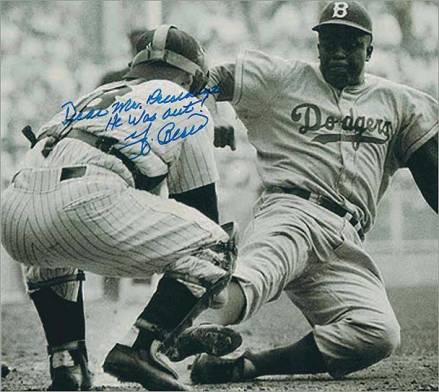
Stealing home on a double-steal attempt is rare enough in the postseason. Stealing home straight, no chaser in the Series makes the double-steal as common as breakfast coffee. Maybe the most fabled attempt was Hall of Famer Jackie Robinson in Game One of the 1955 Series. The Hall of Fame catcher on the play eventually got to autograph a photo of it for President Barack Obama:

Yogi habitually autographed photos of that play with “He was out!” for the rest of his life. Robinson’s was only the fifth successful straight-no-chaser home theft in Series history. The other four?

Game Two, 1909—The Series billed heavily as a showdown between two of the Hall of Fame’s Inaugural Five: Detroit’s Ty Cobb and Pittsburgh’s Honus Wagner. The Dutchman generally out-played the Peach in the Series, but Cobb caught Pirates reliever Vic Willis so fixed on Tigers batter George Moriarty that the baby and his candy had a better chance against a thief than the Pirates did when Cobb stole home.

Game One, 1921—Yankees middle infielder Mike McNally doubled in the fifth, took third on a bunt, and helped himself to home on the house. He made it look almost so simple a man with a fractured leg could have gotten away with it. Sort of.

Game Two, 1921—Yankee legend Bob Meusel decided to return the favour. He had a little help from Giants catcher Earl Smith—when Smith dropped Al Nehf’s pitch around the plate–but, of course, you never look a gift Giant in the mouth.

Game One, 1951—Hall of Famer Monte Irvin led off in the top of the first with a two-out base hit and took third when Whitey Lockman whacked a ground-rule double. Giants manager Leo Durocher, who knew a few things about thievery (such as the telescopic sign-stealing scheme that enabled the Giants’ pennant race comeback and playoff force in the first place), decided Irvin should take the chance with Bobby Thomson at the plate. Yankee pitcher Allie Reynolds helped with his habit of looking down as he took the sign from Berra. Irvin stole home so readily it’s a wonder he didn’t take up bank robbery after his playing days ended.

There but for the grace of maybe four inches would Margot have pilfered his way into the books. Not only would he have had the mere sixth straight home invasion in Series history, his would have been the first such successful heist in any Series game later than Game Two.

The truly bad news for the Rays after Margot was cuffed and stuffed was Dodgers first baseman Max Muncy checking in at the plate in the top of the fifth, with two out and the Dodgers leading 3-2, and wrestling Rays starter Tyler Glasnow to a full count before blasting a fastball down Broadway almost halfway up the right field seats.

Kershaw, who passed fellow future Hall of Famer Justin Verlander to take the top seat on the all-time postseason strikeout list Sunday night, didn’t catch on to Margot’s burglary attempt until just about the last split second.

“That has happened to me before,” Kershaw said, filing his postgame police report. “I wasn’t really anticipating it, but I have talked to first basemen in the past. Muncy, I have talked to him about it as well like, ‘Hey, I look at him but when I come set I don’t really see the runner, so you got to yell at me if they start going.’ And he was yelling at me, step off step off step off. So instinctually I just did it. It was a big out for us right there.”

Beats a burglar alarm.

To err is human . . . and ties a Wild Series

Brett Phillips hits the single heard ’round the world Friday night in the ninth . . .

The unhappiest place on earth Saturday night simply had to be wherever Kenley Jansen, Chris Taylor, and Will Smith were after World Series Game Four ended. If you still find them there today, please resist the temptation to pound pairs of goat horns onto their heads. No matter how many real, aspiring, or alleged prose poets insist on leading you there.

Until further notice—and the way this Wild Series is rounding, bumping, and stumbling into shape, further notice could come as soon as Game Five—Jansen, Taylor and Smith were the three most deeply wounded or sick men on the planet who aren’t suffering COVID-19. They don’t need gasoline poured onto the flames inside their souls, even if Jansen might be more worthy of a critique than Taylor and Smith.

But Brett Phillips may also have been the single highest young man on the planet who needed no alcohol or marijuana to get there, among a crowd of Tampa Bay Rays teammates who probably thought they were somewhere near Phillips’s cloud after what he triggered in the bottom of the ninth.

“The Rays are going to ask for the biggest hit in the life of Brett Phillips,” purred Fox Sports play-by-play man Joe Buck, just before Jansen turned and delivered on 1-2. Nobody says Jansen intended to help Phillips answer in the affirmative. And Phillips, the Floridian who grew up a Rays fan in the first place, wanted nothing more than a simple line-moving base hit.

The ones you should feel for truly are Taylor and Smith. Jansen got into trouble not just by failing to make the pitch that ended up ending Game Four but by failing almost inexplicably to back up home plate, when his proper presence might have choked the Rays off at the pass enough to send the game to extra innings instead of an 8-7 Dodgers loss. Might.

The husky righthander intended anything but throwing Phillips a grapefruit to line softly but surely past the Dodgers’ right-side infield shift and into right center field for a base hit when the Rays were down to their final strike and a 3-1 Series deficit, with Clayton Kershaw looming to start Game Five.

But Taylor didn’t see the ball shoot off Phillips’s bat intending to let it carom off the fingers of his glove when he ran in to play the hop and had his eye just long enough on Rays center fielder Kevin Kiermaier rounding third that he cheated himself out of a clean play. And Taylor didn’t hit his cutoff man Max Muncy past first base with a perfect strike just so Muncy’s relay down the line to Smith could bounce off the edge of Smith’s mitt at the split second the catcher began turning to make a sweeping tag at the plate—unaware that trail runner Randy Arozarena wasn’t even close to scoring yet.

Smith certainly didn’t intend for Muncy’s relay to ricochet behind his right side and all the way to the track behind the plate area. He simply didn’t see Arozarena tripping into a tumblesault halfway down the third base line, scrambling back toward third, before realising the ball escaped in the first place.

“Obviously, Will can’t see that Arozarena fell,” said Dodgers manager Dave Roberts postgame. “Unfortunately, it was like that ‘unperfect’ storm. Just unfortunate.” The manager may have his flaws, but understatement isn’t one of them. This “unperfect” storm became a tsunami in almost a blink.

Arozarena recovered, dove, and pounded his hand on the plate nine times before he finally stood up with his team the winner. That ball might never have gone all the way back, though, if Jansen had backed up the plate the way pitchers are trained to a fare-thee-well to do.

Instead of saving the Dodgers’ hides and sending Game Four to extra innings, perhaps, Jansen inexplicably went toward the third base line almost in a jog. He stood next to it as Smith finished the ball-less sweep tag on a runner yet to arrive, and only as Arozarena finally shot toward the plate as Smith scampered back in a futile bid to retrieve the ball did Jansen run toward the plate.

Then he ran past it, and around the back of it while Arozarena landed with the winning run. He probably wanted to run through the clubhouse, out of the building, and into that Texas night and oblivion if he could have found it. Instead, Jansen faced the press, credited the hitters for doing their jobs, but couldn’t let himself own the backup lapse.

“Yeah, I mean, you know I tried to see, you know, what could I do,” Jansen said postgame. “I could’ve run a little bit more and then just see the play. But like I say, we came up short today, tomorrow’s another day and we’re going to come out there and give everything we’ve got and try to win ballgames.”

This oft-bruised relief pitcher usually faced up to disaster without flinching or ducking during a too-heavy host of Dodgers postseason calamities past. Now, he couldn’t bring himself at last to admit he’d been in the wrong place at the wrong time, when a little more hustle might have given the Dodgers at least one more inning to play, one more inning to make a Series advantage. Might.

How long before it really sinks in for one and all that the possible most insane finish to any World Series game ever came down to the last man sitting on the Rays’ bench? A guy who’d played in parts of four major league seasons, barely hit above the notorious Mendoza Line, and never hit a game-winning anything until the Rays were down to their final Game Four strike?

“When these guys were in the [2008] World Series,” the happy hero said postgame, “I was in eighth grade watching them. And now to be a part of it, helping these guys win a World Series game, it’s special.”

And how long before the “double Buckner” riffing on social media dissipates? Bad enough the late Bill Buckner was given too many years of unwarranted hell despite his moment of horror meaning only that his Boston Red Sox would get to play a Game Seven. Jansen, Taylor, and Smith’s moments of horror mean only that this Series is tied.
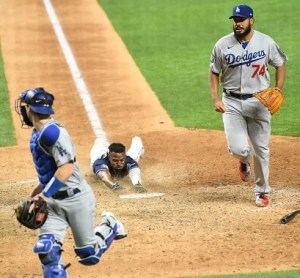
Jansen (74) could barely admit he’d blown it by not backing the plate when Smith lost the relay throw.

Nor was this quite ancient Dodgers catcher named Mickey Owen letting a Game Four-ending strike three become a passed ball, enabling Tommy Henrich to reach first starting a game-winning rally giving the Yankees a 3-1 Series lead instead of tying the Series at two each.

Short memories may be alien to Joe and Jane Fan who often leave you wondering what they crave more, the hero sandwich or a glass of goat’s milk. But they’re absolute requirements for a baseball player’s professional survival, as one reporter surely knew when asking Dodgers third baseman Justin Turner postgame just how that ninth-inning calamity could have happened while describing it in perfect thumbnail.

“You pretty much saw it,” Turner replied with a slightly dazed expression, before repeating the thumbnail in his own words and returning to standard boilerplate: show up, do the work, figure out a way to win tomorrow. Lucky for both teams that there would be a tomorrow.

The Dodgers thought for a moment that they’d send Clayton Kershaw out to the Game Five mound with a 3-1 Series advantage and just nine innings away from the Promised Land at last. Now Kershaw will pitch the biggest game of his life just to break a tie and leave Roberts to ponder whether to go for a bullpen Game Six or shove every one of his chips to the middle of the table with Walker Buehler starting on short rest.

As God and His servant Stengel are my witnesses, I swear to you that Rays manager Kevin Cash didn’t have Taylor misplaying Phillips’s line single or Smith mishandling the relay throw home in mind when he said and meant that, “eventually,” his team would get some bounces going their way.

A-ro-za-rena (as Buck pronounced it while he rounded third), his record-setting bombardier with nine this postseason, after a leadoff deficit-halving launch in the fourth, bouncing back up from that trip-and-tumble to shoot home with the game-winning run? Not even close to a flicker in Cash’s thinking.

“We’d tied the ballgame,” the manager said postgame, “so you’re feeling better, and then you’re sitting there saying, ‘My gosh, can this go any worse?’ There was so much that went through that game right there that I probably don’t even have the best recall right now.”

He did mean things like ten Rays hits including three homers and seven official runs batted in. He did mean bounces on balls the Rays put into play, including the broken-bat balloon shot Kiermaier—whose seventh-inning homer re-tied the game at six—lofted just past onrushing Dodgers second baseman Enrique Hernandez with one out in the ninth.

Maybe the only thing Cash could have predicted was Phillips having the fortitude not to let two strike calls that should have made the count 3-0 and not 1-2 rattle him. Subsequent replays including from straight above showed both those called strikes missing either side of the plate by a yarn thread. Veteran hitters are known to fume, sulk, or scream over such calls.

Phillips didn’t challenge plate umpire Chris Guccione. He didn’t demand immediate accountability from the Elysian Fields archangels. He just reset in the batter’s box, refused to take his eyes off Jansen’s incoming meatball just a little in off the middle at the belt and hit a no-doubt line drive that caught Taylor—moved from left to center field in a seventh-inning double switch—a little too far back before he ran in to play the ball.

The whole thing happened so swiftly it was easy to think that Phillips’s bat flew right out of his hands after he connected, instead of him dropping the bat almost by-the-way as he started running; and, that Smith actually lost the ball when he spun for the tag try. You might clean up at the sports book in the future if you bet on people remembering it just that way.

It might make you forget Turner setting a Series record in the top of the first, when he hit one out for the second straight Series game in the same inning. It might make you forget Dodgers shortstop Corey Seager meeting Arozarena in a five-way tie for the most single-postseason bombs in the third, with a blast so high and far that Rays starting pitcher Ryan Yarbrough didn’t even bother to turn and watch.

It might make you forget Seager tying Arozarena lasted exactly one full inning before Arozarena led off the fourth by hitting Dodgers starter Julio Urias’s first service over the right field fence to stand alone with nine. It might make you forget that the Rays’ oft-saluted bullpen actually had their worst struggle of the Series, after coming into Game Four with a collective ERA under two when taking over for Yarbrough’s games.

It might even make you forget what would have been the most surrealistic play of the night until Phillips hit that soft ninth-inning liner. When Muncy drove Seager home with the third Dodger run, tried advancing to second on the futile throw home, but overslid the base, popped right back up, and stumbled into Rays shortstop Willy Adames, who wrapped his arms around Muncy somehow as the pair fell back—with the ball still in Adames’s glove and Muncy’s foot off the base for the out.

This was also the night the Dodgers set a new single-postseason record by scoring their 54th run on two outs, and a night on which at least one run scored during nine consecutive half-innings, especially in the bottom of the sixth—when Brandon Lowe, whose Game Three looked as though his ferocious postseason slump returned, hit Dodgers reliever Pedro Baez for a three-run homer and the first Rays lead since winning Game Two.

Cash met the postgame press with the kind of wicked grin you expect to see from the joker who just snuck into a swanky cotillion and swiped the most choice bottle of hooch from the wet bar when everyone else was too busy preening to notice. Then a reporter asked him where in the Rays playbook was the play on which you tie and win off a double-ricochet pair of errors.

“We worked on that a lot in spring training over the last couple of years,” Cash said while rubbing the corner of his right eye. “We hadn’t put it in, but I’m glad it was able to play in our favour tonight.” Then he flashed the same hooch-swiping grin with which he started and laughed.

If Jansen, Taylor, and Smith laughed even once in Game Four’s aftermath, it was that they might not weep. For Taylor and Smith, especially, you might want to think about saving a hug for them instead of a slug. There are, after all, two more Series games to play at minimum.

Mortal men on immortal fields show their mortality only too often at the worst possible moments. We should call it being human enough. Unfortunately, in sports, the fans have their own perverse code: to err is human, to forgive is not always fan policy.