What the Yankeegate letter won’t do

Affirming the 2017 Yankees as cheaters won’t exonerate or excuse that year’s Astros or the next year’s Red Sox.

Remember the somewhat infamous admonitory letter from commissioner Rob Manfred to Yankee general manager Brian Cashman, regarding proof that the Yankees were up to some 2017 electronic sign-stealing of their own? The letter the Yankees have fought to suppress with the same ardor as they exercise trying to break a decade-plus World Series ring drought?

The Yankeegate letter’s going to come forth in a fortnight, ESPN says. We’re going to learn at last whether Manfred told the whole story of any such Yankee panky or, if he did, just what it actually involved, other than the once-infamous dugout phone/Apple watch slap on the wrist. It only took two years from the day federal judge Jed S. Rakoff ordered the letter unsealed and disclosed to the public with minimal redaction.

Maybe it was only the dugout phone and/or the Apple watch. Maybe it included the Yankees trying to get cute using a television broadcast camera/monitor for a little extracurricular intelligence gathering. Maybe it included the Yankees operating a replay-room reconnaissance ring similar to that known to have been run by Red Sox players in 2018. Maybe.

The bad news, at least for the DraftKings fantasy baseball group, is that releasing the Yankeegate letter won’t reinstate their $5 million lawsuit over Astrogate and Soxgate and aimed at both those clubs plus MLB itself. The worse news is that, whatever is or isn’t in the Yankeegate letter, it won’t take the 2017-18 Astros especially, or the 2018 Red Sox as well, off the hook.

Memory summons back that some around the Astros—and no few of their fans—believed to their souls that high-tech sign-stealing was prevalent enough that they would have been left in the dust if they didn’t think about a little such subterfuge themselves. Mostly, it involved replay-room reconnaissance. The Red Sox got bagged for it over 2018, but few pretended they were the only team with that kind of spymanship.

The Rogue Sox and their fellow replay-room spies, whomever they were, still required a little of the old-fashioned gamesmanship technique: their pilfered intelligence was useless unless there was a man on base to receive it and thus signal it to the man at the plate. That doesn’t justify, either. Sign-stealing from the basepaths or the coaching lines is one thing. Picking it off replay monitors is something else entirely.

But those rooms were provided by MLB itself, to the home and visiting teams in each ballpark. Expecting them to be there without one or another team giving in to the sign-stealing temptation was (I repeat, yet again) something like Mom and Dad making off for a weekend getaway without the kids and leaving the liquor cabinet keys behind.

The 2017-18 Astros took it quite a few bridges farther. For one thing, a front office intern created a sign-stealing algorithm (Codebreaker) that he warned was legal to use before and after games but not during games, a warning then-general manager Jeff Luhnow pooh-poohed while fostering a since-exposed organisational culture in which, to be polite, human decency, never mind honest competition, was seen as an encumbrance.

For another thing, there was that little matter of either an existing camera altered illegally from its mandatory eight-second transmission delay; or, a second, illegally deployed real-time camera. Either or both of which sent signs to be deciphered from an extracurricular clubhouse monitor and then transmitted to Astro hitters with the infamous trash can bangs.

Nobody with credibility says the replay-room reconnaissance rings were right. And nobody with credibility should ever say those rings made the 2017-18 Astros less guilty. As things turned out, the Astros had such a broad reputation inside baseball for their kind of cheating that their 2019 World Series opponents took themselves to extraordinary lengths to thwart it.

No, the 2019 world champion Nationals didn’t build their own extralegal closed-circuit television spy network. They merely provided every one of their World Series pitchers with five individual sets of signs each to switch up in a split second’s notice, with their catchers provided wrist-band cards featuring every one of those sign sets just in case.

Whataboutism is no defense whether you’re a rogue police officer, a corrupt politician, or an illegal off-field-based electronic sign-stealing cheater. The Astros couldn’t just whatabout their Astro Intelligence Agency and get away with it in the public mind. Nor could the Rogue Sox whatabout it when their 2018 edition was exposed for replay-room reconaissance cheaters.

The Yankees won’t be able to whatabout it if the infamous letter shows their 2017 edition to have been replay-room or broadcasting-camera cheaters, either. But we’ll have to wait at least a fortnight before we know at least some the rest of the Yankeegate story.

The Twins deliver a stunning signing: Carlos Correa

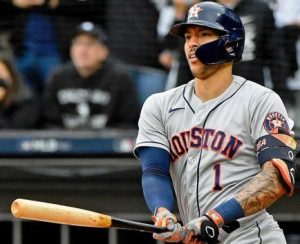
Carlos Correa

Almost nobody expected the longtime Astros shortstop to sign with the Twins.

It’s hard to look at Carlos Correa signing with the Twins for three years and $105.3 million without knowing the Astros’ remaining Astrogate contingent is reduced officially by one. There are now only three position players and one pitcher remaining from the tainted 2017 World Series winners.

This should be good for the Astros in terms of leaving the Astrogate taint further and further behind them. But I suspect it won’t be. With only four Astrogate-team members left last year, the Astros still heard it loud and long from fans on the road. Some of it was mere booing, catcalling, and “chea-ter!” chants. Some of it was inflatable and actual trash cans hitting fields.

I still suspect it’s not going to stop until the last Astrogater standing no longer wears an Astro uniform. Not until second baseman Jose Altuve (who actually didn’t partake all the way in the Astro Intelligence Agency’s 2017-18 off-field based, illegal camera-abetted, electronic sign-stealing operation), third baseman Alex Bregman, first baseman Yuli Gurriel, and pitcher Lance McCullers, Jr. move to other teams if not into retirement.

As it happens, I have tickets for what will now be Opening Day, period, in Angel Stadium on 7 April. Guess who the Angels host to start their regular season. My son and myself will probably wonder en route the ballpark how many other Angel fans will turn up with inflatable trash cans, bangable trash cans, and more to continue letting the Astros have it.

It took decades before the 1951 New York Giants were verified once and for all as off-field based sign-stealing cheaters en route the comeback that forced the fabled pennant playoff. It took only two years from the 2017 World Series to expose and verify the AIA. And it took only a couple of hours during the pandemically-aborted 2020 spring training for the Astros to show the world they didn’t quite think their cheating was that big a deal.

Correa since the infamous spring training 2020 presser has been maybe the most stubborn defender of the Astros’ 2017 Series title. “When you analyze the games,” he said before the coronavirus closed that spring training and half the season to come, “we won fair and square. We earned that championship.”

Funny, but that’s not exactly what Correa said at the infamous presser. While Astros owner Jim Crane tripped over himself, Bregman tossed word salad, and since-gone outfielder Josh Reddick “couldn’t really say [the AIA operation] did or didn’t” give the Astros an advantage, Correa said, essentially, not so fast:

It’s an advantage. I’m not going to lie to you. If you know what’s coming, you get a slight edge. And that’s why [then-general manager Jeff Luhnow and then-manager A.J. Hinch] got suspended and people got fired because it’s not right. It’s not right to do that. It was an advantage. But . . . it’s not going to happen moving forward.

After the Braves nailed last fall’s World Series at the Astros’ expense, Correa spoke in terms that would have made him a fit on the 20th Century Yankees.

Second place is not good enough for us. I know it’s not good enough for you guys. But it speaks volumes of how good our organization is, how talented our clubhouse is. Five ALCS in a row. Three World Series in five years. I don’t know what else you want to ask from a great ball club . . .People expect greatness when you talk about the Houston Astros. They expect us to make the playoffs every year. They expect us to be in the World Series every year.

But the only one they won is the one that just so happens to be tainted.

And, speaking of the Yankees, take a poke around the vast multitudes that root for or at least follow them and it seemed as though the number one thought in and out of their minds Saturday morning was, How on earth could the Yankees miss out on signing Correa? Did they really take Josh Donaldson’s contract on in that trade with the Twins just to let the Twins snatch Correa with the savings?

Others thought Correa outsmarted himself into taking considerably less with the Twins than he thought he might get on a market that got forced into overdrive thanks to that ridiculous owners’ lockout. But he’ll pull down the fourth-highest single-season salary of 2022, behind pitchers Max Scherzer (Mets) and Gerrit Cole (Yankees) plus outfielder Mike Trout (Angels).

The deal also includes opt-outs after this season and next. Turning 28 in the final third of this coming September, and assuming he has a typically Correa season in Minnesota, he could still opt out and play next winter’s market for something more to his supposed liking. Maybe he didn’t really outsmart himself, after all?

Maybe the Yankees still have a spring surprise yet to play. They unloaded Gio Urshela (shortstop) and Gary Sanchez (catcher) to bring Donaldson (third base), Isiah Kiner-Falefa (shortstop), and Ben Rortvedt (catcher) aboard. Maybe they have Kiner-Falefa in mind to play support after they sign free agent shorstop Trevor Story? Maybe?

Or maybe the Twins have decided, yes, they’re coming into it to try to win it, including enticing the shortstop anchor from the penthouse of the American League West for a season at least. Maybe they can make Correa happy in the Twin Cities, after all.

Maybe he can join his fellow high 2012 draft pick Byron Buxton (Correa and Buxton were numeros uno and two-o in that draft) to yank them from the basement to the penthouse. He did prove last year that he knows how to win without any funny business that anyone knew of, even if the Astros came up two bucks short in the World Series.

‘[T]he makings of a formidable lineup are present in Minnesota, though they’ll need a few things to break right,” writes MLB Trade Rumors’s Steve Adams, who also notes their “patchwork starting [pitching] rotation” remains a cause for some alarm even with trading for Sonny Gray from the apparently tanking Reds.

From the defensive side of things, Correa gives the Twins a pair of Platinum Glove winners, joining Buxton in that regard. With quality defenders like [Max] Kepler, Urshela and young catcher Ryan Jeffers also occupying key spots on the diamond, the Twins should have a strong defensive team overall. The Twins already ranked 12th in the Majors both in Defensive Runs Saved and Outs Above Average in 2021, and Correa should boost both marks.

There’s something else Correa could do now that he’s become a Twin, too. Something not exactly unprecedented. He could become the latest 2017 Astro to drop all pretenses, denials, and whataboutisms, and come a lot cleaner about Astrogate.

That began with utilityman Marwin Gonzalez, who signed with the Twins as a free agent for 2018, then with the Red Sox as a free agent for 2021, got released by the Red Sox last August, and signed to return to the Astros for their run to the World Series.

Gonzalez broke the ice around the time of the infamous 2020 Astro presser. “I’m remorseful for everything that happened in 2017,” he told reporters, “for everything that we did as a group, and for the players that were affected directly by us doing this.”

He, too, didn’t use the C word. Maybe it’d be too much to expect Correa to use it, too, if he decides it’s safe to come all the way clean now. But it would give him a better look either way than the one he often had clinging stubbornly to the idea that the 2017 World Series title wasn’t really tainted.

WS Game Six: Bang!! Zoom!!!

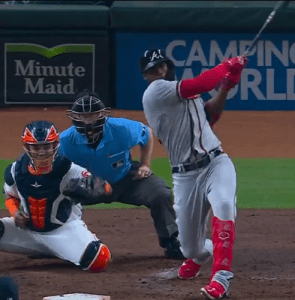
Jorge Soler

Jorge Soler’s detonation in the bottom of the third. (Fox Sports screen capture.)

Blowhard bus driver Ralph Kramden only threatened to bang-zoom his acid but loving wife Alice to the moon in the days of old. (She might have clobbered him if he’d really hauled off.) The Braves may not have threatened to do it to the Astros, exactly, but that’s what they did to win the World Series Tuesday night.

The way Braves starting pitcher Max Fried and relief aces Tyler Matzek and Will Smith worked the Astros over, the Braves needed only one bang-zoom, after all. Getting three and a half was beyond gravy. It was a six course meal crowned with a baked Alaska dessert.

Shutting out the team that led the entire Show with 5.3 regular season runs per game averaged, and the postseason with 6.7 runs per game averaged, also does that for you. However brilliant Fried, Matzek, and Smith were on the mound, though, it goes for naught if you can’t bring anyone home.

But when Jorge Soler hit that monstrous three-run homer in the bottom of the third, it let the air out of Minute Maid Park almost as fast as it took away what wind remained to the Astros. Now . . . everybody, breathe again.

The sun didn’t fall. The heavens didn’t go to hell. The great oceans didn’t dry up and blow away. The stars didn’t go out. When Astros first baseman Yuli Gurriel grounded out to Braves shortstop Dansby Swanson, throwing right on the button to longtime Braves first baseman Freddie Freeman, for game, set, and Series, Armageddon didn’t begin.

But a few things that helped sour the Series for people who don’t live in either Atlanta or Houston ended, too. For now, anyway.

No more race-demeaning Tomahawk Chopping in the Truist Park stands or by traveling Braves fans present in Minute Maid Park. No more of the more stubbornly obnoxious among Astro fans acting and carping (falsely, on both counts) that their heroes were “scapegoated” when Astrogate exploded almost two full years ago.

But, also, there’ll be no more treating the entire Astros roster as barely-repentant cheaters because of the remaining presence of four Astrogaters. (Pitcher Lance McCullers, Jr. missed the entire postseason with an arm injury.) Even the Truist Park crowds for Games Three through Five isolated the point: they saved the “Cheater! Cheater!” chants purely for any of the four.

So now we can review and re-enjoy Fried surviving a near-disastrous near-ankle injury on a play at first base in the first inning to pitch six shutout innings. We can review and re-wonder about Luis (Rock-a-Bye Salsa) Garcia starting on short rest for the Astros, a move risky enough for manager Dusty Baker. He got away with it for two innings. In the third, disaster.

Now, we can re-enjoy Ozzie Albies poking his first base hit since Game Two. We can re-enjoy Fox Sports cameras captured a couple in the stands wearing makeshift World Series trophies for headdresses while Eddie Rosario waited out a five-pitch walk. We can re-enjoy Soler—the American League’s home run king in 2019, but somewhat lost this season, until two weeks before the Royals traded him to the Braves at this year’s deadline—hitting back-to-back, full-count liners foul out of play, before Garcia decided to sneak a cutter past him.

Dansby Swanson

Swanson reaching the Crawford Boxes in the fifth. (Fox Sports screen capture.)

And, we can re-enjoy Soler swinging as though trying to bring a great oak down but settling for bringing Garcia down instead, with the Minute Maid retractable roof open, and the ball flying over the left field seats, over the train tracks, out of the building, and rolling to the street off an awning outside.

Bang!! Zoom!!!

“I got to [full count],” Soler said postgame, “and I didn’t want the same thing to happen as the first inning at-bat, where I struck out on the off-speed pitch. So I was just kind of getting prepared for that.” That was like the Navy saying it didn’t want a Pearl Harbour rerun and was just kind of getting prepared for the Battle of Midway.

“He’s been swinging the bat so good,” said Braves manager Brian Snitker. “This whole World Series. Even just the walks he was taking were really big.”

Fried looked at last as though he had under complete control his familiar, nervous-looking glove-snapping around his hand on the ball when he takes his sign before delivering. He’d shaken off that first-inning play covering at first and getting thatclose to turning his right ankle, his landing ankle, to crumbs when Michael Brantley stepped on it crossing the pad on a ground ball.

A television replay closeup showed that not only had Fried’s foot missed touching the pad, Brantley never touched it either, even as Fried got the gloved ball on it as he fell backward. The Braves chose not to challenge the safe call. Fried picked himself up, dusted himself off, walked back to the mound, and sandwiched Jose Altuve’s runner-advancing ground out between two toasted strikeouts.

After swapping two scoreless innings to Astro reliever Cristian Javier’s one—they both  ended with slick double plays including the one he launched himself to end the bottom of the third—Fried had a breather and Javier went out for a second inning’s work. His first was three-and-three in the top of the fourth. He wouldn’t be that fortunate in the top of the fifth.

Not with Albies leading off with a walk, then taking second on a wild pitch. Not with a strikeout on Travis d’Arnaud proving the mere setup for Dansby Swanson smashing a down-the-pipe fastball into the Crawford Boxes. And, not with Freeman following a two-out walk to Soler by sending him all the way home with a double off the absolute rearmost center field wall.

Bang!! Zoom!!!

Two innings and three Astros relievers later, Freeman decided the Braves needed a little extra insurance, with the Astros down by a mere six. How to get it with two outs was the question. The answer proved simple enough. He caught hold of Ryne Stanek’s slightly dangling slider and drove it over the center field wall a little left of the Phillips 66 sign.

Bang!! Zoom!!!

“He’s been through good times. He’s been through the worst of times and now through the best of times,” said Swanson postgame of Freeman, the longtime Braves franchise face, who’s made no secret of his desire to stay with the team despite his free agency to come this winter. “Nobody deserves it on our team more than him. He stuck it out and really believed in the vision and mission that this place had. I’m just thankful for him to be on our team.”

Fried, Matzek (the seventh and eighth), and Smith (the ninth), kept the Astros so far in check there may have been suspicions that they’d been kidnapped and replaced with android replicas whose designers forgot to include batting eyes and arm strength.

As favoured sentimentally as his post-Astrogate Astros were disfavoured almost universally, Baker still doesn’t have that elusive World Series ring. Snitker, a Braves lifer who’s a mere six years Baker’s junior, has his first in five full seasons manning the Braves’ bridge.

Two old-school baseball men—who’ve learned and worked by the precept that analytics gives you what you need to know going in, but the moment in front of you and slightly ahead of you tells you what you should or shouldn’t do with that information—matched wits all Series long.
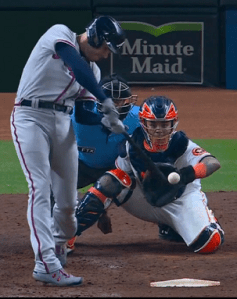
Freddie Freeman

Freeman, still the franchise face, going over the center field wall in the seventh. (Fox Sports screen capture.)

It took stout pitching and a little new old-fashioned long-range bombing to put the Braves over the top and to bury a collection of Astros with too little left in the tank,finally, to repel the invaders.

“First off, you’ve got to give a ton of credit to [the Braves],” said still-struggling Astros third baseman Alex Bregman postgame. “They were unbelievable. They pitched really well. They swung the bats, played good defense. We normally do hit a little bit more for power, and we didn’t. But you learn and move on. You use it as fuel during the off-season to get better and learn from it.”

What the Braves learned this season and taught or re-taught everyone else is that it’s possible to ride the arguable bumpiest road to the postseason and still come away from the ride hoisting the World Series trophy. “We hit every pothole, every bump you could possibly hit this year,” said the otherwise jubilant Freeman postgame, “and somehow the car still made it onto the other side.”

Potholes? Bumps? The Braves came out of a few nasty pileups. They lost franchise face heir apparent Ronald Acuna, Jr. to a season-ending knee injury in the outfield in early July. They entered the season without pitcher Mike Soroka, thanks to his re-injuring the Achilles tendon he’d barely finished rehabbing in the first place. They lost bombardier Marcell Ozuna to domestic violence charges and administrative leave.

The eventual rulers of the none-too-powerful National League East didn’t even have a winning record overall until 6 August. They broke the record for the latest season arrival above .500 they themselves held . . . since their 1914 “Miracle” ancestors arrived only on 3 August that year.

General manager Alex Anthopolous—who had to miss the Game Six and championship fun after being hit by COVID-19—swung four trade-deadline deals to land Soler, Rosario, Adam Duvall, and Joc Pederson. They went 36-14 in their final 55 regular season games. They still looked like postseason underdogs. Until.

They overthrew the NL Central-champion Brewers three straight after losing Game One of their division series. After getting blown out in National League Championship Series Game Five, they overthrew the wild card-winning Dodgers—owners of baseball’s second-best regular-season record with 106 wins—with their lights-out bullpen tandem Matzek and AJ Minter to win the pennant.

Then they lost starting pitcher Charlie Morton to a line drive off his leg in World Series Game One. And defied everyone who said losing the likeable, respected veteran for the rest of the set meant temporal and spiritual disaster for the upstarts.

When they finally reached the Promised Land, the Braves also defied several other factors. They became the first team ever to show a League Championship Series MVP and a World Series MVP who weren’t even with the team in the regular season’s first half. Their four outfield imports hit more postseason home runs together (twelve) than the rest of the team combined (eleven).

Bang!! Zoom!!!

Max Fried

Fried shook off a potentially shattering ankle injury in the first to shatter the Astros’ formidable offense.

When Sock-a-Bye Soler took Rock-a-Bye Samba downtown Tuesday night, only five men before him had ever hit three go-ahead home runs in a single World Series: Babe Ruth (1926), Lou Gehrig (1928), Gene Tenace (1972), Curtis Granderson (2015), and George Springer (2017). Soler joins Gehrig, Tenace, and Springer for doing it for World Series winners.

Only one other man ever got close to where Soler’s blast ended up. That was before the Astros became the team to be named later in the league swap that made a National League team out of the Brewers and sent the Astros to the American League.

The only thing keeping then-Cardinals superman Albert Pujols’s ninth-inning three-run homer from landing in Soler territory in 2005 NLCS Game Five was the closed roof. If the Minute Maid roof was open then, Pujols’s rip off then-Astros closer Brad Lidge might have bounded off the same awning—if not flown right to the street.

Somewhere in their Elysian Fields stomping grounds, the Braves’ late Hall of Famers Hank Aaron, Eddie Mathews, Phil Niekro, and Warren Spahn smiled down upon these rascally Braves while applauding madly.

The Astros went from steamrolling the White Sox and the Red Sox out of the postseason into spending most of this World Series being about as offensive as an ice cream sandwich. Except for stinging the possibly pitch-tipping Fried in Game Two, and overthrowing a first-inning battering in Game Five, the Astro offense either slept or turned up when it didn’t or couldn’t do them many favours.

“We just kind of ran out of gas pitching-wise,” Baker said postgame. “Our guys, nobody complained, nobody alibied. And I’m not going to alibi. We got outplayed. What can you do, except go home, take a shower, figure out how you’re going to come back and win it next year. Look, last year we got one game short of the World Series, and this year we were two games short of the championship.”

Baker was right about their spent pitching. Missing future Hall of Famer Justin Verlander to Tommy John surgery recuperation hurt. Being without their best 2021 starter, Lance McCullers, Jr., hurt. Baker bringing his should-have-been Game Six starter Jose Urquidy in for an inning of Game Five relief probably hurt. Veteran Zack Greinke starting to show his age at last hurt.

If you ask Minter, he’ll tell you the Braves transformed themselves from a small legion of also-rans into the guys who put the big boys into their places by hook, crook, and anything else they could think of so long as failure was no longer a dismaying, disgusting option.

“We are a bunch of misfits this year,” Minter said postgame. “I mean, we’re a group of failures. And that’s what makes this team special, because we know what it feels like to fail. We know what it feels like to lose, and we weren’t willing to accept failure this year. So we pulled it together somehow—and now we’re World Series champions. It’s cool, man.”

The Astros, of course, see themselves as anything but misfits. They were very gracious in World Series defeat. (“They deserve what they have,” said Altuve postgame.) But they see themselves now the way the Yankees did in the ancient, mid-20th Century. Shortstop Carlos Correa—one of their team leaders, one of the remaining Astrogate Five, and a possible departure in free agency this winter—said it right out postgame:

“Second place is not good enough for us. I know it’s not good enough for you guys. But it speaks volumes of how good our organization is, how talented our clubhouse is. Five ALCS in a row. Three World Series in five years. I don’t know what else you want to ask from a great ball club.”

Some might want to ask that they win a World Series without the taint of something like Astrogate.

They may yet win one, even next year, since the pitching remains deep even with Greinke and Verlander likely out of the picture and their youth includes a pair of solid stars in Kyle Tucker and Yordan Alvarez. Even if Alvarez was a one-man wrecking crew in the ALCS brought low in the World Series. Even if Altuve (32), Gurriel (37), and Michael Brantley (34) can’t keep Father Time from coming too much longer.

“People expect greatness when you talk about the Houston Astros,” said Correa, who still seems at once embarrassed by Astrogate yet unable to resist playing the rogue. “They expect us to make the playoffs every year. They expect us to be in the World Series every year.”

But now the guys nobody really expected at mid-season to be in the World Series have won it. With a pitcher defying those critics who thought he wasn’t really ready for center stage just yet. With three big swings having nothing to do with illegally stolen signs sent to the batter’s box by trash can transmission.

Bang!! Zoom!!!

Baker Agonistes

Dusty Baker

Even people who still despise the Astros can’t bring themselves to wish ill upon post-Astrogate manager Dusty Baker.

Tuesday night won’t be virgin territory for the Astros. Two years ago, they came home to play out a World Series in the hole 3-2, too. That was then: They lost twice to the Nationals, who’d beaten them in Games One and Two in Houston as well.

This is now: Having the home field advantage hasn’t exactly helped the Astros yet. They split Games One and Two in Minute Maid Park. Then, they lost two of three to the Braves in Atlanta. They may have put a sanguine public face on approaching Game Six, but second baseman Jose Altuve isn’t exactly ready to pull the champagne corks just yet.

“I don’t feel like going home is any guarantee,” he told ESPN’s Jeff Passan. “We’ve got to go out there and fight. It’s not like, OK, we go home, we got them. No. We’re playing a really, really good team. Those guys take really good at-bats, they know how to pitch, they can do everything. And we got to go out there and fight.”

The Astros lost that 2019 Series a fortnight before the Astrogate whistle was blown at last. They’ve played since with the justly-earned reputation for having been baseball’s most egregious and extreme electronic cheaters, and they haven’t always helped their own cause trying to move past it since.

One minute, they’ve embraced the villain role. The next, they’ve seemed as close to contrite as you’d expect of any team who first thought their well-exposed competitive amorality wasn’t as big a deal as everyone else made it.

Altuve’s sober realism about returning the Series home to one side, Passan has it right when he observes that embracing the bad-guys role goes only so far: “[W]hile some may see the Astros’ use of others’ loathing as backward—the reaction to your misdeed becoming a source of fuel is rather twisted—what’s the alternative?”

One alternative would be winning a World Series to climax a postseason in which the Astros really have played it straight, no chaser. So far. Disdain and contempt will remain attached to them until the last Astrogate team member no longer wears an Astros uniform. That a genuinely great team went rogue above and beyond is nobody’s fault but theirs.

The Truist Park crowds in Atlanta serenaded Altuve, Alex Bregman, and Carlos Correa with singsong chants of “Cheater! Cheater!” every time those three checked in at the plate. (It’s to wonder why the fourth member of the remaining Astrogate infield, first baseman Yuli Gurriel, escaped the serenades.) Those crowds didn’t hammer the entire team over the transgressions of the few remaining. To their eternal credit.

Nobody’s suspected or come up with any evidence that the Astros have been up to no good this fall. They blew the White Sox out of a division series after getting blown out in Game Three. They overthrew the Red Sox in the American League Championship Series after a 13-3 blowout put the Red Sox up 2-1 in the set. They answered Braves center fielder Adam Duvall’s nuke of a first-inning grand slam to beat the Braves 9-5 in Game Five Sunday night and force the World Series back to Minute Maid Park. Straight, no chaser.

But they enter Game Six with a couple of red flags flying regardless. Just what was manager Dusty Baker thinking when he sent Jose Urquidy out to pitch the Game Five fourth, when he had enough capable and available bullpen arms and really needed Urquidy to start Game Six?

Did Baker thus force himself to roll the wrong dice starting Luis Garcia on short rest against a fully-rested Max Fried, whom the Astros pecked apart early but without quite nuking him in Game Two?

Did Baker—who steadied the Astrogate-broiled clubhouse when coming aboard in its immediate wake; whose long and winning resume, historic shortfalls, and personal respect made him the sentimental favourite to win it all at last—really sacrifice a season to send set back to Houston?

Was Baker being canny in Game Five? Too clever by half? Does he know something about Rock-a-Bye-Samba Garcia that nobody else knows yet? Or, will Game Six end up another entry in Baker’s too long, too sad, often rotten-luck roll of postseason fate?

His critics often say he should have known better. His admirers say he’s been as much a victim of surrealistic dumb luck as anything else. Baker is either a big-hearted overthinker or the one-man resurrection of every hard luck team that ever reached the mountaintop and tripped to the rocks on the Jordan’s banks.

The man who’s managed more winning games than any skipper who’s never won a World Series is either Gene Mauch redux; or, he’s a one-man 1908 Giants, 1960 Yankees, 1969 Cubs, 1978 and 1986 Red Sox, 1987 Blue Jays, 2006-07 Mets, and almost every St. Louis Brown or Washington Senator, ever.

2002 World Series, Game Six: Baker lifted his Giants starter Russ Ortiz after the Anaheim Angels (as they were known then) swatted a pair of singles to open the bottom of the seventh with the Giants leading 5-0. With all good intention and heart, Baker handed Ortiz the “game ball” before turning it over to Felix Rodriguez. The Angels weren’t exactly indifferent to that.

Bing! Scott Spiezio hit a prompt three-run homer. The Angels finished handing the Giants’ pen their heads on plates to win at the eleventh hour, then won Game Seven decisively.

2003 National League Championship Series Game Six: Baker’s Cubs stood five outs from the World Series in the top of the eighth. He left a gassed starter Mark Prior in to take it on the chin and off a shortstop’s double play error, opening up what proved an eight-run Marlins eighth.

Then, in Game Seven, Baker inexplicably let Kerry Wood live long enough to surrender seven runs as the Marlins went to the World Series they’d win in six.

Baker’s often been accused of managing certain postseason games as though he’s just taking regular-season target practise against his league’s also-rans. But it wasn’t exactly his fault that his 2017 Nationals lost NLDS Game Five after swapping wins the first four games with the Cubs, either.

He didn’t ask Max Scherzer in relief to surrender a two-run double before Matt Wieters turned a passed ball into a ghastly run-scoring throwing error up the first base line. He didn’t ask Max the Knife to hit a batter with the bases loaded to finish that four-run Cubs seventh, leading to the 9-8 Cubs win.

That doesn’t exactly keep the second guessers in line, of course. I’ve second-guessed Baker often enough in the past, and I know it wasn’t his fault that that inning swallowed him alive—and cost him his job. He’s taken five different teams to postseasons; he’s been fired after 90+ win teams he managed ended postseasons in agony.

There are reasons teams have turned to him over the years, especially the one that wandered into scandal all by itself and needed an untainted human to take their game bridge, while they remade/remodeled the front office almost completely, and figure out how to steer them past it without being buried by it.

It hasn’t been perfect by any means. Baker didn’t look great at this season’s beginning, when road fans now allowed back to the ballparks after the 2020 pan-damn-ic absences trolled his Astros to make up for lost outrage time, and Baker played the whatabout card in return. He was better than that, he knew better than that, and we knew better than that.

The Astros needed heart, dignity, class, and soul to lead them out of their self-inflicted disgrace. That’s why they turned to Baker last year. But one of his 2003 Cubs, Doug Glanville, outfielder turned instructive and respected ESPN writer, has isolated perhaps the best reason Baker now has one more chance to land that ever-elusive claim to the Promised Land.

“Dusty always had time to talk to players to bring them together,” Glanville began, in a piece he published the day before World Series Game Five.

It was a priority that he not only get the biographical notes of your life, but he wanted to put himself in your shoes. Listen to your music, read about your perspective and embrace your culture. Not just as a company-wide initiative but as an evolution of life. He lets you change him, openly trying to grow. And he pushes you to do the same.

These were life lessons, not just baseball lessons. He wanted to take the gift of a lifetime of playing baseball and share it to make us all better. It went way beyond learning how to hit a curve ball or figuring out when Greg Maddux was going to throw his back-up slider. This was real life, and teammates were family. Every day was a celebration, a chance to get together over something joyous. And he was the Godfather, inheriting sons with the humility to know he can learn from them just as much as he can impart his own wisdom.

Does this make a manager better at running a bullpen or using his bench? I can’t say. But 18 years after I played for him, I still apply the lessons I learned from him as a father and a husband.

The Astros could force this World Series to a seventh game. They’d still have to win that. And Altuve is right when he suggests these Braves are no pushovers, no matter how Game Five shook out.

You may think still that an Astro loss would be nothing less than extraterrestrial justice. But you may think as well what a shame it would be that Baker has to be on the bridge incurring it if it happens. And you’d be right.

WS Game Five: Winning in a walk

Martin Maldonado

Maldonado, you’re no longer the weakest link. For now.

The good news is, the Braves can win in Houston. They proved it in Game Two. The bad news is, they’ll need to win there to win the World Series now.

The Astros didn’t let a little thing like a four-run hole after a single Game Five inning on a single swing drive them into an early season’s grave Sunday night.

Not with manager Dusty Baker flipping his lineup a little bit. Not with proving there are times a bases-loaded walk and a well-timed single in the middle of a game are more powerful than a grand slam out of the gates.

Not with the Astros’ heretofore, mostly dormant longtime core finding their bats. And, not with the Braves’ heretofore impenetrable bullpen proving they’re only human, after all, while their own usually tenacious bats mostly went askew following their early slicing, slashing, and thundering.

Their early, incendiary Game Five lead turned into a 9-5 loss to the Astros—but doesn’t have them up against the wall just yet.

“When we won [Game Four], it made it easier, I guess, coming into this one — but we knew it was going to be tough,” said Braves manager Brian Snitker postgame. “That’s just a lot of innings to cover (by relievers) against a club like this that swings a bat so well. The good news is we’ll take a day off and be in good shape.”

Meaning, including and especially, a rested bullpen as well as a re-grouping lineup. But it’s the opposite now of where they stood after Game Five of the National League Championship Series, after the Dodgers flattened them 11-2 in Los Angeles and despite still holding a 3-2 lead in the set.

Then, the Braves’ longtime first baseman and leader Freddie Freeman said they were still in good shape, they still led the set, and they liked their chances going back home to Atlanta. Now, Snitker’s putting the Brave face on and saying, “I’ll take it anywhere. If we win the World Series, it doesn’t matter where it is.”

Two years ago the Nationals proved that in abundance against the Astros. The Braves won’t be winning all needed Series games on the road, but with their Series lead now they need to win only once. It sounds simple when you say it. It’ll be anything but simple when they play it starting Tuesday night.

You can’t get any more profound a reminder of how tough a World Series can be than the Braves got when they only thought they had the Astros buried alive in the bottom of the first Sunday night.

They loaded the bases on Astros starter Framber Valdez with a leadoff base hit by Jorge Soler, a two-out single by Austin Riley, and a 3-1 walk to Eddie Rosario. Then Adam Duvall couldn’t wait to drive Valdez’s first service to him into the seats above the right field wall.

Hindsight’s almost as wonderful as foresight. Snitker has both in abundance. This time, though, hindsight was his BFF. “I’d rather we scored those runs in the seventh inning when you don’t have so much time to cover,” the manager said postgame. “We knew we had a long, long way to go in that game and anything could happen.”

Anything did happen, right away.

Heretofore slumber bat Alex Bregman hit with first and second and one out in the second and lined Braves opener Tucker Davidson’s the other way, all the way to the right center field wall, scoring Yuli Gurriel (one-out, one-hop single to center). Heretofore macaroni bat Martin Maldonado sent Kyle Tucker (full-count walk) home with a sacrifice fly cutting the Braves’ lead in half.

The Astros might have gotten one more run home but for the next batter—Valdez himself. Two swinging strikes around a ball in the dirt, then looking frozen at strike three on the inside forner after a ball just low. You still don’t want the designated hitter in the National League’s parks, old farts? Imagine if the Astros didn’t have to bat Valdez there. They might only have had a one-run deficit to end the frame.

No matter. Their unraveling of the Braves began the very next inning, when Dansby Swanson at shortstop misplayed Jose Altuve’s leadoff hopper, bumping the ball from his glove, recovering too late to throw the swift Mighty Mouse out at first. The rest of the Series will prove whether or not that’ll be this postseason’s most egregious Braves mistake of all.

Davidson walked Michael Brantley on a 3-1 count and Carlos Correa—another of the formerly dormant-at-the-plate Astro core—doubled Altuve home. A fly out later, Brantley scored on Gurriel’s ground out to short. Tie game. The tie lasted long enough for Freeman to lead the bottom of the third off with a mammoth full-count, tiebreaking blast half way up the right center field seats.

The 5-4 Braves lead lasted until the bases loaded and two out in the top of the fifth. Checking in at the plate: Maldonado, the Astros catcher still vying for the title of the single most automatic Astro out, after the Braves ordered Bregman walked on the house to load the pads in the first place.

What came next may yet prove one of the ten most powerful walks of all time. Maldonado looked at ball four inside from Braves relief star AJ Minter, sending Correa (leadoff one-hop base hit to center) strolling home with the re-tying run. Martin, you’re no longer the weakest link. For now.

Not only did Maldonado get daring enough to stand right on top of the plate during the entire plate appearance, the better to get an edge against Minter’s cutter, he even showed bunt as ball four sailed in. He didn’t do it for a laugh, either.

“He came back to the dugout yelling at me, ‘You like my Little League bunt?'” said Astros hitting coach Alex Cintron postgame. “He was prepared before he stepped up to the plate. He was ready for that at-bat. That made the difference.”

“I thought of it in the moment,” said a grinning Maldonado. “I wasn’t going to swing until 3-2. Maybe it would throw him off.”

Then Baker sent Marwin Gonzalez—returned to the Astros after a detour through Minnesota and Boston when the Red Sox released him in August—out to pinch hit for Jose Urquidy, whose shutout fourth set him up to get the Game Five “win.” Gonzalez dumped a floating quail into left center that hit the grass with room enough to send Gurriel and Bregman home with a 7-5 Astro lead.

Maldonado lined Tucker home with a base hit off another Braves pen man, Drew Smyly, in the seventh, and Correa—perhaps sensing Smyly was really taking one for the team now—singled Altuve home with the ninth and last run in the eighth.

Baker made a few pre-game moves to shake his lineup a bit, particularly moving the previously slumping Bregman down to bat seventh. The third baseman’s struggles at the plate this postseason became that alarming—to the manager and to Bregman himself.

“I’ve got a really weak top hand right now,” he said. “I’m releasing the bat behind me, which is causing a ton of problems.” He spent pre-game batting practise all but forcing himself into a two-handed swing finish. It helped when he knocked that second-inning RBI double. It damn near helped him hit one out his next time up.

“The second at-bat, I just missed what would have been a three-run homer, just barely missed under it,” Bregman said. “I’ve got to fix a weak top hand. Normally I hold (the bat) tight and squeeze it, kind of. I’m not able to do that right now.” Missing more than two months of the regular season didn’t exactly do him many favours, either.

For Minter’s part, he credited the Astros with finding their swings when they looked pinned otherwise. “I felt my stuff was just as sharp tonight as it was in other outings,” the lefthander said postgame, denying any fatigue factor from his previous prominent presence. “I felt like I was 1-2, 0-2 on every hitter. Those guys made quality swings on two strikes.

“I guess I could have made some better pitches with two strikes,” he continued, “but with Correa, I got him 0-2, left a cutter up, base hit. Got a good strikeout against Alvarez. And then Gurriel — cutter, backdoor cutter. He stuck his bat out there and had a good hit as well.”

Minter and the Braves now have down time enough to regroup and refresh. They still have the Series lead, even if the Astros and their fans might prefer to think the Braves have the Astros right where the Astros want the Braves.

The better news is, at least we’re rid of that infernal, obnoxious, demeaning Tomahawk Chop for the rest of the calendar year and—barring unforeseen wisdom from baseball’s governors—at least until next spring’s exhibition games begin.

Now, if only we could get rid of the Big Ben tolling, bonging chime that rings in both Truist Park and Minute Maid Park for the rest of this Series. Ask not for whom the bell tolls. It tolls too early, too often, and it’s enough to drive a bat in the belfry bats.

Both parks’ public address people have a habit of sounding Big Ben before the home team has the win secured. It’s pretentious and presumptuous. Almost worse than the Truist Park organist’s too-insulting walk-up serenades to some Astro hitters. Good for perverse laughs among the home audience, good for Astro incentive at the plate. Brilliant.

Wise up, Braves and Astros. The Phillies’ people in Citzen’s Bank Park use Big Ben, too. But at least they have the brains to wait until the Phillies can take a win to the bank.