ALCS Game Five: Off, Guards

Juan Soto

Juan Soto and everyone in Progressive Field knew bloody well where what he just hit was going in the top of the tenth Saturday night . . .

A Guardian shortstop trying to will a tenth-inning double play before he had full control of the ball. A Yankee right fielder already in line for one of the biggest paydays in baseball history willing to wait for the fastball an off-speed-throwing Guardian reliever proved only too willing to provide.

Brayan Rocchio lost the handle on the toss leaving two Yankees aboard instead of side retired. Guards reliever Hunter Gaddis struck Gleyber Torres out but wrestled Juan Soto through six off-speed breakers and a 1-2 count before someone, who knows whom, thought Gaddis could sneak a fastball past Soto, if not lure him into an inning-ending out.

Good luck with that. Showing precisely why he’s in line for a mid-to-high nine-figure payday this winter to come, Soto got the fastball for which he probably prayed hard. Then, he launched it into the right center field seats with the Yankees’ fortieth American League pennant attached.

With one swing Cleveland’s Progressive Field went from extra-innings thrill to funeral parlour. If that was the ballpark mood, imagine the Guardians’ clubhouse mood when the game ended, the Yankees had a 5-2 ticket to the World Series in their pockets, and the Guardians could only think about how far they’d come in how little time only to feel the big wrench of having not quite enough.

“Because we were so close,” said left fielder Steven Kwan, referring to those in the Guards’ uniform, not necessarily the now-finished American League Championship Series, “it makes it sting a little bit more.”

For the Guardians and their respected rookie manager Stephen Vogt, it was the worst possible ending to an ALCS in which they’d made a better than decent showing—none of the five games was decided by a margin larger than two runs—but lacked the kind of putaway potency with which the Yankees seemed overendowed. On both sides of the ball.

Consider: Twice, in Games Four and Five, Vogt had the opportunity to keep Giancarlo Stanton from making mischief. He could have walked Stanton instead of pitching to him. He pitched to him. Stanton made him pay with interest.

Especially in Game Five, when Guardians starting pitcher Tanner Bibee kept Stanton in check in the sixth inning with nothing but pitches off the zone but not yet dispatched. That was the moment someone should have told Bibee one of two things: 1) Walk him, be done with it, then get rid of Jazz Chisholm, Jr., a far more feeble plate presence. 2) If you must pitch to Stanton, keep the damn ball off the zone.

Bibee tried. The slider aiming for the lower corner ended up hanging up under the middle. Stanton sent it hanging over the left center field fence. Tie game at two each.

Soto slammed home the pennant-clinching exclamation point (did anyone really doubt after that blast that the Guards would go quietly into that not-so-good gray night in the bottom of the tenth?), but there are reasons Stanton ended up as the ALCS Most Valuable Player award winner. In a word, he made it impossible for the Guards to contain him. Still.

This series: Four hits, every last one of them clearing the fences. Eight hits lifetime against the Guardians in the postseason, every last one of them bombs. Three set-clinching wins against the Guards (2020, 2022, Saturday night), and Stanton has dialed the Delta Quadrant in each one of them.

That was the last thing the Guardians needed in a set during which their biggest bopper, third baseman José (The Most Underrated Player in the League ) Ramírez, was practically the invisible man. Oh, he had two doubles and a homer in the series, scored a pair, sent three home, but on a Saturday night when the Guards needed every man to patch the sinking ship Ramírez went 0-for-4 with an intentional walk.

Ramírez wasn’t the number one Guard culprit, though. Their closer Emmanuel Clase recovered his regular season form too little, too late to make a big difference. Rocchio was a little too tentative at shortstop. The rest of the Guardian bullpen seemed gassed by the middle of Game Four.

None seemed more so than Cade Smith—who had the dubious honour of not being told to walk Stanton to set up a likely double play in the Game Four sixth, and being allowed instead to serve Stanton a rising fastball that didn’t rise enough for Stanton to miss planting it out of sight.

Those late home runs from Jhonkensy Noel and David Fry in Game Three sure seemed like last year’s news suddenly. And that Guardian bullpen dominance during the season sure seemed like a figment of somebody’s warped imagination now.

Clase and Smith didn’t surrender three homers all season—but they got ripped for three in this set. Gaddis couldn’t be touched with anything including subpoenas all season—but there he was on the wrong end of Soto’s proved-to-be-pennant-winning detonation.

The team called it, invariably, a season of growth. The Guardians did indeed grow into themselves this year, even if they now face of winter during which they may have to think of a tune-up or three. They own a generally weak AL Central division, but they can’t afford to perform a hot stove league disappearing act.

That they got here at all despite losing their ace starter Shane Bieber for the season to Tommy John surgery tells you something about their resilience and their will. Not to mention losing Triston McKenzie to so much struggling after his 2022 breakout that he was disappeared into the minors. Not to mention Logan Allen lost likewise. Alex Cobb and Matthew Boyd weren’t quite enough to make up for that.

So Vogt had to over-rely on his stellar bullpen. On the regular season they were bank. In the postseason their exhaustion collapsed them slowly but surely. To the point where there’s speculation now that Clase might be considered tradeable for some rotation reinforcement. Might.

The Guards needed more against these Yankees and simply couldn’t find or keep it. In Game Five, they needed more than the brothers Naylor collaborating on a run in the second and Kwan singling Andres Gimenez home in the fifth. A 2-0 lead with elimination on the line isn’t enough against these Yankees.

Not that the Yankees took them for granted. Just ask their oft-criticised general manager, who’s had his job so long some Yankee fans might actually believe he was the guy who first hired Miller Huggins away from the Cardinals to manage them.

“I remember just going, ‘Oh my God’,” said Brian Cashman when Soto dropped the big bomb. “Did the prayer sign. And then knew that we had to somehow put them down in the bottom of the inning, because these guys don’t go easy.” Not even when Lane Thomas hit into the final out of the set, a long fly ball . . . to Soto himself in right field.

All that without Aaron Judge swinging one of the big Yankee bats. He managed to hit a pair out this ALCS but the Leaning Tower of 161st Street was otherwise one of the sleepiest Yankees at the plate. (5-for-31; thirteen strikeouts; two double plays.) His awakening in the World Series would be anything but welcome in the opposing dugout.
The Yankees rock and troll

Yankee Stadium

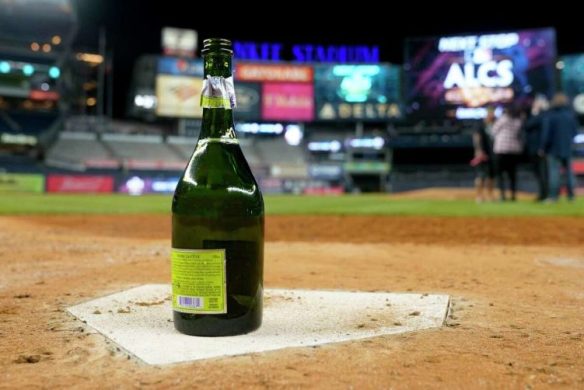
A spent champagne bottle placed on home plate after the Yankees won a trip to the ALCS Tuesday night. The Yankees had to celebrate their win in a hurry—they open against the Astros Wednesday night.

The good news is, Year One of Comissioner Rube Golberg’s triple-wild-cards postseason experiment isn’t going to have an all also-ran World Series, after all. It still yielded a pair of division-winning teams getting to tangle in the American League Championship Series.

The bad news is, those two division winners are still the Yankees and the Astros, after the Yankees sent the AL Central-winning Guardians home for the winter with a 5-1 win Tuesday that wasn’t exactly an overwhelming smothering.

What it was, though, was the game for which the Guardians shot themselves in the proverbial foot. Specifically, two Guardians, one of whom is old enough to know better and the other of whom needs a definitive attitude adjustment.

Guardians manager Terry Francona has more World Series rings this century (two) than Yankees manager Aaron Boone (none). Francona is considered by most observers to be one of the game’s smartest managers who’s made extremely few mistakes and learned from one and all; Boone is one of those skippers about whom second-guessing is close enough to a daily sport in its own right.

But when push came to absolute shove for rain-postponed AL division series Game Five, Boone proved willing to roll the dice Francona finally wasn’t.

After Gerrit Cole held the Guards off with a magnificent Game Four performance Sunday but the rain pushed Game Five from Monday to Tuesday, Boone was more than willing to throw his original Game Five plan aside—Jameson Tallion starting and going far as he could to spell the beleaguered Yankee bullpen—and let Nestor Cortes pitch on three days’ rest for the first time in his major league life.

Francona wouldn’t even think about changing his original Game Five plan, opening with his number-four starter Aaron Civale, who hadn’t even seen any action this postseason until Tuesday, then reaching for his bullpen at the first sign of real trouble. He wasn’t willing to let his ace Shane Bieber go on three days’ rest for the first time in his major league life.

Mother Nature actually handed Francona one of the biggest breaks of his life when she pushed Game Five back a day. Either he missed the call or forgot to check his voicemail. “I’ve never done it,” said Bieber postgame Tuesday, about going on three days rest. “But could I have? Sure.”

“It’s not because he can’t pitch,” said Francona after Game Five. “It’s just he’s been through a lot. You know, he had [a shoulder injury in 2021] and he’s had a remarkable year, but it’s not been probably as easy as he’s made it look.”

It might have been a lot easier on the Guardians if Francona handed his ace the chance to try it, with reinforcements ready to ride in after maybe three, four innings. Even year-old-plus shoulder injuries deserve appropriate consideration, of course. But Bieber surrendered a mere two runs in five-and-two-thirds Game Two innings. Francona’s hesitation when handed the chance helped cost him a shot at another AL pennant.

Civale didn’t have it from the outset. He had as much control as a fish on the line jerking into death out of the water. Giancarlo Stanton slammed an exclamation point upon it when he slammed a hanging cutter the other way into the right field seats with two aboard and one out.

The Guards’ pen did surrender two more runs in the game, including Aaron Judge’s opposite field launch the next inning. But they spread those runs over eight and two-thirds innings’ relief while otherwise keeping the Yankees reasonably behaved. They gave the Guards every possible foot of room to come back and win it.

That was more than anyone could say for Josh Naylor. The Guards’ designated hitter had already raised temperatures among enough Yankees and around a little more than half of social media, when his Game Four home run off Cole resulted in him running the bases with his arms in a rock-the-baby position and motion.

Naylor intends the gesture to mean that if he hits you for a long ball he considers you his “son” in that moment. It wasn’t anything new for him or for those pitchers surrendering the 20 bombs he hit on the regular season. And Sunday’s blast was the third time Naylor has taken Cole into the seats in his major league life. He was entitled to a few bragging rights.

Cole himself thought the bit was “cute” and “a little funny.” He wasn’t half as offended as that half-plus of social media demanding Naylor’s head meet a well-placed fastball as soon as possible. Yesterday, if possible. The Yankees found the far better way to get even in Game Five than turning Naylor’s brains into tapioca pudding.

“We got our revenge,” Yankee shortstop Gleyber Torres all but crowed postgame. Torres even did a little rocking of the baby himself in the top of the ninth, after he stepped on second to secure the game-ending force out. “We’re happy to beat those guys,” he continued. “Now they can watch on TV the next series for us. It’s nothing personal. Just a little thing about revenge.”

Naylor was also serenaded mercilessly by the Yankee Stadium crowd chanting “Who’s your daddy?” louder with each plate appearance. Every time he returned to the Guards’ dugout fans in the seats behind the dugout trolled him with their own rock-the-baby moves. And his most immediate postgame thought Tuesday was how wonderful it was that he’d gotten that far into their heads.

Some say it was Naylor being a good sport about it. Others might think he was consumed more with getting into the crowd’s heads than he was in getting back into the Yankees’ heads. The evidence: He went 0-for-4 including once with a man in scoring position Tuesday.

Oh, well. “That was awesome,” he said postgame of the Yankee Stadium chanting. “That was so sick. That was honestly like a dream come true as a kid—playing in an environment like this where they’ve got diehard fans, it’s cool. The fact I got that going through the whole stadium, that was sick.”

Josh Naylor

Rock and troll: Yankee fans letting Josh Naylor have it on an 0-for-4 ALDS Game Five night.

Did it cross his mind once that his team being bumped home for the winter a little early was a little more sick, as in ill, as in not exactly the way they planned it? If it did, you wouldn’t have known it by the way he continued his exegesis. “If anything, it kind of motivates me,” he began.

It’s fun to kind of play under pressure. It’s fun to play when everyone’s against you and when the world’s against you. It’s extremely fun.

That’s why you play this game at the highest level or try to get to the highest level: to play against opponents like the Yankees or against the Astros or whoever the case is. They all have great fanbases and they all want their home team to win, and it’s cool to kind of play in that type of spotlight and in that pressure.

Wouldn’t it have been extremely more fun if the Guardians had won? Did Naylor clown himself out of being able to play up in that spotlight and its pressure this time? Those are questions for which Cleveland would love proper answers.

So is the question of how and why the Guards didn’t ask for a fourth-inning review that might have helped get Cortes out of their hair sooner than later, after a third inning that exemplified the Guards’ hunt-peck-pester-prod limits.

They went from first and second and one out in the top of the third—one of the hits hitting the grass when Yankee shortstop Oswaldo Cabrera collided with left fielder Aaron Hicks, resulting in a knee injury taking Hicks out of the rest of the postseason—to the bases loaded and one out after Guards shortstop Amed Rosario wrung Cortes for a four-pitch walk. They got their only run of the game when Jose Ramírez lofted a deep sacrifice fly to center.

Now, with two outs in the top of the fourth, Andres Giménez whacked a high bouncer up to Yankee first baseman Anthony Rizzo, who had to dive to the pad to make any play. The call was out, but several television replays showed Giménez safe by a couple of hairs. Perhaps too mindful of having lost three prior challenges in the set, the Guardians’ replay review crew didn’t move a pinkie. Francona seemingly didn’t urge them to do so.

Never mind that it would have extended the inning and given the Guards a chance to turn their batting order around sooner, get Cortes out of the game sooner, and get into that still-vulnerable Yankee pen sooner. Francona’s been one of the game’s most tactically adept skippers for a long enough time, but not nudging his replay people to go for this one helped further to cost him an ALCS trip.

These Yankees don’t look proverbial gift horses in the proverbial mouths. An inning later, with Torres on first with a leadoff walk and James Karinchak relieving Trevor Stephan following a Judge swinging strikeout during which Torres stole second, Rizzo lined a single to right to send Torres home. That was all the insurance the Yankees ended up needing.

Especially when these so-called Guardiac Kids, the youth movement whose penchant for small ball and for driving bullpens to drink with late rallies, forcing the other guys into fielding lapses, winning a franchise-record number of games at the last minute, had nothing to say against three Yankee relievers who kept them scoreless over a final four solid shutout innings.

Especially when they actually out-hit the Yankees 44-28 and still came up with early winter. The trouble was, the Guards also went 3-for-30 with men in scoring position over Games One, Two, Four, and Five, and had nobody landing big run-delivering blows when needed the most. Their ability to surprise expired.

Now the Yankees have a chance for revenge against the Astros who’ve met them in two previous ALCSes and beaten them both times. They had to hurry their postgame celebration up considerably—the ALCS opens Wednesday night.

The Guardians could take their sweet time going home for the winter and pondering the season that traveled so engagingly but ended so ignominiously.

“Winning the division was the first part,” Hedges said postgame. “Wild-card round. Put ourselves in position to beat the Yankees. And we wanted to win the World Series, but that’s a good Yankees team. The cool thing is, now we have a bunch of dudes with a ton of playoff experience in the most hostile environment you can imagine.”

The Guards were bloody fun to watch for most of it. Then Cole, Stanton and Judge rang their bells in Games Four and Five, and they had nothing much to say in return. The Guardiac Kids were the babies who got rocked. There was nothing much fun about that.

The All-Star Game was Clayton’s place

Clayton Kershaw, Blake Grice

National League All-Star starter Clayton Kershaw with fan Blake Grice, who touched Kershaw by telling the future Hall of Famer he was meeting him for Grandpa’s sake.

By right, this year’s All-Star Game start for the National League should have belonged to the Marlins’ Sandy Alcantara (he leads the Show’s pitchers with 5.3 wins above replacement level and his 1.76 ERA). And if the game were played someplace other than Dodger Stadium, it might have been Alcantara’s to start.

Braves manager Brian Snitker, managing the NL All-Stars as the previous season’s World Series skipper does, had his own idea. Especially since this was the first All-Star Game in Dodger Stadium since Jimmy Carter was still in the White House, and a Dodger icon was having an All-Star worthy season himself.

So Snitker elected to hand the opening ball to Clayton Kershaw. A Hall of Fame lock, approaching the sunset of an off-the-charts career, starting the All-Star Game in his home ballpark. You could imagine Snitker thinking to himself that you couldn’t pay to pre-arrange more serendipitous circumstances. Even with his own All-Star Max Fried among his pitching options.

It was a class gesture by the defending World Series-winning manager. Only one thing could have seen and raised, and that one thing was Kershaw himself. By most reports, one of the first things the 33-year-old lefthander did when Snitker called him to say the opening ball was his was to call Alcantara himself.

“He was awesome about it. I was really thankful about that,” Kershaw said, after the American League hung in for a 3-2 win through no fault of Kershaw’s own.

He let himself take the entire atmopshere in, even foregoing his usual pre-start intensity that compels teammates, coaches, and even his manager Dave Roberts to say nothing much more than “hello” to him. (He even let Roberts share lunch with him on Tuesday.) About the only thing Kershaw did remotely work-related was study some American League scouting reports.

One he didn’t have to study was Shohei Ohtani (Angels), whom Kershaw retired thrice when pitching last Friday. Wary of opening the All-Star Game with one of his signature breaking balls, Kershaw pumped a fastball that doesn’t have its former speed and Ohtani—interviewed before the game, promising to swing on the first pitch—smacked a broken-bat floater up the pipe into short left center for a leadoff single.

Then, having Aaron Judge (Yankees) 1-2, Kershaw suddenly couldn’t think of what to throw next. Some described him as buying time when he lobbed a throw to first. He bought more than he bargained for. He’d caught Ohtani having a snooze. Ohtani had drifted away from the pad and Kershaw’s lob turned into the first All-Star pickoff in fourteen years.

The two-way Angel could only laugh. Kershaw could only grin after first baseman Paul Goldschmidt (Cardinals) tagged Ohtani out. Dodger Stadium went nuclear. Kershaw finished striking Judge out, walked Rafael Devers (Red Sox), and lured Vladimir Gurrero, Jr. (Blue Jays) into an inning-ending ground out. The man who wanted to take it all in from start to finish then ducked out of sight and to a press podium under the ballpark.

Shohei Ohtani, Clayton Kershaw

All they could do was grin and laugh after Kershaw (right) picked Othani off first while working to Yankee bombardier Aaron Judge.

While the National League took an early 2-0 lead with Mookie Betts (Dodgers) singling home Ronald Acuña, Jr. (Braves; leadoff double off AL starter Shane McLanahan [Rays]) and—after a double play grounder by Manny Machado (Padres)—Goldschmidt hammering one into the left center field bleachers, Kershaw finished his press conference with a ten year old boy raising a hand.

“What’s up, dude?” Kershaw asked pleasantly.

The boy introduced himself as Blake Grice and told Kershaw how much his late grandfather loved both him and the Dodgers’ long-enough-retired broadcast deity Vin Scully and had wanted to meet them both. (His family had passes courtesy of MLB itself.) “So this moment is important to me,” the boy continued, “because I’m meeting you for him.”

The father of four children himself, Kershaw couldn’t resist when he heard that and saw the boy’s tears of likely gratitude for getting to do something for his grandpa in the presence of a Dodger icon who’s been the closest the Dodgers have had to longtime eminence Sandy Koufax.

“Come here, dude,” Kershaw beckoned. He hugged the boy, gave him a clap on the back, and said, “Great to meet you. Thanks for telling me. That took a lot of courage to tell me that. Your grandad sounded like an awesome guy.” When Kershaw asked Blake if he had a parent with him, the boy’s father held up his cell phone. Kershaw beckoned him forward and he snapped a photo of the pitcher and the boy speaking for Grandpa.

It was more than enough to atone for the prayers thousands of fans in the ballpark and perhaps the millions watching on television must have had that, despite going down to its ninth straight All-Star loss and 21st such loss in 25 such games, the National League didn’t tie the game in the bottom of the ninth.

That’s because the latest to emerge from baseball’s apparent laboratory of mad science would have had the game decided in favour of the Home Run Derby winner’s league if nine full innings ended in a dead heat. (On Tuesday it would have been the National League, thanks to Juan Soto [Nationals] winning the Derby.) Thank God and His servants Branch Rickey and Jackie Robinson that that didn’t come to pass.

The AL overthrew the NL lead with one out in the fourth when Giancarlo Stanton (Yankees) batted with Jose Ramírez [Guardians] aboard (leadoff single) and took Tony Gonsolin (Dodgers) far into the left center field bleachers. Byron Buxton (Twins) following at once found himself ahead in the count 2-1 when he caught hold of a Gonsolin fastball up and drilled it into the left field bleachers. Just like that, Gonsolin had surrendered 882 feet worth of home run travel.

Buxton admired game MVP Stanton’s blast from the on-deck circle and thought to himself, “I ain’t matching that.” Until he damn near did. “I don’t even know if you can put it in words how hard [Stanton] hit the baseball,” Buxton said after the game.

It made all the difference when the game otherwise became a pitching duel of sorts between eleven American League pitchers (including Framber Valdez [Astros] getting credit for the “win” despite striking nobody out in his inning’s work) and nine National League pitchers including the hapless Gonsolin tagged for the loss and, officially, a blown save.

For just the sixth time in four decades an All-Star pitcher got to start the game in his home ballpark. And for a few shining moments on the mound, Kershaw gave his home park’s audience a thrill topped only by the one he gave a ten-year-old boy looking to do his grandpa in the Elysian Fields a favour that couldn’t be done while the older man still lived on earth.

None of the highest highs or the comparatively few lows he’s endured in fifteen major league seasons have let Kershaw forget that baseball at core is about rooting, caring, loving. He had the parallel chance to remind a Dodger Stadium audience about it and to affirm it for a ten-year-old boy. He didn’t flinch at either opportunity.

Max the Knife vs. the Lindor Rock

Max Scherzer

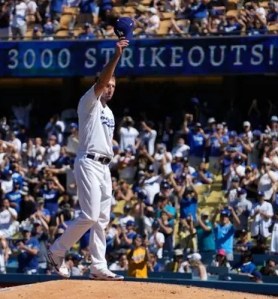
Max the Knife went from immaculate to 3,000 in the same Sunday afternoon game . . .

Who says baseball isn’t good for a little hair raising anymore? If you weren’t paying attention Sunday, you missed some real hair raising in Los Angeles and New York. As a matter of fact, you could feel sorry for Dodger Stadium’s  being upstaged by Citi Field’s.

Even if both hit the history books running.

Max Scherzer took a perfect game into the eighth inning. Along the way he pitched an immaculate inning—the third man ever to do it three times, joining Chris Sale and Hall of Famer Sandy Koufax—and bagged his 3,000th career strikeout. Right there it should have been the biggest story in the game.

Immaculate inning? Three thousand strikeouts? Could that someone be Max the Knife?

Those Big Apple pains in the ass had to horn in on Scherzer’s glory. They had to go from a brothers-in-arms 9/11 twentieth-anniversary hair-raiser to a Sunday night soiree full of chirping, whistling, snarking, bombing, and oh, yes, Francisco Lindor doing what nobody else in the 139-year history of the Subway Series had done before.

It wasn’t enough that Scherzer should have struck San Diego’s Eric Hosmer out swinging on down and in and a full count in the fifth to record the milestone strikeout. It wasn’t enough that Hosmer was sandwiched by Fernando Tatis, Jr. and Tommy Pham in the middle of that immaculate second.

It wasn’t even enough that Hosmer should have been the one to bust Scherzer’s perfect bid with a double deep to right field, a little quiet revenge for having been on the wrong side of Max the Knife’s further burrowing into the history books.

No. Those spoilsport Mets and Yankees had to go out and enable Lindor—the off-season signing splash whose first year as a Met has been a battle at the plate while remaining a study at shortstop (where he’s worth five defensive runs saved about the National League average)—to do the damage that mattered in a 7-6 Met win.

Never in the entire history of New York’s major league teams tangling against each other—we’re talking serious World Series tonnage, plus all those decades when the Dodgers and the Giants turned baseball into total warfare against each other, not to mention the Yankees and the Mets in regular-season interleague play—had any single player hit three home runs in a single contest between them until Sunday night.

In other words, Lindor accomplished what not even a small truckload of Hall of Famers ever did in Big Apple uniforms against each other. Not Home Run Baker or Babe Ruth. Not Lou Gehrig or Mel Ott. Not Joe DiMaggio or Jackie Robinson. Not Yogi Berra or Johnny Mize. Not Mike Piazza or Derek Jeter. Not even Willie, Mickey, and the Duke.

All around the Lindor clock, hey, let’s do the Lindor Rock!

Bottom of the second. Lindor batting lefthanded, squaring off on 1-1 against Clark Schmidt, a Yankee excavated from the farm system to make the start in the first place, and hitting a hanging breaking ball for a three-run homer into the bullpens behind right center field, pulling the Mets from a 2-1 deficit into a 4-2 lead.

“If Francisco Lindor’s first year as a Met could include a signature moment,” called ESPN broadcaster Matt Vasgersian as Lindor came down the third base line and crossed the plate, “we just watched it.” If only his crystal ball had undergone a tuneup.

Bottom of the sixth. One out, Yankee reliever Wandy Peralta throwing his first pitch to Lindor batting righthanded. The changeup arriving down and on the lower outside corner got driven high and into the left center field seats. Fattening a 5-4 Met lead by a run.

Francisco Lindor

“I am the Whistler, and I know many things, for I bomb by night . . .”

On the way home down the third base line, Lindor made a gesture simulating a kid sticking two fingers into his mouth to whistle a huge blast—a zap back at the Yankees over suspicions that Saturday night’s Mets starting pitcher, Taijuan Walker, was caught tipping his pitches with the Yankees whistling the tips to their batters during their five-run second.

Maybe the Yankees did it, maybe they didn’t. It’s not as though the Yankees have been immune to suspicions of on-field chicanery in the recent past, even if they’re not yet suspected or affirmed to have been quite as deep-cover as the 2017-18 Astros were shown to be for espionage aforethought.

But Lindor tripped a Yankee trigger when Giancarlo Stanton smashed a game-tying two-out, two-run homer in the top of the seventh. Stanton and Lindor jawed back and forth while Stanton was still running the homer out, though the Yankees and the Mets were both kind enough to let Stanton cross the plate before the benches and bullpens emptied completely for a little, shall we say, conversation over the matter.

“The last couple nights, we’ve just been loud over there,” said Yankee manager Aaron Boone. “Not doing anything.”

“I’m not accusing them,” Lindor said post-game Sunday night. “I’m not saying they’re doing it 100 percent because I don’t know 100 percent, but it definitely felt that way. And I took that personal. I took that personal and I wanted to put runs on the board to help my team win.”

For his part, Stanton postgame thought Lindor was actually ticked off at Peralta for whistling—not to steal signs but to try putting a little more life into what Stanton suggested had been a sluggish Yankee bench during a sluggish Yankee spell. That, Stanton said, is what he was trying to convey to the Mets’ shortstop en route the plate.

“If you’ve got a problem to Wandy, give it to Wandy,” the left fielder said. “Don’t be talking to multiple people, bringing everybody into it. Running around the bases, that was my thought process. Obviously, I didn’t get all that out running around.”

If anyone had a real complaint about Peralta’s whistling, it was probably Yankee right fielder Joey Gallo. “It’s definitely not for pitch-tipping or anything like that,” Gallo insisted, before complaining  good naturedly. “It’s been hurting my ear, honestly. It’s unbelievable how loud he can whistle.”

Bottom of the eighth, one out, Lindor back batting lefthanded against another Yankee reliever, Chad Green. This time, he hit a 2-0 meatball practically down the chute even higher over the right field fence than his first flog of the night traveled.

It wasn’t as spiritually delicious as Hall of Famer Piazza’s eighth-inning blast in old Shea Stadium, during the Mets’ first home game after the original 9/11 atrocities’ baseball hiatus, but the Citi Field racket as it traveled out of reach was equal in volume to that twenty-year-old cathartic hysteria.

There’s nothing like a three-thump night to make a high-priced shortstop—who’s spent most of his first such high-priced season struggling at the plate if not with the leather—suddenly feel lovable. “It probably helped them believe in me a little bit more,” Lindor said post-game.

Poor Scherzer. The tenacious righthander hit the history books with a flying fist. So he had to be one-upped by those New York yo-yos. Not even Mookie Betts speaking postgame could neutralise things. “He was destined for it,” the Mookie Monster told reporters. “All the work he puts in, everything he does. It kind of sounds weird, but I expect nothing less from him.”

Echoes of Hall of Famer Don Drysdale once saying of his rotation mate and buddy Koufax, “I expect Sandy to pitch a no-hitter every time he takes the mound.”

The bad news in New York was that Met fans have come to expect a discomfiting balance between virtuosity and disaster from reliever Edwin Diaz. And Diaz delivered just what they expected in the ninth Sunday night.

He wasn’t the only bullpen culprit in the hair raising, not after Jeurys Familia threw Gleyber Torres a two-run homer in the sixth, and not after Brad Hand handed Stanton that jaw-inspiring two-run shot in the seventh. But Diaz was the bull most over the edge, almost.

A leadoff strikeout followed by a base hit. A followup walk followed by a swinging strikeout. Then, he had a little help from catcher James McCann, letting a 1-1 pitch to Stanton escape, enabling pinch-runner Tyler Wade and Yankee first baseman Anthony Rizzo to third and second.

Lucky for Diaz and the Mets that Stanton got under the 2-2 fastball and popped it up. To the left side. Where, of all people, Lindor awaited to haul down the game’s final out. Some dared call that one poetic justice.

“Hey, Dad? Want to pitch me a walk-off?”

Tim Anderson

Tim Anderson, finishing the hype-busting Field of Dreams Game with a two-run homer in the bottom of the ninth Thursday night.

The game finished by crossing its original protagonist, Field of Dreams, with The Natural. The most poetically inclined screenwriting/directing team in film couldn’t imagine climax that surreal.

A pair of two-run homers in the top of the ninth to yank the Yankees back into the lead at 8-7. A two-run homer in the bottom of the ninth to win it for the White Sox, 9-8. This wasn’t the way they won ballgames during the 1910s evoked by the special uniforms the two teams wore for the occasion.

Hey, Dad? Want to pitch me a walk-off?

It was as jolting a climax as ever provided by David Freese, Aaron Boone, Joe Carter, Kirk Gibson, Chris Chambliss, Bill Mazeroski, or Bobby Thomson. Even if it didn’t win a World Series, push a Series to a seventh game,  send a team to a Series, or put them in the postseason at all in the first place.

It defied the game’s subtexts. The ones not spoken often if at all in the hype. The ones involving Field of Dreams‘s unlikely turning of baseball’s worst gambling scandal into a fantasy of reconciliation; and, The Natural‘s study of a live young prospect shot Eddie Waitkus-like, into long, long wandering, into a haunted elder returning to prove neither he nor his old dream died, for however long it still had to live.

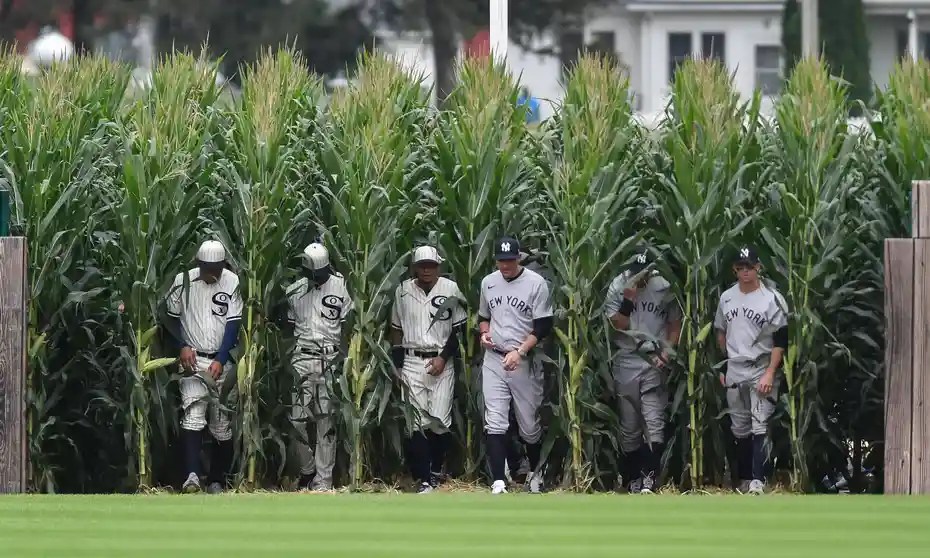
No volume of pre-game hype—this game’s tribute to artifices of fantasy was as hyped as any sports event could be—could have promised and delivered that kind of a ninth inning. Even Field of Dreams star Kevin Costner, escorting both teams onto the field from the corn beyond the wall, asking the crowd, “Is this heaven?” with the crowd hollering back, “No, this is Iowa,” wouldn’t have dared demand that in a script.

But there was Liam Hendricks, the engaging White Sox relief pitcher, looking made for wraparound sunglasses thanks to being endowed with wraparound eyes, working the top of the ninth, shaking a leadoff single off to strike Yankee veterans D.J. LeMahieu and Brett Gardner out swinging on four pitches each.

Then there was Hendricks at 2-1 to Aaron Judge. He threw Judge a high fastball and watched it sail far enough into the right field corn. Following which Hendricks wrestled Joey Gallo—the former Ranger whose stock in trade is either home run feast or strikeout famine, but who has the odd discipline of working walks (he averages 94 per 162 games lifetime)—into a walk after starting him 1-1 without throwing another strike.

Up to the plate stepped Giancarlo Stanton, a former National League Most Valuable Player and one of the game’s more formidable bombardiers until injuries began to grind away at him in earnest. Stanton hit Hendricks’s first service into the left field corn.

Even the somewhat partisan, small audience—savouring a game on the field built adjacent to the famous Field of Dreams farmhouse field, many paying through the nose secondarily for tickets with face values of $375 or $425, Iowa fans and White Sox season ticket-holders, the latter by special lottery—roared when that fabled Yankee power detonated in the top of the ninth.

It was nothing compared to what happened in the bottom, when Yankee reliever Zack Britton, himself having been in the top tier of his particular profession before injuries began shaving him down, too, took the role normally assigned to the injured Aroldis Chapman. He opened by luring White Sox pinch hitter Danny Mendick into a ground out to first but walking White Sox catcher Seby Zavala—who’d hit one into the corn himself in the bottom of the fourth.

Up stepped Tim Anderson, the lively White Sox shortstop. Britton pumped and pitched, a fastball right down the pipe. It was too fat a pitch to resist. If the White Sox have a classic kangaroo court in their clubhouse, Anderson would have been fined for malfeasance.

It didn’t win a pennant. It was more out of The Natural than Field of Dreams, whose co-protagonist by default Shoeless Joe Jackson had only one known walk-off hit in his entire career. (For the White Sox, against the Yankees, in July 1919.) But when Anderson hit it out, it won a ball game keeping the Yankees from gaining on the second place Red Sox in the American League East and fattening the White Sox’s AL Central lead to eleven and a half. Slamming an exclamation point down for baseball itself.

What began with Field of Dreams star Kevin Costner escorting the Yankees and the White Sox through the corn and down across the field ended with an African-American man from Alabama, who wouldn’t have been admitted to the 1910-1919 Show because of his race, channeling his inner Roy Hobbs, The Natural‘s psychically-buffeted protagonist.

Hobbs in the film version was down 0-2 and struggling mightily with an ancient bullet lodged in his insides, causing him to bleed through his lower stomach, when he hit the pennant-winning bomb that also shot the ballpark lights out. Anderson had no such encumbrance when he sent Britton’s canteloupe into the left field corn.

Until that ninth inning viewers at home and the fans who’d paid into the field saw a very reasonably played game. They saw White Sox first baseman Jose Abreu hit the first major league home run ever hit in Iowa in the bottom of the first. They saw Judge become the first Yankee to go long in Iowa when he hit a three-run homer in the top of the third.

Chicago White Sox, New York Yankees

Wearing 1910s style uniforms, the White Sox and the Yankees entered the Field of Dreams Game through the corn Thursday evening.

They saw White Sox starter Lance Lynn nail the first major league strikeout in Iowa when he froze Gardner on a high called strike, on a night when plate umpire Pat Hoberg was as generous with the strike zone ceiling as he was skinflint about proper strikes on the sidewalls of the zone.

They saw the early 3-1 Yankee lead disappear in a four-run White Sox third, when Anderson doubled center fielder Adam Engel home with one out, and recently-restored-from the-injured-list designated hitter Eloy Jimenez cracked a three-run homer into the right field corn.

They saw Gardner put a number on Lynn’s pitching evening when he hit the second pitch of the top of the sixth not too far from where Jimenez’s bomb landed. They saw Yankee infielder Tyler Wade, one of a host of spare parts coming into regular service thanks to the Yankees’ ongoing shuttle back and forth from the injured list, drop one of the only bunts that should be allowed in a game.

With one out, nobody on, and the non-shifting White Sox infield playing deep enough to prompt calls for sending a search party out to find them, the lefthanded Wade saw enough delicious open real estate to push a bunt to the left side, just enough to the middle to keep third baseman Yoan Moncada from doing anything more than grabbing the ball on the run in.

No wasted out. Nothing but a versatile enough utility infielder, who inclines toward hitting line drives (he has four doubles out of 24 hits this season), not feeling he was going to get something to hit on a line, seeing a free gift and pouncing on it before the supply expired.

Then, Wade stole second while LeMahieu occupied himself with working his way into a walk. Then, a ground out pushing second and third and Judge accepting a walk from White Sox speed reliever Michael Kopech after opening with strike one but seeing four straight balls, including a ball four which should have been called strike two.

No matter, far as the White Sox were concerned. Up stepped Gallo, flashing his usual all-or-nothing style at the plate, swinging mightily enough but whacking a pitch a little up out to shortstop to force Judge for the side.

From the moment Lynn started the game with ball one to LeMahieu and LeMahieu nailed the first major league base hit in Iowa baseball history, to the moment Anderson sent everyone home with his corn ball, the game told the hype to take a shower. Even if the live Fox Sports telecast referenced Field of Dreams to a fare-thee-well.

“I knew it wasn’t over,” Anderson said post-game. “The game’s never over. And once Britton walked (Zavala), I knew there was a chance to start something real dope.” So he finished something real dope with something as dope as it gets. In the immortal words of Hall of Fame baseball writer Jayson Stark, “Because . . . baseball!