ALCS Game One: Miller time for the Mariners

Bryce Miller, George Springer

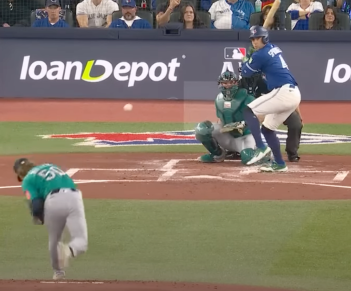
George Springer is about to demolish Bryce Miller’s first pitch of ALCS Game One. It was the only score Miller would allow over six otherwise spotless innings on short enough rest. (Fox Sports television capture.)

At the split second George Springer’s bat connected with Bryce Miller’s first pitch of this year’s American League Championship Series, you could be forgiven if you heard Mariners fans groaning. When the ball banged the Canada Dry sign above the right center field bullpen, you might have heard the groaning turn to moaning.

One pitch, one swing, the 21st postseason bomb of Springer’s career, and only the third leadoff bomb in League Championship Series history since pitch counting began in 1988, according to The Athletic‘s Jayson Stark. Just like that, the Blue Jays took a lead.

And Springer’s opposite-field smash on a fastball away, sending him past Hall of Famer Derek Jeter for fifth place on the all-time postseason bomb list, wasn’t the only reason Mariners fans groaned and moaned.

In the top of that first inning, they groaned, moaned, and fumed when the Mariners didn’t call for a review of that play at the plate on which Cal Raleigh (one-out hit, advancing to third on followup hit) was tagged out when it appeared he’d managed to get his foot on the plate through the legs of Jays catcher Alejandro Kirk. But television replays showed Raleigh’s foot landed a second or two after Kirk tagged his torso.

Were the Mariners unduly alarmed after Springer sprang?

Not after Miller wriggled out of further trouble in the form of a pair of walks courtesy of inducing a pair of line drive outs and a short fly out.

Not after Miller matched Jays starter Kevin Gausman point for point, dollar for dollar, from that point forward, until Raleigh atoned for missing the first inning score by squaring Gausman up, with two out in the top of the sixth, and driving a 2-2 service a little further than Springer’s traveled, about five rows up into the bleachers above that bullpen.

Not after Jays manager John Schneider decided that a followup walk to Julio Rodriguez should be he end of Gausman’s evening before he might incur jn any further damage. That came soon enough when Gausman’s relief Brendon Little wild-pitched Rodriguez to second and surrendered Jorge Polanco’s sharp opposite-field line RBI single to left to crack the one-all tie.

Not after Randy Arozarena wrung a leadoff walk out of Jays reliever Seranthony Dominguez in the top of the eighth, stole second and third while Raleigh suffered a called strikeout, then—after another walk to Rodriguez—came home on another Polanco steak, this time a spanker bouncing three times through the infield and a few more into right.

“I just choked up and wasn’t trying to do too much,” said Raleigh postgame about his bullpen-clearing blast. “I was just trying to get bat on ball and really put something in play, maybe find a hole. I didn’t want to punch out again.” He didn’t seem to mind putting that ball out of reach, out of play, and out of sight, either.

Kevin Gausman, Cal Raleigh

Raleigh is about to smoke Gausman’s splitter for a trip above the right field bullpen . . .

Aside from all that, it was Miller time. For a guy pitching on three days’ rest for the first time in his major league life. For six inning of one-run, two-hit baseball that including getting rid of seventeen of his final nineteen batters. He needed a little comfort from Raleigh at the mound while navigating his way out of that first-inning fire, but that was enough.

Miller went two innings longer than Mariners manager Dan Wilson expected him to go on short rest, only nobody told Miller until he was done for the night.

“They didn’t tell me anything, any plan,” said the lad who threw 27 pitches in the first inning and 49 the rest of his outing. “So I was going out there just letting it rip until they came out and got me.”

“That was incredible from him,” said Mariners reliever Matt Brash (now, there’s a classic name for a relief pitcher), who was one of three Mariners bullpen bulls along with Gabe Speier and Andres Munoz to pitch perfect innings once Miller’s time expired for the evening. Thus the 3-1 Mariners win Sunday night.

“I knew this was the biggest start of my career so far,” said Miller, whom one report revealed stood in Rogers Centre’s center field’s farthest location from the plate staring that direction to help focus, “and I just wanted to get out there and mentally kind of get in a zone and visualize having success on the mound.”

Miller’s season wasn’t always so simple. After a 2.94 ERA in 2004, he ran into elbow inflammation twice and an inflated ERA. He didn’t find himself on his horse fully until some time in August. Then he gave hints of his postseason potential in ALDS Game Four, pitching 4.1 shutout innings against the Tigers.

Remember: These Blue Jays are the ones who demolished the Yankees 34 runs worth in their American League division series and made the Bronx Bombers resemble the Bronx Broken. The Mariners got rid of 23 of the final 24 Jays hitters while they were at it. All of a sudden the Joltin’ Jays didn’t look all that intimidating despite Springer’s first-pitch flog.

Remember, too: These Mariners played fifteen innings Saturday to come out of their ALDS alive and reasonably well and leaving the Tigers for dead. They had to fly cross country and into Canada and endure a four-hour departure delay when mechanical issues forced their airline to get another plane up to Seattle from Los Angeles. They didn’t even have time for a Rogers Centre workout before ALCS Game One.

I’m not sure I’d recommend this as a continuous practise, but it seems as though now and then a team that should have been suffering exhaustion can turn one of the league’s howitzer corps to one side for one night. Now we’ll get to see if the Mariners can manhandle the Jays on a proper night’s sleep and with a proper pre-game workout.

We may even get to see Miller on the mound in a game that would mean the pennant for the Mariners if they win. The lad’s already proving that unthinkable isn’t necessarily impossible.

The Astros keep the extra inch

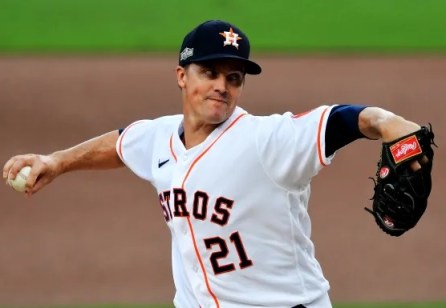
Greinke found what he needed when his skipper’s confidence found him when it was needed.

Once upon a time, stealing the pennant came to mean things like eleventh-hour surges at the end of the stretch drive. Or, off-field-based (and illegal) sign-stealing chicanery. (That means you, 1914 Philadelphia Athletics, 1940 Detroit Tigers, 1948 Cleveland Indians, 2017 Houston Astros, and 2018 Boston Red Sox.)

This time around, it may still mean the Tampa Bay Rays stealing the American League pennant by robbing the Houston Astros wide awake every time the Astros think a nicely-hit ball is about to send a run or two home.

But not quite yet.

Whatever you think about the Astros, they won’t just go gently into winter vacation. They didn’t muster up a jaw-dropping eleven-run first inning such as the Los Angeles Dodgers dropped on the Atlanta Braves earlier Wednesday. They didn’t have to. They needed just an extra home run and a managerial non-decision to live to play one more day at least.

This time, in Game Four of the American League Championship Series, the Astros didn’t give the Rays’ defensive aerialists further chances to rob them blind whenever they thought hard hits had chances to fall in. This time, they didn’t give the Rays the inches from which the Rays would push, shove, nudge, and yank miles.

This time, George Springer hit a tie-breaking two-run homer in the bottom of the fifth off Rays starter Tyler Glasnow and Astros manager Dusty Baker did an about-face rather than lift his starter Zack Greinke with first and second, one out, and white-hot Rays left fielder Randy Arozarena—whose two-run homer off Greinke in the top of the fourth tied the game in the first place—checking in at the plate in the top of the sixth.

Baker had his options just about ready to roll. He had Cristian Javier and Ryan Pressly throwing in his bullpen. And when he went to the mound, he talked to Greinke some but to catcher Martin Maldonado more, and Maldonado stood up for his pitcher just when Greinke needed it the most.

Greinke didn’t forget Game Seven of last year’s World Series. That’s when then-skipper A.J. Hinch noticed he’d run out of fuel and lifted him for Will Harris, his best relief option. To Greinke it meant lack of confidence, never mind that he’d been battered by the Rays in that division series, slapped silly by the New York Yankees in that ALCS, and taken for a home run by Washington’s Anthony Rendon before walking Juan Soto in that Game Seven seventh.

That was then: Greinke came out for Harris and Howie Kendrick ripped what looked like Harris’s unhittable cutter for a two-run homer off the Minute Maid Park foul pole with the Astros’ next-to-last Series hopes attached. This was Wednesday night: Baker turned around and returned to his dugout.

Greinke struck Arozarena out on a check swing. He got help from Astros shortstop Carlos Correa cutting off a hopper from Rays first baseman Ji-Man Choi that might have left room for left fielder Manny Margot to score, if Correa didn’t reach it on the short outfield grass and knock it down.

Then Greinke struck out Michael Brosseau—whose late home run against the Yankees got the Rays to this ALCS in the first place—with a changeup that dove off a cliff just before Brosseau’s bat could give it a kiss. Kiss the Rays’ deepest threat of the night goodbye. Then turn the game over to the pen.

Arozarena’s check swing came on what would have been ball two. Brosseau struck out on what would have been ball four and an Astro lead cut to 4-3. And thus would Rays shortstop Willy Adames’s RBI double have been a tie game in the top of the ninth with the likelihood of extra innings.

“My plan,” Baker told reporters after the 4-3 Astro win, “was to take him out, but I wasn’t really convinced of my plan. Sometimes you look in the guy’s eyes, sometimes you listen to the catcher, and you do what you gotta do.”

“It was nice having someone have confidence in me,” Greinke told the reporters. “Because since I’ve been here, they haven’t seemed to have confidence in my ability. So it was nice having that happen in an important time like that.”

Especially for a seventeen-year veteran whose arm was ailing and inconsistent all postseason long, until he found the best of his late-career self when he needed it the most Wednesday night, putting his best off-speed pitches into a Mixmaster and cranking no higher than cookie-mixing speed.

He also vindicated Baker, a very veteran manager who’s not allergic to the analytic game but who’s lived as much by his gut as his brain and has often been caught with his pants down when his gut gets betrayed by circumstances far beyond his control.

Baker was one game from yet another tsunami of second-guessing when Greinke justified his gut Wednesday night. The skipper isn’t all the way through the turbulence just yet. But for once in his life Baker read his players and tea leaves right. He may yet have a few sharp readings left in him before this set’s over. May.

If baseball’s the game of inches, Greinke and the Houston pen made sure the Rays didn’t get the inches that would have mattered. Not that the Rays bullpen was caught sleeping. They matched shutout innings with the Astros’ bulls until Adames’s double off Pressly, brought in to close things out after Javier walked Choi to open the ninth. And the Rays used two bulls who weren’t exactly considered among their A-list stoppers.

The Astros’ own core five of Springer, Correa, Jose Altuve, Alex Bregman, and Yuli Gurriel played their 54th postseason game together, passing a once-fabled Yankee core (Derek Jeter, Bernie Williams, Scott Brosius, Tino Martinez, and Paul O’Neill) by a game.

Winning it 4-3 made it that much more precious to the Astro core who may yet play their last games together in this set. One Astro win doth not a Rays collapse make, and the Astros are smart enough to know they’re in for a continuing fight, but don’t fault them for savouring Game Four a little extra.

Especially on a night Altuve’s first-inning launch over the left field fence and Springer’s fifth-inning flog meant the eighteenth lifetime postseason bombs for each man. Matching them to Hall of Famer Reggie Jackson and putting them one behind Hall of Famer-to-be Albert Pujols in the divisional play-era postseason rolls.

Not to mention a night on which Altuve’s apparent and frightening case of the yips at second base took its first steps toward potential dissipation, Altuve handling a pair of none-too-tough chances and throwing without the ball deciding on its own to go to the enemy side.

“Those are things that happen in baseball,” Altuve said, facing the press for the first time all series long. “I left that in the past and showed up today ready to play some baseball and help my team.” The question then becomes whether Altuve can leave those game-changing mishaps in the past. He sure thinks so. Springer’s pretty sure he knows so.

“He prides himself in every aspect of the game,” the center fielder said. “When he believes that he failed or let the guys down, he takes it to heart. But one of the most impressive things about Jose is how he can clear his head and contribute in all aspects of his game. I know the head he has on his shoulders. He’s our leader and always has been.”

That comes from the guy who watched Altuve start Wednesday night’s scoring with a second first-inning solo bomb in as many days and his third in the series, swat an RBI double in the fourth, and tell himself, “You’re not taking care of all the scoring, bro,” before driving a 2-1 service down the left field line and into the third patio up the Western Metal Supply Co. building.

The Astros still had to wrestle for their win. Even if the Rays didn’t have to get their acrobats on, they still turned four double plays on the evening and rapped out seven hits to the Astros’ nine. They’re still out-pitching the Astros by a few hairs, finishing Game Four with a team 2.31 ERA to the Astros’ 2.65.

The bad news for the Astros: Come Game Five, the Rays can go to their bullpen A-listers at will. The Astro pen otherwise has looked remarkable for the most part, but the Rays live and die by their bullpen as much as they live and die by their high-wire defense.

Most likely, the Astros send Framber Valdez out to start Game Five, likely against the Rays’ Blake Snell. No announcements were made at this writing, and Rays skipper Kevin Cash would have no compunction at all against going to a bullpen game the Astros aren’t positioned or built to deliver just yet.

But, as the Beatles also sang once upon a time, a splendid time is guaranteed for all.

California bombs, California rough stuff

The pandemic-mandated empty house aside, 5 October might as well be Alex Bregman Day . . .

Mr. October Fifth? What’s up with that?

It’s not Alex Bregman’s birthday. (For the record, that’s 30 March.) It’s not his engagement date. (He popped the question to a Colorado lady named Reagan Howard in January.) It’s not his future wedding date. There seems nothing significant elsewhere for him about that date.

Except when he plays postseason baseball. For a fourth consecutive 5 October Bregman found a pitch meaty enough to send long distance. Mark your 2021 calendar accordingly if you must.

He led off the top of the fourth against Oakland starter Chris Bassitt Monday afternoon, starting an American League division series, and sent a 1-2 service into the pandemically-required unoccupied left field bleachers.

It put his Houston Astros on the board after the Athletics helped themselves to a 3-0 lead on long balls themselves. It gave his infield teammate Carlos Correa thoughts about not wanting to be left out of the action after Kyle Tucker followed with a single through the left side of the infield, Correa hitting a 2-0 pitch over the center field fence.

And—with no small assistance from Oakland’s normally vacuum-handed shortstop Marcus Semien’s boot on Josh Reddick’s two-out grounder in the top of the sixth—the Astros seized the chance at new life, not letting something like a subsequent 5-3 deficit spoil the day, and finished with a 10-5 Game One win.

It almost figured.

There are far worse talismans to attach to a team than 10-5. Especially to a team who got into this convoluted postseason with a losing record and who spent 2018 and 2019 doing not even once what they did Monday—come back from a pair of multi-run deficits.

Especially when several signature Astro bats returned to life at last. Let’s see. George Springer going 4-for-5 after an irregular season in which he had no four-hit games. Correa dialing nine twice and sending four runs home, after an irregular season in which he didn’t send four home or homer twice. The quartet of Bregman, Correa, Springer, and Jose Altuve each driving in at least one run in the same game after not having done that together even once on the irregular season.

And, thanks to the bubble concept putting postseason teams from the division series forward into neutral parks, the Astros’ three postseason wins have now happened in ballparks not their own.

The third, of course, happened in . . . Dodger Stadium. The home of a team with whom they have, ahem, some recent history. The division series home for Games One, Two, and (if necessary) Five of an A’s team that includes the former Astro who blew the whistle on Astrogate at last, last November, after those too well aware of their illegal, off-field-base, altered or extra camera transmitting sign stealing schemes couldn’t convince anyone else to expose it.

“As the game got deeper, the at-bats got better,” said Springer of the Astros’ Monday breakout. “They played the later innings better than we did. We just didn’t have the at-bats we typically do at the end of the game,” said A’s manager Bob Melvin.

How much of a pitcher’s park is Dodger Stadium still, even if it’s not quite the equal of its first two decades? In 91 previous postseason games played there, not once were six home runs hit there. Bregman’s one and Correa’s two were joined by Oakland’s Khris Davis, Sean Murphy, and Matt Olson.

“I’ve never seen the ball carry like that here,” said Astros manager Dusty Baker, who played eight seasons for the Dodgers from the 1970s to the 1980s.

Bregman’s 5 October long-distance mastery has also broken the three-straight-same-date postseason strings of Hall of Famer-to-be Albert Pujols (17 October 2004-05-06) and Francisco Lindor (6 October 2016-17-18). But he’ll have to wait ’till next year for a shot at equaling the five-streaks of Pujols (five straight 30 Mays) and Ryan Braun (five straight 24 Julys) among still-active players.

What’s the regular-season record? Seven. Who holds it? Hall of Famer Lou Gehrig (8 June 1932-38) and former Astros mainstay Lance Berkman. (21 September 2001-07.)

Then the doings down the freeway in San Diego, in Petco Park, had to go steal the show. The Padres had nothing to do with it. The New York Yankees did. Their winning score against the AL East champion Tampa Bay Rays was a measly 9-3, but oh what a show the Yankees made of it.

Somehow, some way, the Yankees find ways to make history just when you think there isn’t a single piece of history left for that franchise to make. It only began with this: Not since 1956 (when Moose Skowron and Hall of Famer Yogi Berra did it in that World Series) had the Yankees hit two grand slams in a postseason at all—but Monday night they sliced salami for a second straight postseason game. No other American League team has ever done that.

Score nine or more runs in three straight postseason-opening games? Nobody did that before the Yankees did it this year. Score 31 runs in its first three postseason games? Nobody did that, either, until this year’s Yankees delivered.

So who the hell needed Gerritt Cole pitching six, striking out eight, and not letting a measly three runs shake him out of his skin before turning things over to Chad Green, Zack Britton, and Luis Cessa?

. . . but John Curtiss knocking down Gio Urshela (29) and Gleyber Torres after his salami was sliced was an uncalled-for and terrible look.

Luis who?

Simple: with a 9-3 lead, Yankee skipper Aaron Boone—with the spectre of no division series days off looming—wasn’t going to burn Aroldis Chapman unless the Rays got ornery in the ninth, which they didn’t. And Cessa got rid of the Rays with no interruption but a mere two-out walk.

Monday’s delicatessen slicer was Giancarlo Stanton in the top of the ninth against Rays reliever John Curtiss. It wasn’t as if Stanton was unfamiliar with Petco Park—he won the Home Run Derby there four years ago. Batting now on 2-2, Stanton caught hold of Curtiss’s slider just off the middle of the plate, and drove it just beyond Rays center fielder Kevin Kiermaier’s glove-extended leap and over the center field fence.

Then Curtiss just had to make the Rays look even worse, didn’t he? The next batter was Yankee, third baseman Gio Urshela—whose second-inning defense would have made ancient Yankees Clete Boyer and Graig Nettles plus Hall of Fame Oriole Brooks Robinson proud, with his leaping stab to pick Manuel Margot’s high hopper and throw him out, then his rolling seat-of-the-pants throw to nail Joey Wendle off a hard smash into the hole.

Curtiss sent Urshela sprawling on an up and in 0-1 pitch, with Urshela finally wrestling his way to popping out to the infield. Then Yankee shortstop Gleyber Torres checked in at the plate. Curtiss waited until 2-2 before playing Torres a little chin music. No wonder Torres couldn’t resist stealing second while Brett Gardner batted next.

Oops. Apparently, an awful lot of people called Torres out for the ninth-inning theft. “I don’t like seeing disrespectful things in the game,” crowed Hall of Fame pitcher Pedro Martinez on a TBS postgame show. Forget that the Yankees went 2-8 against the Rays on the irregular season and might be thinking that, no matter the score or the inning, every run counts.

Martinez might be the wrong man to ask, of course, but if you don’t like Torres stealing second with his team up by six in the ninth, did you like Curtiss making the usually likeable Rays—those unknown soldiers, who can normally beat you with the same aplomb as the big boys with the big names and the bigger paychecks—resemble unsportsmanlike sore losers?

Curtiss also made the Yankees look the way the beasts of the Bronx rarely look—sympathetic. And that’s over a month after Chapman nearly decapitated Michael Brousseau with a 101 mph fastball. But that was then, and Chapman’s been a little wild most of his career, anyway. He doesn’t have quite the control required to plan an execution. Not even with the Rays pitching inside tight to a few too many Yankees on the season before that head scratcher.

You’re embarrassed when a guy slices salami on your dollar? You man up, tip your hat, shake it off, and get the next guy out. You don’t knock that next guy and the guy following him down, off, back, or through just because your ego was sent into half orbit, with or without the bases loaded. (It would also help if you don’t surrender a leadoff single, a walk, a one-out RBI single, and a bases-loading walk to set it up, too.)

Things were notoriously tense enough between the Yankees and the Rays on the irregular season. Then, both sides tried to indicate going in that they were going to do their level best to play nice and no rough stuff. Then Curtiss had to deliver a little un-called for rough stuff anyway. No more Mr. Nice Guys?

Don’t be terribly shocked if Monday’s proceedings make Yankee rooters out of even those to whom rooting for the Yankees otherwise flouts family tradition. For this postseason, anyway, depending on whether the Rays behave reasonably from here on out.

The Washington bury-go-round

World Series - Houston Astros v Washington Nationals - Game Five

In his potentially final appearance as an Astro, Gerrit Cole pitched a Game Five masterpiece.

Hours before Game Five, the World Series weight on Nationals manager Dave Martinez’s shoulders went from that of the world to that of the universe. Scheduled starting pitcher Max Scherzer’s Saturday night neck spasms turned into a Sunday wakeup with his neck locked so tight he couldn’t lift his right arm and needed his wife’s help just to wash and dress.

Putting the Game Five fate of the Nats into the hands of Joe Ross. Who pitched a gutsy turn ruined only by a pair of two-run homers en route a 7-1 Astro win. On yet a third straight night in Washington that suggested the Nats left their offense behind in Houston after Games One and Two.

Hadn’t they manhandled Gerrit Cole in Game One? Hadn’t they out-scored the Astros 17-7 in Houston? That was then, this was Sunday night, and the Nats’ futility at the plate since the Series moved to Washington remained chronic enough to consider fitting them with GPSs to find their directions home when they did get men on in Game Five.

Now three games worth of the Astros outscoring the Nats 19-3 in Nationals Park suggests this World Series still has a chance of being only the second Series ever in which no home team wins a single game. Maybe an outside chance, but a chance nevertheless.

Ross brought the house down just walking out of the dugout for a pre-game round of stretches and limberings-up in the outfield. He sent it nuclear when he shook off George Springer’s leadoff walk to lure Jose Altuve into dialing Area Code 6-4-3 in the top of the first.

But after Yuli Gurriel bounced one high off Ross’s own glove for an infield hit leading off the second, Ross couldn’t stop Yordan Alvarez—getting his first start in the Washington leg after sitting two out due to the lack of designated hitter in the National League park—from hitting a 2-1 pitch almost into the middle of the left center field seats.

It was something Alvarez only waited for all Series long. “All my teammates were saying: ‘Today’s your day. Today’s your day’, ” he told reporters after Game Five. “And it happened.” Nobody ever accused his teammates of being dummies.

And in the fourth, with Alvarez aboard on a two-out single, home plate umpire Lance Barksdale called ball on what should have been strike three, outside corner, side retired with Carlos Correa at the plate. Two fouls and a wild pitch later, Correa hammered one into the left field seats.

Barksdale has a reputation as one of the better plate umpires in the business, but on Sunday night he called enough balls strikes and enough strikes balls against both the Nats and the Astros that calls began ringing out of the park and aboard Twitter for everything short of a federal investigation.

Postgame, the calls began ringing forth all over the Web to get the robots perfected, calibrated, and into service as soon as feasible. Who knows whether the Astros will get jobbed on critical calls in Houston? Who wants to take that chance too much longer?

“Just because the game itself is full of errors shouldn’t give leeway to its arbiters to be judged by that standard,” writes ESPN’s Jeff Passan. “Baseball is an extraordinarily fast game—so fast that umpires should have assistance. Technology has made their jobs even more difficult, exposing them when they miss a call and airing their conversations about those missed calls. Automated balls and strikes are their savior, not their enemy.”

With Donald Trump himself in the ballpark watching the game, it was tough to miss the irony when fans began chanting, “Lock him up! Lock him up!” in the bottom of the seventh. Not at President Tweety but at Barksdale.

Juan Soto, the Nats’ young star who’d found the home leg of the Series as trying as he’d found Game One a personal party in Houston, caught hold of enough of a 2-2 Cole service with one out to launch it just past a leaping Jake Marisnick’s reach and over the center field fence in the bottom of the seventh. A ground out later, Ryan Zimmerman worked a walk on a ball four that looked like it should have been an inning-ending strike.

Up stepped Victor Robles, heretofore one of the Nats most prominently seen in Washington with an invisible bat. In a Series full of full counts as it was, Cole and Robles wrestled to yet another full count with Anthony Rendon on deck. Then Cole threw Robles a nasty looking slider. The ball clearly crossed out of the zone off the low outside corner. Barksdale decided ball four was strike three, side retired.

If you were watching the game on television you could hear an extremely audible, “Come on, Lance! It’s the World Series! Wake up!” That was a miked Martinez. Even Astro fans in the stands—and there were many, including one wearing a Nolan Ryan jersey from his tour with the 1980s Astros, when their jerseys looked like striped orange-shaded pajama tops more than baseball uniforms—joined the calls to lock him up.

There wasn’t a Nat in the house who’d accuse Barksdale of costing them Game Five; Cole especially, but with just a little help from his friends Joe Smith and Ryan Pressley in the final two innings, did a splendid enough job of that. The third highest-scoring team in the Show on the regular season looked so lost at the plate in Game Five, with or without men on, that the GPS couldn’t help.

“Lance didn’t lose us the game tonight,” Zimmerman said. “Gerrit Cole beat us.”

The Nats’ bullpen did a splendid job of holding the fort after Martinez decided Ross had had it for the night. In a slightly surprising move, after Tanner Rainey all but zipped through the sixth with three fly outs, Martinez reached for Sean Doolittle, one of his only two reliable back-of-the-game men, for the seventh. And Doolittle coaxed Correa into dialing Area Code 5-4-3 after a leadoff single before shaking off a walk to get the side without damage.

Then Martinez decided Daniel Hudson was good to go for a second inning’s work after Springer’s leadoff double led to taking third on a ground out, an intentional walk to Michael Brantley, and Gurriel punching him home with a single through the right side of the infield. Despite having Wander Suero warm and ready.

A four-run deficit is still manageable after seven and a half. Except that the Nats once again couldn’t do anything with a man on base, this time Yan Gomes leading the bottom of the eighth off with a single. But it’s still manageable in the ninth. Until Martinez sent Hudson back out for the top of that inning.

And after a one-out single and a swinging strikeout, Hudson threw Springer a fastball with plenty of speed but no movement down the middle of the plate. Springer practically had no choice but to send it into the left field seats. Leaving even gimpy-kneed Astro reliever Ryan Pressly to put the Nats out of their miseries in order in the bottom of the ninth.

Forget the home run for a moment. The Nats would surely need Hudson in Games Six and (if the Series gets there) Seven. Suero took over after Springer’s launch and coaxed Altuve into an inning-ending lineout on a measly two pitches. They’d better hope they find their bats in Houston and make Hudson unneeded too soon in Game Six even with Monday’s travel day.

For Astros manager A.J. Hinch, who’s one of the more thoughtful men in his job today, it was simply a question of keeping his and his players’ wits about them no matter how badly they’d been bopped until they dropped in Houston last week.

“We feel like we’re in every game,” Hinch said. “We’ve had games where we’ve come from behind. We’ve had games where we’ve stretched the lead. We’ve had games like today where we just methodically kept going with big swings and we look up and we have a comfortable win.

“We took a pretty heavy punch in the gut when it came to the first two games,” he continued. “The Nats came out hot . . . And when you take a step back, and you’re like, ‘We’re still in the World Series and it’s still a race to four wins.’ You win that first win.” And the second. And the third.

It’s even easier when you have an Altuve hitting .360 in the Series and still threatening to break Darin Erstad’s record for hits in a single postseason. And, when you have Brantley hitting .400. And, when you have super-rook Alvarez and cagey veteran Springer re-discovering their previously missing batting strokes.

And, when you have a Cole—in what was his final performance as an Astro, potentially—who tightens up his case for the largest free-agency contract for a pitcher in the game’s history yet with a masterpiece of a Sunday night soiree.

But it still ain’t that easy, Clyde. “When we won in 2017, and then didn’t win last year, you remember how it feels,” Springer told The Athletic‘s Jayson Stark. “You remember the goodness that comes. The fun. The honor. To celebrate with your teammates and your friends and all that stuff. Once you get a taste of that, you never want it to go away.”

The Astros yanked themselves back to within a game of their second such taste in three years on Sunday night. And there went Martinez’s likely pre-Game Five hope that Ross and/or someone else could or would prove as surprise a World Series hero as had such previous until-then obscurities as Howard Ehmke (1929), Johnny Podres (1955), Don Larsen (1956), and Moe Drabowsky (1966).

No Series record-setting strikeout performance for Ross, as the end-of-the-line Ehmke did in Game One of the 1929 Series for the Philadelphia Athletics. No shutout heroics, as Podres, the number four man in the Brooklyn Dodgers’ rotation, did in Game Seven of the 1955 Series. Don’t even think about a perfect game such as Larsen delivered for the Yankees in Game Five, 1956.

And don’t even think about a Nat reliever, any Nat reliever, delivering what Drabowsky—until that point a veteran relief rat and superior prankster—delivered for the Orioles in relief of Dave McNally: eleven strikeouts, including striking out the side back-to-back in the fourth and fifth innings, in Game One, 1966.

Martinez wasn’t destined to be that fortunate. But now a World Series that went into Game Five at Defcon Three, before Scherzer’s literal pain in the neck bumped it up to Defcon Two-Five, goes to Houston with the Nats at straight Defcon Two. Even with Strasburg, taking a lifetime 1.34 postseason ERA into Game Six, starting the first of two potential elimination games.

As always, history doesn’t always favour one or the other going to Game Six. Ten teams have lost the first two World Series games before winning the next three, and three—the Cardinals (1987), the Braves (1991), and the Yankees (2001)—lost those Series, anyway. The Cardinals’ loss remains unique in World Series lore: every game won by the home team.

But so far so does this Series: it’s only the third time the road team has won the first five games. It last happened in the 1996 Series that the Yankees eventually won in Game Six, when the set moved back to New York. Now, for the fun part, or at least the part the Nats hope to make fun: they’d like to be the first to win a World Series entirely on the road.

The real road. The 1906 Series between the 116 game-winning Cubs and the “Hitless Wonders” White Sox was not only one of the greatest Series upsets of all time, the White Sox winning in six, but almost every game in that Series was won by the visiting team. (The White Sox won Game Six at home.) But let’s be real: it’s not as though the White Sox had to jump anything traveling farther than a crosstown trolley car to get from one ballpark to the other.

So if the Nats find a way to pillage and plunder the Astros in Games Six and Seven the way they did in Games One and Two, they’ll become the first team ever to win a World Series entirely on the bona fide road, with miles and miles between Nationals Park and Minute Maid Field. It ain’t just a trolley hop, kiddies.

But if Strasburg proves too human and the Nats don’t find the bats they left behind on Tuesday night, forget the trolley hop. They’ll go home for the winter in hearses.

WS Game One: Why dream it? Drive it.

2019-10-23 WashingtonNationalsWSGM01

Juan Soto (22) stole the World Series-opening show Monday night; Ryan Zimmerman (11) opened it by hitting the Nats’ first Series homer ever and the first by any Washington team since . . . 1933.

This was supposed to be a duel of the lancers on the mound to open the World Series. Right? It was going to be ace vs.ace, right? Gerrit Cole, baseball’s almost-Invincible Man, vs. Max Scherzer, going tooth, fang, claw, and anything else they could think of against each other, right?

That’ll teach me to forget the modified Lennon’s Law: Baseball is what happens when you’re busy making other plans. Especially when an initially jittery Juan Soto learns a lesson from Cole in the first inning but takes the A train his next time up.

And, when enough other Nationals prove even this year’s model Cole is only human, after all, at least on a single night. And, when Scherzer for five grinding innings out-pitches Cole for seven despite not having his best night. And, when the Nats bullpen bends but doesn’t break.

And, when the Astros’ vaunted enough home field advantage proves no less intimidating to the Nats than it proved to the Yankees in the opener of their American League Championship Series. We know how that worked out for the Yankees in the end. The Nats know bloody well they still have a none-too-simple road to follow even winning World Series Game One, 5-4, Monday night.

“Why dream it? Drive it,” said a 1941 advertisement for the DeSoto car. “This baby can flick its tail at anything on the road,” said a 1957 DeSoto ad. The Soto in a Nats uniform and still two days from the legal drinking age must have dreamed it entering. Then, he drove it twice.

A mammoth solo home run in the fourth, a long two-run double in the fifth. This baby can flick his tail at anything coming down from the mound. So it sure seemed to the Astros after Game One. “I feel like, in the last twenty-four hours, I’ve seen Soto more than my wife,” cracked Astros catcher Martin Maldonado after the game. “You have to prepared, you have to do scouting reports on it. That guy’s good. He’s very good.”

On Monday night that was like saying the Washington Monument was very tall.

The sharks bit and the Astros bit back. Even if Scherzer vs. Cole transpired the way pitching’s closest observers might have expected things to go until the bullpens were opened, nobody—not the Astros and certainly not the Nats—thought either team would win the easy way.

The Astros came into Game One on a 26-0 winning streak in games during which they scored two or more runs in the first inning, and 2-0 in such postseason games. And Cole came into Game One not having been hung with a loss since 22 May or thrown even one pitch when his team was trailing in a game since 2 September.

According to STATS, LLC., he’d also struck out 258 batters between 22 May and Game One. Not to mention pitching 175 innings from his previous three-run inning until the top of the fifth Monday night. STATS also notes that during the previous 22 starts of his winning string Cole threw 150.2 innings and was behind in only four.

There went those streaks. And, for Game One at least, the mystique of invincibility Cole constructed since the White Sox pried six runs out of him that 22 May in Minute Maid Park. Not to mention the second straight start in which he didn’t roll double-digit strikeouts after an eleven-game such streak to end the season and carry into his first two postseason starts.

But the Nats don’t kid themselves. They know Cole’s liable to get another crack at them before this Series is done. They also know Justin Verlander awaits in Game Two and, while he, too, has shown his vulnerability of late, he’s still Justin Verlander, he’s still a future Hall of Famer, and he still has miles to go yet before his limousine, not to mention his right arm, sleeps.

Just ask Patrick Corbin, who got pressed into relief service in the Game One sixth and dealt with nothing more severe than Astro rookie Yordan Alvarez’s one-out single. “It’s a huge win for us no matter who we were facing,” Corbin said after the game. “But [Cole] has been one of their guys all year and they have a great pitcher going tomorrow. All these games seem like they are going to be like this. It’s two good teams fighting.”

Scherzer fought his way through five innings with seven strikeouts, a first-inning two-run double from Yuli Gurriel, and stranding second and third in the top of the third. He got onto the winning side of the pitching ledger thanks to Adam Eaton singling Kurt Suzuki home with a broken bat and Soto swatting his deep two-run double in the top of the fifth. And, thanks to the Nats’ pen shaking away some testy moments until the ninth.

“Tonight,” Max the Knife admitted after the game, “was a grind. Take my hat off to the Astros offense. I was never able to get in the rhythm tonight. I was having to make all my pitches out of the stretch tonight, it felt like.”

But oh did it feel sweet for the Nats when Ryan Zimmerman, Mr. Nat, the true Original Nat, their first draft in 2005, the year they landed in Washington in the first place, got to hit the first World Series home run in Nationals history.
World Series Nationals Astros Baseball

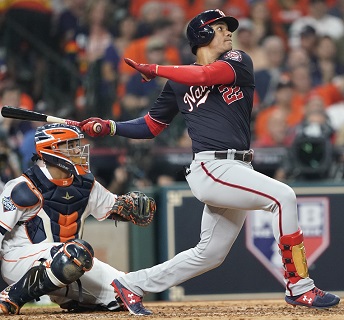
Soto catching the train in the fourth . . .

Zimmerman caught hold of every inch of a Cole fastball traveling 97 miles and hour and arriving right down the chute and drove it high over the center field fence to cut the early 2-0 Astro lead in half in the top of the second. “I’ll be honest with you,” said Nats manager Dave Martinez to former Nats beat writer Chelsea Janes. “I got a little teary eyed for him. “He waited a long time to be in this position.”

“You’re kind of almost floating around the bases,” said Zimmerman, who’s bent on enjoying every last World Series moment now that he and his Nats are here, after a season rudely interrupted by plantar fasciitis in his right foot, and with the knowledge his current deal expires after the Series and his future isn’t exactly written.

And as sweet and sentimental as Zimmerman’s blast was for the Nats even that was nothing compared to Soto leading off the top of the fourth.

Disciplined beyond his years at the plate, as announcers have purred all postseason long and almost to a fare-thee-well, Soto looked at first at a Cole slider that hung up over the top of the zone and inside. Then Soto remembered what he’d learned when Cole struck him out swinging in the first: “He likes the fastball, so I go to the next at-bat ready to hit it.”

Sure enough, here came the fastball considered Cole’s favourite, climbing to the top of the zone. And there went the fastball, the lefthanded Soto driving it high and far enough to land in front of the Minute Maid Park train’s locomotive and bounce between the track rails, tying the game at two. “[He] again used the whole field and he stayed back and stayed within himself,” Cole told reporters after the game. “So you know, good hitters do that.”

Cole knew only two things Monday night. He knew on contact that Soto lit a rocket charge in that 1-0 fastball, and he knew he wasn’t having the sharpest night of a year in which his regular season left him the American League’s Cy Young Award favourite.

“I thought the fastball was leaking a little off the corner a couple times,” he said. “I struggled with the curveball command, kind of buried us in some bad counts and then just a poor pitch to Soto and not being able to finish that inning off without a crooked number.”

For the deep history minded, Zimmerman’s was the first World Series home run by any Washington player since Senators center fielder Fred Schulte smashed a sixth-inning three-run homer in Game Five of the 1933 Series. Providing the only three runs the Ancien Nats got that 5 October. Hall of Famers Heinie Manush and Joe Cronin were on board when he launched.

“Just to get us on the board,” Zimmerman told Sports Illustrated writer/Fox Sports reporter Tom Verducci. “For them to come out and Max grinding it out tonight. He had a lot of guys on base, he made pitches when he needed to, they did a good job not swinging at balls and got his pitch count up. Against a guy like Gerrit it’s not an easy task. So I was just trying to get the ball in the strike zone and, luckily, he made a mistake.

It’s not that any Astros were allergic to making any history themselves. George Springer became first in Show to hit one out in five straight World Series games. Until he sent a 2-1 service from Nats reliever Tanner Rainey over the center field fence to lead off the bottom of the seventh, he’d been tied at four with Hall of Famers Reggie Jackson and Lou Gehrig.

Springer appreciated the feat only to a small extent. “I’d rather win,” he said earnestly after the game. “I mean, cool. Great. It’s an honor . . . But no doubt about it. I’d rather win.”

He did his part to try to make that happen, too, when he doubled in the eighth with Kyle Tucker on second and Daniel Hudson—who’d managed to strand the bases loaded ending the seventh—on the mound for the Nats. And if it hadn’t been for Nats center fielder Victor Robles misreading Tucker at first following his pinch single leading off, and throwing in to first off Aledmys Diaz’s fly out when he might have had a play on Tucker at second, Springer might not have driven in the fourth Astro run of the night.

Springer lingered at first thinking his drive had a shot at going out. Tucker waited to tag thinking the ball might be caught. Then, postgame, Springer fielded questions about why he didn’t end up on third with Tucker scoring. “I can’t go to third right there,” he told reporters. “Because the guy on second had gone back to tag. If I had gone to third, I’m out.”

If not for that, Jose Altuve’s followup high liner to right might have tied the game. But it gave the Nats just enough of a re-awakening for Martinez to reach for Sean Doolittle and ask him for a four-out save. Ask and you shall receive. First, Doolittle ended the eighth by getting Michael Brantley to fly out. Then, he struck Alex Bregman out, got Gurriel to fly out to not-too-deep center, and got Carlos Correa to line the first pitch out to left where Soto snapped it into his glove to end it.

“Welcome to the World Series, baby,” Doolittle replied when asked what he thought about coming in with a man on second. “One-run game, facing Brantley, such a good hitter, such a professional hitter. In the World Series? You know, that’s what you live for, coming into those big moments, in these big games. I’ve tried to change the way that I think about them and embrace them and try to enjoy it.”

Soto surely won’t complain about making a little history of his own. As in, the youngest player to homer and steal a base in the same postseason series, nudging Derek Jeter (Game one, 1996 ALCS) to one side. And, the third youngest to hit cleanup in a World Series game, behind Ty Cobb (1907) and Miguel Cabrera (2003).

Never mind that he’s made an impressions the Astros won’t be able to forget too readily.

“He was the key guy we couldn’t control tonight,” acknowledged Astros manager A.J. Hinch. “His bat-speed is electric . . . He’s calm in the moment. Clearly, this is not too big a stage for him. He was the difference in the game. He’s got that ‘it’ factor. He’s got fast hands. He’s got no fear.”

Springer couldn’t get over Soto’s homer. “I’ve never seen a left-handed hitter hit a ball there against [Cole],” he said of the track job. “Just an incredible swing.”

“He’s a special player,” Zimmerman said. “Really since the day he came up. You can tell the special ones when they come up because they can slow the game down.”

About the only thing the Nats don’t like regarding Soto slowing them down is that, as of Wednesday morning, they’re still two days away from being able to celebrate with Soto in the adult fashion. Come Friday, Soto can have a stiff drink legally.

“That’s why we need to win this,’’ said Nats second baseman Brian Dozier to USA Today‘s Bob Nightengale. “We’ve done all of this celebrating with him, and it sucks, because he’s not old enough to drink. We need to win this so we can do this thing right. This guy is 20 winning a World Series game for us.”

Why dream it? Drive it.