The Angels star in “Forever Framber”

Nolan Schanuel

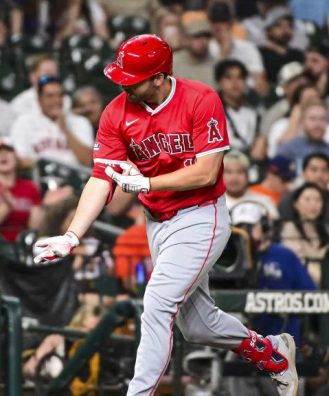
Nolan Schanuel crosses the plate after starting the Angels’ fifth-inning demolition of Framber Valdez Monday.

Framber Valdez started looking a little shaky in the fourth inning Monday. The good news was his Astros supporting him with a 4-1 lead against the Angels and padding it to 6-1 in the bottom of the fourth. The bad news was the top of the fifth.

It wasn’t just that the Angels blasted seven runs in that half inning. It was Astros manager Joe Espada leaving Valdez in to take a beating like that in the first place. Especially considering Espada’s postgame valedictory after the Angels finished what they finally started, a 9-7 win for their fourth win in five games.

“He just kind of was lost,” Espada told reporters postgame. “Started leaving some pitches in the heart of the plate and they put some really good swings on them. “His stuff was really good . . . just that fifth inning he kind of lost the feel for the zone.”

Valdez didn’t look too good in the fourth, either. After more or less cruising through the first three, he threw thirteen pitches only five of which looked genuinely good. He may have been fortunate that the Angels got only two singles in the inning while otherwise grounding into a force out and whacking into an inning-ending double play.

But after Astros left fielder Mauricio Dubón hit a two-run homer off Angels starter Reid Detmers in the bottom of the fourth to set that short-lived 6-1 Astros lead, the Angels went to work almost at once in the top of the fifth, when designated hitter Willie Calhoun smacked a two-strike single to right.

They weren’t exactly looking to detonate bombs. Nobody overswung, nobody tried to turn into a B-2 pilot. But sometimes you can just swing sensibly and discover you’ve a) still got some serious munitions in your bat; and, b) a pitcher who’s throwing you cannonballs without gunpowder behind them.

Valdez walked shortstop Zach Neto on a full count and struck second baseman Kyren Paris out to follow. Up stepped first baseman Nolan Schanuel, and Valdez hung a changeup that got hung into the right field seats. With one swing the Angels cut the Astros’ lead to two.

After a ground out right back to the box, Valdez was all over the place working to left fielder Tyler Ward before Ward finally singled up the pipe. He hung another changeup, sort of, to center fielder Kevin Pillar (he whom the Angels found in the junkyard after Mike Trout went down with a knee injury), and was lucky Pillar could only turn it into a single to left.

Espada still didn’t seem to have a bullpen option at the ready. He’d pay for it with Valdez’s next two pitches. Angels catcher Logan O’Hoppe saw a curve ball hanging deliciously enough to send well into the Crawford Boxes, and right fielder Jo Adell sent a hanging sinker the other way into the right field seats almost immediately to follow.

Just like that, the RBI single by Astros catcher Yainer Díaz and three-run homer by second base mainstay José Altuve in the bottom of the second to stake that early 4-1 lead became pleasant memories for Minute Maid Park fans and just a nuisance of mosquitoes agains which the Angels opened seven cans of Raid in the fifth.

“Things got out of hand there,” Valdez said postgame. “The game started off well and sometimes things happened.”

Unlike Valdez’s previous start, which came a day after the Astros practically emptied the bullpen following Ronel Blanco’s ejection (and subsequent suspension) for sticky stuff in the glove, and which saw Valdez take his team deep en route a 3-0 win, the Astro pen wasn’t exactly taxed for Monday.

But no relief was seen until the top of the sixth, with Rafael Montero taking over. He got a rude hello when Neto caught hold of a rising fastball and sent it to the Boxes. That was all the scoring for the Angels and all they really needed, despite some Astro friskiness in the ninth.

Adell may have broken the Astro spirit to stay for the game when he took off running after Díaz’s leadoff drive to right and took a flying leap to steal a homer from Díaz before he hit the fence padding. “He’s growing in front of your face,” said Angels manager Ron Washington postgame. “That was a big-time play and that play right there may have saved the game.”

It might have, considering Dubón singling to follow and Kyle Tucker driving him home with a base hit an out later. But Angels reliever Carlos Estevez held on despite walking Yordan Alvarez to get Alex Bregman—the veteran third baseman who was usually capable with first and second and two out, able to win it with one swing, until this year (.125/.125/.125 slash in this situation)—to fly out to not-too-deep center for the game.

The Angels set a new precedent at Espada’s and Valdez’s expense, too: this was the first time in the Angels’ history that four players 25 or under cleared the fences in the same game.

“I didn’t realize it until after the fact,” O’Hoppe told reporters. “None of us have said it out loud, but I feel like all of us internally had been waiting for a moment like that for a little while.”

“They’re growing up,” Washington observed. “They’re starting to figure things out. They really didn’t try to do too much and they ended up doing a lot. And that’s what it’s about.” Don’t look now, but they’re 7-6 in their past thirteen games including the four-of-five sealed Monday.

Maybe that thinking brings further unforeseen reward. Especially when the other guys’ manager doesn’t have an immediate bullpen answer for a starter who’s begun losing his stuff clearly enough. The Angels won’t get that lucky that often, but maybe continuing to think less-brings-more begins making their own luck.
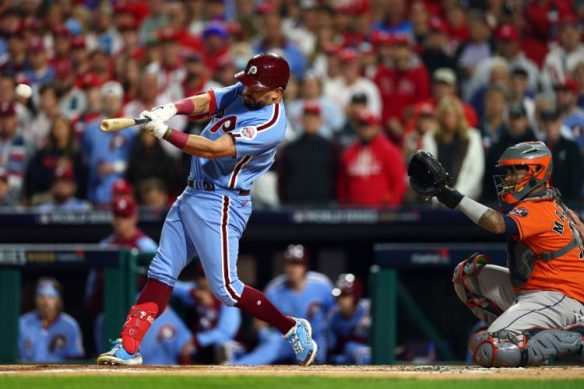
Pity poor Framber Valdez . . .

Framber Valdez

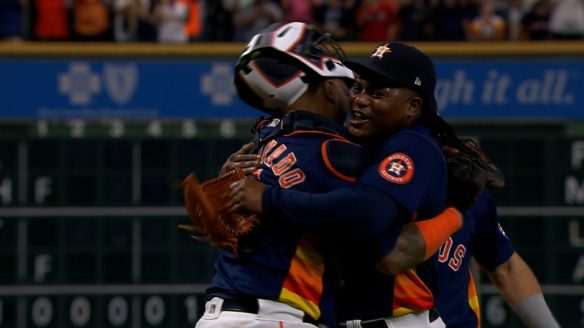
Framber Valdez gets a bear hug from his catcher Martin Maldonado after throwing a no-hitter at the Guardians Tuesday night.

What does it say that, on the day the Astros re-acquired the last man to throw a no-hitter in their silks, their struggling All-Star pitcher shakes off whatever it was prompting him to surrender fifteen earned runs over his past fifteen innings’ work to throw a no-hitter? The Astros may not be the only ones who’d like the answer.

But there it was. One minute, the Astros pulled the proverbial trigger on bringing future Hall of Famer Justin Verlander back. The next, after the trade deadline passed at 6 p.m. Eastern time Tuesday, Framber Valdez kept the Guardians hitless—with more than a little help from his friends—in a 2-0 win both of which Astro runs scored in the bottom of the third.

Verlander came home from the Mets in exchange for a pair of good-looking outfield prospects out of a farm system that was considered more than a little parched by any objective standard. Following their trade of fellow future Hall of Famer (and former Detroit rotation mate) Max Scherzer for a delicious Rangers prospect, the Mets actually looked smart in their unexpected circumstances.

“They did what they had to do, and I’m sure it wasn’t an easy call,” writes Smart Baseball author/Athletic analyst Keith Law, “but the Mets traded away six players from their big-league roster, including three pitchers all age 38 and up who either were heading for free agency or just unlikely to be that much help to the team in 2024 . . . ”

Dealing Justin Verlander and Max Scherzer—while paying enough of their salaries to return three solid prospects in Luisangel Acuña (No. 58 on my midseason top 60), Drew Gilbert (a first-round pick last year), and Ryan Clifford—are the kinds of moves more teams that have spent big only to fall short of contention should be making. And let’s give the Mets some credit for spreading the wealth around by sending one of those starters to Texas and the other to Houston.

I won’t pretend that that’s going to placate today’s generation of Met fans. You know. The generation that pronounces a season lost over one bad inning in early April. But Law is absolutely right. Especially with the coming off-season and, not merely to buy time, the pack of pitching free agents coming to within their glandular budget.

Particularly, a certain unicorn to whom the Angels held on for an (admittedly) outside postseason shot before he enters the market. The unicorn who’s both one of the best pitchers in the American League and a bona fide threat to Aaron Judge’s barely-year-old AL single-season home run record.

The Astros needed Verlander back more than anyone would have predicted when the season began. They’d just won a World Series and looked as though saying goodbye to a (controversial enough) era when they let the freshly-crowned Cy Young Award winner—the only baseball senior citizen ever to land one in his first year back from late-career Tommy John survery—walk into free agency.

But then they lost Lance McCullers, Jr., Luis Garcia, and José Urquidy to the injured list. Then, the Mets’s season went from World Series expectations to the landfill. Even as Verlander shook off early struggles and injury to round back into something resembling his old self (he has a 1.49 ERA over his last seven starts), it wasn’t enough to save this year’s Mets.

So the Mets elected to look 2023 reality in the eye and say time to start repairs. They dealt Scherzer to the Rangers after he delivered seven solid against his old team, the Nationals, en route the Mets taking three of four from the equally moribund Nats. When Scherzer asked the front office what the plan was, and learned it was moving on from deals expiring this year or next, he waived his no-trade clause and let the Mets move him onward.

The Astros are nipping at the Rangers in the AL West. The two teams square off themselves in a three-game set in early September. Tell me you won’t think it must-see television to see JV versus Max the Knife at least once in that set. Even if they’re not exactly young men anymore, they may yet have enough left in their tanks to have the eyes of all baseball upon them, especially with the AL West still at stake there.

It’s kind of a shame that Valdez picked Tuesday to pitch his jewel. Verlander back to Houston; St. Louis’s Jack Flaherty getting a fresh start in AL East-leading Baltimore (where he might get fixed enough to command a nice free agency pay day this coming winter);  the Cardinals otherwise reviving their own testy farm system without surrendering Nolan Arenado or Paul Goldschmidt.

Those were just too big to leave room. As were the Yankees even in inertia. They made no move other than landing middle relief pitcher Kenyan Middletown because they couldn’t realistically do a blessed thing. What they could move was either inconsistent or overpriced; what they could or might have brought in wouldn’t have been enough, even with Gerrit Cole at the head of the AL’s ERA pack and Judge back from his toe fracture.

You think today’s Met fan has the patience of a Nile crocodile? Don’t get me started on Yankee fans. From generation to generation, their credo is that a season lacking a postseason is illegitimate. For the generations since their last World Series win, the merest shortfall is enough to cause them to demand, “What would George do?”

The answer to that question is not what Yankee fan wants to hear anymore. They’d really rather have the late Boss’s tyranny and mutation back than what they have now. Never mind how it turned the 1980s Yankees into a basket case. Peace and quiet isn’t an option if the Yankees aren’t at the top of the AL East. Doesn’t it sound perverse to say a team with a winning record at this writing is also a basket case?

But there Valdez was, on the Minute Maid Park mound, striking seven out, letting his defenders take care of about 81 percent of the outs he needed otherwise, while Kyle Tucker took care of the game’s scoring with a two-run single in the bottom of the third.

Valdez stood at the top of the pitching heap Tuesday, and the trade deadline with all its attendant sidebars left him a hero without decoration. Even if Verlander’s first move on his arrival back with the Astros might be to congratulate him and welcome him to a unique club.

Sixteen no-hitters (four of which were combined, one of which was thrown by Hall of Famer Nolan Ryan) have been thrown by Colt .45s/Astros pitchers since their 1962 birth. From Don Nottebart (vs. the Phillies, 1963) through Valdez. That’s the most of any expansion franchise so far.

Valdez has a unique set of bragging rights while he’s at it. It took 61 years for an Astro  lefthander to do it. He can also say he’s the only man in baseball history, so far as anyone knows, to throw a no-hitter on deadline day, after the deadline hour passed but while the analysis and debates over the deals went hollering apace. The poor guy.

“We’re going to play to the end”

Kyle Schwarber

Kyle Schwarber hitting his first-inning bomb off Justin Verlander in Game Five. “We’re going to play all the outs. We’re going to see where it takes us,” he says approaching Game Six. The “where,” of course, is up to Zack Wheeler and the Phillies against Framber Valdez again.

Approaching World Series Game Six, the Phillies could lean on the experience of one member who’d been there, done that, down 3-2 in a Series, then took the final two and the world championship. That was seven years ago, when he was a Cub, his season began (thanks to injury) in the World Series, and the Cubs finally did what seven-eighths of the earth thought wouldn’t happen in its lifetime.

“We’ve overcome a lot of things throughout the course of this year to be in this position,” said Phillies left fielder/bombardier/periodic base thief Kyle Schwarber as the Phillies traveled to Houston Friday. “I think when we get there, you’re going to see a really resilient club and we’re going to play until the very end and we’re going to see where it takes us.”

Funny, but that’s just about what every 2016 Cub said, too, when the then-Indians had them on the ropes with the Series returning to Cleveland for Games Six and Seven.

That was then: the Cubs pushed, shoved, pitched, and pounded their way through two arduous games. This is now: The Phillies, whose World Series drought is barely an eleventh of those Cubs’, will have to do all that plus rip, snarl, tear, slice, dice, and air fry. Just as when he was a 2016 Cub, the Schwarbinator won’t surrender, to these Astros or anyone else.

“It’s going to take everything,” said Schwarber, who did what he could to keep the Phillies from losing Game Five when he opened with a nasty home run off future Hall of Famer Justin Verlander in what proved a to-the-max 3-2 Phillies loss. “It’s going to take everyone. We’re excited. Trust me. Sure, it’s frustrating, but we’re also very excited.”

The Phillies are in a strange position this postseason. They enter Game Six with their first series deficit since they wrestled their way to the final National League wild card in the first place. Beyond that, they have reason not to fear. They’ve come back several times to get here in the first place.

Game One of the wild card set against the Cardinals? Down 2-0 in the top of the ninth. Then: bases-loaded hit batsman, two-run single, run-scoring infielder’s choice, RBI single, and a sacrifice fly, and two Cardinal runs in the bottom of the inning weren’t enough to deny the first win of a Phillie sweep.

Game Four, National League Championship Series? A four-run Padres first didn’t exactly bury them alive. Bottom of the first: Two-run homer (Rhys Hoskins), RBI double (Bryce Harper). Deficit cut to one. Bottom of the fourth: Tying RBI single. Bottom of the fifth, after Juan Soto put the Padres back up with a homer? Two-run homer (Hoskins, again), RBI double (Harper, again), RBI single, two-run Phillie lead. Bottom of the sixth: Solo bomb (Schwarber), three-run lead. Bottom of the seventh: Solo bomb (J.T. Realmuto), four-run lead, ultimately four-run win.

Game Five, NLCS? Call it the Mud and Guts Game if you must. Bottom of the third: Phillies take a 2-0 lead with another Hoskins two-run thump. Top of the fourth: Soto cuts the San Diego deficit in half with another solo smash. Top of the seventh, with the Citizens Bank Park rain turning the field into a swamp and pitching grips and strides into mush and mire? The Padres take a 3-2 lead with an RBI single and two wild pitches enabling a run. Bottom of the eighth? Harper fights and fouls his way to a dramatic opposite-field two-run homer. Two Phillies relievers make it stick for the pennant.

Game One, World Series? Kyle Tucker’s two bombs help the Astros bushwhack Aaron Nola in the first three innings. So the Phillies return the favour by ripping five out of Verlander—RBI single and immediate two-run double in the top of the fourth; two-run double in the top of the fifth. The score stays tied at five until Realmuto breaks it for keeps with a leadoff bomb in the top of the tenth, and David Robertson survives a double, a walk, a wild pitch for second and third, and gets the game and win-ending ground out.

All the Phillies need to do now is continue overcoming that nasty 0-for-20 with runners in scoring position until Jean Segura slapped an RBI single in the eighth in Game Five. They need Zack Wheeler to be his best self on the Game Six mound. They need to continue overthrowing their earlier reputation for defensive mishaps and cut the Astros off with more of the glovework and derring-do they began flashing during the Philadelphia leg of the Series.

They need, in other words, to be better than the best of their selves that pulled them into the Series and into the 2-1 Series lead the Astros wrested away from them on their own soil. Astros Game Six starter Framber Valdez, who manhandled them in Game Two, also in Houston, intends to let them do nothing of the sort.

“I think I’m just going to try to continue doing what I’ve been doing all season,” Valdez said through an interpreter after Game Five. “Just try and attack hitters early, try to breathe, try to stay calm, try to meditate. It’s something that’s really exciting. I think it’s something that really adds a lot to your career, and I’m really excited for this opportunity.”

It’ll add something to the Astros’ resume, too: their first untainted World Series rings. Not to mention handing their manager Dusty Baker—the man who steadied the Astro starship after it was strafed by the in-house phasers of Astrogate, keeping his gradually turning-over team playing through the aftermath, three seasons following its exposure, despite the organisation’s turmoil and grotesqueries—the first World Series triumph of his long and mostly distinguished managerial career.

The Astros know the Phillies won’t be simple pickings despite shutting them out back-to-back in Philadelphia, once with a combined no-hitter. It’s the Phillies’ job not to make things simple for the Astros.

“What a better storybook ending,” asked Castellanos, whose limp bat is almost forgotten when you’ve seen his defense turning into must-see television all of a sudden, “than if we can go there and win this in Game Seven?”

First things first, Schwarber would remind one and all.

“We’ve got a pretty good pitcher going for us in Game Six,” the Schwarbinator says. “We’ve got to be able to bounce back offensively. I don’t think anyone believes more in this group than we do. That’s going to be a big thing for us. We’ve just got to be able to play all the outs. We’re going to see where it takes us.”

First, it needs to take them past the Astros in Game Six. Then the Phillies can worry about who writes their storybook ending—the team of Roger Towne and Phil Dusenberry (who wrote the screenplay for The Natural); or, any given Astro, plus Jack Benny and Fred Allen, climaxing their long-running mock on-air feud while satirising the notorious weeper quiz show Queen for a Day:

Allen: An expert operating the Hoffman Pressing Machine will press your trousers
Benny: Now wait a minute! (Studio audience laughter and noise.) Now wait a minute, Allen!
Allen: Keep your shirt on, King!
Benny: You bet I’ll keep my shirt on!
Allen: All right, folks, tune in again next—
Benny: Come on, Allen, give me my pants!
Allen: Quiet, King!
Benny: Where are my pants?
Allen: Benny, for fifteen years I’ve been waiting to catch you like this.
Benny: Allen, you haven’t seen the end of me!
Allen: It won’t be long now!

Opening Day: Cross it off the bucket list

Shohei Ohtani

Shohei Ohtani, shown on the Angel Stadium video board during his pre-game warmup as the teams lined up on the foul lines, on Opening Day. He pitched brilliantly but in a lost cause, the Angels losing 3-1.

The owners probably won’t stop by to see what I’m about to write, but their otherwise ill-advised 1 December-10 March lockout did me one solid. But only one.

After the World Series, and as soon as they went on sale, I’d bought tickets for what I thought would be the Angels’ home opener. They were scheduled originally to open the season on the road. But commissioner Rob Manfred’s cancellation of the regular season’s first series, in light of the owners’ further goalpost-moving shenanigans, turned the Angels’ home opener into Opening Day, after all.

It wasn’t enough to turn my thinking toward the owners’ side one iota, but it did enable me to cross something off my bucket list. Despite a lifetime of loving the game and watching countless games in the stands and on television, I’d never actually had the chance to be at the ballpark on Opening Day. Until Thursday evening.

The best part of the evening was that I got to do it with my now 28-year-old son, Bryan. The second-best part was being able to cross another item off the baseball bucket list within half an hour of us getting our pre-game food and drink, after putting replica 1972-1990 Angels hats onto our heads.

The Ball

The foul ball, now crossed off my bucket list, sitting atop my notebook, before I handed it to my son.

While the visiting Astros took batting practise, a line drive sailed into our section down the right field line. Adjacent fans made it impossible for me to see just which Astro hit the ball, but the ball bounced around off seats in front of us, then under them, and riocheted off a fan two seats to our right, before rolling on the floor under us to where I could grab the ball before another fan reaching under the seat in front of me did.

I held the ball up to see for myself that I wasn’t seeing or imagining things, then handed it to my son. He’d only been asking to try to catch a ball at Angel Stadium since, oh, the first time I got to take him there—in 2000, when the Angels beat the visiting Yankees one fine evening by prying the winning run out of The Mariano himself. We’d gone to plenty of games since. Thursday night, it was pay dirt at long enough last.

Of course, there was now a game to play, and the Angels lost, 3-1. These are my ten takeaways:

1) Shoh-time! The good news for the Angels was Shohei Ohtani starting on the mound. I’m convinced that what looked to be a lockout-dejected, ho-hum crowd in advance, shot into a near-sellout once Ohtani was announced as the Opening Day pitcher. Lockout after-effect, I suspected: I’d checked the ticketing for the game just prior to the announcement and there were several thousand seats remaining for the taking.

Well, now. The day before I set out for southern California from my home in Las Vegas, I checked the ticketing again. The tickets seemed to have flown off the board once Angel fans knew it would be Shoh-time. And Ohtani didn’t disappoint, much. He pitched four and two-thirds innings of one-run, nine-strikeout, four-hit, one-walk baseball.

The best the Astros could do against him was the third inning, after he caught Martin Maldonado looking at strike three and blew Jose Altuve away with a swinging third strike: Michael Brantley banged a double off the right center field fence and Alex Bregman sent him home promptly with a base hit to left center.

As a matter of fact, when Ohtani wasn’t becoming the first player in Show history to throw his team’s first pitch of the season and make his team’s first plate appearance of the season (the Angels like to bat him leadoff), he manhandled Altuve for three strikeouts on the night, including the nasty slider that shot over Altuve’s hard swing for the third such strikeout in the top of the fiftyh.

2) The bad news: Astros starter Framber Valdez was just as effective in six and two-thirds innings. (The Angels planned to keep their starting pitchers on an 80-pitch limit for the time being, after the lockout-imposed too-short spring training.) He struck six out, walked one, and surrendered two of the Angels’ four hits on the night.

3) The worse news, for the Angels: They came to within inches of taking a 2-1 lead in the seventh. Mike Trout led off by beating out a throw from shortstop that should have been ruled an infield hit but was ruled an error. Then Anthony Rendon hit a high liner that sailed into the left field seats . . . but missed the foul pole on the wrong side by a hair.

“When I saw the ball flying in the air,” Valdez said post-game of his narrow escape, “I got mad with myself that I didn’t make my best pitch. I just took a deep breath and threw my best pitch.” That would be the hard sinkerball on which Rendon promptely dialed Area Code 4-6-3.

Matt Duffy promptly beat out an infield hit to third, which promptly moved Astros manager Dusty Baker to end Valdez’s night and bring Phil Maton in to strike Jo Adell out swinging for the side.

4) Cruising speed: Maton seemed on a bit of a cruise in relief until he hit Brandon Marsh with a pitch with two out in the bottom of the eighth and David Fletcher shot a 1-2 pitch through to the back of left center and gunned it for an RBI triple. That was the Angels’ first and last run of the game, alas.

5) The worse news, for baseball as a whole: That ridiculous three-batter minimum for relief pitchers. Under normal circumstances, if your reliever comes into the game and gets murdered right away—as Angels reliever Ryan Tepera was in the top of the eighth—you’d know he didn’t have it that night, right?

Father and son

Father (right) crossed Opening Day off his bucket list at last—and had the pleasure of doing it with his 28-year-old son.

Oops. Tepera’s first pitch to Alex Bregman sailed into the left field seats. The next Astros batter, Yordan Alvarez, hit a hanging slider on 1-1 over the center field fence. The Angels were lucky to escape with their lives after two prompt deep fly outs (Yuli Gurriel, Kyle Tucker) followed by a sinking liner up the middle (Jeremy Peña) that Trout caught on the dead run in from somewhat deep center to retire the side. (Trout also drew a loud ovation after he turned around and, from half-shallow center, winged the ball to fans halfway up the right center field bleachers.)

6) But there was good news on the relief front. Neither manager burned his relievers in the bullpens. If either Baker or Joe Maddon warmed a pitcher up, he either came into the game as soon as needed or he was handed what amounted to the rest of the night off. No Angels or Astros reliever was called upon to warm up more than once.

I paid as much attention to the relievers in the pen as I could, considering I was seated far opposite the pens behind the left field fence. The Angels used five relievers and the Astros, three. None of those eight pitchers threw any more than maybe 20-25 pitches before they were brought into the game. None of them could be called gassed going in.

Tepera simply didn’t have it Thursday night; Maton got vulnerable after ending one inning and getting two outs to open the next. The rest of the two teams’ bullpen corps (Hector Neris and Ryan Pressly for the Astros; Aaron Loup, Austin Warren, Jose Quijada, and Archie Bradley for the Angels) pitched clean-as-a-hound’s-tooth relief. Would that all major league managers were that judicious handling their pen men.

7) Memo to: Angel fans. Subject: The Wave. The 1980s called. They want their obnoxious, obstructive Wave back. One fan adjacent to our section kept calling for fans to do the Wave. I kept shaking my head, but I did notice that each of about ten attempts at it starting in our part of the park died before flowing to a fourth section of the field-level seats. Maybe there’s hope in such deaths, after all.

8) You were saying? The back-to-back Astro bombs to one side, this game wasn’t exactly the kind to send the old farts screaming to the whiskey shots. The game’s twelve total hits included three Astros doubles, Fletcher’s triple, and six singles. Altuve even stole second in the ninth, for whatever that was worth, since he ended up stranded.

9) Wasted Out Department: Altuve, the Astros’ pint-sized, gallon-hitting second baseman, also dropped a sacrifice bunt to third with one out in the seventh against righthanded reliever Warren, after Chas McCormick opened the inning with a double. Remember: A man on second with one out, and you have less chance of scoring a run after that bunt than you did before the bunt, even if you do exactly what Altuve did pushing McCormick to third.

Just what a man with a lifetime .512 Real Batting Average (total bases + walks + intentional walks + sacrifice flies + hit by pitches, divided by total plate appearances), and a .297 lifetime hitting average with a man on second and one out, is doing thinking sacrifice escapes. With his team leading a mere 1-0 at the time, the Angels brought Quijada in to pitch to Brantley, and Brantley flied out shy of the track in right center for the side.

That’s what a wasted out did. The righthanded-hitting Altuve might have been futile against Ohtani on the night, but he has a lifetime .301 hitting average against righthanded pitchers. The Astros would have had a better chance scoring McCormick if Altuve hit away.

10) When Bregman checked in at the plate in the top of the eighth, the Angel Stadium video boards flashed a graphic with Bregman’s head shot plus this: [He] donated over 200 iPads  w/protective cases and iTunes gift cards to several Houston-area elementary schools that have autistic classrooms. He does that through his Bregman Cares charity, with a particular focus upon autistic children.

It was almost as admirable for the Angels to show Bregman such respectful acknowledgement as it was for Bregman and his wife, Reagan, to take such an interest in lending hands to autistic children. Even if Bregman’s idea of saying thank you for such respect was to smash a leadoff homer in reply.

WS Game One: Flash! Bash! Alakazam!

Jorge Soler

Soler swings into history and toward a Game One Braves win . . .

Yordan and Eddie Tonight, the Miniseries? The show went on, but they weren’t exactly the stars of the show Tuesday night.

Oh, they performed rather splendidly. But they turned out the headliners blown off the stage by the fourth-lowest opening performer and a wild animal act.

Which is just what Jorge Soler did with the third pitch of World Series Game One from Astros starter Framber Valdez. And, what the Braves bullpen did to the Astros the rest of the way in an emphatic enough 6-2 Braves win.

Fresh off his marquee performance against the Red Sox toward the Astros’ American League pennant, Valdez could only watch with everyone else in the Minute Maid Park house as Soler became the first player in major league history to open a World Series opener with a home run.

The audience could only watch, too, with a hybrid of frustration broken up only occasionally by their usual racket while four Braves relief pitchers kept the Astros to their only runs of the game. Not to mention helping guarantee the Braves a temporary home field advantage at least.

Valdez fell behind Soler 2-0 when he threw a sinker that dumped enough ballast en route the plate that it had altitude enough for Soler to send it on hefty flight into the Crawford Boxes above the left field scoreboard. A ground out (Freddie Freeman), an infield single (Ozzie Albies, beating out a grounder wide of the mound’s left side), and a quick theft of second later, Austin Riley split the left center gap with the RBI double.

The game wasn’t even half an hour old, and already fans of both teams must have asked, Yordan who? Eddie what?

That was before the Braves more or less snuck a third run home in the second—back-to-back opposite-field singles (Travis d’Arnaud to right, Joc Pederson to left), a long fly to the center field wall enabling two tag-ups and second and third, and Soler’s grounder to short getting Pederson caught in a rundown while d’Arnaud crossed the plate.

And, before Eddie Rosario pulled a leadoff base hit to right in the third and—following a come-back-on-message visit to Valdez from Astros pitching coach Brent Strom—Adam Duvall turned a hanging changeup into a cruise missile straight into the Crawfords and sent Valdez out of the game.

“It was my first World Series game, so I’m not going to tell you that I didn’t feel the pressure,” Valdez admitted postgame. “I think just being behind in the count so much is what hurt me more than anything in this game.”

In between Soler’s Series-opening history mark and Duvall’s two-run rip, Morton too a hard smash from Yuli Gurriel off his leg to open the Houston second. The ball ricocheted to Freeman at first for a simple enough out. Morton pitched on, getting the next two outs to end the second and then striking Jose Altuve out called on a particularly nasty curve ball.

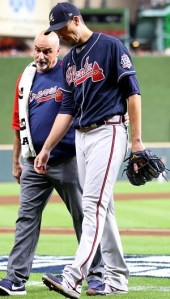
“That one got me good,” Morton’s said to have told his catcher d’Arnaud of the Gurriel comebacker that ended up ending his season. “I’m sorry,” Morton told any and everyone who happened by after his exit and after the game ended.

He’d looked distinctly uncomfortable before throwing Altuve that out pitch. He looked pained but determined after it. Pained enough to come out of the game. He turned out to have pitched to three Astros on a broken fibula that means the end of his postseason and the Braves having to do what they’ve done best in an injury-dominated year—skip out of the way at the last second when disaster comes careening down the street.

A 37-year-old veteran channeling his inner Bob Gibson (1967: tried to pitch on after fellow Hall of Famer Roberto Clemente ripped one off his leg; fracture kept him out thirteen weeks)—and apologising for it postgame. “[I]f that doesn’t tell you everything you need to know about Charlie Morton,” said Freeman postgame, “I’m not sure what does.

Morton’s been there, done that. His career’s first half was as much big and small injuries costing him a lot of his prime time as it was pitching like a craftsman in six postseasons with one World Series ring and a splendid-enough 3.35 lifetime postseason earned run average to show for it. The man is nothing if not a walking exercise in pain management.

“I didn’t think it was broken,” d’Arnaud said. “I just thought he took a line drive off of his leg. But to go out there and strike out the next guy with a broken leg, it blows my mind.” Actually, it turns out Morton’s first X-rays showed no break, but he probably stressed his leg into the break while working on Altuve.

This is the Braves’ lot in 2021 so far. They incurred, dodged, withstood, and found ways to sneak through disaster to get to the postseason in the first place, never mind the World Series. A leg fracture taking their elder starting pitcher out for the rest of the way? Tell them about it. It wouldn’t shock them if they woke up on Game Two day having been kidnapped for the unreachable ransom.

Charlie Morton

Charlie Morton, escorted from the field in the third.

“No kidding. I don’t want to know what’s next,” said manager Brian Snitker after Game One. “But this is what we do, right?” Right. Nothing to it. Hit them with a tidal wave. Send them another hurricane riding the oblivion express. To these Braves those are just sun showers and some autumn breezes.

So far. It’s not that the Braves push their luck by design or premeditation. But you can’t help wondering just how many times they can still just wave their magic bats, gloves, or arms, and—flash! bash! alakazam!—make the other guys disappear.

Snitker had to reach for one of those arms a lot sooner than he might have expected going in. He brought AJ Minter in to take over for Morton. Minter pitched two and two thirds that would have been shutout ball if shortstop Dansby Swanson, usually one of the most sure-handed, sure-footed of the breed, hadn’t inadvertently kicked Astro center fielder Chas McCormick’s hard one-out, first-and-third grounder aside, enabling Kyle Tucker (one-out double) to score the first Astro run.

Luke Jackson followed Minter with one and two-thirds scoreless pitching before handing off to Tyler Matzek with lefthanded swinger Michael Brantley coming up with two outs in the seventh. He shook Brantley’s base hit off to strike Alex Bregman out looking for the side. But he couldn’t do a thing about Alvarez’s leadoff triple to the rear of right center opening the bottom of the eighth.

Alverz came home almost predictably when the next Astro batter, Carlos Correa, grounded out to second. After Matzek struck Tucker out on a somewhat violent swing, Gurriel ripped a drive off the left center field wall whose carom Rosario played perfectly, before throwing in perfectly to nail Gurriel at second trying to stretch the hit.

Or was it? At first glance it looked as though Gurriel’s drive hit on or above the yellow line atop the wall, which would have meant home run. Several television replays confirmed what the umpires on review ruled for certain—the ball struck the wall clearly if just barely below the line. Hocus pocus!

Not that it would have mattered in the end. The Braves landed an extra insurance run in the top of the inning, when Swanson wrung himself into a one-out walk and Soler on a check swing squibbed one into no man’s land beyond the mound that Astros reliever Ryne Stanek couldn’t get on a dive. Enabling Swanson to take third, before Freeman popped out to short right with Swanson on the run home and sliding in safely around Astro catcher Martin Maldonado’s backswinging tag attempt. Shazam!

So the Braves’ M&M Bulls didn’t do it with quite the howitzer heft by which they pinned the Dodgers to the wall winning National League Championship Series Game Six. But they did just what they had to do and kept the Astros from even thinking about a Game One overthrow regardless.

Will Smith shook a leadoff walk to pinch-hitter Aledmys Diaz off in the bottom of the ninth to get three straight ground outs—two force outs at second base, and a ground out to second—and that ended the game.

Abracadabra!

“Our team doesn’t worry,” said Astros manager Dusty Baker postgame, “and our team’s very confident. We have the knack of bouncing back after losses, after tough losses because they don’t quit, they don’t give up, they don’t get down. That’s the secret of sports.”

Beware, Mr. Baker. Your very confident Astros are up against a team that’s had to bounce back from tougher losses than Game One.

These Braves had to bounce back from losing their junior franchise face to a season-ending injury, after losing key young pitcher to a re-injured Achilles tendon and a key bomber to domestic violence protocols. Not to mention losing their leadoff hitting right fielder to COVID for the entire division series and most of the NLCS.

So the Braves will have to find a few more creative ways to survive losing their elder starter and clubhouse sage for the rest of the Series, too? Big whoop. Bad as losing Morton is, this, too, comes right into this year’s wheel house. They’d surely rather not, but where other teams crumple under the weight of forced creativity, these Braves thrive on it. So far.