We can’t have nice things for too long

Emmanuel Clase

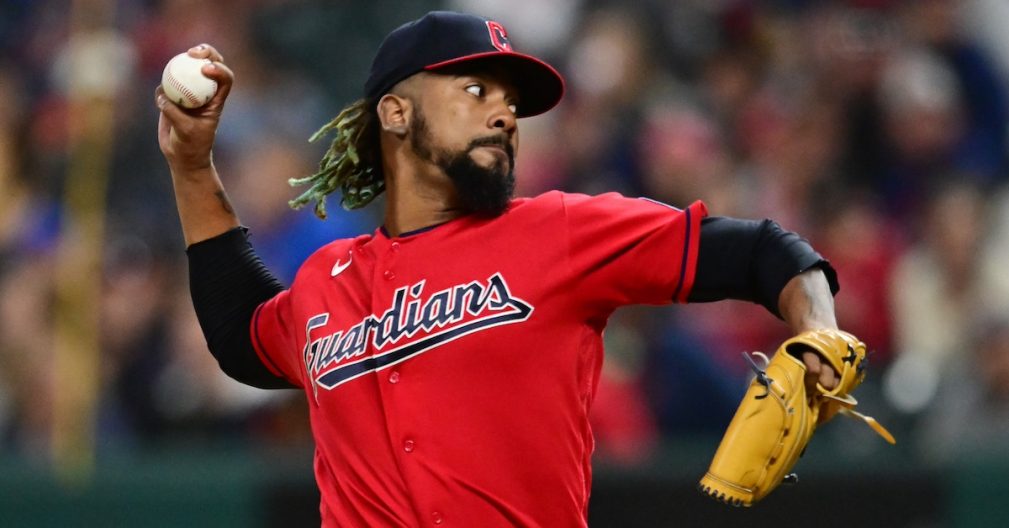
Emmanuel Clase, whom the feds charge masterminded a pitch-rigging scheme for bettors and his fellow Guardians pitcher Luis Ortiz.

How tempting is it to define the present era as the one that tells us we can’t have nice things? And, the one that delivers the message more brutally after each of the rare nice things we get.

Baseball just delivered us a postseason for the ages, even if you don’t hold with the wild card system. Put that to one side a moment and admit it. The game we love spent a month showing us that, any time we care to write the game off as a self-immolating bore, it’ll be more than happy to disabuse us.

Think about it. When you get seven postseason sets ending with winner-take-all games, you’ve been blessed to the tenth power. When you get more than one extra-inning postseason hair raiser without the disgrace of Manfred Man (who’s not allowed anywhere near the postseason—yet), you’ve been blessed that big again.

When you get utter cream-always-rises defiance against the wild card system, putting nobody in either League Championship Series except teams whose butts were parked in first place at season’s end, you’ve been blessed above and beyond whatever it was you had the right to expect.

When you get Shohei Ohtani spending one postseason game striking ten out from the mound and hitting three out at the plate, then spending World Series Game Three reaching base nine times—five with the near-complete consent of the Blue Jays who seemed to prefer death to Ohtani’s singular controlled mayhem—your cups runneth over.

When you get a postseason seeing regular-season supermen continue their feats of derring-do and damage (can we forget Cal Raleigh crowning a 60-homer regular season with five intercontinental ballistic missle launches while the Mariners were in the postseason? Freddie Freeman’s eighteenth-inning walkoff?), and heretofore dismissable Clark Kents turning into assorted breeds of Supermen (Addison Barger, Miguel Rojas, call your offices), your bowls, barrels, vats, and tanks runneth over, under, sideways, down, and back.

In other words, this postseason couldn’t have been more entertaining, exciting, and exemplary if it had been coordinated, produced, and directed by Bill Veeck, Casey Stengel, Kevin Costner, and The Chicken.

No, that beyond good deed couldn’t go unpunished, could it? Can we have (demand) this Sunday back?

First there came the should-be-frightening revelation that, according to a popular podcast, Bryce Harper—he who told commissioner Rob Manfred firmly enough to get the you know what out of the Phillies clubhouse if he wanted to talk salary cap, though the two shook hands and shook it off later on—was threatened by “one of Manfred’s deputies,” who said, supposedly, “Don’t ever disrespect [the Commish] like that again. That’s how people end up in a ditch.”

“If this threat is true,” wrote Yardbarker‘s David Hill, “the next labor stoppage could get ugly fast.” If that threat is true, we don’t have to wait for a lockout or a strike to get ugly fast. It’s just become ugly fast.

And how about the ugly-fast-enough revelation that two Guardians pitchers, relievers Emmanuel Clase and starter Luis Ortiz, on administrative leave since late July on pitch-rigging suspicions, have just graduated from suspicion to formal charges of fraud, conspiracy, bribery, and money laundering? Charges “stemming,” as the federal indictment out of Brooklyn says, “from an alleged scheme to rig individual pitches that led to gamblers winning hundreds of thousands of dollars, according to an indictment unsealed by federal prosecutors Sunday.”

The U.S. Attorney’s Eastern District office in Brooklyn said Sunday that Clase’s involvement in the pitch-rigging plot goes back to May 2023, with Ortiz joining up last June. It didn’t exactly cripple the Guardians’s season to lose the pair, especially when they ended up snatching the American League Central from the unexpectedly rising/unexpectedly sputtering Tigers.

But then came the postseason. The Tigers nudged the Guardians out of the picture in a wild card series. From there, aside from the usual off-season doings, undoings, maneuverings, and meanderings, the question around the Guards became when the other shoes would drop around Clase and Ortiz.

They dropped Sunday, all right. The indictment says Clase arranged with a gambler to throw particular pitches for ball counts so the bettor could bet on those pitches (it’s called proposition betting) and reap the financial reward. The indictment says further that gamblers won almost half a million betting on pitches thrown by the Guardians pair, while the pitchers themselves earned kickbacks for helping the bettors clean up.

Clase and Ortiz, said Eastern District U.S. Attorney Joseph Nocella, Jr., “deprived the Cleveland Guardians and Major League Baseball of their honest services.”

They defrauded the online betting platforms where the bets were placed. And they betrayed America’s pastime. Integrity, honesty and fair play are part of the DNA of professional sports. When corruption infiltrates the sport, it brings disgrace not only to the participants but damages the public trust in an institution that is vital and dear to all of us.

“While the pervasiveness of legalized gambling has upended the sports world, the allegations against Clase and Ortiz are the most severe for the sport since Pete Rose agreed to a lifetime ban for betting on baseball in 1989,” ESPN’s Jeff Passan wrote. “MLB’s rules against gambling on the sport are strict, and Clase and Ortiz could face lifetime bans similar to the one delivered last year to San Diego Padres infielder Tucupita Marcano, who placed nearly 400 bets on baseball.

Nocella’s office described Clase as the scheme’s mastermind, saying he’d throw balls instead of strikes and sliders instead of cutters on first pitches, with gamblers betting on each pitch to be called balls or traveling under specific speeds. The indictment said further that such proposition bets would be stacked in parlays often as not, meaning bigger winnings.

But the indictment also charges that Clase gave money to gamblers to bet on his own behalf, texted with them while games were in progress, and was joined up by Ortiz after he  came to the Guards in a winter 2024-25 trade, Passan said.

Among others, Clase helped gamblers win $27,000 apiece on one Clase pitch faster than 94.9 mph in an interleague game with the Mets. “Weeks later,” Passan said, referring to the indictment, “bettors added a leg to a parlay for a pitch to be a ball slower than 94.95 mph—and won $38,000 when Clase spiked a slider at least five feet in front of home plate.”

By last April, Clase asked for and got kickbacks for throwing specific pitches. He even asked one winning bettor to send kickback money to his native Dominican Republic “for repairs at the country house.” Last June, Ortiz joined the scheme by agreeing to be paid $5,000 to throw a first second-inning pitch for a ball call, with Clase getting $5,000 himself for arranging it, the indictment charges.

The same month, Ortiz agreed to open the third inning with ball one for $7,000. The indictment also says bank security cameras caught Clase withdrawing $50,000 cash, $15,000 of which went to one bettor in a group who placed $18,000 on that pitch.

Ortiz’s attorney denied in a formal statement that his client would do anything to influence a game improperly, “not for anyone and not for anything.”

Clase was making $4.9 million for 2025 and stood to make $6.4 million for 2026, with a pair of team options for 2027 and 2028 at $10 million each. Ortiz wasn’t near six figures yet so far as I could determine, but he wasn’t exactly improverished, either. Why on earth would either man slide into a shady side profession that could end their baseball lives if convicted and banished?

Maybe we shouldn’t ask. Maybe it won’t matter, at least until the case goes to trial, barring any for-now-unknowable chance of one or both pitchers coming to take plea deals and then throwing themselves upon the mercy of the courts of law and public opinion.

Maybe it won’t mean a thing until or unless baseball decides to take a second, third, and fourth look at its cross-promotion deals with legal sports books. Yes, those were supposed to encourage fan betting alone. Baseball’s prohibitions against players, coaches, managers, and team personnel betting on the sport remain stringent.

Oops. Manfred took a presidential gumshoe in the gluteus to declare Rose’s “permanent” and wholly justified banishment applied only while he was alive on earth—thus making Rose eligible to appear on the Hall of Fame’s next Classic Baseball Era Committee ballot.

But five months after Ohtani’s original interpreter Ippei Mizuhara went to the federal calaboose for stealing $17 million of Ohtani’s money to support an out-of-control gambling habit, it might be wise to review and perhaps repel those cross-promotions. Which might require the kind of spine this commissioner displays very selectively.

When an uppity player told Manfred where he can take his salary cap talk, the commissioner’s office ironed up to slap him down. But when an uppity president behaving like the school bully crooked his finger and demanded Rose be sent to Cooperstown as soon as last week, regardless that Rose earned his banishment, Manfred’s spine went Vaseline.

The stove isn’t the only thing that’s hot. It won’t shock me if baseball tempers get a little hot for a good while. That’s the risk whenever baseball’s witless remind us that we can’t have nice things for very long.

Trump threatens to pardon Rose

Pete Rose

The late Pete Rose, shown at a signing table at 2023’s GalaxyCon in Columbus, Ohio.

Those to whom Donald Trump points the way to wisdom by standing athwart it have further evidence to present. The president who thinks (yes, those four words isolated by themselves would flunk a polygraph) he knows all says he will pardon the late Pete Rose. On which grounds, you ask?

Let the man speak a moment:

Major League Baseball didn’t have the courage or decency to put the late, great, Pete Rose, also known as “Charlie Hustle,” into the Baseball Hall of fame. Now he is dead, will never experience the thrill of being selected, even though he was a FAR BETTER PLAYER than most of those who made it, and can only be named posthumously. WHAT A SHAME! Anyway, over the next few weeks I will be signing a complete PARDON of Pete Rose, who shouldn’t have been gambling on baseball, but only bet on HIS TEAM WINNING. He never betted against himself, or the other team. He had the most hits, by far, in baseball history, and won more games than anyone in sports history. Baseball, which is dying all over the place, should get off its fat, lazy ass, and elect Pete Rose, even though far too late, into the Baseball Hall of Fame!

Is there anyone within the oatmeal-for-brains arterials of the second Trump Administration with the will and the backbone to counsel him that he’s talking through his chapeau? Seeing none thus far, I volunteer, though I’m not of the Trump or any other government administration.

To begin, unless Trump speaks of Rose’s conviction and sentence served for tax evasion having to do with his income from memorabilia shows and sales, his power of the pardon doesn’t reach major league or other professional baseball.

Herewith a memory refreshment for the president who once opined—erroneously, unless Congress is still foolish enough to transfer its responsibilities to the White House—that Article II of the Constitution, which codifies the president’s job, enabled him to do as he damn well pleased: From Section 2, Article II: The President shall . . . have Power to grant Reprieves and Pardons for Offences against the United States, except in Cases of Impeachment.

Rose’s violations of Rule 21 weren’t legal offences against the United States. Moral and cultural violations are other stories, of course. (And how, when it came to Rose, alas.) Sorry, Mr. President. (That’s Mr. President, not Your Majesty, Your [In]excellency, or Your Lordship.) That only begins to convict you of erroneous assault with a dead weapon.

Consider: Rule 21’s prohibition of MLB personnel betting on MLB games does. not. distinguish. between betting on one’s team to win and betting on one’s team to lose. The notebooks whose revelations affirmed the depth of Rose’s betting on baseball that began while he was a player/manager affirmed concurrently that there were days aplenty when Rose’s baseball bets didn’t include bets on his Reds.

Read carefully, please: In the world of street/underground/extralegal gambling, a player or other team personnel known to bet on baseball but not laying a bet down on his team on a particular game sends signals to other street/underground/ extralegal gamblers not to bet or take betting action on that team. That’s as de facto betting against your team as you can get.

Now, about that business of, “He had the most hits, by far, in baseball history, and won more games than anyone in sports history.” Rule 21 doesn’t make exceptions for players who achieve x number of milestones or records. Especially not the clause that meant Rose’s permanent (not lifetime) banishment: Any player, umpire, or Club or League official or employee, who shall bet any sum whatsoever upon any baseball game in connection with which the bettor has a duty to perform, shall be declared permanently ineligible.

Did you see any exception for actual or alleged Hit Kings?

If you count Nippon Professional Baseball as major league level, and its quality of play says you should, Rose’s 4,256 hits don’t make him the Hit King—but it does crown as such freshly-minted Hall of Famer Ichiro Suzuki with his 4,367, between nine seasons with the Orix Blue Wave (Japan Pacific League) and nineteen seasons with the Mariners, the Yankees, and the Marlins.

Did you see any exception for those who “won” more games than anyone in sports history?

Modesty wasn’t exactly among Rose’s virtues, but he liked only to brag that he had played in more winning major league baseball games than anyone who ever suited up. Played in. Even Rose never once said or suggested that he won those games all by his lonesome, with no help from the pitchers and the fielders who kept the other guys from putting runs on the scoreboard, or with no help from the other guys in the lineup who reached base and came home.

Baseball is “not in the pardon business,” said Rose’s original investigator John Dowd, in a statement to ESPN, “nor does it control admission to the [Hall of Fame].” Baseball’s commissioner could have reinstated Rose any old time he chose. The Hall of Fame, which is not governed by MLB though the commissioner sits on its board, enacts its own rules, including the rule barring those on the permanently-ineligible list from appearing on any Hall ballot.

Rose tried and failed to get two commissioners to end his banishment. The trail of years during which he lied, lied again, and came clean only to a certain extent. And he did the last only when it meant he could peddle a book. “[W]hat had once been a sensation,” his last and best biographer Keith O’Brien wrote (in Charlie Hustle: The Rise and Fall of Pete Rose, and the Last Glory Days of Baseball), “quickly became yet another public relations crisis for Pete Rose.”

Somehow, his book managed to upset almost everyone . . . He refused to admit that he bet on baseball in 1986 while he was still a player, despite evidence showing otherwise. At times, he painted himself as the victim. Even the book title–My Prison Without Bars–sounded whiny, as if he hadn’t helped build the prison walls with his own choices . . . He picked fights over little pieces of evidence instead of taking full responsibility for his mistakes. He didn’t sound very sorry, critics said, and reinstatement eluded him every time he asked for it: in 2004, in 2015 and 2020, and in 2022. Nothing changed. If anything, his situation only grew worse.

Not even Rose’s jocularity when signing autographs or bantering with fans who met him in the years since his banishment could rescue him. Perhaps that was because, in part, it was tough to tell whether he was just kidding or sending none-too-subtle zingers at the critics he really believed done him wrong. Sorry I bet on baseball. No Justin Bieber, I’m sorry. Build the wall for Pete’s sake. Sorry I broke up the Beatles. I’m sorry I shot J.F.K. About the only thing missing was, I’m sorry I built the Pontiac Aztek.

Only one man was responsible for Rose’s exile to baseball’s Phantom Zone. It wasn’t his original investigators, or the commissioner who banished him under the rules, or the commissioners who denied his reinstatement petitions in the years that followed until his death of hypertensive atherosclerotic cardiovascular disease last fall.

“All his adult life,” wrote another freshly-minted Hall of Famer (writer’s wing division), Thomas Boswell, after Rose was first banished in August 1989, “he has thought, and been encouraged to think, that he was outside the normal rules of human behaviour and above punishment. In his private life, in his friendships, in his habits, he went to the edge, then stepped over, trusting his luck because—well, because he was the Great Pete Rose.”

Funny, but with just a name change at the end, and regardless of party affiliation or ideological core, you could say the same thing about more than one president of the United States. Including and especially the once and current incumbent.

The Nats extend an Opening Day first-pitch invite

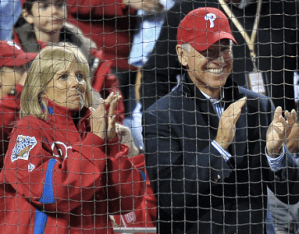
President-elect Joe Biden and his wife Jill, in Phillies gear, watching a game at Citzens Bank Park.

When Donald Trump first took the job he will vacate in January, the Washington Nationals hastened to invite him to throw out a ceremonial Opening Day first pitch. At least, the team and the White House were in “talks” toward arranging it. The then-new president seemingly hastened not to accept the invitation thanks to a “scheduling conflict.”

That was then, this is now. Trump is on the threshold of departing office as only the second sitting American president not to throw out a ceremonial first pitch at any major league baseball game since William Howard Taft introduced the practise in the first place. Who would have thought Trump shared common ground with Jimmy Carter?

President-elect Joe Biden is known to be a longtime Philadelphia Phillies fan but not otherwise sinister on a personal level. (He likes to joke that being a Phillies fan allows him to sleep with his wife.) That didn’t stop the Nationals from extending him a post-victory invitation to come to Nationals Park, just about any old time he chooses, Opening Day preferably, and throw out a ceremonial first pitch.

Spotting the invitation on Twitter myself during a Saturday visit, I couldn’t resist replying to the Nats as I’d replied to Jesse Dougherty, the Washington Post‘s Nationals beat writer: Biden should do well throwing out such a first pitch. He won at last by standing on the mound with the bases loaded, two out, and a full count in the bottom of the ninth, and freezing Trump with a called strike three on the low outside corner.

“[Biden] was up by 4 million+ runs, so not a save situation,” tweeted one respondent. No, but I probably should have made clear that Biden and Trump dueled in a complete game that went to extra innings before Biden finally delivered the game-ending strikeout.

Complete games have become baseball outliers over a longer period of time than stubborn baseball “traditionalists” want to admit or care to research. (The last time half or more of a season’s games were complete games: 1922; the last time forty percent or more were such games: 1946; the last time thirty percent of more were such games: 1959.) So don’t fault the respondent for not knowing one when he saw one.

Biden/Trump wasn’t quite analogous to the most fabled extra-innings complete game, between Harvey Haddix and Lew Burdette in 1959, but the Biden/Trump game in presidential politics is even more of an outlier than was Haddix taking a perfect game to the bottom of the thirteenth.

Trump, of course, pitched the extra innings under protest. No few of his arguments compared to the kind a frustrated 1960 Yankee fan might have made, when he or she noticed the Yankees out-scored the Pittsburgh Pirates (55-27) in the World Series the Pirates won and proclaimed thus that those Yankees were the true Series winners. Well, no, they weren’t.

Those Yankees weren’t exactly outliers, either. Eighteen other teams in World Series history have out-scored the opposition while losing the Series. The Yankees themselves had three other such Series, in 1957 (they out-scored the Braves by two), 1964 (they out-scored the Cardinals by one), and 2003. (They out-scored the Marlins by four.) They’ve also been outscored in three Series (1962, 1977, 1996) they won.

But I digress. Give Trump credit where due: he may have performed the most unusual first-pitch ceremony of all time in September 2004. Invited to throw out the first pitch for the Somerset (NJ) Patriots, Trump audaciously landed his corporate helicopter in center field, then strode to the mound to wind up and throw. For the record, he threw something arriving just under the floor of the strike zone that might have meant a swinging strikeout in actual competition. Might.

Trump did interrupt a coronavirus briefing from the White House in July to say he’d be throwing a first pitch out at Yankee Stadium come 15 August, before a game between the Empire Emeritus and the Boston Red Sox. The president spoke about an hour and a half before Dr. Anthony Fauci threw one out at Nationals Park on baseball’s pandemically-delayed Opening Day. (We do mean “out”: Fauci’s pitch would have been a strike . . . if the low outside corner was more adjacent to the on-deck circle than the plate.)

It proved to be news to the Yankees, more or less; they told reporters the president hadn’t actually been given an invitation for that date. Trump countered that he’d gotten the invite straight from the Yankees’ team president Randy Levine, who’d once been rumoured to be on Trump’s list of candidates for his White House chief of staff.

Levine didn’t affirm or deny, but another Yankee official said subsequently that the invite was on. The invite may have been on but that Trump first pitch ended up not happening.

Biden has said since his win that he’d like to work in a bipartisan spirit as best as possible in (speaking politely) contentious Washington. I have a suggestion for the president-elect and the Nats that might show he means business when Opening Day arrives next April.

He could do as then-president George W. Bush did when major league baseball returned to Washington in 2005. Bush was presented a unique baseball to throw for the ceremonial first pitch, owned by the late Washington Senators relief pitcher Joe Grzenda, who’d saved it from the final Senators game, ever.

Grzenda intended to throw that ball to Yankee second baseman Horace Clarke at the plate, with two out and the Senators looking to say farewell with a 7-5 win on 30 September 1971. Thanks to heartsick Senators fans bursting the fences, swarming the field, leaving the RFK Stadium field and scoreboard resembling the remains of a terrorist attack, and forcing the umpires to forfeit the game to the Yankees, Grzenda never got to pitch to Clarke.

But he kept the ball and, at long enough last, got the invite to throw it as a first pitch in RFK in 2005 before the freshly transplanted (from Montreal) Nationals opened for new business. Instead, he handed the ball to Bush, likewise clad in a Nationals jacket, and Bush—ironically, a former co-owner of the Texas Rangers that the Senators became—threw a neat breaking ball up to the plate.

Nats catcher Brian Schneider caught the Bush pitch. He had ideas about keeping the ball until Grzenda asked to have it back and the memorabilia-happy catcher obliged.

Grzenda died in July 2019. (Clarke passed away three months ago.) Assuming his family still possesses the ball—which Grzenda pitched to get Bobby Murcer on a grounder for the second out before being unable to pitch to Clarke—Biden’s people might think to ask them for the honour of throwing that ball out for the Opening Day first pitch.

The Nats might also think about making that particular ball an annual Opening Day first pitch tradition. They don’t have to worry about weird mojo attaching to the ball. Their 2019 World Series triumph took plenty of care of that.

If Biden jinxes or fouls his own presidency, it won’t be because he throws the last ball of Washington Senators baseball. Just be sure he doesn’t get any bright ideas about arriving at Nationals Park to do it by way of landing Marine One in center field.

With a friend like Trump . . .

DonaldTrumpNewEnglandPatriots

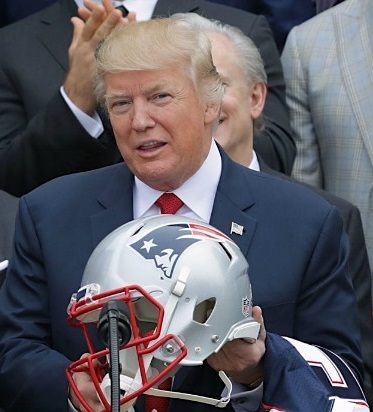
President Donald Trump, holding a New England Patriots helmet at the White House celebrating the Pats’ Super Bowl LIII victory. He managed to conflate a football beneficiary of the former Alabama coach running for the Senate with the man who coached the Pats’ American Football League ancestors, among others.

When last we had occasion to think of Donald Trump in sports terms having nothing to do with kneeling during the National Anthem, he attended Game Five of the last World Series in Nationals Park. He was booed rather lustily, with intermittent chants of “Lock him up!” punctuating the chorus.

The “lock him up!” chants returned in the seventh inning—not for President Tweety, but for home plate umpire Lance Barksdale, whose evening to that point was full of such dubious calls (including the fourth ball called a third strike on Nationals outfielder Victor Robles during the inning) that both Nationals and Houston Astros fans alike wanted him in the stockade.

Now, though, the president about whom “polarising” often feels high praise arouses the attention of Deadspin, the online sports publication. He arouses it by way of the campaign trail, on a conference call, supporting former longtime Auburn University football coach Tommy Tuberville’s campaign as Alabama’s newly-crowned Republican nominee to the U.S. Senate.

Trump wanted to praise Tuberville as the reason the University of Alabama hired a particular football coach, after the Auburn Tigers bushwhacked the Crimson Tide in six straight meetings between the two schools. Then, he wanted to praise that coach. Uh, oh. “Beat Alabama, like six in a row, but we won’t even mention that,” President Tweety began, starting with Tuberville. “As he said . . . because of that, maybe we got ‘em Lou Saban . . . And he’s great, Lou Saban, what a great job he’s done.”

Crimson Tide coach Nick Saban must be double-checking his records to be sure he didn’t change his name inadvertently, somewhere. And, to re-assure himself, with apologies to Mark Twain, that the reports of his death have indeed been exaggerated greatly. The National Football League and its long-ago-absorbed upstart competitor the American Football League would love to know how the real Lou Saban coached from beyond.

That real Lou Saban, as Deadspin couldn’t wait to remind anyone caring, coached in both American pro football leagues and in college football for a very long time. But not past 2002, after a decade of working at far lower than Division I programs.

The president who once denounced the late Sen. John McCain for having been captured as a prisoner of war during the Vietnam War (“I like people who weren’t captured”) and makes a fetish of “winning” (without stopping to think that one man’s “winning” is another’s self-immolation) chose quite a winner to conflate with Alabama’s incumbent football coach.

Saban, who may or may not be a second or more distant cousin to Nick, was a charter coach of the Boston Patriots, when the AFL was born in 1960. From there he enjoyed a sixteen-season career coaching in the AFL and—when his Denver Broncos moved with the merger—the NFL. He had three first-place finishes (coaching the Buffalo Bills, 1963-65) and two AFL championships. And that’s all, folks.

He had six winning seasons in sixteen coaching the pros. His final record as a pro football coach is 95-99-7. Except for his back-to-back AFL championships, Saban never led his teams past a single playoff win. He did get to return to the Bills in 1972, coaching the teams fabled for O.J. Simpson and the Electric Company offensive line, but they never got past second place or a single playoff loss, either. He resigned after a 2-3 start in 1976 and never coached in the NFL again.

But he did return to the college coaching lines, which he’d visited once in the middle of his pro coaching life (University of Maryland: 4-6 in 1966), and where his coaching career began for a single season in 1956. (Northwestern University: 0-8.) He coached the University of Miami to back-to-back losing seasons (1977-78) and Army (1979) to one losing season. His complete coaching record at the major schools: 15-35-2.

Saban left Miami in the middle of a row over three freshman players attacking a Jewish student in yarmulke while he walked toward a campus religious service. They carried him to Lake Osceola in the middle of the campus and threw him in. Having been off campus when the attack happened, Saban returned to learn of it and say, according to Bruce Feldman’s history of Miami football, “Getting thrown in the lake? Sounds like fun to me.”

After he left Army, Saban took a brief, curious career turn. He became one of George Steinbrenner’s “baseball people,” doing Steinbrenner (a personal friend) a favour and becoming president of the New York Yankees for 1981-82. Even allowing that Steinbrenner did love football, engaging a football lifer as a baseball president seemed along the line of hiring a furniture designer to develop vacuum cleaners.

If Saban had anything to say about some of the turmoil around those Yankees, there seems little enough record of it:

* Steinbrenner fired first-time manager Gene Michael in 1981, after Michael challenged The Boss to knock it off with the constant threats. Steinbrenner’s bid to mollify The Stick became a classic of Yankee panky: Why would you want to stay manager and be second-guessed by me when you can come up into the front office and be one of the second guessers?

* Steinbrenner burned through three managers in 1982: Hall of Fame pitcher Bob Lemon (who’d picked up Billy Martin’s pieces and led the Yankees to a World Series championship in 1978), Michael again, then Clyde King.

* Steinbrenner hired former Olympic hurdler Harrison Dilliard to help turn the Yankees into a speed team, an idea so hilarious as it was accompanied by continuous running drills in spring training that wags began calling the Yankees “the Bronx Burners.” (The experiment lived only slightly longer than some Yankee managers kept their jobs.)

The man who thought it sounded like fun for three of his Miami players to dunk a Jewish student in Lake Osceloa isn’t on record anywhere that I know of suggesting what fun Steinbrenner’s King of Hearts act in the south Bronx must have been for those on the wrong end of His Majesty’s scepter.

Lou Saban died at 87 in 2009, two years after Alabama hired Nick. He might not have had a real reputation as a long-term winner but he did have one as a teacher. He was also in no position to be the direct beneficiary of  Tuberville’s constant seawalling of the Crimson Tide. Alabama isn’t exactly renowned for hiring octogenarian head coaches. Nick Saban, on the other hand, has a long-term winning reputation in college football: a 248-65 record; three Bowl Championship Series wins; and, ten bowl game wins otherwise.

Deadspin offers the charitable suggestion that Trump might have conflated Saban with Lou Holtz, the Notre Dame coaching legend. Careful with that axe, Eugene: In some portions of the South, confusing or conflating a Crimson Tide coach with some Hoosier coach can provoke the same kind of tavern debate (if not brawl) as could be provoked in the northeast, formerly,  if you inadvertently confused or conflated Mookie Betts with Mookie Wilson.

Trump’s sports record is dubious at best, shall we say. When he hasn’t beaten his gums about kneeling National Anthem protesters (a subject for another time, for now), he’s been a football owner (in the failed United States Football League some say he destroyed in the first place), a less-than-knowledgeable advocate (speaking politely) of Pete Rose’s reinstatement to baseball and election to the Hall of Fame, and a public critic, equally less than knowledgeable, of Maximum Security’s rightful disqualification in the 2019 Kentucky Derby.

With an expert like that on his side, I’m not entirely sure that Tuberville—whose own college football coaching career was impressive enough (159-99 record; seven bowl wins)—needs adversaries.

They boo presidents, don’t they?

2019-10-27 NationalsPark

The boo birds arose when the president was shown at World Series Game Five Sunday night.

This may disappoint those among his loyal fans who like to think everything he does is without precedent, but Donald Trump isn’t even close to being the first sitting president who was ever booed at a baseball game. That news might bother President Tweety, too, since he likes to think he does things that nobody else has done or would do.

It might surprise no few of Trump’s sycophancy to know that even Democrats were troubled when the president’s mug from a Nationals Park luxury box hit the large video screen on the scoreboard before World Series Game Five and the boo birds chirped and sang “Lock him up!” through the booing.

Frankly think the office of the president deserves respect,” said Sen. Chris Coons (D-Delaware), “even when the actions of our president at times don’t.”

Trump, of course, played some high school baseball and was actually scouted by the Phillies at the time, choosing instead to follow his father into the real estate game. From his presidential inauguration until Game Five, however, President Tweety hadn’t gone to a single live Washington sporting event. Not even when the Nationals reached the postseason in 2017.

In the seventh inning during the Astros’ 7-1 Game Five win, the Nats Park crowd began chanting “Lock him up! Lock him up!” again. But the target that time wasn’t Trump, it was home plate umpire Lance Barksdale, whose evening full of dubious pitch calls—especially the ball four he called strike three with Nats center fielder Victor Robles at the plate that inning—had both Nats and Astros fans outraged.

The problem with Coons’s distinction between the man and the office is that it works far more intellectually than viscerally. Human nature is what human nature is. Ordinary American citizens write screeds against presidents they despise without being accused of despising the office except by those who adore the targets of their wrath. The law is mostly wonderful that way.

And ballpark crowds have booed individual presidents in the past without once believing they’re booing the presidency, even if they don’t always throw in chants to lock them up. Always have, as the Washington Post‘s “D.C. Sports Bog” writer Matt Bonesteel reminds us. And one or two of them were former baseball people themselves.

Herbert Hoover, for example. He played ball at Stanford University, and also served as its team’s student manager. He played shortstop until a dislocated finger compelled him to stop, but it isn’t known whether he played the position like the signature product of the non-related manufacturing family that bore his surname.

Bonesteel reminds us Hoover’s favourite newspaper reading was the sports section. He made a point of throwing out the ceremonial first pitch at every Washington Senators home Opening Day during his single-term presidency. He also went to World Series games in three years, all to watch the Philadelphia Athletics.

And when he went to his final such game in Shibe Park in 1931, the Philadelphia boo birds chirped. Loud. Not because the A’s were doing horribly (they lost two of the three games in Shibe, and would lose the Series in seven to the Cardinals) but because the country was. The Great Depression took hold in earnest, and Prohibition-weary Philadelphians needed a drink pretty much as badly as the rest of the country did.

Hoover was a lukewarm Prohibitionist at best but he often urged the country to dry up about the Eighteenth Amendment and the Volstead Act. Upon his World Series presence the Shibe Park audience chanted “We want beer!” when not booing. “Perhaps,” wrote the (shall we say) acidic columnist Westbrook Pegler, referencing bootlegging, “Philadelphia is tired of whiskey and gin.”

About two decades later, the country wasn’t entirely tired of Douglas MacArthur even if Harry Truman was. Truman had canned MacArthur as commander of U.N. Forces Korea, and the day before Opening Day 1951 in Washington’s Griffith Stadium MacArthur delivered his fabled “Old Soldiers Never Die” valedictory to a joint session of Congress.

When Truman attended that Opening Day and threw out a ceremonial first pitch, the crowd gave Harry a little hell. He got booed even more lustily as the eighth inning approached and the public address announcer asked the crowd to stay seated until the president and his entourage left the park.

Trump isn’t even the first president under the threat of impeachment to get booed at a baseball game. Sen. Robert A. Taft (R-Ohio) called for immediate impeachment hearings when Truman pinked MacArthur, and Truman’s approval ratings sank lower than the worst of Richard Nixon’s during the worst of the Watergate scandal. There goes another precedent, Mr. President.

The first President Bush-, a former Yale first baseman, took it on the chin from the boo birds at the 1992 All-Star Game in San Diego’s Jack Murphy Stadium—Hall of Famer Willie Mays served as an honourary National League captain—perhaps as lingering fury over his broken tax hike promise.

The president didn’t throw out the ceremoninal first pitch that day; San Diego’s native-son Hall of Famer Ted Williams did, after a handshake and pat on the back from the chief executive. But when Bush was introduced formally before the game, the booing cascaded downward.

The second President Bush, formerly the co-owner of the former Senators long entrenched in Texas as the Rangers, got a lusty round of applause when major league baseball returned to Washington in 2005 and he threw out the ceremonial first pitch not long after he was renewed for a White House lease.

He used the ball former Senators pitcher Joe Grzenda didn’t get to pitch to Horace Clarke to try finishing a Senators win in their last-ever home game—because heartsick fans stormed the field, rioted, and compelled a forfeit to the Yankees. And he fired a near-perfect strike to further lusty applause.

But at the Nats’ home opener for 2008, Bush—again wearing a Nationals team jacket as he had in 2005—walked out of the dugout to throw out another ceremonial first pitch. This time, the boo birds out-hollered the cheers rather convincingly for a few moments. The country’s war weariness and economic jitters probably had more than something to do with it.

The boos faded back enough by the time Bush reached the mound to fire one high and to the left of then-Nats manager Manny Acta. A lefthanded hitter would have stood at ball one; a righthanded hitter would have been clutching his head after hitting the batter’s box with a thump.

Barack Obama got his when the boo birds in St. Louis competed with the cheers, as he strode to the Busch Stadium mound—in a White Sox jacket—to throw out a ceremonial first pitch before the 2009 All-Star Game. Obama threw an eephus pitch that might have been clobbered for a home run by a hitter smart enough to wait it out and take a couple of steps forward in the box.

Strangely enough, I could find no record of such presidents as Lyndon Johnson, Richard Nixon, and Bill Clinton being booed (or, in Nixon’s and Clinton’s cases, hit with “lock him up” chants or similar hollers) when they threw out ceremonial first pitches. Hard to believe considering Vietnam, Watergate, and Whitewatermonicagate.

But when Hillary Clinton was First Lady and threw one at Wrigley Field’s Opening Day 1994, she got some boos mixed in with the cheers, doubtless residue from the HillaryCare debacle. And she threw the ball the old fashioned way—from a box seat, not from the mound. She would never have cut the mustard in Mary Tyler Moore’s parlour.

So President Tweety, his minions, and his fanbois and girls can relax. He’s not the first president controversial enough to get a phlegm-and-bile bath at the old ball game. And, whether he is re-elected, or someone from among the Democratic Party’s current gaggle of geese is plain elected next year, he’s not likely to be the last, either.