The unsinkable Mariners

Jorge Polanco

Jorge Polanco shooting the game and ALDS-winning base hit for the Mariners in the bottom of the fifteenth . . .

“Life is what happens when you’re busy making other plans,” sang John Lennon on the last album he released in his lifetime. Instead of singing it in the middle of a sweet lullaby he wrote for his then five-year-old son, the former Beatle could have been singing about baseball.

He could have been singing, too, about such contests as the just-concluded American League division series between the Tigers and the Mariners. The one that came to a fifth game that came down to a fifteenth inning and, possibly, both teams wondering just whom was going to commit a fatal flub, flop, or faux pas, Phillies-like or otherwise.

“It felt the whole game,” said Tigers shortstop Javier Baez post-mortem, “like whoever made a mistake was going to lose.”

Well, nobody in either Tiger or Mariner uniforms made any truly grave mistakes Friday night. The Mariners punched their ticket to the American League Championship Series the old-fashioned way, a hair-raiser of a ball game they finished when Jorge Polanco slashed a single with two out and the bases loaded in the bottom of the fifteenth.

Until that half-inning, the Tigers and the Mariners threw everything at each other except the proverbial kitchen sink. The sink showed up in the bottom of the fifteenth. When Tommy Kahnle relieved a gutsy Jack Flaherty for the Tigers, and J.P. Crawford opened the proceedings with a base hit, the third Mariners leadoff runner in four innings.

But Kahnle followed that by plunking Randy Arozarena on the first pitch, before Cal Raleigh lined out but left Arozarena safe at second thanks to Tigers center fielder Parker Meadows’s errant throw. Then the Tigers ordered Julio Rodriguez walked on the house. In situations leaving first base open with a season on the line, it was the smart move after dodging a Raleigh artillery shell.

Now came Polanco. He and Kahnle fought to a full count with no place to put him. Then Kahnle threw a fastball Polanco shot on a line through the right side and into right field, Crawford racing home and jumping onto the plate and into the arms of teammates who might have been forgiven if they’d just been wondering how much longer this epic could play.

“The back half of that game is like a game in itself,” said Tigers manager A.J. Hinch post-mortem. “We dodged a few bullets, and so did they . . . I didn’t want it to end, certainly,  the way that it did, but I wanted to just keep giving ourselves a puncher’s chance, and they outlasted us.”

Until the bottom of the fifteenth, it was fair to say the Tigers and the Mariners outlasted each other.

From the brilliance of starting pitchers Tarik Skubal and George Kirby to the magnificence of both bullpens plus a pair of starting pitchers pressed into all-hands-on-deck relief service, this game made you wonder whether anyone from the big bats to the supporting cast really knew how to hit anymore.

Skubal in particular pitched like the Cy Young Award winner he seems destined to become this year. He surrendered one run but set a new postseason record with seven straight strikeouts, then set another one with thirteen total strikeouts in a postseason elimination game. He pitched six virtuoso innings and left with his tank below empty.

How could he have known at that moment that things would end up with him making grand, Hall of Famer-like showings in his two ALDS starts but his team ending up on the losing side?

Kirby was almost as brilliant as Skubal. In fact, the only run charged against him scored when he’d left the game in the bottom of the sixth, after surrendering Baez’s leadoff double. Gabe Speier took over and Tigers right fielder Kerry Carpenter hit a 1-0 service into the right center field seats.

That gave the Tigers a 2-1 lead lasting long enough for the Mariners in the bottom of the seventh to tie it up with a little shuck-and-shuffling on the part of skipper Dan Wilson.

He sent Dominic Canzone to pinch hit for Mitch Garver, whose second-inning sacrifice fly opened the scoring in the first place. Hinch promptly brought Tyler Holton in to relieve Skubal’s relief Kyle Finnegan. Wilson countered by sending Leo Rivas up to pinch hit for Canzone.

In the first postseason plate appearance of his major league career, measuring Holton for the cutters and changeups he was most likely to throw, Rivas took a strike, then lined a changeup for a base hit to left to send Polanco home with the tying run.

From that point forward, the bullpens, with or without starters pressed into emergency all-hands-on-deck duty, were brilliant, even when they were slithering, sneaking, or bludgeoning their ways out of jams you could charge were some of their own making.

“It was like (we) got them on the ropes, and then they wiggle out of it. They got us on the ropes, and we wiggle out of it,” said Finnegan postgame. “It was an absolute roller-coaster of a game. That’s the beauty of this sport.”

“A heartbreaker of a finish,” said Tigers first baseman Spencer Torkelson, who’d gone hitless in six Game Five plate appearances, “but an unbelievable baseball game to be part of.”

“My experience feels like the ground was shaking every inning,” said Rivas. He wasn’t exactly wrong. Especially over the extra innings, when it seemed nobody in T-Mobile Park dared to sit back down.

“We knew this was not going to be a football score, that it was going to be a tight pitchers’ duel,” said Mariners president of baseball ops Jerry Dipoto, himself a former major league pitcher, “and our general take was: keep it close until Skubal’s out of there and we’ve got a chance to win this game.”

Even if it took nine innings from Skubal’s exit to do it. But once Speier yielded to Matt Brash, what came out of the Mariners’ bullpen—including and especially starters who hadn’t relieved in either eons or since early minor league days, whichever came first—was magnificent.

Brash himself got six outs for the first time since 2003. Andrés Muñoz, the Mariners’ usual designated closer, walked a pair but escaped and then pitched a spotless ninth. Logan Gilbert, a starter, pitched a pair of scoreless innings. Eduard Bazardo landed eight outs, something he’d never done in his career until Friday night. Luis Castillo, who hadn’t relieved in almost a decade, got rid of all four batters he faced.

The problem was the group of people rooting and cheering even louder than the ballpark crowd: the Blue Jays. Broadcast announcers noted it until even they got sick of saying it, but as the extra innings accumulated the Blue Jays had to have been roaring with delight knowing that, whichever team would meet them in the ALCS, that team’s pitching might be depleted temporarily.

That’s not what you want to throw at the Blue Jays and their own howitzer offense in their own playpen to open. The ALCS may come down to first and second game survival for the Mariners before they can bring the set back to T-Mobile Park. But when they do, the Mariners have at least one comfort upon which to lean: the Blue Jays were a game below .500 on the road while playing .667 ball at Rogers Centre.

And both teams want to end pennant droughts expeditiously as possible.

The Blue Jays haven’t hit the World Series since they won their second of two straight in 1993. The Mariners haven’t hit the World Series at all in their 48 years of existence. The last time they showed up in an ALCS, they’d won 116 games on the regular season, had the 2001 Rookie of the Year in future Hall of Famer Ichiro Suzuki, another Hall of Famer in Edgar Martinez, and lost to the Yankees.

The Tigers haven’t reached a World Series since 2006 or won one since 1984. They wouldn’t mind ending a drought, either. But on a night when Carpenter went four-for-five while the rest of the Tigers managed only four hits, Carpenter becoming the first since Babe Ruth to reach base five times and homer in a winner-take-all postseason game probably made Tiger fans wish they could have run nine of him to the plate Friday night.

It’s hard to think, “What a year,” when thinking of the Tigers. Sure, they’re talented, likeable, and their own kind of resilient. But these are the same Tigers who became this year’s first to win thirty, then forty, then fifty, then sixty games . . . before the worst September win percentage of any postseason baseball team ever. They played September as if on crutches.

The Mariners won their division handily enough, playing September with controlled fury and rolling their best month’s record of the season, 17-8/.680, while earning a round-one bye in the postseason. They proved unbreakable when the Tigers took them to the bitter end Friday night.

And the game proved unbreakable without Manfred Man, the free cookie on second base to begin each half inning. Manfred Man’s extinction should not be restricted to the postseason alone. No mistake.
A tale of two front office executions

Chris Young, Jon Daniels

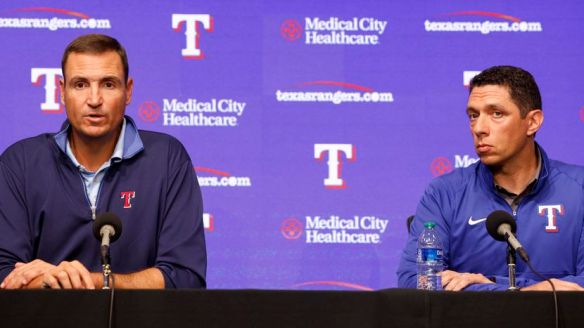
Pitcher-turned-MLB executive-turned-Rangers executive Chris Young (left) now succeeds Jon Daniels (right) as the Rangers’ GM . . . but the move’s timing days after Daniels was made to fire manager Chris Woodward was strange to be most polite.

When the Rangers executed manager Chris Woodward and general manager Jon Daniels, it looked at first as though the organisation simply decided too much was too little and enough already. Likewise when the Tigers decided several days earlier that there was a guillotine with general manager Al Avila’s name on it.

Avila’s dispatch wasn’t exactly likely to generate much in the way of sympathy or empathy.   Tigers owner Chris Illitch probably starting drawing up the warrant after Avila made a pair of 2017 deals that sent away future Hall of Fame pitcher Justin Verlander and ace designated hitter J.D. Martinez and brought back what proved no major league help.

Both those players went from there to help make World Series wins possible with their new clubs, back-to-back even: Verlander helped pitch the Astros to the 2017 Series rings and Martinez helped swing the 2018 Red Sox to the rings a year later.

Never mind how tainted both Series triumphs are, though it’s possible to make the case that Verlander (and his fellow Astros pitchers) wasn’t exactly among the conspirators that birthed and bred Astrogate. And we don’t know for dead last certain whether or how often Martinez himself benefitted from the Rogue Sox’s replay room reconnaissance ring.

From Avila’s first season on the job his Tigers, as Defector notes, were baseball’s second-worst hitters and second-worst pitchers on a team level, not to mention the second-worst in the Show for winning and losing—behind the Orioles, who’ve spent this year going remarkably and maybe inexplicably from the tanks to within a half game’s reach of the wild card picture.

“Then again,” observes Defector writer Ray Ratto (once a longtime San Francisco Bay Area sportswriter), “[Orioles GM] Mike Elias didn’t guarantee a quarter billion dollars in current and future salaries to players who have amassed a 43-68 record, worse than every team in baseball save Oakland and Washington, who have shed payroll to be bad. Spending more to be just as bad is, well, spectacularly contraindicated.”

That was the Avila legacy in an envelope. He gave them his son Alex as a catcher and in exchange steered the team into a ditch. His best year was his first, and that’s never a good way to keep the boss from snarking you up on your way out the door. The current team is on pace to have its second-lowest runs per game output in franchise history (and since we know you’re going to ask, 1904) and the fewest homers in a full season since 1954. We’d call them God-awful, but God has lawyers.

. . .The Tigers just . . .  faded away. Neither hated nor condemned, they just eased into the Phantom Zone and stayed there. They’re not even appreciated for playing the fastest games in the majors, which is the one blessing you can provide your fans when you stink on a daily basis.

Al Avila

Al Avila, watching the Tigers work out the day before Opening Day, seeded his demolition with two 2017 trades.

In other words, if Avila was actively and consciously tanking, he had a mad genius for doing it as far away from deep scrutiny as the current Cubs, Reds, Royals, Pirates, and Nationals have drawn. (“Even the Angels get more condemnation,” Ratto writes wryly, “but that’s because unlike the Tigers, they kept their best players and still failed.”)

So the rebuilding Tigers have to start their rebuild all over again. So, apparently, do the Rangers, whose owner Ray Davis announced Daniels’s firing by saying, “Bottom line is we’re not good, and we haven’t been good for six years. To be competitive going forward, I felt that we needed to make a change.”

It was the way Davis made the change that left more than a few eyes rolling and jaws falling. He made Daniels announce Woodward’s wiring into the electric chair just a couple of days before he threw the switch on Daniels himself, whose contract was due to expire at season’s end.

Saying the decisions were brewing for several months before last Monday’s Woodward execution leaves Daniels with what The Athletic‘s Rangers beat writer Levi Weaver calls “a bad look.” That’s like saying the deal with Adolf Hitler to swap Czech freedom for “peace in our time” left Neville Chamberlain with nothing more than the proverbial egg on his face.

Except that the Czechs knew exactly what was coming, even if portions enough of the world around them still couldn’t believe it. As Weaver writes, Daniels was sent to face the press explaining Woodward’s dispatch with no knowledge that his own hemlock cocktail was being mixed.

What troubles Weaver is that, for all that dispatching Daniels might have been necessary at last, it was done not only underhandedly but a couple of years too late:

After all, as Davis made sure to point out, the Rangers haven’t had a winning season since 2016. In retrospect, the rebuild that began in earnest in 2020 probably should have begun in 2017 — never mind that one source familiar with proceedings said that Daniels intended to do just that, but was pressured into putting a better product on the field for the first season of the new ballpark. Still, Nomar Mazara, Rougned Odor, Chi Chi Gonzalez and a passel of other home-grown talent didn’t turn out to be the next core of stars that fans hoped. Those decisions land at Daniels’ feet and maybe warranted a parting of ways.

But if that were the case, it should have been done back in 2020, when it was clear that plan hadn’t worked.

Those are purely baseball considerations. They fall under such headings as the Rangers’ farm yielding negligible crops; the front office’s unique stability in the Daniels era meaning a lack of fresh blood; and, a lot of circumstantial misfortune such as a pitching staff bedeviled with injuries over too long a period.

But Weaver isolates another problem with the manner in which Daniels was handled now. Reporters so often speak to a man’s peers in a business and Weaver learned things about Daniels from fellow GMs and their underlings that might make him an exception rather than a rule in a sport whose business is as cutthroat and duplicitous as its play is ennobling.

“Daniels cared about his people,” Weaver writes. “Sometimes, in the opinion of those around the league, he cared too much, seeing the best in his employees and keeping them around when others might have pulled the plug.”

Sure, he would make a hard decision when he had to — occasionally, the fit between employee and organization just wasn’t working and it was time to part ways. But the only times Daniels ever took me to task for my reporting was when I wrote those stories. Every time, the message was the same: if you need to blame someone, blame me. I don’t want this guy’s family to read him getting ripped in the press. I’m front-facing; I can handle it.

With [Daniels’ sudden firing] it’s clear that loyalty didn’t work its way up to the ownership level . . .

. . . Choosing one’s employees is an owner’s prerogative. But to fire Daniels publicly after such a long tenure showed a lack of common courtesy or decency. Even if Davis had decided not to renew Daniels’ contract at the end of the year, keeping him around to help with the transition would have accomplished two things. One, it would have given some well-deserved dignity to Daniels, allowing him to quietly step down at the end of the season. He has earned that, and to surprise him with a firing now — just two days after he was the face of a managerial firing — is disrespectful at best.

Secondly, allowing Daniels to finish the year could have potentially been beneficial to [pitcher turned MLB vice president in charge of discipline to Daniels understudy Chris] Young. In an advisory role, Daniels could have helped to prepare Young for the remainder of the responsibilities he was inheriting. We’ll never know now: Davis didn’t run the idea by Young before making the move, opting to act now and let Young deal with the fallout.

Respected for brains on the mound and as a baseball executive in the making, Young doesn’t exactly have people worrying about whether he’ll crack. But Daniels had almost two decades on the job and shepherded the last two (and back-to-back while they were at it) Rangers World Series entrants. (They lost decisively to the Giants in 2010; they were two outs from winning the 2011 Series when they ran into a Cardinals buzz saw named David Freese.)

Daniels and Young enjoyed a close relationship for a very long time, going back to Young’s initial major league seasons pitching for the Rangers. Surely Young knows that being a people person was one of Daniels’s above-average strengths. And the Rangers have had small improvements this year even if they weren’t obviously making more better promises for next year.

How Young balances himself between people personhood and making the hard assessents of the Rangers’ roster and front office should provide interesting observations. But if he assesses the depth of the handling and timing of his former boss’s sentence to the Phantom Zone and finds himself compelled to keep one eye over his shoulder, you can’t necessarily blame him.

3,000 hits, and one for the game’s integrity

Miguel Cabrera

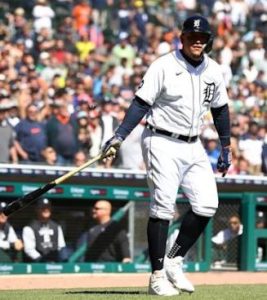
Miggy Stardust standing alone at first base after becoming baseball’s only 3,000-hit/500-home run/Triple Crown winning player Saturday afternoon.

Well, it proved too much to ask that Miguel Cabrera should get number 3,000 by launching one over the fences in Comerica Park Saturday afternoon. Sometimes the Elysian Fields insist that drama takes an inning off. But he didn’t wait long for the big knock, either. A sharply-cued single is equal to a home run in the hit total.

With Robbie Grossman aboard with a leadoff single in the bottom of the first, Cabrera shot a 1-1 fastball from Rockies pitcher Antonio Senzatela through the right side of the infield as if he’d lined up a money shot in a pool tournament. The bedlam began before he had a chance to hold up at first.

The Comerica audience chanted and cheered down upon him from just about the moment he left the batter’s box. He raised his fist at first as the ballpark scoreboard gave him the fireworks equivalent of a 21-gun salute. Former teammate José Iglesias, now a Rockie, ambled over to give him a bear hug—and the ball he’d just hit into history.

The Tigers poured out of their dugout to congratulate their man. His wife, his son, his daughter, and his mother gave and received hugs with him behind the plate while time was still in effect. Who says it wasn’t worth the extra day’s wait?

Cabrera barely had time to settle back in at first base when Jeimer Candelario struck out but Jonathan Schoop pushed him to second and Austin Meadows (safe on a fielder’s choice) home with an infield hit, and Spencer Torkelson—who’s taken first base over while Cabrera settles in strictly as a designated hitter—hit Senzatela’s first pitch to him into the right field seats.

Just like that, the Tigers showed they knew how to celebrate Miggy Stardust’s big knock the right ways. Then, after Grossman singled home a fifth run in the fourth, the big puddy tats ramped up the party with two outs in the sixth, and the guest of honour struck again, his two-run single being sandwiched between a pair of RBI singles, including Candelario pushing Meadows home on another infield hit.

Tigers manager A.J. Hinch gave Cabrera the rest of the game off, and his mates treated him to another two-out four-run inning in the seventh, this time Meadows singling home a pair, Candelario drawing a bases-loaded walk, and Schoop singling Meadows home. The Tiger bullpen took care of the rest, even if Angel De Jesus had to claw his way out of a self-inflicted bases-loaded jam to seal the 13-0 win.

That was the opener of a doubleheader in which the Rockies threatened to shut the Tigers out in the nightcap until Meadows hit a two-out, two-run triple off Rockies reliever Alex Colome. But Colome struck pinch hitter Harold Castro out swinging on three straight cutters to nail the 3-2 Rockies win.

Cabrera picked up another base hit in the nightcap’s bottom of the first to set first and third up for Candelario, who struck out swinging before Meadows forced the guest of honour at second for the side. But nothing could spoil Cabrera’s party, not even a doubleheader split. Nothing could spoil him becoming the first man ever to nail 3,000+ hits, 500+ home runs, and win a Triple Crown.

Not even the Comerica crowd booing wrongly when the Yankees ordered him walked in the bottom of the eighth Thursday, so their lefthanded reliever Lucas Luetge could have a more favourable matchup with the lefthanded-hitting Meadows.

That debate poured into the following two days, even as the Tigers and the Rockies were rained out of playing Friday night. It was a foolish debate, in which the booing Tiger fans proved nothing more than that they’re not averse to a little tanking—when it might involve one of their own getting the ideal matchup to get the big knock after he’d gone 0-for-3 thus far on that day.

Down 1-0, Yankee manager Aaron Boone could have been accused of a little tanking himself if he’d let Luetge pitch to the righthanded Cabrera, whose splits show he manhandles pitching from both sides but is that much better against the portsiders, and handed Cabrera the immediate advantage going in.

Boone had even a slight a chance to hold those Tigers and keep his Yankees within simple reach of overcoming and winning. History be damned, he took it. And even if the lefthanded-swinging Meadows did wreck the maneuver promptly with a two-run double, it happened just as honestly as the free pass to Cabrera occurred.

“What a shame and not a good call by the opposing team,” sniffed one social media denizen about the Yankees, a sentiment expressed by only a few too many thousand from the moment Cabrera took his base that day. “Just let him have his victory at home for the fans. What a shame.”

Just “let” him have his victory?

No—the shame would have been if the Yankees let Cabrera have one more chance to  help beat them even with an historic hit providing a little extra Tiger insurance. The game’s integrity includes especially that everyone present and playing makes an honest effort to compete and win. That’s what the Yankees did in that moment.

Cabrera may be aging, but he’s still a formidable bat. A Hall of Famer whose age is only too pronounced but whose spirit and love of the game hasn’t been eroded out of its career-long presence is too smart not to know the Yankees weren’t about to let him bury them alive if they could help it.

So he waited an extra day or two to swing into the history books. The only thing wrong Saturday was probably that it couldn’t have been a home run. It’s happened before when baseball competition required precedence over baseball history. It can happen again with the next significant milestone approached by the next significant player. For integrity’s sake, we should hope that the participants play the game right then, too, even if it means history waiting an extra day or two.

The Comerica Park racket after Cabrera pulled up at first in the first should tell you one historic swing wasn’t just worth the wait, it was good for baseball, the Tigers, and Miggy Stardust. And in that order.

A Saturday special for Miggy Stardust?

Miguel Cabrera

Miguel Cabrera beamed while tapping his heart, as manager A.J. Hinch helpd him accept a memento from the Tigers for his 500th home run last fall. His 3,000th hit was put on hold one more day by Mother Nature.

“I think,” Miguel Cabrera said when asked his first reaction after he might nail hit number 3,000, “I’m going to cry.” Then, he said, he’d remember the uncle who taught baseball to him in his native Venezuela. He also asked for “El Alma Llanera” to be played through the Comerica Park PA system after he nailed the hit.

He didn’t exactly ask for the rainout Friday that postponed it another day.

Amo, lloro, canto, sueño, con claveles de pasión, the song’s lyric says in part: “I love, I cry, I sing, I dream, with carnations of passion.” That’s as good a short description as any you might find of the way Cabrera has played baseball. Even if it omits mention of high-wattage smiling. Cabrera’s been as good at that as he’s been at the plate.

“So long as one can grasp concepts like ‘fun’ and ‘joy,’ Miguel Cabrera has always been delightfully uncomplicated,” writes Bleacher Report‘s Zachary D. Rymer. “Rarely has he shown any pretense that he’s doing something other than playing a game for a living.”

“I used to low-key creep your at-bats in my hotel room EVERY SINGLE NIGHT, after our games,” tweeted Reds first baseman Joey Votto this past Wednesday. “I knew I had to study the best to beat the best. Good luck with your final steps to 3000. You are a joy to watch.”

Votto wasn’t talking about his own hitting, necessarily, so much as he might have been talking about how him and his team could keep Miggy Stardust in check. That was about as simple as trying to stop an oncoming train with a bathroom plunger.

Cabrera may be unpretentious about the game he plays and the game he brings to it, but this is a player whose first major league hit was a home run, whose 1,000th career hit was a home run, and whose 2,000th hit was also a home run. Would it be too much to ask the Elysian Fields to arrange for number 3,000 to clear the fence for Cabrera this weekend?

Wouldn’t it?

They already arranged it for Hall of Famers Derek Jeter and Wade Boggs. They swung it for Álex Rodríguez. But you wouldn’t necessarily bet against them moving their huge hands on Cabrera’s behalf, either. Not for a player who will become the only man in Show history to collect 3,000+ hits, 500+ home runs, and a Triple Crown.

Fifteen other Hall of Famers—including Oscar Charleston, Ty Cobb, Jimmie Foxx, Lou Gehrig, Josh Gibson, Mickey Mantle, Frank Robinson, Ted Williams, and Carl Yastrzemski—were Crown winners without finishing where Cabrera will finish in all three of those places. (Charleston and Gibson, of course, were limited to the Negro Leagues and their shorter playing schedules arbitrarily and unfairly.)

The chunky first baseman/designated hitter whose face is still mostly that of a wide-eyed ten-year-old boy is about to travel aboard his own exclusive jet. Cabrera’s surname translates to “goatherd.” He’s made goats out of plenty of pitchers from the most modest to the Hall of Famer alike.

In ten or more lifetime appearances each against five Hall of Famers, Cabrera would have a 1.000+ OPS if it wasn’t for John Smoltz, against whom his OPS is a puny .611. He has a 1.105 OPS against Greg Maddux, a .933 against Tom Glavine, a .912 against Pedro Martínez, and an .833 against Randy Johnson. When Miggy Stardust enters Cooperstown, he’ll enter with four sets of bragging rights.

The single mark against Cabrera is that he’s been a career-long negative defender. Among first basemen—and Cabrera’s played more games there than at third base since 2014—he’s five fielding runs and 38 defensive runs saved below his league average. As all-around first basemen go, Albert Pujols he ain’t.

Among third basemen, he’s less: 46 fielding runs and 88 defensive runs saved below his league average. As all-around third basemen go, Mike Schmidt he ain’t. (I could have said Adrián Beltré, too, but Beltré finished 23 short of the 500-bomb threshold, alas. It won’t keep him from welcoming Cabrera as a Hall of Famer in due course.)

He hasn’t exactly been the Road Runner on the bases, either. In fact, he’s barely beyond Cecil Turtle but without Cecil’s bag of sneaky tricks. Cabrera has only 106 infield hits in 2,999. And he’s stolen in a career (39) what Hall of Famer Rickey Henderson could steal in a season—near the end of Henderson’s career.

Cabrera has tried sixty thefts and been arrested a little over a third of the time. He’s only tried an average of three times per season. It may be miraculous, or a case of catching the other guys with their pants down, that he has a .650 lifetime stolen base percentage. Presumably, his teams warned him that any more than three tries a year would get him arrested for malicious mischief.

Except there’s no malice aforethought involved with Cabrera. This is the guy who’s been seen hugging opposing fans in the seats when diving for a foul ball, and giving Phillies pitcher Jeremy Hellickson a grinning thumbs-up, after Hellickson once struck him out on a changeup nobody could hit—even swinging a shovel.

It takes something to stay the course even when your team has collapsed. As age and injuries caught up to Cabrera from 2017 through the end of last season, only one team in Show lost more than the Tigers in the same span. Now, the Tigers actually look like a team approaching true contention, and Miggy Stardust is their still-enthusiastic elder statesman.

Mother Nature trumped the Elysian Fields to rain the Tigers out Friday night. Maybe she knows something we and they don’t. Something about a Saturday special that turns Comerica Park into the hardiest party spot in Detroit.

Cabrera and the Yankees have it right

Miguel Cabrera

A free eighth-inning pass after going 0-for-3 to that point Thursday outraged Tiger fans far more than it outraged Miguel Cabrera to remain one knock short of 3,000.

I don’t want to pour any more gasoline onto the fire of Tiger fan’s outrage, but Yankee manager Aaron Boone did the absolute right thing Thursday afternoon. And it wasn’t as though Miguel Cabrera lacked for shots at his 3,000th lifetime hit.

Boone ordered Cabrera walked on the house in the bottom of the eighth rather than risk the righthanded-hitting Cabrera clobbering his lefthanded relief pitcher Lucas Luetge with runners on second and third, two outs, and the Tigers ahead a mere 1-0.

Now, the move backfired, sort of; Austin Meadows ripped a two-run double to make it 3-0. So think of it as the Tigers’ revenge if you wish. But since when is the other guy “entitled” to make history on your dollar? Since when are you just supposed to be nice guys and let him make his history when he might put a game a little further out of reach against you?

Cabrera was 0-for-3 on the day when his eighth-inning plate appearance approached. He didn’t exactly lack for chances to plant number 3,000 somewhere in Comerica Park. He knew it. Understandably, the Comerica crowd wanted history. Understandably, too, the Yankees wanted to come back and win a baseball game.

But a Hall of Famer is more aware of the big picture than the fans booing the Yankees lustily for ordering the free pass before he could even check in at the plate. He simply dropped his bat in the on-deck circle and make the trek to first base without so much as a wince. He waited until he reached the pad to have a word with or toward Boone.

To which Boone replied, perhaps in good humour, “Miggy was jawing at me after I called for the walk. I told him we’re even. He cost me a World Series in 2003, so now he can sleep on 2,999.” (The reference was to Cabrera then being a member of the Marlins who beat the Yankees in six in that Series—into which Boone’s legendary ALCS-winning home run put the Yankees in the first place.)

Tonight will be only the second night Cabrera sleeps on 2,999. After pulling up that short following Wednesday’s play, during which he went 3-for-4 to get there in the first place, he purred, “Who the [fornicate] cares? We lost. When has this game ever been about individual accomplishments?”

Well, fair play. Baseball has been as much about individual feats as team victories since the game was born, more or less. Cabrera may downplay his failure to reach 3,000 Wednesday—and try calming the Comerica crowd down after the free pass and the eventual Tiger win today—but he can’t really be foolish enough to deny that particular feats resonate as deeply as World Series rings.

If he’s rejecting the idea that individual accomplishment is not something to which a player is “entitled,” good for him and better for the game. There’s nothing in the written rules, and little enough unwritten in the Sacred Unwritten Rules, that says a team’s supposed to roll over and play dead so the other guy can reach a landmark.

But there’s plenty on the ethical side that says you’re supposed to achieve your milestones in honest, unmanipulated competition. Including the part that says the other guys have just as much right to try to beat you as you have to try to beat them, history be damned for the moment.

Few teams are quite as conscious or respectful of history and milestones as the Yankees. But they’re also conscious of the season at hand. They took the chance on a lefthander-lefthander matchup offering the best chance to escape the inning unscathed and try once more for victory.

Meadows and thus the Tigers turned out the winners there, fair and square. The Yankees also had a shot at closing the gap and even tying the game in the top of the ninth, when Joey Gallo beat out an infield hit with one out, until Isiah Kiner-Falefa dialed Area Code 6-4-3 for the side and the game.

The Yankees made a smart move and it backfired. That, too, can happen. If Tiger fans want to call it the vengeance of the baseball gods, they’re, ahem, entitled to that. But they shouldn’t condemn the Yankees for putting honest competition and a chance to come back and win ahead of history.

Tiger fans should also heed manager A.J. Hinch’s counsel. “Boonie’s obligation is to his own team and their chances of winning,” Hinch said postgame. “He had the matchup behind Miggy that he wanted. So you could see it coming. I know our fans responded accordingly, but I totally get it.” That’s called being a gracious winner.

Cabrera’s sound counsel, however crudely expressed, is: We still won, and tomorrow’s another day. Especially with the Tigers still at home for this weekend, hosting the Rockies. Cabrera has three more games in front of the home audience to plant number 3,000, fair and square, in honest competition.