

Diamondbacks pinch hitter Alek Thomas hitting the game re-tying home run off Phillies reliever Craig Kimbrel in the bottom of the Game Four eighth.
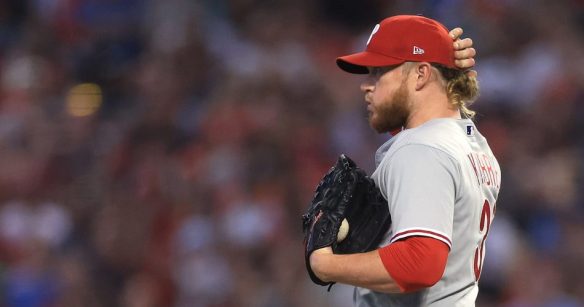
“He’ll be available tomorrow,” Phillies manager Rob Thomson said of his just-chastened reliever Craig Kimbrel after National League Championship Series Game Three ended with Kimbrel surrendering a game-ending, game-losing RBI single, “and he’ll be ready to go.” Those may yet prove to be the nine most frightening words in the Phillies’ or their fans’ vocabularies. This week, this weekend, and maybe this year.
They may not necessarily bring Kimbrel himself much comfort in his heart of hearts, either.
Let’s be absolutely fair and say what we still can’t bring ourselves to say while we’re busy booing, hissing, and dreaming up new and snarkier insults to spread all over social media. There isn’t a professional baseball player alive who doesn’t go onto the field knowing that one mistake, one errant swing, one misstep, one missed pitch, could turn him into a fan piñata for life, or close enough to it.
Let’s also be absolutely fair and say Cardiac Craig didn’t cost his team the pennant yet. The game he allowed the Diamondbacks to tie so late, before his successor reliever José Alvarado served the RBI hit that broke the tie to stay, did nothing worse than tie this NLCS at two games each. Neither team’s season is over just yet.
But is Thomson just as willing to say after Game Four what he said of Kimbrel after he surrendered the Game Three-losing hit?
All Kimbrel had to do going out for the bottom of the eighth inning Friday night was keep the frisky young Diamondbacks from doing anything about a late and hard-earned 5-3 Philadelphia lead. He wasn’t even asked to finish the game. Just keep it there before Thomson could hand off to, say, José Alvarado for the ninth.
Groucho Marx would say it was “so simple a child of five could do it. Now, somebody send for a child of five.” It’s not impossible that a child of five could have come away with only a little singe. Kimbrel came away deep fried.
For all the gags about his high wire relief style, nobody pretends it’s fun to surrender a late, game-turning home run at all. There isn’t a child alive who dreams of going out to the mound in one of The Big Ones and getting his brains blown out. But it really becomes a microcosmic season in hell when it’s pinch hit by a spaghetti bat whose major league value over two seasons is plus defense in center field, enough to atone for the weak bat with nineteen defensive runs saved above the league average.
The fair supposition was that Diamondbacks manager Torey Lovullo sent Alek Thomas out to pinch hit for third baseman Emmanuel Rivera hoping only that a lefthanded bat against the righthanded Kimbrel might pick up enough of a hit to push Lourdes Gurriel, Jr. from second to third.
Kimbrel had opened by feeding Gurriel—who’d robbed J.T. Realmuto of at least extra bases with a leaping catch at the fence in the second—a 2-2 fastball to hit into left for a leadoff double. Then, after designated hitter Evan Longoria lined out to left, Kimbrel started behind Thomas, 3-1. It became 3-2 after Thomas fouled one off.
Then, Kimbrel served up a fastball just enough up and off the middle of the plate. It wasn’t a terrible pitch. Nothing on Thomas’s resume through that moment suggested he’d get anything better with it than a line drive base hit the other way, possibly to be stopped before it left the infield.
But the spaghetti bat pulled it, somehow, into the Chase Field pool behind the right field fence. Tying the game at five each. Tying the stomachs of Philadelphia fans in the ballpark and back in the City of Brotherly Love into knots. It wasn’t the game-losing hit by any definition, but those fans could only have thought, second verse, worse than the first.
A called strikeout later, Kimbrel threw Ketel Marte a meatball right down the pipe and Marte rapped it into left for a base hit. Only when Kimbrel plunked Corbin Carroll on the first pitch did Thomson reach for further relief and bring Alvarado in.
Too late. Alvarado fell behind Gabriel Moreno 3-1, then Moreno singled up the pipe to score Marte for the 6-5 Snakes lead the Phillies didn’t overthrow in the ninth. (Yes. It’s more than a little unfair to hang Kimbrel with the “loss” when he wasn’t even on the mound to surrender the hit that plated what proved the winning run.)
Maybe we should say couldn’t. Kyle Schwarber—who’d first put the Phillies on the scoreboard with a leadoff blast in the top of the fourth—hit Diamondbacks finisher Paul Sewald’s first two-out pitch into the right field corner for a double. But Sewald got Trea Turner to strike out swinging for the game.
What happens to Kimbrel in these moments during such postseasons? What happens to any relief pitcher whose line of work includes going into a game tasked with holding a tight lead, escaping a nasty jam, or just finishing off the opposition in the final frame, only to see it blow up in a single pitch?
The best of that profession had to have their moments of doubt. The best of that profession have been broken in the moment, even and especially the biggest moment. Even Mariano Rivera, the Hall of Famer whose closing career postseason statistics would equal a fluke regular season for a lesser talent, suffered the horror of losing a World Series with one pitch to an ancient Diamondback named Luis Gonzalez.
The Mariano shook that one off, picked himself up, and went on with his Hall of Fame career. Kimbrel generally does likewise after an outing, even if he leaves behind a trail of work that tells observers that, even when he comes out alive, it still feels as though his team lost instead of won.
If the moments are too big for Kimbrel, he almost never lets it show. If they’re too big for him, he probably wouldn’t go out there time and again risking a game, his reputation, and maybe his (and his team’s) nervous system. He’s known both off the charts success and off the charts faltering, regular and postseason alike. Since (and especially during) the 2018 postseason, Kimbrel outings leave people feeling often enough as though his teams lose even when they win.
At 35 years old, Kimbrel must wonder to himself how many more such moments (and how many dollars on his contract) are worth the strain. Others, of course, must wonder how many more such moments the Phillies are willing to risk. They’ll have a spiritual advantage getting the set back to Citizens Bank Park, of course. But they’d rather have a series advantage going home, too.
“We’ve got to talk about that,” Thomson said postgame, when the question became changing Kimbrel’s role to come. “Do you put him in a little lower-leverage spot? I don’t know. I’ll talk to him with [pitching coach] Caleb [Cotham], talk through it, and see where we’re at.” That was a far turn from Thomson’s pregame vote of confidence: “I trust [his bullpen]. Has [Kimbrel] scattered the zone at times? Sure. But if you look at our charts, everybody’s had a little bit of a hiccup, but they’ve bounced back. So you’ve got to trust that.”
Some social media mavens raised the name Mitch Williams, the zany and nerve-challenging Phillies lefthander who served up a World Series-losing home run to Joe Carter three decades ago. They thought the Wild Thing got too wild, too crazy, too reckless.
But it turned out that then-manager Jim Fregosi and then-pitching coach Johnny Podres forgot to tell Williams to back away from the slide-step—put on to keep Hall of Famer Rickey Henderson from as much of his usual basepath mischief as possible (a futile hope, of courae)—that altered and rushed his deliveries and his fastballs.
With Podres already having visited the mound, and neither he nor Fregosi finding a sign to send with the order, Williams was doomed when his slide-stepped fastball went into Carter’s wheelhouse instead of up and away where the Wild Thing wanted it and might have thrown it out of his normal delivery.
The three-legged mistake of Fregosi, Podres, and Williams lost the Phillies a World Series. Kimbrel’s high-wire mistake merely tied an NLCS game. “I rolled up in here and cost us two games,” said Kimbrel postgame, clearly not pleased with himself. “The bright side is we’re still tied at 2-2 and we’ve got a game here tomorrow, then we get to Philly.”
Forced to a bullpen Game Four in which the bulls ran short, Kimbrel ran out, and a few early defensive mistakes made life tougher for the Phillies than it should have been, they need Zack Wheeler to pitch an even better Game Five Saturday than he did enabling the Phillies to win Game One.
They also need Aaron Nola to be his Game Two self in Game Six back home. Their bullpen, whose main men have worked 14.3 innings in this set, needs a huge break. They need to quit underestimating this tenacious crew of Diamondbacks, no matter how silly they’ve slapped Snakes starters Merrill Kelly and Zac Gallen, the latter of whom squares off against Wheeler on Saturday.
They can’t afford to risk Kimbrel tearing it even once more, either.



 Throneberry Fields Forever