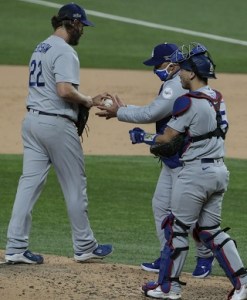
Attempted burglary

Manuel Margot is arrested in the bottom of the fourth by Patrolman Barnes Sunday night.

Manuel Margot missed home invasion by a hair in the bottom of the fourth. Or at least a hand.

Baseball’s first shot at stealing home in a World Series since the Anaheim Angels’s Brad Fullmer in the 2002 Series got thatclose to turning Game Five around in the Tampa Bay Rays’ favour Sunday night. And it wasn’t on the front end of a double steal attempt.

Catching Los Angeles Dodgers starter Clayton Kershaw in a lefthander’s naturally disadvantageous vantage point, and with the left side of the infield unoccupied in a defensive shift, Margot thought burglary’s risk minimal with the reward promising to be great.

“t was 100 percent my decision,” the Rays left fielder said after the 4-2 Rays loss. “I thought it was a good idea at the time. I had a pretty good chance of being safe.”

Center fielder Kevin Kiermaier at the plate. Margot, who’d been taking leads as big as the law allows whenever he reached third all postseason long, jumped right after Kershaw heeded his first baseman Max Muncy and stepped off the pitching rubber.

Kershaw threw home, a little off line. Margot dove to the plate and almost made it. Dodger catcher Austin Barnes got a tag on his slightly raised sliding hand a split second before it touched the plate.

“I thought I was really close,” Margot said. “I really didn’t know where they touched me. [The Rays] didn’t challenge.” A challenge might have proven futile. What Margot did, though, was a kind of triumph despite his arrest for first degree burglary.

Kiermaier certainly thought so. “It was a gutsy move and it didn’t work out that time,” he said postgame. “Manny is a great baserunner. He’s not afraid to take risks. I didn’t have a problem with it . . . It takes a lot of guts to sit here and try that in the World Series. It just didn’t work out.”

Rays manager Kevin Cash wouldn’t object, either. “I think Manny felt he could just time him up . . . I think we try to do things and make decisions and allow players to be athletic,” he said postgame. “If Manny felt he had a read on it, for whatever reason, it’s tough for me to say yes or no, just because he’s a talented baserunner. He might be seeing something I’m not or can’t appreciate in the moment right there.”

Stealing home on a double-steal attempt is rare enough in the postseason. Stealing home straight, no chaser in the Series makes the double-steal as common as breakfast coffee. Maybe the most fabled attempt was Hall of Famer Jackie Robinson in Game One of the 1955 Series. The Hall of Fame catcher on the play eventually got to autograph a photo of it for President Barack Obama:
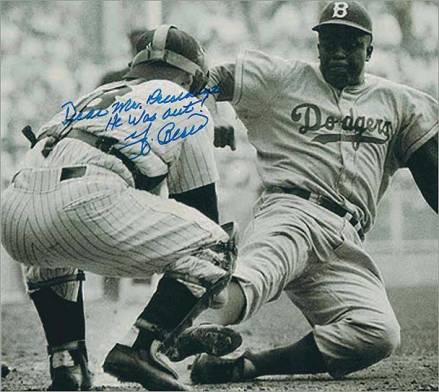
Yogi habitually autographed photos of that play with “He was out!” for the rest of his life. Robinson’s was only the fifth successful straight-no-chaser home theft in Series history. The other four?

Game Two, 1909—The Series billed heavily as a showdown between two of the Hall of Fame’s Inaugural Five: Detroit’s Ty Cobb and Pittsburgh’s Honus Wagner. The Dutchman generally out-played the Peach in the Series, but Cobb caught Pirates reliever Vic Willis so fixed on Tigers batter George Moriarty that the baby and his candy had a better chance against a thief than the Pirates did when Cobb stole home.

Game One, 1921—Yankees middle infielder Mike McNally doubled in the fifth, took third on a bunt, and helped himself to home on the house. He made it look almost so simple a man with a fractured leg could have gotten away with it. Sort of.

Game Two, 1921—Yankee legend Bob Meusel decided to return the favour. He had a little help from Giants catcher Earl Smith—when Smith dropped Al Nehf’s pitch around the plate–but, of course, you never look a gift Giant in the mouth.

Game One, 1951—Hall of Famer Monte Irvin led off in the top of the first with a two-out base hit and took third when Whitey Lockman whacked a ground-rule double. Giants manager Leo Durocher, who knew a few things about thievery (such as the telescopic sign-stealing scheme that enabled the Giants’ pennant race comeback and playoff force in the first place), decided Irvin should take the chance with Bobby Thomson at the plate. Yankee pitcher Allie Reynolds helped with his habit of looking down as he took the sign from Berra. Irvin stole home so readily it’s a wonder he didn’t take up bank robbery after his playing days ended.

There but for the grace of maybe four inches would Margot have pilfered his way into the books. Not only would he have had the mere sixth straight home invasion in Series history, his would have been the first such successful heist in any Series game later than Game Two.

The truly bad news for the Rays after Margot was cuffed and stuffed was Dodgers first baseman Max Muncy checking in at the plate in the top of the fifth, with two out and the Dodgers leading 3-2, and wrestling Rays starter Tyler Glasnow to a full count before blasting a fastball down Broadway almost halfway up the right field seats.

Kershaw, who passed fellow future Hall of Famer Justin Verlander to take the top seat on the all-time postseason strikeout list Sunday night, didn’t catch on to Margot’s burglary attempt until just about the last split second.

“That has happened to me before,” Kershaw said, filing his postgame police report. “I wasn’t really anticipating it, but I have talked to first basemen in the past. Muncy, I have talked to him about it as well like, ‘Hey, I look at him but when I come set I don’t really see the runner, so you got to yell at me if they start going.’ And he was yelling at me, step off step off step off. So instinctually I just did it. It was a big out for us right there.”

Beats a burglar alarm.

The Rays off script, the Dodgers on top

Clayton Kershaw opened the 2020 World Series with more than a flourish.

Somehow, no matter what the pandemic threw down in baseball’s way, we managed to arrive at the World Series. Somehow, the game’s 99 Cent Store from Tampa Bay bumped, pole vaulted, and sky dove to a Series against the game’s Amazon from Los Angeles.

In Globe Life Field, the brand-new playpen of the Texas Rangers. Where the turf is artificial, the roof makes it resemble the hangar for a Boeing 747, and you can just can all the hoo-ha about the wonders of a neutral-site World Series.

The Dodgers entered with a sort-of home field advantage.They’ve been playing at Globe Life from their National League division series forward. With the pandemic-inspired divisional geography schedule on the irregular season, the Rays never got to play the Rangers even once.

They’ve been been playing there from their division series forward. With the pandemic-inspired divisional geography schedule this irregular season, the Rays never got to play the Rangers even once. And the Dodgers sure took advantage of that inadvertent home-field advantage of a sort Tuesday night.

They waited out a hard labouring Rays starter Tyler Glasnow, aided and abetted by Rays manager Kevin Cash forgetting his well-tested plot, then flipped their merry-go-round to cruising speed from the fourth through the sixth innings, and beat the Rays in Game One, 8-3.

Clayton Kershaw did more than his share starting for the Dodgers. With the continuing questions about his overall postseason life of bad fortune, Kershaw brought the best of his new self to bear, his sliders out-numbering his fastballs, striking out eight through six and getting nineteen misses on 38 swings against him for the highest single-game whiff rate of his entire major league life.

“Kershaw was dealing,” Cash said postgame. “You see why he’s going to the Hall of Fame one day.”

What nobody could see clearly was why Cash pushed his luck with Glasnow labouring to survive, his eight strikeouts negated by six walks—including the leadoff pass to Max Muncy opening the bottom of the fourth to start the Dodgers’ fun—and with only a 2-1 deficit against him when he came out of it.

Will Smith grounded Muncy to second almost right then and there. But Cody Bellinger—the man who rang the Atlanta Braves bell so resoundingly in the seventh National League Championship Series game—hit the first pitch into the Dodger bullpen in right center field. After walking Chris Taylor to follow and wild-pitching Taylor to second, Glasnow was lucky to escape with his and the Rays’ lives on a pair of back-to-back strikeouts.

That’s where Cash moved against his own successfully established grain. The Rays live and prosper on not letting the other guys get third cracks at their pitchers and thus keeping their pitchers from falling into position to fail or get failed. They play that game better than most and rolled the American League’s best irregular season record for their trouble.

Cash withstood the alarms blasted after he lifted Charlie Morton in American League Championship Series Game Seven after five and two-thirds efficient innings when trouble brewed with the Rays up 3-0. The move aligned perfectly to the Rays’ usual M.O. and it paid off with a pennant.

On Tuesday night, though, he left Glasnow in for the fifth despite 107 pitches to that point. With Ryan Yarbrough throwing in the Rays bullpen, Glasnow walked Mookie Betts on four straight balls following an opening strike. Over the past three seasons including a 34-start span, Glasnow had only thrown 100 pitches or more in a game three times, and Tuesday night wasn’t exactly one of his prime outings.

Cash still didn’t make a move after the walk to Betts. Room enough for the Dodgers to boot the merry-go-round. Glasnow walked Corey Seager after Betts stole second without a throw on a low pitch. He struck Justin Turner out, somehow—except that Betts and Seager delivered a near-textbook double steal.

Then Max Muncy bounced one right to Rays first baseman Yandy Diaz. Diaz threw home. This was supposed to be one of those plays the Rays’ usually larger-than-life defense executes with an arm missing and half asleep. Except that Diaz’s throw arrived up the third base line and Betts slid into the plate while Seager took third and Muncy stood safe at first.

“The at-bat with Muncy right there,” Cash said post-game, “just was hoping it felt like [Glasnow] was the best guy to get a strikeout.” Not on a night when only 58 of Glasnow’s 117 total pitches were strikes. Glasnow himself acknowledged trying to rush things a little too much in the beginning, but once he adjusted that he thought his mechanics were off.

“I have to execute pitches better and hold runners better,” he said, admitting the latter is probably his weakest attribute. “Later in the game, I wasn’t really able to throw anything for a strike except the heater. I think the changeup, I probably should have thrown that a little bit more . . . That curve ball, later on, I really didn’t have much feel for it.”

Smith knocked Seager home and Muncy to third with a jam-shot single to center. Finally Cash brought in Yarbrough, a good relief pitcher but a young man whose career to date includes that he’s vulnerable pitching with one out and rare (for him) inherited runners but better when he starts an inning clean.

The lefthander got rid of the lefthanded Bellinger on a pop up to third, but righthanded Chris Taylor lined Muncy home with a clean single to left and pinch-hitter Enrique Hernandez sent Smith home by shooting a base hit between short and third.

Yarbrough escaped with no further damage. Cash sent Josh Fleming out for the sixth. The Mookie Monster sent his first pitch into the right field seats. An infield pop out later, Turner and Muncy doubled back-to-back. Fleming didn’t surrender another run through his next two innings worth of work but that came under the too-familiar heading of taking one for the team.

Not that the Rays left things uninteresting on their end. They chased Kershaw’s relief Dylan Floro with one out in the seventh. Manuel Margot singled right through the middle infielders and Joey Wendle drove on to left center that Bellinger gave a great chase until the ball hit off the heel of his glove, setting the Rays up with second and third.

Then Cash sent Ji-Man Choi to bat for Willy Adames. Dodger manager Dave Roberts brought in lefthander Victor Gonzalez to face the lefthanded Choi. Cash pulled Choi for division series hero Mike Brosseau. And Brosseau lined Margot home with a single to right with Wendle stopping at third. He didn’t stay long. Kevin Kiermaier—whose fifth-inning solo home run was his first hit since being hit by a pitch in ALCS Game Three—lined a single to right to send Wendle home.

It was the final Rays homecoming of the night, but it almost wasn’t. Rays catcher Mike Zunino lined a missile right through the box that Gonzalez snatched just sticking his glove to his right, the ball’s force spinning him right into position to throw and double up Brosseau scrambling back to second. A hair off line or the glove missing by a hair and that missile might have been an RBI single with the Rays still swinging. Might.

The Rays tried to flip their own merry-go-round switch and the Dodgers succeeded in throwing a stick into the motor belt, with Pedro Baez and Joe Kelly finishing up throwing the spotless final two innings.

It was also a night to make history. Kershaw nailed his 201st lifetime postseason strikeout, moving him into second place behind his fellow likely Hall of Famer-to-be Justin Verlander. Betts became the first player in World Series history to homer, steal, and score twice in the same Series game. Cash became the first Little League World Series player to manage in the World Series when he grew up.

“It’s great to get the Series going with a win,” said Kershaw to reporters after the game. “That’s the biggest thing, for us, is to get going. Get that first game—it’s always important to get that first game of a series. Just for me, personally, it’s awesome, you get to pitch well and get a win in a World Series. Like I said, I’m just thankful for another opportunity.”

Bellinger going deep looked like a man who shook off the shoulder dislocation his NLCS bombing brought when it happened during the dugout celebration. He took no chances this time.”I said it before the game,” he told reporters post-game. “If I hit one today, I’m not touching anyone’s arm. I’m going straight foot.”

Since he hit the first Dodger bomb of the Series, Bellinger got to lead the first such dance. Appropriately. And you thought last year’s World Series champion Dancing Nationals knew how to bust moves and cut rugs.

Misteroberts’ neighbourhood

Too little, too late: Dave Roberts (masked) lifts Clayton Kershaw an inning late and what the Braves made ten dollars short.

The roll of managers who got their teams into hot water by doing what they shouldn’t have done, or failing to do what they should have done, is thick enough. Dave Roberts made it thicker after National League Championship Series Game Four Thursday night.

At the worst possible moment for his Los Angeles Dodgers, the day after the Atlanta Braves nuked them in Game Three, Roberts couldn’t bring himself to do what he had to do and get Clayton Kershaw the hell out of there. Fast. Before his lefthander left room for another Braves uprising.

It married Roberts to Charlie Dressen, John McNamara, Grady Little, Mike Matheny, and Buck Showalter on the roll of skippers who overthought, overmanaged, undermanaged, or brain-vapoured their way into big trouble if not big postseason infamy.

Kershaw’s postseason calamities are only too well known. They’re the only blemishes on a certain Hall of Fame career. It won’t make him a Cooperstown outlier—Bob Feller, Willie Mays, Joe Morgan, and Tony Perez don’t have sterling overall postseason resumes, either.

But Game Four is the one into which Kershaw’s manager walked him eyes wide shut and the Braves into the real beginning of a 10-2 triumph and one game from going to the World Series.

For five innings Kershaw stood his ground against Braves starter Bryse Wilson, who had only four more major league starts than Kershaw has Cy Young Awards. Wilson actually out-pitched Kershaw, but at the end of five the game was a one-all tie thanks to Alex Rios hitting one into the right field seats in the third and Marcell Ozuna hitting one into the left field seats in the fourth.

Roberts shouldn’t think about hitting the casinos any time soon. He knew Kershaw’s back might still have been a little balky after spasms forced Kershaw to be scratched from his scheduled Game Two start. He got five solid innings out of Kershaw on Thursday and should have been more than content with that.

But no. Roberts had to send Kershaw out for the sixth. “I just thought Kershaw was throwing the baseball really well,” the skipper told reporters after the game, “and there was no reason [to lift him]. I felt really good about it.”

How good did Roberts feel when Ronald Acuna, Jr. opened the Atlanta sixth with a hopper back to the mound but over Kershaw’s head that the evening’s Dodger second baseman, Kike Hernandez, coming from shortstop in the infield shift, threw past first baseman Max Muncy to allow Acuna to second?

How good did Roberts feel after Freddie Freeman promptly shot one right past first baseman Max Muncy into right for an RBI double?

How good did he feel after Ozuna shot one into the left center field gap for an immediate RBI double?

How good did he feel after relieving Kershaw with Brasor Graterol two hitters two late, seeing Travis d’Arnaud line out to right, but then watching Ozzie Albies single, Dansby Swanson shoot one down the left field line for a two-run double, and Austin Riley cue an RBI single up the middle?

How good did he feel after lifting Graterol for Victor Gonzalez and watching him walk Hector Camargo before Cristian Pache singled Riley home? Not to mention Ozuna leading off the seventh with another solo bomb, this one off Dylan Floro? Freeman and Ozuna whacking back-to-back RBI singles off Jake McGee in the eighth?

With nothing else out of the Dodgers offense but the bases loaded and one out in the seventh and only Rios’s sacrifice fly to show for it?

“I’m not going to take Clayton out after a weak ground ball and another ground ball off the bat of Freeman,” Roberts said. “I felt really good with Clayton at that point in time.”

Once upon a time an ancient Dodger manager named Charlie Dressen felt really good about spurning his curve ball specialist Carl Erskine in favour of fastballer Ralph Branca with Bobby Thomson—still less comfortable facing curve balls—coming to the plate in the bottom of the ninth of a third pennant playoff game.

Thomson and his New York Giants felt great about the Shot Heard ‘Round the World—until the final published evidence affirmed decades later what those Dodgers suspected down the stretch: The Giants stole the pennant! The Giants stole the pennant!

John McNamara felt good about leaving his ankle-vaporised first base warrior Bill Buckner in the field for the bottom of the tenth in Game Six of the 1986 World Series, too. He wanted his shattered soldier out there when the Red Sox finally won the World Series again. How did that work out for him?

Grady Little felt good about taking Pedro Martinez’s heart at its word and ignoring his Hall of Famer’s fuel tank crying “empty!” The Yankees listened to the fuel tank and sent Game Seven of the 2003 ALCS to extra innings—and Aaron Boone’s eventual pennant-winning date with stout Red Sox knuckleballer Tim Wakefield.

Mike Matheny felt great refusing to close The Book in Game Five of the 2014 NLCS and bring his closer Trevor Rosenthal into the bottom of the ninth—because it wasn’t even a St. Louis Cardinals lead, never mind a save situation. Travis Ishikawa felt even better turning on rusty Michael Wacha’s weak fastball and sending it to the top of Levi’s Landing. (This time, the Giants didn’t steal the pennant! The Giants didn’t steal the pennant!)

Buck Showalter felt comfy refusing to reach for his closer Zack Britton—with Britton’s 0.54 ERA/1.94 fielding-independent pitching/0.84 walks/hits per inning pitched—because the bottom of the ninth in the 2016 American League wild card game wasn’t a “save situation,” either. It left Edwin Encarnacion comfy enough to hit the three-run homer that sent Rogers Centre batshit nuts and the Toronto Blue Jays to the division series.

Boone himself felt cozy enough not to put Jose Altuve aboard with a free pass—with two out, George Springer on first, a gassed Aroldis Chapman somehow ahead of Altuve 2-0, and a spaghetti bat named Jake Marisnick on deck.  Altuve felt even cozier, blasting a two-run homer with the pennant attached off the back wall of Minute Maid Park.

Casey Stengel failing to set his 1960 World Series rotation so his Hall of Famer Whitey Ford could pitch three and not just two games? Gene Mauch panicking the Phillies out of the 1964 pennant? Darrell Johnson lifting Jim Willoughby in the 1975 World Series? Don Zimmer doghousing Bill Lee down the 1978 stretch?

Roberts may be paying for all of their sins.

It didn’t begin with Thursday night, unfortunately. He brought badly spent Brandon Morrow into a 2017 World Series game and watched Morrow surrender four runs on six pitches. He brought a previously shellacked Ryan Madson into a third 2018 World Series turn with the Dodgers leading Game Four 4-0—and watched Mitch Moreland hit a three-run homer to start the Red Sox’s comeback win.

And, he forgot 2019’s Joe Kelly was too vulnerable when pitching past a single inning, left Kelly in for a second inning in Game Five of last year’s division series, and watched him  load the pads for Howie Kendrick to slice salami and cut the Dodgers’ season off at the blast.

There was no defense for Dressen’s Dodgers, Little’s Red Sox, Matheny’s Cardinals, or Boone’s Yankees against a pennant winner; or for Showalter’s Orioles against a wild card game winner. The Dodgers haven’t lost the pennant yet, but Misteroberts’ neighbourhood is a nebulous one over which to guide neighbourhood watch.

Maybe we wouldn’t talk this way if Roberts’ Dodgers and those other teams found ways to win despite the mental lapses. Maybe we’ll stop talking this way for awhile if his Dodgers iron up and manage to win this NLCS. Maybe.

Maybe if the Dodgers remember how to hit when it matters in Game Five, we’ll stop talking about Roberts as a compromised bridge commander and the Dodgers as something of a deception. They’re lucre rich, farm-system sound, and as front-office brainy as it gets, but their continuing postseason futilities despite owning the National League West for eight seasons straight makes them resemble paper tigers.

They’ll have to make things happen in Game Five. If these Braves let them, that is. These Braves may seem like nice fellows, but they’re not inclined to be that generous.

Protest by postponement

When Mookie Betts (far left) elected not to play in protest over Jacob Blake’s shooting by police, his Dodgers mates—including manager Dave Roberts (second from left) and pitchers Clayton Kershaw (second from right) and Kenley Jansen (far right)—had his back and joined him postponing against the Giants.

This is now: The Show’s government stood by teams postponing games Thursday in a show of respect to Jacob Blake, a young African-American man shot by rogue police, and quiet outrage over the manner in which Blake was shot. (Seven bullets in the back, with his children in sight in their car.)

But that was then: A Cincinnati Reds pitcher was hustled the hell out of Dodge for standing on behalf of not playing baseball during Robert F. Kennedy’s funeral. What a difference 52 years makes.

“Given the pain in the communities of Wisconsin and beyond following the shooting of Jacob Blake,” MLB’s official statement said Thursday, “we respect the decisions of a number of players not to play tonight. Major League Baseball remains united for change in our society and we will be allies in the fight to end racism and injustice.”

It could also have said plausibly that baseball stood athwart the grotesquery of Kyle Rittenhouse—a white teenager (seventeen), making his way from Antioch, Illinois to Kenosha, Wisconsin, where violence and destruction reigned courtesy of those who seize upon genuine grief, rage, and sorrow as a beard to destroy—now accused of shooting two to death after his arrival.

Once the National Basketball Association’s Milwaukee Bucks stepped up front as the first professional sports team to decline play Thursday in protest over Blake’s shooting, and theirs was a playoff game, baseball teams who had yet to play on the day—several games had finished already or were well enough in progress—began to step up front as well.

The Milwaukee Brewers and the Reds postponed, particularly after Brewers relief star Josh Hader spoke publicly about the team considering it. Those who chose to condemn Hader a few years ago, after immaturely racist tweets in his school days surfaced, should ponder once again (if it occurred to them in the first place, when Hader apologised publicly) that, yes, mis-oriented youth can and often does mature into thoughtful adulthood.

The Los Angeles Dodgers and San Francisco Giants postponed their Thursday night game after Dodgers outfielder Mookie Betts, informing his teammates earlier in the day he had no intention of playing as a show of protest, discovered to his happy surprise (he’d encouraged the Dodgers to play anyway) that one and all his teammates had his back on that.

The Dodgers’ long-enough-time franchise face Clayton Kershaw took the lead on backing him. “Mookie was saying, ‘If you guys want to play, I support that’,” Kershaw said when asked. “But we made a collective, group decision to not play tonight and let our voices be heard for standing up for what is right.”

The Seattle Mariners elected as a team not to play Thursday night, and their scheduled opponents, the San Diego Padres, agreed no questions asked. “For me, and for many of my teammates,” tweeted Mariners infielder Dee Gordon, “the injustices, violence, death and systemic racism is deeply personal. This is impacting not only my community, but very directly my family and friends. Our team voted unanimously not to play tonight.”

Elsewhere around the Show individual players declined to play even if their teams went ahead and played, and none of those players looks to face retribution or team discipline for their decisions while their teammates mostly (not unanimously, alas) likewise supported their stance.

Paralyzed waist down by his wounds, Jacob Blake isn’t exactly a model citizen, alas. He had a knife on his car’s floorboard though not in his hands, and police were dispatched to the location after a woman’s call that her boyfriend (Blake) was present when enjoined formally against being there. He also had an arrest warrant upon him. Neither gave Kenosha police officer Rusten Sheskey the right to pump seven bullets into his back.

Wherever he is in the Elysian Fields, Miltiades Stergios Papastergios must be thinking to himself, “Slowly comes the dawn.” You know him if at all by his Americanised name, Milton Steven Pappas. In 1968, he took a stand similar to that taken by the aforementioned teams and players and refused to budge when circumstances altered the original plan. The Reds traded him post haste afterward, and nobody knew for certain whether that stance provoked it.

Milt Pappas became a Red, of course, in the infamous trade that sent Hall of Famer Frank Robinson to the Baltimore Orioles, where Pappas was once part of the Orioles’ heralded but ruined “Baby Birds” starting rotation full of fresh youth. He pitched serviceably if not spectacularly for the Reds but, with Robinson winning a Triple Crown in his first Baltimore season and continuing to play like his Hall of Famer self, it wouldn’t have mattered if Pappas was the second coming of Robin Roberts.

When Dr. Martin Luther King, Jr., was assassinated in early April 1968, baseball’s Opening Day coincided with the day of King’s funeral. Baseball would have played fully if the Pittsburgh Pirates—with such non-white stars as Hall of Famers Roberto Clemente and Willie Stargell, plus former Dodgers shortstop Maury Wills—hadn’t refused to play. The Pirates triggered similar actions by other teams.

Baseball’s then-commissioner, William D. Eckert, was denounced for “calling up the club owners, not to tell them what to do, but to ask them” over the King funeral, wrote New York Daily News columnist Dick Young. But two months later former U.S. attorney general turned senator from New York, Robert F. Kennedy, freshly triumphant after winning California’s Democratic Party primary, was murdered after he left the stage at Los Angeles’s Ambassador Hotel on 6 June 1968.

With the Kennedy assassination, Eckert decreed no games should be played during Kennedy’s funeral. The man nicknamed Spike but derided previously as “the unknown soldier” (he was a retired Air Force general with no known previous baseball tie) proved he learned fast, even if he had to learn the hard way.

The Reds were scheduled to play the St. Louis Cardinals with a starting time well after the Kennedy funeral might have ended originally. Then, the funeral was delayed, after Washington’s notorious enough traffic issues delayed the funeral train’s procession. It looked as though the Reds and the Cardinals would play during the funeral after all.  Not so fast, Pappas insisted. He felt then and to the day he died four years ago that the game shouldn’t be played out of respect to Kennedy.

Reds manager Dave Bristol and general manager Bob Howsam felt the opposite. Howsam even visited the Reds clubhouse to pronounce that RFK himself would have wanted the game played. Pappas argued against playing right then and there. “Who is this guy, anyway,” Pappas told a reporter later on, “to tell us what Bobby Kennedy would have wanted us to do?”

The Reds’ players promptly took a team vote, some after having been strong-armed by Bristol, Howsam, or both. The vote was 13-12 in favour of playing. Pappas quit on the spot as the Reds’ player representative. Six games ended up postponed anyway despite the funeral delay. Three days later, in a deal Howsam swore was in the works before Kennedy’s assassination, he traded Pappas to the Atlanta Braves in a five-man swap making Reds out of fellow pitchers Tony Cloninger and Clay Carroll.

Baseball’s government, much like America’s, often has to learn the hard way about doing the right things as opposed to doing the expedient or the partisan things. There’s little to the appropriate causes monetarily as many do, other than symbolic acts that speak louder than rioters enough because their familiarity and popular appeal is powerful weight to throw above and beyond a game.

Those who think Thursday night’s players and team were out of line might care to ask what they’d prefer as a protest against rogue police and citizens alike—postponing baseball games and denouncing racism; or, breaking entire cities.

Alfred Hitchcock presents Opening Night

AlfredHitchcockAt long enough last came Opening Day. Well, Opening Night. On which New York Yankees right fielder Aaron Judge nailed the COVID-19 delayed season’s first hit and his teammate Giancarlo Stanton nailed its first home run two batters later.

On which the Washington Nationals opened without a key element, outfielder Juan Soto, whose positive COVID-19 test result came back well enough before game time to make him a scratch.

Before that rain-shortened game even got started, the word came from the opposite coast that Clayton Kershaw was scratched from his Opening Night start thanks to a back problem sending him onto the injured list.

In Washington, the Nats’ co-ace Max Scherzer would have loved if Judge and Stanton were Thursday night scratches. They accounted for all Yankee runs in the 4-1 final shortened in the top of the sixth when the rains smashed in with the Yankees having first and third and one out.

In San Francisco, Los Angeles Dodgers rookie Dustin May pitched five innings to San Francisco Giants veteran Johnny Cueto’s four, both men leaving with a one-all tie, and the Dodgers’ new $396 million man Mookie Betts broke the tie scoring on an infield ground out in the top of the seventh.

Scherzer’s good news Thursday night: eleven strikeouts. His bad news: four walks and an inability to solve Judge and Stanton. Judge also doubled home Tyler Wade in the third and Stanton singled home Gio Urshela in the fifth. Remove Judge and Stanton from the Yankee lineup and the Nats’ Adam Eaton’s hefty solo home run in the bottom of the first would have been the game’s only score.

Betts singled with one out in the top of the seventh and called for the ball. Published reports indicate that ball plus the evening’s official lineup card now repose in his home. “It’s just a new chapter in life,” he told reporters after the 8-1 Dodgers win.

After he came home when Justin Turner grounded into a force out, Corey Seager’s grounder got Cody Bellinger caught in a rundown at the plate, but Enrique Hernandez singled home Turner and Seager (who’d taken second during the rundown), Joc Pederson and A.J. Pollock walked back-to-back to load the pads, Austin Barnes sent Hernandez home with an infield hit, and Max Muncy walked Pederson home.

And, on both coasts, all four teams figured out a solution to the issue of whether or not to take a knee for “The Star Spangled Banner” that might actually help more than hurt the too-easily outraged.

Abetted by a suggestion from Philadelphia Phillies outfielder Andrew McCutchen, the Yankees and the Nats lined up on the base lines holding a long, long, long black ribbon, standing apart enough for social distance, then took their knees before “The Star Spangled Banner” was played.

On the same suggestion, the Dodgers and the Giants held a similar long, black ribbon and took their knees before the anthem’s playing. In Washington, both the Yankees and the Nats rose from their knees while the anthem was played. In San Francisco, ten Giants including manager Gabe Kapler plus Betts on the Dodgers’ side stayed on their knees during the anthem, with Bellinger and Muncy putting hands on Betts’s shoulder as a gesture of support.

I went back on record Thursday saying that there are far worse ways than kneeling before a national anthem to protest something you think is dead wrong. Kneeling, as two Scientific American writers I cited remind us, is anything except disrespect.

“While we can’t know for sure, kneeling probably derives from a core principle in mammalian nonverbal behavior: make the body smaller and look up to show respect, esteem, and deference,” wrote psychologists Jeremy Adam Smith and Dacher Keltner in 2017.  “. . . Kneeling can also be a posture of mourning and sadness. It makes the one who kneels more vulnerable. In some situations, kneeling can be seen as a request for protection.”

I’ll ask again: Would you rather those outraged by rogue police doing murder against black or any people raise clenched fists, burn a flag on the field, or start a riot with or without looting and plundering in the bargain? Neither would I. But if only now-former football quarterback Colin Kaepernick had thought in the first place to take his original knee before the anthem played, would that have worked very differently for himself and the outraged?

Let me repeat, too, that you don’t have to subscribe to every last clause or every last impulse of the social justice warriors to agree that rogue police doing murder is not what the land of the free and the home of the brave was supposed to mean. Neither must you subscribe to the formal Black Lives Matter movement itself to agree that black lives and all lives don’t deserve to end when those entrusted to uphold the law break it instead.

Let me repeat further that it’d be far better for baseball to limit playing “The Star Spangled Banner” to before games on Opening Days, games played on significant national holidays, the All-Star Game, and Games One and (if it goes that far) Seven of the World Series. Not so much to cut back on the kneeling protests but to re-emphasise that patriotism compulsory is patriotism illusory.

Back on the field, Soto’s COVID-19 positive test approaching Opening Night shook the game up just enough to provoke serious questions as to how MLB is going to navigate even this truncated season without further medical issues. And, whether the most stringent health and safety protocols will keep more Sotos from turning up positive.

Other surrealities include the empty stands, other than cardboard cutouts of fans in the seats, and the canned crowd sounds at the ballparks. The coronavirus world tour already turned baseball into something between The Twilight Zone and the Mad Hatter’s tea party. Now that the season is underway at last, should we throw Alfred Hitchcock Presents into the mix?

At least neither Opening Night game went to extra innings, so we didn’t have to deal right off the bat with the free cookie on second base awarded each team to start its extra half-inning. The mischief that’ll inspire will just have to wait.

Funny thing, though, about that equally nefarious three-batter minimum for pitchers. Two Giants relievers faced the minimum in that five-run Dodger seventh before surrendering any runs. If bullpen preservation was part of it even if those two got pried, I can see already that this dumb rule isn’t going to end well for Kapler and other managers.

And, let’s be real, the PA people in charge of the piped-in sounds are only human, after all. Who’s going to be the first poor sap having to live down the accident of cranking up the wild cheering when the home team’s batter gets hit by a pitch?

On the other hand, it was easy enough to feel normal again once the Yankees and the Nats got underway . . . when home plate umpire Angel Hernandez began blowing pitch calls. Calling a few strikes balls and a few balls strikes? That’s about par for the course for him. So when’s that umpire accountability coming at last?

Before the game, Dr. Anthony Fauci—otherwise doing his best to battle a pandemic involving both a stubborn virus and a political (lack of) class that surely makes him wonder if he was really there when all this happened—threw out a ceremonial first pitch. Later, he was seen in the stands with his Nats-themed face mask off his face a spell. What’s up with that, Doc?

You’d love to say Fauci threw a perfect strike to Nats relief pitcher Sean Doolittle behind the plate, but you’d be lying like an office holder. Fauci’s delivery is described politely as resembling a man trying to compensate for a fractured upper arm. The ball sailed almost to the on-deck circle. Rumour has it that Hernandez called it a strike on the outside corner.