Don Mossi, RIP: Ugly is as ugly does

2019-07-26 DonMossi

Don Mossi, who proved ugly was only in the eye of the beholder on and off the mound.

“He could run ugly, hit ugly, throw ugly, field ugly, and ugly for power,” wrote Bill James about pitcher Don Mossi in The New Historical Baseball Abstract. “He was ugly to all fields. He could ugly behind the runner as well as anybody, and you talk about pressure . . . man, you never saw a player who was uglier the in clutch.”

Wrote the late Jim Bouton in Ball Four, while musing how players loved to choose up all-ugly lineups to pass time, “he looks like a cab coming down the street with the doors open.”

Hall of Famer Yogi Berra, the all-ugly receiver, once said, “It don’t matter if you’re ugly in this racket. All you have to do is hit the ball. And I never saw anybody hit one with his face.” Mossi, a brainy lefthander who made Berra resemble Cary Grant by comparison, could have said the same thing, with the codicil that he’d never seen anybody pitch one with his face.

Mossi, who died Friday morning at 90 in an Idaho hospital, had nothing on the mound but his brains, an unusual three-finger grip on his fastball, which didn’t travel like a speeding bullet but came to enough forks on the way to the plate and took them to keep hitters off balance, and a deadly enough curve ball. And it gave Indians manager Al Lopez a smart idea when Mossi made the team in 1954.

Lopez used Mossi’s wits and righthander Ray Narleski’s power as an effective bullpen counterweight whenever one of the Indians’ effective starters—Hall of Famers Bob Lemon and Early Wynn, Mike (The Big Bear) Garcia, and aging but still capable Hall of Famer Bob Feller—needed to be spelled, with elder veteran Hall of Famer Hal Newhouser the long man out of that pen.

Used so judiciously, that bullpen helped the 111 game-winning Indians whistle past the 103 game-winning Yankees and into the World Series, with Mossi rolling a 1.94 ERA and a staggering 194 ERA+, then pitching four innings in the World Series without surrendering an earned run or a walk.

If only the Series equaled Mossi’s performance: the Giants swept the Indians in four straight, and it only began with Willie Mays’s stupefying catch in Game One to rob Vic Wertz of a likely extra base hit at the Polo Grounds’s cavernous rear end. In due course, Mossi would admit he was scared to death as a rook until veterans such as Feller and Lemon put him more at ease.

A year later, Mossi was deadlier. He struck out 69 against only eighteen walks, posted a 2.42 ERA and a 2.01 fielding-independent pitching rate, and even drew a few Most Valuable Player votes while he was at it. Who knew that Narleski would begin experiencing elbow trouble and put an end to that skin-tight rear end of the Indians’ bullpen?

Perhaps inexplicably, the Indians moved Mossi and Narleski into the starting rotation for most of 1957. Perhaps also inexplicably, Mossi earned his only All-Star berth. Perhaps even more inexplicably, the Tribe traded both Mossi and Narleski to the Tigers after the 1958 season—for Billy Martin, well along the way to his second career of wearing out his welcome swiftly enough, wherever he landed, after Yankee general manager George Weiss got fed up with him in 1957.

As a Tiger, Mossi became a starter, mostly, and a reasonable back-of-the rotation option. In 1961, Mossi became a curious trivia element when he surrendered only one home run to Roger Maris but none to Mickey Mantle while that pair of Yankees chased ruthsrecord all season long. Mossi also started a 1 September game against the Yankees in which a near-flawless performance was ruined when, with two out, Elston Howard and Berra singled back to back before Moose Skowron drove home Howard with the winning run.

The loss kicked off an eight-game losing streak that knocked the Tigers out of the 1961 pennant race. And that was the last season Mossi pitched before incurring arm trouble that began slowly decreasing his starting assignments and increasing his bullpen options until the Tigers sold him to the White Sox during spring training 1964.

The White Sox put him back into the bullpen permanently, and Mossi responded with a 2.94 ERA over forty innings before the Sox released him after the season. The Kansas City Athletics took a flyer on him in May 1965, but he called it a career after the season.

His comparatively late major league start may have shortened his career a bit; he was 25 when the Indians brought him up in 1954 and one year removed from discovering that odd three-finger fastball grip. He was a good if unspectacular pitcher who married his mind to his arm and did the best he could with both.

Teammates appeared to have loved and respected Mossi. Once upon a time, according to a fan posting on Mossi’s Legacy.com obituary page, Rocky Colavito—dealt to the Tigers controversially in 1960 (Indians fans were ready to arrange the execution of general manager Frank Lane over that and other trades that essentially broke up the Indians’ perennial contenders)—drove a white Cadillac convertible and picked Mossi up in it on the way to Tiger Stadium as long as they were teammates.

But his distinctive (shall we say) appearance stuck in the minds of opponents and fans more than his ways and means on the mound. Beneath eyes similar to those of Edward R. Murrow, Mossi also wore a proboscis that made Danny Thomas’s look like a bob and ears that rivaled the batwing flaps of legendary Hollywood censor Will Hays, earning him the nicknames “The Sphinx” and “Ears.”

Well, now. The Sphinx with Ears ended up having a last laugh. He returned to his native California with his wife, Eunice, and their three children; he’d married his lady on the field at Bakersfield’s Sam Lynn Ballpark while pitching for the Indians’ farm in 1950. Mossi’s baseball afterlife included running several motels in California successfully, not to mention becoming a twelve-time grandfather and a 25-time great-grandfather.

A few years after Mrs. Mossi passed away, her husband retired to Idaho, where much of their family had relocated, and took up an active life indulging his passions for gardening, hunting, and camping. The Mossis were animal lovers to the point that the pitcher’s family declined a funeral service and asked instead that contributions be made to a pet hospital in nearby Oregon.

Clearly enough, ugliness was in the eye of the beholder, and Mossi’s was only skin deep. (Admittedly, you wonder, if Mossi had gone to medical school, he’d have put up with tons of needling about becoming an ear, nose, and throat specialist.) Beneath the ears and the schnozz there rested a competitor on the mound and a gentleman off it.

So laugh, clowns, laugh. This Donald had the last laugh known as a life lived very, very well. Call it winning ugly if you must. But emphasise winning.


A changeup is gonna come . . .

2019-05-30 TimAnderson

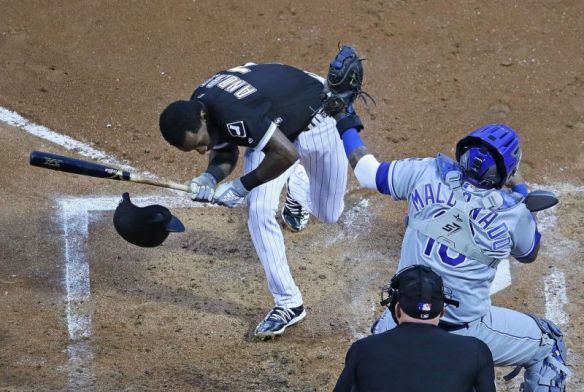
Tim Anderson takes a spin after having his helmet knocked off his head Wednesday.

“Revenge,” Don Vito Corleone advised his in-training son Michael, “is a dish that tastes best when served cold.” Tim Anderson isn’t in training to take over an organised crime family, but he did provide evidence to support the concept Wednesday.

Knock Anderson’s helmet off his head in the bottom of the second? Might not clear both dugouts and bullpens, but he’ll knock what proves the game winning run home for your trouble anyway. And leave you looking like fools without so much as a hint of a bat flip.

For the moment, forget what the pitch actually was that Royals starter Glenn Sparkman threw up and in that hit the bill of Anderson’s batting helmet and blew it clean off the White Sox shortstop’s head. Even a changeup traveling at 86 miles per hour looks frightening when its trajectory takes dead aim at a human face.

Home plate umpire Mark Carlson took all of about two seconds to pounce out in front of the plate as Anderson spun after the helmet took its flying leap and ejected Sparkman no questions asked. If that outraged the Royals’ broadcast crew (Whaaaaaat? one of them asked) and anyone else watching, keep in mind that last month Anderson took one in the rump roast from a Royal arm the next time up after hitting one out and performing one of his signature bat flips.

Royals catcher Martin Maldonado pounced out likewise to protest the ejection, prompting his manager Ned Yost to hustle out there to keep him from an early night off. “As far as we’re concerned,” Yost pleaded to reporters after the game, “coming into this series we had no animosity toward that young man. None. To think that we’re going to hit him is ludicrous . . . We’re not like that.”

Apparently, Yost forgot that his pitcher Brad Keller drilled Anderson to clear the benches 17 April. He may or may not have been aware that Carlson and his fellow umps came into the game well aware of that incident. Hence Carlson taking no chances. And, perhaps, hence why the White Sox, though obviously alarmed over what just happened to their man, didn’t even think about pouring out of their dugout, after Anderson righted himself from his unexpected spinout.

“[T]o think that we’re gonna hit him on purpose is ludicrous, one,” Yost continued. “Two, it was a changeup. It was forgotten. He’d done his part, we’d done our part. It was done. It was over. It was nothing. There was no ill feeling, no ill will, no nothing. It would be totally ignorant on our part to hit him again, for what? We don’t play that game. We’re not like that. It was done, it was forgotten. He got under a changeup and hit him in the helmet. You saw what happened from there.”

It may also be totally ignorant to deny the optics of a pitch sailing up into a batter’s face the first time he hits in the next set during which you face him after he took one in the tail the last time around.

“It could have went either way,” said Anderson himself of the pitch that knocked the helmet off his block. “A ton of things could have happened. Good thing it didn’t do any damage. I was able to stay in the game and keep my composure.”

It ended up damaging the Royals more than anyone else in the yard, and not just because their starting pitcher got himself an early night off for his trouble. After Royals second baseman Nicky Lopez tied the game at seven with a two-run single in the top of the eighth, Anderson stepped in against Royals reliever Ian Kennedy—who’d surrendered Anderson’s first major league double back in the days when Kennedy was still a starting pitcher.

With White Sox catcher James McCann aboard on a one-out double, Anderson looked at a cutter for a strike, then pulled a Kennedy knuckle curve down the third base line, right under a diving Hunter Dozier, for the RBI double that ultimately meant the game when the Royals mustered nothing more than a one-out single against Alex Colome in the top of the ninth.

The two teams hook up again come July. Don’t think for one moment that eyes won’t be upon every trip to the plate Anderson makes against Royals pitching. And this may not quite be the most ridiculous feud in baseball this year. That honour may yet end up going to Pirates broadcaster John Wehner, who thinks about as highly of Reds bombardier Derek Dietrich as a cobra thinks of a mongoose.

Dietrich has come from the Marlins’ scrap heap to become a prize Cincinnati find and a particular Pittsburgh headache, hitting seven home runs in nine games between the two teams, including three on Tuesday night alone. Wehner is not amused, not just because Dietrich has made the Pirates a particularly favourite victim but because Dietrich, like Anderson is not shy about savouring every blast he delivers.

Wehner obviously doesn’t want the kid to have fun. Especially not after Tuesday, especially not after Dietrich hit three two-run bombs in Great American Ballpark, helping his Reds to an 11-6 win. And Wehner takes it even more personally than Pirate pitchers who surrender the launches do.

Wehner can’t start a bench clearing brawl as did Chris Archer on 7 April, after Dietrich hit the first of a pair that sailed into the Allegheny River, Archer greeted the outfielder his next time up with a ball behind his bottom, and five players were ejected before order was restored. But Wehner can and does lament that Dietrich’s grandfather, one-time Pirates coach Steve Demeter, is “rolling in his grave every time this guy hits a home run. He’s embarrassed of his grandson.

“It’s just being arrogant,” Wehner continued, on a radio program. “I don’t get it. I don’t get why you do that. It doesn’t make any sense to me.” He didn’t get the memo, either, that throwing at a batter for no reason better than that your ego was turned into a splash hit makes even less sense than a batter feeling it when he can and does hit one for that kind of distance.

“I think everyone should play the way they play,” Dietrich says. “I’ve got no problems with it . . . I’m just coming to play ball and hit the ball hard. We’re having fun and trying to win. This is baseball.” Having fun and trying to win. The horror.

Do you remember what Dietrich did in that 7 April game the next time he batted after his can felt the breeze from Archer? He hit another home run. Into the Allegheny River. Again. The only thing more foolish than awakening any sleeping giant is thinking you have to awaken him when he’s already wide awake.

Allen’s Alley should lead to Cooperstown

2019-04-29 DickAllen01

Dick Allen (15), presumed launching a baseball toward LaGuardia Airport’s flight line (he’s hitting against the Mets here) . . .

Some time around Opening Day, I spotted an online baseball forum participant huff that he didn’t want to see a particular player in the Hall of Fame because, well, the man fell far short of 3,000 major league hits. I have no idea whether it crossed his radar that drawing and enforcing lines like that would send some of baseball’s genuine greats out of Cooperstown.

Some who concurred I’d known to defend the Hall election of a 22-season man, himself short of the Magic 3,000, whose sole apparent credential for the Hall was being a 22-season man. That’s the Gold Watch Principle at work. Longevity in baseball is as admirable as it is non-universal, but merely having a very long career isn’t the same thing as having Hall of Fame-worthy career value.

More Hall of Famers than you often recall earn their plaques despite somewhat short careers and/or by their peak values above their career values. They only begin with Dizzy Dean, Jackie Robinson, Roy Campanella, and Sandy Koufax. And the player the aforementioned forum denizen doesn’t think should be in the Hall of Fame has a bona-fide, peak-value Hall case.

This player was a middle-of-the-order hitter who hit frequently, and often with power described politely as breathtaking and puckishly (by Hall of Famer Willie Stargell) as the kind that causes boos because they don’t stay to become fan souvenirs. He was run productive to extremes at his absolute peak, but I’m not going to truck with the runs he scored and those he drove in too much for a very good reason: Those are impressive, and valuable, and entirely team-dependent.

Unless you think he could score when those behind him couldn’t drive him home (unless he reached third and could steal home at will), or drive in runs if those ahead of him in the lineup couldn’t reach base (never mind his power, even he couldn’t hit home runs far enough to allow time for two to four trips around the bases before the ball landed), answering “yes” to either means you shouldn’t hang up your shingle as a baseball professor just yet.

What we should want to know, really, is what he brought to the table by himself, when he checked in at the plate or hit the bases when healthy and not buffeted by too many controversies not entirely of his own making.

We should look at his plate appearances (PA), not his official at-bats, because the latter don’t offer the complete, accurate story of what he did at the plate to create runs for his teams. We should look at his total bases (TB), which treats his hits unequally, as it should be, because all hits are not equal. (If you think a single is equal to a double, a double equal to a triple, a triple equal to a home run, better keep the shingle in its original packaging for now.)

We should look at how often he hit for extra bases. (XBH.) (We should also look at how often he took the extra base on followup hits: XBT.) And, we should look at his real batting average (RBA)—his total bases, his walks, his intentional walks, his sacrifices, divided by his total plate appearances. The traditional batting average should really be called a hitting average, because it divides hits by official at-bats only and implies (incorrectly) that all hits are equal.

What I wanted to know along the foregoing lines is everything this player did to create runs.

When I first pondered the RBA concept I didn’t include intentional walks. But while I began revisiting this player it hit me. Why not include them? They’re not what you work out with your acute batting eye and plate discipline, but you should damn well get credit for being so formidable a plate presence that a pitcher would rather you take first base than his head off.

With all the foregoing understood, I hope devoutly, here are the absolute peak seasons of the player in question:

Year PA TB BB IBB SAC HBP XBH% XBT% RBA
1964 709 352 67 13 9 0 40 52 .622
1965 707 306 74 6 12 2 35 57 .566
1966 599 331 68 13 4 3 45 70 .699
1967 540 262 75 18 1 1 45 53 .661
1968 605 271 74 15 9 1 43 63 .611
1969 506 251 64 10 4 0 46 55 .650
1970 533 257 71 16 1 2 44 49 .651
1971 649 257 93 13 6 1 30 53 .570
1972 609 305 99 16 3 1 45 48 .696
TOTAL 5457 2592 685 120 49 11 41 56 .636
162G Avg. 688 327 87 16 8 2 42 57 .640

That should resemble a peak value Hall of Famer to you whether or not you marry it to his slash line for those nine seasons: .298 hitting average (sorry, I’m sticking to the program here), .386 on-base percentage, .550 slugging percentage, .936 OPS (on base plus slugging), and 164 OPS+.

He did it while playing in a pitching-dominant era and while being perhaps the single most unfairly controversial player of his time, especially during the first six of those seasons:

Years PA TB BB IBB SAC HBP XBH% XBT% RBA
1964-1969 3666 1773 422 75 39 7 42 58 .632
162G Avg. 693 336 80 15 8 2 43 59 .636

The player is Dick Allen.

When the Golden Era Committee convened in 2014, Allen missed Hall of Fame election by a single vote. So did his contemporary and co-1964 Rookie of the Year Tony Oliva. Allen missed despite that committee having more members with ties to his career than the Today’s Game Committee had to Harold Baines when electing him, very controversially, a few months ago.

Allen and Oliva have things in common other than missing their last known Hall of Fame shots by a single vote each. They both had fifteen-season major league careers. They both missed the Sacred 3,000 Hit club. (Hell, they both missed the 2,000-hit club.) They both hit around .300: Oliva, .304 lifetime; Allen, .292. And they both had careers rudely interrupted then finished by too many injuries.

Past that, let’s look at their lifetime averages per 162 games where they count the most:

162G Avg. PA TB BB IBB SAC HBP XBH% XBT% RBA
Dick Allen 678 327 87 16 8 1 42 53 .647
Tony Oliva 665 290 43 13 7 6 31 47 .540

Now, let’s look at those parts of their slash lines that matter the most. If you wish to argue as many still do that a .304 lifetime hitting average makes Tony Oliva the superior hitter to a Dick Allen with a lifetime .292 hitting average, be my guest—after you ponder:

162 G Avg. OBP SLG OPS OPS+
Dick Allen .378 .534 .912 156
Tony Oliva .353 .476 .830 131

Especially if you consider that their primes came during an era where a) they were up against some of the toughest pitching in the game’s history and b) hitting in conditions that gave far more weight to pitching overall than to hitting overall, both these players have firm peak-value Hall of Fame cases. Tony Oliva deserves the honour, too, but Dick Allen was a better player.

Allen had more power, more speed, was feared more considerably at the plate, and took a lot more extra bases on followup hits helping him be more run creative. And even in his seasons with Connie Mack Stadium as his home ballpark, Allen had slightly tougher home parks in which to hit than Oliva did. Let’s compare their peaks:

162 Game Avg. PA Outs RC RC/G
Dick Allen 688 441 129 7.8
Tony Oliva 694 465 113 6.5

You’re not seeing things. Allen at his peak, per 162 games, used 24 fewer outs to create 16 more runs. By the way, assuming the home run hasn’t turned you off yet, given fifteen completely healthy seasons each and allowing for a normal decline phase if they hit one by ages 35 (Allen) or 37 (Oliva), Oliva might have hit a very respectable 315 . . . but Allen might have hit 525. Maybe more.

Other than each missing enshrinement by a single vote in 2014, the most compelling reason to compare the two is that people married to baseball know Oliva’s injury history kept him from making his case more obvious (as would those of Dale Murphy and Don Mattingly, and neither of them were as good as Allen and Oliva) but often forget how Allen’s injury history kept the seven-time All-Star from making his case more obvious.

Because, you know, there was, ahem, that other stuff. The stuff that earned Allen a reputation as a powder keg who earned Bill James’s dismissal (in The Politics of Glory, later republished as Whatever Happened to the Hall of Fame?) of the wherefores:

Dick Allen was a victim of the racism of his time; that part is absolutely true. The Phillies were callous to send him to Little Rock in 1963 with no support network, and the press often treated Allen differently than they would have treated a white player who did the same things. That’s all true.

It doesn’t have anything to do with the issue . . . Allen directed his anger at the targets nearest him, and by doing so used racism as an explosive to blow his own teams apart.

Dick Allen was at war with the world. It is painful to be at war with the world, and I feel for him. It is not his fault, entirely, that he was at war with the world . . .

He did more to keep his teams from winning than anybody else who ever played major league baseball. And if that’s a Hall of Famer, I’m a lug nut.

If names such as Hal Chase, Rogers Hornsby, Albert Belle, and Barry Bonds sound familiar, it’s an extremely ferocious stretch to put Dick Allen at the top of that heap. It’s also a ferocious stretch if you know the complete story of the 1964-69 Phillies. Which you can get from one splendid book, William C. Kashatus’s September Swoon: Richie Allen, the ’64 Phillies, and Racial Integration, from 2004.
2019-04-29 DickAllen02

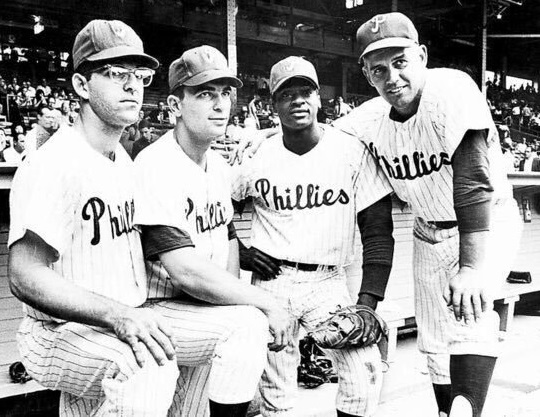
Left to right: infielder Cookie Rojas, outfielder Johnny Callison, third baseman Dick Allen, manager Gene Mauch, 1964. The Phillie Phlop wasn’t anywhere near Allen’s fault . . .

Allen wasn’t even close to the reason for the infamous Phillie Phlop. During September/ October 1964 he posted a 1.052 OPS. Kashatus exhumed the real reason the Phillies didn’t stay truly pennant-competitive again for the rest of the 1960s: a slightly mad habit of trading live young major leaguers and prospects (including Hall of Famer Ferguson Jenkins) for veterans well established but on the downslopes of once-fine careers.

The Phillies had winning records from 1965-67, but that habit began catching up to them in earnest starting in 1968—coincidentally, the season during which Allen really began trying to force the Phillies to send him the hell out of town. But Kashatus and other chroniclers—particularly Craig Wright, a Society for American Baseball Research writer debunking James—have also affirmed that Allen went out of his way to keep his teammates away from any of his desperation antics.

Just ask Bob Skinner, the former Pirate outfielder who succeeded Gene Mauch as the Phillies’ manager in 1968, and who tangled with Allen only over Allen’s bid to dress away from the clubhouse to keep himself from affecting his mates:

We certainly weren’t a bad team because of him. I didn’t appreciate some of his antics or his approach to his profession, and I told him so, but I understood some of it. I do believe he was trying to get [the Phillies] to move him. He was very unhappy. He wanted out. There were people in Philadelphia treating him very badly . . . He obviously did some things that weren’t team oriented, but his teammates did not have a sense of animosity toward him. Not that I saw. They had some understanding of what was going on.

Allen grew up in a strong family, raised by a strong but loving mother (he bought her a new home with his $70,000 signing bonus from the Phillies), in a small, integrated area in Pennsylvania farm and mine country, integrated well enough that black and white children thought nothing of having sleepovers in each other’s homes, even if they might not have dated each other.

Little Rock, Arkansas, was Allen’s first explicit taste of Southern-style racism and his 1963 experience seared him, as well it might have, when sent there for his AAA finishing with no warning of what he was likely to face as the first black player on the Travelers. There were those who wondered why Allen couldn’t take his cue from his hero Jackie Robinson’s experience of a decade and a half earlier.

But Robinson was a 27-year-old Army veteran and Negro Leagues veteran when the Dodgers brought him first to their Montreal farm and then to Brooklyn, and Branch Rickey and company prepared him as thoroughly as possible for facing and surviving the league’s bigots. Allen was 20 when promoted to Little Rock and entirely on his own. As he said himself in his eventual memoir (Crash):

Maybe if the Phillies had called me in, man to man, like the Dodgers had done with Jackie Robinson, and said, “Dick, this is what we have in mind. It’s going to be very difficult but we’re with you”—at least I would have been prepared.

The notorious Philadelphia race riot of 1964, occurring while the Phillies were on a road trip, left white Philadelphia very much on edge and presented the Phillies’ black players as a potential target. But the real first shot of what became Allen’s war was fired 3 July 1965, around the batting cage before a game. The culprit was veteran first baseman/ outfielder Frank (The Big Donkey) Thomas.

Needled by All-Star outfielder Johnny Callison after a swing, Thomas retaliated against Allen–hammering Allen with racial taunts, including “Richie X” and “Muhammad Clay.” Thomas had already infuriated no few teammates, black and white, with a pattern of race baiting, against Allen and other black Phillies, but now Allen finally had enough.

All things considered Thomas should have considered himself fortunate that all he got was Allen punching him in the mouth. But Thomas retaliated by swinging his bat right into Allen’s left shoulder. Those who were there have since said it took six to get Allen off Thomas. And when the brawl settled, manager Mauch made a fatal mistake. Not only did he force Thomas onto release waivers but he ordered Allen, Callison, and all other Phillie players to keep their mouths shut about the brawl or be fined.

Which gave the departing Thomas all the room he needed to bray about it, which he did in a radio interview, accusing Allen of dishing it out without being able to take it and saying the Phillies unfairly punished one (himself) without punishing the other. That’s gratitude for you: Allen actually tried to talk the Phillies out of getting rid of Thomas, out of concern for Thomas’s large family.

Under Mauch’s threat, Allen and his remaining teammates couldn’t deliver the fuller story. That allowed Philadelphia’s sports press of the time to make room enough for the extreme among racist fans to hammer Allen with racial taunts, racial mail, death threats, litter on his lawn (if and when they discovered where he lived), and objects thrown at him on the field, enough to prompt his once-familiar habit of wearing a batting helmet even on defense. (Hence his nickname Crash.)

Already unable to accept Allen as an individual, from rejecting his preferred name (Dick) in favour of one he considered a child’s name (Richie) to out-of-context quoting of him when he did speak out, those sportswriters roasted him at every excuse, even abetting or refusing to investigate the most scurrilous and unfounded rumours about him. The nastiest probably involved the 1967 injury Allen suffered trying to push his stalled car back up his driveway, with speculation that he’d either been stabbed in a bar fight or gotten hurt trying to escape when caught inflagrante with another woman.

Allen didn’t hit as well the rest of 1965 as he had before Thomas smashed into his shoulder with the bat. He overcame a partial shoulder separation in 1966, but the driveway injury severed right wrist tendons enough to require a five-hour surgery to repair them, costing Allen some feeling in two fingers and making it difficult to throw a ball across the infield (which finally made him a near full-time first baseman) or in from the outfield (where he’d also play periodically).

And despite those injuries and those pressures, Allen led the National League with a .632 slugging percentage, a 1.027 OPS, and a 181 OPS+ in 1966; and, on-base percentage (.404), OPS (.970), and OPS+ (174) in 1967. Wright exhumed that Mauch believed to his soul Allen really began wanting out of Philadelphia after the wrist injury rumours.

Introverted by nature, Allen still made friends among black and white teammates alike. He enjoyed talking to younger fans who weren’t possessed of their parents’ bigotries. He smarted over the hypocrisy of fans taunting him and throwing things at him one minute exploding into raucous cheers over yet another monstrous home run the next. He also tried playing through his injuries career-long until their pain became too much to bear.

“Dick’s teammates always liked him,” Mauch himself once said. “He didn’t involve his teammates in his problems. When he was personally rebellious he didn’t try to bring other players into it.” Like perhaps too many overly pressured young men, Allen took refuge in drink, often stopping at watering holes to or from the ballpark. Most of them didn’t have to deal with his so often unwarranted public pressures.

Allen’s possible closest white friend on the Phillies was catcher Clay Dalrymple, who eventually told Kashatus he wondered why Allen—who was known even in Philadelphia for mentoring players without being asked—wouldn’t take the explicit, overt team leadership role Mauch tried to convince him to accept:

It was right there for him to take if he wanted it. “All you have to do is learn how to talk with the press,” I told him. “I’d rather let my bat do my talking and be a team player,” he told me. Well, that was typical [Dick]. He never wanted to tell others what to do, probably because he didn’t like being told what to do.

2019-04-29 DickAllen05

Allen as a Cardinal (right) holding Hall of Famer Willie Stargell on first. Stargell once kidded that Allen got booed because “When he hits a home run, there’s no souvenir.”

Finally the Phillies promised to trade him after the 1969 season. And they did. They traded him to the Cardinals for Curt Flood. Oh, the irony. To Flood, the deal meant he was still a slave at the mercy of his owners; to Allen, who rooted for Flood’s coming reserve clause challenge, the deal was tantamount to the Emancipation Proclamation.

He had a solid 1970 in St. Louis despite Busch Stadium being a far tougher hitter’s park than Connie Mack Stadium and despite a bothersome Achilles tendon and, later in the season, a torn hamstring. He had a solid 1971 with the Dodgers despite Dodger Stadium making Busch Stadium resemble a hitter’s paradise.

Cardinals manager Red Schoendienst, edgy about acquiring Allen originally, was anything but by the time Allen was traded:

He did a real fine job for me. He had a great year, led our team in RBIs, and he never gave me any trouble . . . He was great in our clubhouse. He got along with everybody. He wasn’t a rah-rah guy, but he came to play. They respected him, and they liked him.

The Cardinals traded Allen to the Dodgers not because of any divisiveness issues but because they needed the young second baseman (Bill Sudakis) they didn’t have yet in their own system behind Julian Javier, the veteran coming toward the end of a solid career. The Dodgers traded Allen to the White Sox (for Tommy John) because his reticence about scripted public appearances didn’t jibe with owner Walter O’Malley.

2019-04-29 DickAllen03

Allen with the White Sox: “He played every game as if it was his last day on earth,” said his manager there, Chuck Tanner.

He exploded with the White Sox in 1972, yanking them into pennant contention and winning the American League’s Most Valuable Player Award, then suffered injuries yet again in 1973 and 1974. In spite of which he led the league in home runs (1972, 1974), on-base percentage (1972, also leading the Show), slugging (1972, 1974, the latter also leading the Show), and OPS. (1972, which also led the Show; and, 1974.)

He retired before the 1974 season ended, ground down by the injuries, but he let a very different group of Phillies (Hall of Famer Mike Schmidt led a group to Allen’s Pennsylvania farm) talk him into returning for a final go-round in 1975-76. But the injuries finally extracted their penalties in earnest. After one brief spell with the 1977 Athletics, Allen retired.

White Sox manager Chuck Tanner, who’d known Allen’s family for years as neighbours and had the respect and affection of Allen’s beloved mother, and who was the key in Allen accepting the deal that sent him there:

He was the greatest player I ever managed, and what he did for us in Chicago was amazing . . .  Dick was the leader of our team, the captain, the manager on the field. He took care of the young kids, took them under his wing. And he played every game as if it was his last day on earth . . . He played hurt for us so many times that they thought he was Superman.  But he wasn’t; he was human.  If anything, he was hurting himself trying to come back too soon.

Bill Melton, third baseman and Allen’s best friend on the White Sox and still a White Sox broadcast commentator:

 [M]ost of all he led by example, and had a calming effect on the younger players. He just made us better as a team . . . It meant a lot to him that his teammates befriended him pretty quickly after he was traded here. The young kids loved him, especially the pitchers, because he took the time to mentor them. And the fans cared about him, too. There’s no doubt in my mind that Dick was one of the most beloved players in the history of the White Sox organisation.

Hall of Fame relief pitcher Goose Gossage, a rookie on the 1972 White Sox:

Dick’s the smartest baseball man I’ve ever been around in my life. He taught me how to pitch from a hitter’s perspective and taught me how to play the game and how to play the game right. There’s no telling the numbers this guy could have put up if all he worried about was his stats.

As in Philadelphia, injuries got directly in the way of Allen’s total raw numbers. Enough that White Sox GM Hemond had to defend Allen against accusations by Chicago Sun-Times writer Jerome Holtzman that he was really malingering rather than fighting what proved a leg fracture:

Once we fell out of the pennant race we had to begin thinking about [1974]. We decided that rather than push him and risk further injury to his leg it would be better if Dick sat out and fully recuperated so he’d be ready to go for the next season. Why jeopardise his future for a few extra times at bat?

Allen eventually admitted how immature he’d been in a lot of the ways he’d handled his first Philadelphia tour of duty. Some still believe such immaturity shortened his career. Writing in The Big Book of Baseball Lineups, Rob Neyer rebuked his one-time employer Bill James: “I don’t think his immaturity had much to do with the length of his career. He just got hurt, and so he didn’t enjoy the sort of late career that most great hitters do. It’s that, as much as all the other stuff, that has kept him out of the Hall of Fame”

Calling everything else that buffeted Allen just “all the other stuff” does him a disservice no matter his eventual admission of foolishness trying to beat it back. If anything, it’s to wonder that Allen could have played as well as he played through both the injuries and “all the other stuff.”

Allen might have been given another Hall of Fame shot last year but for his re-classification for the Golden Days Era Committee, which addresses players whose biggest impacts were between 1950-1969, and doesn’t convene again until 2020. Which means that if they elect Allen, he’ll be inducted in 2021.

A man who has endured heartache above and beyond what he was put through in Arkansas and his first Philadelphia tour—a painful divorce, the unexpected death of his daughter, the destruction (electrical fire) of the farm on which he’d hoped to breed thoroughbred horses (asked once about Astroturf, he deadpanned memorably, “If my horse can’t eat it, I don’t want to play on it”)—Allen, who has since remarried happily and keeps his family and friends close, can take or leave the Hall of Fame by himself.

“What I’ve done, I’m pretty happy with it,” he told Kashatus once. “So whatever happens with the Hall of Fame, I’m fine with. Besides, I’m just a name. God gave me the talent to hit a baseball, and I used it the best I could. I just thank Him for blessing me with that ability and allowing me to play the game when I did.”

Jay Jaffe, in The Cooperstown Casebook, gave Allen the first half of his introduction to the chapter on third basemen::

[C]hoosing to vote for him means focusing on that considerable peak while giving him the benefit of the doubt on the factors that shortened his career. From here, the litany is sizable enough to justify that. Allen did nothing to deserve the racism and hatred he battled in Little Rock and Philadelphia, or the condescension of the lily-white media that refused to even call him by his correct name. To underplay the extent to which those forces shaped his conduct and his public persona thereafter is to hold him to an impossibly high standard; not everyone can be Jackie Robinson or Ernie Banks. The distortions that influenced the negative views of him . . . were damaging. To give them the upper hand is to reject honest inquiry into his career.

During Allen’s first Philadelphia tour some fans who rooted for him no matter what hung a banner in the left field upper deck emblazoned with a target framed by two words: “Allen’s Alley.” An honest inquiry into his career should tell you his peak value means Allen’s Alley should lead to Cooperstown at last.

Depends on whose kids play, I guess

2019-04-17 TimAnderson

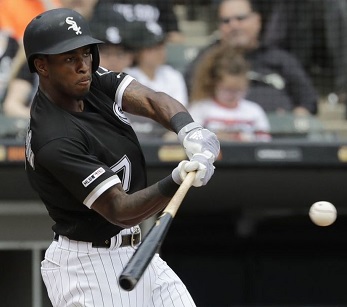
Tim Anderson, a milli-second from making breakfast out of Brad Keller’s full-count grapefruit . . .

It’s beginning to look a little more like letting the kids play, which baseball wishes to push as its watchword, is going to have more exceptions as the season ambles forward. And, it isn’t just from those players still wedded till death do they part to the Sacred Unwritten Rules.

Apparently, baseball’s most notorious umpire wants to have his say about it, too. Apparently, too, there are teams who don’t mind their own kids playing but are ready to rumble if their opponents play.

Come Wednesday baseball’s incumbent hottest hitter, Tim Anderson, learned the hard way about what happens when you’re one of the kids who wants to play but Joe West decides in the moment that he’s your daddy, and Daddy needs to send you to your room for objecting vociferously though not violently over being hit by a pitch your next time up after hitting one out.

Oh, yes, Tim. You came to play, and—with Eloy Jimenez on second and two out—Royals’ starter Brad Keller threw you a full count grapefruit. And just like any major league hitter who happens to be heated up well enough, you saw that grapefruit and knew it meant one thing—breakfast. And oh, did you feast on it. You drove it so far into the left field seats there should have been coffee served with it.

And, considering you’d just had such a yummy breakfast courtesy of a pitcher against whom you’d been (read carefully) 0-for-13 with five strikeouts and not a base on balls on the ledger otherwise, there shouldn’t be a jury on earth that would consider you out of line for striding moderately out of the batter’s box watching it fly, then throwing your bat toward your own dugout as if momentarily in the javelin event at the Olympics before running out the breakfast bomb.

Neither you nor Keller have any clue, probably, that Cy Young’s unrelated namesake is still the only American man to win Olympic gold in the javelin throw, or that Babe Didrikson was the first American woman to win Olympic gold in it. All you know, Tim, is that you’re not staring Keller down, you don’t look into his team’s dugout, you don’t do anything in any way to show the Royals up, unless the Royals suddenly believe firing your bat toward your own dugout shows them up.

You probably care, Tim, only that your next time up Keller throws the first pitch of the plate appearance into your can, and that he probably wishes it was a shot put, not a baseball. And it’s very possible that Keller cares deeply about the little fact that you’ve hit eight home runs off Royals pitching in your career, two more than you’ve hit against any other team.

So right after you got canned, you take a step or two toward the mound and Royals catcher Martin Maldonado—who has the job because Salvador Perez, the catcher who thinks you have no right to have fun until or unless you’ve won a World Series ring, is out for the season with an injury—slithers into your presumed path.

You talk to Maldonado while then giving Keller a well-earned glare. You’re not thinking about charging Keller, like a bull or anything else. You even give Maldonado two pats on the shoulder as you both stride up the first base line, and it looks as though it’s going to be no big deal. Looks aren’t everything, alas.

2019-04-17 TimAnderson02

. . . then, flinging his bat like a javelin toward (underline this, gang) his own dugout . . . 

Because Jose Abreu leads your teammates out of the dugout and the Royals come pouring out of theirs. It’s going to take about seven or eight minutes and a couple of scrums between a couple of coaches and managers, yours and theirs, to get the whole thing settled, even as—rather intriguingly—the mob ended up not around the mound or the plate but near first base.

And all the while, Tim, you’re doing something rather remarkable with a little help from your friends, much as Keller is. You’re both staying away from the rhubarb.

The Royals may be chirping like canaries toward you, and a few of your mates might be chirping likewise toward Keller, but you two aren’t even near the crowd. Even if your coach Joe McEwing has his arms around you from behind just in case, but you sure don’t look like you’re ready for a piece of anyone in Royals fatigues.

Your manager Rick Renteria may be barking at Royals manager Ned Yost to get his kids off the field unless they’re playing in its positions, and Yost may be barking back that there’s no way he’s going to let your boss or anyone bark at his boys. But you and Keller, with a little help from at least a couple of your friends, are actually behaving yourselves during this little danse d’absurdio.

Far as you know, Tim, Keller should be the only one who gets a ho-heave, and maybe your mates should get at least one chance to send the Royals a message in return. Maybe. You’re all about having fun while you play. You know that word “play.” Even if you’re not aware of Hall of Famer Willie Stargell’s wisdom: “The umpire doesn’t say, ‘Work ball’.” Even if you’ve never seen Bull Durham and heard Crash Davis remind his teammates, “This game’s fun, okay?”

Yet you may forget one small detail, Tim.  You may forget that Joe West, one of the base umpires for the game, doesn’t forget.

2019-04-17 TimAnderson03

. . . then, getting drilled his next time up by the pitcher off whom he’d never hit one out until his previous time up.

Last year, you asked him about whether he or anyone else saw you get touched when Javier Baez of the Cubs slid rather hard into you trying to break up a double play in the making. And Country Joe sent you and your skipper to the showers. And you said, quote, “I don’t have much to say about him. Everybody knows he’s terrible. But I didn’t say much. He threw me out. It’s OK.”

Well, it turns out not to have been OK. Because once things settle down Wednesday, Country Joe rounds up the umpires and decides Keller, Renteria, Royals coach Dale Sveum, and . . . you should be sent to your rooms.

You get Keller. You get your skipper. You get Sveum. But you? The original victim? This is like a father learning the neighbourhood bully beat the hell out of his son for no reason and deciding his son needed to be spanked for it.

And you, the son, are diplomatic enough not to reference Daddy’s previous unwarranted punishment over the Baez slide debate, such as it was, when Mother asks what the hell you are doing in time out with a sore bottom for the rest of the day. (You may wish to wonder whether Mother reminded Daddy that, thanks to these punishments he’s now number three on the all-time umpires’ ejections survey thanks to passing Hank O’Day.)

And when the White Sox send someone from their media relations department to ask what Daddy and his fellow umps thought when Daddy laid down the law, all they say in reply is, “Because of the language that was used on the field, the umpires declined comment.”

Somewhere in the middle of the scrum, Tim, Country Joe Daddy actually put his hands on your manager trying to usher him the hell out of it. Now, if you wonder, Tim, where the hell West gets off with that kind of contact—when you and every other fool knows there’d be hell to pay if it had been your manager putting hands on Country Joe Daddy or any other umpire in like circumstances—you’re hardly alone, I’m sure.

Even diplomatic you, Tim, can’t be blamed if your spontaneous thought about that and your ultimate day’s punishment is, “You’ve gotta be joking.” What’s not a joke is that of course the Royals deny any intent on Keller’s part to teach you a lesson about play. Of course Keller himself says he wasn’t trying to put a hole into your left butt.

And of course you and me and everyone else watching that game knows it was about as not-trying as the day Hunter Strickland nailed Bryce Harper on the first pitch of an at-bat, over a pair of home runs almost three years old.

We also know the Royals are a little on the hypocritical side when it comes to these things. They have no problem with one of their own remembering the umpire doesn’t say, “Work ball.” (That one of their own last year, Alcides Escobar, is now in the minor league system of . . . the White Sox. Just sayin’.) They just don’t like it when one of the opposition remembers.

Go back out and have fun today, Tim. Your manager has your back, too. As he says, wisely, about home runs like yours and spontaneous celebrations like yours, “You want him not to do that? Get him out.” What a concept.

And as for you, Brad Keller, I have this: Instead of throwing at the guy who ate your grapefruit for breakfast the next time he faces you, get him out . . . and have a little celebration of your own.

Strike him out. Make your hand into a pistol and fire it (just like Hall of Famer Dennis Eckersley used to do), or fan it. (Just like the late Joaquin Andujar used to do.) Or, make like you’re firing an old fashioned tommy gun. Or, drop to a knee and fire an imaginary bazooka toward him as he slinks back to the dugout. If hitters can have fun, why can’t pitchers?

Or, if the next time up the circumstance allows you to lure him into a double play grounder, make sure your infielders are ready to mime a juggling act. If hitters and pitchers can have fun, why can’t the fielders?

“Remember when you were a kid and you’d skip supper to play ball?” should-be Hall of Famer Dick Allen, near the end of his career, once reminded pressing young Hall of Famer-to-be Mike Schmidt. “You were having fun. Baseball’s supposed to be fun. Enjoy it. Be a kid again.”

Sound counsel for both Tim Anderson and Brad Keller, the latter of whom happens to be two years younger than the former, but who chose instead to behave like a scolding old get-off-my-lawn fart. And, for Joe West, who’s old enough to know better, still young enough to enjoy it, but may think he was born a scolding old get-off-my-lawn fart.


Pants on fire! McDougald didn’t kill Score’s career

0000 PantsOnFire03 HerbScore

The real story of Herb Score and Gil McDougald isn’t as simple as you might still think.

When Anthony Rizzo lined a base hit off Jameson Tallion’s head Monday, there must have been those who’ve watched baseball since before I was born who had two names in the center of their minds: Herb Score and Gil McDougald. As you might imagine they pop into those minds any time they’ve seen a pitcher drilled by a liner back to the box, in the head or otherwise.

Because, well, everybody knows that when McDougald, the Yankee jack-of-all-trades of the 1950s, caught hold of Score’s heater and drilled it right into the face of the Indians lefthander, that 7 May 1957 afternoon, that was it, kiss it goodbye for Score’s promising career. Right?

Wrong. Stop saying that, once and for all. Because that wasn’t quite it for the popular, talented pitcher who eventually became an even more popular Indians television broadcaster with a Yogi Berra-like flair for malaprops. (A classic: He makes the catch for the final out. And after three, the score, Cleveland 4 and the Indians 2.) And, a reputation as a gentleman who wouldn’t harm the proverbial fly.

“He’s such a nice guy,” one-time Indians third baseman Buddy Bell said of him, “that I’ll bet he makes the bed in his hotel when he wakes up in the morning.”

This is what is true: Until that afternoon, Herb Score was, essentially, Sandy Koufax before Koufax became Koufax. He’d just led the majors in strikeouts back-to-back, the 245 he punched out shattering Grover Cleveland Alexander’s record for a rookie pitcher and standing as the rookie record until Dwight Gooden broke it in 1984. His 9.7 strikeouts-per-nine rate led the majors, and he won the American League’s Rookie of the Year award pretty handily.

Score struck out 263 in 1956, again leading the majors as did his 9.5 strikeouts per nine and his 2.78 fielding-independent pitching rate. (ERA minus defense behind you.) He was also a 20-game winner in ’56. His rookie wins above a replacement-level player were 5.6, considered All-Star level or better; in ’56, he had 7.3, just shy of what WAR considered a Most Valuable Player-caliber season. He was an All-Star both those seasons, and his only blemishes seemed to be walks and wild pitches; he led the majors in the latter both years.

“Herb Score is the toughest pitcher I’ve faced,” Hall of Famer Mickey Mantle was quoted once as saying. “I just can’t hit him.” (Not entirely true: Mantle hit .250 against Score lifetime, with two homers, five runs batted in, and an .859 OPS.)

Score was in his fifth game of the 1957 season when McDougald’s liner flattened him. He had 39 strikeouts, a 9.8 strikeouts-per-nine rate, and a nifty 2.00 earned run average against his 2.50 FIP, not to mention 39 strikeouts in 36 innings.

2019-04-11 HerbScore02

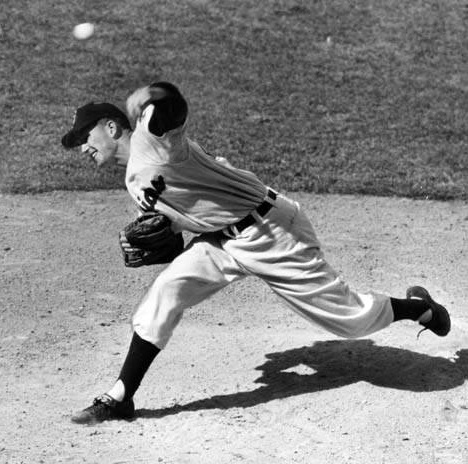
Score in motion, long before the fateful line drive . . .

Score was pitching in the top of the first and had just gotten rid of Hank Bauer on a ground out to third base when McDougald, playing shortstop that day, came up. On 2-2 he caught hold of a low fastball and drilled it, and Score hit the mound in a heap with his hands over his face after the ball ricocheted.

But every eye in Cleveland’s old Municipal Stadium (a.k.a. the Mistake on the Lake) was on the stricken Score. Indians outfielder Rocky Colavito, Score’s roommate and best friend, hustled in and slid his glove under Score’s head after Score turned in agony from his left side to his back.

Score was taken by ambulance to a hospital. Hall of Famer Bob Lemon relieved Score and finished the game, the Indians winning, 2-1, with Colavito himself pushing both Indian runs home: in the seventh, when his sacrifice bunt attempt turned into a throwing error to third allowing Vic Wertz to score the tying run (Bauer had an RBI single in the top of the seventh); and, in the eighth, when he worked out a bases-loaded walk.

McDougald finished the game, but couldn’t contain his grief, either.

“I heard the thud of the ball hitting his head,” he remembered in 1994, to New York Times columnist Ira Berkow, “and then saw him drop and lie there, bleeding, and I froze.  Someone hollered for me to run to first. When Score was taken off the field on a stretcher, I was sick to my stomach. I didn’t want to play anymore.”

Yankee manager Casey Stengel insisted McDougald stay in the game. McDougald obeyed his manager but added, “If Herb loses his eye, I’m quitting baseball.”

Score didn’t lose his eye as things turned out happily enough, but McDougald incurred a truckload of fan abuse over the liner, fans often yelling “Killer” at him when he batted during Yankee road games. Score wasn’t one of his judges, though. Indeed, when the two men met for the first time after Score’s hospitalisation, as Score himself told a reporter, “I talked to Gil and told him it was something that could happen to anyone. It’s just like a pitcher beaning a batter. He didn’t mean it.”

Score’s sister, Helen, was living in Florida at the time and didn’t know what happened to her brother until after the game ended and she returned home from her government job. “When I got home, a lady said my mother had been calling,” she told the Palm Beach Post in 2018. “I got in touch with her and Mom said, ‘It’s bad, but he’s got the finest doctors in the world and they will do everything that they can. You need to go down to the church and say your prayers for Herb, but more than that to pray for Gil McDougald. That man is a hurting man’.”

2019-04-11 HerbScoreGilMcDougald

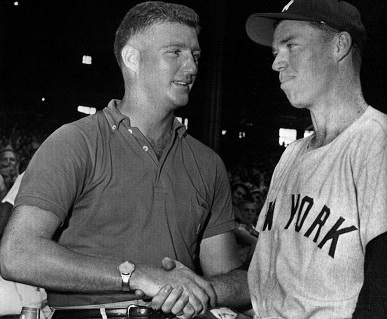
It wasn’t for publicity alone when Score shared this handshake with McDougald later in 1957.

McDougald tried to get updates from the hospital but personnel claimed they were ordered not to say a word to him or even to let him visit Score. (The only visitor Score was allowed, the Post said, was his fiancee, Nancy; the couple moved their planned 1957 wedding date up from October now that Score’s season was over.)

The versatile Yankee’s only reported solace came from Score’s mother, who told him likewise it wasn’t his fault. (A grateful McDougald visited Mrs. Score for years after their careers ended, whenever he was in Florida, the Post said.) But without losing his sight Score recovered and returned to the Indians in 1958.

After a pair of rough starts to open, he had a scoreless relief appearance to earn a save, then threw a shutout at the White Sox which included thirteen strikeouts, very much vintage Score. In his next game Score suffered a loss from an eight-and-a-third inning start in which he was tagged for three earned runs, but he suffered something a lot worse.

As Score himself would remember long after his career ended, it was a cold and wet night and he started feeling forearm soreness. In the seventh inning, he said, he bounced a pitch in front of home plate and his elbow flared on him.

Told he’d torn an elbow tendon, Score sat it out on doctor’s orders for thirty days, then took a relief turn against the Senators in Washington, where he’d first incurred the injury. The game started well, with Score striking out five of his first eight batters, until with two out in the ninth he “felt like someone stabbed me in my left arm.” He got a pop out to end the game on a lob of a pitch, but only pitched on and off the rest of 1958 hoping an off-season’s rest would resolve the elbow.

It didn’t. The theories began abounding; you can get the drift just from broadcaster Jimmy Dudley: “I still insist Herb never got over the effect of that blow to the eye. That would change anyone, and he changed his motion so he would protect his eye. I firmly believe that.”

Score firmly rejected that theory for the rest of his life. The evidence—you know, that pesky evidence—backs him completely. The elbow tendon tear, not the McDougald liner,  was the injury that ultimately finished him as a pitcher. His pitching motion changed trying to overcome any lingering elbow issue. Put down all the juicy speculations and lamentations and let Herb Score tell it himself:

Before I hurt my arm, I could go through an entire season and never scuff the toe plate [of his spiked shoe]. Later, I was ripping up a toe plate every game because I was dragging my foot . . . I couldn’t get out of the habit of dragging my foot, and that wrecked my entire motion to home plate . . . The reason my motion changed was because I hurt my elbow, and I overcompensated for it and ended up with some bad habits.

Score was never again the pitcher he was in 1955-56. After a very down 1959 and a 7.61 spring training ERA in 1960, there were those who believed the Indians gave him special coddling, including a few teammates, with only Rocky Colavito standing up for him.

Score actually had the infamous Colavito-for-Harvey Kuenn trade to thank for getting a trade of his own to a place he dearly wanted to go if the Indians’ infamous then-general manager, Frank Lane, wanted to be rid of him almost as badly as he wanted Colavito out of his sights. To the White Sox, whose manager Al Lopez was Score’s first Indians manager, and whom Score believed could help him get back on the right pitching track.

According to Terry Pluto, in The Curse of Rocky Colavitowhen Indians vice president Nate Dolin asked Score if he’d like to go to the White Sox, Score didn’t flinch:

I told him that it would be the best thing that could happen at this point in my career. Al Lopez had caught more games than anyone in major league history until Bob Boone broke his record . . . Al Lopez had had as much success with pitchers as any manager ever. I knew if anyone could help me, it was Al Lopez.

If it wasn’t for Dolin, Score and Lopez wouldn’t have their reunion. Lane was only too willing to deal Score—but not to Lopez, who’d resigned as the Indians manager after the 1956 season. Lopez accused the team’s management of not standing up for injury-addled third base star Al Rosen, who’d played through injuries down the stretch to furious booing from the stands and criticism in the press.

Pluto also wrote that Lane may have feared that Lopez could indeed revive Score, and that a revived Score could haunt the Indians for seasons to come. But in the heat over the Colavito trade, Dolin confronted Lane:

[Dolin] said something like, “If you have just one ounce of compassion in that bucket of venom you call a heart, you’ll send Herb to the White Sox.” Lane knew that because of the Colavito trade, Dolin still wanted to tear his limbs off and feed them to a family of hungry grizzlies.

For his part, Lane couldn’t let Score go to the White Sox without taking a gratuitous and  nasty slap at the clean-living, forthright pitcher:

Herb’s troubles are more psychological than physical. Maybe a change of scenery will help him. Lopez won’t be any more sympathetic toward Herb than [Indians manager Joe] Gordon was. But Herb will think he is and that may make a difference. Herb has a great imagination.

Colavito’s annual tangles with Lane over contracts, to say nothing of Colavito believing and telling the GM to his face that he was a proven liar (Pluto has cited chapter and verse), made him trade bait. But Score though there was another reason Lane was so anxious to be rid of the pair: “Part of it,” he said, “was that Lane believed ballplayers should be rowdy, hard-living, hard-drinking guys. But that wasn’t Rocky or myself.”

Lopez couldn’t help Score as things turned out, and Score spent the rest of his career between the White Sox and the minors until he bottomed out at Triple-A Indianapolis in 1963.

People asked me why I went to the minors to pitch. I still believed that my arm might come back. I was only thirty. I didn’t want to be sitting somewhere when I was sixty and wondering, ‘What if I had pitched one more year, would I have found it?’ Now I know. I have no doubts. I tried everything, and I pitched until they pretty much tore the uniform off my back.

The only place Herb Score sat at sixty was the same place where he began sitting in 1964, in the broadcast booth doing Indians games on television, until the end of the 1997 World Series. Voices of the Game author Curt Smith quoted a friend thus: “So what if he’s never been a Hall of Fame announcer? Look at it this way. Wouldn’t the city of Cleveland have turned somersaults over the last twenty years just to have ball clubs as decent as their announcer?”

Gil McDougald wouldn’t be quite the same player after the line drive, either. After a pair of very down seasons in 1959 and 1960, the Yankees left McDougald available for the expansion draft that created the second Washington Senators and the Los Angeles Angels. But McDougald elected to retire before that draft, exhausted, he said eventually, of the travel “and the attitude of the baseball people . . . they acted like they owned you and that they were giving you the moon and the stars.”

In fact, his own fate was hit by a line drive two years before his own nailed Score. McDougald was hit behind his left ear by a batting practise liner, in a genuine freak accident, as he eventually told Berkow, while he was behind a screen at second base talking to Yankee coach Frank Crosetti.

I saw a ball lying on the ground nearby and reached to pick it up, my head going just beyond the screen. Just then Bob Cerv hit a ball that hit me in the ear. I collapsed and everyone came running over. They carried me off the field, and I was out of action for a few games.

The doctors told me I’d be all right. Well, I wasn’t. The blow had broken a hearing tube. At first it just affected one ear, my left. One time I’m getting needled by some fan at third base, and I turned to [Phil] Rizzuto . . . and said, “Too bad I didn’t get hit in the right ear, then I wouldn’t have to hear this guy.”

A father of four, McDougald already had a dry cleaning business doing well. He eventually became Fordham University’s baseball head coach—until his right ear went deaf as well, ending his coaching career and forcing him to sell his dry cleaning and building maintenance business.

Berkow told McDougald’s story in 1994 with sad grace in “McDougald, Once a Quiet Yankee, Now Lives in Quiet World.” That, plus the happy followup Berkow wrote after McDougald underwent a successful cochlear implant to restore his hearing enough to allow him to function again, are collected in Berkow’s Summers in the Bronx: Attila the Hun and Other Yankee Stories.

If you think Herb Score spent the rest of his life lamenting what Gil McDougald didn’t take away from him, after all, think again, as Score told Pluto in 1993:

People tell me that I was unlucky. Me? Unlucky? I started with a great team in the Indians and played under a great manager in Al Lopez. Then I went from the field to the broadcasting booth at the age of thirty, and thirty years later I’m still doing the games. If you ask me, that’s not unlucky. That’s a guy who has been in the right place in the right time.

McDougald spent the last years of his life advocating for the hearing-impaired and for the manufacturer of his cochlear implant. After the implant surgery, during an office visit to the audiologist who programmed it after he healed from the procedure, with his wife and one of his children at his side, McDougald wept for joy.

As he told Berkow later, while his home bustled with children and the grandchildren “who came to see Grandpa hear,” as his wife put it, he found the words to describe the gift: “They’ve turned the music on.”

Score retired after the 1997 World Series. He survived a near-fatal 1998 road accident, but then suffered a stroke in 2002, and died in 2008. McDougald died of prostate cancer two years later.