2024: Taking the Fifth, and Other Lamentations

Aaron Judge

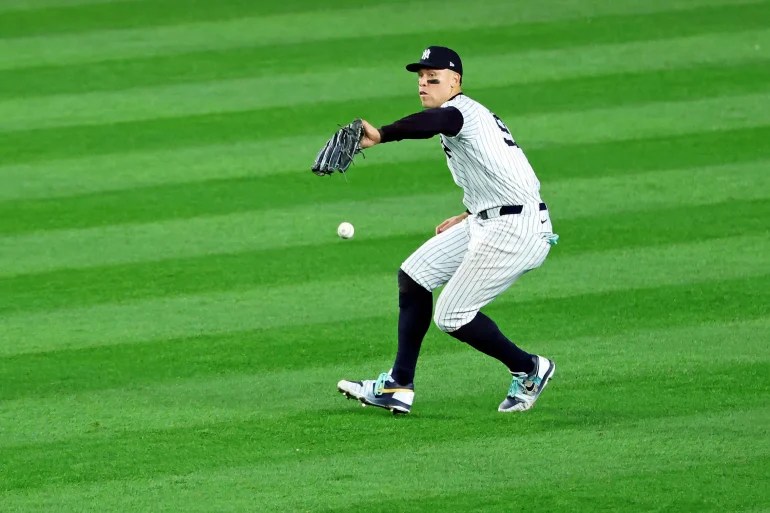
This is not what was meant when the phrase, “I’ve got the drop on you,” was coined . . .

Hands up to everyone who can’t wait for 2024 to depart. Now, hands up to everyone who thinks 2024 was just the most wonderful year of the decade. My, but that’s a barren sea of hands over that second suggestion.

Much like its home country, baseball’s 2024 was . . . well, why don’t we let some of the signature moments, doings, and undoings of baseball’s year speak for themselves. The new flimsy uniforms sucked. The All-Star Game uniforms didn’t suck that badly, but still. Meanwhile, I’m thankful to folks such as Jayson Stark and a few other intrepid sleuths of BBW—that’s Baseball Bizarro World, you perverts—who either unearthed or reminded us about . . .

Take the Fifth—Please Dept.—“Come an’ see my amazin’ Mets,” their manager Casey (I Lost With This Team What I Used to Win with the Yankees) Stengel liked to say of his maiden squad. “I been in this game a hundred years but I see new ways to lose I never knew were invented yet.”

That was the Ol’ Perfesser gazing down from the Elysian Fields, watching the team with whom he won ten pennants and seven World Series perform the single most splendid imitation of the 1962 Mets since . . . the 2024 White Sox finished their sad, sad, sad regular season.

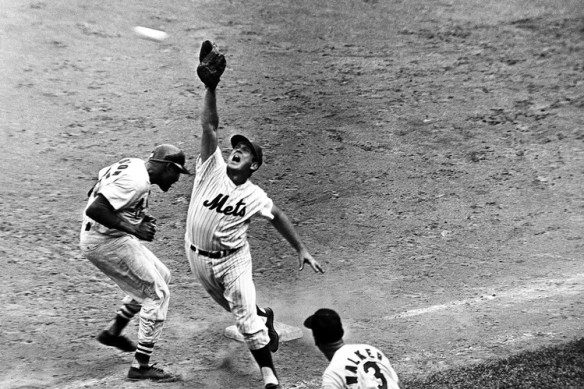
Pace George F. Will, look to your non-laurels, White Sox—the Bronx Bumblers captured 21st Century baseball’s booby prize. You White Sox only out-lost the 1962 Mets this season. You probably never did in one regular season game what only began in a World Series game . . . with a Yankee center fielder who does a credible impersonation of the Leaning Tower of Pisa approaching the plate and Frank Howard at the plate committing his first error playing center field after 538 fly balls hit his way in his entire career to date became outs.

Then . . .

* A Gold Glove-finalist shortstop threw for a force play at third base and saw the ball ricochet off the base instead of reach his third baseman’s glove.

* The arguable best pitcher in the American League got thatclose to escaping a bases-loaded, nobody-out jam when he suffered the brain fart heard ’round the Bronx and the world: he forgot to cover first when Mookie Betts hit a screwdriving ball toward Anthony Rizzo. Oops.

* The Yankee anti-party included a balk and catcher’s interference.

* The Dodgers became the only team in baseball history to score five runs in a World Series game after they were in the hole 5-0.

* The Yankees became the only team in baseball history to serve up five unearned runs in a World Series game since they started counting earned and unearned runs as official statistics. (When did they start? In the same year during which premiered Ford’s moving assembly line, the first newspaper crossword puzzle (in the New York World), and Louis Armstrong’s first cornet. In the New Orleans Home for Coloured Waifs.)

* And the fifth-inning party actually started with everyone from the television announcers to the fans and back pondering whether Gerrit Cole might, maybe, consummate a no-hitter to keep the Yankees alive.

Your Reality Check Bounced Dept.—Too many Yankee fans continue infesting social media with proclamations that the Yankees still have the dynastic history of dynastic histories. And too many baseball fans steeped in reality and not fantasy keep reminding them, Your damn dynasty is just soooooo 20th Century!

Juan Not-So-Small Step for Met World—That’s $765 million the Mets will pay Juan Soto over the next fifteen years. This may or may not mean the end of Pete Alonso’s days as a Met, which may or may not mean . . .

Out with a Bang Dept. . . . that Polar Bear Pete’s final act as a bona-fide Met was the biggest blow on their behalf this century: the three-run homer he blasted in the ninth inning that proved the game, set, and National League division series winner against the Brewers. Which was also the only home run hit by any Met in the set.

Did I Do That Dept.—Alonso’s division series-winning blast came off Devin Williams . . . who’d never allowed a ninth-inning lead-changing bomb in his major leaguer life until then. Then, after some time passed, the Brewers let the Yankees talk them out of keeping Williams, sending them pitcher Nestor Cortes, infielder Caleb Durbin, and cash to take Williams. We still don’t know if the deal was Milwaukee payback for surrendering Alonso’s game-changing/game-swiping bomb.

Out with a Bigger Bang Dept.—That would be Walker Buehler, pitcher. One minute, locking down the Dodgers’ World Series win with a spotless Game Five ninth including two swinging strikeouts. The next, practically (well, give or take a few hours): Signing for one year and $21 million with the Red Sox. Anyone remember the Dodgers making Buehler a qualifying offer for that money and Buehler turning it down? He’s rolling serious dice on himself with this deal.

Shohei-hei Rock and Roll Dept.—You might think anyone can become a member of the 50 home run/50 stolen base club. But you won’t be able to predict who might do it the same way Shohei Ohtani did in September against the Marlins: 6-for-6 at the plate; three home runs; five extra base hits; two stolen bases; ten runs batted in. His own planet? Try realising Ohtani exists in his own quadrant.

A Cut Below Dept.—Pete Fairbanks, Rays reliever. He missed a game in 2024 because of a finger cut. He cut the finger opening a bottle of spring water. Considering his bizarre 2023 injury (incurring a black eye while trying to dunk against his toddler son through a water basketball net), it seems as though Fairbanks just couldn’t cut it anymore.

On Your Knee Dept.—Presented for your consideration: Miguel Sanó, Angel. Aleady on the injured list with an inflamed knee. He put a heating pad over it. He forgot about it just enough to burn the knee and place himself for another month on the IL. Miguel Sanó, who proved he certainly could stand the heat in . . . the Angels’ continuing Twilight Zone.

The King of Pop Dept.—Mookie Betts performs amazing feats at the plate and on the field. At the plate, they usually involve baseballs shot on lines into the outfield, or driven like ballistic missiles over fences. They didn’t involve him popping out for the cycle . . . until 25 September, when, in order, he popped out to: second baseman, third baseman, first baseman, and shortstop.

Don’t do it. Don’t Google “MLB players who’ve popped out for the cycle.” It won’t even call up the Mookie Monster, yet, never mind anyone else who might have had that kind of a day—whether a Hall of Famer, a Hall of Famer in the making, or a guy who’s destined to be forgotten outside such a single singular feat.
Sixty years on, an eyewitness remembers the Original Mets

1962 Mets Yearbook

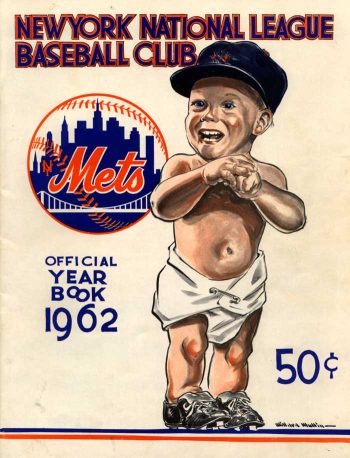
The first Mets yearbook, 1962, drawn by cartooning legend Willard Mullin—whose creation of the Brooklyn Bum in the 1930s proved he knew absurdism when he saw it.

In February 1962, Casey Stengel gathered his sort-of brand-new major league baseball team together, pointed toward the spring training field, and said, “Them are the bases.” Two months later, sixty years ago today, broadcaster Bob Murphy crooned from the booth in St. Louis, “Yes, sir, the New York Mets are on the air in their first great season.”

This year’s Mets awoke this morning after beating the Nationals in Washington three straight before losing 4-2 Sunday afternoon. Their ancestors of sixty years ago awoke that 11 April to lose an 11-4 blowout to the Cardinals in ancient Sportsman’s Park, freshly re-named Busch Stadium.

It began a life-opening nine-game losing streak. And, the birth of a legend. When they recorded their first-ever regular-season win, a handy 9-1 final against the Pirates, the immediate gag became, “Break up the Mets!” No such team setting a record for getting destroyed on the field ever seduced a locale as profoundly as the Original Mets seduced New York.

Still smarting from the exodus West of the Dodgers and the Giants (in whose ancient, rambling wreck of a Polo Grounds home the Mets played awaiting Shea Stadium’s birth), and probably saturated by what seemed decades of Yankee success and its attendant hubris, New York embraced the Mets with a season-long bear hug and a kind of pre-countercultural hysteria in the stands.

If the British played baseball and fielded such a team as the Original Mets, they’d have been considered the game’s progenitors of Monty Python’s Flying Circus. But the National League awarded New York the Mets in its first expansion, their original owner having been the lone stockholding vote against the Giants leaving town. The Mets became . . .

Well, I’ve said it before, but who can resist repeating it? Abbott and Costello performed “Who’s on First” several hundred times before they ended their partnership. Little did they know. The Original Mets seemed to have Abbott pitching to Costello with Who the Hell’s on first, What the Hell’s on second, You Don’t Want to Know’s on third, and You Don’t Even Want To Think About It’s at shortstop.

One minute, the outfield was reasonably competent (and often included Hall of Famer Richie Ashburn at the sunset of his fine career) and the infield (including future Hall of Famer Gil Hodges at first base, before knee injuries put paid to his playing career) was at minimum not bound for infamy. The next, they were the Three Stooges and the Four Marx Brothers.

Except when otherwise genial Marv Throneberry played first base. “This,” wrote then-New York Herald-Tribune writer Jimmy Breslin, “was like saying Willie Sutton works at your bank.” He was a former Yankee prospect now a gangling Charlie Chaplin for Groucho, Harpo, and Chico. When he didn’t hit the long ball now and then (he once ruined the Pirates and relief legend Elroy Face with a game-winning three-run homer), he either made things unravel or things unraveled through him.

The bullpen could have been mistaken for a flock of ducks. (Daffy, that is.) The bench could have been mistaken for the Keystone Kops. There were those convinced that Ernie Kovacs was raised from the dead to take the managing job in the aging Stengel’s stead.

The Mets were impregnated of the bold but ultimately doomed Continental League project in 1959, a third major league brainchild of former Dodgers mastermind Branch Rickey, that attracted several wealthy men and women to buy franchises, including in New York. The majors surrendered. They agreed to expand, for the first time, two new teams each.

They also agreed not to let the new teams get their meathooks to within ten nautical miles of solid talent, and not to let them raid the established rosters without paying through their noses and their ears. (Paul Richards, general manager of the National League’s incoming Houston Colt .45s—you know them today as the American League West’s ogres, the Astros—said it most memorably, if coarsely, to his front office: “Gentlemen, we’ve just been [fornicated]!”)

Casey Stengel

Casey Stengel, on the dugout steps in the ancient Polo Grounds. He may or may not have been asking was he really there when all that happened.

One of the wealthy incomers was Joan Payson, the aforementioned Giants stockholding holdout. She was awarded the National League’s new New York franchise. Some believed she’d really bought herself a zoo with the animals holding the keys.

Among their earliest fans was a certain six-year-old boy in the north Bronx, whose firm but kind and generous maternal grandfather (himself a displaced Giants fan) consented to take me to the Polo Grounds to see the madness. For giving his grandson such a gift, there were those who might have accused Grandpa Morris of child abuse.

Naturally, the Mets lost to the Cubs, 6-3. Only the Mets could make that generation of Cubs resemble contenders. The 1962 Cubs finished 59-103, good for ninth place. (This, children, was before the age of divisional play.) Their saving grace was my Mets finishing 40-120. It may have been one of the few times That Toddlin’ Town offered thanks for the Big Apple.

I saw a game featuring six future Hall of Famers. Four of them played for the Cubs. One of them (Ernie Banks) cracked a two-out home run in the top of the fourth to cut an early Mets lead in half, then slashed a two-run single an inning later to finish overthrowing that early Met lead, and finished the Cubs’ scoring with a seventh-inning sacrifice fly.

Among the Hall of Famers on my Original Mets that day, only Ashburn factored in the scoring, coming home from a leadoff single in the third aboard former Dodger Charlie Neal’s one-out triple. An inning earlier, future Cub Jim Hickman singled Sammy Taylor home with the first Met run of the game; three innings later, Taylor returned the favour by singling Neal home for the final Met run of the game.

As Original Mets games go, there was none of the slapstick that dominated that first surreal season. The lone error of the game wasn’t all that hilarious, outfielder Frank Thomas merely mishandling a drive. There was a lot of the fast-famous LET’S GO METS! chanting during the game, so I couldn’t really complain. I got enough of the slapstick watching the Mets on WOR-TV that summer when not in day camp.

Maybe the more apt comparison should have been to The Ed Sullivan Show, where you were liable to see an elegantly passionate performance of classical music followed immediately by a wild animal act. The Original Mets were much like that. One inning of baseball that might plausibly compare to Prelude to the Afternoon of a Faun would be followed by twenty that compared plausibly to the clown cars of Ringling Brothers and Barnum & Stengel Circus.

“Come an’ see my amazin’ Mets,” Stengel often hectored the incoming Polo Grounds customers. “I been in this game a hundred years but I see new ways to lose I never knew were invented yet.”

Stengel managed the Yankees to ten pennants and seven World Series rings in twelve seasons. With him at the helm, and Hall of Famer Yogi Berra behind the plate, the Yankees actually had a kind of human side. With successor Ralph Houk at the helm, the Yankees merely became efficient and boring, other than occasional uproars such as the 1961 Roger Maris-Mickey Mantle home run chase. Their fans reflected it as a sense of entitlement that’s been handed down through subsequent generations.

The Mets simply played off that Yankee hubris and let the city soon to be called Fun City know there was nothing wrong with having mad fun. The madder the better. Stengel’s triple-talking wit, which some mistook for disengagement, did the invaluable favour of keeping his hapless Mets from indignation and himself from going mad.

Marv Throneberry

“Marvelous Marv does more than just play first base for the Mets. He is the Mets.”Jimmy Breslin, in Can’t Anybody Here Play This Game?

Perhaps the closest Stengel had to a kindred spirit was Ashburn, a longtime Phillies favourite (and one of the 1950 pennant-winning Whiz Kids) before coming to the Mets by way of the Cubs. “I don’t know what this is,” Ashburn observed of his Mets at one point during 1962, “but I know I’ve never seen it before.”

The downtrodden Dodgers of the 1930s inspired comparable loyalty but nothing much funnier than New York World-Telegram cartooning legend Willard Mullin drawing a caricature of circus legend Emmett Kelly, Jr.’s Weary Willie character to represent the Bums. The eternally downtrodden St. Louis Browns were about as funny as a tax audit until Bill Veeck got his hands on the team when it was too little, too late.

The likewise-downtrodden Washington Senators (who managed to win a pair of pennants and a World Series, somehow) had a legend—Washington: First in war, first in peace, and last in the American League—that wasn’t quite as true as it was iambically clever. (In sixty seasons before moving to Minneapolis, the Ancient Nats finished last in the American League exactly ten times.) And, occasional laughs.

“New York,” Veeck would write in The Hustler’s Handbook, “had nothing to prove to anybody. New York had the Broadway theatre, the Metropolitan Opera, the best art museums, the tallest buildings. New York had everything except a lousy ball club.”

Presented with as lousy a team as the most optimistic rooter could hope for, the city responded [to the Mets] with frightening passion. The more inept the club showed itself to be (and it reached pinnacles of ineptitude previously undreamed of), the closer the city hugged it to its ample bosom . . .

The Yankees always took the attitude that they were doing you a favour by permitting you to watch them perform. They would no more deign to court their customers than the Queen would deign to court her subjects when she grants her annual audiences . . .

It has only been with the rise of the Mets and the fall of the House of Houk that they have found it polite to provide entertainment. [1964] is the first year, I suspect, that they have seen a fan close up.

At this writing, it hasn’t worked. The Mets are a trip to the Fun House. The Yankees are still a board of directors meeting. I don’t know about your neighbourhood, but it had been years since anyone rioted on my block to attend a board of directors meeting.

Casey Stengel

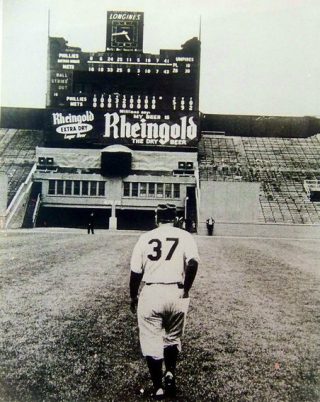
Casey Stengel leaving the field for the clubhouse after the Mets’ final home game at the Polo Grounds, 18 September 1963. The original Eddie Grant memorial monument stone stands in front of the center post supporting the building housing offices and clubhouses. The Mets’ clubhouse is on the right; the visiting Phillies’ clubhouse, on the left. Rheingold Beer sponsored the Mets’ broadcasts from 1962-1973. The Rheingold sign blinked the ‘h’ for a hit or the ‘e’ for an error after official scorers ruled on close or tough plays. The Polo Grounds came down in early 1964; Rheingold died in 1976. Sad irony: the original Brooklyn brewery, like the Polo Grounds, was succeeded by an apartment complex.

The method behind the madness was Mets president George Weiss (Stengel’s general manager in those dominant Yankee years) stocking the Original Mets with names familiar enough to National League fans and a few unknown, untried entities to hold fort while men such as farm director Johnny Murphy built the organisation that ended up in a miraculous World Series triumph. With Original Met Hodges on the bridge as the manager. That’d teach them. Some thought something perversely precious was lost forever.

“There was never a team like the old Mets and there will never be another,” wrote Leonard Shecter—maverick sportswriter/editor, future editor of Jim Bouton’s Ball Four, and the writer who first forged a veteran first baseman almost washed up from underuse into the myth of Marvelous Marv—in Once Upon the Polo Grounds, his reminder to those going even madder over the 1969 Miracle Mets that the Polo Grounds Mets were only too real and not to be forgotten. Ever.

Now it is all different. Casey Stengel is gone. The players, who try no harder than the old Mets, succeed more often and as a result are indistinguishable from baseball players all over. There is stuffiness in the front office. There is great concern about unimportant things. [The manager not long ago suggested to a newspaperman that he need not have blabbed in the public prints that the Mets scored their winning run on a bunt.] And, worst of all, when the Mets lose, there is nothing funny about it at all.

Today’s Mets play in a lovely playpen most of whose architecture evokes the memory of Brooklyn’s Ebbets Field. The green seats are the team’s homage to the Polo Grounds, which also outlined its field box seats with dangling chains. It’s the only reference to the Original Mets in the park, other than Casey Stengel’s retired uniform number 37.

This year’s Mets look competitive, seem entertaining, seem engaging. But their 1962 ancestors are too ancient a memory for today’s attention deficit baseball fan. The Original Mets have been long doomed to repose in the pages of books, the archives of newspapers, the artifacts in the Hall of Fame. And, in the memories of those who still don’t know what it was but knew they’d never seen it before.

If cheaters don’t belong in Cooperstown . . .

Babe Ruth

“That’s a plug! This bat’s corked!”—Dave Henderson, handling one of Babe Ruth’s bats in a traveling exhibit. Soooooo . . . in the interest of keeping “cheaters” out of the Hall of Fame, do we purge the Sultan of Swat, hmmmm?

The evidence means nothing. There’s still a crowd fuming that that “cheater” David Ortiz was elected to the Hall of Fame on Tursday. Enough of that crowd fumes concurrently that “cheaters” have no place in the Hall of Fame.

Enough of them probably don’t remember, if they ever knew, sportswriting legend Heywood Broun pronouncing in 1923, in the New York World, “The tradition of professional baseball always has been agreeably free of chivalry. The rule is, ‘Do anything you can get away with’.”

Let’s take them up on the idea. Let’s start removing cheaters and their actual or alleged abetters from the Hall of Fame. Since I don’t want to be accused of even the thinnest strain of bias, I’m going to run down the list of defendants in alphabetical order.

Is everybody ready? Let’s play ball.

Richie Ashburn—The Shibe Park grounds crew did Ashburn a favour in the 1950s: sculpting the third base foul line into a kind of ridge to prevent Ashburn’s deft rolling bunts up that line from rolling over it into foul territory. Now, we don’t know if this was Ashburn’s idea or theirs, but . . .

Mr. Putt Putt’s out of the Hall of Fame on cheating grounds. If he didn’t suggest it, we’ll call this the Ashburn Rule: guilt by association, whether allowing it or enabling it in fact or by attempt. Just the way so many PED puffers snort often enough that those who played in the PED era are automatically guilty just for playing in it, regardless of whether they actually indulged.

Leo Durocher—Masterminded the from-the-center-field-clubhouse, hand-held telescopic sign-stealing scheme that helped his New York Giants come from thirteen games down to forcing a pennant playoff they won at home. (Fair disclosure: When Durocher asked his players who wanted the pilfered intelligence, Hall of Famers Monte Irvin and Willie Mays demurred.)

The Giants stole the pennant! The Giants stole the pennant! Therefore, loose the Lip from the Hall of Fame.

Bob Feller—The pitching great brought a little souvenir home from World War II: a hand-held spyglass. His 1948 Indians took it into the scoreboard to steal signs down the stretch and may have been stealing signs that way during the World Series they won against the Boston Braves. (First baseman Eddie Robinson blew the whistle in his memoir, Lucky Me.)

So wouldn’t you now agree? Rapid Robert should be rousted out of the Hall rapidly for providing the inappropriate apparatus.

Whitey Ford—In the later years of his career, and by his own subsequent admissions, the brainy Yankee lefthander became a sort-of Rube Goldberg of pitching subterfuge: mud balls (“Ford could make a mud ball drop, sail, break in, break out, and sing ‘When Irish Eyes are Smiling’,” Jim Bouton wrote of it in Ball Four), ring balls (“It was like I had my own tool bench out there,” Ford once said of the wedding ring he used to scrape balls), buckle balls. (When the ring was caught, Ford had catcher Elston Howard scrape balls on his shin guard buckles before returning them to Ford. “The buckle ball,” Bouton wrote, “sang two arias from Aida‘.”)

The Chairman of the Board is hereby deposed. From Cooperstown, at least.

Charlie Gehringer and Hank Greenberg—Their 1940 Tigers cheated their way to a pennant, using the scope from pitcher Tommy Bridges’s hunting rifle to steal signs from the outfield seats and relay them to hitters. Greenberg eventually admitted the scheme in his memoir. “I loved that. I was the greatest hitter in the world when I knew what was coming,” he once said.

Hammer down upon your heads, Mechanical Man and Hammerin’ Hank.

Rogers Hornsby—In 1962, when there seemed a move from baseball government to crack down on sign stealing, Hornsby published an article in True defending sign-stealing through scoreboards . . . which opened by denouncing then-White Sox relief pitcher Al Worthington after Worthington quit the team rather than abide by its scoreboard sign-stealing scheme.

“In my book,” wrote Hornsby, “he was a baseball misfit—he didn’t like cheating . . . I’ve been in pro baseball since 1914 and I’ve cheated or watched someone on my team cheat. You’ve got to cheat.” Hit the road, Rajah.

Connie Mack—Mack was on the 1910-1914 Philadelphia Athletics bridge while they had a novel for the times sign-stealing plot: someone standing atop a tall building beyond the ballpark fences wielding a telescope to steal signs and turning a flag one way or the other depending on the pitch to be signaled to the batter.

Nobody knows for dead last certain whether the Tall Tactician sanctioned the signs. Nor can it be proven (I think) that that had as much of a hand as pure economics in Mack’s first notorious fire sale. But . . . the Ashburn Rule is hereby invoked, and Mr. McGillicuddy shall henceforth be disappeared.

Gaylord Perry

“I just tend to leave a lotta evidence lyin’ around.”—Gaylord Perry.

Gaylord (It’s a Hard Slider) Perry—Even now you don’t even have to run down his record. Even if he was frisked like a street hustler but only once or twice arraigned. Just say the old gunkballer’s  name. Visions of sugar-plum K-Y jelly dance in and out of your head. Not to mention that little routine of brushing the bill of his cap, the sides of (what remained of) his hair, maybe a couple of taps on the front of his jersey, just to make batters think he was lubing up.

That ain’t peanuts, Mr. Peanut Farmer. Even if all you ever did was want them to think you had something naughty on the ball (and I can be convinced Perry’s real secret was psychological warfare), that’s a sub-clause Ashburn Rule purge for you. That’s the way the witch hunt hunts.

Frank Robinson—A member of the 1961 pennant-winning Reds whose erstwhile pitcher Jay Hook helped blow the whistle, sort of, on their ’61 scoreboard-based sign stealings during the same spring Hornsby flapped his flippers in defense of cheating. We don’t know if Robinson took stolen signs, but under the Ashburn Rule, the Judge is hereby judged unworthy of  Cooperstown. (Since Robinson is thought to be one of the creators of baseball’s clubhouse kangaroo courts, this seems even more appropriate, no?)

Babe Ruth—During 1983, the Louisville Slugger people sent a traveling exhibit of historic bats around major league clubhouses. Dave Henderson, then with the Mariners, spotted one of Ruth’s bats and saw something odd but familiar at the end of the barrel: the round end didn’t quite match the barrel’s wood. “That’s a plug!” Henderson hollered.  “This bat’s corked!” (The Babe was also once caught using a trick bat—four different wood pieces glued together—prompting American League president Ban Johnson to ban “trick bats” from game usage.)

As I see it, nothing could be more typical of Ruth than to use a corked bat if he could get by with it. Ruth tested the limits of the rules constantly; this was what made him who he was. He refused to be ordinary; he refused to accept that the rules applied to him, until it was clear that they did.

Bill James, in The New Bill James Historical Baseball Abstract.

Sorry, Bambino. You might have been a corker in real life, but in baseball that pulls the cork on your Hall of Fame departure.

Casey Stengel—Watching his Yankee lefthander Eddie Lopat dueling Brooklyn Dodgers lefthander Preacher Roe in a World Series game, Stengel marveled: “Those two fellas certainly make baseball look like a simple game, don’t they? It makes you wonder. You pay all that money to great big fellas with a lot of muscles and straight stomachs who go up there and start swinging. And [Lopat and Roe] give ’em a little of this and a little of that and swindle ’em.”

A little of this and a little of that? Swindle? Code for illicit pitches, which both pitchers were suspected of throwing. Suspicion isn’t evidence? We don’t know about Lopat, but when Roe retired he promptly owned up in a magazine article. Roger Kahn in The Boys of Summer called Roe the “master of the discreet spitball.”

We’re going after the big fish on this fishing expedition. If we can bar mere suspects using actual/alleged performance-enhancing substances from the Hall of Fame, who says we can’t strip a manager admiring a contest between a couple of spitball suspects, either? Oops. The Ol’ Perfesser is stripped of his tenure.

Don Sutton—“Sutton has set such a fine example of defiance,” longtime Orioles pitching coach Ray Miller once told Thomas Boswell, “that some day I expect to see a pitcher walk out to the mound with a utility belt on—you know, file, chisel, screwdriver, glue. He’ll throw a ball to the plate with bolts attached to it.” We’ll use the file, chisel, and screwdriver to unglue Sutton’s Hall of Fame plaque, instead.

Earl Weaver—Once, with his pitcher Ross (Skuzz) Grimsley in a jam, Weaver counseled Grimsley: “If you know how to cheat, now’s the time.” That should be enough to have Weaver—oft ejected by indignant umpires (“That little [expletive] called me names that would get a man killed in other places, and that was on days I didn’t throw him out,” Steve Palermo once said of him)—ejected from Cooperstown under the Ashburn Rule.

See what I mean? And those are just some of the ones we know.

But what to do with the freshly-purged actual or alleged cheaters, or with those who merely abetted or encouraged? We can’t just pretend their careers didn’t exist. We can’t just pretend they had as much to do with baseball history as I have to do with quantum physics. We’ve hunted down the witches, now which are the stakes on which we burn them?

Let’s re-mount their plaques in another otherwise isolated hamlet somewhere. We’ll nickname it Blooperstown. Ashburn’s plaque will be re-written in baseline chalk. Durocher’s, Feller’s, Gehringer’s, Greenberg’s, Mack’s, and Robinson’s will have little telescopes attached. Ford’s name will be re-written in mud. Hornsby’s will be re-written in Morse code. Perry’s will have a tube of K-Y jelly attached. We’ll re-mount Ruth on a cork board. Sutton’s can include a Black and Decker drill, since he once bragged he was accused so often he should get a Black and Decker commercial out of it. We still have to decide on Weaver, though.

We’ll re-inscribe their plaques in gold. Fool’s gold. In honour of the fools who think it’s that simple to consecrate a Hall of Fame filled with nothing but altar boys, boy scouts, choir boys, and monks.

And, we’ll re-mount them in George Frazier Hall, named for the one-time Yankee pitcher who responded to accusations of using foreign substances, with righteous indignation, “I don’t use foreign substances. Everything I use is made in the U.S. of A.”

#BatFlippersMatter (and other fun thoughts)

Jimmy Cordero–ejected promptly for hitting Willson Contreras over a four-inning-old bat flip Friday night, suspended Saturday for three games.

Jimmy Cordero drilling Willson Contreras over the season’s (and maybe the century’s) most artistic home run-hitting bat flip Friday night got himself a three-game suspension Saturday. At this writing, he plans to appeal. It’s not that Cordero knows me from Adam (Dunn or otherwise), but I’d like to make a suggestion to him for future reference.

Bat flippers matter. And they’re not the only ones who should be given such license when we talk about Letting the Kids Play. But almost never do we see anyone suggesting that if it’s ok for a home run hitter to send his bat into orbit it ought to be ok for a pitcher to celebrate a big strikeout.

I’ve said it before—they’d done it before. Hall of Famer Dennis Eckersley used to make like he was fanning a pistol in his hand after (as he might have said in his old Dial-Eck jive talk) showing them the high cheese before punching them out with the yakker.

Pistol-fanning in the real Old West was something usually frowned upon—except in Hollywood. Wyatt Earp himself once said, “the gun fanner and the hip shooter stood small chance to live against a man who . . . took his time and pulled the trigger once.” In the Old West, it might get you killed. On the mound, it might get you laughs.

If you’re the hitter who doesn’t like it, just wait for your next time up and for the yakker that hangs. Then, have a yakker after you show him the high cheese . . . sailing into the bleachers, or the next county, whichever comes first. Yak for the Morticia is yak for the Gomez, you know.

If you’re a pitcher but you don’t want to be seen as a gun nut, you could always try wielding an imaginary bullwhip. Or a butterfly net. Or your best Al Bundy called bowling strike—roll your ball, pirouette, pump your fist, jerk your knee bend, and holler “steeee-rike!” before you know the ball’s half way to hitting the pins in the first place.

How about the pantomime fading basketball jump shot? Like the one Jim Carrey delivered in court in Liar, Liar. You could even run clubhouse surveys on who does it better—or funnier: a 6’8″ galoot like Dellin Betances, or a 5’7″ peanut like Marcus Stroman. And challenge each other to put that galoot or that peanut to shame.

One thing missed about this year’s Washington Nationals—2,000 year old man Fernando Rodney bending, aiming, and shooting arrows at the sky after nailing a good inning or, especially, a relief save, the latter being a lifelong habit. Now and then, of course, Rodney received tastes of his own medicine, which he didn’t really seem to mind.

Case in point: a 2014 game against the Los Angeles Angels, while he pitched for the Seattle Mariners. Rodney finished a scoreless eighth by shooting his invisible arrow right into the Angels dugout. That’d teach him.

In the ninth, he surrendered a walk to Mike Trout and a prompt RBI double to Albert Pujols. Pujols and Trout shot invisible arrows back and forth between second base and the dugout. The Angels’ Grant Green shot a game-winning RBI arrow through Rodney’s heart and into center field for the 6-5 win. All in good fun, we presume.

But why should the hitters and the pitchers have all the fun? If Willson Contreras can flip a bat spinning up equal to the Guaranteed Rate Field roof line, or Dennis Eckersley can shoot bullets after he’s thrown a few for a strikeout, why can’t the middle infielders have a little mad fun?

Kolten Wong (second base) and Paul DeJong (shortstop) turn double plays smoother than short-order cooks turn pancakes or pizza makers flip and spin the dough, right? (Now that I mention it, Contreras’s Friday night flip did kind of spin as high as some pizza makers spin the dough, at least when they’re spinning it in the front window and they’ve got an audience.)

Often as not, it’s Wong grabbing a hopper close enough to the middle of the infield and flinging inside-out to DeJong to turn and whip one to first base. Especially to retire the side. Why shouldn’t Wong and DeJong face each other, crouch, and juggle imaginary . . . well, anything—bats, balls, knives, garden shovels, meat cleavers, take your pick?

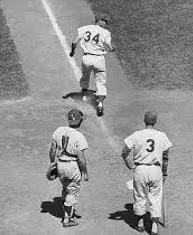
Jim Piersall (34) had his 100th home run trot backwards. (Looking haplessly: Phillies catcher Clay Dalrymple, Mets first baseman Tim Harkness.)

Come to think of it, with a name pair like theirs they could take that act on the road and bring down the house. Unless, of course, they bring down the wrath of a Fun Police pitcher and get to dance erroneously to a little chin music, maestro.

Even in the ancient days, the ones the Fun Police say meant respect, there were those who knew how to have fun. Even the almighty imperial New York Yankees. They had the perfect answer for Bill Veeck’s exploding scoreboard in Comiskey Park. As it happened, they also had the perfect manager for it—Casey Stengel.

Led by the Ol’ Perfesser himself, the Yankees answered one of their own hitting one out by sending up that scoreboard—prancing around the front of the dugout holding Fourth of July sparklers aloft for the Comiskey crowd to see.

And wouldn’t you just love to see a batter hit a milestone home run and celebrate it by trotting around the bases backward? Jim Piersall thought of that, in 1963, when he hit the 100th home run of his major league career, as a Met. Only he learned the hard way that even Stengel’s vaunted sense of humour had its limits.

Piersall led off against Philadelphia Phillies pitcher Dallas Green (future major league manager) in the bottom of the fifth, with the Mets holding a 1-0 lead, and drilled Green’s first service into the Polo Grounds’ right field seats. He took two steps out of the box, did an about face, and backpedaled his way around the bases.

The Phillies were probably too stunned to think of anything other than a few snickers. Piersall’s home run shuffle has yet to be topped even by today’s flippers, fanners, and jugglers. It was Piersall’s first home run as a Met. It was also Piersall’s last home run as a Met.

Stengel—the man who once flipped the bird out from under his hat during a game—was so amused by Piersall’s backpedaling he made sure the veteran outfielder was cut two days later, only to be signed by the tender mercies of the then-toddling Los Angeles Angels.

But I got $6,000 severance pay for one month,” Piersall remembered much later, “which made it my best payday in baseball, although I’d hit only .194 for the Mets. He did me a favor.” Who had the last laugh now?

Al Jackson, RIP: “Everybody here crazy”

2019-08-19 AlJackson

Al Jackson pitching to Hall of Famer Willie Mays in Shea Stadium, 1964. Jackson was a control pitcher whose Original Mets were only too often beyond control.

With the National League’s teams agreeing to let the expansion Mets and Colt .45s (the Astros-to-be) pick only from among their flotsam and jetsam, the two new clubs didn’t have much in the way of quality choices. As the Colts’ first general manager, Paul Richards, said infamously to his crew, “Gentlemen, we’ve just been [fornicated].”

The Colts went for younger unknowns, predominantly, though they did pick a few veterans, notably pitchers Don McMahon and Bobby Shantz, infielders Joey Amalfitano and Billy Goodman, and first baseman Norm Larker.

Knowing New York still smarted over the Dodgers and Giants moving west, the Mets opted mostly but not exclusively for veterans with National League name recognition (several of whom were former Dodgers or Giants), suspecting that might help goose the box office while the Mets set about building an organisation that might bear fruit within the decade.

Their choices included Hall of Fame center fielder Richie Ashburn, first basemen Gus Bell, Ed Bouchee (the NL Rookie of the Year runner-up in 1957), and Gil Hodges (the Brooklyn favourite), infielders Felix Mantilla and Don Zimmer, outfielder/first baseman Frank (The Big Donkey) Thomas, catchers Hobie Landrith and Joe Pignatano, and pitchers Roger Craig and Clem Labine.

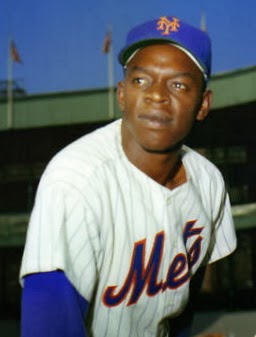
But they did make room, too, for younger players who were either spare parts on other clubs or lucky to get cups of coffee if that much. Maybe the best of the Mets’ finds out of the latter end of the pool was a lefthanded, African-American pitcher named Al Jackson, whom the Mets plucked from the Pirates. To whom manager Casey Stengel took an immediate liking.

“Jackson,” wrote Stengel’s biographer Robert W. Creamer, “was one of the few accomplished players that Casey had when he was managing the Mets, a fine pitcher who could field his position skillfully, handle a bat well, run bases intelligently, and pitch with guile and courage.” The feeling was mutual. “He never treated me with anything but respect,” Jackson once said.

The Waco, Texas native died Monday morning at 83 in a Port St. Lucie, Florida nursing home, following a long illness that came in the wake of a 2015 stroke. Met fans from my generation won’t forget the game he pitched to open 1964’s final regular season weekend. In which, for the very first time in their existence, the Mets actually mattered to a pennant race outcome.

In fact, the infamous Phillie Phlop threatened the prospect of a three-way tie for the 1964 National League pennant. Thanks to that ten-game losing streak eroding what was a six-game lead when it began, the Cardinals opened the weekend in first place by half a game, the Reds were right behind them, and the Phillies were two and a half back.

The Cardinals hosted the Mets three games in St. Louis for that final weekend. The Reds faced the Phillies for a pair. And after the Phillies won their Friday game thanks to a four-run eighth and tidy bullpen work, a Cardinals win later in the day would clinch at least a tie for the pennant. Naturally enough, the Cardinals sent future Hall of Famer Bob Gibson to the mound to dispatch the Mets.

Stengel countered with Jackson. “Jackson,” the manager liked to say, “is a pret-ty good-looking pitcher,” which Creamer wrote was high praise from the Ol’ Perfesser. And at a time when it looked like the novelty of the Mets’ comedy of errors began wearing off, and the losing quit being funny, accompanied by some increased mutterings that Stengel was losing whatever he had left, Jackson proved one of Stengel’s few defenders.

A manager who loved to teach baseball above almost anything else, Stengel savoured Jackson as one of his very few younger Mets who was willing to listen and learn—even while he was at work on the mound. “Casey would stand in the dugout,” Jackson would remember, “and say real loud, ‘If I was a lefthanded pitcher, here’s what I would do right now.’ That’s when I knew he was talking to me.”

There were men on first and second, and you knew the other team wanted to bunt them over. Casey would say, “Here’s what I would do. I would let him bunt. I would throw him a little slider, and I would break toward the third base side, and I would throw his ass out at third.” Casey had the guts to tell you what he’d do in a certain situation when it came up on the ball field. He didn’t wait until after it was over and second guess. He’d tell you right now, and he’d tell you what the other team should do. He’s the only man I ever saw do that.

Gibson and Jackson squared off. The only run of the game scored when Mets first baseman Ed Kranepool singled home outfielder George Altman with two out in the third inning. Despite Gibson striking out seven while scattering eight hits and no walks in eight innings’ work, the script got flipped—the Cardinals committed three errors to the Mets’ none, though none of the errors factored in the score.

Jackson went the distance scattering five hits and a walk and, after surviving a bases-loaded threat in the eighth, retired the Cardinals in order on two fly outs and a ground out to finish. The next day, with the Phillies and the Reds off, the Mets blew the Cardinals out, 15-7. These were the Mets? Now the National League race went from chaos to bedlam.

The blowout left the Cardinals and the Reds tied for first with the Phillies a full game back. If the Phillies beat the Reds on the final Sunday and the Mets could finish sweeping the Cardinals, the National League would have to figure out a round-robin to decide a pennant winner. The Phillies did their job, blowing the Reds out 10-0 behind Hall of Famer Jim Bunning.

2019-08-19 AlJackson02

Al Jackson, in the Polo Grounds, where the Mets played their first two bizarro seasons.

The Mets, alas, didn’t do theirs. Not for lack of trying. They had a 3-2 lead in the middle of the fifth, but the Cardinals dropped a three-spot on them in the bottom of the inning and never looked back; in a game that included Gibson working four innings’ relief, the Cardinals won the game (11-5) and the pennant. At the last possible minute.

Yet somehow the Mets made the Cardinals earn it the hard way, starting with Jackson’s cool shutout. A 5’10” lefthander whose money pitches were a snappy curve ball and a shivering slider, Jackson was as athletic as the day was long and pitched stoutly despite being charged with heavy losses as a Met, and his teammates befriended and respected him.

Kranepool in particular befriended Jackson, the two socialising often, even playing basketball together in the off seasons to stay in shape, according to Newsday.

“You had to be a pretty good pitcher to lose that many games,’’ Kranepool said of Jackson, who was charged with twenty losses in each of 1962 and 1965 and pitched too often in hard luck . “He was in the games at the end because he did so many things well. He was a good fielder and good hitter. He didn’t throw that hard; his curveball was his best pitch. But he was such a nice guy. He really was. You can’t find a negative thing to say about Al Jackson.’’

His fellow Original Mets pitcher, Jay Hook, credited with the win in the Mets’ first-ever regular season victory, had the same admiration. “He had good control, No. 1,” Hook says. “I think he really knew how to pitch.”

Jackson was dealt to the Cardinals after the 1965 season for veteran third baseman Ken Boyer, who was coming to the end of a should-have-been Hall of Fame career. After two fine if unspectacular Cardinal seasons, including not pitching in the 1967 World Series, he was returned to the Mets to finish a trade for relief pitcher Jack Lamabe.

He worked effectively as a swingman in his second Met tour, but before he could be a full part of the 1969 miracle—he if any Original Met had earned the chance after having survived the worst of their earliest seasons of comic futility—the Reds bought him that June. By then a middle reliever, a role that didn’t necessarily suit him, Jackson didn’t pitch as well as previously, and when the Reds released him in 1970 he retired.

He became a pitching coach for about two decades, including with the Red Sox and the Orioles, then returned to the Mets to work as a minor league pitching instructor except for a brief spell on the parent club during Bobby Valentine’s managerial term.

Jackson was as well known for good humour as he was for his pitching ability and knowledge. He needed every ounce of that good humour he could muster, as Jimmy Breslin related unforgettably in Can’t Anybody Here Play This Game. Specifically, about the third inning in a 10 August 1962 game in Cincinnati’s Crosley Field.

This one left even the even-keeled Jackson—who’d pitch the longest game in major league history in terms of the game’s time (four hours and thirty-five minutes, pitching fifteen innings against the Phillies four days later)—wondering if he’d lost his marble. Singular.

The Mets were in a 3-0 hole when Jackson surrendered a leadoff double to Hall of Famer Frank Robinson. Wally Post grounded out right back to Jackson off the mound but Don Pavletich walked to set up first and second. After Robinson stole third, Jackson got Hank Foiles to whack into a sure double play starting at first base.

Marvelous Marv Throneberry fielded it cleanly. He had all the time on earth to start the play. He could go to second for the first out and take the relay; or, he could throw home for the first out and get the relay back. “Don’t think,” Crash Davis warned. “It’ll only hurt the ball club.” Throneberry thought. Then he decided to go home to start the double play. Except that his throw didn’t arrive quite at the moment Robinson did.

Then a walk to Vada Pinson loaded the pads for Don Blasingame. And Blasingame obeyed Jackson’s pitch, too, whacking a perfect double play grounder, this time to second base. Where Hot Rod Kanehl was so anxious to pick it up and get it started that he let the ball bounce right off his leg.

“Jackson,” Breslin wrote, “now has forced the Reds to hit into two certain double plays. For his efforts, he has two runs against him on the scoreboard, still only one man out, and a wonderful little touch of Southern vernacular dripping from his lips.”

Then with Reds starting pitcher Jim Maloney at the plate, Jackson wrestled him to 3-2 and, as he threw Maloney a sure ground ball pitch, the runners broke. And Maloney whacked the ball to Kanehl. This time, the Hot Rod picked it clean. And this time, he tossed the ball to Charley Neal playing shortstop. But since the runners broke on the pitch Blasingame was already safe at second, and Pavletich scored.

Again Jackson threw what he hoped would be a double play pitch. And Cincinnati shortstop Leo Cardenas obeyed orders, whacking it on the ground right to Neal in perfect position to finish the Area Code 6-4-2 dial. “But you were not going to get Charley Neal into a sucker game like this. No sir,” Breslin wrote. Neal fired to first. Out made. Fourth run of the inning scoring.

Then Eddie Kasko lined out to Kanehl for the side. Breslin swore Jackson must have set some sort of record for getting hitters to hit into consecutive double play balls whose pooches were screwed on the first leg.

Stengel decided sending Jackson back out for the fourth would do him irreparable damage, if not what came to be known as post-traumatic stress syndrome, so he sent Ray Daviault out to work the fourth. And, perhaps flummoxed himself over the third inning’s undoings, the Ol’ Perfesser forgot to tell Jackson, who went out to the mound to warm up without seeing Daviault coming in from the pen. The Crosley Field P.A. announcer announced the Mets’ new pitcher—Daviault.

Breslin swore Jackson stopped cold and made his own announcement: “Everybody here crazy.”