26 minutes and other Opening Day salvos

Rafael Devers

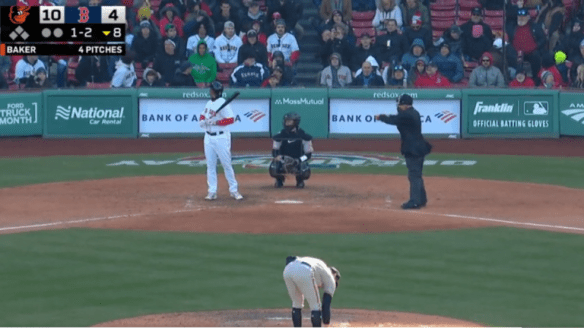
Rafael Devers (Red Sox), the Show’s first ever to strike out without a pitch thrown, taken, or swung on and missed—on a pitch clock violation.

So. After encyclopædic volumes worth were said and done, the average shortening of games on Opening Day was a whopping . . . 26 minutes. The new rules, don’t you know?

I may be on board with the pitch clock, but I’m not on board with cheers about the shortening when a fourth grade math student can tell you they’d have been shortened more by eliminating half the broadcast commercials. That’s accounting for the spots before each half inning and during any inning jam in which a pitching change was made.

But it didn’t stop the Blue Jays and the Cardinals needing three hours and 38 minutes to finish with a 10-9 Blue Jays win, paced by George Springer’s five hits for the Jays and opened with Cardinals pitcher Adam Wainwright warbling “The Star Spangled Banner” to just about everyone’s surprise in Busch Stadium.

Two players made history under the new rules. Rafael Devers (third baseman, Red Sox) became the first in Show to strike out on a pitch clock violation. Marcus Stroman (pitcher, Cubs) became the first in Show to be assessed a ball on a clock violation.

Leading off the eighth, Devers was rung up on 2-2 with Bryan Baker on the mound for the Orioles and the Red Sox in a 10-4 hole. “This doesn’t make sense to me,” said an announcer, “because he’d already looked at the pitcher. The pitcher’s not even ready to throw.”

Devers had checked back into the box with a few seconds remaining after stepping out to knock dirt out of his cleats. Even as Baker wasn’t quite ready to throw, plate umpire Lance Barksdale bagged him. It didn’t stop the Red Sox from posting a three-spot in the inning. “There’s no excuse,” said manager Alex Cora. “They know the rules.”

Knowing them and being able to maneuver within them for the first time in regular-season play are not exactly common. But it’s entirely possible that Devers not being dinged might have made a small difference. Led by Adley Rutschmann becoming the first catcher in Show history to have a five-hit Opening Day, the Orioles out-lasted the Red Sox, 10-9, after almost handing the game all the way back to the Olde Towne Team in the bottom of the ninth.

Remember: I’m also on board with turning the damn clock off in the eighth and later. Devers may yet prove evidence on behalf of that.

Stroman got his while checking Brewers runner Brice Turang at second with Christian Yelich at the plate in the third. The pitch clock expired about a hair before Stroman turned to pitch from the stretch. “It’s tough, this pitch clock,” Stroman told reporters postgame. “It’s a big adjustment. I don’t think people really realize it. It just adds a whole other layer of thinking.”

Yelich finally worked a walk out. The Brewers didn’t score then or the rest of the game. The Cubs won it, 4-0.

Jeff McNeil became the first Met to be hung with a pitch clock violation strike—for waiting for Pete Alonso to get back to first on a foul ball. Oops. Manager Buck Showalter was unamused that the clock began to tick before Alonso returned to the pad. McNeil remained mad just long enough to nail a base hit.

That was in an Opening Day game the Mets won, 5-3, beating the Marlins, but they might have had one more, at least, if not for someone whacking Brandon Nimmo with the stupid stick in the third. With first and third, Nimmo dropped a bunt—and hit into an inning-ending double play despite the run scoring. Thus the risk the wasted out, which is exactly what the sac bunt is, carries against defenders alert enough.

The good news there was Max Scherzer holding on despite all three Miami runs charged to his account and the Mets making simple enough work against a still not quite ready Sandy Alcantara. The bad was Justin Verlander having to miss a week while dealing with a muscle strain in his upper back near his throwing shoulder.

Perhaps it was miraculous that Aaron Judge picked up right where he left off from last season and hit one out in his first plate appearance against the Giants. That launched a 5-0 Yankee win that saw both starting pitchers, Gerrit Cole and Logan Webb, nail eleven and twelve strikeouts, respectively—the first opposing Opening Day starters to do that since Max the Knife (then a National, with twelve) and Jacob deGrom (then a Met, with ten) in 2019.

Speaking of deGrom, alas, the good news was, the Rangers got him a small truckload of runs. The bad news was that deGrom, still not all the way ready after a spring training disrupted by a side strain, also surrendered five before the Rangers unloaded for a nine-run fourth and held on to win, 11-7. They became the first Opening Day team to have a nine run-or-better inning since the Padres dropped 11 in the sixth against the Mets in the 1997 opener.

And Shohei still gonna Shohei. The Angels’ two-way unicorn struck ten Athletics out before his day’s work was finished. He even ripped a 110 mph base hit and threw a 101 mph pitch before he was done. And what did it prove worth in the end? Squatski. The Angels lost, 2-1. It put Ohtani onto a dubious record book page: the only pitcher to punch ten out and surrender no runs in his team’s Opening Day loss.

Meanwhile, the Rockies are still gonna Rockie, alas, even when they win. With a pair of home runs by first baseman C.J. Cron leading the way, the Rockies battered the Padres for seventeen hits—despite striking out at the plate seventeen times against four Padres pitchers. Making them the first team since 1900 to deliver that dubious 1-2 punch in a nine-inning game. Ever.

I’ve said it before, but I’ll say it once more. This is baseball. Where anything can happen—and usually does. With or without rule changes running the bases from the sublime to the ridiculous and back to the absurd. And wish though Commissioner ADD and his minions might, 26 minutes isn’t exactly that big a difference from even last year’s average.

The deeper issue at play in the Kay trial

Matt Harvey

Harvey admitting on the witness stand that he did coke as a Met shouldn’t be bigger than Harvey suggesting too many players still feel desperate to return to action despite not being recovered fully from injuries.

The Eric Kay trial—in which the former Angels communications director faces up to twenty years in prison on drug charges if convicted, stemming from the unexpected overdose death of pitcher Tyler Skaggs in 2019—seemed the sleeper of the week. Until it suddenly wasn’t, after sworn testimony from one-time Angels pitcher Matt Harvey.

Harvey, once a star in New York but still trying to rebuild a career compromised less by his once-notorious night life than by the aftermath of thoracic outlet syndrome surgery. Harvey, once the Dark Knight, but since struggling to find any semblance of the form that once made him what his old rotation mate Jacob deGrom has become.

You had to strain yourself, though, to hear anyone discussing what ESPN writer T.J. Quinn  tweeted Tuesday morning from the trial. “[Matt] Harvey is describing culture of MLB,” Quinn wrote, “guys desperate to stay on field and play through injuries.”

That was about as cryptic as a sledgehammer blow. Harvey wasn’t exactly revealing classified information he’d formerly flushed down the nearest precious-metal commode, either.

But for every one who got what Quinn described him saying during his testimony, there were probably a few hundred more interested in Harvey copping to doing coke as a Met and how many Angels were getting and gulping assorted painkillers from Kay directly or by way of others.

Joe and Jane Fan would rather just dump on the druggies than admit a big reason they get their meathooks on assorted painkillers and other naughty pills and powders in the first place is that too many team medical staffs—even today, even with everything we know about sports injuries that wasn’t known or ignored for generations preceding—could still be tried by jury for medical malpractise.

The Twitterpated are more titillated that the former Dark Knight had a few too many off-field nights partying than that he, too, felt all but forced to perform despite his body’s inner warnings. The talk about the “drug culture” on those Angels (and don’t think it doesn’t exist on other teams) seemed to override talk about the pressures placed upon the injured to get back onto the mound or onto the field like yesterday—no matter how fully they’ve recovered from their injuries.

Harvey wasn’t the only one of Skaggs’s teammates looking for pain relief. Pitcher Mike Morin, an Angel from 2014-2017 now with the Marlins, testified he sought Kay’s help after Skaggs mentioned Kay as someone who could provide painkillers like oxycodone to help Morin, too, deal with what turned out thoracic outlet syndrome. Former Angels relief pitcher Cam Bedrosian (now with the Phillies) and first baseman C.J. Cron (now with the Rockies) also said they got painkillers from Kay.

Harvey also copped to giving Skaggs one Percocet. Why? He thought he was doing his teammate in pain a favour and wanted to be a good teammate. That may still be enough to get him suspended under baseball’s drug policy. Now a free agent, after an up-and-down 2021 that ended almost a month early due to a knee injury, Harvey may have a harder time catching on when the current lockout ends.

In case you forgot or didn’t know in the first place, Skaggs himself had an injury history. He underwent Tommy John surgery after returning to the Angels in a trade from Arizona and starting eighteen games in 2014. Missing all 2015 recovering and rehabbing, he subsquently incurred oblique, adductor, and ankle injuries. And it’s not impossible that he was given something powerful enough coming out of TJ surgery to hook him.

When the Texas coroner’s report revealed fentanyl may have caused Skaggs’s accidental overdose death, USA Today columnist Bob Nightengale wrote of him as a young man in pain.

“Perhaps more physical than even the doctors and trainers knew,” he wrote. “Maybe more mental than even any team therapist knew. It will be a bigger tragedy if we never understand why. Prescription painkillers are a scourge in this country, and professional sports—with catastrophic injuries and the expectation to play through the pain they cause—are ripe for potential abuse.”

It’s not just a particular contingent among current players talking these things, on a witness stand or elsewhere. Hall of Famer Pedro Martinez is talking about those pressures, too. His freshly-published memoir, Pedro, includes a portion where Martinez says that, as a Met, then-chief operating officer Jeff Wilpon forced him to pitch despite a toe injury that affected either his push off the rubber or his landing as he threw—in September 2005, despite the Mets being out of the pennant race.

Before Joe and Jane Fan start barking ohhhhhh, he was forced to earn his keep when his itty bitty toesy hurt, they should try to remember Dizzy Dean. That Hall of Fame pitcher once forced himself to alter his delivery to compensate, after suffering a broken toe courtesy of an Earl Averill batted ball in the 1936 All-Star Game. Dean ruined his shoulder with the new motion, turning the second half of his career from Hall of Fame great to nothing special.

Maybe if Dean had been allowed to recover completely from the toe fracture it would have been a different story? “I was unable to pivot my left foot because my toe hurt too much,” the ever-locquacious Dean was quoted as saying, “with the result I was pitchin’ entirely with my arm and puttin’ all the pressure on it and I felt a soreness in the ol’ flipper right away. I shouldn’ta been out there.”

When the 1969 Cubs burned out and faded down the stretch as the Miracle Mets heated up to take the National League East en route their championship series sweep of the Braves and World Series conquest of the Orioles in five games, it turned out that manager Leo Durocher cowed too many of his players into not disclosing injuries for fear he’d denounce them—in the press as well as in clubhouse reamings—as quitters.

Now retired, Jacoby Ellsbury was oft injured even in his Red Sox years . . . and accused of malingering when he tried his best not to return prematurely. After shining in his contract walk-year during the Red Sox’s 2013 World Series conquest, Ellsbury signed big with the Yankees—and ran into the injury bug again.

And again. And again. Knee injuries, concussions, hip injuries, setbacks rehabbing. Joe and Jane Fan wrote him off as a waste of Yankeebucks. Some even called him a quitter, never mind that his injuries came from playing the game as hard as he could with what he had.

Was it Ellsbury’s fault he’d been injuried on the job, in honest competition? Maybe we should wonder that, so far as anyone knows, Ellsbury didn’t seek the kind of extracurricular pain relief others have, clearly enough.

Skaggs’s death at 27 “shines a harsh spotlight on the dark underbelly of playing professional sports,” writes FanSided‘s Gabrielle Starr. “Many players feel forced to go to extremes to be able to compete, and we’re now witnessing the worst possible outcome of that desperation.”

What is it with the Angels’ organisational culture that compelled several players including Skaggs to seek extracurricular pain relief? Were they, too, being pushed beyond reasonable expectation to come back from injuries? Do you really think they’re the only team who’d be guilty of that?

Could those Angels have been pushed unreasonably compared to the team’s Hall of Famer-in-waiting Mike Trout, who’s been injured often enough but was never pressured improperly so far as anyone knows to return before he was healed completely? As in were the Angels’ administrators sending the message Trout himself would never send, that, well, he’s Mike Trout and . . . you’re not?

Don’t dismiss the Kay trial as just another sports drug trial. It’s easy to denounce the druggies. It’s a lot harder to remember that a lot more of them than we might have thought went there not for kicks but for genuine pain relief. It didn’t have to take the death of a still-young major league pitcher, whose death provoked game-wide grief, to mean those issues might finally be addressed with the seriousness they deserve.

Unless you’re diffident or soulless, it makes you stop to ponder that maybe we shouldn’t be too swift to worship the players or teams who “grit” or “gut” or “grind” it out through various injuries of all dimensions. (The 2019 Yankees, the Broken Bombers, using 53 different players and sending thirty to the injured list that season, come to mind as a recent example.)

Maybe, instead, we should question the sanity lost when they push themselves or are pushed to play injured—with the reward now barely worth what might be lost to their futures. Think about that before you denounce the injured as gutless, heartless, useless quitters. Again.