
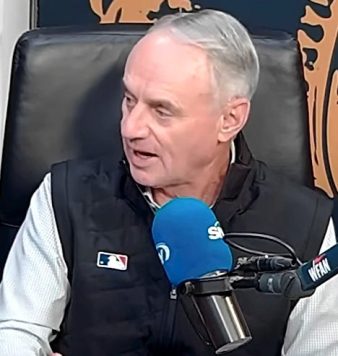
Manfred insists he’s done when his contract is. What manner of mischief might he wreak before then?
This is commissioner Rob Manfred’s story and he’s sticking to it. For now. Ask him whether he’s going to want to rethink his previously-enunciated intent to retire when his current contract expires in three years, and he digs in like a batter who knows he’s facing not Bob Gibson but Bobo Garglebargle.
“I’m done at the end of this contract. I’ve told [the owners] that, and I’m gonna stick to it,” Manfred insisted in a WFAN radio interview last week. “I’ll be 70. It is enough . . . You have a certain period of time when you have things that you want to accomplish, you take your best shot, you try to get as much done as possible. And then it’s sort of time for the next guy with his set of things. And I think that’s healthy and good for this.”
So far, so good. So, what does the most inveterate tinkerer who ever held the commissioner’s office want to get done before he moseys off into the sunset?
Without saying he’s committed to it—yet—Manfred mentioned discussions about inflicting a split season and in-season tournaments upon major league baseball. “We do understand that 162 (games) is a long pull,” he said. “I think the difficulty to accomplish those sort of in-season events, you almost inevitably start talking about fewer regular-season games.”
But not fewer postseason rounds and games, of course. Manfred isn’t that sensible. “It is a much more complicated thing in our sport than it is in other sports,” he continued. “Because of all of our season-long records, you’re playing around with something that people care a lot about.”
You’re playing around with a lot more than that, Commissioner Pepperwinkle.
Wait until it gets to the part where he speaks of bringing MLB to 32 teams. And, realigning baseball into eight divisions of four teams each. Presuming it’s going to be one new team in each league, would it do to suggest something a lot more sensible?
You guessed it. I’m going there again. Instead of eight divisions of four teams each, how about four divisions of eight teams each? How about two such divisions in each league? If you wish, you can keep them named the National League East and West, and the American League East and West. Goodbye three-division lunacy and wild-card whackadoodling.
Think of the benefits that would come forth. I’ve made the argument before, but it’s worth making it yet again. Four divisions, eight teams each, and you don’t get to play for a championship unless your butts were parked in first place at season’s end. Let’s not forget to put an end to the farce of regular-season interleague play, either. Save that for where it really belongs, the All-Star Game and the World Series.
And won’t it be fun to have something we haven’t really had in this century—namely, real pennant races again. No more of this Bizarro World nonsense of the thrills, spills, and chills of teams fighting to the last breath to finish the season . . . in second place.
Come to think of it, let’s be done at long enough last with those hideous All-Star and City Connect uniforms. They go from ugly to disgusting and back to repulsive before turning nauseating. Haven’t you missed seeing All-Stars wearing their own uniforms, the fatigues of the teams they represent in the game?
And we haven’t arrived until now at the truly fun part. You want to get rid of postseason saturation as much as I do? You want to make the postseason both meaningful and fun again? You want more World Series such as last fall, when a) the only combatants were teams who finished first in their divisions, anyway; and, b) those two went tooth, fang, claw, and anything else they could think of until somebody finally won it? You want to relieve Manfred’s discomfort over the long season?
Of course you do. So . . .
We’ve simplified the game’s alignment to two divisions each for each league. We’ve made for real pennant races again. Now we get to call for best-of-five League Championship Series. That’s the way they played it from divisional play’s birth in 1969 through 1984. Now, you restore the World Series’s primacy by keeping it a best-of-seven. Did I mention that it also means no baseball under snow or November watch anymore?
You also have postseasons of—maximum—seventeen games under the foregoing back-to-the-future remake/remodel. Meaning you have yearly totals of—maximum, again—179 major league games for each league. You can’t tell me that’s not plenty of baseball. And who says an earlier opening to the Hot Stove League won’t be a little more fun, either?
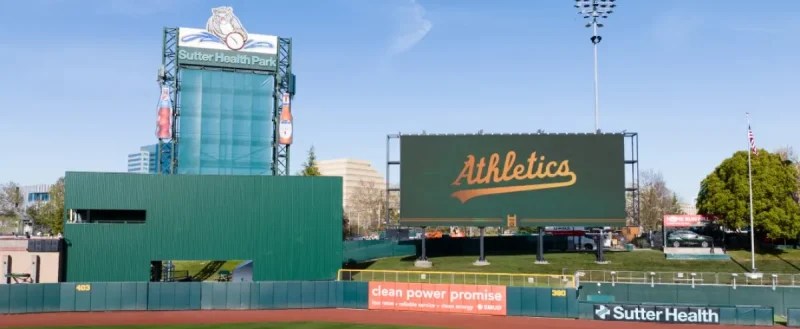
Speaking of which, beware. Maybe the only thing worse than Manfred pondering in-season tournaments would be landing a hard deadline for free agency signing. Athletics outfielder/designated hitter Brent Rooker called it the most anti-player idea Manfred could have. So, naturally, Commissioner Pepperwinkle started stumping for it harder the day after Rooker spoke against it.
“I think there’s going to be some more conversation about it, because I do believe that there’s a marketing opportunity,” Manfred told WFAN. “Let’s face it, we operate in a really competitive environment. Just put entertainment, generally, to one side—just sports, right? It’s really competitive. And I think that you make a mistake, particularly during the offseason, when you don’t take every advantage to push your sport out in front of your fans during that down period.”
Some think you make more of a mistake taking the fun out of the Hot Stove League. For owners and players alike. The owners aren’t saints, but they’re not wholly brainless. The ones who can (will) spend love the chase. The ones who can’t (won’t) spend love to bitch about the ones who can. Fans who kvetch one moment about swelling player dollars cheer the next when their team lands an Alex Bregman.
(By the way, don’t pity the Red Sox for failing to convince Bregman to stay. Not when they seem to have quaked over including a no-trade clause in his new deal but the Cubs had no problem giving him one. Well, there’s still Bo Bichette to whom the Red Sox might turn, within reason.)
“[W]hat they said back was, they thought that kind of [signing] deadline would work to the disadvantage of the players,” Manfred said of player reaction to the idea. “And you know, I just—I don’t put much credence in this.” Shocker.
At least, Manfred promised that any realignment would not include forcing two-team cities into the same division. But the bad news is that, historically, it was easier for pitchers to hold Hall of Famer Rickey (The Man of Steal) Henderson on base than it is to put most commissioners’s promises in the bank.

 Throneberry Fields Forever