Marcus Stroman and other trade deadline thoughts

2019-07-30 MarcusStroman

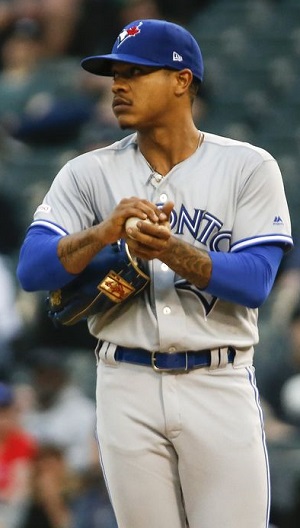
Marcus Stroman to the Mets—method to madness or madness to method?

As regards the Mets dealing a pair of mixed-reviews pitching prospects to the Blue Jays for their staff ace Marcus Stroman, and the coming trade deadline in general a few observations. Beginning with the one that tells me it seems at least three-quarters of baseball never saw this Stroman deal coming.

Anyone who thought Stroman’s new address would be New York by this year’s new single trade deadline figured it would involve the Yankees, leaders in the American League East, and not the Mets, strugglers to stay within reasonable sight of even the second National League wild card.

Or, if Stroman was going to move on from Toronto, he’d be more likely to land with one or another viable 2019 competitor—say, the Braves, where I seem to recall some observers thought he’d make a better mutual fit if the Yankees really were convinced Stroman was good enough to pitch but not necessarily fit.

But Stroman, who makes his living largely by way of his ability to lure ground balls, is now a Met. So where do we and they go from here?

1. Former major league general manager Jim Bowden, who now writes for The Athletic, says the Mets have no intention of landing Stroman just to flip him for a better package by the close of trade business Wednesday. And the two pitching prospects going to the Jays—Anthony Kay and Simeon Woods-Richardson—are considered solid but not elite prospects, but the Jays believed they weren’t going to get better than them for Stroman when all was said and done.

2. The Mets aren’t a team of elite defenders especially around their infield this year, and yet Steven Matz—returning to the rotation after a brief spell in the bullpen to re-horse—pitched a complete-game 3-0 shutout Saturday night in which his calling cards were a deft blend of breaking and off speed stuff and putting his fielders to work, which for a change they did rather admirably behind him.

3. Matz’s performance may well have had a firm impact on the Mets’ pitching thought. May. They’ve tried since 2013 to cultivate an arsenal of power arms in the rotation and seen, when all is said and done, only Jacob deGrom live up to any expectations. They watched Matt Harvey’s injuries collapse him from a power pitcher to one in search of a new cause and, now, a new team. They’ve seen Noah Syndergaard and Zack Wheeler bring the power without delivering the consistent results.

If the Mets had eyes for Stroman before Matz took the mound Saturday night, Matz’s performance had to have told them it wouldn’t be a terrible idea to add another arm to the rotation that belonged to a young man who uses more than his arm to survive on the mound. Stroman isn’t a strikeout machine; he has the second highest ground ball rate among all Show starting pitchers.

4. Maybe acquiring Stroman begins to get the Mets re-thinking their incumbent defense, too, especially marrying him to Matz in their rotation. Rookie of the Year candidate Pete Alonso forced Dominic Smith off first base, but Smith in the outfield looks almost exactly like the un-natural he is out there even though he hits with authority. Rookie general manager Brodie Van Wagenen’s willingness to take aging Robinson Cano if he wanted closer Edwin Diaz from the Mariners last winter forced Jeff McNeil, their obvious second baseman of the future, likewise into an outfield where he’s about as comfortable as an elephant in front of a mouse much of the time.

5. Diaz has been a mess not entirely of his own making this season, mishandled, sometimes mis-deployed, and while the raw talent is still there the Mets are now rumoured to be shopping him. Cano has four years left on the contract the Mets took on from the Mariners, making him almost an immovable force. Whether the Mets’ contradictory ownership might be willing to take a bath on the deal in order to start moving defensive parts back where they belong is anyone’s guess.

6. With Stroman off the market eyes turned not just upon Syndergaard but the rest of this trade deadline’s pitching market.

The Giants’ unexpected resurgence means Madison Bumgarner isn’t likely to go anywhere the rest of the season, compared to a month ago when the observers and speculators pondered where, not if he’d move on. The Yankees need whatever starting pitching help they can get but the market now seems more constricted—and as much as they’re wary of dealing with the Mets, Syndergaard now might look like an attractive Yankee target. Might.

And the Nationals, like the Giants but at a higher level, have had an unexpected resurgence of late after they were all but written off as dying as late as early June. They ran into a buzzsaw in Los Angeles this past weekend, needing Stephen Strasburg to pitch the masterwork he did in seven Sunday innings to escape with even a single win, but now Max Scherzer—whom all the Smart Guys said had to go on the trade deadline block once upon a time, in large part to bring them badly needed bullpen relief—may find his barking back barking well enough into August.

At first glance, then, it would seem the Nats have a big problem as they prepare to square off against the National League East-leading Braves Monday night. Except that the Braves, who ran roughshod over the league before the All-Star break and still lead the Nats by five and a half games, have suddenly regressed to being only human. Not only have they lost seven of their last eleven, they’ve lost two critical elements—shortstop Dansby Swanson, resurgent veteran right fielder Nick Markakis—to the injured list. The Nats won’t have Strasburg or Scherzer to throw at the Braves this week but the Nats might still gain key ground, anyway.

7. The bullpen dominos began falling over this past weekend, too. Veteran Sergio Romo, once a key to a couple of Giants World Series winners, just went from Miami to Minnesota where the Twins, this year’s American League surprise, just bumped their bullpen up several notches by bringing him aboard. Jake Diekman went from Kansas City to Oakland, a sign the Athletics are gearing up for another wild card run. There are contenders aplenty who need help in the pen and few more than the Nats.

8. If the Jays are rebuilding in earnest, bullpen-longing eyes may be cast upon the surprising Ken Giles. After his 2017 World Series mishap (which wasn’t entirely his sole responsibility) and subsequent personal and mound meltdowns, Giles has rehorsed completely in Toronto. As in, a career year: a 1.54 ERA and a 1.60 fielding-independent pitching rate. Not to mention a 5+ strikeout-to-walk rate and a 14.9 strikeout-per-nine rate.

Yes, the Nats have eyes upon Giles and his Jays pen mate Daniel Hudson. But so may the Red Sox and any other contender who needs a bump among the bulls. Even the Twins, despite landing Romo, might still make a play for Giles at least or, if Giles eludes them, Norman, whose 2.87 ERA and June-July of only four earned runs in 21 innings’ work yanked his trade value up accordingly.

Bowden rates the Stroman deal a B+ for the Mets and a B- for the Jays. It wouldn’t hurt the Jays’ standing to try prying a slightly better haul back for Giles and/or Hudson. And although Giles is dealing with a slight nerve issue in his pitching elbow, wiping out the side as he did in a Saturday night assignment should make his suitors breathe a little easier, assuming they don’t fall tempted to overwork him while he works through it.

9. The Mets may or may not yet have a wild card long shot this year, but don’t kid yourselves: they were thinking as much about 2020 as now when they made their play for Stroman. And since Stroman is under team control through the end of 2020, don’t be surprised if they like what they see from him the rest of this season and start talking extension with him before 2020 begins.

Which might also mean that Syndergaard at minimum, and Wheeler at maximum, may yet have changes of address coming by Wednesday afternoon. And with whisperings that the Red Sox have eyes upon Diaz for their pen, which needs a little help but isn’t as badly mismanaged as the Mets pen has been this year, the Mets should be thinking smart and looking very closely at that Red Sox farm system.

Because the Mets could also use a third base upgrade from veteran Todd Frazier, who’s reliable but beginning to show his age. And as thin as the Red Sox system is for now, AAA third baseman Bobby Dalbec was named both the offensive and defensive player of the year for 2018 in the Red Sox’s minor league award valuations. If the Olde Towne Team wants Diaz for their pen that much, the Mets should all but demand Dalbec in the return haul.

10. Too many teams never quite do what they should when it counts. The Mets, alas, are notorious for that. Even when they’re winning.
 

Pumpsie Green, RIP: The modest pioneer

2017-07-19 PumpsieGreen

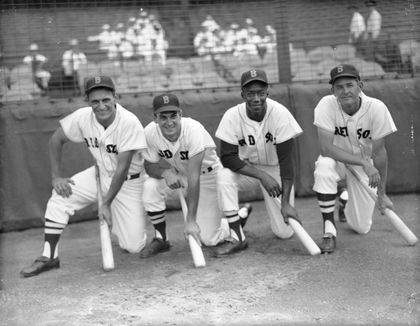
Pumpsie Green poses with three Red Sox who helped make his integrating the team that much more bearable. From left: third baseman Frank Malzone, shortstop Don Buddin, and first baseman Pete Runnels.

For those whose hobbies include forging off the wall trivia questions, here’s a beauty.  What does Pumpsie Green have in common with Jackie Robinson and Lou Brock? The answer is two parts: 1) Green, too, was the first black man to play on a particular major league baseball team. 2) He was also a teammate of the now-late Ernie Broglio, traded most notoriously for Hall of Famer Brock in 1964.

Part two is the far less problematic, of course: Green and Broglio were teammates for El Cerrito High School in California. Part one, alas, is the more so: Green was the first black man admitted to the ranks of the Red Sox, who were, alas, the final team in major league baseball to admit a black player and one of the first, alas far further, to reject Robinson, Willie Mays, and others over a decade earlier.

A catcher/first baseman in high school, Elijah Jerry Green, Jr., who died at 85 Wednesday morning, two years older and the morning after cancer claimed Broglio, became a middle infielder who wasn’t as well endowed with baseball gifts as Robinson and wasn’t built to blow the walls down. Pioneers—reluctant (a word so often used to describe Green) and otherwise—are quiet as often as they are vibrant. And Green, a handsome young man with a smile that said “Hello, my friend,” was as quiet as the season was long.

He was the son of an Oklahoma transplant who’d farmed in the Sooner State before moving his family to California. The old man became a sanitation worker and mother worked on the Oakland docks as a welder during World War II before becoming a convalescent nurse. It was Mom who gave Green his nickname, calling him Pumpsie from when he was a toddler. He had no idea what inspired it.

But loving baseball as he did, he had a fine idea what inspired him to set his sights on a possible major league life. The tough old Pacific Coast League integrated in 1948, and when the Oakland Oaks hosted a barnstorming team of all-stars led by Jackie Robinson himself, the teenage Green—who attended as many Oaks games as he could—wasn’t going to miss the game.

“I scraped up every nickel and dime together I could find,” Green told Herb Crehan for Red Sox Heroes of Yesteryear. “And I was there. I had to see that game . . . I still remember how exciting it was.” Green’s ambition then was to play for the Oaks, whose shortstop Artie Wilson was their first black player, and Green modeled his own playing style on Wilson, who once led the PCL in batting average and stolen bases.

The Oaks did sign Green but assigned him to an A-level affiliate in Washington state. By 1955, he was Red Sox property, but when they wanted to send him to their affiliate in Montgomery, Alabama, Green was only too understandably reluctant. Young black men were about as anxious to go to Alabama then as a cobra might be to go on a dinner date with a mongoose.

By spring 1957 Green impressed the Red Sox’s farm system administrators, including then-system director Johnny Murphy, the former Yankee relief pitcher and future Mets general manager. He was assigned to the Oklahoma City Indians in the AA-level Texas League, where he discovered he was good for a break whenever the Indians had to play the Shreveport (Louisiana) Sports.

“When the team went to Shreveport,” Green recalled, “I didn’t go, because they didn’t allow blacks to play in Louisiana. So I had a three- or four-day vacation.” Some vacation. But he played well enough with the Indians to earn a promotion to the Minneapolis Millers, whom the Red Sox made their AAA affiliate after the New York Giants moved to San Francisco and surrendered their rights to Minneapolis, where they first planned to move.

Every major league team except the Red Sox had integrated by the time Green became a Miller in 1958. Green didn’t play particularly well on the regular season but, in the American Association postseason, he went 5-for-12 with four runs scored and three batted into help the Millers win it.

The good news is that Green was finally invited to spring training with the Red Sox themselves in Scottsdale, Arizona, in 1959. The bad news is that spring training was the only place the Red Sox broke the colour line at first. They refused to do as some of the other integrated teams did, forcing Green to stay at a hotel seventeen miles from camp because the team’s regular spring hotel near camp refused to admit black guests.

Green finally found spring training lodging at the hotel where the Giants trained in Phoenix, the Giants having been integrated since 1949 and compelled the hotel to accept the entire team long since. And despite being considered the best rookie in camp, the Red Sox officially seemed ambivalent about him. Their manager at the time was Pinky Higgins, a former infielder known as a close buddy of owner Tom Yawkey but also known to be rather a bigot.

Even in Howard Bryant’s magnificent study of the Red Sox’s and Boston’s racial growing pains, Shut Out: A Story of Race and Baseball in Boston, it’s not entirely clear whether it was Yawkey or Higgins who declared, a decade earlier, “There’ll be no niggers on this ballclub as long as I have anything to say about it.”

Most notoriously in the mid-1940s, the Red Sox worked out Robinson, Mays, and other black players in sessions long since shown to have been shams for show after enough in the Boston press (particularly Boston Record columnist and Ted Williams nemesis Dave Egan) and the increasingly influential black press (such as the Pittsburgh Courier) pressured the team to do it.

While the rest of the Show caught on, little by little, to the good the black talent pool could do their teams, the Red Sox remained clueless. And, futile. The black talent pool didn’t suddenly make winners of all the teams, of course (we mean you, Cubs, for one example), but choosing to remain in the paleozoic era did the Red Sox no favours, either.

Higgins left room for further ambivalence when he sent Green back to Minneapolis to begin the 1959 season. “The Red Sox won no prizes this spring for the way they treated Pumpsie Green,” fumed Boston Globe baseball columnist Harold Kaese. “From a strict baseball point of view they may have been doing the wise thing when they optioned their first Negro player to the Minneapolis farm club yesterday. From every other point of view, they undoubtedly have pulled a colossal boner.”

All this blew around the head of a soft-spoken 25-year-old middle infielder who had no intention of fomenting revolution and who could never grok—even four decades after the fact—why such men as Higgins and other Boston racists had to be as they were. “Sometimes,” he told Bryant for Shut Out, “when I think of the things people like me had to go through, it just sounds so unnecessary. When you think about it, it is almost silly, how much time and energy was wasted hating.”

2017-07-19 PumpsieGreenMets

Pumpsie Green finished his major league career with the early Mets, though he missed the insanity of the original edition of the team.

“His,” Bryant wrote, “is the outsider’s story of life in a very insular city.” Today it seems somewhat difficult to remind yourself that the Jim Crow South wasn’t the only part of the country that couldn’t decide whether, as Malcolm X once phrased it, it should be, “Let’s keep the niggers in their place” or “Let’s keep the Knee-grows in their place.”

“I want to be judged like any other ballplayer,” Green said after his return to Minneapolis. “I don’t want to be a crusader. I just want to play ball.” He finally got his chance with the Red Sox after Higgins—whose alcoholism was almost as notorious around baseball as his racism—was canned in favour of Billy Jurges.

Jurges welcomed Green with open arms, as did such teammates as Hall of Famer Ted Williams plus Pete Runnels and Frank Malzone, the splendid third baseman who had Hall of Fame talent but had been buried in the minors a little too long before he finally made the Red Sox in 1955.

“I used to love to talk to Ted Williams, once of the nicest guys I ever met,” Green once told the Globe. Williams took enough of a liking to Green personally, too, that the Splinter made Green his regular for playing catch to exercise both their throwing arms during spring training and later.

As things turned out, Williams proved far more. His 1966 Hall of Fame induction speech jolted the Hall:

The other day Willie Mays hit his five hundred and twenty second home run. He has gone past me, and he’s pushing, and I say to him, ‘Go get ’em, Willie.’ Baseball gives every American boy a chance to excel. Not just to be as good as someone else, but to be better. This is the nature of man and the nature of the game. I hope that some day Satchel Paige and Josh Gibson will be voted into the Hall of Fame as symbols of the great Negro players who are not here only because they weren’t given the chance.

Pumpsie Green was the reluctant Red Sox pioneer, but his pal Williams instigated the moves that finally brought the best of the Negro Leaguers, including Paige and Gibson, into the Hall of Fame.

Green had other allies among his Red Sox teammates, including pitcher Bill Monbouquette. When coach Del Baker and then Higgins both dropped the N bomb, according to the Society for American Baseball Research, Monbouquette told coach and skipper alike he didn’t want to hear that. “[T]hen [Baker] started to give me a bunch of crap, and I said, ‘I’m going to tell you something. I’ll knock you right on your ass. I don’t care if you’re the coach or not.’ I said, ‘You don’t do things like that!’”

It would be wonderful to say that, when Green was finally brought to the Red Sox, he knocked the team’s and the leagues’ record books for the proverbial loop. He wasn’t that talented, unfortunately. He was good enough for the Show but it wasn’t going to make him a baseball star, never mind a Hall of Famer, on purely baseball grounds.

He has a respectable .357 lifetime on-base percentage and walked a little more often than he struck out, but he was used preponderantly as a pinch swinger and defensive replacement. And by his own admission he probably pressured himself far more than need be to produce in his unique circumstances.

In 1962, Green hit the headlines in one of the most peculiar ways imaginable, when he joined pitcher Gene Conley and walked off the team bus on a hot New York day, after a tough set with the Yankees, looking for refreshment. And, while moseying in and out of assorted watering holes, Conley invited Green to join in heading for Bethlehem in Israel “to be nearer to God.”

The astonished Green elected instead to return to the Red Sox immediately. Conley made his way as far as Idlewild Airport in Queens (not yet renamed for the assassinated President John F. Kennedy) before rejoining the team two days later. “We were just crying in our beer,” Green once remembered.

After that season Green was traded to the embryonic Mets, along with Tracy Stallard, the pitcher known best as the one who served Roger Maris his 61st home run at the end of the 1961 season. The Mets sent the Red Sox third baseman Felix Mantilla, once a comer with the Braves, who’d devolved into a player whose most amazing gift was for going the wrong way when batted balls came his way.

Green needed to knock himself back into shape in spring 1963. The Mets sent him to AAA Buffalo and recalled him in September. He had only 66 plate appearances as a Met but showed a very respectable .278/.409/.426 slash line, even hitting the last of his thirteen lifetime major league home runs off Philadelphia’s Ray Culp on 17 September. He began suffering hip issues, played two more seasons in Buffalo, was released in July 1965, then gave it one more try with the Syracuse Chiefs and retired.

The quiet man called Pumpsie had a fine life after his playing days. He went to college and earned a degree in physical education from San Francisco State, then ran baseball programs in the Berkeley Unified School District and coached the game for a quarter century. Some of his charges eventually made the major leagues, including Glenn Burke, Ruppert Jones, and Claudell Washington.

2019-07-18 PumpsieGreen

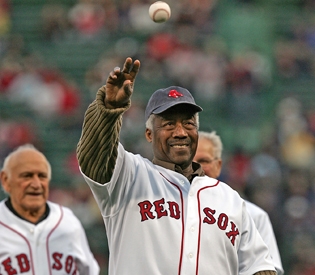
Pumpsie Green, serene and happy, throwing out a ceremonial first pitch in Fenway Park.

Green also taught mathematics and helped oversee school security while he was there. When not doing all that, he and his wife, Marie, raised two children, one of whom became a high school teacher and principal herself. And despite his quiet struggle for acceptance with the Red Sox, the years passing by made Green appreciative of just what he achieved there.

“There’s really nothing that interesting about me,” he once told Danny Peary. “I am just an everyday person happy with what I did. I take a lot of pride in having played for the Red Sox. I would like to be remembered in Red Sox history as just another ballplayer.”

One then remembers reading often enough that the Robinsons and Mayses and Larry Dobys and Frank Robinsons were one thing, but the real test would be whether and when black men could be accepted when they were as ordinary as the most ordinary white player, too. Green, however, was ordinary only as a baseball player. As a man, he wasn’t as ordinary as he liked to describe himself. Not even close.

“He laughs bitterly that the Red Sox humiliated Jackie Robinson, that it slept when it could have acquired Willie Mays, and that these twists of fate left it to unassuming Pumpsie Green to integrate the Red Sox,” Bryant wrote.

It is a fact that he is proud of, even if during those days he wanted little to do with the attention that came with being at the epicenter of a moral drama within a franchise and a city. He harbours no bitterness toward the Red Sox or the city of Boston for any reason. He wanted an opportunity to play baseball and they gave him that chance. If he does not rage at being set apart from the Red Sox in those early Scottsdale days, it is this personality that allows him not to be devoured by the past, and that makes him healthier today. It is, he says evenly, what healing is all about.

Green followed the Red Sox for the rest of his life. You may rest very assured that he was among those pumping his fists and cheering at home when the Red Sox—long past their 1950s shame, long enough removed from the Yawkey era, in which the real curse on the team was boneheaded administration, and as well integrated as the day was long—returned at last to the Promised Land, for the first of four such returns after the turn of this century.

“In 1997, they asked me to come back for opening day and throw out the first pitch,” Green told Bryant. “[Then-general manager] Lou Gorman was very friendly. They brought a limousine for me and my wife. We had a hell of a time.” A very different hell of a time than the one he had to make the Red Sox in the first place.

Bird of prey or prey itself?

One of America’s most famous airport architectures was the TWA international terminal at New York’s Kennedy Airport. Designed by architectural legend Eero Saarinen, the terminal—eventually occupied by JetBlue as part of its terminal complex, but converted since May 2018 into the TWA Hotel—depicted the cleverly stylized image of an eagle’s majestic landing.

When you see Craig Kimbrel on the mound in a baseball game, he assumes a set position taking his catcher’s signs that causes him to perform the single most near-perfect depiction of Saarinen’s masterpiece any human being can perform. Arms bent and elbows up, chest down, the pitcher as bird of prey about to land in or atop the target’s head.

2019-06-26 KimbrelTWA

Craig Kimbrel–will the Cubs have the bird of prey he depicts a la Saarinen or the prey itself?

From all appearances, it looks as though Kimbrel will come up to the Cubs either Thursday or Friday, after pitching at their Iowa (AAA) affiliate since 16 June to finish rounding himself into game shape. The question before the house is which version of the 31-year-old righthander the Cubs will get.

Will they get the no-questions-asked shutdown reliever of 2010-2015 and 2017? Will they get the one whose 2016 looked like a single comparatively down season against that body of work? Will they get the 2018 version whose ERA as of that 23 July was 1.90 but swelled to a 2.74 by season’s end?

Or will they get the Kimbrel whose postseason helped inspire Worcester Telegram-Gazette writer Bill Ballou to resist submitting his Hall of Fame ballot—rather than send one without a vote for Hall of Famer Mariano Rivera (ultimately, he sent it anyway with a vote for The Mariano)—because Kimbrel exposed the worthlessness of the save as now defined, since when he pitched “Boston’s victories felt like defeats”?

Beneath the surface of six saves, Kimbrel allowed nineteen baserunners, posted a ghastly 6.18 ERA, and put the Red Sox on so high a tension wire that they didn’t dare think of him when they had the chance to put the World Series away once and for all.

Kimbrel’s misfortune was to enter free agency after the World Series rings the Red Sox reached almost in spite of him. With the memory of his meltdowns still too fresh despite the Red Sox getting to the Promised Land for the fourth time since the turn of this century. With the Red Sox either in Fenway Park or on the road that postseason needing to keep mobile crash cart units standing by.

Against the Yankees in Game One of the division series, Kimbrel suffered only what you might expect to suffer when the Yankees need a big blast, Aaron Judge leading off the top of the ninth with a launch into the right field bullpens, before striking out the side post haste.

He didn’t appear in the Yankees’ Game Two win or, back in Fenway Park, in the Red Sox’s 16-1 Game Three bludgeoning of the Empire Emeritus, but in Game Four the crash carts went from yellow to red alert. Kimbrel went out for the top of the ninth with a 4-1 lead to protect. That’s the last simple thing you can say about it.

He walked Judge to open and surrendered a single to Didi Gregorius almost immediately to follow. He struck out Giancarlo Stanton but walked Luke Voit to load the bases. He plunked pinch hitter Neil Walker on the first pitch to send Judge strolling home and keep the ducks on the pond. He may have been fortunate that Gary Sanchez hit nothing worse than a sacrifice fly, pulling the Yankees to within a run, and that Gleyber Torres grounded out to end it before the paddles had to be charged.

Against the Astros in the American League Championship Series, Kimbrel wasn’t a Game One thought when the Astros took a one-run lead to the top of the ninth and it fell to Brandon Workman to let the Astros put the game out of reach, thanks to a leadoff homer by Josh Reddick and a three-run bomb by Yuli Gurriel.

But Cardiac Craig came out to play in Game Two. He was asked to nail down a 7-4 Red Sox lead, and he ran Red Sox Nation’s temperatures into the life-threatening zone yet again.

He got two swift outs to open, getting Evan Gattis to pop out behind second base and striking out Reddick swinging. Then 2017 World Series MVP George Springer shot one through the hole at shortstop that ended up a double. With Jose Altuve at the plate Kimbrel wild-pitched Springer to third, before Altuve lofted what turned out a high single down the line and toward the Monster to score Springer. Alex Bregman flied out to end it.

The collective sigh of relief had enough thrust to qualify as a potential hurricane.

The Red Sox didn’t need Kimbrel to nail down an 8-2 Game Three win in Houston, but Kimbrel should buy Andrew Benintendi’s steak dinners for five years at least after Game Four. This time, Red Sox skipper Alex Cora asked Kimbrel for two innings. That was almost like asking a suicide bomber to get away with two attacks.

Cardiac Craig opened the eighth with: a single to right that turned into an out when Tony Kemp tried and failed to stretch it into a double; another plunk (Bregman); a double to right (Springer); and, a run-scoring ground out to the hole adjacent to third. (Altuve.) Then he shook off a steal of third to strike Marwin Gonzalez out swinging.

And that was just the overture to the ninth. When Gurriel popped out over the line behind first. When Reddick and Carlos Correa walked back-to-back. When Reddick took third on Brian McCann’s fly to right. When Kemp walked to set up the ducks on the pond. When Bregman sent a line drive to the deeper reach of the left field corner that might have tied the ALCS at two each if Benintendi hadn’t scampered in like a puppy spotting a toy in the short distance and taken the dive that resulted in the catch of the season, if not the decade, saving both Kimbrel’s and the Red Sox’s hides.

Game Five, in which Red Sox starter David Price re-discovered his changeup and pitched himself six scoreless, masterful innings while his mates found Justin Verlander’s vulnerabilities just often enough, saw Kimbrel on the mound yet again in the ninth. Call it defiance of the Red Sox gods if you must. But Cardiac Craig let them off easy this time, with only a one-out walk, two strikeouts, and the ALCS-winning fly out, almost appropriately, to Benintendi in left.

Those may not have been your grandfather’s Red Sox of outrageous misfortune. But the box scores alone say Kimbrel saved four in those first two sets while leaving you entirely on your own to remember or revisit the gory details behind the saves. Be still, your hearts and stomachs.

In the first two World Series Games against the Dodgers, he was the classic, not the cardiac Kimbrel, striking out two of three hitters in the former and, in the latter, retiring the side in order on a fly out and back-to-back ground outs. Then came Game Three—which ended up going to the bottom of the eighteenth before his Game One strikeout victim Max Muncy ended the marathon with a blast into the left center field bleachers.

Kimbrel shook off a walk to end the bottom of the eighth with a foul pop out behind the plate before getting two outs on a pop and a grounder to open the ninth, then shaking off a ground-rule double before ending the ninth with an infield pop. It may not have been enough to ring an alarm, but it wasn’t exactly calm and peaceful, either.

And in Game Four, brought in for the ninth despite a five-run Red Sox lead, Cardiac Craig came home to roost yet again. He opened with a walk to Brian Dozier before Enrique Hernandez hit a 1-1 service not far from where Muncy’s Game Three finisher landed. He got Muncy to ground out before Justin Turner singled on a dying liner to short left field, but Manny Machado grounded out and Cody Bellinger flied out to end the game before the Red Sox needed to call in the crash carts.

If the Red Sox let Kimbrel get anywhere near Game Five with the chance to slip on the rings, they would have been tried by jury for attempted mass murder. They turned instead to Chris Sale, normally a starting pitcher, to finish the Dodgers off. And Sale gave the Red Sox what they once thought Kimbrel was guaranteed to deliver, striking out the side for game, set, and their fourth return to the Promised Land in the new century.

Kimbrel still thought he had a decent chance at making himself baseball’s first $100 million reliever regardless. Baseball apparently thought through its none-too-discreet laughter that someone spiked his Series-celebratory champagne with one or another controlled substance.

It took him seven months and the June draft, after which any new employer wouldn’t have to surrender anything but his salary to sign him, before the Cubs did just that, for three years and a measly $45 million. He won’t exactly be heading for the welfare office any time soon.

It’s not that the Cubs don’t need a late-game reliever with Kimbrel’s overall flight jacket. Since losing Brandon Morrow after he looked to be posting a magnificent 2018, the Cubs’ bullpen this season has been an inconsistent presence. Steve Cishek, Brandon Kintzler, and Kyle Ryan have overall numbers that won’t make you reach for the rye bottle, but Cishek and Pedro Strop have received most of the game-finishing assignments, and Strop hasn’t been the same pitcher he’d been in the recent past, and they’re both suited better for setup duties.

The good news is that the Cubs right now are at the top of the National League Central heap. The bad news is that they’re there by a thread, a game ahead of the Brewers who still don’t know the meaning of the word “quit.” The worse news is that they’re 5-7 in twelve games including splitting a pair with the Braves in a four-game set.

When Kimbrel joins the Cubs, either for the set final with the Braves at Wrigley Field Thursday or against the Reds in Great American Ballpark to start a weekend series Friday, the Cubs can be forgiven if they ask which Kimbrel comes out to play.

Will it be the Kimbrel who resembles a stylized eagle landing after a majestic flight and pitched like one for a long enough time? Or will it be the bird of prey who becomes the prey itself? The Cubs’ season may turn considerably on the answer.

“Let me wear this uniform one more day!”

2019-06-10 DavidOrtiz2004ALCS

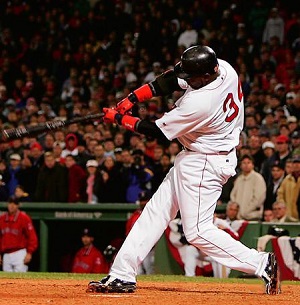
David Ortiz hits the winning bomb,  Game Four of the 2004 ALCS.

Baseball was stunned to learn retired longtime Red Sox superstar David Ortiz was ambushed and shot in the back outside a Santo Domingo nightclub Sunday. His father has said Ortiz is in stable condition following surgery to remove parts of his intestine and his colon as well as his gall bladder.

Aside from prayers for his recovery, I can think of no tribute other than to republish the last essay I wrote about Ortiz, who was responsible for so much Red Sox success after the franchise incurred so many surrealistic failures over its long, storied history. This one’s for you, Big Papi . . .

“Let me wear this uniform one more day!”
(12 October 2016)

Both American League Championship Series combatants get there by way of division series sweeps. For the Indians, it had to be a little extra special to get there by sweeping the Red Sox.

Twelve years ago, Indians manager Terry Francona managed an entirely different club of Red Sox to the Promised Land the franchise hadn’t seen since a kid named Ruth was in the starting rotation.

That was then: Francona’s charges had to figure out a way to keep an entirely different gang of Yankees from sweeping them out of the ALCS when they were down to their last out. This is now: His Indians — who haven’t seen the Promised Land since the Truman Administration — will have to figure out ways to keep the Blue Jays’ bats quiet and arms at bay.

It wasn’t supposed to be that simple against the Red Sox, was it? Even as youthful as they’d become?

But who could bargain that the formidable Red Sox youth corps who’d all but carried the Olde Towne Team to the postseason in the first place, pocketing the American League East to get there, would finally run out of fuel?

As adroitly as Francona shepherded his Indians, especially his bullpen, Red Sox manager John Farrell turned out to have his hands full with young players getting their first tastes of postseason play and a grand old man, who’d meant so much to the franchise’s championship revival for three World Series rings worth, finally spent by the time the postseason arrived.

Rookie left fielder Andrew Benintendi had a decent first trip, going 3-for-9 overall, but all three hits came in Game One, including a solo home run to lead off the third and give the Red Sox a 2-1 lead that lived for exactly that half inning — before the Tribe hit three homers in a sequence of four plate appearances in the bottom of the inning, before Francona answered a too-close 4-3 Indians lead by going to Andrew Miller when starter Trevor Bauer was spent in the fifth.

But Mookie Betts, a young sprout and a Most Valuable Player award candidate, finished 2-for-10 in the series and found himself struggling to adjust when he realised the Indians plan was to keep pitches out of his reach. Fellow young sprout Jackie Bradley, Jr. struck out in seven of his first nine at-bats and had only one hit all series long, a single to right in the Game Three ninth.

And Xander Bogaerts, first seen in 2013 in brief flashes including in the World Series, finished the set 3-for-12 overall, seeming to spend most of his plate time trying to find the target on sliders all over the place.

The homegrown Red Sox trio learned the hard way that your first trip to the postseason can turn into your worst nightmare.

“It’s a great experience, a lot of pressure,” said Bogaerts, whose brief 2013 Series sightings weren’t quite the equal of being thrown full tilt into the postseason fire. “But we have to learn how to control it, how to think in that moment. Just not overthinking a lot of stuff. Just trying to be in the moment and being focused.”

Veteran second baseman Dustin Pedroia, who’d been there/done that himself, concurred. “I think the tough part is you play every day during the year and then you have a few days off,” he told reporters about the young trio’s initiation. “You wait different times between games. It just throws you out of whack. I think they didn’t know what to expect out of that because it is different. It’s hard to get into a rhythm.”

Manager John Farrell, who shepherded the 2013 Series winner, gets it.

“There’s been a lot of conversation for the first-year guys, for the guys going through it for the first time, and not just with the staff but with their teammates,” he told reporters. “But there’s the old adage: You can’t replace experience. There’s a different feel to it. The fact that we had three days down, a later [Game One] start, five guys in our lineup being their first postseason, there were some things that were firsts, and I’m sure that lent to swinging at far too many pitches below the zone and above the zone.”

“Now we kind of know what to expect,” said Betts, rather thoughtfully, when the sweep was finished. “It’s going to be really important in the years going forward. We’ll know what to expect and how to handle adversity and how to go about the games and whatnot. It’s going to definitely be a positive.”

Attitudes like that should carry this coming generation of Red Sox back to postseason contention next year and for several seasons to come. But they’ll miss the big man.

David Ortiz won’t be retiring as a World Series champion. He won’t even see one more American League Championship Series. He’d never admit it, but just maybe, as much fun as it might have been for him to bask in the farewell tributes other Show teams gave him in his final season, it finally wore him down.

His final plate appearance? A four-pitch walk from Indians closer Cody Allen. It triggered an eighth-inning rally that put Fenway Park on gleeful edge for awhile, at least to the extent that Hanley Ramirez moved him to second as the potential tying run with a bullet single to left. Then Bogaerts lined out just as sharply to Indians second baseman Jason Kipnis, one of the Tribe’s Game 1 bombardiers.

He got a final round of twenty-one guns from the Fenway faithful when it was over and the Red Sox were going on winter vacation. And loved it. Tipping his cap, he tried to keep a stone face but his tears betrayed the effort.

“Those moments, they are always going to be special. They are always going to stay with you,” said the man who left Red Sox Nation with about a hundred times more special moments. “I’ve been trying to hold my emotions the best I can, but that last second I couldn’t hold it no more.”

“He’s helped us in so many ways,” Pedroia said. “We wanted to win the World Series and send him out the way we all wanted to, but that didn’t happen.”

He’ll have to step into the next part of his life without a fourth World Series ring. But Ortiz knows how blessed he’s been in baseball terms. Most never get a single Series ring, never mind the love of a city that Ortiz has known.

And he left the younger Red Sox something, too. In the Game Three sixth, with the Indians up 4-1 and Pedroia on third, Ortiz battled Miller, who’s become the Indians’ relief star this postseason thus far. The big left-handed slugger wrestled the big left-handed lancer and finally hit a low-flying line drive to center field. Indians sub centerfielder Rajai Davis caught it practically at his knee.

It was enough to send Pedroia home with the second Boston run. If only it could have been more. When he came off the field for a pinch runner in the eighth, he was heard to holler at his teammates, “Put me back in it! Let me wear this uniform one more day!”

They tried with two gone in the ninth. Bradley singled and Pedroia wrung out a walk off Indians closer Cody Allen, but Travis Shaw wrung a full count for naught as he flied out modestly to right field.

So Ortiz settled for telling the younger team he would now depart to be proud of having gone from last to first in the AL East on the regular season and build on it. Even if he wasn’t going to be there. Except maybe in spirit.

Then, he settled for one more bath of Fenway Park love on a night it seemed to hurt Red Sox Nation less to lose the division series in a sweep to a remarkable club of Indians than to realize the big man with the big heart who often held Boston’s hand when the city needed him most (This is our f@cking city! he bellowed to a city bludgeoned by the Boston Marathon bombing) and wanted him best.

And Francona, who’d never dismiss the meaning of the two World Series rings to which he managed the Red Sox, rings he’d never have won without Big Papi, is probably telling his own youthful enough Indians that right there was the example of what you might do when the rest of the world has its doubts. The Indians will need a big shot of that going forward now.

Red Sox and White Houses

2019-05-03 BostonRedSox2018Series

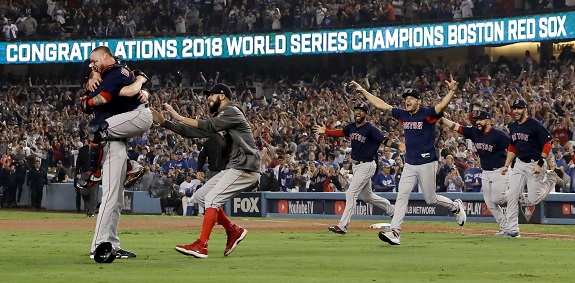
The Red Sox start celebrating their 2018 World Series conquest in Dodger Stadium . . .

On purely baseball terms the season barely a month old hasn’t been outstanding for the defending world champion Red Sox. There are small signs of them turning a corner, but small is the key word. So far.

They’re 14-18 to open, after a bullpen faltering led to a one-out, game-winning three-run homer by Nicky Delmonico of the White Sox in the bottom of the ninth Thursday night. It left the Red Sox six and a half games out of first in the American League East, while their eternal rivals from the south Bronx—battered as they’ve been so far—sit a mere two and a half out.

On terms just outside the lines these are interesting days for the Olde Towne Team. They’re scheduled to visit the White House next Thursday, after finishing a set with the Orioles in Baltimore, which is one sort of convenience. Maybe the only sort. Not that every last Red Sox plans to be there, but the club didn’t make the visit mandatory and offered their personnel the option to join or not.

The Athletic believes that traces back to an incident that followed their 2004 triumph, when co-owner Tom Werner turned up at a rally for presidential candidate John Kerry wearing a Red Sox jacket. He’d been criticised heavily for wearing the jacket at a political rally, and he says accepting the Trump invitation is simply a question of a presidential honour regardless of whom the office holder happens to be.

“To me, having sort of reflected on it, this is something that is an honor that’s been bestowed by the president and the White House on the Red Sox, and it’s not a mandatory event for the players,” Werner told the magazine. “Many players are excited to go, and many players have elected not to go, but we feel as an organization that we are appreciative of the invitation and we look forward to the experience.”

Werner, co-owner John Henry, their organisation, and their players are mindful enough that no matter who decides what it could be taken the wrong way, considering the political climate. Massachussetts isn’t exactly a bastion of unquestioned support for President Tweety, but the invitation did put the Red Sox in a kind of metaphysical bind, as The Athletic notes:

[A]ccepting or declining the invitation could have been spun as a political statement. In that sense, the Red Sox were in a lose-lose situation. If they turned down the invitation, the decision would have been cheered by many as a strong rebuke of the Trump administration, but it would have been derided by others as an overreach of political ideology. By accepting the invitation, the Red Sox have allowed their players a perhaps once-in-a-lifetime opportunity, while disappointing some of their blue-state fan base who will see, perhaps not an endorsement, but a tacit acceptance of the president’s more extreme statements and views.

The individual Red Sox are a mixed group when it comes to who will or won’t be at the White House next week. And Werner prefers it that way.

Manager Alex Cora still hasn’t decided whether to go; he’s been critical of how the Trump Administration dealt with hurricane relief in his native Puerto Rico. Pitcher Chris Sale and still-ailing second baseman Dustin Pedroia plan to be there. J.D. Martinez, the Red Sox designated hitter/outfielder, is an open Second Amendment supporter and is liable to be there, too.

Some observers may fear Trump himself will take those absent personally. or his supporters may take it as an indication the Red Sox need to be brought to heel. Maybe it ought to be made plain that accepting an invitation to the White House after a World Series or other triumph shouldn’t be assumed a concurrent gesture of support for a particular White House’s policies or politics, no matter who happens to occupy it.

Regardless of how many Red Sox actually show up next week, they’ll be the first baseball team of the 21st century to have met three sitting presidents. The stupefying, actual-or-alleged curse bust in 2004 plus their 2007 followup got them two meetings with George W. Bush. Their 2013 triumph, the first time they’d won a World Series in Fenway Park itself since Babe Ruth was still one of their pitchers, got them a meeting with Barack Obama.

The Yankees have some catching up to do. For that matter, so do the Giants: their Series conquests this century got them meetings with only one president (Obama), albeit three times. The way things are now, with the Giants in painful need of a remaking/ remodeling, the Yankees have a better chance to meet either Trump or his immediate successor.

Baseball and the White House were casual acquaintances for the most part since the Grant White House hosted its first professional major league team—the 1869 Cincinnati Red Stockings. Ronald Reagan—who began his professional life as a baseball broadcaster in Iowa and remained a baseball fan for life—turned inviting World Series winners to the White House into the tradition it’s become.

The Dodgers (twice), the Cardinals, the Orioles, the Royals, the Mets, and the Twins visited Reagan after their 1980s World Series wins. For his part, Reagan preceded those visits with calls to their managers (Tommy Lasorda, Whitey Herzog, Joe Altobelli, Dick Howser, Davey Johnson, Tom Kelly) immediately after they won those Series.

When Pete Rose broke Ty Cobb’s career hits record, the Reds’ then player-manager got a congratulatory telephone call from Reagan, who said, “You know, Pete, I’ve been rooting for you your whole career. Come to think of it, I used to root for the fella whose record you broke.” Had he still been in office when Hall of Famer Nolan Ryan blew Hall of Famer Rickey Henderson away for his 5,000th career strikeout (Ryan’s, not Henderson), Reagan would likely have called the Express.

Reagan himself entered the broadcast booth one more time before his term expired in 1988, joining Cubs broadcast legend Harry Caray. “You know, in a very few months I’m going to be out of work, so I thought I ought to audition,” the president quipped—before delivering an inning and a half of very credible play-by-play.

Try to imagine Trump, Obama, Bush (who was actually a former Rangers co-owner), Bill Clinton, or George H.W. Bush as baseball announcers, even in jest. Don’t ask, don’t tell.

What a difference over half a century made. The Washington Senators (the ancient, not-quite-wholly-accurate legend: “Washington—First in war, first in peace, and last in the American League”) won the 1924 World Series but Calvin Coolidge, who wasn’t exactly a baseball fan, wasn’t in any big hurry to host them at the White House–despite a flood of fan mail begging him to do it.

The Senators won the 1925 pennant and then Silent Cal met the Old Nats—right before they lost the Series in five games to the Pirates. Nobody knew, or dared to suggest, whether that proved any kind of White House jinx.

Coolidge’s successor, Herbert Hoover, was an unapologetic baseball fan who loved throwing out the ceremonial first pitch at Washington’s Griffith Stadium every April. He also made sure to be in the house for Game Five of the 1929 World Series, in Philadelphia’s Shibe Park, as the Athletics finished off the Cubs for whom Hoover was suspected of rooting—the Cubs at the time did their spring training on Catalina Island in California, near where Hoover had one of his two homes.

When major league baseball celebrated its centennial in 1969, Richard Nixon—who loved the game deeply (in his retirement he frequently brought his grandchildren to the field boxes in Shea Stadium)—greeted a large group of incumbent and former players, including Phillies pitcher Grant Jackson. At the time, troubled Phillies star Dick Allen was in a contract holdout. When Nixon advised Jackson to tell Allen to sign already because he wouldn’t make a better living anywhere else, Jackson didn’t miss a beat.

You tell him, Mr. President,” Jackson said. “He’s making more money than both of us.”

Dwight Eisenhower was a regular at Senators games in the 1950s, as well as a friend of owner Clark Griffith. Maybe his rooting interest (and, perhaps, the popularity of Damn Yankees?) kept Ike from nothing more than a personal letter to Don Larsen when that Yankee righthander pitched his perfect game in the 1956 World Series.

When the Yankees were invited to the White House after winning the 1999 World Series, a band struck up “Hail to the Chief” as Bill Clinton walked into the room accompanied by the Yankees’ then-owner, the (shall we say) Falstaffian George Steinbrenner. It might have inspired the least disingenuous remark Clinton ever uttered as president.

“Don’t get any ideas,” Clinton quipped to The Boss as the music began. “It’s not for you.”