The Red Sox Devers-ify . . .

Rafael Devers

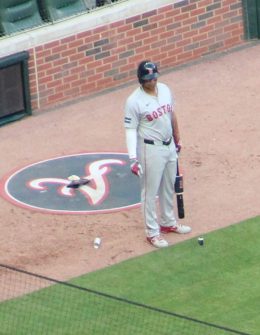
Devers in the on-deck circle. He now joins the Giants in a deal that may not bear immediate fruit for the Red Sox but manna at the plate for the Giants.

Even leading the 21st Century in World Series titles (four), the Red Sox haven’t lost their capacity to stun. They can sweep their eternal rivals and neutralize those rivals’ number one hitting threat one moment (they held Aaron Judge to 1 bomb, while striking him out 9 times during the sweep) and trade a slugging three-time all-star the next.

Yes, that sounds too simple. So we’ll flesh it out a big more. A relationship fractured by foolishness on both sides ends with Rafael Devers going to the Giants and left-handed pitcher Kyle Harrison, right-handed pitcher Jordan Hicks, outfield prospect James Tibbs, and minor league right-hander Jose Bello going to the Red Sox.

Almost five years after the Red Sox traded Mookie Betts rather than think much about paying him his true value, they’ve unloaded a far more problematic player than Betts ever was. That won’t make the deal go down any more smooth for a Red Sox Nation too much flummoxed by the team’s front office follies in recent seasons, alas.

The deal also means the last of the Red Sox’s 2018 World Series winners are gone. The Mookie Monster has since been a critical element in two Dodgers world champions; Xander Bogaerts has become a mainstay in San Diego and a few National League pennant races.

Say what you will about Devers, the man can hit. His to-date .858 OPS, his average 33 home runs per 162 games lifetime, both prove it. His batting eye improves with age; he led the American League in walks at the time of the deal. And he took care of the second of two runs the Red Sox needed to finish sweeping the Yankees with a hefty 2-out home run in the bottom of the fifth. The Giants may have a home ballpark nowhere near as hitter-friendly as Fenway Park, but they’re getting a guy to whom the dimensions don’t matter so long as he can tee it up and swing big.

Part of the problem, and a critical reason why things came to Devers’s transcontinental change of baseball address, is that when you play him at third base “poisonous” doesn’t begin to describe it. He led the league in errors in six of his first seven seasons and the entire Show for the first four of those. He was 80 defensive runs below league average. (Fair disclosure: Bogaerts hasn’t exactly been toxin-free at shortstop, not being 27 defensive runs below league average for his career to date.)

That’s a compelling reason why the Red Sox thought signing free agent third baseman Alex Bregman was a smart idea. The problem was that the Red Sox took the clumsy way to handle both that and the little matter of convincing Devers that the longer he stayed at third base the more likely the Red Sox were to declare the area off limits pending a hazmat cleaning.

How would Devers have done at first base? We won’t know, at least regarding the Red Sox, because Devers didn’t exactly pounce on the opportunity when it was offered as Triston Casas hit the injured list. He won’t be taking a new shot on third in San Fran, either, since the Giants have a verified Gold Glover holding it down (Matt Chapman). He may not get a crack at first, either, with the Giants having a willing Wilmer Flores to move over in case former Met Dominic Smith needs a break or can’t hold it down longer-term.

But Devers will provide the Giants with something they haven’t had since their freshman top executive, Buster Posey, was last seen behind the plate for the Giants — a great hitter. Posey may also give Devers what the Red Sox couldn’t for whatever reason, a clear presentation of the “why” behind any move without insulting Devers’s considerable pride. Posey had bloody well better, too, considering the Giants have taken on the remainder of Devers’s contract — running through 2033 and paying him a nifty $250 million plus.

What do the Red Sox get other than out from under Devers’s remaining money and maybe a little more egg on their faces considering they didn’t exactly handle Devers with graceful hands and heads?

Harrison — Considered highly talented and still only 23, so he has time to put things together despite his 4.56 fielding-independent pitching rate to date. Depending on the Red Sox pitching injury picture, Harrison just might be seen in Red Sox silks before the stretch drive arrives. And that might occur next to any pitching the team ponders acquiring at or before the trade deadline now that they have about $250 million to play with.

Hicks — Serviceable relief pitcher whom the Giants tried out of the rotation last year, but when that experiment imploded Hicks went back to the bullpen, and the Red Sox are liable to keep him there.

Tibbs — A first-round pick last June, he’s been showing plenty of upside in the minors, but the Red Sox will likely wait for his AA-level results before thinking of him as Show bound.

Bello — Has bullpen upside to burn, from the look of his minor league life to date.

The rest of the Sox — With Devers gone, it looks as though there will be plate appearances to spare to spread around especially in dispersing an outfield crowd partially. But it’s an open question as to just whom would replace Devers’s plate production. For now. And maybe longer. Which means the Red Sox’s re-entry into the AL East race picture may be an arduous re-entry to sustain.

Published originally by Sports Central.
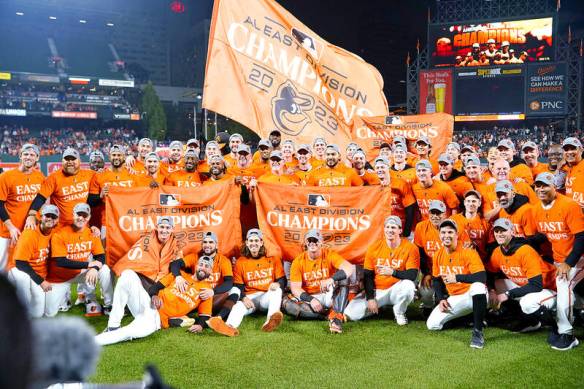
Party hearty, Baltimore, but . . .

Baltimore Orioles

Your American League East champions, who got here the hard, disgraceful way.

You hate to dump rain upon the Oriole parade just yet. But their clinch of both the American League East and home field advantage through the end of the American League Championship Series (if they get that far in the first place) isn’t exactly the early climax of a simon-pure story.

Of course it’s wonderful to see the Orioles at the top of their division heap and Baltimore going berserk in celebration. Of course it’s wonderful to see the first team in Show history ever to lose 100+ in a season flip the script and win 100 within three years.

Of course it’s wonderful that the Orioles are going to stay in Camden Yards for three more decades at least, an announcement that came in the third inning Thursday. It sent the audience almost as berserk as they’d go when Orioles third baseman Ramón Urias threw the Red Sox’s Trevor Story out off a tapper to secure the clinch.

Of course it’s wonderful that we don’t get to call them the Woe-rioles, or the Zer-Os anymore. And of course it’s going to feel like mad fun rooting for the Orioles to go deep in the postseason to come, even one that remains compromised by too many wild cards and too many fan bases thus lost in the thrills and chills of their teams fighting to the last breath to finish . . . in second place or even beyond for a nip at the October ciders.

Unfortunately, it’s not easy to forget how the Orioles got to this point in the first place. In plain language, they tanked their way here. There’s no way to sugarcoat it.

However marvelous and resilient they were all season, however much of a pleasure it’s been to see this year’s Orioles behaving like their illustrious predecessors of 1966, 1970, 1983, and numerous other division champions and pennant winners, they got here via tanking. That should never be forgotten. It should never happen again. To the Orioles or any other conscientious major league team.

It started after their 2016 season ended too dramatically. When then-manager Buck Showalter kept to his Book and his Role Assignments, declined to have his best relief pitcher Zack Britton ready and out there, because it wasn’t a quote save situation. Leaving faltering Ubaldo Jimenez on the mound to face Toronto’s Edwin Encarnación. Baltimore still won’t forget the three-run homer Encarnación parked in the second deck of Rogers Centre with the Blue Jays’ ticket to the division series attached.

They tanked from there forward, picking up from where they left off after 1988-2015. They finished dead. last. in the AL East in three of the four seasons to follow. (A fourth-place finish broke the monotony.) As of a hot August 2021 day when the Angels (of all people) bludgeoned them 14-8, including thirteen runs over three straight innings, they were 201-345—after having been the American League’s winningest regular-season team from 2012-2016.

Before the 2021-2022 owners lockout ended and spring training began, The Athletic‘s Dan Connolly came right out and said it, even though he admitted it didn’t really bother him: rebuilding the entire organisation, ground up, and giving almost all attention to the minors and the world baseball resources but so little to the parent club, “produces a tank job in the majors.”

They weren’t the only tankers in the Show by any means. Famously, or perhaps infamously, the Astros tanked their way to the 2017 World Series—which turned out to be tainted thanks to the eventual revelations that the 2017-18 Astros operated baseball’s most notorious illegal, off-field-based, electronic sign-stealing scheme.

They were preceded by the 2016 Cubs, who tanked their way to that staggering World Series conquest. Like the Astros, the Cubs came right out and said it: they were going into the tank in order to win in due course. The 2016 Cubs don’t have the 2017-18 Astros’ baggage, and their conquest was mad fun, but their fans endured a few seasons of deliberate abuse to get there.

Yes. I said it again. Just like Thomas Boswell did in July 2019. “It’s dumb enough to tear down a roster that is already rotten or old or both,” he wrote.

But it’s idiotic to rip up a team that has a chance to make the playoffs, even as a wild card, especially in the first era in MLB history when six teams already are trying to race to the bottom. With more to come? What is this, the shameless NBA, where tanking has been the dirty big lie for years?

. . . With the Orioles (on pace for 111 loses), Tigers (111), Royals (103), Blue Jays (101), Marlins (101) and Mariners (98) all in the same mud hole wrestling to get the same No. 1 draft pick next season, we’re watching a bull market in stupidity. And cupidity, too, since all those teams think they can still make a safe cynical profit, thanks to revenue sharing, no matter how bad they are . . .

. . . In the past 50 years, losing usually leads to more losing — a lot more losing. I’ve watched it up close too often in Baltimore. In 1987-88, the Birds lost 202 games. Full rebuild mode. In the 31 seasons since, the Orioles have won 90 games just three times. At one point, they had 14 straight losing seasons. Why did D.C. get a team? Because the Orioles devalued their brand so much that there was nothing for MLB’s other 29 owners to protect by keeping a team off Baltimore’s doorstep.

Baseball has seldom seen a darker hour for its core concept of maintaining the integrity of the game. Commissioner Rob Manfred is either asleep or complicit.

Too many teams are now breaking their implicit vows to the public. They’re making a profit through the back door as money gushes into the game from revenue streams, many of them generated over the Internet, which are divided 30 ways. For generations, fans have believed that they were “in it together” with their teams. Bad times made everybody miserable — fans, players and owners alike. Now, only the fans take it in the neck.

And in the back.

So this year’s Orioles, a genuinely fun and engaging team, with a lot of genuinely fun and engaging players, have won 100 games for the sixth time in their franchise history. They have the home field postseason advantage for as long as they endure through the end of the American League Championship Series. They’re liable to make things interesting for any team looking to dethrone them this postseason. Just like their former glory days.

It’s wonderful to see Camden Yards party like it’s 1969 again. Or 1970-71. Or 1979-80. Or the scattered good seasons between then and now. But it should be miserable to think of how they got here in the first place. It should be something no Oriole fan, no baseball fan, really, should wish to see again.

Tanking is fan abuse, plain and simple. It also abuses the game’s integrity. That integrity has taken more than enough shots in the head from other disgraces perpetuated by its lordships. Don’t pretend otherwise.

But now that we’ve got that out of our system, for the time being, let’s celebrate. The once-proud organisation that gave us the Brooks-and-Frank-Family Robinson era, The Oriole Way, and the era of Steady Eddie and Iron Man Cal (though beating the 1983 Philadelphia Wheeze Kids could have been called shooting fish in a barrel), is going back to the postseason at last.

And, this time, let’s pray, that when a true as opposed to a Role-or-Book “save situation” crops up in the most need-to-win postseason game, manager Brandon Hyde won’t leave his absolute best relief option in the pen—a dicey question, considering they’ve lost closer Félix Bautista (now to Tommy John surgery), even with Yennier Cano emerging to look like a grand candidate—waiting while a misplaced, faltering arm surrenders a season-ending three-run homer before their time.

Maybe these guys have what it takes to wrestle their way to a World Series showdown with that threshing machine out of Atlanta. Maybe they won’t just yet. Let’s let Baltimore and ourselves alike enjoy the Orioles’ October ride while it lasts, however long it lasts. The loveliest ballpark in the Show has baseball to match its beauty once again.

It’s déjà vu all over again

Four years ago, the Yankees were so injury riddled that I couldn’t resist (half) joking that the team’s yearbook would be an issue of The New England Journal of Medicine. And, that Yankee Stadium would have to feature a banner above its main entrance:2019-04-21 YankeeStadium02

It’s déjà vu all over again. The Yankees are . . . injury-riddled. Again. They’re also two games above .500 as of Thursday morning’s standings, but they’re also fifth in a deceptively tough American League East. Just as in much of the past few seasons, The New England Journal of Medicine could be mistaken for the Yankee yearbook. And fans of the Broken Bombers are getting restless. Yet again.

The defending American League single-season home run record holder, Aaron Judge, hit the infirmary list when he injured his hip. Happy 31st birthday, Your Honour. Giancarlo Stanton suffered a hamstring injury in mid-April that may keep him out until early June. Josh Donaldson, Tommy Kahnle, Jonathan Loáisiga, Frankie Montas, Carlos Rodon, Luis Severino, Lou Trivino—infirmary list.

And that was before Harrison Bader—sprung from the injured list Tuesday—went right back onto it, taking Oswald Peraza with him, when they collided Tuesday night on a ninth-inning play enabling the Guardians to break a two-all tie in a game the Yankees finally won, 4-3.

Oh, sure, manager Aaron Boone made a point of saying postgame that Bader was in good spirits and even laughing about the crossroad collision as he came diving from one way as Peraza came diving from the other way. But it had to be laughter like Figaro’s, that the Yankees might not weep. Yankee fans, of course, don’t know whether to weep or call for summary executions.

The Yankees had Thursday off. At the rate they’re going so far, off days may be the only days guaranteed not to feature yet another Yankee off to sick call. But the Rays—those guys who opened the season with a thirteen-game winning streak, and still have a Show-beat 25-6 record—own the AL East after the first month plus. The Orioles (!) have twenty wins and sit ten games above .500, close enough to the franchise’s good old days. The Blue Jays are 18-13 and already took two out of three from the Broken Bombers. The Red Sox are 18-14, still have some kinks, but little enough compared to the Bronx’s orthopedic ward.

Maybe the Yankees aren’t in the game’s worst shape. Certainly not compared to the usual tankers and especially those in Oakland who’ve been driven into the tanks by an owner who’s all Three Stooges at once without being even a tenth as funny. But all you have to do is listen to enough Yankee fans. You’d think it was the end of the world as you knew it and you shouldn’t feel fine.

Do I really have to repeat myself and say there are scads of fans all around the Show who’d just love to be able to think a season without their team in or winning the World Series is an illegitimate season? Can you name one other team whose fans remain—by dint of having been there, or handed down as a smug legacy—wedded to the battle cry, “Wait till last century!”

‘Tis true that without its Goliaths baseball’s Davids would have nothing toward which to aspire. The Yankees in this century are anything but Goliaths. Once upon a time you couldn’t tune your memory to times when the Yankees were less than baseball’s Huns. Today the Yankees are only human, but their fans are still spoiled rotten.

Look yonder to the National League Central, where the Pirates—who’d been in the tank longer than the town drunk—sit prettily enough atop that division. The NL Central isn’t exactly the Third Army of World War II, but a 20-11 record isn’t necessarily dismissable.

Never mind that they’re one game above .500 against other contenders real or reputed. These Pirates are for real, for now. Their fans have a few glories from last century on which to lean, but they certainly don’t behave as though they’re entitled to a bloody thing. Maybe too many years in the tank does that for you.

The Orioles were long thought left for dead by their own ten-thumbed owners, but lo! They, too, were 20-10 as of Thursday morning. Camden Yard has gone from a ghost yard to a party yard. Never mind that they were exactly .500 against actual or alleged contenders. Don’t spoil Oriole fans’s fun just yet. The song of the Birds is the sweetest it’s been for eons.

But look, too, toward such twisted reaches of crazy sorrow as Cincinnati and Oakland. The Reds remain in the tank. The Athletics would only like to be in the tank—it would be a major upgrade from the sewage mistreatment plant they’ve been in for too long.

For decades, it seemed, Cub fans were rather like the one who whipped up a placard in the Wrigley Field bleachers saying “Wait ’till next year!”—as the Cubs’ Opening Day starting pitcher turned to throw the first pitch to the plate. Today’s Met fan thinks the season is lost upon one bad inning—in April.

The Yankees’ seemingly eternal general manager, Brian Cashman, has pleaded, “Don’t give up on us, that’s all I can tell you. Don’t count us out.” Between the blinding lack of moves during the offseason, other than securing Judge to his gigabucks extension and dealing for Franchy Cordero, his plea may yet fall upon ears sewn shut or suffering tinnitus.

“I don’t think there was anything on the table that I could have pulled down that would make a difference,” Cashman said of the Yankees’ comparatively quiet offseason. “I don’t see any missed opportunities with everything that was in play.”

Thus have they come to rely on Cordero (.684 OPS thus far), Willie Calhoun (likewise thus far), Isiah Kiner-Falefa (hits the price of a cheap cigar though he has a decent outfield glove), Aaron Hicks (making IKF resemble Hall of Famer Dave Winfield at the plate but in the negative in the field for run prevention), and a gang of straw arms behind Gerrit Cole. (Cole: 2.16 fielding-independent pitching; the rest of the starters: 4.75 FIP. ) Major league-ready talent down on the farm? Don’t ask.

The good news is, the previous decade including this season thus far isn’t even close to the Lost Decade of 1965-75 for Yankee futility, and at minimum there isn’t even a hint of the sort of executive insanity that was the 1980s Yankee hallmark. Principal owner Hal Steinbrenner isn’t even within transcontinental distance of his father for pushing panic buttons, throwing out the first manager of the year, or demanding summary executions every other bad inning.

But that exhausts the good news for now. That and the Yankees somehow taking two of three from the Guardians this week. Tonight, the Yankees begin a three-game visit to Tampa Bay. The Guards may sit in second place in the AL Central, but they do it at 14-17. The Rays, remember, are nobody’s pushovers this year thus far.

This weekend may not break the Yankees for good, the season remains too young for that. But wait till next year? If things continue as they have thus far, Yankee fans may yet come to lament, perhaps as early as the end of this month, “This year is next year.”

An epic Yankee fall?

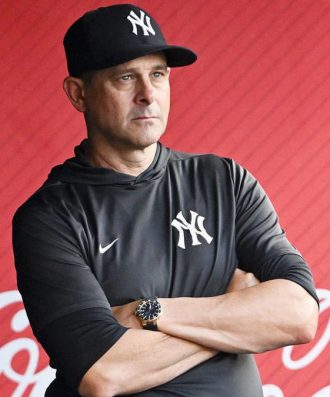
Aaron Boone

Aaron Boone—how often does a four-game division lead feel like the next rung down of a collapse?

“If we don’t dig ourselves out,” Yankee manager Aaron Boone told reporters after the Yankees lost to the Rays 2-1 Saturday night, “you’ll have a great story to write.” Sometimes, greatness is in the eye of the beholder. If the beholder is a typical Yankee fan, this kind of greatness is the last thing the Yankees need.

There’s always been a trunk full of cliches about the Yankees. The two most significant have been a) they don’t like to lose; and, b) their fans consider no postseason legitimate unless the Yankees are in it. (The third most significant, at least since a certain man bought the team in 1973: To err is human; to forgive is not Yankee policy.)

Even the terminally optimistic Boone feels the weight. If he’s telling reporters they’ll have a “great” story to write unless the Yankees find a way out of their current spinout, there’s no joy in half of New York. The other half is hanging with the Mets, who may have a mere two-game lead in the National League East but whose fans aren’t exactly ready to call for summary executions despite their team having ended May 10.5 games ahead of their divisional pack.

The Mets’ faithful learned from the crib that there’s no such thing as an entitlement to success. (Quick: Name any Yankee team ever called a miracle team.) The Yankee faithful were spoiled so rotten by their 20th Century success that their descendants still think the World Series trophy is fraudulent unless it has the Yankee name on it.

Maybe the Yankees will dig themselves out of their present funk. But maybe they won’t. They’re 15-16 in the second half so far and went 10-18 in August alone, but they awoke Sunday morning having lost six of nine. Dropping the first pair of a weekend set with the second-place Rays is one thing, but entering that set splitting four with the sad-sack Athletics and two of three to the equally sad-sack Angels is not the look the Yankees wanted going in.

Their toughest opponents the rest of the way will be those same Rays for a three-game set in Yankee Stadium starting 9 September. They return home from Tampa Bay to host the Twins for four, and the Twins are no pushovers, but they’re not exactly up to the Rays’ performance level just yet. They’re also not quite up to the level of the suddenly-amazing Orioles, whom the Yankees host to end September and open October.

The Orioles—who looked as though they’d surrendered their heart and soul when trading Trey Mancini at the trade deadline, which could have threatened their unlikely sightline to the wild card picture. While almost nobody was looking, the Orioles not only finished July with a 16-9 month but they consummated a 17-10 August and opened September with three straight wins—one against the AL Central-leading Guardians and two against the A’s. Once upon a time the victims of a miracle team (in 1969), these Orioles may yet <em>become</em> a miracle team themselves.

They were as deep as 23 games in the AL East hole as of 2 July. They were 35-44. They’ve since gone 36-25. This regular season may yet finish with a debate over which was greater, the Yankees’ collapse from a one-time 15.5 game AL East lead or the Orioles’ resurrection from a 23-game divisional deficit to a postseason berth.

Yankee and other eyes concurrently train upon Aaron Judge’s pursuit of the 60 home run barrier across which two Yankees have gone (Hall of Famer Babe Ruth’s 60 in 1927; Roger Maris’s 61 in ’61) and—after a healthy leadoff belt in the top of the ninth off Rays reliever Jason Adam Saturday night—Judge himself is only eight shy of meeting. Some think Judge is so locked in he may even meet the 70-bomb single-season barrier head-on before the regular season expires. He’d be the first player to reach it without being under suspicion of actual/alleged performance-enhancing substances, anyway.

But Yankee cynics make note that, for thirty days including Saturday night, the Yankees’ team slash line of .213/.289/.325 is only that high with Judge, himself the possessor of a .279/.446/.593 slash for the same span. Without him, they’d be .208/.268./.295. Their Lost Decade of 1965-75 looked better than that.

How on earth did the Yankees get here? Easy enough. Hal Steinbrenner isn’t the man his father was, good and bad. The good side: Prince Hal isn’t exactly the type to decide one bad inning is enough to demand heads on plates, and if he fires a manager he wouldn’t have the gall to say, “I didn’t fire him. The players did.” The bad side: He doesn’t like to invest half as much as his father did.

Say what you will about George Steinbrenner, but the man didn’t care how much he had to spend, either on the free agency market or on keeping the farm reasonably fresh. Prince Hal’s running the most profitable franchise in the American League as if they were a minor league outlier or the A’s, whichever comes first. Nobody wants the bad side of The Boss resurrected, no matter how often Yankee fans demand it now. But nobody wants the good side buried interminably, either.

Which means general manager Brian Cashman, the longest-tenured man in his job in baseball, had little choice but to cobble a roster with one proverbial hand tied behind his back. But that acknowledgement goes only so far. Cashman’s eye for diamonds in the rough has failed him long enough. The present Yankee roster makes some rebuilding teams (the Orioles, anyone?) resemble threshing machines.

Which also means Boone—the only man in Yankee history to manage back-to-back 100-game winners in his first two seasons on the bridge—looks a lot larger for his faltering in-game urgency managing and getting less than the best of the men not named Judge or (relief pitcher) Clay Holmes on his roster. So do the three Yankee hitting coaches who can’t seem to shake the non-Judge bats out of what one of them is quoted as calling the wrong case of the “[fornicate]-its.”

The definition to which those coaches hold is translated admirably by strongman designated hitter Giancarlo Stanton: “We’ve just got to give whoever is on the mound a tough at-bat, even if we get out. We’ve just gotta wear ’em down a little bit. Just be a little tougher on them.” The definition to which the Yankee bats have held mostly of late seems to be unintentional surrender.

Yes, the Yankees have been injury-addled. Yes, they’ve been playing a curious chess game with minor leaguers brought up to the club to the point where they had to send two promising pitchers back down because the roster was about as flexible as an iron gate. But the lack of urgency the Yankees seemed to feel when they looked like AL East runaways hasn’t been resolved just yet with the team looking as though they can be overtaken before this is over.

Once upon a time, New York was rocked by a Brooklyn Dodgers team that looked as though it was shooting the lights out in the National League but found itself overtaken into a pennant tie by a New York Giants team that was 13 games out at one point. That tie and subsequent playoff, of course, turned out to be as tainted as the day was long. (The Giants stole the pennant! The Giants stole the pennant!)

To the best of anyone’s knowledge, nobody’s cheated their way back into the AL East race. If the Yankees keep up their current malaise, nobody would have to. Collapsing entirely from a 15.5 game lead would stand very much alone on the roll of Yankee infamy.

Sorry, Charlie

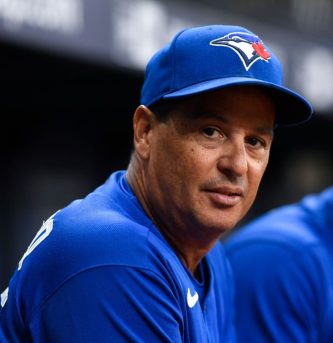
Charlie Montoyo

Montoyo takes the fall for somewhat less than gets other managers executed.

Let’s see. The Phillies sat 22-29 and having lost 11 of their previous 17 when they executed manager Joe Girardi in favour of Rob Thomson—whose team has gone 24-14 since.

The Angels went from 27-17 to 27-29, the first team in major league history to plunge from  ten games over .500 to a twelve-game losing streak, and sent manager Joe Maddon to the guillotine in favour of Phil Nevin. Nevin’s crew has gone 12-21 since, including 2-11 to open July.

The Blue Jays went 46-42 through Wednesday morning but suffered a five-game losing streak after opening July with a win, went 1-7 against one American League West wild-card contender and one of the division’s weaker teams, and awoke Wednesday at 2-12 for the month to date. Thus did they decide manager Charlie Montoya had a date with the firing squad despite the Jays beating those Phillies Tuesday.

Bench coach John Schneider was handed the bridge with the usual “interim” tag. The Blue Jays’ first act under their interim commander was to beat the Phillies to sweep a two-game set. Thomson’s been a steady skipper thus far; Nevin’s been little more than an apprentice seaman. One win isn’t enough to make the call on Schneider.

But something stunk about Montoya’s firing at first that was a little more profound than the fragrances surrounding the Girardi and Maddon executions. The timing especially.

Earlier this month first base coach Mark Budzinski’s seventeen-year-old daughter Julia was killed in a tubing accident. On Monday, Montoyo—who’d left the dugout with Budzinski in the middle of a doubleheader on receiving the news—joined other team reps in attending Julia Budzinski’s funeral.

Maybe collapsing to a 2-12 July opening gave the Jays enough reason to think Montoyo had to go, but with the All-Star break approaching it’s not unreasonable to think they might have waited just a short while longer, maybe on the eve of the break itself, to align the firing squad.

This may have been the second most cold-blooded managerial firing in modern major league history. The first would have to have been the Yankees dumping pennant-winning manager Yogi Berra in favour of the man who beat him in the 1964 World Series, the Cardinals’ Johnny Keane, the day after the Cardinals won in seven, a move that was planned back-channel before the Yankees put on the stretch drive (going 30-13) that nailed their pennant in the first place.

It looked even worse if you thought about was Montoyo having managed the Jays to 91 wins and a near-miss to the 2021 postseason despite the continuing coronavirus pan-damn-ic compelling the team to make three different cities the site of their home games.

But as Ken Rosenthal of The Athletic pointed out in the immediacy of Montoyo’s execution, the Jays may have their still-euphemistic “compelling reasons” to give the command to fire. If that’s true, maybe they shouldn’t have let him stay on the bridge with a one-year extension and a couple of option years to follow to open the season in the first place.

Like Girardi and Maddon before him, Montoya bore the burden of a misconstructed team even if it’s a team still in the new but dubious wild card hunt. It wasn’t Montoya who delivered a bullpen that finds as many bats as it misses or a starting rotation whose rear end resembles the northbound end of a southbound moose.

They opened July in second place in the tough American League East, but hitting the skid let the re-horsing Red Sox and the Rays pass them in the division standings while letting the Mariners match them for the third wild card thus far.

Now it comes forth, too, that some in the Jays clubhouse thought they needed a somewhat firmer hand when they hit the skid and Montoyo, as loved and popular as he was on the bridge, wasn’t quite the man to offer that hand.

Athletic Blue Jays beat reporter Kaitlyn McGrath found at least two players willing to talk about the clubhouse atmosphere, one anonymously but another willing to go on the record. Of course.

The anonymous Jay told McGrath that hitting the skid required what Montoyo apparently lacked. “When you’re [in a] 1-9 [slump], you’re looking for someone to come in and either kick you in the ass or pump you up, just something, some guidance,” the player said. “And you could have it as players, for sure, and we did, but you really do need it coming from the top and that just wasn’t happening . . . If we were playing better, this wouldn’t have been as much of an issue, but we weren’t, so you’re looking for leadership and a lot of us felt like it wasn’t really there.”

But even that didn’t erode the respect the Jays’ players have for Montoyo the man, if you take the word of pitcher Ross Stripling, who earned the Wednesday win against the Phillies with six strikouts but eight ground outs and ten fly outs in seven innings during which he surrendered two earned runs on two hits.

“I don’t think anyone would ever think that he doesn’t want us to have success individually or as a team, the whole Blue Jays organization,” Stripling told McGrath.

He had our backs all the time and wanted us to win baseball games. And it’s a shame—he’s been here since 2019, when this kind of young core got going—that he’s not going to be there to see a lot of their success and where they go and where we go as a team. But I think everyone would say thank you to him and the effort that he gave us for the years that he did and that we love him and wish him well.

General manager Ross Atkins, who carried the execution forth, said it’s not “necessarily” good starting pitching and good bullpens alone that contend and win. “Look at the history of the game,” he said, “good teams win championships. The person to look to is me. I’m the one that needs to be accountable. And we will continue to work hard in every area of our team to improve.”

In other words, don’t blame me because Charlie couldn’t make do with shallow starting and bullpen bulls.

For now the Phillies have lived a somewhat charmed team life since Girardi’s dismissal, even while losing Bryce Harper to a thumb fracture after the right fielder was limited to DH duty thanks to an elbow injury. They’re only nine games out of first in the National League East, though they have a formidable wall to climb with the first-place Mets and the second-place (and defending World Series champion) Braves making life none too simple.

The Angels? They could bring Casey Stengel back from the dead and still sputter. Especially since, in addition to their still-usual pitching problems not named Shohei Ohtani, the bottom of their order became such a trainwreck that it didn’t matter what the bigger bats did. It comes into sadder play when such bigger bats hit the slumps to which all bats are prone, even those of future Hall of Famers.

Nevin’s tenure has been a plane crash thus far. Especially when he landed himself a ten-game suspension for being none too subtle about looking to avenge a ninth-inning Mike Trout head hunt the night before and sending an opener to start the game and exact revenge. The Mariners may have had it coming, but one behind-the-back pitch and a subsequent plunk was out of line.

And while the umpires sounded mealymouthed in not starting the game with warnings after Trout was inches from decapitation in the ninth the night before, the ensuing brawl after Andrew Wantz hit Jesse Winker in the hip cost Nevin a key relief pitcher (Archie Bradley) for a month, at least, when he hopped over the rail to join the fracas and broke a bone in his pitching elbow.

It’s gotten to the point where the published calls for the Angels to start thinking about the once-impossible: trading both Trout at this year’s trade deadline and Ohtani before he reaches his first free agency, the better to get a replenishing return (hopefully, with pitching slightly above the level of arthritic cleaning crews) while the getting is prime—aren’t waiting until their season is all but officially dead.

So the Blue Jays aren’t exactly that bad off just yet. It’s still too soon to call a single win under a new bridge commander the beginning of an in-season resurgence. Who knows what Atkins might move upon as the trade deadline approaches? But there’s still something badly disconcerting about the Montoya execution. The man’s been a class act who’ll probably get another chance to take another major league bridge soon enough.

There may yet be more to come in the way of deeper details. As often as not, there usually are. And it’s not impossible to ponder whether Atkins himself might now be on a seat whose temperature rises a little more as the season goes forward.