ASG: As (almost) usual, show biz yields to baseball

Jarren Duran

Red Sox center fielder Jarren Duran hoists the clear bat awarded the All-Star Game’s Most Valuable Player. His tiebreaking two-run homer held up to give the AL the 5-3 win.

God help us all, everyone. The All-Star break began with a pre-Home Run Derby singing of “The Star Spangled Banner” Monday night (by country star Ingrid Andress) that made youth cringe and elders think wistful thoughts of Roseanne Barr. It ended with a tenth American League All-Star Game win in eleven seasons.

In between, of course, was much to ponder and much to dismiss as patent nonsense, which seems to be far more the norm than Chicago Tribune sports editor Arch Ward, who initiated the game in 1933, might have imagined.

Phillies third baseman Alec Bohm could be seen having to labour to keep from laughing (presumably, that he might not weep—or wish to commit manslaughter) when Andress tackled “The Star Spangled Banner” as though too well besotted. It turned out that appearance was everything: She copped the following day to being drunk and having enough issue with it to seek rehab and recovery.

Wish her well, but demand to know why nobody in baseball’s administration noticed she was drunk as she took the mike in the first place.

That was then: The Derby rules were, a participant had ten outs to hit as many homers as they could, the hitter with the most such bombs advanced, and that was that. So simple that, in fact, even Mark Belanger (human Electrolux at shortstop, but a spaghetti bat who hit three fewer homers in eighteen major league seasons than the late Hall of Famer Willie Mays hit in the first half of 1965) could have done it.

This is now: Round One—three minutes or forty batted balls, whichever came first, followed by an old-style three outs to hit as many bombs as possible. Round Two—the top four floggers moved to a bracket-like semifinal. Round Three—the two semifinal winners head to head. The net result: Teoscar Hernandez (Dodgers) defeating Bobby Witt, Jr. (Royals), who nearly forced a playoff with a ICBM-like blast stopped only by the left center field fence.

Some of us still wonder why we’re supposed to tolerate three-hour long Home Run Derbies but arise armed against two and a half hour-plus real baseball games. Or, why we had three-minute commercials aboard Fox’s All-Star Game telecast Tuesday before seeing supersonic relief pitchers blowing the side away in order in a minute and a half if that long.

Perhaps commissioner Rob Manfred might have an answer to that one. At least he has a sort-of answer to the question (posed by The Athletic‘s Tyler Kepner) of when the ever-more-hideous generic All-Star Game uniforms of the past several years will be disappeared in favour of returning the fine old tradition of All-Stars wearing their own uniforms and thus representing their teams.

“I am aware of the sentiment and I do know why people kind of like that tradition,” Commissioner Pepperwinkle told Kepner. “There will be conversations about that.” The proper two-word answer to that, of course, is, prove it. About knowing why people (more than kind of) like that tradition and holding serious conversations about it.

Well, take the proverbial pause for the proverbial cause. That very first All-Star Game featured the American League representatives wearing their own teams’ home uniforms with the National League wearing road threads, as modeled below by Hall of Fame catcher Gabby Hartnett:

Gabby Hartnett

Behold now this year’s threads for each league:
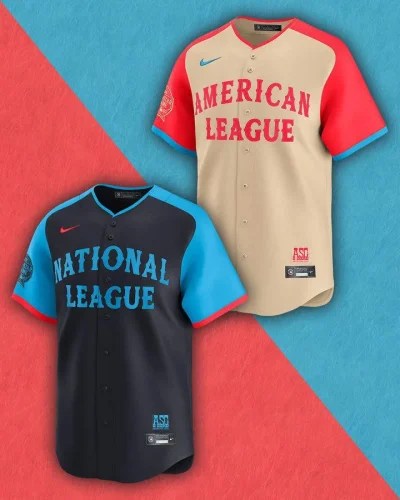
Yes, we have seen far worse for generic All-Star uniforms.

Except for each league’s colour scheme, is it really that radically different from the 1933 NL haberdashery? Now, this year’s threads would look far nicer if the American League jersey was done with red-on-white (the AL was the home team in Globe Life Field) and the National League was done with blue-on-gray (since the NL is the visiting team). And worn over either white (home) or gray (road) pants.

My normal position is to be all-in on returning to the practise of each league’s All-Stars wearing their own teams’ uniforms, representing their teams and fan bases, as their forebears did for so many decades. If Commissioner Pepperwinkle insists ultimately upon keeping generic league uniforms, this year’s style just might be the right way to go, switching the core white and gray each year depending upon which league is the All-Star host.

The wherefores of this year’s uniforms mattered less when the game got underway, and rookie NL starting pitcher Paul Skenes (Pirates) got to face Aaron Judge (Yankees) after all, thanks to Judge’s teammate Juan Soto wringing himself into a walk. The bad news: Judge forcing Soto at second with a grounder to third for the side.

AL manager Bruce Bochy (Rangers) was well aware of the marquee appeal of Skenes versus Judge while penciling Judge into his cleanup slot. But he sent three lefthanded swingers with impeccable on-base credentials up against the righthanded Pirate phenom to open, hoping precisely to get that marquee match without sacrificing his best chances to start winning the game.

Joe and Jane Fan insist, “This is just an exhibition, dammit!” Maybe they’re right. Maybe the metastasis of regular-season interleague play to a full-season thing has left the All-Star Game bereft of meaning, as opposed to such artifices as the period when postseason home field advantage went to the league who won the Game..

But maybe a Hall of Famer in waiting who’s won four World Series as a skipper knows, however the game’s been kicked around like a commissioner’s plaything for too damn long, that himself, his NL counterpart Torey Lovullo (Diamondbacks), and the players on both sides, actually do play this particular game as baseball, not show business.
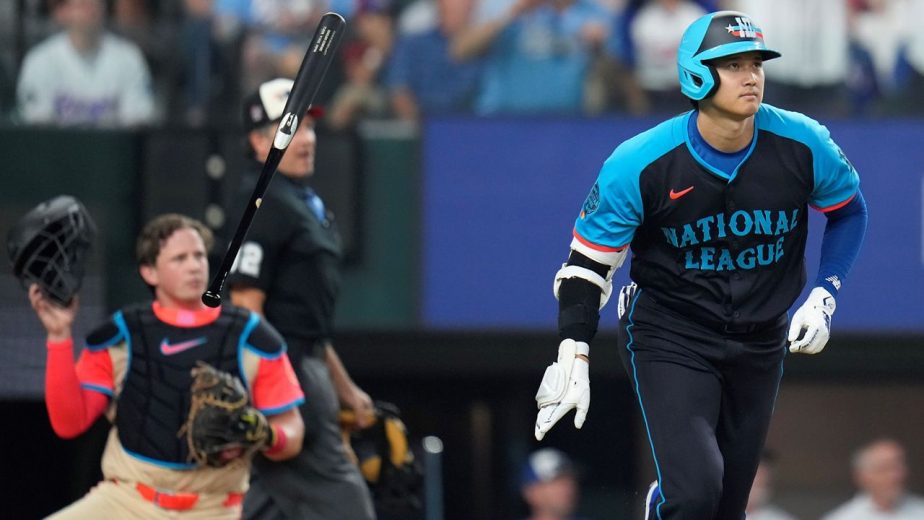
Shohei Ohtani

Shohei Ohtani detonating a three-run homer in the third inning. “To be able to share a dugout with him was surreal.”—Pirates pitcher Paul Skenes. Ohtani is now the only player in Show history to earn a pitching win in one All-Star Game and a home run in another All-Star Game.

So Bochy got Joe and Jane Fan their marquee matchup the old fashioned way, and Skenes came out of it on top, but Bochy’s diligence left him the only manager in major league history to win a World Series and an All-Star Game in each league. And, the first since Hall of Famer Joe McCarthy to manage an All-Star Game at home the season after he won a World Series.

Putting baseball ahead of show biz has enriching payoffs, of which Commissioner Pepperwinkle seemed as unaware as both managers were reminded soon enough en route the American League’s 5-3 win Tuesday.

Lovullo got the first such reminder when Shohei Ohtani (Dodgers) faced Tanner Houck (Red Sox) in the top of the third with nobody out, two men on, and sent a 2-0 splitter a few rows back into the right center field seats. (The last Dodger to hit one out in All-Star competition? Hall of Famer Mike Piazza, 28 years earlier.) Bochy got his in the bottom of that inning, when Soto shot a two-run double to center and David Fry (Guardians) singled him home to tie the game at three after another Judge ground out.

Two innings later, Lovullo got the reminder that ended up counting for the game, when Jarren Duran (Red Sox) batted with two out and one on, took a strike from Hunter Greene (Reds), then caught hold of a Greene splitter and sent his own message into the same region of seats where Ohtani’s blast landed.

“It won’t hit me until I try to go to sleep tonight,” Duran told The Athletic postgame. “Who knows if I’ll be able to sleep tonight.”

A guy in his fourth Show season who entered this All-Star Game leading it with ten triples and the AL with 27 doubles, then detonated what proved the winning bomb Tuesday, deserves to sleep the sleep of the just. So does the rookie whose first two months in Show have made him a name and an arm to reckon with as it was, without giving him the additional gift of being an Ohtani teammate even for just one game—thus far.

“I tried to enjoy the three hours I had on a team with him,” Skenes said postgame, “because that’s probably only going to happen once a year. It was really cool to watch him do that, really cool to watch him go about his business and get to meet him and all that. You know, he’s—I don’t know of any hitters I’ve faced that’s better than him in my career. So, to be able to share a dugout with him was surreal.”

The only thing better for either would have been an NL win, of course. Nobody had to tell Skenes it was neither his nor Ohtani’s fault the NL came up two bucks short Tuesday.

The All-Scar Game

Austin Riley, Pete Alonso

Austin Riley’s (Braves, left) kneeling throw to kneeling scooper Pete Alonso (Mets, right) ended the bottom of the All-Star Game eighth with a double play . . . (MLB.com photo) . . .

The best thing about Tuesday night’s All-Star Game? Easy. That snappy eighth inning-ending double play into which Athletics outfielder Brent Rooker hit. He shot one up the third base line to Braves third baseman Austin Riley, who picked and threw on one knee across to Mets first baseman Pete Alonso, who scooped on one knee to nail two outs for the price of one, doubling Blue Jays second baseman Whit Merrifield up.

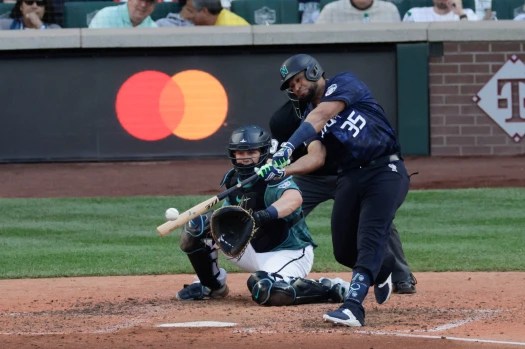
That play preserved what proved the National League’s 3-2 win over the American League in Seattle’s T-Mobile Park. They got the second and third runs in the top of that eighth, when Elias Díaz (Rockies) pinch hit for Jorge Soler (Marlins) with Nick Castellanos (Phillies) aboard after a nine-pitch leadoff walk and nobody out. Díaz sent Orioles righthander Félix Bautista’s 2-2 splitter off a bullpen sidewall, then off an overhang into the left field seats.

It meant the first NL All-Star win since 2012. It also meant Díaz becoming the Rockies’s first-ever All-Star Game Most Valuable Player award winner. Otherwise? It meant almost nothing. Because the worst thing about this year’s All-Scar Game was . . . just about everything else.

Mr. Blackwell, call your office. All-Star Game specific threads have been part of it for long enough. They began ugly and devolved to further states of revulsivity. But Tuesday night took the Ignoble Prize for Extinguished Haberdashery. The only uniforms uglier than this year’s All-Star silks are those hideous City Connect uniforms worn now and then during regular season games. Both should be done away with. Post haste. Let the All-Stars wear their regular team uniforms once again.

Who are those guys? They sort of anticipated long ovations for the hometown Mariners’ All-Star representatives. But they didn’t anticipate they’d be longer than usual. To the point where two Rays All-Stars—shortstop Wander Franco, pitcher Shane McLanahan—weren’t even introduced, when they poured in from center field among all other All-Stars. (Rays third baseman Yandy Díaz, an All-Star starter, did get introduced properly. But still.)

Maybe the two Rays jumped the gun trotting in while the ovation continued, but they should have been announced regardless.

While I’m at it, what was with that nonsense about bringing the All-Stars in from center field instead of having them come out of the dugouts to line up on the opposite base lines? Some traditions do deserve preservation. Not all, but some. What’s next—running the World Series combatants’ members in from the bullpens? (Oops! Don’t give the bastards any more bright ideas!)

Down with the mikes! In-game miking of players has always been ridiculous. But on Tuesday night it went from ridiculous to revolting. When Rangers pitcher Nathan Eovaldi took the mound miked up, the poor guy got into trouble on the mound almost at once. He had to pitch his way out of a two-on, one-out jam in the second inning. He sounded about as thrilled to talk while working his escape act as a schoolboy ordered to explain why he put a girl’s phone number on the boys’ room wall.

What’s the meaning of this? We’ve got regular-season interleague play all year long now. The National League All-Stars broke a ten-season losing streak? Forgive me if hold my applause. So long as the entire season is full of interleague play, the All-Star Game means nothing. Wasn’t it bad enough during those years when the outcome of the All-Star Game determined home field advantage for the World Series?

The road to making the All-Star Game mean something once more is eliminating regular-season interleague play altogether.

Elias Díaz

. . . saving the lead (and, ultimately, the game) Elias Díaz gave the NL with his two-run homer in the top of the eighth. (And, yes, the All-Star uniforms get uglier every year. Enough!) (AP Photo.)

Tamper bay. Sure it was cute to hear the T-Mobile Park crowd chanting for Angels unicorn star Shohei Ohtani to come to Seattle as a free agent. The problem is, he isn’t a free agent yet. He still has a second half to play for the Angels. I’ll guarantee you that if any team decided to break into a “Come to us!” chant toward Ohtani, they’d be hauled before baseball’s government and disciplined for tampering.

I get practically every fan base in baseball wanting Ohtani in their teams’ fatigues starting next year. If they don’t, they should be questioned by grand juries. But they really should have held their tongues on that one no matter how deeply you think the All-Scar Game has been reduced to farce. Lucky for them the commissioner can’t fine the Mariners for their fans’ tamper chants. (Not unless someone can prove the Mariners put their fans up to it, anyway.)

Crash cart alert. Cardiac Craig Kimbrel (Phillies) was sent out to pitch the ninth. With a one-run lead. The National League should have put the crash carts on double red alert, entrusting a one-run lead to the guy whose six 2018 postseason saves with a 5.90 ERA/6.74 fielding-independent pitching still felt like defeats. The guy who has a lifetime 4.13 ERA/4.84 FIP in postseason play.

Kimbrel got the first two outs (a fly to right, a strikeout), then issued back-to-back walks (six and seven pitches off an even count and a 1-2 count, respectively) before he finally struck Jose Ramirez (Guardians) out—after opening 0-2 but lapsing to 2-2—to end the game. Making the ninth that kind of interesting should not be what the Phillies have to look forward to if they reach the coming postseason.

Sales pitch. How bad is the sorry state of the Athletics and their ten-thumbed owner John Fisher’s shameless moves while trying and failing to extort Oakland but discovering Nevada politicians have cactus juice for brains? It’s this bad—when the T-Mobile crowd wasn’t chanting for Ohtani to cast his free agency eyes upon Seattle, they were chanting “Sell the team!” when Rooker whacked a ground rule double in the fifth.

Can you think of any other All-Star ballpark crowd chanting against another team’s owner in the past? Not even George Steinbrenner’s worst 1980-91 antics inspired that. That’s more on Fisher, of course, but it’s still sad to think that a team reduced to cinder and ashes with malice aforethought captured an All-Star Game crowd’s attention almost equal to the attention they might have paid the game itself.

Commissioner, anyone?

Adapted from JK’s speech to the Las Vegas chapter of the Society for American Baseball Research delivered 10 June 2023.
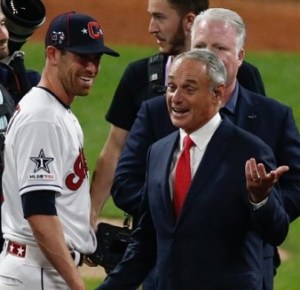
Calling baseball commissioner Rob Manfred an inveterate tinkerer is calling Donald Trump and Joe Biden mountebanks. Calling Manfred a visionary denigrates the very definition of vision. But those who pine for the so-called good old days, while letting themselves think Manfred’s lust for rule remaking/remodeling points toward them, must first be made to answer, “Which good old days?”

Certainly not the days when the bases were large stones. Certainly not when pitchers were required to throw no way but underhanded and from a standing position strictly. Certainly not when the one-hop hit to the outfield was ruled an out if the fielder snagged the ball on that hop. Certainly not when none but white men were permitted to play the major league game. 

There are some things from the so-called Good Old Days that ought to be preserved or exhumed, of course. That’s without regard to the particular period of Good Old Days the get-off-my-lawn crowd prefers to revive. There are also things heretofore inconceivable to which today’s governors of our game, Manfred on down, should lend far more thought than they do. But it cannot be Manfred to shepherd it any longer.

Would you like to become baseball’s next commissioner? If your answer is yes, at minimum you’ll need a reasonable station from which to disembark your train. What follows is a fourteen-step platform:

1. The august office itself. Upon assuming office, the new commissioner shall convene a rules committee to explore broadening the means by which commissioners are chosen in the future. There’s no sound reason why the owners alone should choose the game’s public steward and top administrator, since it’s long been proven that under the owners alone the commissioner thinks the good of the game is little more than making money for it, and them.

The commissioner of the future should be elected by the following group of 79 people: Single representatives of the owners and the players, each; and, designated representatives from each of major league baseball’s nineteen umpiring crews.

2.Tick-tock clock. On paper, and in the imagination, the pitch clock seemed sound as a nut. In actuality, it wreaks more havoc than should be allowed. Havoc, and no few injuries ranging from the simple to the serious and back. Not to mention the imposition upon pitchers with unique or at least colourful pitching styles. Those concerned about the coming of the Clockwork Baseball Player should concern themselves about and stand athwart anything that would make that coming reality.

3. Game time. Are we supposed to applaud that, thus far, the pitch clock and its concurrent impositions upon the batter have shaved a whole . . . half an hour on average off the time of play? Are we supposed to applaud that the truest culprit of the elongated major league game—namely, the broadcast commercial blocks after each half inning and during each pitching change—remains unmolested?

The pitch clock’s elimination should be matched by all effort to make a new broadcasting agreement that includes no commercial blocks longer than one minute after half-innings and thirty seconds during pitching changes. (Yes, Virginia, it really does take less time now for a relief pitcher to get from the bullpen to the game mound than for the commercials to play.)

4. Manfred Man. The free cookie on second base to open each extra half inning shall be eliminated. Permanently. The only Manfred man that should ever be in the public mind shall be, once again, the hitmaking band of the 1964-66 British Invasion.

5. We’re on the air, anywhere. Eliminate all blackout rules for television. Allow any major league game to be broadcast in any region regardless of whether the ballpark is in the same broadcast region. Let a million television sets bloom because decades of evidence have proven that, of all the reasons for people to stay away from the ballpark, television like radio before it is the least of those reasons.

(As a relevant aside, I still remember seeing Dodger Stadium fans clutching tiny portable TV sets in the park. With the pictures turned down but the sound turned up. Why? Because they wouldn’t believe what they’d just seen from beginning to end unless they heard it from the late Vin Scully.)

6. Umpires can be impeached, too. The umpires have been laws unto themselves for long enough. It’s past time for them to be held as accountable for their malfeasance as players, managers, and team administrators. There’s no reason on earth for accuracy below 96 percent to be permissible. If you doubt that, ponder that a surgeon with a 96 percent accuracy rating wouldn’t face job security, he’d face malpractise suits.

Umpires with accuracy below 96 percent shall be placed on probation for the rest of the incumbent season or the first half of the following season. Failure to improve will result in suspensions. And, yes, the rule book strike zone shall be enforced strictly. The days of umpires deploying their own strike zones must end. That by itself should help assure accuracy of 96 percent or higher behind the plate.

7. No tank you veddy much. Team ownerships who fail repeatedly to invest properly in their major league product and their minor league support systems shall be put on notice. You have one year to decide: Will you invest properly in your teams, every year, regardless of the free spoils of revenue sharings you receive before each season begin; or, will you sell your team to a local/regional ownership willing to do what needs to be done to put an honestly competitive team on the field.

Tanking is fan abuse, plain and simple. If you can afford to buy a major league baseball team, you can afford to put forth a product that gives honest effort to compete. Rebuilding on the fly has been done for eons, before and after the free agency era.

Concurrently, past commissioner Bowie Kuhn’s ridiculous prohibition on player sales shall be rescinded. Teams shall be allowed to sell their players on an open market for whatever price other teams are willing to pay—and the players to be sold shall receive at least 25-30 percent of the sale price. This will allow the supposedly not-so-rich teams to stay minimally competitive, too.

Call it the Averill-Landis Rule, after the ancient commissioner who thought Hall of Famer Earl Averill wasn’t nuts to demand to know how much of the sale price he might receive when the Cleveland Indians bought him from the Pacific Coast League.

While we’re at it, a tanking team must never be given permission to relocate, which leads to . . .

8. If you want to build it, we will come. Under no circumstances shall any team seeking to build a new ballpark go to the local and/or state government for help. For now we mean you, Oakland Athletics. It takes colossal gall to try strongarming your incumbent locale into building you a new ballpark and, when they call your bluff, try to strongarm Las Vegas into building one for you; or, at least, paying for half if not more of it.

The willful self-destruction of a team fan base should never be sanctioned. Neither should regional taxpayers be made to foot all or most of the bill for a new playpen. The Voice in Field of Dreams assuredly did not say, If you build it, they will pay for it.

9. Interleague, schminterleague. Eliminate it from the regular season. Entirely. Save it for when it truly matters—during the All-Star Game, and during the World Series.

10. Are the All-Stars out tonight? Absent one fan, one vote, one time requirements, eliminate the fan vote. Why? Because the All-Star Game must include rosters containing none but the absolute best players on the season thus far. If this means one or more teams lack All-Star representation, tough. This isn’t T-Ball.

While we’re at it, the next commissioner must rule that the All-Star Game also needs to cease being used as a gold watch, even for future Hall of Famers. They’ll get their tributes appropriately around the circuit without a final All-Star honorarium, not to mention those so qualified getting the big one in Cooperstown in due course.

11. Competition, not compensation. This nonsense must cease. The regular season’s meaning has been compromised long enough. And the saturation of postseason games has compromised more than enhanced the game. There’s no reason on earth why any team not parked in first place at season’s end should be playing for baseball’s championship.

Expansion should be pursued to create divisions with even numbers of teams. Then, two conferences of two divisions each shall be fashioned in each league. The wild cards shall be eliminated entirely.

Then, each league’s division champions will meet in a best-of-three division series. The winners in each league will then meet in a best-of-five League Championship Series. (You want the Good Old Days restored, there’s a splendid restoration.) The World Series shall remain its best-of-seven self with its primacy thus restored. (Postseason saturation will be scaled back considerably under such a system, too.)

Thus will baseball fans no longer be subject to the thrills, spills, and chills of watching teams fighting to the last breath to finish in . . . second or even third place.

12. We want a real ball! Something’s very wrong when the Japanese leagues can develop baseballs pitchers can grip easily and are eminently fair to both sides of the ball but the American major leagues—which own a major baseball manufacturer—can’t. All effort to develop a baseball that doesn’t require that new-fashioned medicated goo for pitchers but is consistent and fair to hitters as well shall be undertaken.

A new, consistent baseball shall be developed and brought into play within one year of the new commissioner taking office. It’s long past time for the thinking person’s sport and those who support and supply it to start thinking. Hard.

13. Pensions. The new commissioner shall convene an immediate panel from among all team ownerships and the Major League Baseball Players Association. This panel, at once, shall agree that it was wrong to eliminate pre-1980 short-career major league players from the realignment of 1980. That realignment granted pensions to all players who accrued 43 days of major league service time, and health benefits to all players accruing one day of major league time.

The calculations shall be done to ensure full and proper pensions, based on their actual major league time, to all 500+ surviving short-career players who played before the 1980 realignment. The 2011 Weiner-Selig stipend—one small payment per 43 days service time, which today equals $718 per 43 days—was laudable, but insufficient.

Those players backed their players union’s actions that led to or upheld free agency, too. They do not deserve to remain frozen out.

14. As your absolute first order of business in office. Before assuming office, the new commissioner’s first official pronouncement shall be to demand . . . a recount.

Roots and Blues

Vladimir Guerrero, Jr.

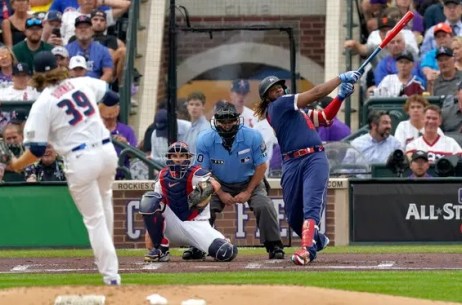
Vladimir Guerrero, Jr. takes Corbin Burnes across the Colorado state line in the All-Star Game. Manfred wants baseball back to its roots? How about also knocking off these hideous All-Star uniforms and letting the All-Stars represent their teams in their own uniforms again? It was good enough for the Home Run Derby, it should stay good enough for the All-Star Game.

Who are the faces of baseball today? Put the current injured lists to one side. Barring unforeseen complications or corollary issues, one and all on those lists now will be back either this season or next. Barring, too, one player of extraterrestrial achievement—you should spot the one most likely to produce it the rest of the year, too—it shouldn’t really be a singular face.

They should be players like Ronald Acuna, Jr., Pete Alonso, Mookie Betts, Shane Bieber, Kris Bryant, Nick Castellanos, Jacob deGrom, Rafael Devers, Freddie Freeman, Vladimir Guerrero, Jr., Bryce Harper, Aaron Judge, Clayton Kershaw, Trey Mancini, Shohei Ohtani, Max Scherzer, Juan Soto, Fernando Tatis, Jr., Mike Trout, Brandon Woodruff.

Instead, the face of the game, singular, seems to be its ten-thumbed, two-left-feet, too-lawyerly-for-his-own good commissioner, a man who seems almost never to let pass a chance to let the stars shine in baseball’s sky without sending up a homemade cloud.

On Home Run Derby Night, the Coors Field audience and baseball nation transfixed upon Ohtani (the prohibitive favourite), Soto, Mancini (the sentimental favourite), Guerrero, and Alonso (the eventual winner), among others. During the All-Star Game—which the American League won, 5-2—Ohtani and company were at least as watchable and discussable as those missing in action due to health concerns might have been.

So, perhaps naturally, Rob Manfred stepped all over himself yet again. Asked whom he thought the face of baseball is today, Castellanos named Manfred. Informed of that designation, Manfred said no. Then, he dropped a few matters to indicate his lips said no-no but there was yes-yes in his eyes.

He told a Baseball Writers Association of America meeting the day of the All-Star Game, “I think anything that distracts from the attention being on what goes on in the field is a bad thing.” Unfortunately, Commissioner Nero—who’s spent too much of his commissionership fiddling while baseball seems to burn—went on to do just that.

Manfred could well enough have waited until after the All-Star Game, confined his remarks to the BBWAA to just his thought on “distraction” from the All-Star field, then said he’d talk a little more the day after if they were willing to listen. (And who wouldn’t have been?)

I’ve already discussed his thought that the doubleheader of seven-inning games might disappear after this season. (And, why I think keeping the idea is sound as a nut.) Manfred also spoke of disappearing the free cookie on second base (known to wags as “Manfred Man”) to open each extra half-inning, a disappearance devoutly to be wished. As would be the three-batter minimum for relief pitchers. (Unless they enter during a jam and get rid of the side before batters two, three, or both appear.)

Unfortunately, Manfred didn’t address that third part, so far as I know. He must have been asleep at the switch the night Bryce Harper and Didi Grigorius got hit back-to-back by a fresh Cardinal reliever whose control took the night off but whose manager couldn’t relieve him legally until he faced his third batter.

The law of unintended consequences too often escapes Manfred’s lawyerly ways.

He also suggested he’d like to ban defensive overshifting, formally, as part of what he says is part and parcel of returning baseball “to its roots.” He suggests the owners are all in on that return, though long experience tells you that with most owners changes or restorations have less to do with the game itself and more to do with whether something means making money for it, which usually means for themselves.

Never mind that the shifts could and would be neutralised if teams start instructing their batters to take advantage of all that free real estate. Screw the unwritten rules. Just hit the ball onto it. Take first base on the house before the shifters can scramble for the ball. Even if the other guys have a no-hitter going to the final outs. I’ll say it again: you hand me that free territory with a no-hitter going, let your pitcher hold you to account when I show up on first on the house.

I’ll say it again: that, or an infield you know to be full of butchers enabling such base hits, should be the only time you want to see a widespread return of bunting. In all other situations, a bunt is a wasted out. Outs to work with are precious. Why waste a third of your inning’s resources and do the other guys such a favour?

You guessed it: I’m all in if Manfred really does bring the universal designated hitter back to stay in 2022. Guess which defensive position sports the Show’s worst slash line this year? (.109/.149/.142.) The worst OPS? (.291.) The most wasted outs? (No other positions show more than the catchers’ 40; these guys show 221.) A real batting average (RBA: total bases + walks + intentional walks + sacrifice flies + hit by pitches, divided by plate appearances) of .167?

Hint: Since the final decade of the dead ball era, they’ve hit a collective .166. Tell me how long a catcher, an infielder, or an outfielder would survive in the Show—if he was lucky enough to get to it at all—with that kind of hitting. Even if he was the defensive second coming (based on runs saved above their leagues’ averages at their positions) of Ivan Rodriguez, Keith Hernandez, Bill Mazeroski, Ozzie Smith, Brooks Robinson, Barry Bonds, Andruw Jones, or Roberto Clemente.

Manfred should consider the Pirates owner of 1891 who first proposed what we know now as the DH. About whose proposal a journal of the time, The Sporting Life, said in concurrence:

Every patron of the game is conversant with the utter worthlessness of the average pitcher when he goes up to try and hit the ball. It is most invariably a trial, and an unsuccessful one at that. If fortune does favor him with a base hit it is ten to one that he is so winded in getting to first or second base on it that when he goes into the box it is a matter of very little difficulty to pound him all over creation.

It wasn’t an invention of that nefarious American League. And if it hadn’t been for Chris (I am der boss pressident of der Prowns!) von der Ahe, reneging on a previous commitment to support William Chase Temple, when the idea came up at the next National League rules meeting, the NL would have had the honour of introducing what Pirates catcher-turned-Philadelphia Athletics manager Connie Mack tried but failed to introduce to the AL fifteen years later.

If you want to see a little more leveling out between pitching and hitting, be advised that when the DH is used this year (by AL teams, and by NL teams playing interleague in the AL Park) the DHs have the best OPS (.767) in Show at this writing. If you want more “strategy”—and you won’t throw things at me when I remind you that 95 percent of all “strategy” is plotted before the game begins—you should prefer that number-nine batting order slot go to either a second cleanup type or an extra leadoff type.

“Returning baseball to its roots” can be tricky. Even if it suggests Manfred might finally be willing to quit trying to prove that the birth child of that backstreet affair between Rube Golberg and the Mad Hatter should be a baseball executive.

It depends on the roots to which you want to return. How about eliminating regular-season interleague play? How about eliminating the wild card system that’s produced the thrills and chills of teams fighting to the last breath to finish . . . in second place?

How about a best-of-three division series with each league’s best first-place finisher having a bye while the other two winners slug it out? How about returning the League Championship Series to the best-of-five of its birth and childhood? How about thus eliminating October saturation and restoring the World Series to its proper primacy?

Unfortunately, those beg one further question right now: Since Manfred can’t seem to find the right way to make serviceable, field-leveling baseballs (easier to look into an acceptable stickum for pitcher grips, as he’s also doing), how far above his pay grade would those and other reasonable moves really prove?

Back to baseball’s roots? Be gone, hideous 2021 All-Star uniform! The threads (especially the American League’s “road” blue) made the horrific 1970s single-colour pajamas of some teams resemble something from Pierre Cardin. If players wearing their own uniforms, representing their teams, is good enough for the Home Run Derby, it’s still good enough for the All-Star Game.

Where have you gone, Bart Giamattio? A nation turns its lonely eyes to you.

Georgia on our minds

Commissioner Rob Manfred congratulating 2019 All-Star Game MVP Shane Bieber. Did he think deep or hard before moving this year’s All-Star Game out of Atlanta?

Most of us, generations be damned, grew up hearing the two most certain of life’s certainties are death and taxes. Everyone has candidates for the third certainty, including that which reminds us of one thing that crosses partisan lines even if the partisans forget the other side does it, too.

Translated to baseball terminology, that thing seems to be demanding a replay review when ball four is called in election races on what they think they threw for strike three. When such a review turns into something such as a new state election law, as in Georgia, there comes a fourth guarantee: somebody isn’t going to like it.

A lot of somebodies don’t like the law. Such somebodies as former Georgia state lawmaker Stacey Abrams and President Joseph Biden. A lot of not-so-much-somebodies don’t like the law, either, and their agitation as much as any other factors have prompted among other things major league baseball’s government moving this year’s All-Star Game and college draft out of Atlanta’s Truist Park.

Abrams had skin in the game going in. She lost Georgia’s 2018 gubernatorial race to Brian Kemp, who signed the omnibus bill into law earlier this month, by 50,000 votes, claiming then-Georgia secretary of state Kemp erased thousands from state voter rolls.

Kemp had skin in the current game going in, too. For the heinous offense of certifying that now-former president Donald Trump didn’t push the winning run across the state plate in the bottom of the twelfth, regardless that Kemp wasn’t exactly known to favour anyone other than Trump, Kemp faced Trump’s none-too-silent wish to see him thrown out of the league.

The most understandable result of Trump’s post-campaign campaign to overthrow his loss to Biden might have been Georgia and other states reviewing and tightening up their election laws. The only place where fury and back-and-forth charges of foul get more furious might be a baseball game decided (in truth or in allegation) by a close call for or against one or the other side at the final out.

Election shenanigans have been as common in American politics as yard signs, and they didn’t begin or end with such ancient players as New York’s Tammany Hall, Chicago’s Daley Machine, Kansas City’s Prendergast Machine, or Nassau County’s (Long Island) Margiotta/D’Amato Machine. Wherever you landed observing Trump vs. Biden, your least shocking revelation would have been one or another state addressing their election laws in the aftermath.

When Kemp signed the new Georgia election law, Abrams charged that it “suppresses voters, criminalizes compassion & seizes election authority from local + state officials.” That statement wasn’t half as incendiary as Biden’s prompt denunciation of the law as both un-American and as “Jim Crow on steroids.”

Georgia’s real history with Jim Crow is grotesque enough, from state poll taxes (1877) and literacy tests from which descendants from Confederate and Union soldiers were exempt (1907) to the “white primary” rule (1908) that prohibited non-white voting explicitly. Jim Crow in any southern states was (and remains) a portion of American history for which the nation can never be proud.

Now, about the new Georgia election law. Examine deeper than what you see excerpted in the press and aboard social media. Comparing it to Jim Crow is nebulous. It only begins with the fact that mandating seventeen days pre-election (two Saturdays included) for early voting—with mandatory eight-hour-minimum open times and allowance for twelve-hour (7 a.m.-7 p.m.) times—doesn’t exactly “suppress” voters.

A good number of states lack that allowance, including Biden’s home state Delaware which isn’t going to put it in place before the next Congressional election year 2022. Biden himself—with different priorities and a far less grotesque personality, he’s like Trump in showing you wisdom by standing athwart it—also said the Georgia law imposes limits on absentee voting that “effectively” (his word) deny voting to “countless” people. That’s not exactly what the law says or does.

For one thing, no-excuse absentee voting stays in place with just a couple of adjustments. I’d be hard pressed to think a voter is being “suppressed” because the absentee ballot application window is a “mere” 67 days, or because such applications you can now do online, because the state secretary of state is now required by law to offer them online. Or, because the absentee ballot must be received by election officials at least eleven days before Election Day.

Some of the new law’s critics harp about the voter identification portion, which has now shifted it from matching signatures to identification numbers from a voter’s driver’s license or free voter identification card. Lacking either, a Georgia voter can present a photocopy of a utility bill, a bank statement, a paycheck, a government check, or an official document that includes his or her name and address. All they have to do is include the last four digits of their Social Security numbers if they don’t have driver’s licenses or previous voter ID numbers.

If that’s “voter suppression,” I’m Willie Mays. And if that’s something designed to keep non-white voters from voting, I’m hard pressed to comprehend the 2016 Gallup survey that found 77 percent of non-white voters supporting photographic voter identification. You’d think (properly) that non-white voters have just as much stake in preventing real (not alleged) voter fraud as white voters have. And you’d be right.

The new Georgia election law also puts the famous drop boxes into law. They showed up in Georgia for the first time last year thanks to the pan-damn-ic, and now they’re legally mandatory with or without the coronavirus. The new law requires one drop box for every one hundred thousand registered voters or one for every advance vote location in any Georgia county, whichever number is smaller.

Abrams was right about one thing: the new law does “criminalise compassion,” sort of. Giving, offering, or helping give food and/or drinks to people within 150 feet of polling places or within 25 feet of voters in line to vote becomes a legal misdemeanor. Even, seemingly, when the benefactor isn’t discussing the election or particular favoured candidates.

The law also bars ordinary Georgians from photographing or recording their own votes. Guess who gets an exemption from that: the state secretary of state, whom the law requires to create “a pilot program for the posting of digital images of the scanned paper ballots created by the voting system,” with the images becoming “public records subject to disclosure.”

I’ve read about enough early proposals for inclusion in the law that were foolish at minimum, dangerous at most, and thrown out of the bill before it became a final product. But how the hell did that one slip in? How close do you think that one gets to the kind of thing you thought was reserved for the Third Reich, the Soviet Empire, and other authoritarian/totalitarian states who’ve used ballots when allowed at all against their citizens?

Kemp and any Georgia governor has a line-item veto power—but it affects only statewide and state executive budget items. Even he can’t be comfortable with the idea that his or any Georgia secretary of state can come that close to crossing the line from scanning paper ballots to making Georgians’ votes public.

You can bank it. Baseball commissioner Rob Manfred and his minions probably didn’t read the new Georgia law in almost any way, shape, or form. You can understand why, since the law’s volume is 68 percent (92 pages if you’re scoring at home) the length of Philip Roth’s legendary novella Goodbye, Columbus. But the mis- or mal-excerpting of the law did them no favours and puts baseball into a precarious position.

For one thing, the Atlanta Braves themselves aren’t thrilled with baseball pulling the All-Star Game out of their home playpen. Indeed, even Abrams herself has said Georgia companies shouldn’t jump all the way into boycotts but first “use the chance to publicly condemn the law, invest in voting rights expansion and support wide-ranging federal election legislation before they’re targeted with a boycott movement,” as the Atlanta Journal-Constitution puts it.

For another thing, former UN ambassador and Atlanta mayor Andrew Young demurs from any such boycott, especially involving Atlanta, whatever he thinks of the new law, telling The Athletic, “Everything doesn’t depend on sports. But if you hurt the sports, you hurt the hotels, you hurt the airport, you hurt every business in town . . . [Atlanta’s] the 44th largest economy in the world — and, you can quote me, I don’t know why anybody wants to [fornicate] with that.”

Manfred and his look more like knee-jerkers than thoughtful protesters who considered the whole thing reasonably. (They look, in other words, much the way Trump looked when thundering against Maximum Security’s 2019 Kentucky Derby qualification or on behalf of Pete Rose’s Hall of Fame entry without troubling himself with the deets on both rejections.) Lacking an immediate suggestion for an alternate All-Star Game site this year is the least of Commissioner Nero’s largely self-imposed problems.

On Wednesday night, some Republican lawmakers in Georgia’s state House of Representatives voted to cancel a tax break for Georgia-based Delta Air Lines, on the grounds that Delta objected to the new election law. “You don’t feed a dog that bites your hand,” said Georgia’s House speaker David Ralston. “You got to keep that in mind sometimes.”

Imagine the furies if Democratic officials behaved likewise. Oops . . . Lois Lerner, for openers, call your office.

Wherever you sit about the law itself, the thought of governing officials deciding a private entity needs to be punished for taking any position regarding any legislation or policy should scare the hell out of you. If they can do it to an airline, they can do it to anything, including the business of a game.