“They threw the first punch”

ALCS Yankees Astros Baseball

Gleyber Torres, making Zack Greinke’s and the Astros’ Game One life miserable . . .

It was supposed to be a treat watching the Astros and the Yankees, mostly recovered from their regular season’s medical challenges. If you could say a pair of 100+ game winners were lucky to be there after they fought injury bugs as arduously as they fought field opponents, the Astros and the Yankees were just that.

Didn’t the Astros fight like six parts street gang and half a dozen parts cheetahs on speed to get their postseason home field advantage, going 12-2 to finish the season to nail down the point? Didn’t they look just that much better than the 6-8 finishing Yankees when the postseason began?

And hadn’t they survived an unexpectedly arduous division series with the upstart Rays—forcing them to open with Zack Greinke instead of Justin Verlander or Gerrit Cole—to get to the American League Championship Series in the first place? While the Yankees turned out to have it so painfully simple sweeping the suddenly somnambulent Twins to get there that you could be forgiven for suggesting the Yankees might be just a little vulnerable?

There went those ideas in Game One Saturday night.

The Yankees were good on the road this year(.568 winning percentage) but they weren’t supposed to be able to handle the Astros there. They played each other seven times on the regular season with the Astros sweeping the Yankees in three in Minute Maid Park. But somebody forgot to remind the Yankees as they opened the ALCS.

At least, somebody forgot to remind Yankee second baseman Gleyber Torres. The Yankees shut the Astros out 7-0 in Game One and Torres was practically their one-man demolition operation. The Astros’ long term survival may now depend on how well they can keep Torres from even thinking about seeing and raising from Game Two forward.

Nobody’s going to accuse the Astros of being on the ropes after a Game One loss. The Yankees won’t be foolish enough to level that charge. Not even when they punctured the Astros’s hard won, hard desired home field advantage.

“We’ve been in the situation before,” said Astros second baseman Jose Altuve after the game, referring to 2017, when the Astros were down 3-2 in that ALCS but won. “Tomorrow we have Justin, we all know how good we feel about him, so it’s just one game, it’s a seven game series, so we still have a lot of baseball to play.”

With Verlander to start Game Two and Cole to start Game Three, everyone in Astroworld should be feeling good again. No matter how good these Yankees are at finding and exploiting even the tiniest rupture in the other guys’ armour.

“They played a great game,” said Astros shortstop Carlos Correa, “a near perfect game.”

But who the hell is Gleyber Torres? Oh, yeah—he’s the guy who became a Yankee when they traded Aroldis Chapman to the Cubs in the middle of 2016. But now he’s the youngest Yankee ever to drive in five in a single postseason game. And his clutch hit reputation is beginning to fan out beyond the Bronx.

You expected trouble going in with the Aaron Judges, Giancarlo Stantons, D.J. LaMahieus, Edwin Encarnacions, and Brett Gardners. The last one from whom you expected any pinstriped lip, never mind bat, is a kid middle infielder who may have hit the most quiet 38 regular season home runs of the year.

Outside New York, Torres isn’t exactly the Yankees’ biggest star yet. But on a night when Yankee starter Masahiro Tanaka was as untouchable as he was very touchable in the regular season, and Greinke proved vulnerable enough if not quite the pinata the Rays made out of him in the division series, Torres became the last guy the Astros wanted to see at the plate. Or anywhere else, for that matter.

“Man, they’re going to be telling stories about that kid for a while,” said Judge after the game. “He’s going to be a Yankee great, I know it. He just comes to work every single day. He’s always got a smile on his face. No situation is too big. I’ll see him in the box, bases loaded, big situation and he’ll give us a little smile in the dugout like he knows he’s going to go up there and do his job.”

At first it looked as though Tanaka and Greinke would turn Game One into a pitching clinic, if not quite the ones put on by Nationals pitchers Anibal Sanchez and Max Scherzer in the first two National League Championship Series games. Tanaka looked as untouchable as he normally does against the postseason Astros, and Greinke looked nothing like the guy who’d been humiliated at the hands and tails of the Rays.

“I thought Zack did a good job giving us a chance to win,” said Astros third baseman Alex Bregman, “and we just didn’t do anything offensively.”

“When you’re facing really good pitching, it makes hitting even harder,” said mostly struggling Astros center fielder George Springer, their 2017 World Series MVP but hitting a buck twenty in this postseason to date. “Hitting’s hard. But that being said, we’re a good team, and we understand that, so we’ve got to grind and string together some at-bats and we’ll see what happens.”

As the top of the fourth began each side had one base hit apiece and they’d both been negated by inning-ending double plays. Then LaMahieu opened the Yankee fourth with a base hit and swiped second while Judge struck out swinging on one of Grienke’s nastier sliders of the night. Up stepped Torres, whom Greinke struck out swinging to end the first. And he drove one to the back of left center bounding off the fence to score LaMahieu with the game’s first run.

Torres and Greinke squared off again in the sixth after Judge led off flying out to Astros center fielder George Springer. Once again Greinke’s first service looked just too good to Torres. This one got hammered into the middle of the Crawford Boxes.

And after a six-pitch, full count, wrestling strikeout to Encarnacion, Greinke battled Giancarlo Stanton—who’d only gotten to play eighteen regular season games thanks to two trips to the injured list—and, after wriggling his way to a full count after opening 0-2, Stanton nailed a fastball just under the middle of the plate and sent it into the Astros’ bullpen behind the right center field fence.

An inning later, Torres was in the middle of it yet again. With two outs, Yankee shortstop Didi Gregorius, LaMahieu, and Judge singled back-to-back-to-back, all into right field, off Astros reliever Ryan Pressly, before Torres sent the first pair home with a bloop single to center and helped himself to second when Springer threw in futilely toward the plate.

It was the kind of night on which Torres even making an out proved productive enough. With reliever Bryan Abreu on the mound for the top of the ninth Yankee third baseman Gio Urshela hit the first pitch of the inning, a slightly hanging slider, into the right field seats. Then with one out LaMahieu walked, Judge singled him to third, and—with the Astro infield drawn in just enough—Torres whacked a grounder to an oncoming shortstop Carlos Correa.

The good news: Correa pounced on the run to throw Torres out handily enough. The bad news: LaMahieu got such an excellent jump off third he could score the seventh Yankee run without fear even with Correa all over the Torres grounder well onto the infield grass.

The Astros hurt themselves when it was still a one-run game, though. In the bottom of the fifth, Bregman, their no-questions-asked MVP candidate, worked Tanaka for a leadoff walk and Yordan Alvarez, their probable no-questions-asked Rookie of the Year, slashed a line drive to right.

As Bregman led a little too far off first, as in more than half way to second, obviously thinking of third base as his immediate destination, Judge ran to snare Alvarez’s rope. Then the tall Yankee with the toothy grin of a kid a third his age fired in to first. Bregman slipped running back to the pillow but it almost wouldn’t have mattered since he’d had a bigger lead than the law allowed in the first place.

Was Judge catching Alvarez’s liner a guarantee? Fifty-fifty at best. But he has one of the better throwing arms among American League right fielders and with Bregman that far off the pillow, slip back or no, Bregman was dead meat.

It negated the spectacular theft Bregman committed in the top of the third, when he took a spinning leap behind third with his glove arm up like the Statue of Liberty to turn Urshela’s nasty line drive, which probably would have gone further up the line for extra bases, into a nasty out.

Tanaka can’t beat the Astros in the regular season, but in the postseason he looks like an ogre against them, taking a 2.00 lifetime postseason ERA against them into Game Two. He worked the corners like a craftsman and left the usually smart hitting Astros looking half lost at the plate.

“He was throwing the ball really good today,” said Altuve. “He was hitting spots with the slider, split, and fastball. He makes it out pretty good. You have to tip your hat to that. He got a late break, normally you can see the spin, but we couldn’t see anything.”

When they got into the Yankees’ effective bullpen, they actually pried a couple of base hits out of Adam Ottavino, back-to-back singles by Michael Brantley and Altuve, but Ottavino lured Bregman into dialing an inning-ending Area Code 6-4-3.

The Astros bullpen is usually one of the league’s best, too, but Pressly didn’t look comfortable in his turn and Abreu’s inexperience was exploited a little too readily. Especially against a Yankee team who—knowing Verlander and Cole awaited them in Games Two and Three—treated Game One like a must-win contest.

“They threw the first punch in Game One,” said Astros manager A.J. Hinch. “We get to the next day. We can punch right back tomorrow. I don’t think they’re going to be too comfortable tomorrow coming to the ballpark thinking they’ve got an easy game ahead of themselves.”

Verlander gives the Astros a far above average chance to punch back in Game Two. The last thing they want is going to the south Bronx in the hole. The Yankees have ways of burying people once they’re in holes against them. One of them is a 22-year-old second baseman who prefers hitting with men on base and has the numbers to prove it so far.

“The way he’s able to get to all kinds of pitches on different planes is impressive,” said Yankee relief pitcher Zach Britton, who worked a near-spotless eighth (one walk, two punchouts) Saturday night.

“As a pitcher, you know you have to executive every single pitch throughout an at-bat or you know he’s going to beat you,” Britton continued. “That’s where the bat-to-ball skill comes in. It’s crazy. You just don’t see it in such a young player.”

You do now.

Masterpiece, then theater

2019-10-06 GerritCole

Gerrit Cole was the Dali of pitchers Saturday night . . .

You’d think a man who pitches like Bob Gibson in a postseason contest wouldn’t have to see his masterpiece turned into a hair raiser after he finally has to leave the game. But you can rest assured Gerrit Cole has seen a lot worse than the ninth inning Saturday night.

And you can rest assured further that he’d rather have seen his Astros survive that inning and come out one game from sweeping their way to the American League Championship Series than any known alternative.

Fifteen strikeouts. Five third strikes fastballs, five on curveballs, five on sliders. Missing by one measly walk an immaculate inning in which all three punchouts went swinging strike, foul, swinging strike. His lone walk being the one that ended his evening at last when his petrol ran empty at last.

Mentioned without apology in the same conversations as Gibson (with whom Cole shares uniform number 45), Howard Ehmke, Kevin Brown, and Gibson’s fellow Hall of Famers Sandy Koufax and Mike Mussina, among single postseason game punchout artists.

And what was Cole’s final reward for painting such a masterpiece as Dali himself would envy? Other than watching his Astros more or less sneak a run home in the seventh and eighth, to pad the lead Alex Bregman provided with a leadoff home run in the top of the fourth?

He had to watch his relief Roberto Osuna go from striking out Yandy Diaz—without whom the Rays wouldn’t even have been in the division series in the first place—on three pitches to end the eighth to stringing maybe the skinniest tightrope the Astros could possibly walk in the top of the ninth.

He had to watch Austin Meadows greet Osuna with a liner down the left field line that George Springer, moved over from center in a defensive re-alignment, couldn’t get to in time for a leadoff hit. He had to watch Tommy Pham stroke an immediate followup single right up the pipe. He had to watch Osuna walk Ji-Man Choi to load the bases once.

Then, he had to watch Bregman uncharacteristically bobble for just a moment Avisail Garcia’s bouncer to the left, settling for a force at second but no shot at a double play, and allowing Meadows to score. And, he had to watch Osuna wrestle Brandon Lowe to a full count before walking him to re-load the bases.

Exit Osuna, enter Will Harris, exit Rays catcher Travis d’Arnaud on a hard-earned swinging strikeout, exit Rays center fielder Kevin Kiermaier on a bouncer to first, and for the first time since the eighth Cole and the Astros could breathe without reaching for the oxygen tanks. And the 3-1 win put the Rays’s season on a respirator after all.

“Not the way we wanted to end it,” said Astros shortstop Carlos Correa after the game, “but we got it done and it’s a W.” Maybe the hardest-earned W of a season in which the Astros pushed 107 winning chips to the postseason table. Sometimes even the most powerful threshers in baseball don’t thank their mound lancers by finishing what he started simply.

If Rays manager Kevin Cash thought his team was Verlandered in Game One, they got even more Coled in Game Two. And the Astros’ bullpen got thatclose to throwing Game Two away. Astros manager A.J. Hinch must be feeling very fortunate that he has the kind of starters who make things like the Rays’ and others’ bullpenning a non-topic for him.

“Whether it’s about the new-age opener or pulling guys third time through, most of the people that support that haven’t had Verlander or Cole on their team,” the skipper said, and he’s speaking only the plain truth. Most teams would thank God and His servant Stengel for having just one superstud starter. He’s got three; Nationals manager Dave Martinez also has three.

“It’s hard for me to relate to having to pull guys early or wanting to pull guys early when these guys are putting up these kinds of performances,” Hinch continued. Right again, skip. “I’m going to roll with these boys while we have them.”

He may not yet have to get as creative with his boys as Martinez has had to with Stephen Strasburg relieved by Max Scherzer Friday night, but then Hinch normally doesn’t have a bullpen full of arsonists, either. Hinch has three stud relievers in Osuna, Smith, and Ryan Pressly. Make large room for all the bullpens who’d be grateful to have just one.

Pressly was a non-factor Saturday for having worked in Game One. It’s not scarifying just yet for Osuna to have one off-night, but even these finely tuned, well-oiled, near-perfectly calibrated Astros can’t afford another one too soon if at all. Because even superstud starters like Verlander and Cole have their absolute limits.

Let’s admit that for seven innings Cole didn’t know the meaning of the word “limits.” For seven innings he pitched like two Hall of Famers for the price of one, even as for six  innings the Astros pushed Rays starter Blake Snell—pitching gutsily after missing two thirds of the season on the injured list—and two Rays relievers but couldn’t quite break them except once.

Cole throttled the Rays with his mind almost more than his arm. His reputation in the game, very well earned by now, is that of a man who’ll throw a pitch in the first inning thinking it’s going to set up a pitch four or five innings later.

“He goes to areas of the strike zone whenever he needs to, whenever he wants to, whenever he sees something. That’s creative,” Hinch said after the game. “When we talk about creative, we often talk about guys that don’t have elite stuff like this. He can execute virtually any game plan for a reason . . . His mind and his ability to trust his adjustments set him apart.”

The only real breakage the Astros gave Snell opened the bottom of the fourth. Bregman worked  himself back from 0-2 with three straight solid takes on pitches low and away from him, fouled off an inside fastball, then sent the next fastball to the back of the Crawford Boxes to start what little scoring there’d be in the game.

Cash lifted Snell after he struck out Astros uber-rook Yordan Alvarez swinging right after the Bregman bomb. The Rays bullpen kept the Astros to just that run until the bottom of the seventh, while Cole looked more and more as though he’d go the entire distance without so much as a twitch of nerve or a flicker of exhaustion.

With the Rays’s usual closer Emilio Pagan opening the Houston seventh, Astros first baseman Yuli Gurriel grounded one hard to the hole at short and Willy Adames grabbed it, bobbled it, and threw in the dirt past first. Correa promptly ripped the first pitch down the left field line to the wall for second and third.

After rookie Kyle Tucker grounded out right back to the box, Astros catcher Martin Maldonado, Cole’s personal catcher who doesn’t hit well but handles pitchers like a symphonic conductor, checked in at the plate. He hit well enough this time, dumping a quail into left center enabling Gurriel to beat a throw home for a second Astros run.

It could have been worse for the Rays but somehow Pagan got George Springer to pop out to second and Jose Altuve, Game One’s co-hero, to fly out to the edge of the right field track to escape for the time being.

No such luck in the bottom of the eighth with Nick Anderson on the mound. Diaz knocked Bregman’s hard one-out grounder and threw wide of first enabling Bregman’s infield single. Alvarez then tore the first pitch into right for a base hit and first and second, and Gurriel flied deep enough to right to push Bregman tagging to third.

Then Correa slashed a 0-1 fastball into right to send Bregman home, before Colin Poche relieved Anderson and caught Tucker looking at strike three.

“We’ve got a lot more work to take care of,” said Cole after the game. “There’s a few months this winter that maybe we can sit back and have a drink about it. Right now, it’s on to the next one.”

That may come sooner than even the Astros think. And considering the results in New York—where the Yankees bludgeoned the Twins in the first two games of their division series, outscoring the Twins 18-6 over the two, with the crowning burial Didi Gregorius’s monstrous grand slam in a seven-run third Saturday—they’ve probably got the scouting reports on the Battered Bombers well enough studied.

An Astros-Yankees American League Championship Series would be a hell raiser. The league’s two most triumphant teams and their two most injury battered on the season, both of whom showed they were deeper than the Pacific Ocean when the casualties began. Gray’s Anatomy vs. House.

Says Cash: his guys know what’s at stake. Says Twins manager Rocco Baldelli: his guys know they can turn it around. Say the Astros and the Yankees, with Wade Miley (Astros) and Luis Severino (Yankees) due to start their Game Threes, and just as the man used to say on the radio: it ain’t gonna be easy, Clyde.


This Derby doesn’t quite fit that well

2019-07-09 PeteAlonsoHomeRunDerby

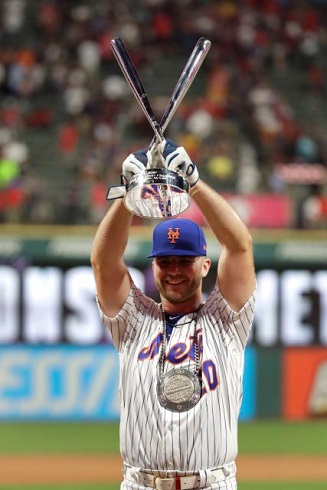
One of the 2019 Mets’ few bright lights, Pete Alonso proudly hoists his Home Run Derby winning trophy Monday night.

The remade/remodeled rules of the thing enabled Pete Alonso to win Monday night’s Home Run Derby in Cleveland’s Progressive Field. And Alonso, who’s one of the extremely few bright lights on a Mets team described charitably as a basket case, would have been the star of the show all around if it wasn’t for the kid named Vladimir Guerrero, Jr.

Gone is the longtime ten-outs window through which the Home Run Derby’s participants had to perform in the past. In is the three-minute, no-outs window through which they get to mash to their hearts’ content and their swings’ contact. Through that window did the chunky Blue Jay mash his way into becoming half of the only father-and-son tandem ever to win the Derby.

And, into the hearts of both the packed Progressive Field (commentators invariably noted the full house stayed full from late afternoon until the Derby finished) and the television audience. Hitting 91 home runs on the evening can do that for you, especially if you’re as effervescent as this son of a Hall of Famer showed himself to be.

It was great entertainment.

But it wasn’t baseball.

And there was the chance going in that this year’s Derby could be won by a guy who wasn’t even an All-Star in the first place.

As likeable as he is, as promising as his future still appears to be despite his awkward career opening after he’d turned the minors into his personal target practise, Guerrero isn’t even a member of the American League’s All-Star team. And Joc Pederson, whom Guerrero beat to set up the final showdown with Alonso, isn’t a member of the National League’s All-Stars this time. The Derby operates by a slightly different set of criteria than the All-Star Game, which has problems enough every year.

But Alonso is an All-Star. So is Alex Bregman, the Astros’ deft third baseman who often seems to be six parts Little Rascal and half a dozen parts high on laughing gas, and you’re never quite sure which side dominates at any given time. Bregman was eliminated in the Derby’s first round after a mere fourteen blasts. He may not necessarily have been complaining.

Watching the showdown between Guerrero and Pederson, who put on a big show of their own (including two swing-offs) before Guerrero yanked his way to the final showdown with Alonso, Bregman got off the arguable second best line of the night: I couldn’t imagine three rounds of that. I was gassed after two minutes of it. The arguable best line of the night? It showed up on Twitter: Joc Pederson’s going after that $1 million like he’s behind in his rent.

And, on television, Dodger pitcher and All-Star Clayton Kershaw inadvertently provided the most charming moment—his two young children, Cali and Charley, accompanied Daddy to the ballpark for the Derby. There was Cali Kershaw, pretty in pink, pumping her hands and hollering, “Let’s go, Joc! Let’s go, Joc!” The little lady’s a natural scene-stealer, just as she was during last year’s National League division series.

This year’s Derby winner added $1 million to his bankroll for his effort. In Alonso’s case, earning $1 million for one evening’s glorified batting practise all but doubles what he’s earning all season long as a Met. And, entering the Derby and the All-Star break, Alonso out-performed the guy down the freeway in Philadelphia who signed a thirteen-year, $330 million contract by the time spring training was about two-thirds finished.

Alonso also made good on his very public promise to divide ten percent of the Derby prize money equally, if he won, between the Wounded Warriors project (which aids post-9/11 military wounded) and the Stephen Siller Tunnel to Towers Foundation, named for the firefighter who lost his life on 9/11 trying to save lives in the World Trade Center.

“There’s a lot I was hitting for tonight,” the exhausted Met said after he was handed the winning medal and trophy. “I’m just happy that I can donate some money to the causes that I wanted . . . I mean, I have the utmost respect for the people that put their lives on the line every single day. And I just want to show my gratitude, because a bad day for me is a lot different than a bad day for the service men and women that serve this country.”

Whom among the Derby participants is also an All-Star? Ronald Acuna, Jr. (Braves), Josh Bell (Pirates), Matt Chapman (Athletics), and Carlos Santana (Indians). Ridiculously, one of the Derby semi-finals was between two guys who aren’t even All-Stars this year. Alonso beat his fellow All-Star Acuna to set up the showdown with Vlad the Impaler, Jr.

Even an observer who isn’t irrevocably wedded to the more stubborn of baseball’s traditions is justified in saying that the Home Run Derby is more entertainment than baseball, since it is tied explicitly to the All-Star festivities, if it invites those who didn’t make either All-Star team as well as those who did.

And one is reminded even briefly that Yankee star Aaron Judge pre-empted any participation in this year’s Derby during spring training, when the Leaning Tower of the South Bronx said he was more concerned with helping his team win games after the All-Star break than with joining and winning a Derby. Judge won the Derby in 2017. His second-half performance wasn’t quite the same as his first half, and he won the American League’s Rookie of the Year award anyway. (He also may have exacerbated a shoulder issue while swinging for his Derby win.)

I analysed Derby winners’ seasons at the time Judge declined and discovered at least half of them had lesser than equal or better second halves of the regular seasons in which they won their Derbies. Last year’s champion, Bryce Harper (now a Phillie), had a better second than first half, to name one; Guerrero’s Hall of Fame father (then an Angel) had a lesser second than first half when he won the Derby, to name one more.

It’s great entertainment.

But it isn’t baseball.

And, contrary to the naysayers, nannies, and nattering nabobs of negativism (thank you, William Safire, of blessed memory), baseball games are better entertainment than million-dollar batting practise. Even million-dollar batting practise that turned out to contribute to two extremely worthy causes.

If there’s a 50-50 chance that a Derby winner will have a lesser than better second half after winning the prize, with or without Alonso’s admirable charity intentions, it’s a little more alarming for baseball than it is engaging for Joe and Jane Fan.

And guess who’s going to be the first to complain, of course, if and when their heroes in the Derby become less at the plate and in the field, especially if and when their teams hit the stretch drive running.