The new Yankee bats are barrels of fun

Baseball Bugs

Contrary to social media bleating, this is NOT one of the new Yankee bats . . .

They resemble elongated bowling pins upon first glance, those new and legal Yankee bats, perhaps the kind that would be spotted on a bowling lane . . . built for Paul Bunyan. Don’t laugh. Wielding those curious new bats among their regular lumber on Saturday against the Brewers, the Yankees resembled a gaggle of Bunyans at the plate. It began (ahem) right off the bat against former Yankee Néstor Cortés.

Three pitches. Three long enough solo home runs.Two outs later, another solo smash. That was just in the bottom of the first, against the guy they traded to make a Yankee out of postseason Brewers victim Devin Williams.

OK, let’s get more detailed. After the Brewers did nothing with a one-out walk to Christian Yelich from newly-minted Yankee starter Max Fried in the top of the first, Paul Goldschmidt—erstwhile Diamondback and Cardinal, now manning first base for the Yankees and leading off, of all things—watched a first-pitch, four-seam fastball travel well enough into his wheelhouse to drive it to the rear end of the bullpen in left center field.

One pitch, one bomb, one run.

Newly-minted Yankee Cody Bellinger—erstwhile Dodger and Cub, who hasn’t really been the same since a shoulder injury during the Dodgers’ 2020 run to the World Series title—watched another first-pitch, four-seam fastball rising in the middle of the zone, but not high enough that he couldn’t yank it into the right center field seats about six rows past the bullpen wall.

Two pitches, two bombs, two runs.

Aaron Judge—the Yankees’ bona-fide Bunyan, all 6’7″ of him, beginning his tenth season in the sacred pinstripes—watched Cortés switch things up a little, having learned the hard way abour first-pitch fastballs not always obeying orders. The lefthander opened with a cutter. It got even more into Judge’s wheelhouse than that fastball got into Goldschmidt’s. And it disappeared into the left center field seats.

Three pitches. Three bombs. Three runs. Who knew the Yankees were just getting warmed up? (And, did Goldschmidt feel even a small kind of déjà vu all over again, since he’d once hit three out against the Brewers by himself, as a Cardinal?)

Cortés then showed the Brewers what they thought they’d traded for when he struck (All That) Jazz Chisholm, Jr. out looking and got Anthony Volpe to ground out right back to the mound. Up stepped Austin Wells, who’d opened the Yankee season with the first known leadoff bomb ever hit by any major league catcher last Thursday.

Wells was kind enough to wait until Cortés opened up with a pair of cutters off the inside part of the plate for a 2-0 count before Cortés threw him a fastball and he drove it over the left center field fence. It took back-to-back walks and a called punchout on Trent Grisham to stop the bleeding. The tourniquet proved unable to contain it for very long.

From there, after Fried almost handed the Brewers a quick enough tie on the house, what with a one-out hit batsman, an RBI single, a run scoring on an infield error, another base hit, and a run scoring when Fried threw Yelich’s grounder offline, the Yankees had more treats in store.

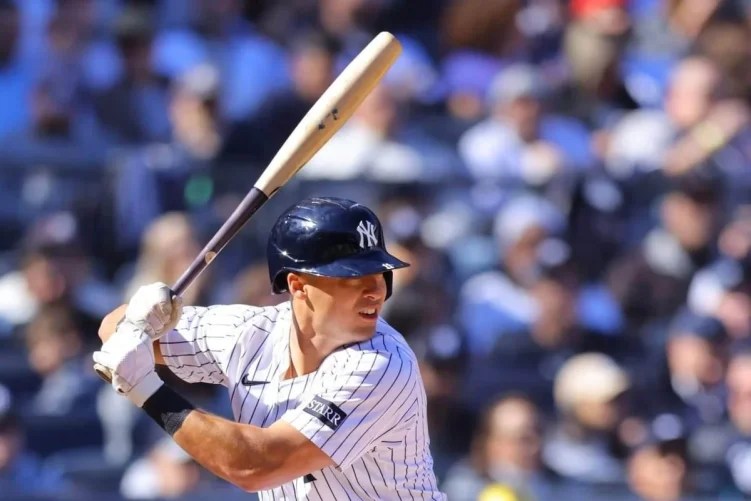
They began with Volpe, who turned out to have been the inspiration for the new elongated bowling-pin bat. Yankee fans watching the broadcast on television got the skinny from broadcast institution Michael Kay when Chisholm batted in the first:

The Yankee front office, the analytics department, did a study on Anthony Volpe, and every single ball it seemed like he hit on the label. He didn’t hit any on the barrel, so they had bats made up where they moved a lot of the wood into the label, so the harder part of the bat is going to actually strike the ball. It’ll allow you to wait a little bit longer.

Anthony Volpe

. . . but this is, in the hands of the man whose plate performances got the Yankee brain trusts—oh! the hor-ror!—thinking. (Volpe rewarded them by hitting one of the nine Yankee bombs against the Brewers Saturday.)

The woofing and warping began aboard social media (cheaters! cheaters!) until someone, who knows whom, slipped into the bellowing the fine and legitimate point that the rule book doesn’t quite outlaw such bats. I give you Rule 3.02: The bat shall be a smooth, round stick not more than 2.61 inches in diameter at the thickest part and not more than 42 inches in length. The bat shall be one piece of solid wood. You might note that it says nothing about just where the thickest allowance must be.

You might also note that there do remain baseball traditions immune to change. Suspecting the Yankees of crime is one of them. But you don’t have to be a Yankee cultist to wonder why it was (and is) that nobody else thought of creating such bats within the rules before the Yankees got the a-ha!

You might also note, further, that Cortés wasn’t exactly unfamiliar to the Yankees, since he’d been one of them fo five of the past six seasons. “Nestor (had) been here for years,” said Judge postgame. “He’s one of the best lefty pitchers in the game. He’s going to go out there and throw strikes and attack you. We just tried to go out there and be aggressive in our zone. Goldy and Belli, they were aggressive and got things going there. This place was rocking once I got up there.”

So. When Volpe batted the secone timd in the bottom of the second, he had Judge and Chisholm aboard and two out. This time, he waited until he had a full count before swinging and hammering a Cortés cutter over the left field fence. Now the game was 7-3, Yankees. And the party wasn’t even close to being over.

Fried survived a miniature jam in the top of the third, but Cortés didn’t survive walking Yankee designated hitter Jasson Domínguez to open the bottom. Connor Thomas came in to pitch. Grisham singled Domínguez to second, Thomas plunked Goldschmidt, Bellinger beat out an infield hit to send Domínguez home and load the pillows for Judge—who sliced salami on a 2-1 up-and-in cutter.

Then Chisholm wrung his way up from a few fouls to hit a 1-2 service into the right field seats. Making it 13-3, Yankees, which turned to 16-4 (erstwhile Phillie Rhys Hoskins poked an RBI single in the top of the fourth) in the bottom of the fourth, when Bellinger sent Grisham home on a sacrifice fly after Goldschmidt doubled him to third, but Judge followed with a two-run homer over the center field fence.

Judge’s third major league three-bomb day and his first since 2023. Eight home runs on the day for the Yankees so far, tying a franchise record they’d break when pinch-hitter Oswald Peraza hammered Brewers reliever Chad Patrick for a one-out, two-run homer in the bottom of the seventh. Making it 20-6 (the Brewers scored two in the sixth); the Brewers had at least an RBI double (Jake Bauers) and a two-run homer (Brice Turang) in them before the carnage finally ended.

“You think you’ve seen it all in baseball,” said Brewers manager Pat Murphy postgame, “and you haven’t because we saw it today—three pitches, three homers. Usually, you wake up from that. You go, ‘Wow. God. That can’t ever happen.’ It just did.”

The game was so disastrous for the Brewers that Murphy finally sent Bauers forth to pitch the bottom of the eighth, hoping to spare his pitching staff any further humiliation. The first baseman didn’t do any worse on the mound than the real pitchers, either. He shook off a two-out hit batsman and followup walk with a pop out for the side. He’d even gotten Judge to fly out in the eighth, an inning after Judge’s bid for a four-bomb day came up short enough in the sixth that he settled for a double.

He had to settle for becoming the fourth Yankee ever to have three three-bomb days, joining Hall of Famers Lou Gehrig (he had four of them) and Joe DiMaggio, plus third baseman Álex Rodríguez. “Anytime you get mentioned with those guys and what they’ve done in the game, and the careers they’ve had,” Judge said postgame, “it’s pretty special.”

Not that the Yankees were perfect on the day. Their five errors, which weren’t half as disastrous as their Game Five fifth inning in the World Series, hung Fried with four unearned runs among the six he did surrender on the day. Still.

“What a performance,” Yankee manager Aaron Boone summed up. “Kind of a weird, crazy game.” Kind of a crazy way to describe a massacre, too.

2024: Taking the Fifth, and Other Lamentations

Aaron Judge

This is not what was meant when the phrase, “I’ve got the drop on you,” was coined . . .

Hands up to everyone who can’t wait for 2024 to depart. Now, hands up to everyone who thinks 2024 was just the most wonderful year of the decade. My, but that’s a barren sea of hands over that second suggestion.

Much like its home country, baseball’s 2024 was . . . well, why don’t we let some of the signature moments, doings, and undoings of baseball’s year speak for themselves. The new flimsy uniforms sucked. The All-Star Game uniforms didn’t suck that badly, but still. Meanwhile, I’m thankful to folks such as Jayson Stark and a few other intrepid sleuths of BBW—that’s Baseball Bizarro World, you perverts—who either unearthed or reminded us about . . .

Take the Fifth—Please Dept.—“Come an’ see my amazin’ Mets,” their manager Casey (I Lost With This Team What I Used to Win with the Yankees) Stengel liked to say of his maiden squad. “I been in this game a hundred years but I see new ways to lose I never knew were invented yet.”

That was the Ol’ Perfesser gazing down from the Elysian Fields, watching the team with whom he won ten pennants and seven World Series perform the single most splendid imitation of the 1962 Mets since . . . the 2024 White Sox finished their sad, sad, sad regular season.

Pace George F. Will, look to your non-laurels, White Sox—the Bronx Bumblers captured 21st Century baseball’s booby prize. You White Sox only out-lost the 1962 Mets this season. You probably never did in one regular season game what only began in a World Series game . . . with a Yankee center fielder who does a credible impersonation of the Leaning Tower of Pisa approaching the plate and Frank Howard at the plate committing his first error playing center field after 538 fly balls hit his way in his entire career to date became outs.

Then . . .

* A Gold Glove-finalist shortstop threw for a force play at third base and saw the ball ricochet off the base instead of reach his third baseman’s glove.

* The arguable best pitcher in the American League got thatclose to escaping a bases-loaded, nobody-out jam when he suffered the brain fart heard ’round the Bronx and the world: he forgot to cover first when Mookie Betts hit a screwdriving ball toward Anthony Rizzo. Oops.

* The Yankee anti-party included a balk and catcher’s interference.

* The Dodgers became the only team in baseball history to score five runs in a World Series game after they were in the hole 5-0.

* The Yankees became the only team in baseball history to serve up five unearned runs in a World Series game since they started counting earned and unearned runs as official statistics. (When did they start? In the same year during which premiered Ford’s moving assembly line, the first newspaper crossword puzzle (in the New York World), and Louis Armstrong’s first cornet. In the New Orleans Home for Coloured Waifs.)

* And the fifth-inning party actually started with everyone from the television announcers to the fans and back pondering whether Gerrit Cole might, maybe, consummate a no-hitter to keep the Yankees alive.

Your Reality Check Bounced Dept.—Too many Yankee fans continue infesting social media with proclamations that the Yankees still have the dynastic history of dynastic histories. And too many baseball fans steeped in reality and not fantasy keep reminding them, Your damn dynasty is just soooooo 20th Century!

Juan Not-So-Small Step for Met World—That’s $765 million the Mets will pay Juan Soto over the next fifteen years. This may or may not mean the end of Pete Alonso’s days as a Met, which may or may not mean . . .

Out with a Bang Dept. . . . that Polar Bear Pete’s final act as a bona-fide Met was the biggest blow on their behalf this century: the three-run homer he blasted in the ninth inning that proved the game, set, and National League division series winner against the Brewers. Which was also the only home run hit by any Met in the set.

Did I Do That Dept.—Alonso’s division series-winning blast came off Devin Williams . . . who’d never allowed a ninth-inning lead-changing bomb in his major leaguer life until then. Then, after some time passed, the Brewers let the Yankees talk them out of keeping Williams, sending them pitcher Nestor Cortes, infielder Caleb Durbin, and cash to take Williams. We still don’t know if the deal was Milwaukee payback for surrendering Alonso’s game-changing/game-swiping bomb.

Out with a Bigger Bang Dept.—That would be Walker Buehler, pitcher. One minute, locking down the Dodgers’ World Series win with a spotless Game Five ninth including two swinging strikeouts. The next, practically (well, give or take a few hours): Signing for one year and $21 million with the Red Sox. Anyone remember the Dodgers making Buehler a qualifying offer for that money and Buehler turning it down? He’s rolling serious dice on himself with this deal.

Shohei-hei Rock and Roll Dept.—You might think anyone can become a member of the 50 home run/50 stolen base club. But you won’t be able to predict who might do it the same way Shohei Ohtani did in September against the Marlins: 6-for-6 at the plate; three home runs; five extra base hits; two stolen bases; ten runs batted in. His own planet? Try realising Ohtani exists in his own quadrant.

A Cut Below Dept.—Pete Fairbanks, Rays reliever. He missed a game in 2024 because of a finger cut. He cut the finger opening a bottle of spring water. Considering his bizarre 2023 injury (incurring a black eye while trying to dunk against his toddler son through a water basketball net), it seems as though Fairbanks just couldn’t cut it anymore.

On Your Knee Dept.—Presented for your consideration: Miguel Sanó, Angel. Aleady on the injured list with an inflamed knee. He put a heating pad over it. He forgot about it just enough to burn the knee and place himself for another month on the IL. Miguel Sanó, who proved he certainly could stand the heat in . . . the Angels’ continuing Twilight Zone.

The King of Pop Dept.—Mookie Betts performs amazing feats at the plate and on the field. At the plate, they usually involve baseballs shot on lines into the outfield, or driven like ballistic missiles over fences. They didn’t involve him popping out for the cycle . . . until 25 September, when, in order, he popped out to: second baseman, third baseman, first baseman, and shortstop.

Don’t do it. Don’t Google “MLB players who’ve popped out for the cycle.” It won’t even call up the Mookie Monster, yet, never mind anyone else who might have had that kind of a day—whether a Hall of Famer, a Hall of Famer in the making, or a guy who’s destined to be forgotten outside such a single singular feat.

Mystique and Aura, kidnapped by the Dodgers

Walker Buehler

Walker Buehler (21, far left) about to be swarmed by fellow Dodgers after he locked the Bronx Bumblers down for keeps to finish World Series Game Five.

Has it really sunk in yet that the Dodgers are full-season, no-doubt, take-no-quarter World Series champions? Has it really sunk in yet that the Yankees aren’t just another group of also-rans but a team as fully able to implode at the wrong time as any team in major league history?

Both teams needed the best they had available for Game Five Wednesday night. The Dodgers to win it, the Yankees to stay alive long enough to force a cross-country trip to Los Angeles for Game Six at minimum. When the Dodgers needed reinforcements, they found them, sometimes in places unexpected outside their portal.

Anyone remember Mystique and Aura? The Dodgers kidnapped them with no known ransom demand turning up at this writing. The Yankees needed Mystique and Aura but they got Wobbly and Rickety.

Just one night after showing serious enough life by blowing the Dodgers out of Game Four, the Bronx Bumblers self-dismantled in ways almost unheard-of by any previous World Series contestant. The Series-clinching, Game Five final was 7-6. It was a close game only if you ignore the way the Yankees helped the Dodgers close an early 5-0 Yankee lead.

The Game Five Dodgers almost didn’t need stout innings from their bullpen, a shutdown ninth from projected Game Seven starter Walker Buehler, and too-timely hits enough to matter. If you didn’t know better, you’d be swearing the Yankees were handing it to the Dodgers on a platinum platter.

The 161st Street Stumblers lost the Series to a Dodger team that found ways not to let little things like too many injured pitchers and a half-effective bullpen keep them down for very long. bullpen half of which would be effective keep them down for very long. But Game Five night just might have been the single most surrealistic game of this Series, if not any Series.

Trust me when I say that that’s saying something.

The top of the fifth challenges such sad Series mishaps past as Fred Snodgrass’s glove turning into a trampoline, Freddie Lindstrom’s pebble, Ernie Lombardi being dismantled at the plate, Mickey Owen’s passed ball, Willie Davis losing two Oriole flies in the sun in the same inning, Curt Flood losing Jim Northrup’s drive in the sun, or Bill Buckner’s horror seeing the slow grounder skip beneath his downstretched mitt.

Does anyone remember that the 11-4 Game Four beatdown the Yankees dropped on the Dodgers actually had people predicting with straight faces that the sleeping giants were awakening enough to do the unheard-of and take the next three straight to teach those ornery louts from Los Angeles a lesson in manners and championship?

There went those ideas. Above and beyond the Yankees waiting fifteen years to get back here only to tumble away this time, above and beyond the Dodgers winning eleven out of twelve National League West titles with only one World Series conquest to show for it until now, this is what everyone will remember about this Series in general and Game Five in particular:

They’ll remember Series MVP Freddie Freeman’s Game One-winning ultimate grand salami as the first salvo toward his reaching the seats in the first four games, which marries to his bombs in Games Five and Six in 2021 (when he was still a Brave) to tie George Springer for the longest Series home run streak (six games).

They’ll even remember Freeman overcoming a balky ankle keeping him somewhat calm in the earlier postseason rounds. Somewhat. Because by the time Freeman got finished with his bombing in Game Four, Yankee fans were holding up signs pleading, “Freddie, Please Stop!” As if Freeman had any intention of obeying.

Aaron Judge

First, Judge was the sleeping giant coming wide awake . . .

They’ll remember Shohei Ohtani jamming his shoulder on a failed Game Two stolen base attempt, leaving himself all but useless for most of the Series, but insisting upon staying in the lineup just in case. If only for the presence.

They’ll remember Dodger starting pitcher Jack Flaherty keeping the Yankees to two runs starting Game One but getting flogged for four before he could get out of the Game Five second—including Aaron Judge, heretofore the Yankees’ first among the sleeping giants, awakening himself and Yankee Stadium with a two-run homer in the bottom of the first, followed immediately by Jazz Chisholm, Jr.’s solo bomb . . . until . . .

They remember the Yankees leading 5-0, and Yankee starter Gerrit Cole striking Gavin Lux and Ohtani out swinging back to back, and not one Dodger hit thus far.

Until . . . come the fifth . . .

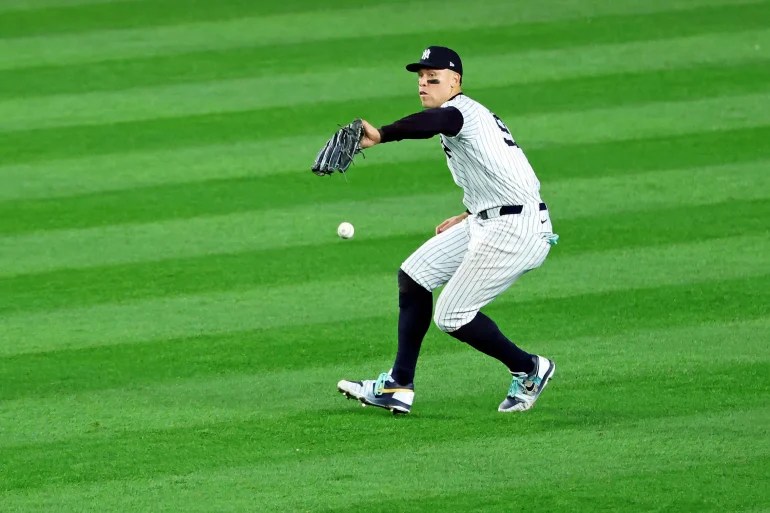
* With Kiké Hernandez aboard on a leadoff single, busting any shot Cole had at a no-hitter, Tommy Edman lined one that Judge—who committed only one error all year to that point—normally catches in his sleep. This time, the ball hit the web of Judge’s glove and bounced away.

* Five pitches later, Will Smith grounded one to Yankee shortstop Anthony Volpe’s right. Volpe picked it clean the way a Gold Glover does. Then he threw an awkward short-hopper to Chisholm at third the way a Cold Glover does. Chisholm couldn’t get the handle on that throw. The Dodgers had the bases loaded and nobody out.

* The Mookie Monster singled Hernandez home, on a squibber first baseman Anthony Rizzo had to step back to snag because it was spinning like a gyroscope, practically . . . leaving Cole not covering first because the pitcher took a bad route to the ball, leaving both men resembling raw rookies with signals crossed and knotted.

* Freeman singled Edman and Will Smith home and set up first and third.

* Teoscar Hernández doubled Betts and Freeman home.

* And every last one of those five runs in the Dodger fifth was unearned.

Aaron Judge

. . . but, then, his unlikely error began handing the Dodgers the fifth inning and beyond.

“This is as bad as it gets,” Cole said postgame. “It’s the worst feeling you can have. You have to keep sometimes willing yourself to believe and give yourself a chance. You keep pushing and pushing, and ultimately, you fall short. It’s brutal.”

“You can’t give teams like that extra outs,” said Judge, who’d made what threatened to be the play of the night when he stole an extra-base hit from Freeman by scaling the left center field fence in the fourth. “They’re going to capitalize—their 1-2-3 at the top of the order, they don’t miss. You give them a chance with guys on base, they’re going to capitalize. You gotta limit the mistakes.”

Then, everyone will remember Blake Treinen, the man who usually gets the final three outs of a Dodger win, coming in a little bit sooner than usual to clean up a mess and keep the Yankees at bay from there. As in, the bottom of the sixth, with the Yankees back in the lead 6-5 but threatening to put the game back out of reach with first and second, two out, and Volpe due at the plate.

The same Volpe who really started the Yankees’ Game Four mayhem—when they were down 2-1 in the third thanks to yet another Freeman flog two innings earlier, but with the bases loaded on two out—by hitting Daniel Hudson’s first service into the left field seats.

Treinen got Volpe to ground out to second for the side this time. Then he retired the Yankees in order in the seventh and squirmed out of a first-and-second jam with a fly out by Giancarlo Stanton and a swinging strikeout on Anthony Rizzo.

Somewhere in the middle of all that, Buehler ambled down to the Dodger bullpen. Just call me if you need me, boss. He’d only told any Dodger personnel, from teammates to front office people, that he was available to work in Game Five if need be. He made for the Dodger bullpen after the bottom of the fifth.

Then, Buehler started loosening up. Then, he started warming up in earnest. He may well have thrown the equivalent of the first two and a half innings worth of a quality start by the time he got the call to handle the bottom of the Game Five ninth.

He got Volpe to open with a sharp ground out to third base. He struck Austin Wells out swinging on a full count. He struck former teammate Alex Verdugo out swinging on 1-2. Buehler then spread his arms like an old-time nightclub singer inviting applause for the big finish and his mates began pouring onto the Yankee Stadium infield to start the party.

They survived the early bombs by Judge, Chisholm, and Giancarlo Stanton. They survived their Game Four bullpen game plan getting vapourised, going into sacrificial lamb mode the better to keep their six best relief arms available for Wednesday night. They survived their own recent past of, manager Dave Roberts admitted postgame, losing games that handed them what Game Five had before the fifth inning.

They didn’t stop to ask questions when the Yankees began passing out early Christmas presents one botched out after the other in the top of the fifth. They knew the answers going into the Series.

Their knowledge only began with Betts working on playing caroms off the wall almost as incessantly as he does on his batting swing. It only continued with every Dodger no matter how wounded attacking basepaths rather than just running them. The Dodgers scouted the Yankees and determined they were über talented but fundamentally lacking. They didn’t have to advertise it. They simply exposed it.

The Yankees didn’t pay close enough attention to any reports telling them the Dodgers could match them talent for talent even with their MIAs. The Dodgers, for all their star and firepower, were too grounded fundamentally to let the Yankees treat them like just another poor-relations team.

Freddie Freeman

To absolutely nobody’s surprise, Freddie Freeman was named the Series MVP. (A home run in each of the first four games, plus tying a Series record with twelve RBIs, does that for you.) Now named for the late Willie Mays, the trophy depicts Mays making his fabled 1954 World Series catch against Vic Wertz.

Most of all—unlike the title they won at the end of the surrealistic, pan-damn-ically shortened season and under-isolation postseason—nobody so inclined can hang any kind of asterisk on this one. These Dodgers went the distance no matter whose interpreter swindled him out of millions to cover debts to a bookie, no matter who hit the injured list, no matter who lost a season to an injury. No matter that they tied and took what proved the winning lead on a pair of eighth-inning sacrifice flies.

The last man standing? A pitcher who once resembled a mound terror until two Tommy John surgeries and other ailments kept him limited this regular season, only to show up in October looking as close to his former self as his age and body allowed and hell bent on doing something, anything, to secure his team the Big Prize.

“This is the only reason I play,” Buehler said postgame, “for games like this. The whole year—the offseason, spring training, the regular season—it doesn’t matter. Well, it matters, but not like these games. To win championships is why I play. It’s the best feeling in the world. I live for this.”

He pitched the ninth to prove it. A ground out and back-to-back swinging strikeouts. Followed by stepping down from the rubber, holding his arms out like a vintage nightclub singer delivering the Big Finish, and being mobbed by a swarm of Dodgers. They all lived for this.

ASG: As (almost) usual, show biz yields to baseball

Jarren Duran

Red Sox center fielder Jarren Duran hoists the clear bat awarded the All-Star Game’s Most Valuable Player. His tiebreaking two-run homer held up to give the AL the 5-3 win.

God help us all, everyone. The All-Star break began with a pre-Home Run Derby singing of “The Star Spangled Banner” Monday night (by country star Ingrid Andress) that made youth cringe and elders think wistful thoughts of Roseanne Barr. It ended with a tenth American League All-Star Game win in eleven seasons.

In between, of course, was much to ponder and much to dismiss as patent nonsense, which seems to be far more the norm than Chicago Tribune sports editor Arch Ward, who initiated the game in 1933, might have imagined.

Phillies third baseman Alec Bohm could be seen having to labour to keep from laughing (presumably, that he might not weep—or wish to commit manslaughter) when Andress tackled “The Star Spangled Banner” as though too well besotted. It turned out that appearance was everything: She copped the following day to being drunk and having enough issue with it to seek rehab and recovery.

Wish her well, but demand to know why nobody in baseball’s administration noticed she was drunk as she took the mike in the first place.

That was then: The Derby rules were, a participant had ten outs to hit as many homers as they could, the hitter with the most such bombs advanced, and that was that. So simple that, in fact, even Mark Belanger (human Electrolux at shortstop, but a spaghetti bat who hit three fewer homers in eighteen major league seasons than the late Hall of Famer Willie Mays hit in the first half of 1965) could have done it.

This is now: Round One—three minutes or forty batted balls, whichever came first, followed by an old-style three outs to hit as many bombs as possible. Round Two—the top four floggers moved to a bracket-like semifinal. Round Three—the two semifinal winners head to head. The net result: Teoscar Hernandez (Dodgers) defeating Bobby Witt, Jr. (Royals), who nearly forced a playoff with a ICBM-like blast stopped only by the left center field fence.

Some of us still wonder why we’re supposed to tolerate three-hour long Home Run Derbies but arise armed against two and a half hour-plus real baseball games. Or, why we had three-minute commercials aboard Fox’s All-Star Game telecast Tuesday before seeing supersonic relief pitchers blowing the side away in order in a minute and a half if that long.

Perhaps commissioner Rob Manfred might have an answer to that one. At least he has a sort-of answer to the question (posed by The Athletic‘s Tyler Kepner) of when the ever-more-hideous generic All-Star Game uniforms of the past several years will be disappeared in favour of returning the fine old tradition of All-Stars wearing their own uniforms and thus representing their teams.

“I am aware of the sentiment and I do know why people kind of like that tradition,” Commissioner Pepperwinkle told Kepner. “There will be conversations about that.” The proper two-word answer to that, of course, is, prove it. About knowing why people (more than kind of) like that tradition and holding serious conversations about it.

Well, take the proverbial pause for the proverbial cause. That very first All-Star Game featured the American League representatives wearing their own teams’ home uniforms with the National League wearing road threads, as modeled below by Hall of Fame catcher Gabby Hartnett:

Gabby Hartnett

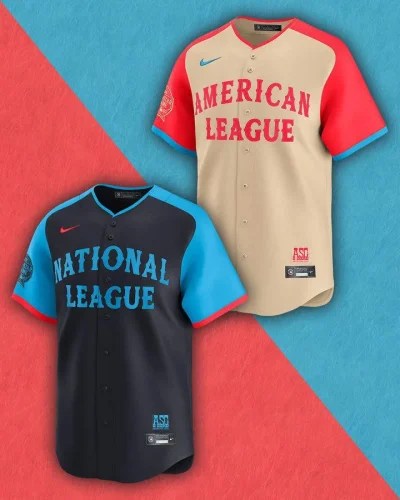
Behold now this year’s threads for each league:

Yes, we have seen far worse for generic All-Star uniforms.

Except for each league’s colour scheme, is it really that radically different from the 1933 NL haberdashery? Now, this year’s threads would look far nicer if the American League jersey was done with red-on-white (the AL was the home team in Globe Life Field) and the National League was done with blue-on-gray (since the NL is the visiting team). And worn over either white (home) or gray (road) pants.

My normal position is to be all-in on returning to the practise of each league’s All-Stars wearing their own teams’ uniforms, representing their teams and fan bases, as their forebears did for so many decades. If Commissioner Pepperwinkle insists ultimately upon keeping generic league uniforms, this year’s style just might be the right way to go, switching the core white and gray each year depending upon which league is the All-Star host.

The wherefores of this year’s uniforms mattered less when the game got underway, and rookie NL starting pitcher Paul Skenes (Pirates) got to face Aaron Judge (Yankees) after all, thanks to Judge’s teammate Juan Soto wringing himself into a walk. The bad news: Judge forcing Soto at second with a grounder to third for the side.

AL manager Bruce Bochy (Rangers) was well aware of the marquee appeal of Skenes versus Judge while penciling Judge into his cleanup slot. But he sent three lefthanded swingers with impeccable on-base credentials up against the righthanded Pirate phenom to open, hoping precisely to get that marquee match without sacrificing his best chances to start winning the game.

Joe and Jane Fan insist, “This is just an exhibition, dammit!” Maybe they’re right. Maybe the metastasis of regular-season interleague play to a full-season thing has left the All-Star Game bereft of meaning, as opposed to such artifices as the period when postseason home field advantage went to the league who won the Game..

But maybe a Hall of Famer in waiting who’s won four World Series as a skipper knows, however the game’s been kicked around like a commissioner’s plaything for too damn long, that himself, his NL counterpart Torey Lovullo (Diamondbacks), and the players on both sides, actually do play this particular game as baseball, not show business.

Shohei Ohtani

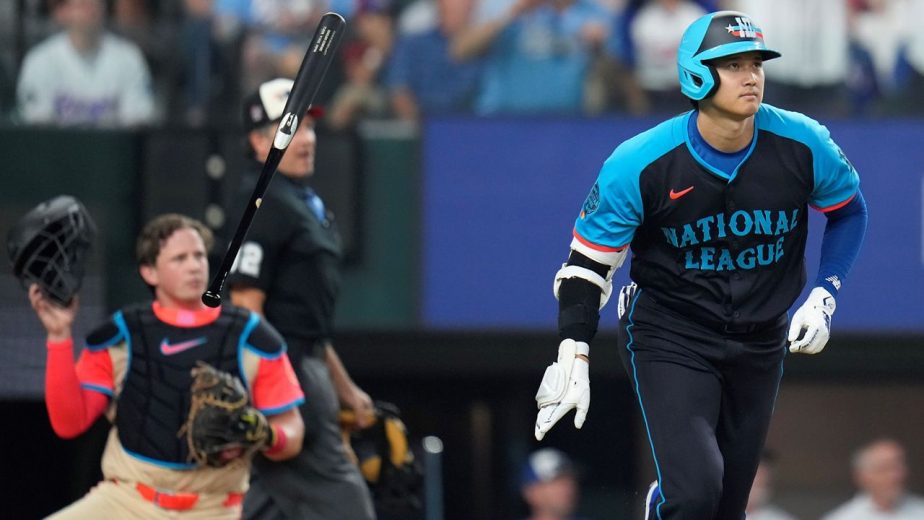
Shohei Ohtani detonating a three-run homer in the third inning. “To be able to share a dugout with him was surreal.”—Pirates pitcher Paul Skenes. Ohtani is now the only player in Show history to earn a pitching win in one All-Star Game and a home run in another All-Star Game.

So Bochy got Joe and Jane Fan their marquee matchup the old fashioned way, and Skenes came out of it on top, but Bochy’s diligence left him the only manager in major league history to win a World Series and an All-Star Game in each league. And, the first since Hall of Famer Joe McCarthy to manage an All-Star Game at home the season after he won a World Series.

Putting baseball ahead of show biz has enriching payoffs, of which Commissioner Pepperwinkle seemed as unaware as both managers were reminded soon enough en route the American League’s 5-3 win Tuesday.

Lovullo got the first such reminder when Shohei Ohtani (Dodgers) faced Tanner Houck (Red Sox) in the top of the third with nobody out, two men on, and sent a 2-0 splitter a few rows back into the right center field seats. (The last Dodger to hit one out in All-Star competition? Hall of Famer Mike Piazza, 28 years earlier.) Bochy got his in the bottom of that inning, when Soto shot a two-run double to center and David Fry (Guardians) singled him home to tie the game at three after another Judge ground out.

Two innings later, Lovullo got the reminder that ended up counting for the game, when Jarren Duran (Red Sox) batted with two out and one on, took a strike from Hunter Greene (Reds), then caught hold of a Greene splitter and sent his own message into the same region of seats where Ohtani’s blast landed.

“It won’t hit me until I try to go to sleep tonight,” Duran told The Athletic postgame. “Who knows if I’ll be able to sleep tonight.”

A guy in his fourth Show season who entered this All-Star Game leading it with ten triples and the AL with 27 doubles, then detonated what proved the winning bomb Tuesday, deserves to sleep the sleep of the just. So does the rookie whose first two months in Show have made him a name and an arm to reckon with as it was, without giving him the additional gift of being an Ohtani teammate even for just one game—thus far.

“I tried to enjoy the three hours I had on a team with him,” Skenes said postgame, “because that’s probably only going to happen once a year. It was really cool to watch him do that, really cool to watch him go about his business and get to meet him and all that. You know, he’s—I don’t know of any hitters I’ve faced that’s better than him in my career. So, to be able to share a dugout with him was surreal.”

The only thing better for either would have been an NL win, of course. Nobody had to tell Skenes it was neither his nor Ohtani’s fault the NL came up two bucks short Tuesday.

The Baltimore rumble

Basebrawl

The Orioles and the Yankees rumble in the bottom of the ninth Friday night, after Oriole Heston Kjerstad took one on the side of his head from a Clay Holmes who clearly couldn’t control his pitch grip as the rain kept falling on Camden Yards . . . and after an incensed Oriole manager Brandon Hyde hollered at a Yankee or three to trigger the rumble. Upper right: Aaron Judge (with eye black) about to re-enter the crowd and scatter Orioles as best he could . . .

You could see the rainfall continuing in Camden Yards to the point where Yankee relief pitcher Clay Holmes had few dry spots on his road jersey. You could also imagine gripping and pitching a baseball in that bottom of the ninth moment, the Yankees up 4-1, one out, none on, and an 0-2 count on Orioles center fielder Heston Kjerstad, would be two things: difficult, and impossible.

What you didn’t have to imagine was Kjerstad on the ground in the batter’s box after Holmes’s supposed-to-have-been sinkerball took an ascending flight, instead, crashing into Kjerstad’s head through the right helmet flap, with a crack loud enough that you might have thought for one moment the ball hit Kjerstad’s bat, somehow, and enough force to knock the helmet off Kjerstad’s head as he went down.

What you didn’t want to imagine, if you still had your marble (singular) and weren’t bound to whole servitude by a particular rooting interest, was Holmes wanting to leave Kjerstad with a hole in his head when he was a strike away from putting Kjerstad away for a second out and the Yankees that much closer to sealing a win.

But too many of those bound by Oriole rooting interest decided in the jolt of the moment that Holmes, if not his fellow Yankees, was guilty of attempted murder. I can’t speak for you, but I’m not aware of that many murder attempts that end with the executioner moving and talking toward an apparently genuine concern for the victim’s well-being.

Whatever your position on the Sacred Unwritten Rules, on this much there seems general agreement: It is easier for a fastball to travel through the eye of the needle than for its pitcher to decide with premeditation that two outs short of his team’s victory requires he perform sixty-foot-distance neurosurgery upon the batter in the box

Orioles manager Brandon Hyde thought anything but, seemingly. Almost the split second Kjerstad hit the deck in agony, and Holmes himself tried to make certain he’d be all right, Hyde’s switch flipped. So did his team’s, soon enough, the Orioles pouring out of their dugout and bullpen and the Yankees pouring forth likewise from both directions.

You might understand why when you remember that Yankee pitches have hit Oriole batters up and in with alarming proliferation this season. Yankee pitches have hit a lot of players on several teams with alarming proliferation; the Yankee staff accounted for 62 hit batsmen as of Sunday morning. The Oriole staff? Tied with those of the Padres and the Rangers with 37 each to their discredit.

But Oriole pitchers had hit only three Yankees before Friday night’s blight, compared to Yankee pitchers hitting ten Orioles before that point. It’s one thing to point out that the Yankee strategy against the Orioles’ lefthanded hitters has been to work them inside, inside, and inside, but keeping it that way without resembling headhunters requires control, and lots of it.

Holmes has three hit batsmen thus far this season and has averaged seven per 162 games lifetime. This is not necessarily the resumé of a marauder. But the Orioles had reason enough to find fault that it may have escaped their thinking that the rainy inning affected Holmes’s grip enough to rob him of his control. His attempt to determine Kjerstad’s condition almost at once should have been the clarifier.

Not so fast, Hyde decided. Checking his fallen batter around the plate, Hyde first glared at Holmes; then, as Kjerstad arose from the batter’s box and began to walk around with a trainer’s aid, Hyde looked toward Holmes and hollered a rasping “[fornicate] you!” to the Yankee pitcher. The umpiring crew heard it loud enough and clear enough to converge and keep the Yankees reasonably calm and the Orioles from thinking about a rumble in the Camden jungle.

Hyde sticking up for his player was one thing, as even the Yankees acknowledged after finishing the 4-1 win. “Anybody who was out there knows it was tough to grip the baseball tonight,” said Yankee pitcher Gerrit Cole. “That said, though, the guy got hit in the head. It’s understandable that Brandon’s pissed. He’s defending his players.”

But Hyde hollering vulgarities at the Yankee pitcher who showed some genuine human concern over a serious injury he’d caused without intent was something else. As Kjerstad was escorted to the Oriole clubhouse, a  few Yankees chimed in with a variation on it was an accident, you know it was an accident, look at this rain, brain, and don’t give our guy that crap! 

At which point Hyde turned toward the Yankee dugout, and you didn’t require lip-reading training to see he was hollering back, You talkin’ to me? [Fornicate] you! Don’t [fornicating] talk to me! Then, Hyde confronted and pushed Yankee catcher Austin Wells backward some steps. Whoops.

Out poured the teams into a thick pushing and shoving mob around the innermost infield. Into the scrum walked Aaron Judge, the Leaning Tower of River Avenue, who looked to all the world as though single-handedly bumping this, that, and the other Orioles to one side as best he could.

Somewhere in the middle of the melee Hyde was ejected for the rest of the game. Somewhere else, two fan bases tried their best to urge the Yankees to pull back on the constant up-and-in pitching (down-and-in, we presume, would be less likely to incite on-field riots) and to urge the Orioles, their skipper especially, to take a breath before deciding an opponent who wounded one of theirs without intent should be tried, convicted, sentenced, and executed right then and there.

Both sides picked themselves up, dusted themselves off, and started all over again Saturday, with the Yankees winning again, this time 6-1, ensuring their first series win in what began to seem eons. Not an Oriole or a Yankee got hit by a pitch, either. The temptation was to greet each inning by whispering, “they wouldn’t dare.”

But a few baseballs got rapped or detonated by Yankee bats, especially Judge setting a new team record for most bombs before an All-Star break (the previous record holder: you guessed it—Roger Maris) immediately following Juan Soto’s solo in the fifth, and Wells blasting a three-run homer in the top of the first.

The series wrapped Sunday afternoon with a 6-5 Orioles win that began with their starting pitcher Dean Kremer hitting Judge with the first pitch of the plate appearance in the first. It ended with Yankee left fielder Alex Verdugo misplaying Oriole center fielder Cedric Mullins’s liner into a game-winning two-run double, after Yankee shortstop Anthony Volpe misplayed  what should have been Oriole first baseman Ryan Mountcastle’s game-ending, Yankee win-sealing grounder, allowing the bases to stay loaded for Mullins and the Orioles back within a run.

That left the Orioles in first place in the AL East by a hair entering the All-Star break. It also ended the regular season series between the Yankees and the Orioles. The two American League East beasts don’t have to look at each other the rest of the regular season. While wishing for Kjerstad’s fully restored health, it’s also nice to see that, as of Sunday, the Judge plunk to one side and with no apparent rough stuff as a result, the two really do know how to play nice with and against each other.