Mudcat Grant, RIP: Motivation

Mudcat Grant

Mudcat Grant shook a nagging cold and short rest to beat the Dodgers in the ’65 Series on the mound . . .

Jim (Mudcat) Grant, the first African-American credited with 20+ pitching wins in an American League season, was also only the second American League pitcher to hit a World Series home run. But he wasn’t sure how far he’d go starting Game Six of the 1965 World Series.

The righthander pitched on two days’ rest and a cold that nagged at him for a couple of weeks. Then, with deuces really wild—two out, two aboard, and his Twins holding a 2-0 lead against the Dodgers—Grant swung on Dodger reliever Howie Reed and drove one into the left center field seats, dancing his way across the plate.

The Twins held on to win Game Six, but it proved just a holding pattern until Hall of Famer Sandy Koufax could beat them with his second Series shutout in as many days. But it still wasn’t bad for a thirty-year-old pitcher who once had to, shall we say, clean up his act.

The Mudcat was said to have rubbed the inside front of his uniform with soap, waited for the daily sun to warm up enough to produce a little foam, then scoop a little onto his hand to apply to the ball. He got away with it until the day he overdid the soap inside his gray road uniform and the foam became too visible to ignore.

Hall of Famer Don Sutton once bragged that he was accused of throwing doctored balls so often he should get a Black & Decker commercial out of it. In due course, Sutton did get just that. It’s a shame nobody thought to offer the Mudcat—who died Saturday at 81—a commercial for Dial. Or at least Lifebuoy.

Just picture the friendly-looking Grant holding a bar and purring, with that power failure-defying smile of his, “Aren’t you glad I stopped using Dial? But don’t you wish nobody else would?” Or, “Take it from a stinker on the mound—use Lifebuoy so you won’t be a stinker anywhere.”

Behind that friendly face and somewhat extroverted personality, there bristled a man who’d once gotten into racial trouble he didn’t ask for as a young Indian. In the bullpen one day, singing along with “The Star Spangled Banner,” Grant sang “this land is not so free/I can’t even go to Mississippi.” He claimed he did it for fun, but bullpen coach Ted Wilks was not amused.

“Wilks heard me and called me a (racial) name,” the Mudcat told the Cleveland Plain Dealer. I got so mad I couldn’t hold myself back. I told him that Texas [Wilks’s home state] is worse than Russia. Then I walked straight into the clubhouse.”

Manager Jimmy Dykes had no clue of the source after Grant walked into the clubhouse, changed clothes, and left the ballpark entirely without a further word. The skipper suspended Grant without pay for the rest of the season and refused to rescind it even after Grant called the following day to apologise. Wilks apologised, too, but Grant understandably refused to accept that at face value; the coach would be gone after the season.

Dykes didn’t hold it against Grant, however. He settled Grant into a starting role in 1961. Grant led the Indians with 244.2 innings pitched and three shutouts and was second with 146 strikeouts behind Gary Bell’s 163. Since pitching wins then were considered the alpha and omega, though, Grant’s team-leading fifteen have to be measured against his 3.86 ERA and his 4.45 fielding-independent pitching.

Still, he made himself an Indians fixture, even working in the team’s off-season ticket office and with their community relations department, until a hard 1964 start got him dealt to the Twins that June, for pitcher Lee Stange and infielder George Banks. Twins manager Sam Mele was convinced the trade was a winner for both sides.

Mudcat Grant

. . . and with the insurance runs off his own three-run homer in the bottom of the sixth.

It was for Grant. As a 1964 Twin he posted his lowest ERA (2.82) over twenty or more starts in a season. In 1965 he parlayed 5.4 runs of support per start into those 21 wins that season. (In due course, Grant would write a book about the so-called Black Aces, the African-American pitchers who’d enjoyed 20+ win seasons including himself.) He also posted a 2.74 World Series ERA in three starts with two credited wins. (He beat Hall of Famer Don Drysdale in Game One, lost to Drysdale in Game Four, then beat Claude Osteen in Game Six.)

The Mudcat also swore he got his biggest 1965 help from pitching coach Johnny Sain, the one-time Boston Braves pitching standout, who’d taught him a way to throw his curve ball faster. “I’ve never had a real good fast curve before,” he told writer Jim Thielman.

I’ve always had a good fastball, a change of pace and a slow curve. They said I needed to change speeds. I’ve always been able to change off my fastball, throw a straight slow ball up there. But until this year, I never thought in terms of spinning the ball. That’s where Sain helped me.

Grant shook off a hard first half in 1966 to pitch a strong second half. Then two things happened in 1967. First, he was struck on the forearm as spring training was about to end, costing him the season’s first two weeks. Then, Mele—who’d already dumped Sain as pitching coach at 1966’s end—faced his own firing squad, replaced by Cal Ermer.  Between injuries (knee and arm) and Ermer’s inability to define his role, Grant began looking for a way out of town.

He got it when the Twins traded him and their 1965 American League Most Valuable Player award-winning shortstop Zoilo Versailles to the Dodgers for 1968. The Mudcat loved the idea—the Twins atmosphere in parts had become intolerable to him.

“It was a problem between the Minnesota manager and management and myself,” he told the Los Angeles Times. “Some of it was racial, too. They made me feel as though I wasn’t even a man. I’d pitched only 95 innings and it isn’t because of my knees, either. I have lived with the knee trouble for years. But I told them I couldn’t remain with them and wanted to be traded.”

Now a full-time reliever, Grant pitched brilliantly enough as a 1968 Dodger: a 2.08 ERA, a career-low 2.57 FIP, and—even more remarkably, considering his proneness to it in the past and even allowing Dodger Stadium’s difficulties for hitters—he surrendered only one home run all season long.

The Montreal Expos adopted the Mudcat in the expansion draft, then dealt him to the Cardinals in early June. A somewhat lost season turned into a sale to the Athletics, and Grant flashed one more brilliant season in relief, with a 1.86 ERA for the year even with the A’s selling him to the Pirates that September. But after a 1971  for the Pirates and (sold back to) the A’s, and his failure to make a return to the Indians stick in spring 1972, the Mudcat called it a career.

Grant’s concern for black ballplayers didn’t end when his career did. In due course, the righthander who once led a musical group named Mudcat and the Kittens became an active and vocal presence encouraging African-American youth toward baseball.

It certainly took in his own family. (Grant was also the grandfather of 34.) Domonic Brown—who looked like a Phillies comer until an assortment of knee and leg injuries diminished him as an outfielder, then a hitter, until he finally made his way through three seasons in the Mexican leagues—is Grant’s nephew.

“We just gotta motivate them to play and we’ve got to be around,” said Grant in 2008, after he’d been an Anheuser-Busch distributor and, before that, a television analyst for the Indians and the A’s and a pitching coach for the Triple-A Durham Bulls. Not to mention the author of The Black Aces.

“We haven’t been around enough,” he continued. “Now, part of that is the African-American ex-players’ fault, too, because we haven’t been there. Even though we see tons of children, we haven’t been in the inner city like we should.” He probably helped awaken others like him to get there.

Unlike some of the pitches he Dialed in once upon a time, there was no soft-soaping it for the Mudcat there.

The continuing reach of Astrogate

If there is one thing I am absolutely sure of, it is that it was not a two-man show. We all did it. And let me be very clear that I am not denying my responsibility, because we were all responsible . . . Everyone who was part of the team from around mid-May until the end of the season, we are all responsible.

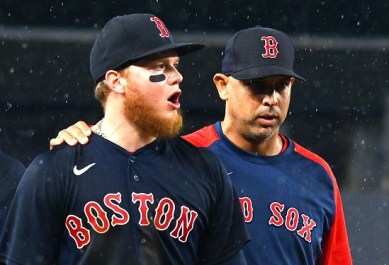
—Alex Cora, bench coach for the 2017 Houston Astros.

Would you believe a high school baseball game unwittingly inspired major league baseball’s first known extralegal sign stealer? An 1899 Phillies utility player turned third base coach was playing the ponies in New Orleans, watching the nags through binoculars, when he spotted something in the distance through them: the hands of a catcher flashing signs in that high school game.

From there, Pearce Chiles devised a system whereby one man would post behind the outfield fence with binoculars to decipher signs, then tap pulses to a device embedded below Chiles’s third base coaching line. After Reds shortstop Tommy Corcoran smelled the proverbial rat and unearthed the rig, the Phillies’ team batting average sank by 44 points.

If you must, call Chiles the great-great-great grandfather of Astrogate. SNY writer Andy Martino just about does, in his sober, engaging, and freshly troubling Cheated: The Inside Story of the Astros Scandal and a Colourful History of Sign Stealing. (New York: Doubleday; 270 p, $28 [$25 on Amazon].) It’s a freshly published reminder that, whether or not Astro fans or anyone else like it, Astrogate will not disappear soon into history’s recesses.

Nor should it. And this is while the forthcoming Winning Fixes Everything: The Rise and Fall of the Houston Astros—by Evan Drellich, one of the two Athletic writers (Ken Rosenthal was his partner) who sent Astrogate to the point of no return, when they finally had a player with direct knowledge (pitcher Mike Fiers) go on public record—may be delayed from its original planned August publication.

“Were the Astros part of a long tradition of sign stealing? Or were they outliers, worse than anyone else in history?” asks Martino, a ten-year veteran of baseball journalism now an SNY reporter. Then, he answers—yes, and no: “The answer is, well, both. What Houston did was the logical extension of more than a century of teams looking for an edge on the fringes of legality. But it was also new and different than anything that came before it.”

It also soiled irrevocably a championship run that gave a Houston battered badly by Hurricane Harvey an immeasurable spiritual lift. The team who put its collective arms around the ravaged city made it resemble fools for rooting for a team whose high-tech cheating came from the amoral front office down.

“[T]he team had access to technology that no other generation of cheaters could use,” Martino writes. ” . . . This was a twenty-first-century scam, pulled off by a group of people with the right blend of intelligence and moral flexiblitiy.”

Then, he quotes a baseball legend I’ve quoted a time or two through the entire Astrogate aftermath, a legend often accused of his own amorality until that and much else was almost completely debunked—Ty Cobb, who wrote in 1926 that “mechanical devices worked from outside sources” was “reprehensible and should be so regarded.”

The time-tested ways and means of legitimate (if only slightly unethical) on-base, on-field sign decoding have always had their experts. They’ve caught onto anything, not just the signs from catchers to pitchers, but assorted little hints in assorted moments, from catcher positioning when receiving certain pitchers to pitchers’ gestures when preparing to throw certain pitches.

In this century, Martino writes, they’ve included such men as Hall of Famer Roberto Alomar plus Carlos Beltran, Carlos Delgado, Joe Carter, Alex Cora, Shawn Green, Alex Rodriguez, and others. As Blue Jays teammates, Delgado and Green learned from manager Cito Gaston and from Alomar and Carter; Beltran learned from Delgado when they were Mets teammates. They were only too happy to pay it forward and teach teammates to come such intelligence arts.

Those men would use that kind of intelligence on the bases and even compile their own post-game logs (Delgado especially was such a player) on the various tells and reveals they’d discovered. So long as they did nothing in-game other than basepath espionage, all they had to do was hope the opposition didn’t catch on right away and switch signs or correct tells.

They weren’t operating the kind of high-tech cheating that came from Astros front-office intern Derek Vigoa, who convinced cold-blooded, results-before-humanness general manager Jeff Luhnow about a computer algorithm he’d developed for sign decoding called Codebreaker—but who warned to no avail that using it pre- and post-game was one thing but in-game was illegal.

The kind that gave Cora—now the Astros’ bench coach, with Beltran aboard as the team’s designated hitter and unofficial player mentor—an unexpected a-ha! when he discovered the high-speed, thousand-frame-a-minute Edgertronic camera. Until that discovery, Cora and Beltran were merely well-oriented, long-experienced students of what Paul Dickson’s study of the craft and its abusers alike called The Hidden Language of Baseball.

By the time Cora and Beltran began brewing their side of the Astro Intelligence Agency, more than a few other teams figured out a way to help baserunners send stolen pitch intelligence to their teammates at the plate: the replay room. The Astros weren’t wrong when they spoke publicly about those.

But the Astros played the whatabout game to deflect from their having gone above and beyond even the replay room reconaissance rings. Even after rumour and speculation graduated to fact and they were exposed for all time as transdimensional high-tech cheaters.

Those who still don’t get the difference between using established replay rooms to augment old-school gamesmanship (remember: the 2018-19 Red Sox’s replay room reconnaissance ring still depended on having a baserunner to send a batter the purloined numbers) and an illegal real-time camera sending signs should be ignored roundly.

MLB finally accepted instant replay, and installed replay rooms in the first place with the best of intentions, Martino reminds us. The entire sport was mortified by first base umpire Jim Joyce making a wrong safe call to deny Tigers pitcher Armando Gallaraga a perfect game on what should have been the final out. The result was both a helpmate and an unintended headache.

Boys will be boys, even in the 21st Century. Even the best-intentioned of newfangled solutions to immediate or time-worn problems find themselves at the mercy of boys being boys. When they’re the highest of high-tech solutions, there will be and there were boys being boys figuring out how to put them to nefarious service.

Martino insists quickly and supports in detail that that the most notorious illegal, off-field-based sign stealers who preceded or accompanied the 2017-19 Astros didn’t and still don’t justify the AIA. Quickly enough that it’s Cheated‘s second chapter, titled “No, the 1951 Giants Don’t Justify the Astros.”

Not those Giants, whose manager Leo Durocher installed a coach with a hand-held Wollensak spyglass in the clubhouse above the Polo Grounds’ center field to steal signs, enabling their stupefying comeback from thirteen games out of first place and, in due course, the pennant playoff triumph.

Neither do such telescopic cheaters as the 1910 New York Highlanders (exposure of which cost manager George Stallings his job), the pennant-winning 1940 Tigers (using a hunting rifle scope to steal signs from the outfield seats) or the 1948 World Series-winning Indians. (Courtesy of Hall of Famer Bob Feller’s Wollensak-like spyglass, brought inside the Municipal Stadium scoreboard to steal signs down the stretch.)

Those already went above and beyond the time-honoured ways and means of on-field sign stealing and discoveries of pitch tipping and other “tells” and “reveals” exploitable by the excessively observant. The AIA made the ’10 Highlanders, the ’40 Tigers, the ’48 Indians, and even the ’51 Giants resemble kids playing Spy vs. Spy.

This was a genuinely talented, well-built team surrendering hook, line, and stinkers to the high-tech temptations. With pliant, “conflict-averse to a fault” manager A.J. Hinch—burned by his first managing job in Arizona, where he clashed with veterans suspicious of his contemporary, information-augmented style—bent on fostering “a largely positive environment” with vets and youth alike in his clubhouse.

Enough that he felt without power to stop the high-tech cheaters in his own dugout.

Not every Astro was completely on board. Martino argues that second base star Jose Altuve objected vocally after hearing banging while he batted, even yelling at teammates in the dugout to knock it off. Neither did Altuve wear any kind of buzzer on his body. Veteran reserve catcher Brian McCann (since retired) and right fielder Josh Reddick (now with the Diamondbacks) also demurred.

Those who accused Mike Fiers of just keeping his mouth shut until he was an ex-Astro  might be surprised to discover Martino recording very plausibly what other reporting since has affirmed: Fiers actually did object to the AIA while he was an Astro, before passing warnings to beware on to his eventual Tigers and Athletics teammates.

We’ve known long enough that the A’s filed complaints with the commissioner’s office about their suspicions that the Astros were up to things above and beyond old-school on-field gamesmanship. We’ve also known long enough that Fiers finally went on the record  after too many other writers couldn’t convince their editors to let them run players’ suspicions without disclosing their identities.

Rob Manfred has earned most of the criticism he’s garnered during his term. But Martino records that he hoped he could get the deep Astrogate story without giving players immunity. When that proved implausible, Martino writes, the commissioner finally resigned himself and, with the players union’s agreement, got AIA players and personnel past and incumbent to talk—so long as the players got blanket immunity.

That was then, this is now. Manfred, the owners, and the players union have since agreed that players caught performing Astrogate-like electronic espionage can be suspended without pay and without credit for MLB service time.

Manfred’s January 2020 report, of course, named only one player publicly—Beltran, whose involvement cost him his new job managing the Mets . . . before he got to manage even a spring training game. Cora resigned before he could be fired as the Red Sox’s manager—but was brought back after last season. His confessional to ESPN reporter Marly Rivera a year ago probably went a long way toward rehabilitating him enough to get that second chance.

Hinch sat out his suspension, then got a second chance managing the rebuilding (and next-to-last-place) Tigers. Some say that’s cruel and unusual punishment for Hinch, who spoke candidly to Sports Illustrated‘s Tom Verducci last year about his failure to contain and dissipate the AIA.

A year after the infamous break-in, Richard Nixon gave a speech in which he insisted, a little testily, “One year of Watergate is enough.” Nixon was wrong then. Those who think a little over a year and a half of Astrogate is enough are wrong now.

Even with only five members of the Astrogate teams remaining on the club, their facing  pan-damn-ically delayed fan fury over the tainted champions is one example. Martino’s book is another. Drellich’s will be a third. With apologies to Professor Berra, when it comes to Astrogate literature it won’t be over until it’s over.

Is Alonso’s alarm a little sticky?

Pete Alonso

The Mets first baseman couldn’t care less which pitches have which syrup on the ball—he thinks, not implausibly, that there’s a larger ball-manipulation manipulation involved.

Just when you might have started thinking the sticky skirmish over pitchers and their new old-fashioned medicated goo was a mess as it was, here comes a new ingredient in the controversy. It may or may not stick, but it may or may not be entirely out of bounds, either.

Pete Alonso, the Mets’ slugging first baseman, doesn’t want the pitchers to be unstuck. More significant is his thinking as to why the balls themselves have been manipulated in recent seasons: nothing to do with the way the game’s played on the field, and everything to do with playing games with free agency.

“I think the biggest concern is Major League Baseball manipulates the baseball year in and year out depending on free agency class or guys being in an advanced part of their arbitration,” Alonso told a videoconference call including New York Daily News reporter Deesha Thosar, before the Mets met (and murdered) the Orioles in Baltimore Wednesday.

I do think that’s a big issue, the ball being different every single year. With other sports, the ball is the same, like basketball, tennis, golf, the ball is the same. That’s the real issue, the changing of the baseball. And maybe if they didn’t, the league didn’t change the baseball, pitchers wouldn’t need to use as much sticky stuff.

Alonso’s take doesn’t have hard, tangible evidence, but neither does Thosar dismiss him out of hand.

“It’s been widely believed that MLB has manipulated the baseball for years now, but the league is never forthright about it,” she wrote. “In 2019, the alleged juiced ball led to the highest home run rate in MLB history. This year, the league sent a memo to all thirty teams just before spring training, explaining that the ball would be altered this season to sail one to two feet shorter on fly balls hit over 375 feet. In other words, fewer home runs.”

“Forthright” and “baseball government” are too often about as synonymous as “celibacy” and “promiscuity.”

Back in 2019 the pitchers suspected and spoke up about the balls being “juiced.” This year the balls are supposed to have been de-juiced. Whatever they’ve been or not been this time around, enough pitchers are looking for every way they can think to control them when they throw them. That’s Alonso’s story, and if you’ll pardon the expression he’s sticking to it for now.

Thosar adds that Alonso’s “candid stance” doesn’t exactly jibe with MLB’s wants, either. Not just because the sport is about to unwrap what’s been speculated to be a firm crackdown on the pitchers’ sticky syrups, either.

“[T]hough it was already expected, it’s becoming all the more obvious that there will be a fight between the Players Association and MLB with the sport’s current collective bargaining agreement set to expire in just six months,” she reminds us. “Both sides have been publicly combative in recent years, and many around the league believe a potential strike could be in play.”

As though the owners were strangers to manipulating, undermining, or wrecking the free agency market before, you know.

Not those straightforward owners whose forebears abused the ancient reserve clause into making players chattel; forced a strike or two with harebrained ideas about compensation pools; colluded to suppress legitimate free agency markets; and, forced a truly ruinous strike (and a cancelled World Series) by trying to strong-arm players into stopping them before they over-spent, mis-spent, or mal-spent yet again. Not them.

Alonso admits he’s not thinking hard-line about the pitchers’ stickum, gripum, syrup, honey, wax, whatever,  because he’s even more concerned about batter safety at the plate—particularly after every Met player, coach, official, and fan had the daylights scared right out of them when Kevin Pillar took an out-of-control fastball right smack in the sniffer last month.

Even if you admit that the subtexts include too many baseball organisations hunting speed first and control on the mound almost as an afterthought, Pillar’s proboscis is only a fraction’s distance from the sport facing another Conigliaro tragedy—if not another Chapman one.

“I would rather [pitchers] have control,” Alonso told Thosar. “I don’t care what they use.”

For me, I use pine tar to hit. I have lizard skin, I have batting gloves. I have the most advantage when it comes to holding onto my bat. So I wouldn’t care. On our on-deck bag we have a pine tar rag, we have a pine tar stick, a special sticky spray with rosin. I mean you name it, we have it.

“I wouldn’t care if they had that behind the mound to help hold onto the ball, because when we start getting into these hotter months, guys start to sweat. And let’s say if they lose a fastball arm-side, I mean we all saw what happened to Kevin Pillar. That’s scary. We’re lucky that he only had a broken nose. It could be a lot worse depending on where it hits a guy.

It was a lot worse when Tony Conigliaro got hit in the eye by an errant Jack Hamilton fastball in mid-August 1967. A comeback or two to one side, Conigliaro was never really the same player again, his eyesight damaged for life—and we’ll never know whether continuing aftereffects of that drill led to the stroke that sent him into a coma for the last eight years of his life. (He died at 45.)

It was a lot worse than that when Ray Chapman got drilled and killed in a time when batters wore no helmets and pitchers were just about allowed to put anything on the ball they could think of—until the fear that an out-of-control Carl Mays spitter did the dirty work prompted a formal ban on spitters and other kinds of ball doctorings.

Which didn’t stop the mound’s Houdinis and Copperfields, of course. News flash: Various pitchers have continued looking for various edges—sometimes even using various edges—on their pitches all these decades since. Depending upon the atmospheres of enforcement, managers have either 1) let it ride because a few of their own men might be loading or scuffing; or, 2) called for immediate arrests and arraignments because . . . a few of their own might be subjects of sworn warrants.

Today’s honeyballers just might be the spiritual great-grandchildren of Hall of Famer Whitey Ford, whose late-career tricks and treats included a secret sauce of rosin, turpentine, and baby oil he said helped him grip his breaking balls better, har har. Depending on the depth and substance of the coming crackdown, today’s brewers won’t be too quick to plead the Ford defense: “Better ideas, driven by you.

Nobody among baseball’s government wants to admit to another dirty little secret: Among its other self-inflicted problems, the three-batter minimum for relief pitchers makes it impossible for a manager to get an out-of-control pitcher the hell out of there, before he does worse than Genesis Cabrera did to Bryce Harper and Didi Grigorius opening a relief inning back-to-back last month. Grigorius got it in the ribs. Right after Harper took one off his honker onto his wrist—and Harper hasn’t been the same hitter since.

Even a de-juiced baseball can still break a human beak.

Does Alonso have tin foil under his hat? Or, is he onto something substantial? He’s implied what The Athletic‘s Brittany Ghiroli comes right out to ask, then answer, in part:

[W]ho enabled the system that allowed these pitchers to cash in? Who decided to ignore the sticky stuff for years? Was the initial hope that the entertainment value — like performance-enhancing drugs — would perhaps translate into more eyeballs and excitement for the sport?

. . . The onus now, all of a sudden, is on upholding the integrity of the game. But what took so long?

Whatever new rules or regulations are put in place will be to enforce an existing rule. And while it’s easy to pile on the pitchers and pitching coaches and teams who knowingly broke the rules, the blame should not start there.

It should start with Commissioner Nero. Ever fiddling—with unneeded rules, with refusing to enable the needed one or two, with the baseballs themselves—while baseball burns.

Strange brew? Or, Whitey’s great-grandchildren?

Whitey Ford

Could the late Hall of Famer Whitey Ford have been the great-grandfather of today’s scientific pitching brewers?

She’s some kind of demon messin’ in the glue
If you don’t watch out, it’ll stick to you–to you
What kind of fool are you?
Strange brew, kill what’s inside of you.
–Cream, in 1967,
the year before the Year of the Pitcher.

Oh. The horror. Pitchers looking for every last edge they can find—by hook, crook, and anything else they can get onto their hands and onto their pitches. What is this game coming to? It’s coming to a head that looks at once like a throwback and a future shock, that’s what.

Before the doctored ball was outlawed officially in 1920, pitchers did whatever they could think of to baseballs short of injecting explosives. Come to think of it, you could think of a few comedians who would have loaded a ball to go boom! on contact. Not the kind of boom! you associate with Babe Ruth, Henry Aaron, or Ronald Vladimir Tatis, Jr., either.

Almost two months ago I observed that today’s apparent metastasis of pitchers using some new old-fashioned medicated goo (assorted elixirs of pine tar, rosin, sunscreen, glue, and who knows what the hell else) was liable to create baseball’s next cheating scandal.

As for those who still think pitchers stopped looking for every last edge they could find just because ball doctoring was banned formally after the Ray Chapman tragedy of 1920, you may find many of them lining up to place bids on that Antarctican beach club.

Sports Illustrated‘s current cover story is headlined: “The New Steroids.” The photograph shows a pitching hand gripping a ball with something running down upon it that could be taken for anything from bee honey to Log Cabin syrup to teriyaki sauce and back. I’ve heard of certain pitchers having certain hitters’ breakfast, lunch, and dinner (and vice versa), but that’s ridiculous.

SI reporters Stephanie Apstein and Alexs Prewitt may quote an unnamed Show executive as saying, “This should be the biggest scandal in sports”—but is it hard to take seriously when it’s illustrated by something flowing down a ball that looks less like a sunscreen-rosin-tar froth and more like what you have on your breakfast pancakes.

It’s also hard to take seriously, above and beyond the apparent extra creation that goes into this 21st Century version of gunkball, because the wet one has been called “the biggest scandal in sports” more than once over baseball’s life. When Roger Angell lamented the Year of the Pitcher when it finally ceased, he mentioned, not quite in passing, “the persistence of the relatively illegal spitter.”

And that was in 1968. A decade later, the advent of Hall of Fame relief pitcher Bruce Sutter and his split-fingered fastball (really a refinement of the forkball Pirates relief legend Elroy Face made a work of art) caused some inside and outside the game to believe the pitch’s spitter-like break made the real spitter superfluous—even while they couldn’t decide whether to condemn or laugh with Hall of Famer Gaylord Perry’s actual or alleged grease balls.

What the hey, there were those who thought Hall of Fame reliever Mariano Rivera’s devastating cutter—the “cut” was in Rivera’s grip—made the spitter superfluous if you could learn and throw it the way The Mariano did. You could also fill a stadium with the hitters who’ve thought pitchers who owned them while getting murdered otherwise were treating them in particular to a few little tricks.

Nobody doubts that pitchers today have an upper hand—whatever they happen to have in hand, in glove, or under their hats. Apstein and Prewitt get all manner of comment about it, from a very few willing to speak on the record to an awful lot who insisted on anonymity for possible fear of hitting the unemployment line.

No one doubts that advancements in pitching analysis and mechanical applications have led to the present fetish with the rates of spin the balls take out of the pitchers’ hands. Apstein and Prewitt round up a considerably widespread belief that, whatever that new-fashioned medicated goo is, it’s turning hitters already believed undoing themselves with the concurrent launch-angle fetish into guys who look like they’re swinging pool noodles and not bats.

It’s turning professional full-time hitters into pitchers at the plate, for crying out loud!

“More recently, pitchers have begun experimenting with drumstick resin and surfboard wax,” the SI pair write. “They use Tyrus Sticky Grip, Firm Grip spray, Pelican Grip Dip stick and Spider Tack, a glue intended for use in World’s Strongest Man competitions and whose advertisements show someone using it to lift a cinder block with his palm. Some combine several of those to create their own, more sophisticated substances. They use Edgertronic high-speed cameras and TrackMan and Rapsodo pitch-tracking devices to see which one works best. Many of them spent their pandemic lockdown time perfecting their gunk.”

We’ve come a long way from Pud Galvin, Happy Jack Chesbro, Ed Walsh, Eddie (Shine Ball) Cicotte, and Burleigh Grimes. Not to mention Preacher Roe, Lew Burdette, Whitey Ford, Mudcat Grant (who got away with a soap ball—it was said—until he once rubbed too much inside his gray road uniform and the warm sun foamed it too visibly through the flannel), Phil (The Vulture) Regan, Gruesome Gaylord, Don (Black & Decker) Sutton, Mike (Scuff) Scott, and Joe (Emery) Niekro.

Just picture assorted pitchers in their garages or even their kitchens throwing this stickum, that spray, the other glue, and some particularly choice liquids otherwise into the Mixmaster. (From your ancient history: that’s what we old folks called a food processor in the mid-20th Century.) With Vincent Price grins on their faces and Dr. Frankenstinker tightening the bolts in their necks.

Apstein and Prewitt cited numerous personnel saying the new gunkballs might help pitchers keep a grip on the new, reputedly lighter baseballs in use this season, but they also tend to sound as though they’re being ripped out of the pitchers’ hands. Kind of the present fraternity of hard, bullet-throwing pitchers is ripping the bats right out of the hitter’s hands, so it is alleged.

One unnamed American League manager swore to the pair that, “You can hear the friction.” They cited an unnamed, “recently retired” relief pitcher as comparing it to ripping a particularly adhesive Band-Aid right off the skin. “A major league team executive,” they add, “says his players have examined foul balls and found the MLB logo torn straight off the leather.”

Burdette and even Perry were suspected just as often of playing mind games more than they played real spitball games. What was true in Chesbro’s day seemed true in their day and beyond. Let the hitter think you’re loading up, and you’ve got two strikes on him before you even throw the first pitch. Spitter on the brain beats tobacco juice (Burdette’s suspected lube of choice) on the hide every time.

Do today’s mad pitching lab rats have a spiritual great-grandfather? It might be Hall of Famer Ford himself. Forget the legends of his late-career mud ball, ring ball (a rasp in his wedding ring enabling him to cut balls: “It was like I had my own tool bench out there”), and buckle ball. (His later catcher Elston Howard would scrape a ball on his shin guard buckles before returning it to him.)

He also had his own strange brew. The Cooperstown Casebook author Jay Jaffe, then writing for SI himself, described Whitey’s secret sauce as a blend of rosin, turpentine, and baby oil. The lefthander was believed to keep the blend in an emptied-out roll-on deodorant bottle (Ban, perhaps?), claiming to use it for a better grip on his breaking ball, hee hee hee.

(Ford’s worst victim may not have been an enemy batter but his own Hall of Fame teammate Yogi Berra. Thomas Boswell once recorded that, knowing Berra was prone to nicking personal products like deodorant whenever he ran short, fellow Hall of Famer Mickey Mantle moved Whitey’s sauce to a shelf spot where Berra couldn’t miss. Minutes later, Yogi ran screaming into the trainer’s room to have his arms shaved free of his sides.)

Have Apstein and Prewitt unlocked the true secret to this season’s hitting crisis—you know, all homer/all the time, nobody settling for measly singles, blah-blah, woof-woof—if a crisis it truly is?

I spent Friday morning looking it up. There were 1,672 major league games played at the end of business Thursday night. There were 13,061 hits in those games—an average of 7.8 hits per game. Sixty-four percent of those hits were singles; thirty-six percent were extra base hits; fifteen percent were home runs. There was an average 5.0 singles per game and 2.8 extra base hits per game.

Maybe they’re not hitting as often as they used to, but I’m having a hard time believing that whenever the hitters are making contact they’re coming out exclusively as all-or-nothing bombardiers, too. Eight percent of all 2021 plate appearances through Friday morning ended in bases on balls; 21 percent of them ended in hits.

Maybe the pitchers and their goo, gunk, glop, and sticky balls are tying them up at the plate. But brace yourselves—24 percent of all 2021 plate appearances through Friday morning ended in batter strikeouts. They’re hitting almost as often as they’re striking out, ladies, gentlemen, and miscellaneous.

“I’m tired of hearing people say that players only want to hit home runs,” Rockies rightfielder Charlie Blackmon has told Apstein and Prewitt. “That’s not why people are striking out. They’re striking out because guys are throwing 97 mile-an-hour super sinkers, or balls that just go straight up with all this sticky stuff and the new-baseball spin rate. That’s why guys are striking out, because it’s really hard not to strike out.”

Let’s have a parallel awakening. There just might be another, legitimate reason why the hitters can’t buy base hits no matter how they shake off the launch angling and just make contact—which they’re actually doing 47 percent of the time. The reason isn’t coming strictly from the pitcher’s mound . . . or his kitchen, garage, laboratory, double-secret research facility, or friends at Dow Chemical.

You heard me. Now hear Baseball Prospectus writer Robert Arthur, who published an essay Friday morning with the following headline:

BETTER DEFENSE IS COSTING MLB THOUSANDS OF HITS

It doesn’t say “hundreds.” Arthur’s acute research also doesn’t say it’s all or even mostly the fault of those human Green Monsters crowding either side of the infield in shifts, either.

“Across the board, fielders at every position have backed away from home plate, a change so pervasive and consistent it was unlikely to come from chance alone,” Arthur writes. “I found that two positions were affected more than any other–third basemen and center fielders–and that those two positions, perhaps not coincidentally, have also driven the greatest share in the decrease in [batting average on balls in play] since 2015.”

Arthur’s findings include an analysis in which he discovered that third basemen and middle infielders have tended to play deeper with or without shifting and that outfielders are generally playing somewhat deeper almost regardless of whether the man at the plate is a spray-hitting savant or a bombardier—and not just in such alignments as the so-called “no doubles” defense, either.

A week earlier, Arthur published another essay in which he argued, persuasively “[I]t’s hard to prove definitively, [but] improved defensive tactics look like they may be partially to blame for the historic falloff in BABIP. Just as batting average was drying up, teams look to have been repositioning their fielders across the board, pushing nearly every position back a few steps. The positions that moved back most—third basemen and center fielders—appear to be responsible for almost the entire decrease in BABIP in the last few years.”

Let Commissioner Rob Manfred and his lieutenants crack down on the goo-gunk-glop-stickum-ballers. Just be sure you’re going after the real Houdinis, not just the guys who want nothing more than a better grip on these ridiculously lightened balls in use this year. And use the discretion that (of all people) Joe West did near the end of May, when all he did was order Cardinals reliever Giovanny Gallegos to change hats and thus rid himself of the one with a little sunscreen on it.

Oh, sure, West ejected manager Mike Shildt for defending his player, and Shildt did fume post-game that they were picking “the wrong fight” because just wait until you see how much syrup is getting onto how many balls from how many pitchers. But at least Country Joe didn’t try suggesting Gallegos was up to anything more than either a good tan or ultraviolet protection, either.

You want to police some sunscreen and rosin? Go ahead,” Shildt challenged. “Get every single person in this league . . . Why don’t you start with the guys that are cheating with some stuff that’s really impacting the game?”

We’ve come a long way, too, from the day when Hall of Fame manager Earl Weaver visited the mound during a jam to counsel his pitcher Ross [Skuzz] Grimsley—suspected of using his abundance of hair grease for subterfuge. “If you know how to cheat,” Weaver told Grimsley, “now’s the time.”

Don’t kid yourself that even an earnestly firm crackdown is really going to re-level the field. Especially when organisations still prefer to find human howitzers who can throw the proverbial lamb chops past a full pack of wolves without knowing where the balls are going in the first place. Especially, when wiping out today’s syrup balls won’t wipe out the tradition of pitchers looking for, finding, and deploying every last slippery cutting edge they can find to get one up on those naughty hitters—who aren’t as contact challenged as you think.

And, especially when fielders are being positioned with more deftness than even the U.S. Navy needed to win the battle of Midway.

The original spitball ban and the plain-language rule against ball-teration don’t stop the mound’s Jekyll Hydes. All a hitter can do for now—and maybe for all time—is call upon one tradition that’ll never be obsolete. Keep your eye on the ball. Wait for the one that doesn’t break. And hit it on the dry side.

Mike Marshall, RIP: A prophet scorned

Mike Marshall

Mike Marshall, pitching in the 1974 All-Star Game.

One of Jim Bouton’s teammates on the Ball Four Seattle Pilots was a young righthanded pitcher named Mike Marshall. “I’m afraid Mike’s problem,” Bouton observed, “is that he’s too intelligent and has too much education.”

Marshall’s intelligence and education brought him a groundbreaking 1974 Cy Young Award—the first relief pitcher so honoured. It also brought him a doctorate in exercise physiology, a lifetime of learning, remaking, and trying to teach his art, and further affirmation of his sense that baseball’s entrenched couldn’t decide whether he was a nutbag, a menace, or both.

The doctor has gone to the Elysian Fields. Marshall died Monday at 78. His ideas about pitching remain, even if it took baseball a near-eternity to catch on and even if the game’s most advanced thinkers still don’t get a lot of them.

On the mound, Marshall set one of those records that sets the old school alight and indignant at once. Alight because he appeared in 106 1974 games, pitching 208.1 innings every one of them in relief, and was credited with fifteen pitching wins in relief, not to mention a 0.75 earned run average in the only postseason in which he got to pitch.

Indignant, because that old school continues lamenting the lack of durability among even relief pitchers nowadays. The old school’s ongoing failure to comprehend that no two human beings, never mind pitchers, are constructed entirely alike is one thing Marshall spent his post baseball life doing his best to transcend.

Four years after his Cy Young season, Marshall completed a doctorate in exercise physiology. His graduate education began as much on the mound as it did in the laboratory. If you’d asked Marshall himself, as ESPN writer Jeff Passan once did when Passan still wrote for Yahoo! Sports, Marshall would have told you the mound was his laboratory.

“I’m a researcher,” Marshall told Passan in 2007. “People forget that about me. That’s where my heart is. I pitched baseball, really, as the lab experiment of my research to see if it worked. Turned out it did. I don’t need any more validation that I know something about baseball. I know what works. That’s the greatest truth there is. I have a responsibility to give it back. Nobody wants it? Hey. That’s not my problem.”

Tommy John was one teammate who wanted it long before Marshall attached a doctorate to it. Marshall figured out (and loved reminding people) it was John’s ulnar collateral ligament that blew on the lefthander, leading Dr. Frank Jobe and the surgery that’s long since borne John’s name. Passan noted in ’07 that Marshall also suggested John adopt a regimen including exercises involving swinging his arm at his side with an iron shot-put ball.

Thus did John pitch thirteen major league seasons after his groundbreaking surgery.”We would just look at him and go, ‘He’s kind of wacko’,” John once said. “Yet you saw these feats. What I saw him do, there had to be a reason for it.”

One point in Marshall’s favour was that he didn’t come from the Dick Radatz school of hard-throwing relief monstrosities. His money pitch was a screwball of the kind that normally compromises if not ruins pitching elbows in younger men (Hall of Famer Warren Spahn developed his somewhat late in his career), but he was a pitcher who preferred to out-think both the opposing batter and his own body.

It wasn’t his intellect but a childhood accident that launched Marshall’s interest in kinesiology, that study of the human anatomy’s mechanics. At age eleven, he rode in a car with his uncle and the car was hit by a train, killing the uncle and hospitalising the boy with back injuries. During that hospital stay, the boy became fascinated with just how the whole human body actually works.

He earned his bachelor’s degree at the University of Michigan in 1965, while he was in the Phillies’ organisation. “Marshall applied his college course load to pitching and began to develop his own theories of pitching and pitching mechanics,” wrote Bruce Markusen in The Hardball Times in 2010.

He even devised an unusual pickoff move, in which he twisted his body in the direction of first base while making a throw to second base. The move looked painful, to say the least, but Marshall executed the maneuver without hurting his arm.

What Marshall sought most, after a delivery flaw caused him shoulder issues, was to simplify both the art and the physics of pitching on behalf of performing it as painlessly as possible for as long as possible.

“[H]e used high-speed film to analyze himself and noticed that if a pitcher pronates his forearm, it protects his elbow and shoulder,” wrote Passan, “pronating” being turning your hand so your palm faces down or in. “Marshall continued to refine the motion, adding the pendulum swings, where musculature prevents elbow-ligament damage, and the step forward, to prevent the arm from flying out and locking up. Marshall’s theory: Apply all force toward home plate instead of wasting it laterally with complicated wind-ups.”

Mike Marshall

“I’m afraid Mike’s problem is that he’s too intelligent and has too much education.”—Jim Bouton, Marshall’s teammate on the Ball Four Seattle Pilots.

Marshall began to look like a comer at last with the Montreal Expos of 1971-73. After the Expos traded him to the Dodgers for aging outfielder Willie Davis in December 1973, Marshall performed the impossible in relief. After 1974, though, Marshall’s flaws—including an impatient personality, an intolerance toward those who didn’t at least listen to his developing beliefs, and unapologetic activism in the Major League Baseball Players Association—got him traded to the Braves in mid-1976.

He finished 1976 strongly enough with the Braves but four bad appearances to open 1977 got him sold to the Rangers, where he struggled with injuries before becoming a free agent for the first time. He signed with the Twins and, at ages 35-36, had two sterling seasons before a bad 1980 opening got his outright release. Except for the Mets taking a flyer on him for 1981—and him responding with a 2.62 ERA in twenty games at age 38—Marshall never pitched in the Show again.

He took up the life of the itinerant pitching guru after throwing his last major league pitch. If it was too late for him to continue refining and developing his theories for his own work, he could still bring it to those aspiring to the art after him.

“A major part of Marshall’s teaching involves the highly unusual pitching motion that he advocates,” Markusen observed.

With this delivery, the pitcher has no real leg kick. He does not rotate his hips toward second base. After the pitcher lifts the ball over his ear, he follows through with an extreme pronation—turning the wrist outward with his thumb pointing toward the ground. By following these precepts, Marshall believes, pitchers can become injury free.

I’ve seen Marshall demonstrate this pitching motion on HBO and the MLB Network. It looks painful and awkward. Then again, maybe I’m just imagining that it’s pain-inducing because I’m so used to watching the classic pitching delivery. After all, Marshall knows a lot more about the human body, and the ways that its limits can be stretched, than I do.

Marshall also developed theories and demonstrated their operation regarding the rate and ways a baseball turns out of a pitcher’s hand decades before anyone else thought of analysing spin rates. “Even today, Marshall’s theories are finding new life,” Passan wrote for ESPN upon Marshall’s death.

On his website in 2003, he posited a theory he called “The Marshall Effect” . . . The premise was that the way a baseball is made, the Magnus effect—the phenomenon that predicts that a ball moving through space should do so rationally—was incomplete. There was something else making balls move, and Marshall believed that it had to do with the seam orientation of pitches. Eighteen years later, the concept Marshall introduced — now being referred to as seam-shifted wake—has invigorated a baseball physics community that believes it is perhaps the most important breakthrough in decades for understanding how pitches move.

Marshall ran his own low-rent teaching academy for a couple of decades. Descriptions melded together might make you think of a makeshift pitching lane with maybe a couple of small sheds and shacks, but there he worked and thought and taught, in the futile hope that maybe someone within baseball’s artery-hardened establishment would decide that maybe he really wasn’t baseball’s version of Anton Mesmer.

“I got tired of appeasing the stupid,” Marshall told Passan in that 2007 encounter, answering why he finally quit corresponding with most people inside the official game.

“Put it this way,” said Jeff Sparks, once an also-ran Tampa Bay relief pitcher who found and got wise to Marshall’s philosophies when it was too late to save his pitching career but not too late to learn regardless. “If [Marshall’s] way of throwing becomes the mainstream, what does every pitching coach who has been preaching the traditional pitching motion forever and has no idea how to teach this have?”

“[T]he baseball world sees him for what he hasn’t done, and that is consistently produce major-league-caliber players,” Passan observed then. “And so develops the Catch-22: Teams think Marshall is too much of a kook to send him top-of-the-line talent and elite players avoid him because they don’t want any sort of associated stigma.”

That wasn’t good enough for Markusen, either. “Really, what would be the harm in some major league organization taking a few of its struggling young minor leaguers—pitchers who are not considered prospects—and having them adopt the Marshall philosophy?” he asked. “If they have no chance of reaching the major leagues using their current mechanics, what would they stand to lose by giving another approach a try?”

It was done all the time before and after Marshall developed his pitching thought, just not Marshall’s way. We’ve read how many stories about this or that pitcher changing approaches and deliveries to go from nothing special to never better? We’ve pondered how many times that pitching really isn’t just a matter of rearing back and firing without control, thought, or purpose?

We’ve pondered how many injuries to how many pitchers that we’ve thought to ourselves could have been avoided with more intelligent management and something better than a still lingering inclination toward patch-him-up/get-him-back-there quackery?

Marshall now reposes serene in the Elysian Fields, where Jim Bouton might have welcomed him home telling him, “Around here, you’ll probably get occasional visits from other prophets. Other people the world thought were out of their minds, too. About things a lot more grave than getting hitters out, winning pennants, and trying to save pitchers.”

Away from baseball, those who surely didn’t believe Marshall was out of his mind included especially his late first wife, Nancy; his second wife, Erica; and, his daughters Deborah, Rebekah, and Kerry. They mourn something unique having gone from their world, and ours, a truly individual mind. We’re left only to ponder what he might have contributed if that mind trained elsewhere than upon the game he loved.