Throneberry Fields Forever

. . . a calm review of baseball

Throneberry Fields Forever

Appreciating Wade Davis

Wade Davis

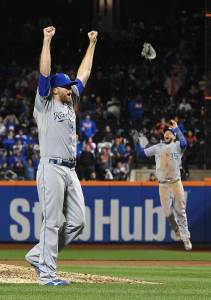
As leaping Eric Hosmer (35) flung his first baseman’s mitt skyward, Wade Davis launched the Royals’ party after he froze the Mets’ Wilmer Flores on a 2015 World Series-ending called strikeout.

The H-D-H intials usually register in the public mind with the great Motown songwriting and production trio Holland-Dozier-Holland. For a few years in the middle of the previous decade, H-D-H stood for a very deadly Royals bullpen trio.

Wade Davis was the D. They had their own Holland (Greg) plus also-retired Kelvin Herrera. But Davis wasn’t just the best of the trio, he was one of the absolute deadliest relief pitchers in the solar system for four years, three with the Royals and one with the Cubs.

Perhaps his most indelible moments were getting the last five outs when the Royals clinched the 2015 American League pennant in Game Six of that American League Championship Series; and, freezing the Mets’ Wilmer Flores to secure a 2015 World Series the Mets’ porous defense all but handed the Royals on a platter.

He looked and acted stoic on the mound, the emotionless assassin, but his exuberance after catching Flores completely stiff with that third-strike cutter is as eternal an image of Royals baseball as Hall of Famer George Brett’s “Pine Tar Game” and Game Seven of the 1985 World Series.

Things began fading after Davis signed as a free agent with the Rockies. After year one in Colorado Davis’s shoulder began barking relentlessly enough. When he returned to the Royals for 2021, any nostalgia for those 2014-2015 runs to the World Series in which Davis loomed large dissipated under continuing shoulder plus forearm issues.

They reduced him to being a mentor to the Royals’ younger relievers while he came to see his former form was in an increasingly distant past. So at 36 Davis calls it a career. But how good was he, really, during that 2014-2017 run? Have a gander:

2014-2017 FIP K/BB K/9 BB/9 HR/9 WHIP
Wade Davis, RP 2.23 3.60 11.7 3.2 0.3 0.95

His number-one flaw seemed a small propensity for walks. By far his deadliest of the four seasons was 2014, when he struck 109 batters out in 72 innings’ work, and though he surrendered 4.9 hits per nine innings that season nobody hit one out against him. Davis was also impossible to hit one out against in 2016 (zero); he surrendered three in 2015 and six in 2017.

If you were going to beat him, in other words, you had to either wait him out for the walk or wait for him to make a mistake you could plant some place in the outfield.

Davis pitched in nine postseason series over those four seasons. Except for 2017, when he pitched for the Cubs and got slapped around a bit in the division series and the National League Championship Series, Davis is a little different:

2014-2017 FIP K/BB K/9 BB/9 HR/9 WHIP
Wade Davis, Postseason 0.70 7.6 14.1 1.9 0.0 0.57

He was more deadly in those postseason series than in those regular seasons. And this is without discussing the four saves with which he was credited in the 2015 postseason. That’s because I’ve changed my mind about the save statistic. It’s as nebulous and deceptive as such analysts as Anthony Castrovince, Keith Law, and Brian Kenny have argued.

As a matter of fact, Castrovince—writing in his book, A Fan’s Guide to Baseball Analytics—mentioned Davis in his full chapter about the save, “Save Us From the Save.” Castrovince thinks the retired relievers giving Greg Holland the 2014 American Reliever of the Year Award had it dead wrong:

To be sure, Holland had a fantastic season—a 1.44 ERA in 62 1/3 innings across 65 appearances, with 90 strikeouts, 20 walks, and a .170 opponents’ average. And yes, he also had 46 saves.

But Holland wasn’t even the best reliever on his own team. That was Wade Davis, who had an even 1.00 ERA in 72 innings across 71 appearances with 109 strikeouts, 23 walks, and a .151 opponents’ average. As the setup man, Davis had only three saves. But he was the Royals’ most dominant bullpen force and should have won the award.

Think of it this way: How valuable are “saves” when Craig Kimbrel could—and did—pitch 10.2 postseason innings in 2018, allow nineteen baserunners, post a 5.90 ERA . . . and still show a perfect six-for-six in those “save” situations? Kimbrel was like the psychopathic teenage noodnik in Endless Love working his way back to his girlfriend’s family’s good graces by torching their house so he could save their lives heroically.

“The save . . . tells us nothing we couldn’t already glean from the box score,” wrote Law in Smart Baseball, “and gives people the illusion of meaning by its mere existance, which has contributed to overspecialised relief usage and a perverse system where teams often reserve their best relievers for the ninth inning even if those aren’t the toughest outs to get.”

Davis was made into a relief pitcher after starting didn’t suit him or his teams best. For four years he was as lights out as any reliever in the business. And I’m still willing to bet that Joe and Jane Fan think the season after that four-year run—2018, after he signed big with the Rockies—is his “best” season because, made their closer, he was credited with 43 “saves” while rolling a 4.13 ERA and a 3.65 fielding-independent pitchiing rate.

The Royals traded Davis to the Cubs after the 2016 season for Jorge Soler, before that Colorado deal that set a record for average annual value paid to a relief pitcher. All things considered, Davis was traded so Soler could end up being traded to the Braves last July—and end up their World Series MVP this year.

Nice delayed synergy in that, one World Series behemoth being traded for a World Series behemoth to be, six years removed. You could say, then, that Davis contributed to two world champions, one indirectly, but still. That’s as nice a baseball legacy as that four-year run when his name was synonymous with piledriving relief pitching.

Fixing the Hall of Fame vote, revisited

National Baseball Hall of Fame and Museum

The National Baseball Hall of Fame and Museum. It’s time to look again at how to fix the Hall of Fame’s voting processes.

Last year’s Hall of Fame vote by the Baseball Writers Association of America was troubling enough, for more reasons than just Curt Schilling falling short sixteen votes and Schilling’s demand to be removed from their ballots. This year’s vote could prove just as big a pain in the rump roast.

It’s the last roundup for a few players thanks to the ten-year limit on the BBWAA ballot. Schilling is one of them. Others include some with that storm cloud of actual or alleged performance-enhancing substances still hovering above them. (Good morning, Barry Bonds and Roger Clemens.) It’s also the first roundup for a couple of players above whom the cloud hovers (Alex Rodriguez) or gets pulled (David Ortiz).

Whatever those issues truly are, I’m still convinced we can agree upon this much: Something is still drastically wrong with the Hall of Fame vote. The vote still needs to be fixed. The question remains how to do it. The answers won’t be any more simple now than last year. But they’re worth revisiting.

Last year, the big sub-issue was the blank ballot. There was too much talk about some voting BBWAA members turning in blanks. What I said then still holds: how many blanks came in isn’t as relevant as thinking that, if you do submit a blank ballot, you should lose your Hall vote a spell.

What I didn’t suggest was how long following such a submission. Maybe losing your next two Hall votes should send the message: This isn’t the presidential election where, in some states, you’re entitled to answer to no parties producing candidates to your taste with a) the write-in vote; or, b) the ballot choice “none of these candidates.”

I’m not all that willing to allow the voting baseball writers a write-in vote. Some of their published arguments for or against certain Hall candidates cross into Cloud Cuckoo-Land as it is. But if a voting writer submits a complete blank, he or she should be blanked from the next two Hall votes.

At least, so long as the foolish ten-year limit for BBWAA ballot candidates remains in place. The far better course would be to re-open the eligibility window. It used to be fifteen. Why not make it twenty? You’d run far less risk of ballot logjams that might squeeze a Hall-worthy player out of the running through no fault of his own.

All that said, let me repeat what I wrote last year: Voting for the Hall of Fame isn’t exactly a right. The Hall gave the writers the privilege almost a century ago. With privilege comes responsibility, regardless of any controversies attached to any Hall candidates. The responsibility still includes the one holding the voting privilege doing his or her job—thinking hard, and voting.

It would be far simpler to exercise that responsibility without the ten-year eligibility limit. So here’s hoping the BBWAA thinks that one over and re-opens it to fifteen or twenty years’ eligibility.

Every year, the Internet Baseball Writers Association of America sends its membership a ballot for the Hall of Fame. Yes, it’s only symbolic, since the Hall of Fame doesn’t recognise us as a voting entity. No, the vote isn’t simple, cut, dried, or pre-natal surgery.

When I get my IBWAA Hall ballot, I take some time to think it all over. Then I vote. I even write about how and why I voted for the players I choose. I might now advocate returning the fifteen-year eligibility period or making a twenty-year period for candidates, but the flip side of that coin is that the BBWAA asked for it with the ten-year period—and, if I can do my symbolic job, they can do their real ones.

The ten-year maximum eligibility was imposed in the first place out of concern to do whatever the writers could think to keep those nefarious suspected users of actual/alleged PEDs from getting through. Aside from that jet taking off decades ago (greenies, anyone?), the bullets with which they shot themselves in the proverbial foot traveled far enough to delay or torpedo entirely more than a few legitimate Hall of Fame cases thanks among other things to several jammed ballots.

Kenny Lofton surely wasn’t the only man wondering why the number ten center fielder ever to play major league baseball can’t be in Cooperstown (pending a future Era Committee consideration) except as a visiting customer.

Everybody still with me? (All ten of you?) Good. Now hear (well, read) this. If we really want to fix the Hall of Fame vote, the Hall itself should step up, step in, and decide the BBWAA has played enough games for long enough. It’s time to broaden the Hall vote. It’s time for the BBWAA and the assorted Eras Committees to have company among those conferred the privilege of voting for the Hall of Fame.

Who else should be invited to the party? I had some ideas about that last year, and they’re worth revisiting with a couple of adjustments:

1) The living Hall of Fame players and managers themselves. No one should feel funny about allowing such as Jeff Bagwell, Johnny Bench, Craig Biggio, George Brett, Bobby Cox, Dennis Eckersley, Rollie Fingers, Tom Glavine, Ken Griffey, Jr., Vladimir Guerrero, Rickey Henderson, Whitey Herzog, Trevor Hoffman, Derek Jeter, Randy Johnson, Chipper Jones, Sandy Koufax, Greg Maddux, Willie Mays, Mike Piazza, Tim Raines, Cal Ripken, Jr., Nolan Ryan, Mike Schmidt, Ted Simmons, Ozzie Smith, John Smoltz, Joe Torre, and Larry Walker, to name a few, voting for successors worthy of joining their fraternity.

Some of them get to be part of assorted sixteen-member Eras Committees, of course, which also include “executives, and veteran media members” according to the Hall itself. We can adjust that reasonably: The living Hall of Famers should have to choose whether to vote concurrent to the BBWAA or as members of one or another Era Committee considering overlooked/snubbed BBWAA candidates—but not both.
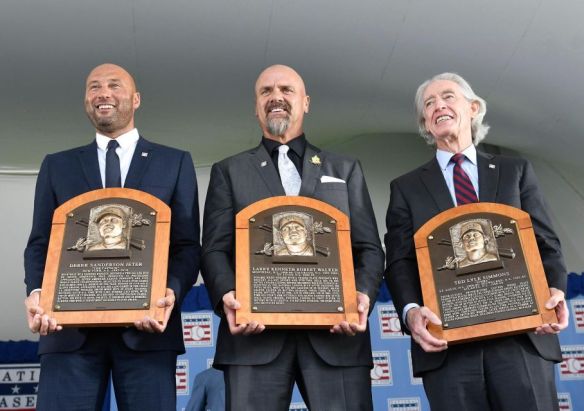
Left to right: Derek Jeter, Larry Walker, Ted Simmons. Why shouldn’t they and their fellow living Hall of Famers have Hall of Fame votes?

2) The living Ford C. Frick Award winning broadcasters, and those currently working in major league broadcast booths. They see as much of the games as the writers do. The Hall would not be disgraced by the like of Marty Brennaman, Joe Buck, Chip Caray, Bob Costas, Jaime Jarrin, Jim Kaat, Brian Kenny, Buck Martinez, Tim McCarver, Al Michaels, Jon Miller, Vin Scully, Bob Uecker, or Suzyn Waldman, among others, having a vote.

3) The statistics mavens, since statistics remain the life blood of baseball.  No, ladies and gentlemen, it would not be a travesty for Allen Barra, Bill James, Keith Law, Rob Neyer, or the folks at Baseball Prospectus, Baseball Reference, FanGraphsretrosheet, and The Elias Sports Bureau to be included in the Hall of Fame vote. So much of their work has provoked re-assessments of several subsequent Hall of Famers as well as incoming Hall candidates. They should not be regarded as voting interlopers.

4) Those writers/historians who were never admitted to the BBWAA ,but who’ve established themselves long and with particular distinctions as blessings to the game. Find us a valid reason for ageless Roger Angell plus Paul Dickson, Richard Goldstein, Peter Golenbock, John Helyar, Donald Honig, Peter Morris, George F. Will, or plenty of the fine excavators of the Society for American Baseball Research, just for openers, to be excluded from the Hall vote. You’ll have a simpler time finding Atlantis.

5) Umpires with above-average ratings. (God and His servant Doug Harvey only know you don’t even want to think of bringing Angel Hernandez or half the arbiters who worked this year’s postseason into the voting fold.) Those people had the second-best views of Hall of Fame candidates for themselves. (The first-best is probably a tossup among several.) The best umpires didn’t just call the pitches or the plays, they developed particular appreciation for players who strove for and achieved Hall of Fame-level excellence.

They would not lack credibility as Hall voters if allowed the chance. Should a voting umpire lose his (or her, in due course?) above-average rating, their Hall vote can be suspended for that year.

6) How about the IBWAA? As in, members not concurrent BBWAA members (we do have a few, including Spink Award Hall of Famer Jayson Stark) but whom the IBWAA leadership deems by their actual works to be worthy of a Hall of Fame vote to exercise wisely and diligently. (Fair disclosure: I’m not an IBWAA leader or officer yet.) The IBWAA is not just another gaggle of fans ranting our heads off. We’ve got some excellent observers, analysts, commentators among us who have earned the chance.

7) Establish a Pioneer Committee. This would be a group considering and giving due to those people—players, executives, statisticians, others—whom we’d consider to have changed the game profoundly in ways other than how they played or managed or administered the game. (It wouldn’t have let Marvin Miller wait until death did he part for his well-deserved Cooperstown enshrinement, either, if it lived while he did.)

The Pioneer Committee could begin with considering Curt Flood, who kicked the door to free agency open just enough with his reserve clause challenge. It could consider Andy Messersmith, who shoved the door open all the way by finishing what Flood started and prevailing right to the end. It could consider Tommy John, who enjoyed a long, distinguished second act after undergoing the first of the ligament-replacement elbow surgeries that’s long since borne his name.

They didn’t quite post Hall of Fame playing careers, but they all changed the game profoundly, and irrevocably. There should be a place in the Hall of Fame for all three.

This Pioneer Committee should also consider those such as Allan Roth, arguably the godfather of deep statistics. Bill James, who picked up where Roth left off, all but invented sabermetrics, and sired subsequent generations of deeper analysts many of whom came to play key roles in re-developing baseball organisations. Bob Kendrick, whose administration and representation of the Negro Leagues Baseball Museum does invaluable work advancing the Negro Leagues legacy not as mummified artifacts but as a just portion of living, breathing major league baseball history.

If those are unworthy of consideration for having Hall of Fame votes, remember that my Antarctic beach club has yet to find a buyer.

8) Dump once and for all the prejudice against first-time votes/first-ballot Hall of Famers. If you think a player or manager belongs in the Hall of Fame, vote him in the first time. (Again, raising the eligibility limit back to fifteen years or all the way to twenty years should help.) You don’t need reminders of how many Hall of Famers you assumed to be locks waited five or more times to get their due. Or, of how often you wrote fuming over that sad fact.

People still think it’s more than a little surreal, if not insane, that Yogi Berra, Craig Biggio, Joe DiMaggio, Whitey Ford, Hank Greenberg, Lefty Grove, Vladimir Guerrero, Willie Mays, Juan Marichal, and Cy Young aren’t first-ballot Hall of Famers. Even if things worked out well enough for Ford that he got in on his second try, the following year—next to his old running mate Mickey Mantle, on Mantle’s first.

By now you’ve probably noticed no mention of Joe and Jane Fan into the Hall vote discussion. There’s one bloody good reason not to even think of handing them a Hall vote: the hash they’ve made over All-Star Game votes, too many times, either with ballot-box stuffings or choosing to confer gold watches.

The All-Star Game vote needs a complete overhaul, too, though that’s still a subject for another day for now. But do you really want to know how much worse Joe and Jane Fan would make the Hall than the Today’s Game Committee that decided Harold Baines deserved a platinum watch?

Portions of the foregoing essay have been published previously.—JK.

What Syndergaard wanted most

Noah Syndergaard

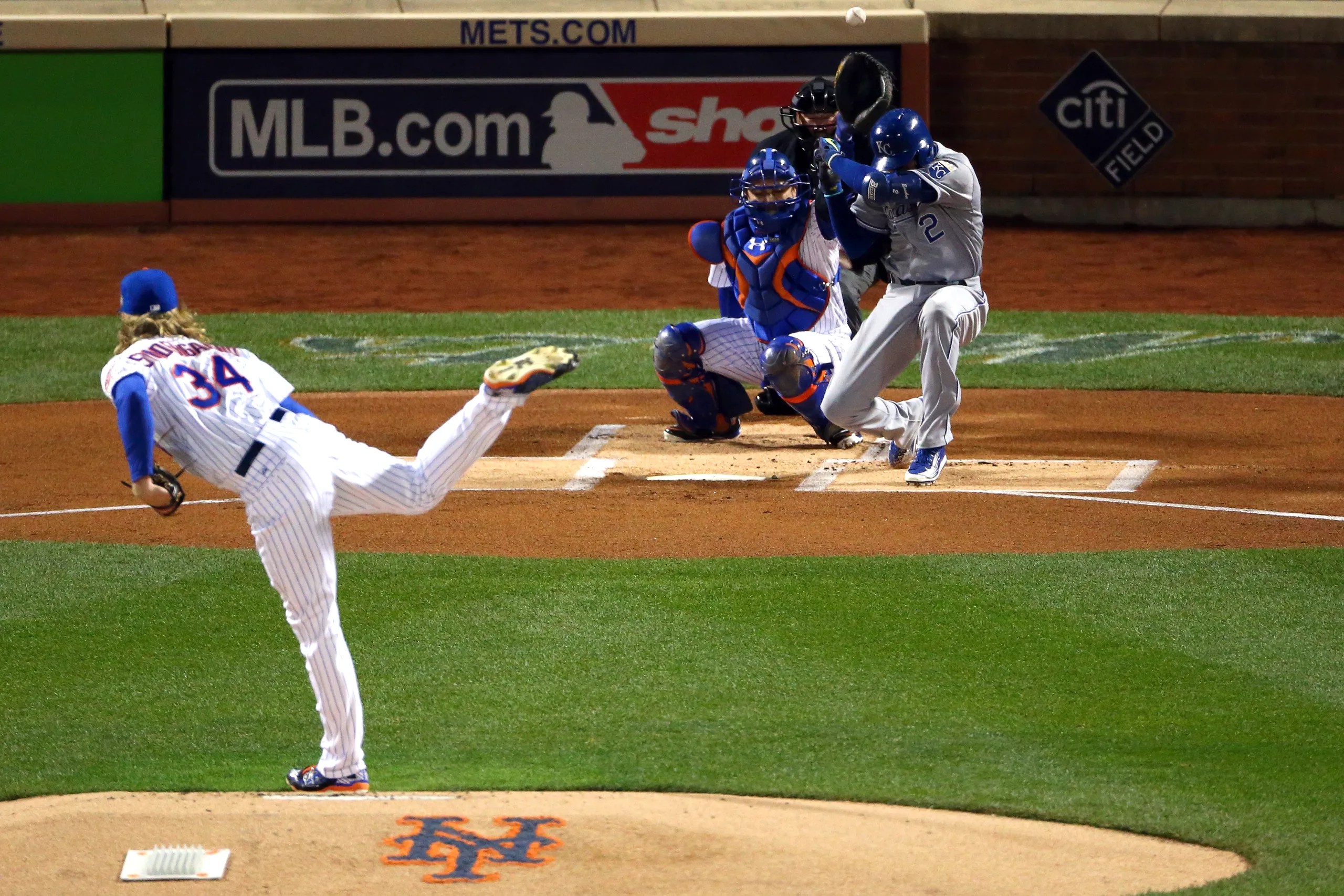
Met fans won’t forget Noah Syndergaard dropping Alcides Escobar to open Game Three of the 2015 World Series. Now the talented but oft-injured Syndergaard will be an Angel because the Mets’ administration slept at the switch after making his qualifying offer.

Go ahead and cling to the surface look if that’s your preference. Cling to the Mets showing Noah Syndergaard a qualifying offer and Syndergaard electing instead to let the Angels seduce him for a couple of million dollars more for next year, if it makes you happy. Cling to the narrative that Syndergaard’s heart with the Mets could be bought, if you must.

But now you must ask yourself concurrently just why it was that Syndergaard’s Mets heart was abandoned while the Angels swept in and swept him off their feet. Your answer is no further than New York Post writer Joel Sherman, who says the Angels had a plan for the power-pitching righthander coming back from Tommy John surgery—and the Mets apparently lacked one.

Oh, sure, the Mets plan to win if they can help it. But that’s it. When they tendered Syndergaard his qualifying offer, that was it, too. They had no general manager at that moment. They had no manager. They still don’t. They’ve got a pitching coach, Jeremy Hefner.

But nobody in the Mets’ organisation talked much of anything yet about how they were going to shepherd a starting pitching staff going forward. They didn’t talk about how they were going to manage Syndergaard’s work load during his first full season back after Tommy John surgery, recovery, and rehab.

Enter Angels general manager Perry Minasian. He knew Syndergaard wanted a deal and the physicals done before today’s qualifying-offer deadline, just in case the physicals didn’t wash, leaving Syndergaard a Mets fallback after all. He also knew what Syndergaard wanted beyond a solid-enough, prove-it-year’s deal.

Syndergaard wanted a plan. Minasian high tailed it to New York to present him one. “[F]or the best organizations these days preparing pitchers physically, for the season and for each game, is a collective effort across multiple departments,” Sherman writes.

There were efforts in the first year under [Steve] Cohen’s ownership to bulk up these areas, but [the Mets] still pale in comparison to clubs such as the Dodgers, Giants and Blue Jays, among many others.

Minasian . . . came to New York armed with details on, among other things, how his club would have him pitch to individual players on each team in the AL West. He spoke of the success the Angels enjoyed last year with a six-man rotation, which helped get Shohei Ohtani through a season of hitting and pitching healthy. Minasian said the plan would stay the same and showed Syndergaard how pitching in a six-man rotation would give more time for recovery and lower his overall inning total when all he had in 2020-21 in the majors was two one-inning stints to close out the past season. Minasian brought data to show what the Angels liked about his delivery and pitch mix and how to make them even more effective.

In other words, Minasian caught the Mets sound asleep at the Syndergaard switch. While the Mets just slid a qualifying offer under the righthander’s nose with nothing substantial behind it to show him anything resembling love or respect, the Angels’ GM—who goes back with Syndergaard to the Blue Jays, having been part of their drafting team when they first picked him—brought all three. Love, respect, and substance.

Minasian also brought it with the most aggressive and committed push among several contenders for Syndergaard’s prove-it season, including the world champion Braves, the Red Sox, and the Jays.

Sherman notes that the Angels weren’t exactly thrilled about having to lose a draft pick for signing Syndergaard, but they were less thrilled than that about the prices in the free agency starters’ store—and starting with a Syndergaard whom Minasian knew well enough would give them decent odds in the upside department before pondering another starter or two on that market

The Angels’ seduction, Sherman writes, mattered as greatly as the Mets’ apparent lack of it: “Syndergaard is going to pitch at 29 this year. He recognizes how vital it is that he performs well to set himself up to re-enter the market next year at 30 to try to score a lucrative, long-term pact. And here were the Mets not even talking to him throughout this process. Here they were without an infrastructure in place. Here they were unable to provide a detailed plan to him beyond the big picture that Cohen wants to win now.”

The Mets hired former Angels GM Billy Eppler—Minasian’s immediate predecessor—as Syndergaard’s deal with the Angels came forth. This can be called crossing one end of the street without bothering to see who’s coming down the block from the other end. This can also be called too little, too late. This can be called, further, that’s still so Mets.

Leaving Mets fans with memories of a stout, tenacious pitcher who could be lights out when healthy and who gave them one whale of a performance in the 2015 World Series: Syndergaard dropping plate-crowding, plate-overcomfortable Royals shortstop Alcides Escobar to open Game Three, the only game in the Series that the Mets’ then-porous defense couldn’t cost them.

God knows the Angels themselves need a starting pitching overhaul—again. If a year’s worth of Syndergaard at minimum helps it begin, the deal will have been worth it. If Minasian’s plan for him works well enough, the Angels might think of extending Syndergaard or Syndergaard will have a solid market when he hits free agency next winter.

If losing Syndergaard now means a swift enough kick to the Mets’ posterior on behalf of shaking them further out of their funk before and after any possible lockout, it might be worth it, too. Eppler’s hiring to the contrary, with these Mets that’s a glandular if.

Will Eppler get to run the Mets unimpeded?

Billy Eppler, Mike Trout

Then-Angels GM Billy Eppler—seen with Mike Trout, whom he signed to a glandular Angel-for-life extension in 2019—now gets to run the Mets without a contradictorily heavy hand above and undermining him.

The good news (yes, it’s good news) is that the Mets finally have a new general manager. The bad news is that an awful lot of people may be shaking their heads and lamenting, “They put on that crazy hunt to end up with this?”

Billy Eppler wasn’t exactly a resounding success when he held the same job with the Angels from 2015-2020. Not overall, anyway. In isolated moments he looked like a budding genius. In the big picture, he looked like another one of Angels owner Arte Moreno’s designated fall guys.

The budding genius side: Eppler did the heavy lifting when it came to making Mike Trout an Angel for life and for making Shohei Ohtani an Angel at all after his Japanese splash. He secured the game’s best all-around position player and his three American League MVPs and landed this year’s two-way sensation who just might shake out as this year’s AL MVP.

The fall guy side: Moreno’s contradictory penchant for splash signings, low enough budgets otherwise, and moves he pushed out of sheer fury after failures to strike  designated targets. Moreno is a lot more like Eppler’s one-time boss George Steinbrenner’s bad side than Angel fans often dare admit outright.

Before Met fans continue shrugging their shoulders and lamenting that this, too, is so Mets, ponder if you will that when the Angels hired Eppler in the first place—after he’d spent copious time as Brian Cashman’s assistant with the Yankees after running their scouting system a few years—Eppler went in with an arm and a half tied behind his back before he could make his first phone call.

Perhaps insanely, Moreno gutted just about his entire scouting system. He made international scouting director Clay Daniels pay with his head after some of Daniels’s subordinates were caught skimming signing bonuses. He pinked his overall scouting chief Eddie Bane over a series of bad drafts and free agency signings, even if one of Bane’s last solid moves was pressing the Angels to sign a kid named Trout in the first place.

Several of Eppler’s moves blew up through no fault of his own. Zack Cozart struggled as a new Angel in 2018 before a torn labrum killed the second half of that season and neck and further shoulder surgery killed much of his 2019 before he was traded away and ultimately retired.

Eppler made a number of reclamation-project free agency signings that failed miserably enough, as in former Met Matt Harvey plus Cody Allen, Trevor Cahill, Tim Lincecum, and Julio Teheran. With the best intentions Eppler looked foolish for those deals, just as he would for extending outfielder Justin Upton.

But Upton points to Eppler’s better side as well. Left to half by Moreno’s big-sign/low-budget-otherwise style, Eppler did what he could with whatever he was left to work with, and it wasn’t exactly his fault that his penchant for sharp trading and a sharp waiver-wire eye was made to look foolish by subsequent events.

Trading for Upton in the first place looked smart at first—before the extension and before the unanticipated injuries that have throttled Upton since 2019. Eppler also made several trades that made useful Angels out of Dylan Bundy (pitcher), Tommy La Stella (middle infield), Andrelton Simmons (shortstop), Felix Pena (pitcher), Patrick Sandoval (pitcher), and Max Stassi (catcher), for short whiles, anyway.

Eppler was also deft enough to land Brian Goodwin, Blake Parker, Noe Ramirez, and Hansel Robles off the waiver wire, getting some success from the group before they, too, petered away.

None of those moves translated into postseason trips for the Angels, of course, but you can look closely at just about all of them and discover the issues and baggage of most of those players didn’t arise until well after they arrived in Anaheim. But just as a manager takes the fall for “underachieving” or “shortfalling” teams, GMs take the fall when their moves turn out disastrous even through no fault of their own.

Essentially, the Mets played that postseason song-and-dance GM hunt to end up with a guy who’s been in and out of the reputed New York incinerator. (Remember Sandy Alderson saying it was just that overwhelming Apple heat that kept the Mets from bringing the best and the brightest aboard?) A guy who may not be cuffed and stuffed by a contradictory owner with a reputation for hard meddling.

It couldn’t have come at a stranger time. This may be so Mets—the former Angels GM taking the Mets’ helm as one of their key pitchers signs with the Angels. All Noah Syndergaard had to do—following his recovery/rehab from Tommy John surgery—was show a little enough of his classic Thor form in a pair of token gigs at season’s end, plus reject a Mets’ qualifying offer after the season, and the Angels take a flyer on his recovered self for a one-year, $21 million deal . . . pending physicals.

So Eppler gets to go to work right away redressing the Mets’ pitching depth issues. With all-world ace Jacob deGrom a question mark until he actually gets back on the mound next year, and their most reliable non-deGrom starter Marcus Stroman now a free agent, the Mets’ starting corps isn’t exactly a finalised 2022 product just yet.

Eppler will also have to step into the Mets’ efforts to convince middle infielder Javier Baez to keep his defensive virtuosity and reviving bat in Queens next to his keystone partner Francisco Lindor. He’ll have to start pondering moves to fortify their outfield. He’ll also have to think swiftly enough before any possibility that, with the current collective bargaining agreement due to expire and the owners threatening a lockout, the game shuts down for enough of a winter chunk.

But you can almost picture Eppler looking back upon his Angels tenure, then looking out now from his new perch with the Mets, and thinking to himself, “Jeez, I thought it was going to be impossible!” He may yet think that, compared to where he was, he’s in the next best thing to a professional jacuzzi now. May.

Are we still missin’ a great game?

Whitey Herzog

Whitey Herzog, inducted into the Hall of Fame as a manager in 2010: “The state of the game is about as bad as I’ve ever seen it,” says the man whose baseball life began as a tenacious outfielder and student of the game.

Perhaps if Whitey Herzog were about three decades younger than he is now, you might think he’s casting his retired eyes upon Rob Manfred’s job. Talking to the St. Louis Post-Dispatch‘s Rick Hummel, you’d almost think the Hall of Fame manager wishes he could turn the proverbial clock back and let someone post his name for the job. Almost.

“The state of the game in baseball,” says the White Rat, who turns 90 today, “is about as bad as I’ve ever seen it. It’s all strikeouts and home runs and a high number of pitches.” Well.

In 2021, home runs accounted for fifteen percent of all hits. Doubles accounted for twenty percent; triples, for two percent; singles, then, still accounted for 63 percent of all hits. Pitchers threw 709,842 pitches during the season’s 4,858 games; in 2019, the previous full season, pitchers threw 732,511 pitches.

Herzog stands on stronger ground over pitch volume than he does over home runs. In 2021 games averaged 146 pitches per; in 2019, 151. On the other hand, both seasons averaged four pitches per plate appearance. And, in 2021 and 2019, batters made contact on 74 percent of the pitches they saw.

During 1960, with sixteen teams playing the last season before baseball’s first league expansions, home runs accounted for ten percent of all hits. Doubles accounted for sixteen percent. Triples, three percent. Leaving singles to account for 61 percent of all hits.

A season that’s part of an era still glorified by certain old fans, with almost half as many major league teams as today, had only three percent less singles than twice that many teams playing in 2021. Forget percentages, do you want to see raw numbers?

Season 1B 2B 3B HR
1960 (16 teams) 15,206 3,442 658 2,128
2021 (30 teams) 25,006 7,863 671 5,944

Pitch totals for 1960 aren’t available, so we don’t know for dead last certain the percentage of pitches on which 1960 batters made contact. From the look of the raw numbers above the triple does seem to have collapsed. (Only twelve triples more this year than 61 years ago?) But 1960 batters struck out in 14 percent of their plate appearances, while 2021 batters struck out in (wait for it!) 23 percent of their plate appearances.

I’m not entirely certain that there’s that significant a difference between a season in which 86 percent of plate appearances didn’t end in strikeouts and one in which 77 percent of plate appearances didn’t.

Herzog really starts winding up with Hummel when he strikes at Manfred’s purported game-shortening experiments. “He keeps talking about the three-batter rule for [relief] pitchers. Stupid,” he says. “And then the tenth inning rule [the free cookie on second to open each extra half-inning]. Stupid. Seven-inning doubleheaders. Stupid. None of that is going to shorten the games at all, until we can lower the amount of pitches that they throw.”

The White Rat is dead right about the three-batter relief pitchers’ minimum and the free cookie on second to start each extra half-inning. The latter was dropped during this year’s postseason, thankfully, but the former wasn’t. But the seven-inning doubleheader has a benefit critics and supporters alike tend to miss—the season is long enough without compounding players’ wear and tear and injury risks.

Something noticeable under the three-batter minimum was a lot of managers leaving a reliever in after facing his minimum third batter but getting battered before or after that third minimum batter. It’s worth reminding ourselves that relief pitchers have already been pitching in the bullpens before they get into the game in the first place.

Whitey Herzog

The White Rat, in the Cardinals dugout during a 1980s game: “[We’re not] going to shorten the games at all until we can lower the amount of pitches that they throw.”

Herzog, you may or may not remember, is the manager who once wrote, “The good skipper does his managing before the game starts. The guy you see out there managing is the one who’s screwing up the arms.” He’s the manager who once ran his bullpens according to a strict rule: if he warmed a pitcher up more than once but didn’t bring him in after the second warmup, the man had the rest of the day or night off.

This is the same manager who [in his memoir/critique, You’re Missin’ a Great Game] criticised two men he liked, Tommy Lasorda and Pete Rose, for misusing their bullpens by warming, sitting, warming, sitting, then bringing in relievers who’d already been gassed enough by the time they got into the game—and got murdered on the mound.

Some managers think if a guy’s not actually in a game, he’s not pitching. But if he’s tossing on the sidelines, man, he’s getting hot. Over the years I dealt some of my pitchers to [the Dodgers] . . . and they always came back with the same report: Tommy was still messing up the pen . . .

Pete Rose was like Tommy. Wonderful baseball man, but he was impaired when it came to handling pitchers. Here he had three world-class relievers, Norm Charlton, Rob Murphy, and Rob Dibble, all in the same pen . . . With those three guys on your side, you shouldn’t lose games after the sixth. But Pete found a way.

He’d get Murphy up in the third; he’d warm him up in the fourth. Then he’d sit him down. He’d get Charlton up in the fifth. Sometimes I’d look down there and he’d have both lefthanders going at the same time. Why would you warm ’em both up at once? You’re only going to use one lefty or the other! Then, after he’d worked ’em out three or four times, Pete would put one in the game and be surprised he had no zip. “He can’t be tired,” he’d say. “He ain’t pitched in three days!” Somebody counted how many times he warmed Murphy up one year, and it was over two hundred. I like Pete, boy—but I loved managing against him.

It’s worth listening to Herzog, then, when he tells Hummel that none of Manfred’s gimmickry is going to shorten a thing until managers can reduce the pitch volume. In 2021, batters faced an average just a sliver under four pitches per plate appearance. It comes out to 709,842 pitches for 182,128 plate appearances all regular season long.

“I watch every game at home,” the White Rat says. “I generally don’t go to bed until 11 at night when I’m watching the West Coast games and when the teams throw 340 to 360 pitches every night, there’s no way you can shorten the games. I sit and watch an 0-2 pitch — a perfect pitch on the black — (the umpires) never ring anybody up. It’s always a ball.”

Herzog may have exaggerated the number slightly (there were more like 292 pitchers per game on average, covering both sides of a game), but he makes a pretty point. Especially if he’s absolutely right about the umpires, most of whom still have their “own” strike zones, not calling the rule book strike zone, compelling hitters and pitchers alike to think in the terms that once alarmed Sandy Alderson, when he was MLB’s vice president of baseball operations in 1999.

The old Major League Umpires Association fumed (and ultimately imploded) in 1999, over MLB’s then-intention to hold umps to account over strike zone distinctions. When their then-leader Richie Phillips snarked that umpires should be compared to federal judges, Alderson snarked right back. “Federal judges can be impeached,” he said. “I got worried when I found out that players were more concerned with who was umpiring the next day than they were about who was pitching.”

In 2021, pitchers threw 453,466 strikes. Those resulted in 42,145 strikeouts. Remember—that’s 23 percent of 2021 plate appearances ending in strikeouts. But how many of those strikes were called when the pitch actually traversed the plate outside, under, or above the real strike zone?

Herzog is on board with analytics to a particular extent. You should expect that of a man who believes the good manager does his managing before the game begins. “Analytics are a wonderful thing–up to a point,” says the Rat. ” . . . [T]here are a lot more things that go into managing a baseball game than analytics. The people who sit up in the office don’t make out the lineup, but they tell you which eight players should be playing. But they don’t know if a guy’s sick or got a hangover or having marital problems.”

Or, if a guy might be playing through an injury while actually making things worse for himself and his team. Baseball history is littered with players playing hurt and managers plus front offices pressuring them back before injuries are healed properly and fully. Leo Durocher, to name one notoriously, had a penchant for ripping the injured as quitters. Too many fans even today think injuries equal quitting.

Alex Bregman’s near-complete absence at the plate during the Astros’ run to the World Series was much remarked. The righthanded-hitting third baseman underwent right wrist surgery Monday, having dealt with the issue since September to crown an injury/illness-disrupted season. (A quad injury took him out for the first two months.)

Just how much did Bregman trying to play and hit through the wrist issue hurt the Astros’ Series hopes? Being a “gamer” is one thing, but you can and too often do hurt your team more than help when you’re playing with and through an injury that you can and often do make much worse for your trouble.

Bregman played excellent postseason third base defense, mostly. But he looked as lost as the treasure of the Incas at the plate. His backup Aledmys Diaz is a capable defender at third (he was worth six defensive runs above the American League average when he played the position), hit capably when batting third or sixth in the lineup this season, and hit .342 with men in scoring position on the season.

The Astros’ World Series undoing came in significant part because they had a sudden penchant for leaving men on base, and in part because the champion Braves plain out-pitched them when it mattered most.

They might have seen a few different results with Diaz stepping in for Bregman, though. It might not have made the difference overall, and certainly Astro fans would have preferred to see Bregman at his customary stand. But maybe the Astros wouldn’t have gone down by being shut out in Game Six, either. They might even have gotten to play a Game Seven instead of watching the Braves celebrate in their house. Might.