Pete Ward, RIP: The un-cover boy

Pete Ward

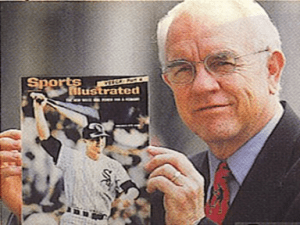
Pete Ward hoists the Sports Illustrated cover on which he would have appeared if not for some guy named Muhammad Ali in 1965.

Trivia time: Name the only major league third baseman who ever got knocked out by Muhammad Ali. The answer: Pete Ward. With a real phantom punch.

No, Ward wasn’t foolish enough to step into the ring against Ali. Ward was supposed to be a 1965 cover star when Sports Illustrated planned a cover story on the White Sox’s pennant hopes. Until he wasn’t.

“They just got the pictures there in time to do it,” said Ward—who died at 84 on 16 March—to interviewer Mark Liptak in 2003. “Sports Illustrated did send me some of the covers that were supposed to have me on it though.”

Ali-Liston II put paid to that idea. Ward eventually kept one of the covers’ prints in his office at his post-baseball travel agency, signing another and giving it to the magazine’s vice president for communications, Art Berke.

When a story about Ward’s death was posted to a Facebook baseball group, one commenter made a remark about “nobodies” being hoisted. Well, now. A guy who finishes a tight second to a White Sox teammate in the 1963 American League Rookie of the Year voting is many things. A nobody isn’t one of them.

Ward was a slick third baseman who was actually worth more wins above replacement level than the infielder who bagged the 1963 National League Rookie of the Year award—a kid named Pete Rose. (Ward: 4.1; Rose: 2.4.) If only his teammate Gary Peters hadn’t led the American League with his 2.33 ERA that season.

If it hadn’t been for an April 1965 auto accident that left him with neck and back trouble, Ward might have put up better than a nine-season playing career otherwise. Over his first two full seasons, Ward averaged 33 doubles, five triples, 24 home runs, and a .478 slugging percentage; over his final six: eighteen, two, thirteen, and .364.

The accident that changed the trajectory of Ward’s career happened after the White Sox returned to Chicago following a rainout in Washington. As Ward told Liptak, he managed to score tickets for a Chicago Blackhawks hockey game for himself and pitching teammate Tommy John. It was after the game that the accident occurred:

[A]s we were leaving, I was in the front seat on the right side and Tommy was in the back seat on the left when a car rear-ended us. At the time I didn’t think that much about it, it wasn’t really that hard of a hit but the next day I woke up with a stiff neck and was sore all over. I went to see a doctor and he told me I had a case of whiplash and it bothered me the rest of the year. It just caused a lot of problems for me. Tommy also had neck problems.

As Ward told SI in due course, “I was never comfortable from that point on.” More than his batting numbers bear him out. He’d been worth eighteen defensive runs above his league average in 1964; he remained a plus defender at third in 1965 but he was worth eight such runs above league average for that season. He divided defensive time between the outfield, third base, and first base the rest of his career.

“I preferred third base,” Ward told Liptak, laughing, “because I was a bad outfielder!”
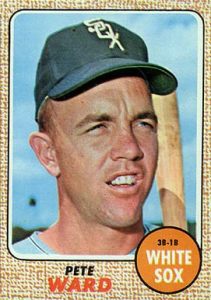
Pete Ward

As a boy, your chronicler usually opened packs to find several Pete Ward baseball cards a year during Ward’s White Sox years; this was Ward’s 1968 card.

Chicagolander though I wasn’t, I’d had a particular affinity for Ward when I was growing up in the 1960s. It seemed that his baseball cards were almost ubiquitous; I could guarantee that out of my first three packs of Topps cards on the year, there’d be at least one and maybe three Ward cards among the bunch.

Ward was an Orioles discovery with a 1962 cup of coffee for Baltimore, before he was traded to the White Sox prior to spring training 1963. Quite a trade. The White Sox sent the Orioles Hall of Fame shortstop Luis Aparicio and veteran outfielder Al Smith; the Orioles sent Ward, Hall of Fame relief pitcher Hoyt Wilhelm, shortstop Ron Hansen (the American League’s 1960 Rookie of the Year), and spare outfielder Dave Nicholson.

In his memoir Safe By a Mile, then-White Sox scout/coach Charlie Metro remembered pushing then-White Sox manager Al Lopez that Ward be included or there’d be no deal:

I insisted on Pete Ward coming over to the White Sox in a deal with Baltimore because I had worked with Pete out in Vancouver. He was a pretty good hitter. He was very aggressive. He loved to play, quite a cocky kid. When the White Sox had a chance to make the trade, I said, ‘Make them throw Pete Ward in the deal. He can play, he can hit.’ Al Lopez said, ‘Well, what kind of fielder is he?’ I said, ‘Well, he’s not too good a fielder, but if you hit him a thousand ground balls at third base, he’ll do pretty fair. But he can hit, and he can drive in runs and has some power. Don’t make the deal unless you get Pete Ward.

Ward’s White Sox life ended when he was dealt to the Yankees in December 1969. Then in the middle of their Lost Decade (1965-75), the Yankees got only a shell of Ward’s former ability and released him in March 1971. But they respected Ward’s baseball mind enough to make him the manager of their Fort Lauderdale (A) farm team; he managed them to the league championship in 1974.

Ward managed two other Yankee farm teams, plus a White Sox farm team, before he left baseball to work for Miller Brewing before he opened his own successful travel agency in the Pacific Northwest, to which his family had originally moved during his childhood. The Montreal native—and son of 1935 Stanley Cup-winning Montreal Maroons right wing Jimmy Ward—was elected to the Canadian Baseball Hall of Fame in 1991.

Known as much for a good sense of humour as anything else, Ward proved sanguine about his missed SI cover. “You know,” he said to SI writer Richard Deitsch at the turn of the century, “Ali was on something like forty covers. It would have been nice if he could have let me be on just one.”

God willing, Ward met Ali in the Elysian Fields and said, “You knocked Liston out with your fist, but you knocked me out with a phantom punch!” Ward’s otherwise bereft wife, children, and grandchildren surely settle proudly for knowing Ward was always their cover guy.
What the Yankeegate letter won’t do

Affirming the 2017 Yankees as cheaters won’t exonerate or excuse that year’s Astros or the next year’s Red Sox.

Remember the somewhat infamous admonitory letter from commissioner Rob Manfred to Yankee general manager Brian Cashman, regarding proof that the Yankees were up to some 2017 electronic sign-stealing of their own? The letter the Yankees have fought to suppress with the same ardor as they exercise trying to break a decade-plus World Series ring drought?

The Yankeegate letter’s going to come forth in a fortnight, ESPN says. We’re going to learn at last whether Manfred told the whole story of any such Yankee panky or, if he did, just what it actually involved, other than the once-infamous dugout phone/Apple watch slap on the wrist. It only took two years from the day federal judge Jed S. Rakoff ordered the letter unsealed and disclosed to the public with minimal redaction.

Maybe it was only the dugout phone and/or the Apple watch. Maybe it included the Yankees trying to get cute using a television broadcast camera/monitor for a little extracurricular intelligence gathering. Maybe it included the Yankees operating a replay-room reconnaissance ring similar to that known to have been run by Red Sox players in 2018. Maybe.

The bad news, at least for the DraftKings fantasy baseball group, is that releasing the Yankeegate letter won’t reinstate their $5 million lawsuit over Astrogate and Soxgate and aimed at both those clubs plus MLB itself. The worse news is that, whatever is or isn’t in the Yankeegate letter, it won’t take the 2017-18 Astros especially, or the 2018 Red Sox as well, off the hook.

Memory summons back that some around the Astros—and no few of their fans—believed to their souls that high-tech sign-stealing was prevalent enough that they would have been left in the dust if they didn’t think about a little such subterfuge themselves. Mostly, it involved replay-room reconnaissance. The Red Sox got bagged for it over 2018, but few pretended they were the only team with that kind of spymanship.

The Rogue Sox and their fellow replay-room spies, whomever they were, still required a little of the old-fashioned gamesmanship technique: their pilfered intelligence was useless unless there was a man on base to receive it and thus signal it to the man at the plate. That doesn’t justify, either. Sign-stealing from the basepaths or the coaching lines is one thing. Picking it off replay monitors is something else entirely.

But those rooms were provided by MLB itself, to the home and visiting teams in each ballpark. Expecting them to be there without one or another team giving in to the sign-stealing temptation was (I repeat, yet again) something like Mom and Dad making off for a weekend getaway without the kids and leaving the liquor cabinet keys behind.

The 2017-18 Astros took it quite a few bridges farther. For one thing, a front office intern created a sign-stealing algorithm (Codebreaker) that he warned was legal to use before and after games but not during games, a warning then-general manager Jeff Luhnow pooh-poohed while fostering a since-exposed organisational culture in which, to be polite, human decency, never mind honest competition, was seen as an encumbrance.

For another thing, there was that little matter of either an existing camera altered illegally from its mandatory eight-second transmission delay; or, a second, illegally deployed real-time camera. Either or both of which sent signs to be deciphered from an extracurricular clubhouse monitor and then transmitted to Astro hitters with the infamous trash can bangs.

Nobody with credibility says the replay-room reconnaissance rings were right. And nobody with credibility should ever say those rings made the 2017-18 Astros less guilty. As things turned out, the Astros had such a broad reputation inside baseball for their kind of cheating that their 2019 World Series opponents took themselves to extraordinary lengths to thwart it.

No, the 2019 world champion Nationals didn’t build their own extralegal closed-circuit television spy network. They merely provided every one of their World Series pitchers with five individual sets of signs each to switch up in a split second’s notice, with their catchers provided wrist-band cards featuring every one of those sign sets just in case.

Whataboutism is no defense whether you’re a rogue police officer, a corrupt politician, or an illegal off-field-based electronic sign-stealing cheater. The Astros couldn’t just whatabout their Astro Intelligence Agency and get away with it in the public mind. Nor could the Rogue Sox whatabout it when their 2018 edition was exposed for replay-room reconaissance cheaters.

The Yankees won’t be able to whatabout it if the infamous letter shows their 2017 edition to have been replay-room or broadcasting-camera cheaters, either. But we’ll have to wait at least a fortnight before we know at least some the rest of the Yankeegate story.

The Twins deliver a stunning signing: Carlos Correa

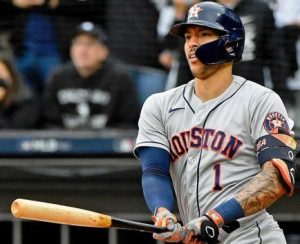
Carlos Correa

Almost nobody expected the longtime Astros shortstop to sign with the Twins.

It’s hard to look at Carlos Correa signing with the Twins for three years and $105.3 million without knowing the Astros’ remaining Astrogate contingent is reduced officially by one. There are now only three position players and one pitcher remaining from the tainted 2017 World Series winners.

This should be good for the Astros in terms of leaving the Astrogate taint further and further behind them. But I suspect it won’t be. With only four Astrogate-team members left last year, the Astros still heard it loud and long from fans on the road. Some of it was mere booing, catcalling, and “chea-ter!” chants. Some of it was inflatable and actual trash cans hitting fields.

I still suspect it’s not going to stop until the last Astrogater standing no longer wears an Astro uniform. Not until second baseman Jose Altuve (who actually didn’t partake all the way in the Astro Intelligence Agency’s 2017-18 off-field based, illegal camera-abetted, electronic sign-stealing operation), third baseman Alex Bregman, first baseman Yuli Gurriel, and pitcher Lance McCullers, Jr. move to other teams if not into retirement.

As it happens, I have tickets for what will now be Opening Day, period, in Angel Stadium on 7 April. Guess who the Angels host to start their regular season. My son and myself will probably wonder en route the ballpark how many other Angel fans will turn up with inflatable trash cans, bangable trash cans, and more to continue letting the Astros have it.

It took decades before the 1951 New York Giants were verified once and for all as off-field based sign-stealing cheaters en route the comeback that forced the fabled pennant playoff. It took only two years from the 2017 World Series to expose and verify the AIA. And it took only a couple of hours during the pandemically-aborted 2020 spring training for the Astros to show the world they didn’t quite think their cheating was that big a deal.

Correa since the infamous spring training 2020 presser has been maybe the most stubborn defender of the Astros’ 2017 Series title. “When you analyze the games,” he said before the coronavirus closed that spring training and half the season to come, “we won fair and square. We earned that championship.”

Funny, but that’s not exactly what Correa said at the infamous presser. While Astros owner Jim Crane tripped over himself, Bregman tossed word salad, and since-gone outfielder Josh Reddick “couldn’t really say [the AIA operation] did or didn’t” give the Astros an advantage, Correa said, essentially, not so fast:

It’s an advantage. I’m not going to lie to you. If you know what’s coming, you get a slight edge. And that’s why [then-general manager Jeff Luhnow and then-manager A.J. Hinch] got suspended and people got fired because it’s not right. It’s not right to do that. It was an advantage. But . . . it’s not going to happen moving forward.

After the Braves nailed last fall’s World Series at the Astros’ expense, Correa spoke in terms that would have made him a fit on the 20th Century Yankees.

Second place is not good enough for us. I know it’s not good enough for you guys. But it speaks volumes of how good our organization is, how talented our clubhouse is. Five ALCS in a row. Three World Series in five years. I don’t know what else you want to ask from a great ball club . . .People expect greatness when you talk about the Houston Astros. They expect us to make the playoffs every year. They expect us to be in the World Series every year.

But the only one they won is the one that just so happens to be tainted.

And, speaking of the Yankees, take a poke around the vast multitudes that root for or at least follow them and it seemed as though the number one thought in and out of their minds Saturday morning was, How on earth could the Yankees miss out on signing Correa? Did they really take Josh Donaldson’s contract on in that trade with the Twins just to let the Twins snatch Correa with the savings?

Others thought Correa outsmarted himself into taking considerably less with the Twins than he thought he might get on a market that got forced into overdrive thanks to that ridiculous owners’ lockout. But he’ll pull down the fourth-highest single-season salary of 2022, behind pitchers Max Scherzer (Mets) and Gerrit Cole (Yankees) plus outfielder Mike Trout (Angels).

The deal also includes opt-outs after this season and next. Turning 28 in the final third of this coming September, and assuming he has a typically Correa season in Minnesota, he could still opt out and play next winter’s market for something more to his supposed liking. Maybe he didn’t really outsmart himself, after all?

Maybe the Yankees still have a spring surprise yet to play. They unloaded Gio Urshela (shortstop) and Gary Sanchez (catcher) to bring Donaldson (third base), Isiah Kiner-Falefa (shortstop), and Ben Rortvedt (catcher) aboard. Maybe they have Kiner-Falefa in mind to play support after they sign free agent shorstop Trevor Story? Maybe?

Or maybe the Twins have decided, yes, they’re coming into it to try to win it, including enticing the shortstop anchor from the penthouse of the American League West for a season at least. Maybe they can make Correa happy in the Twin Cities, after all.

Maybe he can join his fellow high 2012 draft pick Byron Buxton (Correa and Buxton were numeros uno and two-o in that draft) to yank them from the basement to the penthouse. He did prove last year that he knows how to win without any funny business that anyone knew of, even if the Astros came up two bucks short in the World Series.

‘[T]he makings of a formidable lineup are present in Minnesota, though they’ll need a few things to break right,” writes MLB Trade Rumors’s Steve Adams, who also notes their “patchwork starting [pitching] rotation” remains a cause for some alarm even with trading for Sonny Gray from the apparently tanking Reds.

From the defensive side of things, Correa gives the Twins a pair of Platinum Glove winners, joining Buxton in that regard. With quality defenders like [Max] Kepler, Urshela and young catcher Ryan Jeffers also occupying key spots on the diamond, the Twins should have a strong defensive team overall. The Twins already ranked 12th in the Majors both in Defensive Runs Saved and Outs Above Average in 2021, and Correa should boost both marks.

There’s something else Correa could do now that he’s become a Twin, too. Something not exactly unprecedented. He could become the latest 2017 Astro to drop all pretenses, denials, and whataboutisms, and come a lot cleaner about Astrogate.

That began with utilityman Marwin Gonzalez, who signed with the Twins as a free agent for 2018, then with the Red Sox as a free agent for 2021, got released by the Red Sox last August, and signed to return to the Astros for their run to the World Series.

Gonzalez broke the ice around the time of the infamous 2020 Astro presser. “I’m remorseful for everything that happened in 2017,” he told reporters, “for everything that we did as a group, and for the players that were affected directly by us doing this.”

He, too, didn’t use the C word. Maybe it’d be too much to expect Correa to use it, too, if he decides it’s safe to come all the way clean now. But it would give him a better look either way than the one he often had clinging stubbornly to the idea that the 2017 World Series title wasn’t really tainted.

Freeman gets the sixth year he wanted—from the Dodgers

Freddie Freeman

Freddie Freeman, crossing the plate after hitting what proved last fall’s NLDS-winning home run gainst Josh Hader and the Brewers. The Dodgers now give him what the Braves wouldn’t.

Freddie Freeman got what he wanted most . . . from the Dodgers. A sixth year on his next contract. The dollars are nothing to dismiss at $162 million total and $27 million annual value. And Freeman now has the pleasure of playing for the team stationed about an hour away from where he grew up in southern California.

The Dodgers weren’t the only team in play for Freeman if the Braves inexplicably and falsely decided they couldn’t afford to give him the sixth year he wanted. The Padres had eyes for him. So did the Blue Jays. So did the Red Sox. Aside from the benefits the Red Sox would have reaped from Freeman’s hitting and leadership style, there’d have been another mad fun factor.

The Yankees re-upped Anthony Rizzo after all on a fresh deal. Rizzo and Freeman have a long-standing friendship that translates now and then to deliciously hilarious moments on the field together. Especially Rizzo, sent to pitch to Freeman while the Braves were blowing the Cubs out last April, striking Freeman out swinging on five pitches in the bottom of the seventh last April.

The laughter between the pair was priceless. In the thick of the usual Yankee-Red Sox rivalry, it would have been much needed levity if the Yankees might be blowing the Red Sox out and Red Sox manager Alex Cora could have ordered Freeman to the mound to pitch to Rizzo; and, if Freeman could have exacted friendly revenge by striking Rizzo out.

So much for fields of dreams. Right now that sound you hear is Dodger fans crowing, “We had him all the way!” From the moment Freeman hit his first free agency after his Braves won last year’s World Series, you couldn’t swing a bat without it smashing into the hind quarters of a Dodger fan believing to his or her soul that a Dodger uniform would be the next wardrobe addition for the native of Villa Park, California, just a few miles east of Anaheim.

From the same moment, though, you couldn’t swing a bat with it smashing into the hind quarters of a Braves fan praying from his or her soul that the Braves, somehow, some way, would do right by the franchise face who’d done nothing but right by them from the moment he first turned up at first base in Braves’ silks.

Then, during the owners’ lockout, when Braves owner Liberty Media’s 2021 financials were released as mandatory for a publicly-traded corporation, you saw just the Braves’ considerable 2021 revenues and very considerable 2021 profit. And you realised any talk of the Braves being “unable” to afford to make Freeman a Brave for life was a shameless lie.

This Braves ownership couldn’t bring itself to do what a previous Braves ownership did whenever Hall of Fame third baseman/former franchise face Chipper Jones came to within striking distance of free agency, get him extended or signed to a coming new deal before he could hit the market, knowing Jones’s baseball heart remained with them.

This Braves ownership preferred to spend less on an import first baseman, four years younger than Freeman, dealing for him a day before extending him eight years and $168 million worth. Matt Olson won’t earn per season what Freeman will, and he may well shake out as essentially the Braves having swapped a Freeman for a Freeman Redux. May.

But the Braves’ corporate overlords sent the message clear enough and shameful enough: The only ones in baseball expected to be loyal are the players. Just the way they always were. This isn’t purely a free agency era thing, and anyone who says otherwise either needs a refresher in baseball history or is too willfully blind to allow it.

Have a good gander at the roll of Hall of Famers whose careers were entirely or mostly in the reserve era, the era before Andy Messersmith finally finished in 1975 what Curt Flood began in 1970. Those would be players elected before 1980. There are 127 of them. Now: 89 played for two teams at minimum; fourteen played for five teams at minimum. That would leave you with (count them) 24 single-team Hall of Famers from the reserve era.

Let’s look at the Hall of Famers elected after 1980, men whose careers careened into the free agency era or who played all or most of their careers during the era. There are sixteen such single-team Hall of Famers—including Jones. The free agency era has yet to surpass the reserve era for length, so it’s fair to say that both eras sent an equivalent portion of single-team players to Cooperstown.

What Joe and Jane Fan and no few writers (who really ought to know better) still forget is that, during the reserve era, players had absolutely no say in where they played, and owners could and did trade or sell them at will, and not always for reasons that made purely baseball sense.

Fans and writers alike have broadened their view in recent times, appropriately. You could see more than the fans and writers fuming over the owners’ lockout before it was finally resolved and baseball could get back to the serious work of play.

You could see them fume over the prospect that the Braves would do exactly as they did, declaring expendable the guy who stayed the course from the lows to the competitive highs, all the way to their first World Series triumph since the Clinton Administration. If the Braves wouldn’t give Freeman the sixth year he wanted, the Dodgers were only too willing.

That’s going to be some packed Dodger lineup coming your way. With a small pack of All-Stars including five-timer Freeman. With a small pack of MVP winners, including Freeman, apparently resurgent Cody Bellinger, and Mookie Betts. With Trea (The Slider) Turner acquired at last year’s trade deadline now able to play his natural position at shortstop following Corey Seager’s free agency departure to Texas. With aging but still effective future Hall of Famer Clayton Kershaw re-upping for 2022 at least.

If Olson gives the Braves both solid performance on the field and at the plate, and proves to be a solid clubhouse presence, that might take some of the sting of losing Freeman away. Some. Olson knows he might “succeed” Freeman without truly “replacing” him. Returning Ronald Acuna, Jr. knows he, too, might “succeed” Freeman as the Braves’ face without truly replacing him.

But if the Dodgers tangle with the Braves in the postseason to come, the Braves may learn the hard way what their ownership’s concept of “loyalty” can cost in more ways than one. May.

Loyalty, in the eye of the beholder, still

Freddie Freeman

Freddie Freeman, hitting his 2021 World Series Game Six home run, but the face of the Braves no more. (Fox Sports screen capture.)

Let’s talk about “loyalty.” But let’s do it reasonably. It never truly existed in baseball, whether during the reserve era or the free agency era. In the former, teams could trade or sell players at will and players had no choice in the matter, but in the latter a player has the right to play his job market once his contract expires.

Today’s players also have the rights to insert into their contracts lists of teams to which they’d consent to be dealt. Often enough, too, their contracts include clauses allowing them to opt out of their incumbent deals and test their markets a little earlier.

Joe and Jane Fan often still think it’s the players who’ve lost the meaning of the word “loyalty.” They need reminders that players learn or re-learn that loyalty is too often in the eye of the beholder, especially among their employers. The defending world champion Braves just handed them a beauty of a reminder.

Their franchise face since around 2011 (when he finished second to his then-teammate Craig Kimbrel as the National League’s Rookie of the Year), Freddie Freeman remains an unsigned free agent, albeit one whose heart and soul told him there was still no place like home so long as the Braves would do right by him in return for him having done so right so long by them.

The Braves elected instead to trade for another first baseman, Matt Olson, who looks a lot like Freeman on the surface and is four and a half years younger. Then, seeming to add insult to grievous injury, the Braves managed somehow to sign Olson to an eight-year, $168 million contract extension within 24 hours or so after making the deal to make him a Brave in the first place.

Throw in the four prospects the Braves sent the Athletics to make Olson Freeman’s successor, and the Braves paid a phenomenal price for deciding that even Freeman’s attachment to the team by which he’d done nothing but right over his first twelve seasons didn’t necessarily matter when it came to cold, hard business.

All of a sudden, it didn’t matter that Freeman kept the faith as the Braves went from reconstruction to contention to a return to the Promised Land at long enough last. (Until last fall, they hadn’t gotten there since the first year of Bill Clinton’s second term in the White House.)

Signing an eight-year deal to stay the course and stay a Brave, which is just what Freeman did in 2014, he kept that faith during four putrid seasons followed by four of the Braves returning to contention. The climax only began when Freeman parked a Josh Hader service in the left center field seats for what proved the game and 2021 division series win that sent them to the National League Championship Series in the first place.

It finished when Freeman delivered the final two runs of the Braves’ emphatic World Series-winning Game Six triumph in Houston, an RBI double to the back of left center field in the top of the fifth, and a home run bounding off the Phillips 66 porch above Minute Maid Park’s center field in the top of the seventh. And, when he caught the final out of the set as shortstop Dansby Swanson had to throw to first on Astros first baseman Yuli Gurriel’s grounder.

“It’s a situation unlikely to repeat itself,” writes Yahoo! Sports’s Zack Crizer. “Wrack your brain all you want, and you probably won’t come up with a star who bridged a rebuild quite like Freeman. He was an established, nine-figure extension-worthy player when the Braves blew it up. And he was an established, nine-figure free-agent-to-be when their reincarnation reached the pinnacle.”

And he climaxed the Braves’ improbable self-resurrection from midway last year—when their entire outfield needed to be rebuilt on the play—to hoisting one of commissioner Rob Manfred’s pieces of metal when it all ended with a flourish.

Those comparing Olson now to Freeman at the same age might care to examine both over the six seasons and counting of Olson’s career but a little deeper than normal. Like Freeman, Olson can hit and slug. Olson’s a slightly better defender at first base, but if you measure them according to my Real Batting Average metric—total bases + walks + intentional walks + sacrifice flies + hit by pitches, divided by total plate appearances—there’s a decent size gulf between them:

Player, 2016-2021 PA TB BB IBB SF HBP RBA
Freddie Freeman 2868 1370 362 62 15 33 .642
Matt Olson 2369 1046 272 25 14 35 .588

A 54-point gulf between them. In fairness, though, Olson spent his first six seasons with a none-too-great home park in which to hit, and he’s been measurably better on the road so far. Freeman has been practically the same hitter at home or on the road over his career thus far. But give Olson a park like Freeman’s Truist Park in which to hit at home, and he would get a lot, lot closer to Freeman’s performance papers.

So maybe, big maybe, in pure baseball terms the Braves switched a Freeman with a Freeman. If so, why on earth do it in the first place when it involves not just one of the game’s elite first basemen but a still-young man who was only too happy and proud to wear the Braves uniform and would have loved nothing more than to wear it to the end of his playing days?

The Braves are said to have offered Freeman five years to come, and Freeman is said to have wanted the sixth. Adjusted for inflation, Freeman’s now-expired eight-year extension equals the one Olson has now signed. As Crizer observes dryly, the Braves basically signed a slightly younger Freeman.

But Olson’s not Freeman redux just yet. We don’t know what kind of clubhouse cred Olson will prove to develop as a Brave. Freeman had such cred to burn. Assorted now-former Freeman teammates spoke of losing him as just about a death in the family, about losing a guy who wasn’t just a game or season-changing player but a guy who reached to pull everyone else up with him.

What of Freeman’s age? Well, now. He probably has a better chance of keeping his formidable bat for the entire eight seasons to come than his legs and reflexes at first base. The designated hitter becomes permanent in the National League this year. It’s entirely conceivable that the Braves re-signing Freeman for just the six years he sought meant they’d keep a quality first baseman for its first four and still have a quality DH over the final two.

Even general manager Alex Anthopolous sounded as though he’d made the Olson deal at all but gunpoint. In the wake of revelations that the Braves’ owners, Liberty Media, generated such revenues and profit last year that put the lie to the owner-side pleas that investing in baseball isn’t investing profitably, it sounds even more now as though, to the Braves, loyalty was about as valuable as Major Strasser described human life in Casablanca.

Olson to his credit isn’t even thinking about trying to “replace” Freeman. “I’m just going to go out there and do what Matt Olson does,” he told the San Francisco Chronicle. So far, so good, for him, never mind that you can’t remember Freeman ever referring to himself in the third person.

But do you think they’re going to love Freeman’s clubhouse embrace and his penchant for the lefthanded inside-out swing in Boston? (They need anything resembling a quality first baseman who can hit.) In San Diego? (They’re unafraid to spend and they’re shopping incumbent Eric Hosmer, who’s no Freddie Freeman and has barely been an Eric Hosmer since leaving Kansas City.) In Toronto? In Los Angeles?

Freeman meant enough to the Braves, their fan base, and even the opponents who respected and, yes, enjoyed him, but they meant something to him, too.

“We’d lost 97 games six years ago. And we’re looking at four straight division titles [since] and a world championship now,” Freeman said in a television interview right after the World Series ended in triumph. “It’s just a testament to this organisation, the guys they brought in, the front office, they pushed all the right buttons and we played so well for the last three months . . . Being in this organisation means everything to me . . . Everyone knows this is a crazy game, a crazy business, but everyone knows where my heart is, and this is the Atlanta Braves.”

The Olson deal sealing Freeman’s future away from Atlanta reminds one who was there of the manner in which a certain university president, destined to become a baseball commissioner, nailed how Mets fans felt when contentious negotiations (and scurrilous media attacks) turned into the unceremonious purge of a certain Hall of Fame pitcher in 1977:

[A]mong all the men who play baseball there is, very occasionally, a man of such qualities of heart and mind and body that he transcends even the great and glorious game, and . . . such a man is to be cherished, not sold.

Or, left to the waiting arms of another team for whom those very qualities of heart, mind, and body might mean another trip to the postseason that includes another lease upon the Promised Land.