Opening Day: Cross it off the bucket list

Shohei Ohtani

Shohei Ohtani, shown on the Angel Stadium video board during his pre-game warmup as the teams lined up on the foul lines, on Opening Day. He pitched brilliantly but in a lost cause, the Angels losing 3-1.

The owners probably won’t stop by to see what I’m about to write, but their otherwise ill-advised 1 December-10 March lockout did me one solid. But only one.

After the World Series, and as soon as they went on sale, I’d bought tickets for what I thought would be the Angels’ home opener. They were scheduled originally to open the season on the road. But commissioner Rob Manfred’s cancellation of the regular season’s first series, in light of the owners’ further goalpost-moving shenanigans, turned the Angels’ home opener into Opening Day, after all.

It wasn’t enough to turn my thinking toward the owners’ side one iota, but it did enable me to cross something off my bucket list. Despite a lifetime of loving the game and watching countless games in the stands and on television, I’d never actually had the chance to be at the ballpark on Opening Day. Until Thursday evening.

The best part of the evening was that I got to do it with my now 28-year-old son, Bryan. The second-best part was being able to cross another item off the baseball bucket list within half an hour of us getting our pre-game food and drink, after putting replica 1972-1990 Angels hats onto our heads.
The Ball

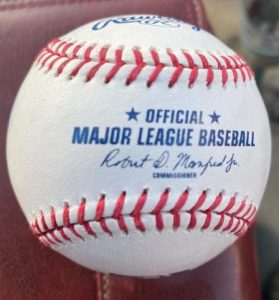
The foul ball, now crossed off my bucket list, sitting atop my notebook, before I handed it to my son.

While the visiting Astros took batting practise, a line drive sailed into our section down the right field line. Adjacent fans made it impossible for me to see just which Astro hit the ball, but the ball bounced around off seats in front of us, then under them, and riocheted off a fan two seats to our right, before rolling on the floor under us to where I could grab the ball before another fan reaching under the seat in front of me did.

I held the ball up to see for myself that I wasn’t seeing or imagining things, then handed it to my son. He’d only been asking to try to catch a ball at Angel Stadium since, oh, the first time I got to take him there—in 2000, when the Angels beat the visiting Yankees one fine evening by prying the winning run out of The Mariano himself. We’d gone to plenty of games since. Thursday night, it was pay dirt at long enough last.

Of course, there was now a game to play, and the Angels lost, 3-1. These are my ten takeaways:

1) Shoh-time! The good news for the Angels was Shohei Ohtani starting on the mound. I’m convinced that what looked to be a lockout-dejected, ho-hum crowd in advance, shot into a near-sellout once Ohtani was announced as the Opening Day pitcher. Lockout after-effect, I suspected: I’d checked the ticketing for the game just prior to the announcement and there were several thousand seats remaining for the taking.

Well, now. The day before I set out for southern California from my home in Las Vegas, I checked the ticketing again. The tickets seemed to have flown off the board once Angel fans knew it would be Shoh-time. And Ohtani didn’t disappoint, much. He pitched four and two-thirds innings of one-run, nine-strikeout, four-hit, one-walk baseball.

The best the Astros could do against him was the third inning, after he caught Martin Maldonado looking at strike three and blew Jose Altuve away with a swinging third strike: Michael Brantley banged a double off the right center field fence and Alex Bregman sent him home promptly with a base hit to left center.

As a matter of fact, when Ohtani wasn’t becoming the first player in Show history to throw his team’s first pitch of the season and make his team’s first plate appearance of the season (the Angels like to bat him leadoff), he manhandled Altuve for three strikeouts on the night, including the nasty slider that shot over Altuve’s hard swing for the third such strikeout in the top of the fiftyh.

2) The bad news: Astros starter Framber Valdez was just as effective in six and two-thirds innings. (The Angels planned to keep their starting pitchers on an 80-pitch limit for the time being, after the lockout-imposed too-short spring training.) He struck six out, walked one, and surrendered two of the Angels’ four hits on the night.

3) The worse news, for the Angels: They came to within inches of taking a 2-1 lead in the seventh. Mike Trout led off by beating out a throw from shortstop that should have been ruled an infield hit but was ruled an error. Then Anthony Rendon hit a high liner that sailed into the left field seats . . . but missed the foul pole on the wrong side by a hair.

“When I saw the ball flying in the air,” Valdez said post-game of his narrow escape, “I got mad with myself that I didn’t make my best pitch. I just took a deep breath and threw my best pitch.” That would be the hard sinkerball on which Rendon promptely dialed Area Code 4-6-3.

Matt Duffy promptly beat out an infield hit to third, which promptly moved Astros manager Dusty Baker to end Valdez’s night and bring Phil Maton in to strike Jo Adell out swinging for the side.

4) Cruising speed: Maton seemed on a bit of a cruise in relief until he hit Brandon Marsh with a pitch with two out in the bottom of the eighth and David Fletcher shot a 1-2 pitch through to the back of left center and gunned it for an RBI triple. That was the Angels’ first and last run of the game, alas.

5) The worse news, for baseball as a whole: That ridiculous three-batter minimum for relief pitchers. Under normal circumstances, if your reliever comes into the game and gets murdered right away—as Angels reliever Ryan Tepera was in the top of the eighth—you’d know he didn’t have it that night, right?

Father and son

Father (right) crossed Opening Day off his bucket list at last—and had the pleasure of doing it with his 28-year-old son.

Oops. Tepera’s first pitch to Alex Bregman sailed into the left field seats. The next Astros batter, Yordan Alvarez, hit a hanging slider on 1-1 over the center field fence. The Angels were lucky to escape with their lives after two prompt deep fly outs (Yuli Gurriel, Kyle Tucker) followed by a sinking liner up the middle (Jeremy Peña) that Trout caught on the dead run in from somewhat deep center to retire the side. (Trout also drew a loud ovation after he turned around and, from half-shallow center, winged the ball to fans halfway up the right center field bleachers.)

6) But there was good news on the relief front. Neither manager burned his relievers in the bullpens. If either Baker or Joe Maddon warmed a pitcher up, he either came into the game as soon as needed or he was handed what amounted to the rest of the night off. No Angels or Astros reliever was called upon to warm up more than once.

I paid as much attention to the relievers in the pen as I could, considering I was seated far opposite the pens behind the left field fence. The Angels used five relievers and the Astros, three. None of those eight pitchers threw any more than maybe 20-25 pitches before they were brought into the game. None of them could be called gassed going in.

Tepera simply didn’t have it Thursday night; Maton got vulnerable after ending one inning and getting two outs to open the next. The rest of the two teams’ bullpen corps (Hector Neris and Ryan Pressly for the Astros; Aaron Loup, Austin Warren, Jose Quijada, and Archie Bradley for the Angels) pitched clean-as-a-hound’s-tooth relief. Would that all major league managers were that judicious handling their pen men.

7) Memo to: Angel fans. Subject: The Wave. The 1980s called. They want their obnoxious, obstructive Wave back. One fan adjacent to our section kept calling for fans to do the Wave. I kept shaking my head, but I did notice that each of about ten attempts at it starting in our part of the park died before flowing to a fourth section of the field-level seats. Maybe there’s hope in such deaths, after all.

8) You were saying? The back-to-back Astro bombs to one side, this game wasn’t exactly the kind to send the old farts screaming to the whiskey shots. The game’s twelve total hits included three Astros doubles, Fletcher’s triple, and six singles. Altuve even stole second in the ninth, for whatever that was worth, since he ended up stranded.

9) Wasted Out Department: Altuve, the Astros’ pint-sized, gallon-hitting second baseman, also dropped a sacrifice bunt to third with one out in the seventh against righthanded reliever Warren, after Chas McCormick opened the inning with a double. Remember: A man on second with one out, and you have less chance of scoring a run after that bunt than you did before the bunt, even if you do exactly what Altuve did pushing McCormick to third.

Just what a man with a lifetime .512 Real Batting Average (total bases + walks + intentional walks + sacrifice flies + hit by pitches, divided by total plate appearances), and a .297 lifetime hitting average with a man on second and one out, is doing thinking sacrifice escapes. With his team leading a mere 1-0 at the time, the Angels brought Quijada in to pitch to Brantley, and Brantley flied out shy of the track in right center for the side.

That’s what a wasted out did. The righthanded-hitting Altuve might have been futile against Ohtani on the night, but he has a lifetime .301 hitting average against righthanded pitchers. The Astros would have had a better chance scoring McCormick if Altuve hit away.

10) When Bregman checked in at the plate in the top of the eighth, the Angel Stadium video boards flashed a graphic with Bregman’s head shot plus this: [He] donated over 200 iPads  w/protective cases and iTunes gift cards to several Houston-area elementary schools that have autistic classrooms. He does that through his Bregman Cares charity, with a particular focus upon autistic children.

It was almost as admirable for the Angels to show Bregman such respectful acknowledgement as it was for Bregman and his wife, Reagan, to take such an interest in lending hands to autistic children. Even if Bregman’s idea of saying thank you for such respect was to smash a leadoff homer in reply.

The universal DH: “Evidence over ideology”

Bruce Hurst

As a hitter, Bruce Hurst was an excellent 1986 World Series pitcher.

Long before I got religion about the designated hitter, George F. Will did. I didn’t have a specific road-to-Damascus moment, merely a lot of re-thinking based upon a lot of evidence I’d ignored previously. Will’s road-to-Damascus moment came watching Game One of the 1986 World Series, which opened in New York’s Shea Stadium.

The ill-fated Red Sox (weren’t they always ill-fated from 1919 through the end of 2003?) were stripped of their DH playing in the National League ballpark. Their Game One starting pitcher Bruce Hurst was compelled to bat for, possibly, the first time since high school during the Ford Administration.

From the moment the Red Sox drafted Hurst in round one, 1976 draft, until that World Series game, he had exactly one professional plate appearance, in the minor leagues—and struck out. Now, in his first three major league plate appearances, Hurst struck out three times. Permit me to remind you of those three plate appearances.

Top of the third, two outs, against Mets starter Ron Darling: Three pitches, three swings, one strikeout, and one home plate umpire, John Kibler, laughing his fool head off over the absurdity of it.

Top of the fifth, two outs, a man on first (Dave Henderson, after a one-out base hit up the middle), also against Darling: A slightly miraculous 2-2 count, then swinging strike three. Runner stranded.

Top of the seventh, two outs, against Darling yet again: Well, what do you know. With Red Sox catcher Rich Gedman on second, after his grounder to second resulted in Hall of Famer Jim Rice scoring on an errant throw home, Darling walked shortstop Spike Owen—a .231 hitter on the regular season, but a .429 hitter while the Red Sox won the American League Championship Series—to pitch to Hurst.

After his well-reported harrumphing, “I’m serious,” Hurst on 1-2 swung and missed. Kibler really couldn’t help himself that time.

“Umpires are carved from granite and stuffed with microchips,” Will wrote then. “They are supposed to be dispassionate dispensers of Pure Justice, icy islands of emotionless calculation . . . Nothing that causes such a collapse of decorum can be in the national interest.” Neither was yet another rally killed by a pitcher with a pool noodle bat, in a game in which the unearned run Rice scored off the Gedman grounder was the game’s sole run.

A veteran ESPN writer, Tim Kurkjian, laments the advent of the universal DH because we will have a little less “magic” in the game: “The universal DH, for all of its uniformity, practicality, and Shohei Ohtani, saddens a small few of us, for it eliminates one of the game’s underappreciated elements: pitchers hitting, or not hitting, which, for 150 years, has provided great statistics, stories and smiles.”

Kurkjian’s roll of outliers—and, Ohtani to one distinct and extremely-extreme outlying side, outliers is what they are—kicks off with Michael Lorenzen, for seven years a Reds relief pitcher until signing as a free agent with the Angels last November. As pitchers go at the plate, Lorenzen is an outlier with his .233/.282/.429 career slash line at the plate. In 2018, he hit .290, and the entire 2018 Reds pitching staff hit .101.

Three years ago, as Kurkjian celebrates nostalgically, Lorenzen pitched and was credited with a pitching win, hit a two-run homer, and played center field in the same game, against the Phillies on 4 September.

Lucky for him. What Kurkjian omits is that Lorenzen got positioned for a win credit only because he’d served Jay Bruce a 1-2 pitch meaty enough to hit over the center field fence and tie the game at five in the top of the seventh. Lorzenen got the next five outs before getting to bat with a man on in the bottom of the eighth and hit Phillies reliever Blake Parker’s first service into the left center field seats.

You saw that how many times a season? A decade? A century? From how many members of the collective class that (ha! you thought you’d avoid me saying it one more time) has hit .162 from the end of the dead ball era’s final decade through the end of last season?

Now, riddle me this, and be absolutely honest about it for once: You saw how many more rallies destroyed by a pitcher who might as well have a cardboard paper towel tube on his shoulders when compelled to hit with a man or two on base in the early innings, because he was pitching too well to lift just yet—but rally dead because he struck out swinging or whacked into an inning-ending forceout or double play?

Smugger-than-thou National League-loving “traditionalists”—whose league once introduced carpet baseball, and who forget the DH concept was first conceived by a National League owner—love to harrumph about baseball’s diminishing entertainment thanks to managers bereft of “strategy” with the presence of the DH. Very well.

A lot of the same “traditionalists” kvetch concurrently about the alleged and unentertaining epidemic of strikeouts. (Funny how we hate strikeouts unless the pitchers we root for ring them up.) Guess which batters struck out in the highest percentages of their plate appearances last year? (44 percent.) And, a decade earlier? (37 percent.) That’s entertainment?

The age of analytics presents us with things such as the spectacle of its enemies stuck for answers when asked why they oppose more, deeper, truer  information about the game they profess to love. Long before the age arrived, however, baseball’s best managers did 90-95 percent of their “managing” before games even started.

Military pilots obtain encyclopedic, detailed knowledge of enemies and their aircraft before take off, but no conscientious air group sends them up without their parachutes. The universal DH means no baseball manager equipped with any level of knowledge before a game goes into it with the hole in his parachute that a pitcher at the plate normally proves.

In-game strategy isn’t going the way of the Pontiac yet. Like the military pilot, the manager still faces enough moments with minus one second to make the choice that proves the difference between survival and disaster.

I write as a man who was stubborn enough to ignore the evidence before him for a very long time, on the field and in the records alike. Even while watching pitchers wasting outs with sacrifice bunts that in only one out of six known “bunt situations” leave their teams a better chance of scoring after the bunt than before it. Even while watching nine and a half out of ten pitchers swing bats as if trying to swat flies with single sheets of paper. Even while watching poor Bruce Hurst at the plate in Game One of the ’86 Series.

“The real case for the DH is this: it represents the triumph of evidence over ideology,” Will wrote. “The anti-DH ideology is that there should be no specialization in baseball, no division of labor—everyone should play ‘the whole game.’ That theory is slain by this fact: most pitchers only go through the motions at bat. The DH is a way of facing that fact. It says: only serious batters shall bat.”

No one did what Lorenzen did on that 2019 day that since Babe Ruth did it in 1921. “I have a baseball card with only me and Babe Ruth on it,” Kurkjian quotes Lorenzen as saying. “It doesn’t get any cooler than that.” Reds fans bereft of the entertainment in winning a World Series since just after the death of freshly-retired conductor/composer Leonard Bernstein might beg to differ.

River deep, mountain high, and often still denied

Jean Ramirez

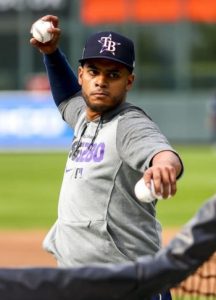
Jean Ramirez, here pitching batting practise—suffering too silently.

My former Call to the Pen colleague/editor Manuel Gómez was emphatic enough about it last Friday, writing of the suicide of Rays bullpen catcher Jean Ramirez. He thinks appropriately that Ramirez should never have had to let his inner despair drive him to death by his own hand.

“In this world, it’s seemingly not acceptable to feel depressed or anxious,” Gómez wrote for Our Esquina. “To feel this way is interpreted as a sign of weakness, a lack of intestinal fortitude. We need to forcefully change that cultural mindset.”

He wrote of both our world as a whole and Latino worlds in particular, worlds he said compelled Ramirez to suffer silently, “smiling on the outside while terribly sad on the inside.”

Unfortunately, this is how we have conditioned ourselves in the Latino community. Pair that with the machismo often found within sports organizations, and it’s a recipe for disaster at times.

Ramirez died about a month before former major league outfielder Jeremy Giambi shot himself to death. Those who knew him in the game remembered Giambi much the way those around the Rays spoke of Ramirez, a fun-loving fellow who gave you the best of his ability and his personality alike.

Giambi “was an incredibly loving human being with a very soft heart and it was evident to us as his teammates that he had some deeper battles going on,” texted former Athletics  pitcher Barry Zito to San Francisco Chronicle writer Susan Slusser. “I hope this can be a wake up call for people out there to not go at it alone and for families and friends to trust their intuition [w]hen they feel somebody close to them needs help. God bless Jeremy and his family in this difficult time.”

Not to go it alone. Easier said than done.

“The loss of our son has been the most excruciating experience we have lived,” Ramirez’s family said in a statement upon their son’s death. “Unfortunately, we sometimes don’t see the signs. Struggling in silence is not OK . . . We are very grateful to the Tampa Bay Rays organization, whom we consider our family, for their love and support. Our son felt loved by all of you.”

You can feel loved by everyone except your own self under the incessant lash of mental illness. But in professional sports you can also feel as though what lashes you is seen by those who profess to love you as evidence that you’re gutless, that you can’t handle yourself playing “a kid’s game,” that you’re even stealing the large money you’re paid to play it.

You can turn it on in the batter’s box, in the field, on the mound, in front of thousands in the ballpark and millions in front of their television sets or computers or tablets. But when you step back into the dugout or the clubhouse, or head for home, you can’t just snap your fingers and turn off whatever lashes you inside your heart, soul, and mind.

The slightest act, the slightest incident, can spin someone into the morass of mental illness without any prior hint, though much of that depends on things such as age, overall maturity, time and place, and the acts of those with powerful influence in a sufferer’s life.

Some such victims can make themselves professionally productive but internally paralysed. Some can’t compartmentalise themselves that way. Even today, knowing and acknowledging more about mental illness that we could and did fifty years ago, knowing or facing it in a loved one, a friend, an admired professional is no simpler than turning on a fastball out-racing a sports car and driving it to the back of the park.

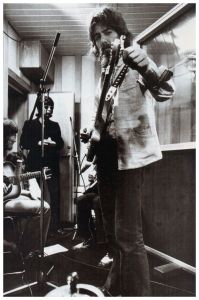
Phil Spector (in sunglasses) with former Beatle George Harrison at a 1972 recording session. Discovering the lie about his father’s death may have triggered Spector’s destructive mental morass.

Fabled music songwriter/producer Phil Spector faced his father’s death during his boyhood, learning only later that what his abusive mother and his family told him of his father’s “accidental” death turned out to have been suicide. His mother often blamed him to his face violently for his father’s death as well; in due course he titled his first hit record (as a late teenager, yet) with the epitaph on his father’s tombstone.

“The most vile word in the language,” Spector once said, having suffered his father’s plus a few friends’ and one child’s deaths, “is dead.”

Who’s to say that grotesque original familial lie didn’t spin the ambitious but too-sensitive Spector into the mental morass that enabled both his monumental music achievements (especially his “Wall of Sound” production style) and his monumental deficiencies as a man, a husband, a father, a collaborator, whose recklessness finally got him convicted of killing a young woman named Lana Clarkson at his home? (Too late in life, Spector may actually have undergone treatment for mental illness.)

While Spector grew up both haunted and driven in the Bronx, its baseball team discovered a prospect with outsize talent and an inability to harness it or himself. John Malangone was found by the same scout (Paul Krichell) who’d previously discovered Hall of Famers Lou Gehrig and Whitey Ford, and the Yankees engaged two Hall of Fame catchers (Mickey Cochrane, Bill Dickey) to groom him as Yogi Berra’s heir apparent. Even Yogi himself pitched in.

Malangone clowned and crashed his way out of a Yankee spring training game without seeing a single major league plate appearance. Only later did anyone learn he’d haunted himself into mental paralysis after the childhood death of his best friend/biological uncle, killed by an infection after being hit inadvertently by Malangone’s own homemade javelin—a tragic accident for which his family demanded silence but he insisted inwardly that there could be no punishment sufficient enough.

It took a friend’s urging decades later for Malangone to see the coroner’s report at last and understand the death was purely an accident for which he held no malicious responsibility. (Gary Smith once wrote deeply, eloquently, and compassionately about Malangone’s dilemna and eventual self-redemption in Sports Illustrated, “Damned Yankee,” republished in his splendid anthology Beyond the Game.)

John Malangone

John Malangone (center) with Hall of Fame catchers Mickey Cochrane (left) and Bill DIckey—a live prospect who punished himself mentally for decades over a childhood death for which he had no true guilt.

He’d worked for both New York City and Sears for decades before finally finding a cautious peace, even pitching well in local baseball leagues populated by older players, and was the subject of 2006’s Long Road Home, before he died last year at 89. What would he have been if he’d been reached decades earlier? We’ll never know.

This week, the Dodgers surprised just about everyone in baseball when they re-signed outfielder Andrew Toles—a diagnosed schizophrenic, who hasn’t played since 2018, whose tortured life includes being in and out of mental facilities, being found asleep behind an airport terminal, and numerous police confrontations. They don’t expect him to play, USA Today says, but “the renewal of his contract will allow him to have access to mental health services and health insurance.”

The Dodgers both surprised and pleased a public often jaded by the shadier sides of baseball as a business. It was both a compassionate and decent thing for the team to do.

Toles—who posted a 1.082 OPS in the 2016 National League Championship Series—is the son of a former New Orleans Saints linebacker who has said he wants nothing more than his son back to live as “normal” a life as possible. “I just want him to have a chance in life,’’ Alvin Toles told USA Today baseball columnist Bob Nightengale last year. “That’s all. Just to be healthy, live a normal life. I’d do anything for my son and my kids, and I know their mother cares a great deal, too.”

Andrew Toles

Andrew Toles—the Dodgers re-signed him compassionately so the outfielder diagnosed a schizophrenic could have access to health care.

“Mental illness is just now getting the attention of people now when it should have been a long time ago,” said his goddaughter Gwendolyn Boyd-Willis. “I can’t imagine what Alvin is going through as a parent. He’s been a phenomenal father.”

Alvin Toles is one parent who sees his son’s despair and tackles it as head on as possible. Black communities and families often fostered their own machismo and struggled to terms when discovering such illness in their children. So did Italian cultures such as those from which Malangone sprang, and Jewish ones such as that from which Spector did.

Yet the elder Toles comes from playing one of the most machismo-drenched of sports and faces, not fudges his son’s disease. For generations prior, such families as those of Malangone and Spector either rejected or denied mental destruction. Ramirez’s and Giambi’s families neither rejected nor denied, they merely couldn’t see their sons’ sufferings, and their sons seemingly couldn’t express them beyond their haunted selves.

“It’s a travesty many Latino families suffer through being unable to properly identify and treat issues of mental health,” wrote my friend Gómez. “Issues with mental health are viewed as signs of weakness. Many folks are shamed into silence, labeled as crazy and forgotten.”

Shamed, or self-driven into an isolation that can and often does end in living death if not premature, self-inflicted death. Don’t waste your time telling such victims to look on the bright side. Those who suffer so would trade any temporal success for a real path to the bright side. And don’t tell them how many people have things worse. It only tells a mental illness victim that he or she doesn’t really matter.

You can insert too many other ethnicities in place of “Latino” and find Gómez’s words applying just as acutely. You can also find—whether speaking of a mental illness victim or of a victim of a mentally ill person—too many other such lives compromised, wasted, and ended needlessly because of it.

“It’s all in your head,” say too many still when a loved one suffers such a paralysing condition.

Little do they truly know. Mental illness for anyone who suffers but, perhaps, athletes and other performers in particular, could be described by the title of the swollen production that drove Spector out of the music business for a spell, once upon a time. River deep, mountain high.

The Edgy Angels?

Shohei Ohtani, Mike Trout

I’m to a point now where I can speak up a little bit. That’s a new thing for me. I just go out there and play. But I think this team needs it . . . There’s a time and a place. If something needs to be straightened out, I’m going to take care of it. That’s a big step for me. I think that step needs to be taken for this team to win.—Mike Trout.

Ask manager Joe Maddon, as The Athletic‘s Ken Rosenthal has, how long he wants to keep managing, and he’ll smile when he says it even if he’s not kidding. “As long as Mick Jagger performs,” the skipper replies. Well, now.

Maddon’s Angels aren’t exactly the Rolling Stones of baseball, even if the team was created three years before the original Stones lineup cut their first record in England. The Angels have had disasters in their midsts, too, but nobody to the best of anyone’s knowledge has been killed during an Angels game. Yet.

There were times over the years when you might have thought the Angels might have wanted to kill a manager or two, if not each other, but no edition of the Angels was ever as willing to fight each other as the 1972-74 Athletics.

For several years, now, two themes have attached to the Angels: 1) They find everything they need except quality pitching. 2) It might be easier to pass the proverbial camel through the proverbial eye of the proverbial needle than to get the Angels back to the postseason before Mike Trout earns the last dollar on his contract. (In 2030, if you’re scoring at home.)

This is a team that’s had the single greatest player of his and many generations (Baseball Reference lists him as the number five center fielder of all time), a guy who plays a solid center field and whose five top comps as a batter through age 29 are, in descending order, Duke Snider, Willie Mays, Vladimir Guerrero (Sr.), Barry Bonds, and Frank Robinson.

And he hasn’t seen even a sliver of a postseason since his Rookie of the Year 2012, through no fault of his own. Trout exercised maybe baseball’s greatest sense of loyalty when he decided to forego his first entry into the free agency market to sign that $330.1 million contract extension just a sliver over two years ago. Questioning the Angels’ loyalty to him—as in, a team their and baseball’s best all-around player could be proud of—was wholly appropriate.

But Rosenthal now gives the Angels two cheers. Not just because the Angels in this abbreviated spring training look healthy and even happy, but because second-year general manager Perry Minasian has impressed the living daylights out of just about everybody in an Angel uniform, from the manager to Trout to all the way down the roster.

“It starts from the front office, the desire to win, the desire to be better every day,” says one of Minasian’s signature signings, former Mets pitcher Noah Syndergaard, a guy who’s been to the World Series and to two postseasons total. “I see a lot of what I saw in 2015, just the overall grit and badass persona, playing with a chip on our shoulder. It’s been a while since the Angels made the playoffs. This is my first year here. The overall tone is they’re kind of all sick of this s—.”

If anyone has credentials to discuss badass personae, it’s the guy who thought nothing of opening Game Three of the 2015 World Series by dropping Kansas City shortstop Alcides Escobar—who’d gotten a little too comfortable at the plate in the first two games—right onto his seat with the first pitch, before striking him out emphatically. Perhaps coincidentally, it was the only Series game those Mets won in a set during which their then-porous defense blew three other games they could have won.

That was then, this is now. Syndergaard isn’t the only Angels pitcher saying they’re sick of all that you-know-what. “I see a bunch of guys that are hungry, that know the pressure is on us,” says young starting pitcher Patrick Sandoval. “Everyone says the Angels’ rotation is a question mark every single year. The guys like me, Shohei [Ohtani] and [Jaime] Barría, we’ve heard it for three years now. We’re kind of sick of it.”

Minasian also did what was once thought unthinkable, never mind undoable in the recent Angels past. He overhauled the bullpen, $92.75 worth of overhaul, keeping closer Raisel Iglesias (2.83 fielding-independent pitching rate last year) on a four-year deal, and guaranteeing former Met/Ray/Padre/Phillie/Blue Jay Aaron Loup (2.45 FIP last year) plus former White Sox/Cub/Jay Ryan Tepera (2.56 FIP) two years each.

The Angels also think that a healthy Trout and Anthony Rendon married to Ohtani’s bat in the lineup makes them a little more formidable at the plate. They may not be wrong. Especially playing under the new rule that allows Ohtani, the defending American League Most Valuable Player, to stay in a game as the designated hitter when his starting pitching assignment ends for the day. Just as he did in last year’s All-Star Game.

Trout is even doing something a little more overtly now that he did only by example his first ten seasons: leading. What he began when he made himself the team’s public face in the shock of Tyler Skaggs’s death in 2019 he’s continuing more verbally than he ever has in the past.

He spoke often of what Skaggs meant as a person as well as a pitcher. (This was well enough before we learned sadly enough that Skaggs was badly hooked on painkillers, a hooking that may have gone back to his Tommy John surgery and may have been abetted by his own agent urging him to pitch through pain regardless.)

Maybe the most staggering and surreal recent memory for Angel fans was their first home game after Skaggs’s unexpected death. When Trout opened the evening’s proceedings against the Mariners with a mammoth two-run homer in the bottom of the first, launching a combined no-hitter (by Taylor Cole and Felix Pena) and a 13-0 blowout.

“When I first came up, I kind of just went out there and played my game, let my game speak for itself,” Trout admitted to Rosenthal.

I’m to a point now where I can speak up a little bit. That’s a new thing for me. I just go out there and play. But I think this team needs it. I’ve had a lot of talks with the front office and players. There’s a time and a place. If something needs to be straightened out, I’m going to take care of it. That’s a big step for me. I think that step needs to be taken for this team to win.

Trout’s coming-out party as a conscious leader came before this lockout-abbreviated spring training began. When commissioner Rob Manfred announced that first set of canceled games, Trout was distinctly unamused. The guy who did his talking with his bat, his glove, and his personal fan-friendliness fired back.

“I want to play, I love our game, but I know we need to get this [collective bargaining agreement] right,” he tweeted on 2 March. “Instead of bargaining in good faith-MLB locked us out. Instead of negotiating a fair deal-Rob canceled games. Players stand together. For our game, for our fans, and for every player who comes after us.”

Maybe it’s the Angels about to play their first full season since Albert Pujols’s departure last year, but Maddon thinks it’s just a question of Trout having the chance to lead. “He wants to lead,” the manager says. “To me, that means, on a daily basis, when you walk in the building to put everybody else before you. He’s definitely got that in him. He’s very empathetic. He wants to win. He’s willing to share his knowledge. He’s got all the ingredients. He just needed the opportunity.”

And he doesn’t mind pulling others up with him. When Ohtani hogged the headlines last year, after the calf tear put paid to Trout’s season prematurely, Trout enjoyed Shohtime as much as anybody else.

“Shohei’s season was nothing short of electric,” he said when Ohtani won the MVP. “At times, I felt like I was back in Little League. To watch a player throw eight innings, hit a home run, steal a base, and then go play right field was incredible. What impresses me the most about him, though, is the way he carries himself both on and off the field. With so much on his plate daily, he still manages to do it with a smile.”

Imagine that. The Smiling Angels. Whom FanGraphs projects to a seventh-best 82 wins among American League teams. Not so fast, Rosenthal warns:

Projections are largely pointless except as a discussion point, especially in a season when injuries might be more prevalent after a shortened spring training. But the Angels face so many “ifs,” it’s difficult to imagine them being better than the six teams ahead of them — the Blue Jays, Yankees, Astros, Red Sox, White Sox, and Rays. They also might not be better than the Twins and Mariners, the two teams immediately behind them.

I have more than the usual skin in this game. Somehow, I managed to score tickets for what was first the Angels’ mere home opener but, thanks to the owners’ lockout and Commissioner Nero’s first cancellations, is Opening Day, period, at Angel Stadium. Ohtani is already announced as their starting pitcher. My 28-year-old son and myself will be seated in our standard perch down the right field line.

We’ll look for two things at minimum: 1) Whether there will remain Angel fans willing to hammer the visiting Astros with inflatable trash can bangings and other signs, shouts, and sneers over Astrogate. 2) Whether these Smiling Angels, these Edgy Angels, these Fed Up With All That You-Know-What Angels, show just how fed up they are at the plate and in the field through those edgy new smiles.

Being an Angel fan has been many things in the decades since they were born in the American League’s first expansion. Dull hasn’t been one of them, though being dulled–if not sent to their nineteenth nervous breakdowns—has been something else entirely. And living on that 2002 World Series triumph got tiresome well before they wrapped their silks around a big fish named Trout.

It’s Miller time . . . for retirement

Andrew Miller

The Cubs won the 2016 World Series but, until they did, Cleveland relief pitcher Andrew Miller may have been that postseason’s biggest star.

Andrew Miller’s mother once hoped he’d parlay his high 1500s SAT results into a college degree from Masschussetts Institute of Technology. Mrs. Miller would just have to settle for her brainy son becoming a lefthanded pitcher who helped revolutionise relief work, and who helped articulate the folly of the owners’ lockout from December through almost mid-March.

Miller had long proven that the best, most valuable relief pitcher in the bullpen isn’t necessarily your “closer” earning “saves,” particularly with the team then known as the Indians (now the Guardians) in the 2016 postseason plus the second half of 2016’s and most of 2017’s regular seasons.

But during the foolish lockout, the 36-year-old Miller also helped clarify that the players refused to suffer tanking any more gladly than tanking teams’ fans do.

“All during these negotiations,” Peter Gammons wrote in The Athletic as the lockout finally came to its end, “Miller drove home the players’ insistence that tanking and ideas that diminished competition were contrary to their beliefs. He consistently called ‘increased competition a core goal’ of the negotiations. ‘Anything that points towards mediocrity is the antithesis of the game and what we’re about as players,’ he said.”

Miller announced his retirement Thursday, after a considerably distinguished sixteen-season pitching career, in which he shifted himself from a nothing-special starting pitcher who couldn’t harness his repertoire into a game-changing relief pitcher who used his stamina and his wipeout slider to show both the uselessness of the save-centric mindset and resurrect an ancient—and then-controversial, too—idea about relief work.

Hall of Fame manager Casey Stengel thought nothing of bringing prime relief (Joe Page, Allie Reynolds, Bob Turley, to name three) in earlier than the latest innings when he managed the Yankees. He hammered the point that the time to reach for a stopper happens any time, even in the earliest innings. Miller’s Indians manager Terry Francona, whose new toy came from the Yankees in a non-waiver trade deadline deal, used Miller in just that way the rest of 2016 and all the way through the postseason.

It finished what Miller’s four-year/$36 million deal with the Yankees in December 2014 started: making a mostly non-closing relief pitcher into a star. He stayed with the Yankees until that trade deadline. For the second half of 2016, right up to the moment he ran out of petrol in Game Seven of the 2016 World Series (an RBI single, plus David Ross’s last major league hit–a leadoff home run), Miller was the Indians’ best relief pitcher.

According to fielding-independent pitching, which accounts for the things within a pitcher’s control as traditional earned-run average doesn’t, it wasn’t even close: his 1.53 FIP was 80 points below the next-lowest in the pen, Dan Otero’s 2.33 . . . and 1.78 below designated closer Cody Allen.

The ancient beer commercial proclaimed, “Now—it’s Miller Time.” The skipper for team known then as the Indians proclaimed, “Now—it’s Miller Time,” whenever he needed a stopper in that postseason. Quick: Name the only two relief pitchers ever to win a postseason Most Valuable Player award without being their teams’ primary closers. Answer: Miller, in the 2016 American League Championship Series; and, Rob Dibble, in the 1990 National League Championship Series.

Miller was just as deadly in 2017 (1.99 FIP) until he developed patellar tendinitis in his right knee, his landing knee, in early August, returning that September. He ran out of fuel again in the postseason, this time against his former team, the Yankees, in the Indians’ division series exit.

In due course he signed with the Cardinals, but he fought injuries and the inconsistencies they provoked. He never really looked like the force of nature he was in 2016-17 again, except during three brief postseason trips with the Cardinals. In fact, his entire posteason relief FIP—seven postseasons, 29 games, and one trip to the World Series—is more sparkling than his regular-season career marks as a reliever and as the starter he first was before he discovered life in the bullpen with the 2011-12 Red Sox:

Andrew Miller—Fielding-Independent Pitching (FIP), Career
As a starting pitcher 4.78
As a relief pitcher 3.02
As a postseason reliever 2.43

He’d shortened his delivery into a partial slide step to help him put more bite on that slider. He also paid close attention to just how he and his fellow relief corpsmen were handled, fuming over an early-season set in Chicago during which then-Red Sox manager Bobby Valentine seemed almost indifferent to how the April chill affected their pen preparation.

“The Red Sox returned home . . . and when Miller got to the park, he was upset about the usage of Rich Hill—who had already worked through a couple of operations in his career,” Gammons wrote.

Miller talked about how Hill had gotten up “close to eight times” and finally got in to face one lone batter in the bottom of the eighth inning, and Miller said, “there ought to be some kind of punishment for doing that to a pitcher, particularly someone with a medical history.” Miller turned a corner in his career that season under [2012 Red Sox manager Bobby] Valentine and there were no public issues. But he felt a teammate had been jeopardized and for 24 hours remained in that window.

“The problem still seems to be,” I wrote in the 19 March edition of the Internet Baseball Writers Association of America’s Here’s the Pitch newsletter, “that enough managers pay too little attention to the pitch volume relievers throw in the pen before they come into games . . . if they come into games. Some of those managers still think a relief pitcher hasn’t “pitched” unless he’s been in a game. Those men may well throw more innings’ worth of pitches in the pen than they’ll ever throw on the game mound.”

Apparently, there was at least one relief pitching thinking along the same lines in 2012. Rest assured, Miller’s probably not the only such reliever with the only such thoughts. The need to monitor relief pitchers’ warmup work carefully and manage it prudently remains profound if rarely appreciated.

Miller’s Cardinals teammate Adam Wainwright, himself now approaching the end of a splendid pitching career, appreciates Miller as both a relief pitcher and an advocate for the greater good of the game as one of the players’ union’s main negotiators.

He changed the game and he kind of took that relief role back to when it first started, guys who could do two, three innings–and he was the guy who did it in the postseason. I have an appreciation for what he did for the entire game of baseball. As many hours as that guy put in for the union over these past few years is kind of staggering. He may retire and that means this whole offseason he still spent sixteen hours on the phone a day, for us, for who’s next–that means a lot.

Miller is also the kind of young man who appreciates such things in life as fine wines and (this endears him to my guitar playing heart even more) the woods used to make guitars. The relief force who has worn the uniforms of the Tigers, the Orioles, the Red Sox, the Yankees, the Indians, and the Cardinals also has a calm appreciation for baseball’s history and signatures.

“I’m usually pretty quick to be able to step back though and see how lucky I have been,” Miller told the Post-Dispatch. “The hard times were necessary for me to grow and to be able to appreciate the highs along the way. Ultimately, I was able to play for many great franchises, wear historic uniforms, and play in some amazing ballparks.”

Pondering such appreciation causes me to ponder that I’d love to find a way to suggest Miller in retirement could bring his considerable weight to bear, as a baseball thinker as well as pitcher, on behalf of a forgotten player class: the now 504 pre-1980, short-career major leaguers who were frozen out of a 1980 pension realignment that made pension vesting possible after 43 days’ major league service time

All those players have received since is an annual stipend negotiated by former Players Association director Michael Weiner and former commissioner Bud Selig. The original stipend was $625 per 43 days’ major league service time, up to $10,000 a year. Somewhere during the lockout, the stipend—whose February payment was delayed pending the lockout settlement—was hiked fifteen percent. Now, it’s $718.75 per 43 days’ major league service time.

It’s hardly close to what those pre-1980 short-career men deserve, but it’s something. The further bad news is that those monies still can’t be passed to those men’s families upon their deaths.

Many of those men were active union members supporting the battles for players’ rights and respect, which compounds the original injustice. Several of those players have said they believe a perception that most were mere September callups factored in their original freeze-out. Well. I’ve been looking it up. So far, the majority of such players either made even one of their teams’ rosters out of spring training or appeared on rosters as early as later in April, or May, or June, or July, or August.

Articulate, intelligent, sensitive Andrew Miller, entering a richly-earned retirement, would be an invaluable voice of influence on behalf of those men, if he could be made further aware of such an injustice.