“But . . . history, dammit!!!”

Clayton Kershaw

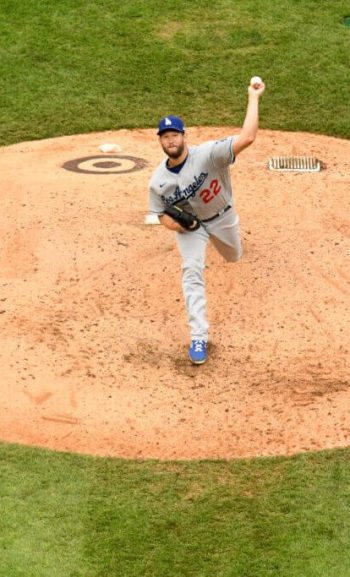
Clayton Kershaw pitching in Target Field, against the Twins, Wednesday. He was lifted after seven perfect innings and the world went nuclear.

Finally, Steven Kwan went hitless. It took his sixth major league game before somebody’s pitchers finally found ways to get him out all day long, if you don’t count the bases-loaded walk he took in the second to start the scoring in a 7-3 Guardians win.

Then Vladimir Guerrero, Jr. smashed three home runs against the Yankees in the south Bronx, including a pair off Yankee ace Gerrit Cole, en route a  6-4 Blue Jays win, a performance that had even the Yankees dropping their jaws in amazement.

Those might have been the top stories Wednesday if not for Clayton Kershaw and Dave Roberts.

Kershaw pitched seven perfect against the Twins in Minneapolis. Despite his having thrown “only” seventy pitches while striking thirteen Twins out including striking the side out in the sixth, Kershaw didn’t come back for the eighth inning. Roberts ended Kershaw’s day knowing both men agreed he’d be on a limited leash in his first season’s start at all, never mind pitching in temperatures in the thirties.

The world went nuclear over it.

Sometimes during the uproar it seemed nobody wanted to listen when Kershaw postgame explained, among other things, “I knew going in that my pitch count wasn’t going to be one hundred. It’s a hard thing to do, to come out of a game when you’re doing that. We’re here to win. This was the right choice.”

He’s Clayton Freaking Kershaw and he should have been entitled to finish that perfect game!

“Those are selfish goals. We’re trying to win,” said the lefthander who pitched a no-hitter in 2014 and whose black ink from ages 23-29 has already secured his reservation in the Hall of Fame.

That’s really all we’re here for. As much as I would’ve wanted to do it, I’ve thrown 75 pitches in a [simulated] game, and I hadn’t gone six innings, let alone seven. Sure, I would’ve loved to do it. But maybe I’ll get another chance.. . . I would have loved to have stayed, but bigger things, man, bigger things . . . Earlier in my career, I’d be built up to a hundred pitches. Blame it on the lockout. Blame it on me not picking up a baseball until January. My slider was horrible the last two innings. It didn’t have the bite. It was time.

Whaddabout history?!? Whaddabout entertainment?!? This is the way baseball brings the fans back?!?

What about the injury history of a 34-year-old pitcher, working in that 30-degree temperature range in crisp Minnesota, after an owners’ lockout-imposed badly abbreviated spring training, and coming off a season ended by forearm/elbow inflammation, accompanied by speculation he might even face Tommy John surgery? To say nothing of Kershaw not picking up a ball until January because of continued recovery from that forearm issue?

Goddam analytics!!!!!

Protecting a pitcher’s health—which is exactly what Roberts did, presiding over a starting rotation about whose long-term health Roberts has said on the record is the key to the Dodgers’ long-term seasonal health and success—has absolutely nothing to do with analytics. All the analytical information available to managers and players about their own and their oppositions’ tendencies isn’t going to tell you whether or when a player’s liable to incur injuries. Analytics aren’t that smart.

“It was a short spring training after a lockout,” reminded no less than Aaron Gleeman, who covers the Twins for The Athletic. “He’s not fully built up. Nothing to do with analytics.”

Nolan Ryan wouldn’t have come out after only seventy [fornicating] pitches, and his manager would have had a fight on his hands if he tried to lift Ryan!!!!

Any time any starting pitcher gets the early hook for any reason in any circumstance—never mind that most managers now have their starters on pitch limits in an admirable bid to compensate for the too-short spring training preparation and assure their long-term season’s health as best as possible—there still comes even one ignorant Ryan name-drop. This one delivered truckloads of them all around social media.

I’m going to let Athletic analyst Keith Law say it for me as I also did when reviewing the book in which he said it, The Inside Game: Bad Calls, Strange Moves, and What Baseball Behaviour Teaches Us About Ourselves, two years ago:

The center square on your [Pitch Count Bingo] card is Nolan Ryan, whose name is certain to come up in any attempt to discuss the limits of the human body to throw a projectile at 95 mph repeatedly over a three-hour span . . .

Nolan Ryan was a physical marvel, and an extreme outlier when it came to durability, although most discussions of the latter ignore the part where he missed 1967 and 1968 with persistent arm trouble. Ryan did things we will probably never see again, not now that pitchers throw harder than ever and play more than ever as kids, while teams work to keep their most gifted pitchers healthy until they reach the majors . . .

Nolan Ryan is the ultimate survivor, the survivor ne plus ultra, the übersurvivor when it comes to survivorship bias. Yes, Ryan defied everything we know now about pitch limits, and shouldered (pun intended) workloads that no MLB would ever allow a pitcher to carry [now], whether in individual games or entire seasons . . .

He is . . . an outlier, a great exception—not one that “proves” the rule, but one that causes many people to discard the rule. Most pitchers can’t handle the workloads that Ryan did; they would break down and suffer a major injury to their elbow or shoulder, or they would simply become less effective as a result of the heavy usage, and thus receive fewer opportunities to pitch going forward. Teams did try to give pitchers more work for decades, well into the early 2000s, but you don’t know the names of those pitchers because they didn’t survive: they broke down, or pitched worse, or some combination of the above. (Emphasis added.)

By the way, the Dodgers did finish the victory they began while Kershaw was in the game. They led 3-0 when he came out. With one out in the top of the eighth, Cody Bellinger, Gavin Lux, and Austin Barnes smashed back-to-back-to-back home runs off Dereck Rodriguez working his fourth inning of relief. Then Max Muncy greeted Rodriguez’s relief Griffin Jax by leading off the top of the ninth hitting a full-count fastball over the right field fence.

They also lost the perfecto when Kershaw’s relief Alex Vesia surrendered a one-out line single to former Yankee Gary Sanchez in the bottom of the seventh. Nobody saw Kershaw complain. If anything, he looked about as jovial and hail-fellow in the dugout as a man can look after being “robbed” of a shot at “history.” A man who knows his baseball immortality is already assured is far more sanguine in such circumstances than the world going nutshit about his “robbery.”

There were 233,345 major league baseball games before Wednesday, and only 23 of them were perfect. Thirteen (57 percent) were pitched by men who’d get to the Hall of Fame as visitors only. Only one—Hall of Famer Sandy Koufax’s jewel of 9 September 1965, after Koufax threw mere no-hitters in each of his three previous seasons—actually proved that practise makes perfect.

Should the Dodgers fail in their quest for one full-season World Series championship while Kershaw remains among them, it won’t be because he was lifted after seven perfect innings in his first season’s start. Should they succeed in that quest, it will be in considerable part because Roberts placed his pitcher’s long-term, season’s health—with his pitcher on board entirely—ahead of “history.”

“But who is a perfect game for, anyway?” asks Sports Illustrated writer Emma Baccelieri, who answers promptly. “It might be just as easy to conceive of it as selfless rather than selfish: a great communal gift as much as a great individual achievement. Everything on Wednesday made sense. But perhaps it is not selfish—not unreasonable—to wish that everything did not have to make so much sense all the time.”

Would I have loved to see Kershaw consummate a perfect game? You might as well ask if I still enjoy being alive. Just don’t ask me to list the roll of Hall of Fame pitchers who never got to pitch perfect games, either. They’d only begin with Walter Johnson, Christy Mathewson, Warren Spahn, Whitey Ford, Juan Marichal, Bob Gibson, Tom Seaver, and, yes, St. Ryan himself—who threw seven no-hitters but was never perfect even once.

You’re worried about “entertainment?” The single most entertaining things in baseball other than actual games and even World Series triumphs are arguments liable to last as long as baseball itself will last. Even when those arguments are as witless as the day is long.

The swath of Kwan

Steven Kwan

Against easy pickings, Kwan owned the season’s first weekend. The competition to come isn’t liable to be that agreeable.

The baseball team formerly known as the Indians launched their season against the Royals in Kansas City. Though the launch began with a pair of low-scoring losses (3-1, 1-0), it concluded with a 17-3 blowout win and a 10-7 three-run win. Meaning that the Guardians out-scored the Royals 30-9 for their trouble.

Meaning, too, that they, like every American League Central team not named the White Sox, opened 2-2. But the Guardians opening was important for things that didn’t happen almost as much as things that did, including:

The Hope Memorial Bridge, whose Guardians of Traffic sculptures inspired the team’s new name, didn’t collapse. No known tidal wave arose from Lake Erie to flood or drown the city. No crash of thunder, lightning, and rain poured onto the city. The Rock and Roll Hall of Fame didn’t induct Lawrence Welk, as an early influence or otherwise.

But a Guardians prodigy made nineteen trips to the plate during the four-game season-opening series without striking out even once, without missing the chance to send runners home in three such plate appearances, and with extra base hits in 15.8 of those season-opening plate appearances.

The only mistake center fielder Steven Kwan made during those first four games of his life, and of his team’s life as the Guardians, happened in the bottom of the seventh Monday, when Kwan saw himself throwing Royals outfielder Andrew Benintendi out at the plate on a bases-loaded liner by Royals third baseman Hunter Dozier.

Kwan’s foresight forgot to inform him the ball actually needed to be in his glove before he could make the throw he saw in advance. Rookies make such mistakes all the time. The ball hit the heel of the glove instead, allowing Benintendi to score before Kwan’s outfield partner Myles Straw threw Royals first baseman Carlos Santana out on a tight play at second base.

The Guardians escaped further damage by inducing an inning-ending double play, then loaded the bases on the Royals in the top of the eighth on a leadoff double and a pair of walks alternating with two air outs. Like any rookie, Kwan was more than anxious to atone for his seventh-inning slip, particularly because it allowed the Royals back to within a run. Unlike many rookies, Kwan performed the perfect atonement.

He slashed a 1-2 hanging curve ball into the right field corner for a bases-cleaning triple  and put the Guardians up 9-5, a lead they’d pad by a run with a ninth-inning run-scoring ground out. Good thing, too, because Benintendi thanked Kwan for the seventh-inning miscue enabling his run when he batted in the bottom of the ninth and, with touted-enough Royals rook Bobby Witt, Jr. aboard with a leadoff walk, planted one over the right center field fence.

Guardians relief pitcher Emmanuel Clase retired the next three Royals in order to secure the 10-7 win. But who needed him? Kwan finished the game and awoke the next morning as the talk of about 98 percent of baseball and its watchers, many of whom were only too well prepared to name him this season’s American League Rookie of the Year, Most Valuable Player, and Silver Slugger awards, and to the Hall of Fame, post haste.

Not so fast.

Yes, Kwan reached base fifteen times during the four-game set. No player ever did that in his first four major league games. Yes, Kwan is also the first major league player since the Great Depression to have a five-hit game in only his third major league game. Yes, too, he faced 82 pitches in his first four games and never once swung on and missed a single one of them.

And, yes, especially, Kwan seems as grounded as the day is long, the product of agreeably down-to-earth parentage, a young man unlikely to let something like smashing precedents go to his head and find room aplenty to bounce around.

But, as Akron Beacon-Journal columnist Ryan Lewis warns, there’s more likelihood that the grounded Kwan returns to earth than there is for him making Ted Williams resemble Ted Cruz. “Kwan is obviously not going to continue to hit .692 forever,” Lewis writes.

But until his fortunes reverse just as severely as what he’s shown so far, he has his place in the No. 2 spot in the lineup. It means that for the time being, the Guardians have Myles Straw locked into center field and Kwan in one of the corner outfield spots. That leaves the other spot to Oscar Mercado, Amed Rosario and Josh Naylor, once he’s able to return from an injury—though Naylor could also time at first base with Bobby Bradley struggling to get going. All of a sudden, at least in the short run, the Guardians’ outfield has some answers.

USA Today writer, Steve Gardner, is even more cautious, handing Kwan an award . . . a “Tuffy Award,” named facetiously in honour of a 1994 Cub, Tuffy Rhodes, a modest journeyman who opened that season immodestly, becoming the first in Show to smash three home runs in his first three season’s plate appearances, and off a former child prodigy named Dwight Gooden.

From there, Rhodes hit only five more bombs the rest of that season. He finished his Show career with thirteen home runs and 45 extra-base hits total over 675 lifetime Show plate appearances. Then he went to play in the Japan Pacific League—and hit 464 home runs in thirteen seasons (including tying Sahaharu Oh’s single-season JPPL-record 55 in 2001) before retiring after the 2009 season.

“[W]hat’s not to like about someone with an .800/.857/1.000 slash line?” asks Gardner, the slash line combining Kwan’s short-spring training performance to his regular season premiere? Then, Gardner answers:

Playing time certainly doesn’t seem to be an issue for Kwan in the near future. And with that kind of on-base percentage, he should remain near the top of the lineup. The question is how much else he will be able to provide over the long haul.

Kwan hit twelve homers and stole just six bases last year in the minors. And at 5-9, 175 pounds, there’s still doubt about how much power he’ll ever have. It’s not impossible, of course, but it’s more likely that he’s a closer comp to Nick Madrigal than Jose Altuve.

Beating up on Royals pitching to start the season is the tide that lifts all boats along the shores of Lake Erie. At the risk of incurring the wrath of Kwan (and the rest of the Guardians), the journey is about to become much more difficult.

The Guardians get to slap Cincinnati pitching silly for their next two games, the Reds having said—after the owners’ lockout and the eventual new collective bargaining agreement was supposed to have started putting a big dent in tanking—“That’s what you think,” dumping key parts of their pitching staff, outfield, and infield alike.

But then the Guardians get to tangle with the defending National League West champion Giants, the defending American League Central champion White Sox, and the tied-for-second-in-the-AL-East-finishing Yankees. One after the other. No team or its most immediate rookie star gets to face the pushovers all the time.

In The Godfather (the novel, not the film), Don Vito Corleone mused how true it was that great misfortune sometimes led to unforeseen reward. There’s always the chance, for Kwan and his Guardians, that great immediate reward leads to too-often-foreseen misfortune, if not disaster. But his opening act was incomparable, invaluable fun.

Sixty years on, an eyewitness remembers the Original Mets

1962 Mets Yearbook

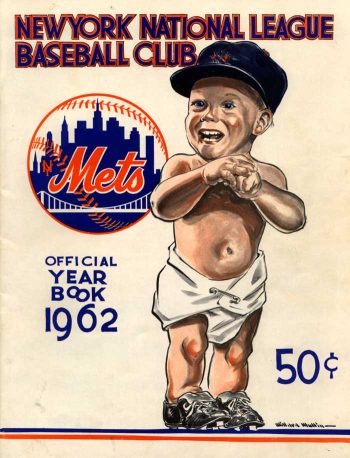
The first Mets yearbook, 1962, drawn by cartooning legend Willard Mullin—whose creation of the Brooklyn Bum in the 1930s proved he knew absurdism when he saw it.

In February 1962, Casey Stengel gathered his sort-of brand-new major league baseball team together, pointed toward the spring training field, and said, “Them are the bases.” Two months later, sixty years ago today, broadcaster Bob Murphy crooned from the booth in St. Louis, “Yes, sir, the New York Mets are on the air in their first great season.”

This year’s Mets awoke this morning after beating the Nationals in Washington three straight before losing 4-2 Sunday afternoon. Their ancestors of sixty years ago awoke that 11 April to lose an 11-4 blowout to the Cardinals in ancient Sportsman’s Park, freshly re-named Busch Stadium.

It began a life-opening nine-game losing streak. And, the birth of a legend. When they recorded their first-ever regular-season win, a handy 9-1 final against the Pirates, the immediate gag became, “Break up the Mets!” No such team setting a record for getting destroyed on the field ever seduced a locale as profoundly as the Original Mets seduced New York.

Still smarting from the exodus West of the Dodgers and the Giants (in whose ancient, rambling wreck of a Polo Grounds home the Mets played awaiting Shea Stadium’s birth), and probably saturated by what seemed decades of Yankee success and its attendant hubris, New York embraced the Mets with a season-long bear hug and a kind of pre-countercultural hysteria in the stands.

If the British played baseball and fielded such a team as the Original Mets, they’d have been considered the game’s progenitors of Monty Python’s Flying Circus. But the National League awarded New York the Mets in its first expansion, their original owner having been the lone stockholding vote against the Giants leaving town. The Mets became . . .

Well, I’ve said it before, but who can resist repeating it? Abbott and Costello performed “Who’s on First” several hundred times before they ended their partnership. Little did they know. The Original Mets seemed to have Abbott pitching to Costello with Who the Hell’s on first, What the Hell’s on second, You Don’t Want to Know’s on third, and You Don’t Even Want To Think About It’s at shortstop.

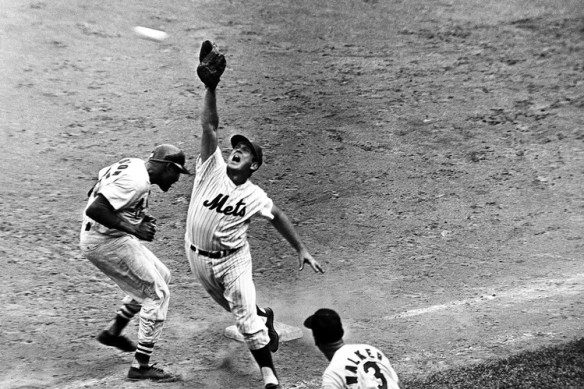
One minute, the outfield was reasonably competent (and often included Hall of Famer Richie Ashburn at the sunset of his fine career) and the infield (including future Hall of Famer Gil Hodges at first base, before knee injuries put paid to his playing career) was at minimum not bound for infamy. The next, they were the Three Stooges and the Four Marx Brothers.

Except when otherwise genial Marv Throneberry played first base. “This,” wrote then-New York Herald-Tribune writer Jimmy Breslin, “was like saying Willie Sutton works at your bank.” He was a former Yankee prospect now a gangling Charlie Chaplin for Groucho, Harpo, and Chico. When he didn’t hit the long ball now and then (he once ruined the Pirates and relief legend Elroy Face with a game-winning three-run homer), he either made things unravel or things unraveled through him.

The bullpen could have been mistaken for a flock of ducks. (Daffy, that is.) The bench could have been mistaken for the Keystone Kops. There were those convinced that Ernie Kovacs was raised from the dead to take the managing job in the aging Stengel’s stead.

The Mets were impregnated of the bold but ultimately doomed Continental League project in 1959, a third major league brainchild of former Dodgers mastermind Branch Rickey, that attracted several wealthy men and women to buy franchises, including in New York. The majors surrendered. They agreed to expand, for the first time, two new teams each.

They also agreed not to let the new teams get their meathooks to within ten nautical miles of solid talent, and not to let them raid the established rosters without paying through their noses and their ears. (Paul Richards, general manager of the National League’s incoming Houston Colt .45s—you know them today as the American League West’s ogres, the Astros—said it most memorably, if coarsely, to his front office: “Gentlemen, we’ve just been [fornicated]!”)

Casey Stengel

Casey Stengel, on the dugout steps in the ancient Polo Grounds. He may or may not have been asking was he really there when all that happened.

One of the wealthy incomers was Joan Payson, the aforementioned Giants stockholding holdout. She was awarded the National League’s new New York franchise. Some believed she’d really bought herself a zoo with the animals holding the keys.

Among their earliest fans was a certain six-year-old boy in the north Bronx, whose firm but kind and generous maternal grandfather (himself a displaced Giants fan) consented to take me to the Polo Grounds to see the madness. For giving his grandson such a gift, there were those who might have accused Grandpa Morris of child abuse.

Naturally, the Mets lost to the Cubs, 6-3. Only the Mets could make that generation of Cubs resemble contenders. The 1962 Cubs finished 59-103, good for ninth place. (This, children, was before the age of divisional play.) Their saving grace was my Mets finishing 40-120. It may have been one of the few times That Toddlin’ Town offered thanks for the Big Apple.

I saw a game featuring six future Hall of Famers. Four of them played for the Cubs. One of them (Ernie Banks) cracked a two-out home run in the top of the fourth to cut an early Mets lead in half, then slashed a two-run single an inning later to finish overthrowing that early Met lead, and finished the Cubs’ scoring with a seventh-inning sacrifice fly.

Among the Hall of Famers on my Original Mets that day, only Ashburn factored in the scoring, coming home from a leadoff single in the third aboard former Dodger Charlie Neal’s one-out triple. An inning earlier, future Cub Jim Hickman singled Sammy Taylor home with the first Met run of the game; three innings later, Taylor returned the favour by singling Neal home for the final Met run of the game.

As Original Mets games go, there was none of the slapstick that dominated that first surreal season. The lone error of the game wasn’t all that hilarious, outfielder Frank Thomas merely mishandling a drive. There was a lot of the fast-famous LET’S GO METS! chanting during the game, so I couldn’t really complain. I got enough of the slapstick watching the Mets on WOR-TV that summer when not in day camp.

Maybe the more apt comparison should have been to The Ed Sullivan Show, where you were liable to see an elegantly passionate performance of classical music followed immediately by a wild animal act. The Original Mets were much like that. One inning of baseball that might plausibly compare to Prelude to the Afternoon of a Faun would be followed by twenty that compared plausibly to the clown cars of Ringling Brothers and Barnum & Stengel Circus.

“Come an’ see my amazin’ Mets,” Stengel often hectored the incoming Polo Grounds customers. “I been in this game a hundred years but I see new ways to lose I never knew were invented yet.”

Stengel managed the Yankees to ten pennants and seven World Series rings in twelve seasons. With him at the helm, and Hall of Famer Yogi Berra behind the plate, the Yankees actually had a kind of human side. With successor Ralph Houk at the helm, the Yankees merely became efficient and boring, other than occasional uproars such as the 1961 Roger Maris-Mickey Mantle home run chase. Their fans reflected it as a sense of entitlement that’s been handed down through subsequent generations.

The Mets simply played off that Yankee hubris and let the city soon to be called Fun City know there was nothing wrong with having mad fun. The madder the better. Stengel’s triple-talking wit, which some mistook for disengagement, did the invaluable favour of keeping his hapless Mets from indignation and himself from going mad.

Marv Throneberry

“Marvelous Marv does more than just play first base for the Mets. He is the Mets.”Jimmy Breslin, in Can’t Anybody Here Play This Game?

Perhaps the closest Stengel had to a kindred spirit was Ashburn, a longtime Phillies favourite (and one of the 1950 pennant-winning Whiz Kids) before coming to the Mets by way of the Cubs. “I don’t know what this is,” Ashburn observed of his Mets at one point during 1962, “but I know I’ve never seen it before.”

The downtrodden Dodgers of the 1930s inspired comparable loyalty but nothing much funnier than New York World-Telegram cartooning legend Willard Mullin drawing a caricature of circus legend Emmett Kelly, Jr.’s Weary Willie character to represent the Bums. The eternally downtrodden St. Louis Browns were about as funny as a tax audit until Bill Veeck got his hands on the team when it was too little, too late.

The likewise-downtrodden Washington Senators (who managed to win a pair of pennants and a World Series, somehow) had a legend—Washington: First in war, first in peace, and last in the American League—that wasn’t quite as true as it was iambically clever. (In sixty seasons before moving to Minneapolis, the Ancient Nats finished last in the American League exactly ten times.) And, occasional laughs.

“New York,” Veeck would write in The Hustler’s Handbook, “had nothing to prove to anybody. New York had the Broadway theatre, the Metropolitan Opera, the best art museums, the tallest buildings. New York had everything except a lousy ball club.”

Presented with as lousy a team as the most optimistic rooter could hope for, the city responded [to the Mets] with frightening passion. The more inept the club showed itself to be (and it reached pinnacles of ineptitude previously undreamed of), the closer the city hugged it to its ample bosom . . .

The Yankees always took the attitude that they were doing you a favour by permitting you to watch them perform. They would no more deign to court their customers than the Queen would deign to court her subjects when she grants her annual audiences . . .

It has only been with the rise of the Mets and the fall of the House of Houk that they have found it polite to provide entertainment. [1964] is the first year, I suspect, that they have seen a fan close up.

At this writing, it hasn’t worked. The Mets are a trip to the Fun House. The Yankees are still a board of directors meeting. I don’t know about your neighbourhood, but it had been years since anyone rioted on my block to attend a board of directors meeting.

Casey Stengel

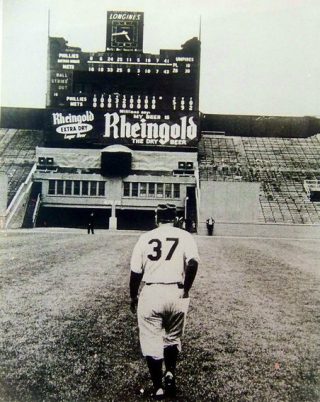
Casey Stengel leaving the field for the clubhouse after the Mets’ final home game at the Polo Grounds, 18 September 1963. The original Eddie Grant memorial monument stone stands in front of the center post supporting the building housing offices and clubhouses. The Mets’ clubhouse is on the right; the visiting Phillies’ clubhouse, on the left. Rheingold Beer sponsored the Mets’ broadcasts from 1962-1973. The Rheingold sign blinked the ‘h’ for a hit or the ‘e’ for an error after official scorers ruled on close or tough plays. The Polo Grounds came down in early 1964; Rheingold died in 1976. Sad irony: the original Brooklyn brewery, like the Polo Grounds, was succeeded by an apartment complex.

The method behind the madness was Mets president George Weiss (Stengel’s general manager in those dominant Yankee years) stocking the Original Mets with names familiar enough to National League fans and a few unknown, untried entities to hold fort while men such as farm director Johnny Murphy built the organisation that ended up in a miraculous World Series triumph. With Original Met Hodges on the bridge as the manager. That’d teach them. Some thought something perversely precious was lost forever.

“There was never a team like the old Mets and there will never be another,” wrote Leonard Shecter—maverick sportswriter/editor, future editor of Jim Bouton’s Ball Four, and the writer who first forged a veteran first baseman almost washed up from underuse into the myth of Marvelous Marv—in Once Upon the Polo Grounds, his reminder to those going even madder over the 1969 Miracle Mets that the Polo Grounds Mets were only too real and not to be forgotten. Ever.

Now it is all different. Casey Stengel is gone. The players, who try no harder than the old Mets, succeed more often and as a result are indistinguishable from baseball players all over. There is stuffiness in the front office. There is great concern about unimportant things. [The manager not long ago suggested to a newspaperman that he need not have blabbed in the public prints that the Mets scored their winning run on a bunt.] And, worst of all, when the Mets lose, there is nothing funny about it at all.

Today’s Mets play in a lovely playpen most of whose architecture evokes the memory of Brooklyn’s Ebbets Field. The green seats are the team’s homage to the Polo Grounds, which also outlined its field box seats with dangling chains. It’s the only reference to the Original Mets in the park, other than Casey Stengel’s retired uniform number 37.

This year’s Mets look competitive, seem entertaining, seem engaging. But their 1962 ancestors are too ancient a memory for today’s attention deficit baseball fan. The Original Mets have been long doomed to repose in the pages of books, the archives of newspapers, the artifacts in the Hall of Fame. And, in the memories of those who still don’t know what it was but knew they’d never seen it before.

“I felt like there was an angel by my side tonight”

Noah Syndergaard

The mighty Thor didn’t have to strike ’em out to get ’em out and help shut ’em out Saturday night.

About the only correct observation out of the Angels’ 2-0 shutout of the Astros Saturday night was this, about the starting duel between two returning Tommy John surgery patients, Noah Syndergaard (Angels) and Justin Verlander (Astros): it was a matchup of returning former aces. Vintage, it was not.

But it didn’t have to be. Especially so far as the Angels were concerned. “He’s just a strike thrower,” said Angels manager Joe Maddon of his new pitching toy. “The changeup is outstanding, and the slider, he’s willing to pitch inside . . . He was totally in command of everything that he’s doing out there.”

“It was fun to play behind him,” said Mike Trout, who accounted for the second Angels run with a mammoth late game home run. “He gets on the mound, throws strikes. He tries to get back in the dugout as quick as he can. You saw that tonight. He’s just out there grinding.”

Syndergaard entered the game with a lifetime 4.63 strikeout to walk ratio and 9.7 strikeout-per-nine rate. Verlander entered with a lifetime 2.33 strikeout-to-walk rate and a 12.6 strikeout-per-nine rate. Now, have a gander at their Saturday night special.

The former Met known as Thor struck nobody out, surrendered two hits and issued two walks, and lived mostly on the ground, with eleven grounders among the sixteen outs he got in five and a third innings’ work. Verlander struck seven out (including designated-hitting Shohei Ohtani thrice), walked three, and surrendered three hits while getting an even number of grounders and flies.

“It’s a long road, man,” Verlander said postgame. “Lots of nervousness and anxiousness leading up to it. Felt like my debut. Got some things to work on, but coming out of it feeling pretty good.”

One problem was Verlander feeding Angels first baseman Jared Walsh a fat enough fastball to open the bottom of the second and Walsh hitting it over the right center field fence. Another was no Astro except Kyle Tucker (in the top of the second, a single) and Chas McCormick (top of the third, single) hitting anything that didn’t find an Angel glove, though a third (Aledmys Diaz) reached on a throwing error opening the top of the seventh.

A third, for the Astros, anyway, was Trout serving notice that he’d had it with the slump that marked his first two games and the Astros demolition that accompanied it. The Astros had battered Angels pitching for eight home runs in those games. But while their contact wasn’t hard Saturday night, Trout’s was.

He smoked a fly out to the rear end of Angel Stadium in the first, a hard ground out to second in the fourth, a hard line out to center stranding two runners ending the fifth, and then—as if to prove practise makes perfect—he turned on a 1-2 fastball a little low and a little away, from Astros reliever Ryne Stanek, and yanked it off the rocks behind the left center field fence, 445 feet from the plate, in the eighth.

“Trout’s gonna get you,” observed Astros manager Dusty Baker postgame. After a 2021 ruined early enough by a torn calf muscle, and an owner-lockout-imposed short spring training this time around, one that included a short illness toward its end, Trout found a dramatic way to shake away his season-opening rust.

So did the Angels’ bullpen. Ryan Tepera entered Opening Night by surrendering prompt, back-to-back homers to Alex Bregman and Yordan Alvarez, but on Saturday night he got five straight outs in relief of reliever Aaron Loup—who’d gotten three in relief of Syndergaard but was hapless to prevent Diaz reaching aboard third baseman Anthony Rendon’s off-line throw. And designated closer Raisel Iglesias used only eight pitches to retire the Astros in order to finish it.

The bulls also struck four Astros out, three more punchouts in their 3.2 innings’ work than Syndergaard in 5.1.

Syndergaard had other things on his mind to accompany his manhandling of the Astros’ formidable lineup. Wearing the same number 34 he’d worn as a Met, the number had particularly sober significance for his new team.

No Angel had worn the number since 22-year-old pitcher Nick Adenhart, thirteen years to the day before—when Adenhart was killed by a drunk driver celebrating his successful Angels debut. The Angels didn’t retire 34 officially, but no player sought that number since, just as no Angel since the death of pitcher Tyler Skaggs almost three years ago has asked for Skaggs’s number 45.

By most accounts, Syndergaard asked the team to wear the 34 he’s worn all his life, after signing a one-year, $22 million deal with the Angels, and he was only too well aware of what Adenhart’s death meant to the franchise and its fans. “I felt like there was an angel by my side tonight,” Syndergaard said postgame. “That was really special to me.”

As athletes, I feel like our number—to the everyday person, it’s just kind of a number—but to us, it’s part of our identity. Growing up, my number was 34 because I was a huge fan of Nolan Ryan. But now it kind of means something a little bit different to me. I want to use that to lift up his name.

If Syndergaard continues lifting his team the way he did Saturday night, there could be more than a few angels on the Angels’ shoulders over the long, arduous season yet to come.

Brothers in baseball and bereavement

Jose Iglesias, Freddie Freeman

Iglesias mourned his father after his first hit of the season Friday; Freeman hugged and empathised with him.

José Iglesias signed with the Rockies in March. For the first ten seasons of his career, his father, Candelario, who’d played professionally in Cuba, saw over three thousand of his plate appearances. The elder Iglesias died a few weeks before Opening Day; the son still grieves even as he plays the game father and son loved together.

The son tagged his first base hit against Dodgers starter Walker Buehler in the bottom of the second Friday. He couldn’t fight his emotion as he arrived, nor could he resist a gesture heavenward. And the Dodgers’ new first baseman, Freddie Freeman, wouldn’t let him fight or resist either.

Freeman asked what was wrong. The Rockies shortstop acknowledged his grief over losing his father. Freeman—the defending World Series MVP with last year’s Braves, who has never been shy about his own grief following his mother’s death when he was ten—hugged Iglesias by his head, leaned it against his shoulder a moment, then gave him a few fraternal pats on the shoulder and head before play continued.

Iglesias had just knocked a run home to stake the Rockies to an early 2-0 lead (he went 1-for-4 on the day) that would turn into a 5-3 Dodgers win, with no small help from Freeman, who struck out, was hit by a pitch, then had a hand in the Dodgers’ five-run fourth by walking, going first to third on an RBI base hit, and scoring on a wild pitch, before he beat out an infield hit in the sixth (he was stranded) and looking at a third strike in the eighth.

But in the second inning, Freeman and Iglesias weren’t opponents but brothers in parental bereavement. “There’s nothing harder than losing a parent,” Freeman said to Iglesias before the game resumed.

“He was everything to me,” Iglesias said of the father who’d once played shortstop, too,  but would come home to play ball with his son after long post-baseball days labouring in a factory for $10 a day in Castro’s Cuba. [The younger Iglesias defected in 2008.] “His dream was to watch me in the big leagues. He told me once ‘If I can watch you play for one day, I’ll be good to go after that.’ He watched me play for ten years . . . he’s in a better place now, watching me play every day.”

“We’ll never know what any of us are going through in life,” Freeman told reporters postgame.

I think it just kind of reminds you to just have some compassion, some humility, and just be kind to others. That’s what’s so special about baseball too is you get to be around so many great people and so many people that just care about and love the game of baseball. His father was shining down on him to be able to get that single.

“You never forget your dad. All I could do is give him a hug. You know, when you lose a parent, all you can do is just give that person a hug. There are no words. No word is really going to be enough. Just let that person know you care about him.

“It was a beautiful moment,” Iglesias said, “beyond baseball, we’re human beings. That was very nice of Freddie.”

Freeman’s mother, Rosemary, died of melanoma in 2000. The son who was ten at that time can never forget climbing aboard her hospital bed despite his size for his age just to stay close to her, believing to his ten-year-old soul that she’d recover.

“Her pain was a twenty out on a scale of ten and she never said one word,” Freeman told ESPN’s Buster Olney for a profile a year ago. “She let us crawl in bed and she tried to be as much as she could to us, even though she had to lay there. And she was more than that, a mom, even in those times. We obviously thought she was going to beat it . . . She did everything she could to beat that disease.”

So Freeman eventually held on to his father. Now, an opponent pulling up to first base let his grief over his father’s death, over his father no longer seeing him play except from a heavenly perch, overcome him. Freeman more than most understands such loss, no matter what age parental bereavement comes, and cares. He cares enough not to give a damn who’d object to his comforting a stricken opponent.

“We have different uniforms on,” Freeman said, “but you take the uniforms off and we’re all friends in this game. That’s the key. That’s the beauty of this sport. We all switch teams throughout our careers so you get to come across a lot of amazing people. From the looks of it, [Iglesias’s] family loves baseball just as much as we do, so I’m just glad to be able to be a part of anything I could do for him.”

Bet that Rosemary Freeman and Candelario Iglesias sat together in the Elysian Fields exchanging hugs and agreeing that there’s one word for what Rosemary’s son did for Candelario’s in the second inning. The word is class.