Pete Rose’s ongoing grotesquery

Pete Rose

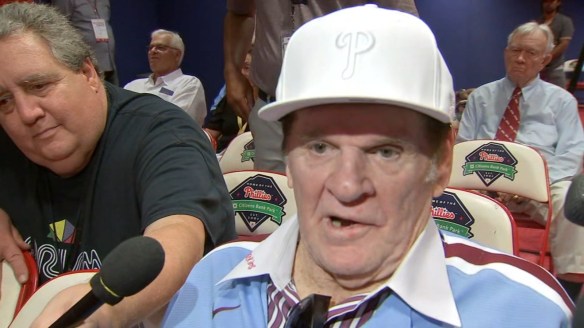
Pete Rose talks at a commemoration of the Phillies’ 1980 World Series conquest and exposes himself as a moral idiot. Again.

So long as he remains on baseball’s permanently ineligible list, Pete Rose’s presence at any major league team event sends a negative message as things stand already. But when he appeared at Citizens Bank Park to join the commemoration of the Phillies’ 1980 World Series winner, the mere negative went to grotesque in the same speed of light by which Rose made it so in the first place.

Not because of Rose’s Rule 21(d) violations that got him banished from baseball in the first place, but because Philadelphia Inquirer reporter Alex Coffey had the temerity to do her job Sunday afternoon.

“I asked Pete Rose what he would say to people who say his presence here sends a negative message to women,” Coffey tweeted. “His response: ‘No, I’m not here to talk about that. Sorry about that. It was 55 years ago babe’.” What “that” was is the early 1970s extramarital affair he conducted with a girl who wasn’t quite at the legal age of consent when it began.

That revelation first emerged in court in 2017, during Rose’s defamation lawsuit against John Dowd, the attorney who first investigated the depth of his baseball gambling under the aegis of then-commissioner A. Bartlett Giamatti. Two years earlier, Dowd gave a radio interview in which he said Michael Bertolini—through whom Rose often bet on baseball and whose notebooks had notes aplenty on those bets—told investigators Rose had “underage girls” brought to him during a spring training and, shall we say, engaged sexually with them.

The specific girl in question, the one who prompted Coffey’s question to Rose in the first place, provided the court a sworn statement in a motion. It amounted to saying Rose committed statutory rape, since the legal age of sexual consent in Ohio then and now (Rose was with the Reds at the time) is sixteen years old. (Both sides dropped the suit later.)

Rose was fortunate that he was beyond arrest and prosecution over that, since the statute of limitations for statutory rape expired long before that affair came to light. Morally, of course, it was another stain upon him well before he couldn’t help himself with Ms. Coffey.

“It was 55 years ago, babe?”

Put aside for one moment (and only one) the message Rose’s cavalier dismissal and term of address to Coffey. Consider that his presence Sunday sent a negative message to women and men as well as baseball. For a few grotesque moments the Phillies looked like a team that couldn’t have cared less about anything beyond a cocktail of nostalgic self-celebration and the ballpark gate.

After Sunday’s on-field ceremony, the Inquirer itself noted, Rose was made available to the press and asked about Coffey’s question and his comment. “I’m going to tell you one more time. I’m here for the Philly fans,” Rose replied. “I’m here for my teammates. I’m here for the Phillies organization. And who cares what happened fifty years ago? You weren’t even born. So you shouldn’t be talking about it, because you weren’t born. If you don’t know a damn thing about it, don’t talk about it.”

That’s the man who once said of Cincinnati naming a street after him that they “should have named an alley after me, the way I acted in school” and who once displayed a knowledge of baseball history that was almost as encyclopedic as his at-the-ready knowledge of his own statistics. (“We’re going down,” Rose once told a teammate when the Reds’ flight hit harsh turbulence, “and I have a .300 lifetime batting average to take with me. Do you?”)

He must have missed or ignored history classes having nothing to do with baseball and everything of the very anchorage that says teachers teach and students learn and discuss events far older than a mere half century.

“He’s an intellectual from Yale, but he’s very intelligent,” Rose said of Giamatti’s successor Fay Vincent. What would Rose know about intellect or intelligence above and beyond ninety feet between the bases, sixty feet from the pitching rubber to the rear point of home plate, and how to make enough occasions involving his old teams about himself above them?

What Rose does know is selectivity. Once upon a time it was the kind that enabled him to become (if you didn’t believe it, he’d tell you proudly) baseball’s first million-dollar singles hitter. Today it enables him to dismiss such inconvenient truths as his lifetime banishment for violating Rule 21(d) (he says of it that he was “suspended”) and his ancient but no less disgraceful extramarital dalliances with a girl who should have been thinking of the prom instead of the ballplayer old enough at minimum to have been her father.

Rose’s permanent banishment, of course, means that any of his teams who wish to include him in certain event must ask permission from the commissioner’s office. It’s probably a stretch to presume Rob Manfred will dismiss future such requests after Rose’s Sunday grotesquery, since this is a commissioner to whom the common good of the game usually involves making money for it first and Rose remains perversely good box office.

But if Rose hadn’t been so bluntly dismissive of Ms. Coffey’s very legitimate question, maybe the worst that would have come forth from Sunday’s doings and undoings would have been Rose’s 1980 Phillies teammate Bob Boone.

Bad enough that Boone had “no idea” whether Rose’s ancient dalliance with a teenager was considered when other 1980 Phillies insisted he be part of the celebration. Almost as bad: Boone saying, “This is the best hitter we’ve ever had. And he did some things wrong. If you want to, put something on the board that says he did these things wrong, but I always felt he has to be in there. He’s not in there, but I’m telling you, he’s the greatest hitter to ever play.”

This is the best hitter we’ve ever had?

Well, now. The best hitter on the 1980 Phillies posted a 1.004 OPS. He played his entire career with the Phillies, has a franchise-high 106.8 wins above a replacement-level player (WAR), and has the highest Real Batting Average (total bases + walks + intentional walks + sacrifice flies + hit by pitches, divided by total plate appearances), .626, of any Hall of Fame third baseman who played in the post-World War II/post-integration/night-ball era.

If Rose hadn’t written the script that got him banished not just from baseball but from standing for Hall of Fame election, he would be one of twelve postwar/post-integration/night-ball era Hall of Famers with a sub-.490 RBA. (Rose’s is .483.)

The best hitter the Phillies have ever had—who just so happens to have been named both the 1980 National League’s Most Valuable Player (one of his three such awards) and the Most Valuable Player of the 1980 World Series—was unable to attend Sunday’s doings because he tested positive for COVID-19. “I’m sorry that I can’t be with my championship brothers,” said Mike Schmidt in a video statement to be shared for the occasion.

“To have his body,” Rose once said of Schmidt, “I’d trade him mine and my wife’s and I’d throw in some cash.” To have Rose’s self-inflicted (and permanent, not “lifetime”) banishment from baseball and the Hall of Fame, self-soiled reputation, and self-imposed image as a statutory rapist who eluded account for it simply because of the statute of limitations and, we assume, his one-time teen paramour’s longtime reluctance to speak up and out, Schmidt probably wouldn’t trade even one brain cell.

Vin Scully, RIP: We did need him more

Vin Scully

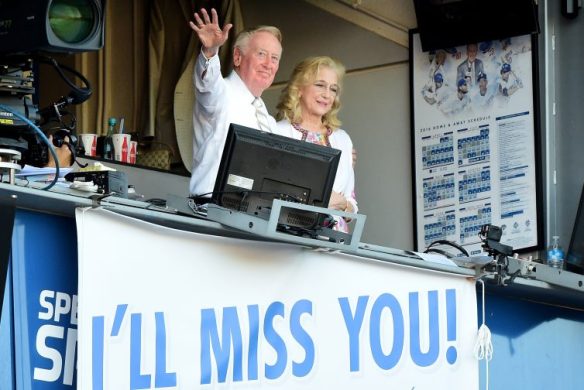
Vin Scully waving to the crowd as his wife, Sandra, stood by him in the Dodgers broadcast booth at the end of his final season on the job.

Football is to baseball as blackjack is to bridge. One is the quick jolt. The other the deliberate, slow-paced game of skill, but never was a sport more ideally suited to television than baseball. It’s all there in front of you. It’s theatre, really. The star is the spotlight on the mound, the supporting cast fanned out around him, the mathematical precision of the game moving with the kind of inevitability of Greek tragedy. With the Greek chorus in the bleachers.

Vin Scully, 1976.

When Bryce Harper grew up in Las Vegas, where he could watch the Dodgers on television and listen to Vin Scully, he noticed readily what most of the world knew for decades. It wasn’t just about the game to Scully. “It was about the beauty of the game, the beauty of the fans, how much he could bring the fans together and the Dodgers together, things like that,” Harper told the New York Times once. “When you think of the Dodgers, you don’t just think about all the greats that played for the Dodgers, you think of Vin Scully, as well.”

There was a time when that was said about the man who brought Scully to the Dodgers in the first place, Red Barber. How long ago was that? Put it this way: On April 1, 1950 (this is no joke, folks), future Supreme Court Justice Samuel Alito was born in New Jersey; surgeon Charles Drew, who invented the concept of the blood bank, died; the number one song in the country (Billboard) was Teresa Brewer’s “Music, Music, Music.” (That was from my ootsy-poo period she said years later, when she transformed into a respected jazz singer.) Milton Berle was numero uno on television, Jack Benny was radio’s king (nobody out-rated him in 1950 except for the rotating ensembles anthologised by Lux Radio Theater), and the Dodgers prepared to break spring camp and get a season going.

The faithful in Brooklyn were as likely to talk about and think about Barber as they were about Jackie Robinson, Pee Wee Reese, Duke Snider, Don Newcombe, Carl Erskine, or Roy Campanella. Little did Barber know that his protege would eclipse even him in recognizability, prestige, and affection after the Dodgers went west.

In Barber’s day and for well enough after, the thought of a farewell tour wasn’t even a topic. Joe DiMaggio didn’t take one with the Yankees; he simply retired, feeling he and especially his bothersome back no longer had it, after the 1951 season. Robinson — despite a hilarious bid to trade him to the New York Giants — simply made his quiet promise of retirement permanent in 1956, standing by an article in Look explaining why.

Ted Williams asked nothing more than a chance to go out like a champion — and punctuated his Comeback Player of the Year season with a poetic home run at the end of 1960. Stan Musial didn’t exactly take the tour, though he was saluted in a few cities in 1963. In 1966, Sandy Koufax—who once told Scully it was almost as much fun listening to him calling a game as it was to pitch a game—confided in one reporter that it would be his final season, then went out, pitched above and beyond even his own extraterrestrial level, and retired formally after the season.

And, in 1973, Willie Mays—by then a further aging Met—simply made you weep for your own mortality when he told a packed Shea Stadium on Willie Mays night, “I look at these kids over there, the way they are playing, and the way they are fighting for themselves, and it tells me one thing: Willie, say goodbye to America. Thank you very much.”

These days, some farewell tours by baseball’s greats have been sublime. Some have been ridiculous. But when was the last time you heard of a team’s announcer getting the farewell tour? For that matter, name any baseball broadcaster who stayed in the booths for a single team from April Fool’s Day to the day 67 years later that British violinist/conductor Neville Marriner died.

Not that Scully was feted in person in some cities in 2016. As the Times observed wryly, the farewell tour came to him all season. Players and staffers from teams visiting Dodger Stadium made the pilgrimage to the stadium press box, long since named for him, to visit and salute Scully. And he cherished every such visit. Even the umpires. “They look up to the booth and they see me,” said Scully’s Dodger radio broadcast partner, Charley Steiner. “They kind of doff their caps, but they hold their palms upward as if to say, ‘Where is he?’ I’ll say, That’s the best I can do!”

Near the end of August 2016 the Dodgers gave their longtime voice an amusing tribute. When players, coaches, manager, and front office staffers joined up for a team photograph, they hoisted Scully face masks in front of their own mugs. The lone holdout? Scully himself, seated front and center, grinning appreciatively, appropriately, and perhaps just a little mischieviously, before shrugging in mock fatalism.

When ESPN conducted its 2007 polling to determine the face of each major league franchise, with each team’s fans voting, Dodger fans voted Scully in a walk. That sweet man of sonorous voice, impeccable diction, insurmountable knowledge, impeccable wit, and inviolably calm strength, was the only non-player/non-coach/non-manager/non-executive so voted.

It’s rare for a man or a woman to excel at something for the normal career span. Scully excelled at it for almost seven decades. Even his old employer Barber, who was legendary for his understatement and his anecdotal style, seems now to have been an amateur by comparison. Barber gave you a profile of a player while he batted. Scully told stories. Barber was the pleasant horticulturist next door who didn’t mind if you eavesdropped. Scully opened the door, invited you in to pull up a chair (he said it often enough opening his broadcasts, anyway), and poured you a cold, tall one, right before the first pitch.

He meant it when he spoke as though talking to friends, just as his listeners meant it when they told anyone who’d listen that they felt him a friend. Numerous stories about him noted that when people met him for the first time and address him as “Mr. Scully,” he’s quick to offer a handshake and say, “Forget the Mister. I’m Vin.” A few years ago, doing a game that coincided with the anniversary of D-Day, he started a mid-game talk about it thus: “I don’t want this to be an intrusion, but I think we’ve been friends long enough, you’ll understand.”

Vin’s genuine warmth cooled down the most boiling baseball hotheads while inviting viewers to smile with him as he ordered a camera pan to capture a very young child in the park and spoke about that child with a truly fatherly affection. “Hello, sunshine,” he said at one such pan of a baby in her father’s arms. “Sleeping the sleep of the good child.” A man who survived the accidental death of his first wife and (in a helicopter crash) his oldest son, but remarried happily (and remained so) and extended his own family, appreciated and celebrated the ties that bind families, to baseball and otherwise.

Vin Scully, Sandy Koufax

Scully with Hall of Famer Koufax on Vin Scully Night.

On the rare occasion did he editorialise, understated, while observing and discussing less commendable acts on the field. As often as not he was unafraid to keep the microphone unoccupied and let the moment deliver its own message, preceding the silence with something such as, “You really ought to see it and hear it for yourself, so I’m just going to keep my mouth shut.”

But you still require a facility the size of a university video archive to line up the absolute best of Scully because nearly everything he delivered qualifies for the distinction. Which doesn’t mean there weren’t a single wall full of Scully moments that transcended even that actuality. Moments such as 1 May 1959, before an exhibition game between the Dodgers and the Yankees in the Los Angeles Coliseum, as Los Angeles did honour to the Hall of Fame catcher whom an off-season automobile accident left quadriplegic before he could play even one game on the west coast:

Friends, right now the Yankees have been asked to leave the field, and the Dodgers are not out on the field. For right now, the Coliseum, all of the lights will be turned out, as Pee Wee Reese wheels the chair that holds Roy Campanella across the first base foul line, and heads him toward the pitcher’s mound. The lights are going out, this final tribute to Roy Campanella, the lights will be lowered, and everyone at the ballpark, 93,000 people, are asked in silent tribute to light a match to Roy Campanella.

And we would like to think that, as 93,000 people light the match, it would be 93,000 prayers for a great man. The lights now are starting to come out, like thousands and thousands of fireflies, starting deep in center field, slithering around to left, and slowly the entire ballpark lighting up with individual lights. And Roy Campanella, as the years go back, standing off to the right is Pee Wee Reese. A sea of lights at the Coliseum. Perhaps the most beautiful and dramatic moment in the history of sports.

Let there be a prayer for every light. And wherever you are, maybe you in silent tribute to Campanella can also say a prayer for his well being. Roy Campanella, who thousands of times made a trip to the mound, to help somebody out, a tired pitcher, a disgusted young pitcher, a boy who’s perhaps had his heart broken in a game of baseball. And tonight, on his last trip to the mound, the city of Los Angeles says hello to him. Listen . . .

Moments such as the ninth inning of the game in which another Hall of Famer, Sandy Koufax, proved that when it came to an annual no-hit, no-run game, practise makes perfect:

There are 29,000 people in the ballpark and a million butterflies . . . He is one out away from the promised land, and Harvey Kuenn is coming up. So Harvey Kuenn is batting for Bob Hendley. The time on the scoreboard is 9:44. The date September the ninth, 1965. And Koufax working on veteran Harvey Kuenn.

Sandy into his windup, and the pitch—fastball for a strike. He has struck out, by the way, five consecutive batters, and this has gone unnoticed. Sandy ready, and the strike one pitch—very high, and he lost his hat. He really forced that one. That was only the second time tonight where I have had the feeling that Sandy threw instead of pitched, trying to get that little extra, and that time he tried so hard his hat fell off . . . One and one to Harvey Kuenn. Now he’s ready—ball two.

You can’t blame the man for pushing just a little bit now. Sandy backs off, mops his forehead, runs his left index finger along his forehead, dries it off on his left pants leg. All the while, Kuenn just waiting. Now Sandy looks in, into his windup, and the 2-1 pitch to Kuenn: swung on and missed, strike two. It is 9:46 p.m. Two-and-two to Harvey Kuenn—one strike away.

Sandy into his windup. Here’s the pitch—swung on and missed! A perfect game! [Long pause for the crowd noise.] . . .

And Sandy Koufax, whose name will always remind you of strikeouts, did it with a flourish. He struck out the last six consecutive batters. So, when he wrote his name in capital letters in the record book, the K stands out even more than the O-U-F-A-X.

Moments such as the bottom of the fourth, Atlanta Fulton County Stadium, 8 April 1974:

He means the tying run at the plate now, so we’ll see what Downing does . . . Al at the belt now, and he delivers, low, ball one. And that just adds to the pressure, the crowd booing. Downing has to ignore the sound effects and stay a professional and pitch his game . . . One ball, no strikes, Aaron waiting, the outfield deep and straight away. Fastball — and a high drive into deep left center field, Buckner goes back, to the fence, it is gone!!! . . . [long pause during crowd noise and fireworks] . . .

What a marvelous moment for baseball, what a marvelous moment for Atlanta and the state of Georgia, what a marvelous moment for the country and the world. A black man is getting a standing ovation in the deep South for breaking a record of an all-time baseball idol. And it is a great moment for all of us, and particularly for Henry Aaron, who was met at home plate not only by every member of the Braves, but by his father and mother . . . It is over, at 10 minutes after nine in Atlanta, Georgia, Henry Aaron has eclipsed the mark set by Babe Ruth.

There were Games Six and Seven of the 1986 World Series, when Scully worked concurrently for NBC. There was Fernando Valenzuela’s no-hitter (If you have a sombrero, throw it to the sky!), Kirk Gibson’s pinch homer winning Game One of the 1988 Series. (In a season full of improbables, the impossible has happened!) And, his hilarious 2012 interpretation of Dodger-turned-Rockies manager Jim Tracy’s expletive fuming after a shallow sinking line out—or was it?—married on the spot to an argument for instant replay, which finally arrived long overdue two years later.

Uh-oh. Uhhh-oh. The [umpires] meeting looks like they’re going to call it a trap, and Jim Tracy . . . [crowd noise] . . . He caught the ball, Jim says. He caught the ball. He caught the blinkin’ ball. He caught the darn ball . . . [crowd noise, as Tracy pulls his hat off and slams it to the ground two-handed] . . . oh, oh, you’re gone. Heeee’s gone . . . [crowd noise] . . . That is blinkin’ fertlizer! I’m doing the best to translate . . . you’ve gotta be blinkin’ me! . . . The ball, he caught the ball! . . . It’s unbelievable! Blinkin’ unbelievable! . . . No way! No blinkin’ way! No bloody way!

Jim’s gone, so he’s spending house money now . . . [crowd noise] . . . [brief, slow-motion replay of the outfielder’s original attempted off-the-grass catch] . . . take another look, looks like it’s in the glove . . . what’s a shame, really, we have this [replay] equipment, and no one takes avail of it. I mean, they say it would slow up the game, what did that do? They could have had someone upstairs, or an umpire go and look at the tapes. Instead, big argument, the manager’s kicked out of the game, the umpires have to reverse.

I’m not second guessing the reversal, they’re doing the best they think, but I’m just saying here we are, with all that equipment to show it. Want to show it again, Brad? Dustin? Take another look. How do you call it? [The play is shown again, semi-slow motion.] There’s the glove, there’s the ball, it’s in the glove, isn’t it? Didn’t it hit the webbing?

And there was future World Series-winning Red Sox manager Alex Cora, at the plate for the Dodgers against the Cubs’ Matt Clement, 12 May 2004, with future World Series-winning Dodger manager Dave Roberts then a teammate, and Dusty Baker managing the Cubs:

. . . The crowd now is really into the pitches . . . and still two and two. Nobody out. Big foul . . . wow! . . . It’s a sixteen-pitch at-bat, and the crowd loves it, and look at Dave Roberts. They’re all enjoying this battle. Matt Clement and Alex Cora. Coming into the game, Cora was hitting .400 against Clement, he is oh for two tonight. So the game within the game here.

So here’s the sixteenth pitch. What an at-bat! . . . [foul ball] . . .  Seventeen pitches . . . it is the rare time that you can be in the ballpark and everyone is counting the pitches, and it’s gonna be a seventeen-pitch at-bat, now, at least. We, I don’t know, you know, they don’t keep records of pitches in at-bats, but it’s kind of special. This will be the seventeenth pitch. Grabowski’s exhausted, and Mike Ireland reminds me how about if Grabowski had been running on every pitch? Time . . . ohhh, the crowd is loving it . . . Ever see so much excitement? And nothing’s happened, that’s what’s really funny about it.

All right, here’s the seventeenth pitch—and, it’s foul. Foul ball by a hair! So that means that it will be at least an eighteen-pitch at-bat . . . Clement has made more pitches to Alex Cora right now than he has made in any inning but the third . . . the eighteenth pitch—high fly ball into right field, back goes Sosa, way back to the gate, it’s gone!! Home run, Alex Cora, on the eighteenth pitch, and the Dodgers lead, four to nothing.

What a moment! 9:23 on the scoreboard if you want to write it down for history . . . what an at-bat! And Dusty Baker says, “We’re gonna stop the fight.” And Dusty’s going to bring in a fresh horse. That’s one of the finest at-bats I’ve ever seen. And, then, to top it off with a home run, that is really shocking. Yeah, take a bow, Alex, you deserve it and then some. Oh, by the way, that also means the Dodgers have homered in six straight, but it took a whale of a job to do it. Stay where you are, four-nothing Dodgers, and look at the ball club.

Somehow the writers and director of the 1999 film For Love of the Game captured the Scully style when casting him as himself, with Kevin Costner cast as a veteran Tigers pitcher in Yankee Stadium threatening a season-ending perfect game while his backstory was told adjacent to the game: the career, the star-crossed romance seeming to end before he arrived at the ballpark, the autograph on a ball telling the Tigers owner he would retire after all.

When Costner’s Billy Chapel consummated the perfecto, with his estranged love watching in an airport bar, Scully crooned, “The cathedral that is Yankee Stadium belongs to a Chapel.” On script, unless—considering his Koufax, Aaron, Valenzuela, Gibson, and Cora calls among thousands—the director crossed out any written comment and substituted, “Let Vin Scully be Vin Scully.”

“I mean, how do you come up with that? It’s completely off the top,” said Gary Thorne, a longtime baseball broadcaster who’s been the lead for the Orioles since 2007 .” It’s completely because you have the talent and ability to do it.”
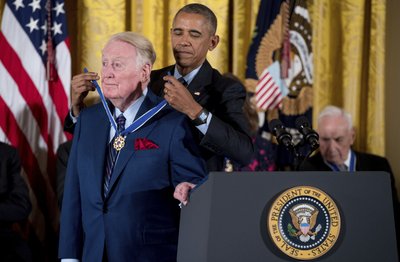
Vin Scully, Barack Obama

Scully receiving the Medal of Freedom from then-President Barack Obama.

Scully also had a flair for overcoming his extremely rare mistakes with self deprecating wit and grace. In June of his final season’s work, Scully inadveretently described a Dodgers-Nationals pitching matchup as Clayton Kershaw versus Stephen Spielberg. Nat-for-life Stephen Strasburg’s reaction is unavailable, assuming someone made him aware of it, but a couple of days later Scully owned the mistake: “The other night, I think I said Stephen Spielberg. But I regret to say he is unable to pitch.”

Vin’s ability to put those who met him at immediate ease was equaled perhaps by his parallel ability to put the pompous in their immediate place, my absolute favourite such incident being described by Keith Olbermann, a man about whom much has been written and said that’s not exclusively flattering (including “pompous” as one of his least self-immolating attributes) among those who’ve concurred with his positions, writing in GQ in 2016:

Legendary is the story of the blustery political commentator who years ago had ‘his people’ advise the Dodgers he wanted to meet Scully because Scully was “number one” in his field. “Everywhere I go, Mr. Scully, I try to meet whoever is Number One because I’m Number One in what I do and it’s important to recognize and salute those of my own stature, and you’re Number One here!” The man bellowed on like this for several moments as the crew in the Dodger booth squirmed. When he finally paused, too impressed with himself to sense Scully’s anger, Scully quietly, politely, and efficiently cut the blowhard into little pieces. “Well then, you’ll want to meet Arthur here, who is our Number One stage manager.” The commentator found himself unwillingly shaking hands. “And of course, you’ll want to meet Debbie, she’s our Number One makeup artist.” Another unhappy handshake. “And Don, our Number One cameraman—who, coincidentally is on Camera Number One.” Again with the handshake. “And in the row behind you, that’s Antonio, our Number One intern . . .” Witnesses disagree as to how many Numbers One Scully introduced before the man angrily muttered “I gotta go”—but all agreed he was several feet shorter when he went.

In his final decade’s work, Scully often wavered about returning for the following season and without wavering his fans all but begged him to say it wasn’t so. “The people have responded so well—so touchingly—that it will be very difficult for me to just suddenly walk away,” he said in 2014. “It’s the human relationships I will miss when the time comes. Like everyone in life, I’ve had my tragic moments, and the crowd has always got me through those moments. That’s why I’ve said ‘I needed you far more than you needed me.’ I rarely use the word ‘fans.’ I realize the origin is ‘fanatics,’ but I always use the word ‘friends’.”

“If my math is correct, I’ve known Vin Scully now for sixty years,” said Sandy Koufax to a Dodger Stadium throng on Vin Scully Night in 2016.

More than sixty years. Growing up in Brooklyn, the Dodgers had a redheaded announcer by the name of Red Barber. And he was good. Then, a few years later, another redhead showed up. And I thought he was very good. I’m not sure I realised how good he was until 1958, when the Dodgers from Brooklyn became the L.A. Dodgers, and moved into the Coliseum. It was a very strange phenomenon, to be on the field and hear the broadcast coming out of the stands. The people of Los Angeles, even though they were at the game, didn’t enjoy it without listening to Vin tell them about it. He entertained and he educated.

I knew before that night how right Koufax was. I saw it for myself the first time I took my then-young son to Dodger Stadium. By then, Scully would do all nine innings solo on television and be heard on radio in a simulcast for the first three innings. I’d been to several major league ballparks and a few minor league parks in my life to that point, but I’d never seen so many people in those parks holding small portable television sets in their laps, the pictures turned off and the sound turned up. And it struck me that, whatever they saw on the field, they still wouldn’t believe it actually happened until they heard it from Scully.

But they also heard a man who respected the whole game and didn’t allow himself to become just a home team shill. “For all the years that I heard him,” Koufax continued, “he used the Dodgers as a word. Never the word ‘we’.” Scully’s respect for the game and those who played and managed it extended to the World Series in a way you can’t imagine many other broadcasters bearing.

“Before the World Series, Vin would go to church and pray,” Koufax said. “Not for a win, but there would be only heroes in the World Series, no goats. He didn’t want anybody in the future to be tarnished with the fact that they lost the World Series for their team.” Maybe the Hall of Fame’s Ford C. Frick Award, honouring the game’s greatest broadcasters (Scully himself was so honoured in 1982), should be renamed the Vin Scully Award.

No volume of clips preserved and stocked aboard YouTube or archive.org atones for knowing that we were without Vin since 2017. But we knew he was still among us, savouring his life, his family, the fans he made friends, and even doing what he could to reassure us when the coronavirus pan-damn-ic struck in earnest in early 2020.

I never had the honour of meeting the man and spending even two minutes in his company, and it feels as though I’ve shirked my duty to remember that once, as a boy myself, I queued up with fellow day campers on a trip to Shea Stadium to get the autograph of . . . Mets broadcaster Lindsey Nelson, affable in his own right and yet to make the habit of wearing his once-well-remarked multicoloured blazers. Now, I wonder: Knowing Scully’s from-boyhood love of baseball and dream to become one of the men who called the games on the air, did he ever queue up for autographs from such radio voices of his formerly beloved Giants as Arch McDonald, Garnet Marks, Mel Allen, Connie Desmond, Don Dunphy, Jack Brickhouse, or Russ Hodges?

The last words Scully ever delivered through the mike and the set as a broadcaster, including the affectionate Irish prayer he offered, passed by soon enough and too damn soon.

Many years ago, a little redheaded boy was walking home from school, passing a Chinese laundry, and stopped to see the score of a World Series game posted in the window. The Yankees beat the Giants, 18 to 4, on October the second, 1936. Well, the boy’s reaction was pity for the Giants, and he became a rabid Giants fan from that day forward, until the joyous moment when he was hired to broadcast Brooklyn Dodger games in 1950. Ironically, October the second, 2016, will mark my final broadcast of a Giants-Dodger game. And, it will be exactly eighty years to the day since that little boy fell in love with baseball.

God has been very generous to that little boy, allowing him to fulfill a dream of becoming a broadcaster, and to live it for sixty-seven years.

Since 1958, you and I have really grown up together, through the good times and the bad. The transistor radio is what bound us together. By the way, were you at the Coliseum when we sang “Happy Birthday” to an umpire? Were you among the crowd that groaned at one of my puns? Or, did you kindly laugh at one of my little jokes? Did I put you to sleep with a transistor radio tucked under your pillow? You know, you were simply always there for me. I’ve always felt that I needed you more than you needed me, and that holds true to this very day. I’ve been privileged to share in your passion and love for this great game.

My family means everything to me, and I’ll now be able to share life’s experiences with them. My wife, Sandy; our children, Kevin, Todd, Erin, Kelly, and Katherine; along with our entire family, will join me in sharing God’s blessings of that precious gift of time. You folks have truly been the wind beneath my wings, and I thank you from the bottom of my heart for joining me on this incredible journey of sixty-seven years of broadcasting Dodger baseball.

You know friends, so many people have wished me congratulations on a sixty-seven-year career in baseball, and they’ve wished me a wonderful retirement with my family. And now, all I can do is tell you what I wish for you:

May God give you for every storm, a rainbow,
For every tear, a smile,
For every care, a promise,
And a blessing in each trial.
For every problem life sends,
A faithful friend to share,
For every sigh, a sweet song,
And an answer for each prayer.

You and I have been friends for a long time, but I know in my heart that I’ve always needed you more than you’ve ever needed me, and I’ll miss our time together more I can say. But you know what—there will be a new day, and eventually a new year. And when the upcoming winter gives way to spring, rest assured, once again it will be time for Dodger baseball. So this is Vin Scully, wishing you a very pleasant good afternoon, wherever you may be.

Forget the Dodgers; forget Los Angeles; forget baseball, for a moment. Knowing Vin Scully wasn’t at the mike, calling a game, telling the stories within the stories around the stories behind the stories, just like knowing Yogi Berra no longer lives among us on this island earth, America sometimes wasn’t America anymore.

Now he’s gone to the Elysian Fields. Reunited serene and happy with his beloved Sandra, his beloved son Michael, with numerous players who had the honour of their highest triumphs immortalised and their lowest shortfalls given empathy and respect, not opprobrium. From God’s Little Acre in Brooklyn to God’s big ballpark. As was said by one world leader to a fallen other, Shalom, chaver—peace, friend.

Beltway bombshells—Soto, Mancini go west

Juan Soto

Juan Soto stole the show in Game One of the 2019 World Series and helped his Nats reach the Promised Land. That was then, this is now, and the still-top-flight Soto is a young man going west to San Diego . . .

The Big One dropped, in both directions on opposite coasts. The Nationals, who’ve gone from surrealistic World Series champion and National League East powerhouse to hell in a little over two and a half years, traded what should have stayed a franchise foundation to the Padres, the National League West contenders who often enough mistake splash for sustenance.

Juan Soto goes West the day after it turned out he’d end his Nats tenure with a bang, throwing Tomas Nido out at the plate to keep the Mets to a mere three-run top of the second, and crunching his former teammate Max Scherzer’s 1-1 fastball for a leadoff home run in the bottom of the fourth en route a 7-3 loss to the Mets. It won’t make it easier for Nats fans to swallow this.

Soto became expendable when he turned down a $440 million extension that looked stupid-fat on paper while packaged to deny him the thing he wanted most. He wanted ten years and got them. He wanted the total dollars and got them. He didn’t get the highest annual average value the way the packaged was packed.

Maybe Soto was foolish taking the all-or-nothing stance. But maybe the Nats were just as foolish, with or without a pending potential ownership change, to decline making even that small enough adjustment. Standing just as all-or-nothing, with Soto not due to hit free agency for the first time until 2025, the Nats decided even the next Ted Williams was expendable.

Stop laughing at the Ted Williams comparisons. Only five hitters through age 23 have higher OPSes than Soto does: Williams, fellow Hall of Famers Ty Cobb and Stan Musial, and Hall of Famers to be Albert Pujols and Mike Trout. The order from the top is Williams, Cobb, Trout, Musial, and Pujols. His June slump leaves his season so far not quite as good as his priors, but rehorsing himself last month restored Soto on the way back where he belongs.

But if he had a fat enough hand in the Nats’ 2019 in-season resurrection from the outhouse to the Promised Land, will it be fat enough to push the Padres to the Promised Land at last? Baseball’s worst kept secret is that Padres general manager A.J. Preller has a genius for trades equal to Soto’s big swings and nothing much to show for them.

Oh, he’s managed to land some of the bigger fish on the trade market in exchange for high-rated prospects who haven’t yet returned to take a big bite out of his hind quarters for the most part—if you don’t count Trea Turner. (Nat turned Dodger.) But there’s always a real first time. Isn’t there?

He’s run the Padres eight seasons, delivered such blockbuster trade acquisitions, at the in-season deadline or the offseason, as Mike Clevinger, Jake Cronenworth, Yu Darvish, Joe Musgrove, Blake Snell, and Fernando Tatis, Jr., the Padres haven’t yet gone to any full-season postseason. (They reached the National League division series during pan-damn-ic short 2020.)

And he may be lucky that his incumbent first baseman Eric Hosmer declining to waive his no-trade clause to move to Washington didn’t kill the Soto deal. Hosmer has declined so precipitously since becoming a Padre as a free agent that, if Preller wants to get the rest of his due salary off the San Diego books, he’ll have to move yet another good prospect to do it if he finds a team willing to take Hosmer on.

Then, again, as USA Today‘s Bob Nightengale notes, Soto locked in through 2025 has another upside: in the unlikely event the Padres still can’t cross the threshold, Preller can still find a way to flip him on behalf of bringing other delicious-looking prospects back for a team and organisational renewal.

If there’s good news for the Nats, it’s getting five prospects in return for Soto and Josh Bell, with all five rated somewhat higher than the haul they took back from the Dodgers in exchange for Max the Knife and Trea Twinkletoes. But if there’s worse news for the Nats, it’s the number one problem with prospects: No matter how highly rated, they’re just prospects who might or might not cut it fully as Show players.

If they do cut it, it’ll take the sting out of losing a bona fide franchise player only if their cutting it turns into another world championship or two. If they don’t, this one’s liable to sting for Nats fans as long and as deep as such historically notorious purgings as Brock for Broglio, Ryan for Fregosi, Seaver for a quartet that sounds more like a law firm—Flynn, Henderson, Norman, and Zachry—than team reinforcements.

This wasn’t even the top deal of the day when it comes to breaking fan hearts. It’s not that Nat fans weren’t wringing hands and drying tears once they first knew Soto became expendable, but Oriole fans in the throes of seeing an unlikely revival enough to put the team right into the wild card hunt from almost out of nowhere hurt even more losing Trey Mancini.

Hours before Soto moved west, Mancini’s ticket to the Astros was punched in a three-way deal sending promising but inconsistent outfielder Jose Siri from the Astros to the Rays, pitcher Chayce McDermott from the Astros to the Orioles, and pitchers Jayden Murray and Seth Johnson from the Rays to the Orioles.

Trey Mancini

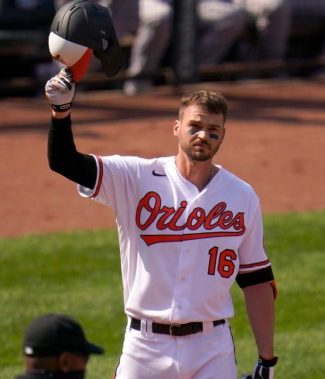
Trey Mancini tipping his cap to Oriole fans after what proved his final home game in Baltimore—he goes somewhat west now, to the Astros.

For Mancini it’s a terribly mixed blessing. One moment he goes from a home ballpark whose left field fence was moved back far enough to cut his power production at home to a ballpark with a short enough porch that he’d have hit over twice the ten bombs he has on the season so far. But he also says goodbye to a mutual love affair between himself and a city starving for the days when the Orioles were consistently great, year-after-year.

His agreeable personality and his courageous fight to beat colon cancer two years ago endeared him even further to Oriole fans than his live bat. As Baseball Prospectus observes, “Mancini . . . was the heart and soul of a franchise long depleted of either.”

The depletion may include Orioles general manager Mike Elias, who offered one of the most cacophonous explanations ever heard after a team struggling to return to greatness unloads a highly popular and franchise-valuable player:

The winning last couple of months that we have, the momentum we have, has made this a much more difficult decision and a much more complicated trade deadline than it would have been or that any of the past ones have been.But ultimately, I have to tether my decisions to the outlook and the probabilities of this year. We have a shot at a wild card right now but it is not a probability that we’re going to win a wild card.

Translation: In one deal and one bowl of word salad whose flavour no dressing on earth could improve, Elias as much as told Oriole fans he’s pushing the proverbial plunger on both this season whole and his team’s gallant, almost-from-nowhere re-entry into the postseason picture, however much distance the Orioles might still have to travel to get there.

Maybe Elias is still building for the nearest future after all. But maybe something could have been done without making the Orioles’ heart and soul the proverbial sacrificial lamb. Could, and should. “He’s the nicest human I’ve ever met,” says Orioles first baseman Ryan Mountcastle, a sentiment that seems to be common in the Oriole clubhouse and Baltimore itself.

Until today, people were even willing to bet on the Orioles having a phenomenal enough shot of reaching in. Now they’re uttering a couple of four letter words, one of which is the vulgar synonym for fornicate and the other a word meaning either a large receptacle for holding gas, an armoured attack vehicle, or taking a dive. Three guesses which meaning Orioles (and Nats) fans think applies.

“Teams liked to claim that captains were no longer necessary because one player shouldn’t be elevated above his teammates,” BP says, “but also, that same force made one player essentially untradable. If someone is designated the heart of a team, you can’t cut him out. Their value might go to waste.”

The region of the nation’s capital has taken enough blows that have knocked the wind out of its belly in the last few years. The Nationals and the Orioles, both of whom enjoy substantial capital followings, have told them, basically, “What’s two more sucker punches among friends?”

And now, the end is near for Trout?

Mike Trout

His back may have other ideas soon enough, but Mike Trout insists his career isn’t over until it’s over.

Time was when thinking of the Angels without thinking of Mike Trout was the proverbial non-starter. You knew you were seeing a Hall of Famer in the making the further his career progressed. You also knew concurrently that the Angels’ administrative inability to build a team their and the game’s best all-around player could be proud of made them Hall of Shamers.

Now the shame may be multiplied exponentially. Bedeviled by injuries as it was the last three years, Trout may have been hit at last by the one that puts paid to his career. May.

The official diagnosis has been “a costovertebral dysfunction” in his number five vertebra. He’ll have to alter his entire preparation and perhaps even the way he plays to continue. It’s not unrealistic to picture him becoming a full-time designated hitter soon enough. It’s also not unrealistic to wonder whether he’s been playing through any kind of back issue for long enough, and whether his team knew or dismissed it.

But a potential actual diagnosis may yet prove to be spinal stenosis. The very condition that knocked former Mets third base star David Wright and former Yankees first base bellwether Don Mattingly out of their careers and their Hall of Fame cases. Either way, Trout’s back may yet put paid to his career before its time—and his Hall of Fame case is overwhelming as it is right now.

His optimism is laudable. “I appreciate all the prayer requests,” he cracked when the official diagnosis became public, “but my career isn’t over.” But how soon will he have to walk that back?

The Angels already incurred the indignity of coming out of spring training determined to make real American League West noise, then opening their season 27-17, then collapsing into a fourteen-game losing streak and going 14-27 since they ended that streak. They’ve executed a manager and gone from postseason hopes to the dogs as the proverbial dog days of August knock on the door.

The issue that’s bedeviled them for the whole of Trout’s career to date continues bedeviling them, their inability to develop or build a serviceable pitching staff and their administration’s inability to stop just retooling under the Mud Plan: throw a few tons of it at the wall and hope some of it sticks.

Optimists such as Deadspin‘s Sam Fels would say that just shows at least the Angels, as opposed to the notorious tankers, really were trying. Pessmists would say that just shows there isn’t a truly verifiable brain among the Angels’ administrative brain trust.

But now the fallen Angels, 23.5 games out of first in the AL West and unlikely to make a 2019 Nationals-like turnaround to the postseason at all, never mind the Promised Land, are even willing to listen to 2 August trade-deadline queries involving Shohei Ohtani, their two-way pitching/hitting star. Angel fans cry “Help!” uncertain what the word even means for their team now.

Ohtani isn’t exactly unprepared for life beyond Anaheim, not just because he’s eligible for free agency after the 2023 season. Theoretically, life beyond Anaheim may happen within the next few days. It might even be only slightly beyond Orange County, if the prospects-rich Dodgers as rumoured are “engaging” the Angels in trade talk.

“Regardless of where I’m playing,” he said after yet another Angels loss Thursday, I’m going to give it my all and try to win that ballgame in front of me. I’m with the Angels right now, and I’m very thankful for what they’ve done. I love my team and my teammates. Right now I’m an Angel, and that’s all I can focus on.”

The Angels themselves aren’t yet talking about shutting Trout down for the rest of the season, reportedly. But that may not hold very long. Especially if it’s shown plausibly that he’s been playing with a bothersome back all season long, which may explain a lot about his periodic slumps that lasted a little longer, it seemed, than a typical Trout slump (yes, even Hall of Famers have them) ever did before.

The possibility also exists that Trout may never again be the player he’s been through this season, even if he knows he’s going to have to perform additional self-maintenance for the rest of what career he does have left. That’s just about the last thing long-enough-suffering Angel fans need to know.

They’ve had to grin and bear it while such a larger-than-life baseball talent with the results to back it up was never really supported with a team that could compete at all, never mind at his level. They’re not always comforted by having had the pleasure of seeing a once-in-a-billion player play above and beyond anyone else who ever wore the Angels uniform and treat them like friends at the ballpark while he was at it.

Mike Trout

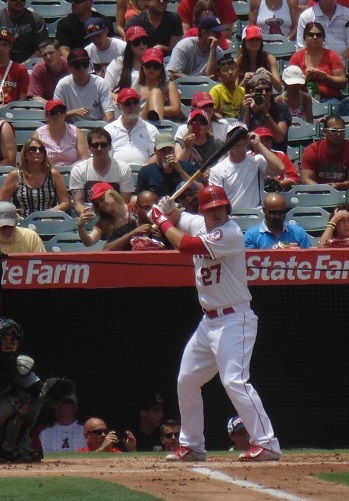
Your author took this photograph of Mike Trout batting in the first inning of a 2014 game—right before he hit one over the fence.

They swallowed hard when no less than commissioner Rob Manfred accused Trout himself of being the reason he didn’t quite become The Face of the game, saying the Show couldn’t “market” him because he wouldn’t market himself. Trout isn’t big on self-promotion and, when he isn’t at the ballpark, prefers to let what he’s done at the park speak for itself. The very idea. Being a man over a brand.

Not to mention being a Hall of Famer in waiting. Trout could retire this minute and he’d go into the Hall of Fame in a walk in a few years. (The Hall’s minimum career longevity requirement is ten seasons; Trout has twelve including this year. And the Hall of Fame is supposed to be about greatness, not mere longevity. It’s not supposed to be a platinum watch.)

Baseball-Reference, using The Cooperstown Casebook author Jay Jaffe’s JAWS calculators for Hall worthiness, ranks Trout the number five center fielder in baseball history. He has 8.3 more career wins above replacement-level (WAR) than the average Hall of Fame center fielder already. His seven-year-peak 65.1 WAR is 20.4 above the seven-year peak of the average Hall center fielder.

And, according to my Real Batting Average (RBA) metric—total bases + walks + intentional walks + sacrifice flies + hit by pitches, divided by total plate appearances—Mike Trout is the number one rank among those Hall of Fame center fielders who played in the post-World War II/post-integration/night-ball era by far and 92 points ahead of the average for those center fielders . . .

Center Field PA TB BB IBB SF HBP RBA
Mike Trout 5986 2884 904 115 52 91 .680
Mickey Mantle 9907 4511 1733 148 47 13 .651
Willie Mays 12496 6066 1464 214 91 44 .631
Ken Griffey, Jr. 11304 5271 1312 246 102 81 .620
Duke Snider 8237 3865 971 154 54* 21 .615
Larry Doby 6299 2621 871 60 39* 38 .576
Andre Dawson 10769 4787 589 143 118 111 .534
Kirby Puckett 7831 3453 450 85 58 56 .524
Richie Ashburn 9736 3196 1198 40 30* 43 .463
HOF AVG .588

About the most forward Trout has ever let himself become was that fine afternoon six years ago when he hired a skywriting team to propose to the woman who became his wife. Unless it was the days when he put the entire Angel organisation on his back, after pitcher Tyler Skaggs’s tragic death in Texas, including the team’s first home game after, when he launched a 13-0, combined-no-hitter blowout with a two-run homer in the bottom of the first and–as the Angels batted around and then some—finished that seven-run frame’s scoring with a still-one-out, two-run double.

You’d love to think Trout is right when he says his career isn’t over yet. You’d also love to think he didn’t waste and won’t continue wasting such a glittering career on behalf of an organisation that couldn’t build a top-to-bottom competitive team around and alongside him.

But if his career does end too soon, he won’t lack for a certain breed of distinguished company. Luke (Ol’ Aches and Pains) Appling, Ernie Banks, Jim Bunning, Rick Ferrell, Harry Heilmann, Ferguson Jenkins, George Kell, Ralph Kiner, Ted Lyons, Minnie Miñoso, Ron Santo, and George Sisler are those who can tell you how it feels to reach Cooperstown without reaching the postseason. Dick Allen may join their ranks if the newly-configured Classic Baseball Era Committee (covering pre-1980 players) finally elects him, albeit posthumously a la Miñoso.

It wasn’t their fault that their teams couldn’t and didn’t build competitive groups they could be proud of, either. Mike Trout’s issue has never been his ability or the performance papers to back it. His issue has been that his Angels teams couldn’t put eight more Trouts into the lineup and didn’t find even the minimally competitive ways to augment him while he stood baseball on its head.

————————————————————————————————-

* From writing more extensively about Real Batting Average (RBA) last year: The sacrifice fly wasn’t made an official statistic until the 1954 season. Several post-World War II/post-integration/night ball-era Hall of Famers played a third or more of their seasons prior to the rule coming on line. How could I overcome that hole?

I tinkered with a few ideas until I tripped over a best-case scenario. I took those players’ numbers of recorded sacrifice flies and divided them by the number of seasons they played under the rule. Then, I took that result and multiplied it by the number of Show seasons they actually played. The formula is sacrifice flies (SF) divided by sacrifice fly-rule seasons (SRS), multiplied by MLB seasons. Or, if you insist on seeing it in mathematese:

SF / SRS x YRS

Thus I had as best as I could get to the total number of sacrifice flies you could have expected those players to hit all career long. I marked their sacrifice fly numbers with (*).

Clowns to the left of me, jokers to the right

Victor Robles

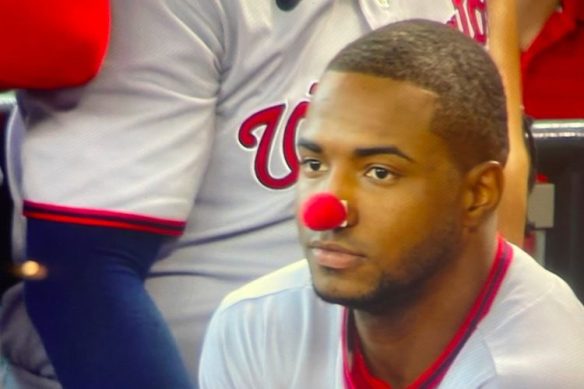
That was a clown dismissal, MadBum . . .

Grumpy Old Men Dept.—It’s tough to determine which stung Madison Bumgarner more, Victor Robles hitting one over the fence and savouring it visibly on his dollar or Robles responding with a classic troll when Bumgarner dismissed him as a clown: Perhaps if MadBum wishes not to be clowned, he might ponder the thought that surrendering 24 homers a year on average goes a long way toward denying such wishes. Earth to MadBum: that was a clown dismissal, bro.

Busted Dept.—I’d like to go on record yet again as saying and believing that a player who’s sent from promise to unfulfilled promise because of injuries incurred while he actually plays the game isn’t a bust. I’d also like to go on record in that regard as saying anyone who claims otherwise and matches such players to those who either can’t cut it after all or squander their talent (drugs, too much high life, too little conditioning and work ethic, etc.) should be dismissed as a damn fool.

Glove Story Dept.—Amidst most of the high-fiving among Yankee fans over the team acquiring left fielder Andrew Benintendi from the Royals in exchange for a pitching prospect trio, maybe 99 percent of the chatter pointed to Benintendi’s on-base machinery this year and maybe one percent pointed to his equivalent gift for preventing runs.

I get Yankee fans trying to swallow that this guy was once a rival on the Red Sox, but they should be very mindful of Benintendi’s ability to break the other guys’ backs with his legs and glove in left field. Their Yankees may yet need him to save a pennant the way he helped do for the 2018 Red Sox:

Giant Steps Dept.—That was then: the Giants not looking to deal away veterans. This may be now: the Giants may order about face! to the rear, march! on that. Various reports indicate the recent Giants fade has “other teams” keeping one eye on that possibility—including prospective free-agent veteran pitcher Carlos Rondon and outfielder Joc Pederson. But will the eyes have it?

Relief Dept.—It’s enough that Juan Soto is on the trade market, apparently. But Nationals general manager Mike Rizzo, also apparently, insists that he’s also not going to use moving Soto as a tack to unload a bad or at least compromised contract—such as pitcher Patrick Corbin’s remaining $50 million. You’d love to think that even the forthright Rizzo wouldn’t really play that game. Memo to teams interested in Soto: Trust your mother but keep the spare tire inflated properly.

You’ll Be Happier with a Hoover Dept.—The Astros got beaten, swept, and cleaned this week. By the Athletics. The dead-in-the-(AL)-West Athletics. In Oakland, where the A’s were 17-30 before the first-in-the-West Astros came to town. They even beat Luis (Rock-a-Bye Samba) Garcia and Cristian Javier while they were at it. And, won each game by exactly two runs. Break up the A’s?

You Can Be Sure Dept.—From self-described king of the Mets’ Twitter underground, handling himself METSMENACE, after the Mets swept the Yankees in a two-game set with Max Scherzer punching out six including Aaron Judge thrice: “It’s a good thing [Jacob] deGrom wasn’t in the dugout when Scherzer was giving high fives from hell or he’d be out for another 9 months.” As if Max the Knife would be that blind.

Bronx Savings Bank Dept.—In one way, Andrew Benintendi didn’t lose a thing being traded to the Yankees: the Royals were scheduled to fly to New York for a weekend set with the Empire Emeritus, so he was going to the Bronx one way or the other. The only thing he has to change is his field wardrobe. This is what’s known at times as the perfect storm. But what if the Yankees use the Royals for target practise and Benintendi proves one of the best marksmen this weekend?

Portside Dept.—The Red Sox insist they have no intention of trading either of their left-side infield mainstays, Xander Bogaerts (shortstop) and Rafael Devers (third base). They insist despite recent struggling that they’d prefer to buy and sell at once for the coming trade deadline, maybe selling other veterans and buying a few long-term pieces. Says Red Sox Nation: Heavy sigh of relief. Says experience, and not just regarding Boston: Is that just the same old song? Don’t touch that dial.