He gets my Vogt

Stephen Vogt

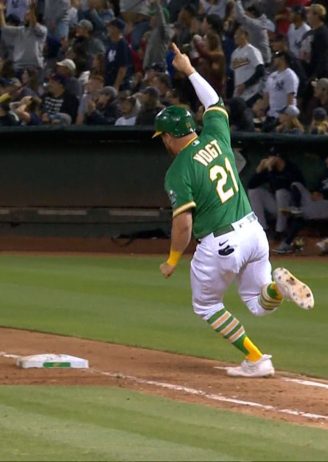
Stephen Vogt runs out the game-tying bomb he hit toward an A’s walk-off win over the Yankees in late August. The 37-year-old veteran will retire at season’s end.

As legendary 20th century radio malaproprietess Jane Ace might say, we’ve been sitting on pins and cushions awaiting the milestones this season. Pick the season, show yourself who has a shot at reaching which one before the season ends. Nature of the baseball fan beast.

We’re waiting for in-prime Aaron Judge to meet and pass Roger Maris as the American League’s new single-season home run champion. We’re waiting for elder Albert Pujols, who busted Blake Snell’s no-hit bid in the seventh Wednesday, to join the 700 Club—and we don’t mean the one Pat Robertson founded, either.

Waiting for the stars to erupt further in the record books one way or the other is as old as the professional game itself, seemingly. But just as Meryl Streep didn’t bag Academy Awards without solid supporting casts off which to play, baseball’s big men don’t have room to be the big men without the not-so-big men around and behind them.

One of those journeymen will call it a career after the regular season ends. He won’t get a postseason epilogue; his Athletics are about as close to being there as a mouse to trapping the cat. Stephen Vogt is one of those little big men who deserves to be shown the love after a decade which personified the journeyman’s life.

His career began 0-for-32, from 2012 through 28 June 2013. Then, leading off the bottom of the fourth with the A’s ahead 5-0, Vogt sent an 0-2 service from then-Cardinal relief pitcher Joe Kelly down the right field line and over the fence. If you’re going to smash a career-opening slump that went year-to-year, you couldn’t do it better even in the cheesiest film script.

What began ending the longest career-opening position player’s hitless streak since another Athletic (Chris Carter) did it three years before Vogt teed off became a career that included two All-Star selections and clubhouse value to five teams including his return engagement in Oakland this year.

Vogt didn’t make a show of that slump-breaking, first-hit home run. Idolising Barry Bonds when he grew up, Vogt could only remember his father’s advice prior to his making the Show in the first place, after asking as a kid why Bonds stood watching before a home run cleared the fences. “Stephen,” the old man replied, “when you have 500 home runs in the major leagues, you can do whatever you want. Until then, you put your bat down and you run around the bases.”

He told a reporter he made one exception a few months after that first-hit homer, facing future Hall of Famer Justin Verlander in the 2013 American League division series—his first career game-winner, a bases-loaded RBI single—after fouling off seven in a ten-pitch plate appearance—for the 1-0 win over the Tigers that sent the set to Detroit tied at a game each.

Such moments have been few enough for the 37-year-old who’s caught, played first base, and played in the outfield in his Show decade, but he’s been one of those there-to-be-called-upon who inspired fan loyalty wherever he suited up. “I believe in Stephen Vogt!” became their rallying cry. Over a journey such as his, it has to be appreciated. (The A’s will honour his career before their season-ender against the Angels on 5 October.)

Vogt is realistic about a career that’s paid him a somewhat modest (in baseball terms) but much liveable $14 million.

“I haven’t always been the best player,” he said. “I’ve been one of the best players in the league, I’ve been one of the worst players in the league. I’ve been injured and everywhere in between, I’ve been DFA’d twice, I’ve been traded, I’ve been non-tendered, you name it. I’ve been the guy that knew he was going to have a job next year to the guy that had to fight for his job next year, and just always go out and earn it.”

A guy with that becalmed an attitude is a guy who earns respect without having to reach for the heavens or punch a hole in them. He’s also a guy who earns it on a self-resurrecting World Series champion even if he couldn’t contribute on the field because he was injured. That was Vogt earning a ring regardless with last year’s Braves.

“Vogter is one of the most inspiring players I’ve ever managed,” says Padres manager Bob Melvin, who once managed him with the A’s. “What he means to a clubhouse is immeasurable—two-time All-Star, beloved in Oakland. One of my all-time favorites. Definitely has a future in managing.”

Vogt has picked the brains of Melvin plus managers Mark Kotsay and Craig Counsell (for whom he once played in Milwaukee) along the way, perhaps with just that purpose in mind. He’s been a student of the game as long as he’s played it, and Melvin may not be out of line to suggest his baseball future. If nothing else, too, Vogt may become one of those skippers who knows how to keep his clubhouse engaged.

“He felt passionate about it and spoke up,” Kotsay told reporters, after the A’s beat the Mariners Tuesday. “Does he need to do that at this point in the season when he’s on his last fifteen games? No, he doesn’t. But that shows his character and his love for the game, his love for his teammates. It came across loud and clear.”

“Having him back this year is great,” says Sean Murphy, the A’s catching anchor now, who remembers Vogt mentoring him right out of the gate in spring training 2017 and taking him around to meet everyone the better not to let him feel like just another rook. “When I heard they signed him, I was like, ‘Yes, awesome, I can’t wait to play with him again’.”

“I had a coach tell me, ‘Every day you take the field, there’s a little boy or girl that’s at their very first baseball game and you need to show them the correct way to play’,” Vogt says,  “and I’ve taken that to heart. And every night, that’s why I run hard, that’s why I play hard. It’s the correct way to play baseball.”

We’re not waiting for Vogt to punch a hole in the heavens for a major milestone. But we might be waiting to hit the Net running or pick up what’s left of the newspapers or flip on the television news and learn that Vogt’s going to be somebody’s next manager.

For now, let’s do honour to the Stephen Vogts who didn’t have to be game breakers, postseason race difference makers, or record busters, but who were equal value to their teams than the ones who earn the MVPs or the Cy Young Awards or just plain break the games and the championships open wide enough.

With the Vogts among them, the big men who can’t do it all by themselves don’t have to do it all by themselves. They don’t have to try striking guys out with single pitches equaling three strikes or hitting six-run homers with every swing. The Vogts let them play the game with the least possible additional stress.

That’s what the A’s will honour iat the end of their otherwise deflated season. It’s a tribute the hint of which other clubs might care to take when it’s time for their own veteran journeymen to step away from the field.
The Sixty Special

Aaron Judge

“Slide over, Babe, you’ve got some company!” So hollered announcer John Sterling as Aaron Judge hit number 60 Tuesday night.

If nothing else, it might have been the only time a solo home run that started a ninth-inning comeback win could possibly upstage the grand slam that finished it. That’s what happens when your teammate’s chase of baseball history precedes you.

On any other night, Yankee designated hitter Giancarlo Stanton’s ultimate grand slam, off Pirates reliever Wil Crowe, would have put a vise grip on the headlines. Even on a night the crosstown Mets came from behind against the Brewers in Milwaukee to take a lead they wouldn’t relinquish on a Francisco Lindor grand slam in the seventh.

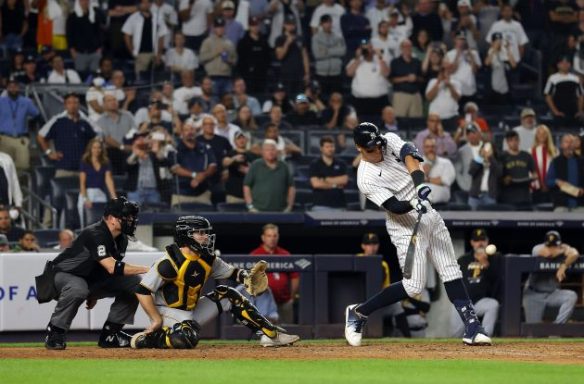
Stanton’s launch suffers a fate almost worse than that suffered by Crowe leading the inning off, when he fed Aaron Judge a 3-1 sinker that didn’t quite sink and was enough to send three-quarters of the way up the left field bleachers. “Slide over, Babe, you’ve got some company!” Yankee announcer John Sterling hollered as Judge rounded second.

Cadillac once called a variant of its top-of-the-top-of-the-line Fleetwood model the Sixty Special. The marque’s Fleetwood line is long gone, of course. But what Judge did Tuesday night made it resemble a Trabant.

Not just because the Yankees went from there to win without the Pirates recording a single out. Not just because Anthony Rizzo followed Judge by reaching for a down and away changeup and doubling to center. Not just because Gleyber Torres walked on five pitches to follow. Not just because Josh Donaldson singled to right to load the pads. And, not just because Stanton turned on a 2-2 changeup and drilled it to roughly the same real estate as Judge’s milestone, if not quite as far back.

From the moment it appeared Judge really would chase the ghosts of Babe Ruth and Roger Maris for the American League’s single-season home run championship at minimum, the old 154-vs.-162 game shibboleth instigated by then-commissioner Ford Frick’s capricious conflict of interest (he was, of course, a Ruth ghostwriter once upon a time) was revived a little too often by the idiot brigades of today’s social media swamp.

With Maris’s sons Roger, Jr. and Kevin among the Yankee Stadium crowd, Judge connected to finish a night on which it looked as though he might go hitless. He’d grounded out twice, struck out once, and walked once, before he launched the milestone that began the overthrow of an unlikely four-run Pirate lead. He did it in the Yankees’ 147th game, seven sooner than Ruth in 1927 and twelve sooner than Maris in 1961.

His chances of going past Ruth and Maris in the Yankees’ Sixty Special Club are overwhelming. He may or may not get to the Seventy Society populated by two men, Mark McGwire and Barry Bonds. But would you really bet heavily against a man who’s hit more into the ether since the All-Star break than any individual on four known teams (the Athletics, the Pirates, the Giants, the Nationals) has hit all season?

Now that Judge has met and stands on the threshold of passing Ruth, and is likely to meet and pass Maris posthaste from there, Judge may also have wrapped up the American League’s Most Valuable Player award. May.

Shohei Ohtani remains in the conversation, and the Angels’ two-way unicorn won’t go gently into the proverbial good gray night no matter how far out of contention the badly misadministered Angels are. It might not be out of bounds to ponder whether it ends up with Judge and Ohtani sharing the award. May.

It isn’t always the rule that a league MVP should play on a postseason contender. It isn’t always the rule that he shouldn’t, either. But pursuing history has its call upon MVP voters, too. Ohtani’s already made his history, with his Rookie of the Year 2018 and his MVP 2021; anything else he does merely augments it, unless he becomes crazy enough to bust a single-season home run record while winning a Cy Young Award.

Judge is doing his level best not to think about things such as that, or about things such as the ginormous free agency payday into which he’s swinging himself when the Yankee season finally ends, whenever that may be. It’s about as simple as having to face far more and far different pitching with near-guaranteed freshness every day than Ruth and Maris had to face in the conditions of their time.

“I don’t think about the numbers,” Judge told reporters postgame. “We talk about Ruth and Maris and Mantle and all these Yankee greats, you never imagine as a kid getting mentioned with them. It’s an incredible honor and something I don’t take lightly at all. But we’re not done. We’ve still got a couple of games left in this season, and hopefully more wins come with it.”

His Yankee teammates are another proposition. “Having a front seat from the on-deck circle for most of this,” says Rizzo, “has been amazing.

“He hit 60 tonight and it’s like nothing happened,” Stanton said. “He’s got more work to do, and that’s the mindset. This is just fun to be a part of.”

“The craziest thing,” said pitcher Gerrit Cole, “is that he’s gonna hit so many more. If we play baseball another six weeks, through the postseason, he’s gonna hit like 12, 13 more home runs. He’s just getting started.”

“I want him to hit a home run in every at-bat,” said catcher Kyle Higashioka, “and I think that’s the same sentiment amongst everybody else in this clubhouse, too. As good as he’s playing on the field, he’s the best teammate you could ever imagine. So there’s nobody in here who doesn’t wish for the absolute best for him.”

Judge had to be all but forced out of the dugout for a quick curtain call that amounted to nothing much more than a small wave. He tried to wave it off as nothing much and somewhat out of proportion. “I really didn’t want to do it,” he said. “Especially, we’re losing. It’s a solo shot.”

He had to know he wasn’t going to get away with that. With or without the overthrow he ignited. “I’m trying to enjoy it all, soak it all in,” he said, “but I know I still have a job to do out on the field every single day and I just have to keep my head down, keep preparing and stay mentally focused.”

Maybe forget 60. Or 61. Maybe start thinking about a Seventy Special. Even lifelong, hard credentialed, card-carrying Yankee haters are enjoying this. Lifelong, hard credentialed, card-carrying Yankee fans, of course, may petition to have the stadium’s Judge’s Chambers renamed the Supreme Court.

The Red Sox need to receive, not send messages

Rafael Devers

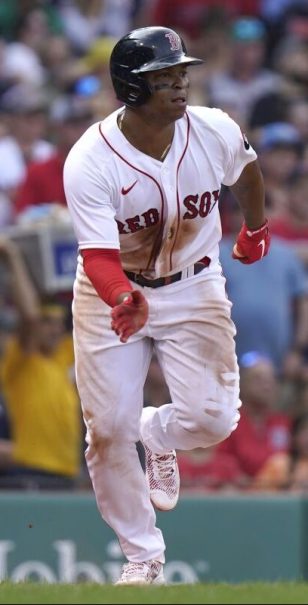
Rafael Devers’s 4-for-6 Sunday—including a two-run single and another RBI single—helped the Red Sox bury the Royals. Where were days like these from others when the Red Sox needed them most?

When the Orioles sent Trey Mancini to the Astros in a three-way deal at the trade deadline, it looked like general manager Mike Elias pushed the plunger on the season despite the team rising back from the dead. No less than Baseball Prospectus described the popular Mancini as “the heart and soul of a franchise long depleted of either.”

Well, Mancini’s now guaranteed a trip to the postseason with the Astros having clinched a postseason berth at minimum (wrapping up the American League West is just a formality waiting to happen for them) . . . and the Orioles remain within sight of a wild card entry, a mere four games back of the Mariners for the league’s fourth wild card.

Nobody really wanted to see Mancini leave Baltimore, not even Elias despite his word-salad explanation of the deal. Not in the Oriole clubhouse, not in the Camden Yards stands. But candor requires us to own up and admit the Mancini deal wasn’t popular but neither did it prove disastrous. It’s been how long since the Orioles finished seasons with winning records?

The Orioles may end up falling short, but they put on a show of self-revival that portends well for their 2023 and shows what teams can do despite losing well loved members to the business’s actualities. There are teams who would do very well to pay attention, listen, and learn.

The team in Boston, for example.

It sent the Red Sox clubhouse into a wrench when backup catcher Kevin Plawecki was designated for assignment late last Friday night and released officially Monday. On Sunday, after the mostly moribund Red Sox ironed up and smothered the Royals 13-3, the players bathed the joint with Plawecki’s walk-up song, “Dancing on My Own.” That’d send the message, right?

What message? The message that it’s not nice to send a popular clubhouse guy packing? The message that it’s not nice to cut a guy loose who kept the club loose amid disaster and started the laundry-cart dugout ride for home runs with them even if he didn’t get to take the ride himself too often? The message that the front office just doesn’t get it?

How about whether the Red Sox didn’t need to be sending but receiving messages? Such messages as yes, the front office Lucys got some splainin’ to do but so do the players. They got some splainin’ to do about what NBC Sports Boston’s John Tomase calls “this undercurrent of victimization and grievance that has left the clubhouse feeling like it plays no part in the results on the field.”

We saw it in the mopey reaction to the trade of catcher Christian Vazquez, whose replacement, Reese McGuire, has significantly outperformed him, it must be noted. We saw it a year earlier when trade deadline reinforcements didn’t arrive quickly enough, even though Kyle Schwarber ended up keying a run to the American League Championship Series. And we’re seeing it now with Plawecki, a fine backup and veteran presence who isn’t the issue here.

The issue is the reaction of players who seem unwilling to accept responsibility for their role in this disappointing campaign. When right-hander Nathan Eovaldi tells WEEI.com’s Rob Bradford the clubhouse misses presences like Schwarber, Plawecki, and Hunter Renfroe, it comes off as a direct dig at Bloom’s priorities. But how about Eovaldi fills that gap? We’re still talking about a veteran-laden roster, after all. From Xander Bogaerts to J.D. Martinez to Rafael Devers to Kiké Hernández to Nick Pivetta to the dearly departed Vazquez, the Red Sox did not lack for experienced, winning players.

So where were they when the season started going south in July? They never stanched the bleeding, even though within their very own division, the Rays survived the loss of burgeoning superstar Wander Franco, Gold Glove center fielder Kevin Kiermaier, All-Star catcher Mike Zunino, ace relievers Andrew Kittredge and J.P. Feyereisen, and potential future ace Shane Baz, among others. They currently trail the Blue Jays by only half a game for the first wild card.

The Rays didn’t give up when injuries hit, but the Red Sox did, rendering the final eight weeks of the season meaningless.

It might now seem an Eighth Amendment violation to remind the Olde Towne Team now. It wasn’t that long ago when their age-old rivals from the south Bronx went to back-to-back postseasons despite being hit with injury bugs so pronounced you’d have thought their games were episodes of Bones, Grey’s Anatomy, and House, and that The New England Journal of Medicine was really the Yankee yearbook.

I get it. Plawecki wasn’t a world beater at the plate or behind it; his usual role seemed to have been as the catcher of choice for starting pitchers Eovaldi and Michael Wacha, their two best starters when they’re not injured. Above and beyond that, Plawecki was one of the cast of Show characters who play roles unseen on the field.

“The Plaweckis of the world,” writes the Boston Globe‘s Jon Couture, “get teams through the grind, help rookies adjust, and are beloved for their conscientiousness and camaraderie. They’re needed. Thus, the pointed reaction for an end-of-the-roster guy.” (Thus, too, the likeliest reason the Rangers are interested in the now-free Plawecki and might even sign him today.)

Tomase gets it, too, but only to a particular valid extent. “Recognizing the temperature of the locker room is a necessary management skill,” he writes, “and at times the Red Sox could do a better job of communicating decisions to the rank and file.”

But we often go too far in castigating this move or that as harmful to the delicate clubhouse ecosystem.

Sometimes the players just need to man up and admit that management doesn’t owe them anything, because they did not honor their half of the bargain. Sometimes their performance leaves the boss no choice but to cut their buddy because he’s not part of the future. Sometimes next year matters more than this one.

Castigate Bloom as you wish for this unmade move or that unmade move or the other move that backfired. Fair enough. But when Tomase says the Red Sox players left Bloom little enough choice this year but to play wait-till-next-year, too (or wait-till-last-year, considering their reinforced run to the ALCS), he’s not just writing through his chapeau.

Lucky for the Red Sox they’ve got more 21st Century World Series rings than anyone else in the Show so far. Before that, a season such as this would have been written off as just another entry in the long log of rotten Red Sox malfortune. Who would have thought that the Orioles of all people would end up better off and with more respect approaching the finish line?

On Plesac’s agents dumping him

Zach Plesac

Zach Plesac, earning his D.A.* of the Month award 26 August.

I promise, I have more important things to ponder. Things such as whether next year’s rule changes really will do anything substantial. (If what I saw watching the Las Vegas Aviators host the Tacoma Rainers Wednesday night says anything, don’t hold your breath. Even with the pitch clock and strict obedience thereto, the 8-7 Aviators loss still took about three hours and ten minutes to play. Thank 37:19 minutes worth of between-innings time for the real culprit: broadcast commercials )

Things such as whether Aaron Judge will reach not 60+ home runs but maybe 70, at the rate he’s going. (He parked 56 and 57 in Fenway Park Tuesday night while his Yankees beat the Red Sox 7-6 in ten innings. He left himself four short of Roger Maris, the Yankee single-season record-holder, in game 143 of the season, if you still really care about such arbitrary things.)

Things such as whether the coming expanded postseason will prove a convoluted mess on top of its going in as a true competition dilution. (Why is Commissioner Rube Goldberg more interested in arbitrary time-of-game tinkering than he is in adjusting divisions, eliminating regular-season interleague play, and restoring real pennant races? He still doesn’t get it: 2:15 minutes worth of commercials after each half inning elongate games more than pitchers or hitters adjusting after every pitch, in-inning pitching changes, or mound conferences ever did.)

Things such as the Rays making history by putting the Show’s first all-Latino team on the field to commemorate Roberto Clemente Day, and clobbering the Blue Jays 11-0 while they were at it. The leading lashers: Randy Arozarena (3-for-5 including a double, a run scored, and a run driven home), Yandy Díaz (a three-run homer in the second), and Manuel Margot (a three-run double in a six-run ninth).

But no. I have to ponder a very rare instance of a player being dumped by his agents instead of the other way around. And this is because Zach Plesac, Guardians pitcher, did something dumb once too often for their taste.

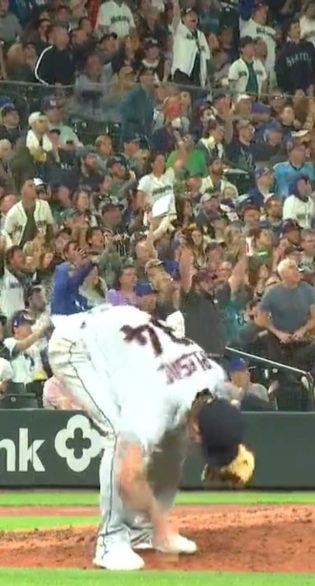
On 26 August, Plesac surrendered two long balls already when he had Seattle’s Jake Lamb 1-2 in the bottom of the seventh. Then he fed Lamb a meal fit to pad a Mariners lead into 3-1 after Lamb fed it over the right center field fence. Plesac spun around on contact, bent over a bit as he watched the ball fly, then punched the mound in abject frustration.

Uh-oh. Even as the Guardians struck back to bust the tie and hang in to win off a three-run eighth, that punch took Plesac out for the rest of the season thanks to the fractured hand that resulted. This was the last thing the American League Central-leading, postseason-bound Guards needed.

It also proved the last thing Creative Artists Agency needed, too. About two weeks after the Guards put Plesac on the injured list, CAA dropped him as a client. “Three strikes appeared to be enough for CAA to say ‘you’re out,’” writes the New York Post‘s Jeremy Layton. “Plesac, despite a 3-11 record in 2022, has pitched decently for Cleveland (4.39 ERA), and is eligible for a big arbitration payday in the offseason. Still, the agency clearly decided the juice was not worth the squeeze.”

This is the pitcher who co-violated the team’s COVID protocols in 2020, having a night out  in Chicago including dinner in a restaurant and a card game at a buddy’s place, without getting team clearance first. The Guards ordered Plesac and co-partyer Mike Clevinger to issue statements. Then he went on Instagram and said the incident being reported in the press made it the media’s fault.**

This is also the pitcher who incurred a thumb fracture in May 2021. Was he hit by a comebacker? Was he hit by a pitch while batting in an interleague game in a National League ballpark? Nope. He suffered the injury . . . while ripping his jersey off and apart after he was battered for five runs (only three earned) during a Guards loss to the Twins. It cost him a month and the Guards another team migraine.

Not many players self-destruct as publicly, spectacularly, or ridiculously as Plesac. He’s  probably cost himself a considerable enough piece of the arbitration payday he might have expected otherwise this offseason. Maybe that will finish sending the message CAA began.

If Plesac’s agents can dump him merely for being a repeat jerk, why don’t other baseball agents—and teams, for that matter, whether trading, releasing, or letting them just walk into free agency—drop those guilty of far more grave behaviours? They’ve done it before, in various ways, and they can and should do it again.

Especially regarding such behaviours as domestic violence. A player being a repeat jerk is just that. Domestic abusers are many things more serious. Calling them mere jerks would be an unwarranted compliment.


* —Dumb Ass.

** —When you like us, we’re the press. When you hate us, we’re the media.—William Safire.

About those coming rule changes . . .

Mike Hargrove

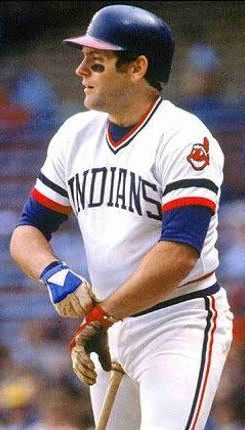
Mike Hargrove—the Human Rain Delay might lead the Show in unpitched strikeouts starting next year if he was playing major league ball now.

Hands up to everyone screaming blue murder about the rules changes coming to baseball in 2023. Now, listen up. They might actually be not as grave as you think. Might.

It’s probably a good thing that Mike (The Human Rain Delay) Hargrove (first baseman) and Pedro Baez (relief pitcher) don’t play now. The new pitch clock rule would have Hargrove leading the Show in batting strikeouts with about half of those coming without pitches being thrown, and Baez would likely lead the Show in pitching walks without throwing pitches.

Starting next year, pitchers get fifteen seconds to throw to the plate with the bases empty and twenty to throw with anyone on base. Hitters better be in the batter’s box ready to swing after eight seconds on that pitch clock.

They’ve used the pitch clock in the minors for a few years now and, well, if you don’t count the unconscionable contraction of the minors a couple of years ago nobody’s proclaimed the end of the world as we know it yet.

The bases are going to get a little bigger, too. The bases have changed since the game was first organised, unless you never knew they began as large stones, changed to wood posts, and then to pure sandbags before somebody thought to make them the filled canvas squares that were familiar to one and all until about three decades or so ago. Stop snarling, Boring Old Fart. Then, pick up a copy of Peter Morris’s A Game of Inches, and learn that baseball was never quite as static as you let yourself be led to believe.

Why enlarge the bases even a relatively small amount? (From fifteen-inch squares now to eighteen-inch squares starting next year.) MLB’s Competition Committee thinks they’ll cut down on baserunning injuries (to name one, future Hall of Famer Mike Trout missed about half a season one year after incurring a thumb injury sliding into base) and raise the prospect of basepath theft in the bargain.

“In Triple-A, the first season of larger bases didn’t make much of a change on its own—but in the lower levels, bigger bases combined with rules about pickoffs saw large increases in steals per nine innings,” noted ESPN’s Jesse Rogers. “Even combined with the disengagement rules, though, MLB doesn’t believe either change will lead to teams being unable to control the run game.”

The infamous defensive overshifts will be verboten, too. Starting next season, teams will be required to keep four infielders on the infield dirt, including one each on either side of second base. This won’t exactly eliminate pure defensive shifting—you can still position a shortstop almost behind second base itself or a second baseman almost directly behind the pad, and move your first and third basemen accordingly against pure pull hitters—but you won’t see those walls of infielders on one side or a shortstop in short right field or a second baseman in short left, for a couple of examples.

But how to enforce? “If the hitting team reaches base and runners advance on a ball hit under the violation, the game proceeds without penalties,” Rogers wrote. “If the play has any other consequence—an out, a sacrifice, etc.—the hitting team can decide either to accept the penalty—which would add one ball to the hitter’s count—or decline it, and the play would stand.”

I wish he hadn’t said “sacrifice.” I’ve said it before, I’ll say it again: deliberate sacrifices waste outs, your most precious commodity when your guys are at the plate. You can look it up, too: in six known “bunt situations,” only once do you have an absolute better chance of scoring after than before that bunt (men on first and second, nobody out), only once  otherwise do you have an even scoring chance before and after (man on second, nobody out)], and all four others you have less chance to score after than before that bunt.

Unless you’ve got the next Brett Butler on your team (that half-pint center fielder dropped 337 bunts in his long career and 85 percent of them were for base hits), you should be fined heavily for wasting outs and scoring probabilities with bunts.

These three new rules won’t be as drastic as the continuation of the free cookie on second base to open each extra half inning is and will remain. The players on the Competition Committee were outnumbered 6-4, but I’d love to know if they pushed to get rid of Manfred Man at all. It’s a ridiculous rule that probably did nothing to cut down the time of a game, which was of course the critical factor in devising the aforementioned new rules. (It’s also another of the extremely few reasons to waste an out with a bunt: you’re handed a man on second going in, you have an even chance of scoring after bunting him to third, go for it. Make Manfred Man look like anything but a pretty flamingo.)

But will they really cut down on the times of games? From where I sit the jury’s going to have a long deliberation. And two things that would really cut down on the times of games don’t even seem to have been topics. You don’t need me to tell you that eliminating broadcast commercials a) between half-innings and b) during pitching changes in jams would probably do more to cut the times of games than any of the foregoing changes—especially if they’re married to thing two: eliminating the eight warmup pitches on the game mound for relievers coming in in the middle of those jams.

Go ahead and scream. All better? Now listen up. Again. (I’ve argued this before.) When you bring a pitcher into a jam, unless you’re bringing him in because your incumbent was injured, you shouldn’t even have to think about the new man warming up on the game mound.

He might have thrown anywhere from one to three or even four innings worth of pitches getting to where you could bring him in in the first place. Warm up? He’s coming in hotter than a Las Vegas summer. It takes less time for him to get from the bullpen to the game mound, most of the time, than it does to run those ridiculous “this call to the bullpen” commercials.

You brought him in to get you out of that jam. He’s nuclear hot already. Let him get right to work. Your reliever’s not going to have less men on base behind him or a less pesky hitter at the plate after he throws those eight useless warmups, is he? (Oops. Better not give Commissioner Rube Goldberg any more bright ideas!)