Hobie Landrith, RIP: Of Polo Grounds and oranges

Hobie Landrith

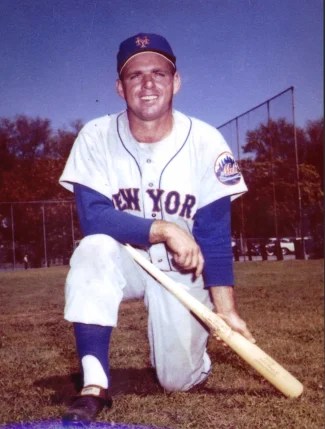
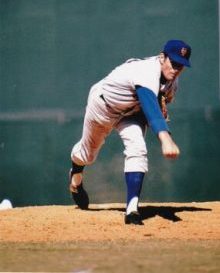
Landrith, the very first Met.

The plot was simple enough. Visiting my favourite aunt and uncle in their still somewhat new Poughkeepsie (NY) digs, a splendid colonial home that was actually the model for the development, my three cousins would awaken me promptly at seven the next morning. They wanted to see me and my twelve-year-old baseball brain win a local radio station’s “Sports Call” contest and whatever prize would come.

So there was Tommy drumming out the fabled climax of the William Tell Overture (or, the theme from The Lone Ranger, if you prefer) against the nightstand next to my bed. (And, specifically, my ear.) There was Bobby, ready to dial the “Sports Call” number with the phone to my ear. Not to mention Linda, the eldest of the trio, standing by with a grin I’d swear was caught between amusement and amazement.

And there I was, maybe a quarter awake, Bobby starting to dial the split second the host began asking the question: Who was the first player chosen in the National League’s expansion draft? (The draft creating the Montreal Expos and the San Diego Padres was yet to arrive.)

Great hitters can hit rice pudding thrown right into their wheelhouses for distance, even if they happen to be hung over. At age twelve I wasn’t exactly hung over, but I wouldn’t have said no to about two more hours sleep except for the “Sports Call” idea. (A 7 A.M. awakening when it wasn’t a school day was not my idea of paradise.) Sure enough, the other end of the line answered, the host’s voice asking the question again to me directly. Right into my wheelhouse.

I managed to croak, “Hobie Landrith, catcher, by the New York Mets.” Pay dirt. Minutes later, the station’s music finished and the host came aboard to say he’d just received the fastest correct “Sports Call” answer since he’d begun doing the feature on his morning show. A few hours later, there were Bobby, Tommy, Aunt Marge, and yours truly, in the station wagon, pulling up to . . . a pleasant stand-alone produce market, where my knowledge of Landrith’s expansion draft status landed me two large crates of freshly imported Florida oranges.

I left one of the two crates with Aunt Marge and Uncle Herb, now of blessed memory. (Their long, happy marriage ended only with their departures to the Elysian Fields a year apart in 2015-16.) Somehow, I managed to haul the other aboard the train to Marble Hill in the Bronx, where my mother met me for a night at my maternal grandparents before returning home to Long Beach. She almost collapsed when she saw me hauling the oranges with my small suitcase atop the crate.

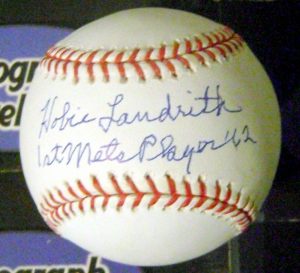
In later years, Landrith loved to sign autographs adding that he was indeed the first Met ever. 

“The first thing you have to have is a catcher,” said Original Mets manager Casey Stengel, explaining why the new team handed the first expansion draft pick chose the non-renowned veteran catcher from the Giants. “Because if you don’t have a catcher, you’re going to have a lot of passed balls and you’re going to be chasing the ball back to the screen all day.”

Stengel was probably too occupied managing and winning pennants with the 1949-60 Yankees to notice that, as a 1956 Cub, Landrith was charged with ten passed balls. But in the same season, he threw 23 would-be base larcenists out for a respectable 38 percent caught-stealing percentage. In three seasons as a Giant part-timer, before the Mets picked him, Landrith’s caught-stealing percentage was 41 percent.

“Thirty-one year old catcher who looked twenty-eight and played like forty,” wrote Leonard Shecter, in Once Upon the Polo Grounds, of Landrith, who died at 93 in California last Thursday. “Hobie always said he was 5’8″. He probably was 5’6″. It wasn’t his fault he wasn’t big enough to play this game.” (Baseball Reference actually lists Landrith as 5’10”, if you’re scoring at home.)

The Decatur, Illinois native was a perfect Original Met, until he wasn’t. On Opening Day 1962, he threw past second trying to arrest a base thief. He was charged with three passed balls in 21 games. But he spoiled the fun when the Mets swept a doubleheader from the Braves that May. He won the first game by pinch hitting a two-run homer off Hall of Famer Warren Spahn. Into the upper deck of the ancient Polo Grounds, the Original Mets’ home while awaiting Shea Stadium’s completion.

Remember: The Original Mets had Abbott pitching to Costello, with Who the Hell’s on frst, What the Hell’s on second, You Don’t Want to Know’s on third, and You Don’t Even Want to Think About It’s at shortstop. Clearly enough, Landrith didn’t really have what it took to animate the Original Met faithful. So the Mets made him do the only thing, really, that he could have done to help the anti-cause.

The next month, they sent him to the Orioles to complete a deal they made in May, a deal in which they sent cash plus a player to be named later for first baseman Marv Throneberry. Marvelous Marv himself. It may have been Landrith’s greatest contribution to the Original Mets’s unlikely grip upon New York’s heart. “The Mets were different, they were counterculture, they were fun,” Stengel biographer Robert W. Creamer would remember. “The worse they were, the more fun they were.”

The Orioles didn’t yet resemble contenders when Landrith was sent there. The Washington Senators, to whom the Orioles sold him later in 1963, weren’t exactly American League ogres, either. At least Landrith got to have a sort-of reunion before the Second Nats cut him loose after that season. His former Met teammate, Hall of Famer Gil Hodges, became their manager, after Mickey Vernon’s 14-26 ’63 start led to his execution and Eddie (The Walking Man) Yost’s running the team for one loss before Hodges came aboard.

“I was in the major leagues more because I was a good defensive catcher, and the fact that I was good at handling pitchers,” said Landrith, once upon a time, to This Great Game. The pitchers who threw to him lifetime had a respectable 3.92 ERA. His not-so-formidable bat was probably the thing that kept him from becoming a regular catcher over his early seasons with the Reds, the Cubs, and the Cardinals—even if he walked 253 times while striking out 188. (His lifetime Real Batting Average—total bases + walks + intentional walks + sacrifice flies + hit by pitches, divided by total plate appearances: .424.)

“I always thought I was a fairly decent hitter, but I realized that I wasn’t in the big leagues for my bat,” he continued in the same interview.  “I had what they called ‘warning track power.’ You know, I’d hit the ball pretty good, the fans would get up on their feet, and then they’d groan, because the ball would die at the warning track.”

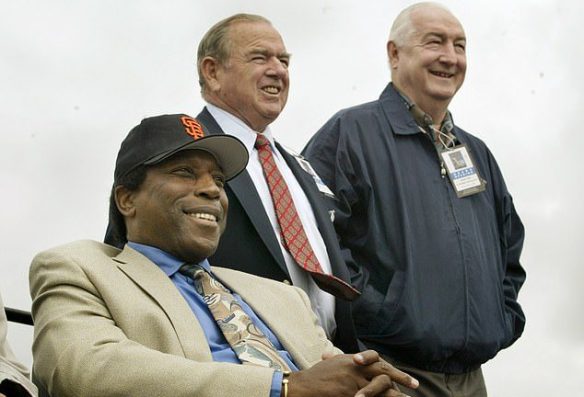
Willie McCovey, Hobie Landrith, Tom Haller

The San Francisco Chronicle captured Landrith (center), flanked by former Giants teammates Willie McCovey (left) and Tom Haller, watching a game in 2003.

As a Giant, Hall of Famer Willie Mays called Landrith “Honest John.” Landrith had no idea why. “He gave some of us strange nicknames. Folks would criticize Willie for being hard to talk to, but it wasn’t always that way. Willie got burned by the [San Francisco] press one time too many, and he got a little harder every time it happened. He was never that way with his teammates, though. I loved Willie and I had a great relationship with the man. I still do.”

Likewise Hall of Famer Willie McCovey: “People ask me all the time, what kind of a guy is Willie McCovey? And I tell them, if Willie walks into a room and smiles, everyone in that room smiles too. I was in the lineup for his first major league game when he went 4-for-4 against [Hall of Famer] Robin Roberts. I just feel fortunate that I was able to play with the man during my career. He’s just a wonderful person.”

That game, on 30 July 1959, featured three Original Mets to be (Landrith, Hall of Fame center fielder Richie Ashburn, and Phillies first baseman Ed Bouchee), plus two more eventual Mets: Mays, and Giants shortstop Ed Bressoud—who ended up becoming an Original Colt .45 (Astro) first, in the same expansion draft in which the Mets selected Landrith to kick things off.

After working as a Senators’ coach for 1964, Landrith left baseball and became a longtime public relations executive for Volkswagen. He and his wife, Peggy, had six children (three sons, three daughters), eleven grandchildren, and eleven great-grandchildren. If he just wasn’t made to be a true Original Met, he certainly was made for family and business success.

His roost in the Elysian Fields should only be that kind of serene. And I still can’t drink a glass of orange juice without remembering a certain phone call that landed me two crates of its source. Or, without remembering the catcher who helped make those crates plus Marvelous Marv possible.

For safety’s sake on the mound and at the plate . . .

Josh Smith

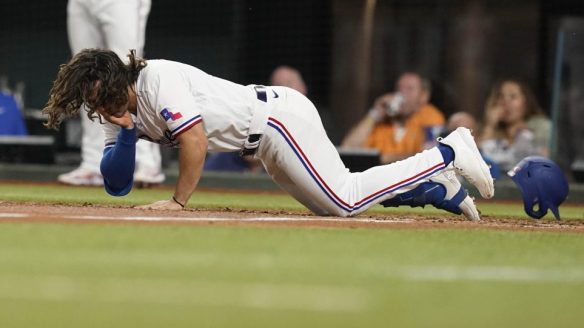
Josh Smith took one for the team Monday—a slider in his face . . .

Maybe it depends upon your definition of “good news.” Rangers outfielder Josh Smith took one on the jaw in the third inning Monday, on an 89 mph slider from Orioles relief pitcher Danny Coloumbe. A Rangers trainer looked him over before he walked off the field under his own power, but Smith was sent to the hospital regardless.

“We did take him to the ER,” said Rangers manager Bruce Bochy, the former three-time World Series-winning Giants manager now in his first season out of retirement. “He had some CT tests. They came out clean. So, we got good news there. He’s feeling better as I’m speaking right now. Tomorrow, we’ll just reevaluate him.”

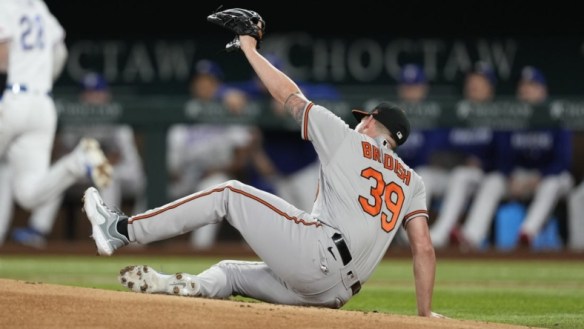
Coloumbe himself was in the game that early because Orioles starter Kyle Bradish was knocked out of the game an inning earlier. Not by a Rangers uprising—the Orioles held on to win, 2-0—but by a line drive off his right foot, courtesy of Rangers catcher Jonah Heim. Initial X-rays showed no fracture but Bradish is out for now with a bruise.

If you want to call it that, Bradish was a little more fortunate than Smith. Not just because Heim’s liner nailed his foot and not his face, but because the liner was measured as traveling 104 mph.

Go ahead and say baseball ain’t beanbag if you must. But at least acknowledge that batters injuring pitchers on bullet-train line drives back to the box aren’t trying to be cute or sending messages. Neither are pitchers injuring batters even on 89 mph sliders they’re not throwing as purpose pitches and may not be able to control.

There was also Boston’s Justin Turner and San Diego’s Austin Nola taking pitches in the face during spring training. There were Bryce Harper (Phillies) and Kevin Pillar (then a Met) each taking one in the face two seasons ago. There’ve been others. Too many others. On both sides of the ball.

Unless Commissioner ADD and his rules-changing fetishists take a hard look at another rule change or two, someone’s going to get killed, either by a pitch or a line drive in the head. Maybe the first change should be moving the pitching rubber back at least the equal distance to the length of home plate.

Kyle Bradish

. . . an inning after Orioles starter Kyle Bradish was hit in the right foot by a comeback line drive. Bradish was lucky—it could have been his face.

Right now, you think the rubber is 60’6″ from the plate. You’re wrong. As my cherished Mets/Senators/Tigers friend, former pitcher Bill Denehy, pointed out to me when we first talked four years ago, the actual distance is 59’1″ from the front of the plate. The 60’6″ is the distance from the rubber to the back point of the plate. Throw in a pitcher who can break three digits on the speedometer with a long stride, and the distance shortens. Dangerously.

Denehy was the player sent to the Senators to finish the agreement by which Hall of Famer Gil Hodges became the Mets’ manager. Today he’s almost as passionate about moving the rubber back for safety’s sake as he is about the struggle to get full major league pensions for himself and 500+ other pre-1980, short-career players frozen out when the owners and the players’ union re-aligned the pension plan in 1980.

“What baseball hasn’t seemed to take into account is, if you go back forty years ago, the average fastball back then was probably about 85 miles an hour,” the former righthander  said by phone from his Florida home Monday.

You had your exceptional pitchers who could throw at 95, or Nolan Ryan who was over 100. As the fastball has increased . . . they’re also not taking into account the size of the ballplayer. You now have several pitchers 6’8″ or 6’10”. When you look at a pitcher that tall, he’s going to take a stride as long as seven feet. If you take that closer to home plate, you’re throwing 100 mph not at 59’2″ but less than that because of the stride that person takes.

That’s looking from the mound side of the equation. Now, look at it from the batter’s box. Denehy is just as emphatic about it. As well you might expect of a pitcher who experienced two batted balls hitting him in the head, a hit just off his eye in college and once off the side of his face in the minors.

“Because of the strength and the velocity of the balls coming off the bat nowadays,” he said, “a pitcher, if he throws his all out fastball like the majority of the relief pitchers do today, he’s not going to be in that perfect fielding position. If a ball is hit around the head area, he’s not going to have the time to be able to get the glove up to deflect or move his head in one direction or the other to get out of the way of a line drive.”

The day before we spoke of it, the Yankees’ Giancarlo Stanton hit a home run that traveled 485 feet at 118 mph. Some drives, line and otherwise, have been measured traveling as fast as 122 mph. When you watch a game on television and note what the exit velocity of a batted ball is shown to be, picture that ball traveling not into the outfield or over the fence but up into the pitcher’s face.

Bill Denehy

Because of the strength and velocity of the balls coming off the bat nowadays, [a pitcher’s] not going to be in that perfect fielding position. If a ball is hit around the head area, he’s not going to have time to be able to get the glove up to deflect or move his head in one direction of the other to get out of the way of a line drive.—Bill Denehy, former major league pitcher.

Now do you get it? These aren’t all “glazing” or “glancing” blows as too many people want to think. These can be howitzer shells against which either a pitcher whose stride shortens an already deceptively-short distance from the plate, or a batter set to hit, has maybe minus a second to react and survive. You can’t just shake off a 118 mph bullet hit right back into your grille or a 101 mph bullet thrown up into it.

The control issue has two sides to it. Those tasked with finding fresh talent still seem to prize velocity uber alles. It’s no longer just a pleasant joke that an absolute control pitcher such as Hall of Famer Greg Maddux, who couldn’t throw a ball through a sheet of paper but knew what he was doing on the mound and knew where to put his pitches, wouldn’t get even half a second look as a prospect today.

Those who note the inconsistency of manufactured baseballs the past few years struggle to convince baseball’s government that too many of the inconsistently-made balls are difficult if not almost impossible for pitchers to control even if they’re not trying to throw bullet-train fastballs alone.

The independent Atlantic League tried moving the rubber back in 2021. Wrote Bleacher Report‘s Brett Taylor, “Unlike other changes that were met with skeptical acceptance, that one was never particularly popular, nor did the data bear out that it was getting the intended results (more balls in play, as batters should have a little more time to make contact).”

The cited link is a Ringer piece by The MVP Machine co-author Ben Lindbergh with Rob Arthur. The piece said the rule was designed to “increase action on the basepaths, create more balls in play, improve the pace and length of games, and reduce player injuries.” Notice which one was the last of four considerations noted.

Ray Chapman was killed by a fastball to his head in 1920; Hall of Famer Mickey Cochrane was nearly killed by one in 1937. It took several experiments, too many of which were laughed out of town, before batting helmets became mandatory between 1953 (when Branch Rickey’s Pirates began using them) and 1971 (when the last grandfathered such player retired).

But Herb Score may have been lucky to be alive after Gil McDougald’s line drive crashed into his face in 1957. His pitching career was compromised soon enough, after his elbow blew out while making an impressive early 1958 return. It left him never the same pitcher again, but he lived a full life after the mound as a beloved Cleveland baseball broadcaster from 1964-1997.

Hall of Famer Mike Mussina took one on the mound in 1998. Three years later, he called his injury “almost entirely mental,” as if saying that overcoming any fear that any ball he threw would be hit right back to him was harder than getting hit in the face. He was lucky a broken nose was all he got from it.

It’s no funnier when a pitcher gets drilled in the face than when a batter gets it. Spare us the mental toughness bit, please. Mental toughness is admirable but it should not be tested by injuries that can be made a little more preventable—and a lot less potentially fatal.

Do you want to see pitchers going to the mound and batters going to the plate with football helmets and facemasks on their heads? Didn’t think so. The absolute least you can do for their protection—screw basepath action, more balls in play, and paces of play—is move the damn rubber back another seventeen inches. (And, dammit, start making consistent baseballs fair to both pitchers and batters that even the speed-uber-alles pitchers can control.)

Baseball’s supposed to be the thinking person’s sport. It’s too long past time for the game’s thinking people to do some hard thinking and doing about this.

26 minutes and other Opening Day salvos

Rafael Devers

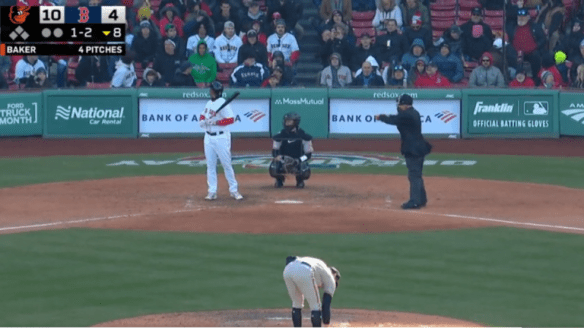
Rafael Devers (Red Sox), the Show’s first ever to strike out without a pitch thrown, taken, or swung on and missed—on a pitch clock violation.

So. After encyclopædic volumes worth were said and done, the average shortening of games on Opening Day was a whopping . . . 26 minutes. The new rules, don’t you know?

I may be on board with the pitch clock, but I’m not on board with cheers about the shortening when a fourth grade math student can tell you they’d have been shortened more by eliminating half the broadcast commercials. That’s accounting for the spots before each half inning and during any inning jam in which a pitching change was made.

But it didn’t stop the Blue Jays and the Cardinals needing three hours and 38 minutes to finish with a 10-9 Blue Jays win, paced by George Springer’s five hits for the Jays and opened with Cardinals pitcher Adam Wainwright warbling “The Star Spangled Banner” to just about everyone’s surprise in Busch Stadium.

Two players made history under the new rules. Rafael Devers (third baseman, Red Sox) became the first in Show to strike out on a pitch clock violation. Marcus Stroman (pitcher, Cubs) became the first in Show to be assessed a ball on a clock violation.

Leading off the eighth, Devers was rung up on 2-2 with Bryan Baker on the mound for the Orioles and the Red Sox in a 10-4 hole. “This doesn’t make sense to me,” said an announcer, “because he’d already looked at the pitcher. The pitcher’s not even ready to throw.”

Devers had checked back into the box with a few seconds remaining after stepping out to knock dirt out of his cleats. Even as Baker wasn’t quite ready to throw, plate umpire Lance Barksdale bagged him. It didn’t stop the Red Sox from posting a three-spot in the inning. “There’s no excuse,” said manager Alex Cora. “They know the rules.”

Knowing them and being able to maneuver within them for the first time in regular-season play are not exactly common. But it’s entirely possible that Devers not being dinged might have made a small difference. Led by Adley Rutschmann becoming the first catcher in Show history to have a five-hit Opening Day, the Orioles out-lasted the Red Sox, 10-9, after almost handing the game all the way back to the Olde Towne Team in the bottom of the ninth.

Remember: I’m also on board with turning the damn clock off in the eighth and later. Devers may yet prove evidence on behalf of that.

Stroman got his while checking Brewers runner Brice Turang at second with Christian Yelich at the plate in the third. The pitch clock expired about a hair before Stroman turned to pitch from the stretch. “It’s tough, this pitch clock,” Stroman told reporters postgame. “It’s a big adjustment. I don’t think people really realize it. It just adds a whole other layer of thinking.”

Yelich finally worked a walk out. The Brewers didn’t score then or the rest of the game. The Cubs won it, 4-0.

Jeff McNeil became the first Met to be hung with a pitch clock violation strike—for waiting for Pete Alonso to get back to first on a foul ball. Oops. Manager Buck Showalter was unamused that the clock began to tick before Alonso returned to the pad. McNeil remained mad just long enough to nail a base hit.

That was in an Opening Day game the Mets won, 5-3, beating the Marlins, but they might have had one more, at least, if not for someone whacking Brandon Nimmo with the stupid stick in the third. With first and third, Nimmo dropped a bunt—and hit into an inning-ending double play despite the run scoring. Thus the risk the wasted out, which is exactly what the sac bunt is, carries against defenders alert enough.

The good news there was Max Scherzer holding on despite all three Miami runs charged to his account and the Mets making simple enough work against a still not quite ready Sandy Alcantara. The bad was Justin Verlander having to miss a week while dealing with a muscle strain in his upper back near his throwing shoulder.

Perhaps it was miraculous that Aaron Judge picked up right where he left off from last season and hit one out in his first plate appearance against the Giants. That launched a 5-0 Yankee win that saw both starting pitchers, Gerrit Cole and Logan Webb, nail eleven and twelve strikeouts, respectively—the first opposing Opening Day starters to do that since Max the Knife (then a National, with twelve) and Jacob deGrom (then a Met, with ten) in 2019.

Speaking of deGrom, alas, the good news was, the Rangers got him a small truckload of runs. The bad news was that deGrom, still not all the way ready after a spring training disrupted by a side strain, also surrendered five before the Rangers unloaded for a nine-run fourth and held on to win, 11-7. They became the first Opening Day team to have a nine run-or-better inning since the Padres dropped 11 in the sixth against the Mets in the 1997 opener.

And Shohei still gonna Shohei. The Angels’ two-way unicorn struck ten Athletics out before his day’s work was finished. He even ripped a 110 mph base hit and threw a 101 mph pitch before he was done. And what did it prove worth in the end? Squatski. The Angels lost, 2-1. It put Ohtani onto a dubious record book page: the only pitcher to punch ten out and surrender no runs in his team’s Opening Day loss.

Meanwhile, the Rockies are still gonna Rockie, alas, even when they win. With a pair of home runs by first baseman C.J. Cron leading the way, the Rockies battered the Padres for seventeen hits—despite striking out at the plate seventeen times against four Padres pitchers. Making them the first team since 1900 to deliver that dubious 1-2 punch in a nine-inning game. Ever.

I’ve said it before, but I’ll say it once more. This is baseball. Where anything can happen—and usually does. With or without rule changes running the bases from the sublime to the ridiculous and back to the absurd. And wish though Commissioner ADD and his minions might, 26 minutes isn’t exactly that big a difference from even last year’s average.

When it gets late, ditch the clock

Max Scherzer

[I]f everybody’s playing baseball the way it should be, don’t ever let that [pitch] clock determine the outcome of the game. Ever.—Max Scherzer.

Very well, I surrender. I can live with the pitch clock—on one condition. The same condition by which the Mets’ Opening Day starting pitcher, Max Scherzer, can live with it.

“I’m not saying the clock’s not valuable,” Scherzer tells The Athletic’s Spink Award Hall of Fame writer Jayson Stark. “It is. But if everybody’s playing baseball the way it should be, don’t ever let that [pitch] clock determine the outcome of the game. Ever.”

Max the Knife was agreeing with Stark’s own assessment, an agreement with which I agree, too, with one codicil I’ll note shortly:

I’d be thinking seriously about turning the clock off in the eighth and ninth innings of games when the score was within three runs either way. That removes the chances of a game ending on a pitch-clock technicality. Plus, when those at-bats freeze in time, as the tension hangs over the big moment, that doesn’t fit anyone’s definition of “dead time.” Does it?

How is it any kind of problem if the game-turning at-bats late in tight games last a few seconds longer? Isn’t that the lesson of Mike Trout versus Shohei Ohtani, as the most dramatic final at-bat any WBC scriptwriter could ever write?

My codicil: Turn the damn pitch clock off for the eight and the ninth, period, I don’t care what the score happens to be. Not even if the game still looks like a blowout with a mushroom cloud. It’s entirely possible for a team to pick up, dust off, and neutralise or overthrow a blowout in the mid or late innings.

You demand the evidence? You got it. Here are the regular season double-digit deficits that started closing up in the fifth or later across Show history:

Twelve-run deficit5 August 2001: The Guardians (known then as the Indians) down that margin coming into the seventh. Manager Charlie Manuel may or may not have thought it was the impossible deficit when he pulled four regulars out of the lineup. Well, now: Three in the seventh, four in the eighth, five in the ninth—and with two outs, yet—forcing extra innings where a no-name named Jolbert Cabrera sent Kenny Lofton home with a broken-bat single in the eleventh. Final score: 15-14.

15 June 1925: Philadelphia Athletics vs. Cleveland. Down by twelve in the seventh as well, Connie Mack’s men scored once in that inning . . . then sent thirteen runs home in the eighth, an uprising only beginning when Jimmy Dykes slashed a three-run triple. It ended with Hall of Famer Al Simmons hitting a three-run homer. In between, nine of ten reached on seven singles and two walks. Talk about serving the ancient Indians a shit sandwich: they couldn’t push a run across in the top of the ninth. Final: 17-15.

Eleven-run deficit17 April 1976: Phillies vs. Cubs. The Phillies were in the hole 13-2 by the fifth. Oops. Hall of Famer Mike Schmidt hit a two-run homer in the fifth. They scored three in the seventh, five in the eighth (two-run single by should-be Hall of Famer Dick Allen; three-run bomb by Schmidt), three in the ninth for a 15-13 lead, and—after the Cubs tied it in the bottom of the ninth—a third homer from Schmidt (two runs) and a sacrifice fly, answered by only one Cub run in the bottom of the tenth. 18-6 your final from the Friendly Confines.

Ten-run deficit—As it happens, there are five such games:

2 June 2016, Mariners vs. Padres. The Ms down ten in the top of the sixth; came back to win, 16-13. The biggest inning—the seventh, when the Ms sent nine runs home on seven RBI singles.

8 May 2004, Rangers vs. Tigers. Down 14-4 in the fifth, the Rangers marched back to win, 16-15, in ten innings.

21 August 1990, Phillies vs. Dodgers. Down 11-1 in the eighth, the Phillies overthrew the Dodgers, 12-11. The biggest inning—the Phillies’ nine-run top of the ninth, including John Kruk’s one-out, all-runs-unearned grand slam to tie, followed by a base hit and an RBI double to take the lead the Dodgers couldn’t close in the bottom of the ninth.

4 June 1989, Blue Jays vs. Red Sox. Down 10-0 entering the seventh. The biggest inning—none, really: Two in the seventh on a double play grounder and a ground-rule double. Four in the eighth on a two-run single, an RBI double, and an RBI single. Game-tying RBI single in the ninth. Unanswered two-run homer in the top of the twelfth. 13-11, Jays the final.

25 April 1901, Tigers vs. Orioles. OK, that’s a ringer: in 1901, the Orioles were born as the Milwaukee Brewers, before moving and becoming the infamous St. Louis Browns who moved to Baltimore in 1954. The Tigers trailed 13-3 in the eighth. The game log isn’t available, but the line score is: the Tigers scored one in the eighth and ten in the bottom of the ninth. 14-13 your final, and that was four years before a kid named Ty Cobb arrived in Detroit. By the way, that was also Opening Day, folks.

Berra’s Law: It ain’t over till it’s over. Andujar’s Law: In baseball, there’s just one word—you never know. Stark’s Law: In baseball, anything can happen. Kallman’s Amendment: . . . and usually does. Incumbent or newborn, the rules should not make room for another of Professor Yogi’s fabled observations to come sickeningly true: It gets late early out there.

Emphasis on “classic”

Shohei Ohtani

Baseball’s great unicorn struck baseball’s greatest all-around position player out to end the WBC in Japan’s favour. Who says baseball’s gods don’t know how to script classics anymore?

Well, now. Japan walked it off against Mexico, earning the chance to face the United States in Tuesday’s World Baseball Classic final, and those who hadn’t been driven away by the harrumphing over Edwin Diáz’s season-ending injury after closing out a win by Puerto Rico last week got the most dreamy of dream matches.

Teammates on the Los Angeles Angels, Mike Trout and Shohei Ohtani squared off in the WBC final. It was Japan’s third trip to that final dance and first since 2009. It was Trout’s first appearance in any kind of championship or championship-aiming game since his third full major league season.

The game’s greatest all-around position player, still, against its unicorn of a virtuoso two-way player. Anyone who says this was what Trout and Ohtani really signed up for when Ohtani joined the Angels and Trout extended with them is fooling him or herself. But it slammed an exclamation point down upon this WBC in ways that would have been ridiculed as corny in a Hollywood treatment.

There was Trout, with Mets jack-of-most-trades Jeff McNeil aboard on a leadoff walk and two out—thanks to Mookie Betts dialing Area Code 4-6-3—for the United States. There was Ohtani on the mound for Japan. There was Cardinals first baseman Paul Goldschmidt on deck. And there was Ohtani throwing a slider just away from Trout’s swing. Strike three. 3-2, Japan. Third WBC title for Japan in three trips to the penultimate game.

“I was hoping,” Goldschmidt said postgame, “when Jeff got on base, that if Mike hit a two-run homer to win the game, that everyone was going to go bananas, that the world was going to end.”

“Great pitch,” said Cardinals third baseman Nolan Arenado. “If Mike Trout’s not hitting it, I don’t think anybody else is.”

“It sucks it didn’t go the way I wanted it to,” Trout said postgame. Then, he tipped his fins to his Angels teammate in Japan’s silks. “He won Round One.” Suggesting there might be yet one more showdown between the pair in another WBC a few years hence. Might. Who knows? Both Angel teammates say they’ll be back for the next one.

Teammates and friends in MLB, Trout and Ohtani (and everyone else partaking) knew this one had the potential of immortality. After Ohtani ignited the rally that pushed Japan past Mexico at the eleventh hour, with a leadoff double, he let the world know just how aware of it he really was.

“Obviously, it’s a big accomplishment to get to the championship series,” he told reporters, “but there’s a huge difference between getting first and second. I’m going to do all I can to get to first place.” He made good on it.

Dream makers loved nothing more than to see Ohtani on the mound with Trout at the plate. Ohtani said he’d be available for bullpen duty in the title game. If brought in and Trout was on his inning’s menu, there wouldn’t really be words to describe the moment’s electricity.

That wouldn’t stop assorted observers and pundits from hunting those words. They wouldn’t all be hosannas, either. From the moment Diáz went down with a patellar tendon tear that put paid to his 2023 season for the Mets while celebrating a Puerto Rico win, the volume of screaming bloody murder has equaled that of reminding one and all that freak injuries—which is precisely what Diáz’s was—can happen any old time.

In spring training. En route a spring training camp. In your own home or driveway. At the supermarket or the mall. Even playing with your children at home or on the beach or in a park. Celebrating after MLB wins regular, postseason, or postseason-sending alike. Or, suffering a non-contact anterior cruciate ligament tear just prior to the WBC’s beginning in the first place—as happened to Dodgers middle infielder Gavin Lux to put paid to his 2023 season, too.

My, but the lack of bleating about canceling spring training because of its dangers was enough to leave you with a bad case of tinnitus, wasn’t it? But the Mets’ top relief pitcher incurring an absolute freak injury that can happen—and has happened—any old time during an MLB season or postseason caused what seemed like half the world demanding the WBC’s demise, post haste.

Trout probably spoke for his teammates, the players on all competing WBC teams, and the fans watching those games in the ballparks and on television where possible, when he said, “It was probably the funnest ten days I’ve ever had. I can’t really express what’s different about it. You can just feel it in your veins. It’s a special, special feeling.”

Baseball was fun to play again. The WBC was fun to watch. Three trainloads of MLB players entered the WBC representing their home countries or countries to which their families have powerful enough ties. They had the time of their lives playing games that meant something to them personally. In a tournament that looked more sensibly arrayed than MLB’s competition-diluting postseason array. Jumpstarting renewed interest in baseball in the countries whom they represented.

Maybe Mets pitcher Max Scherzer’s onto something when he says move the WBC out of springtime and into the All-Star break’s time frame.

Maybe with the All-Star Game meaningless, after all, what with the infestation and continuing pestilence of regular-season interleague play, it ought to be dumped once and for all and the WBC should take center stage in mid-July.

Maybe MLB’s lords should think twice before signing off on any more Rob Manfred rule tinkerings, time-of-game twistings, and postseason maneuverings. Then, maybe they should tell him to either think of remaking MLB’s postseason as truly meaningful as the WBC proved or find another line of work. (While they’re at it, they can tell him they’ve had it with broadcast blackouts, just the way fans have had it. It hurts the lords, too.)

Maybe MLB’s lords should just think, period. Or would that be asking them to behave beyond their competence?