How to avenge an unwarranted plunk

Willson Contreras, Ian Happ

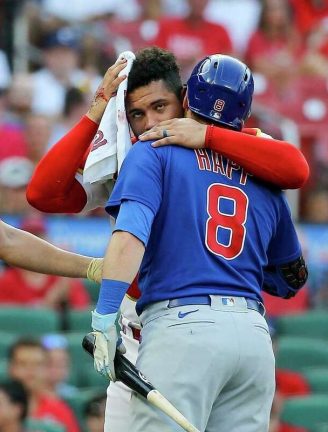
Contreras and Happ embracing, after Happ’s backswing caught Contreras on the coconut, quite accidentally—which didn’t stop Cardinals starter Mike Mikolas from buzzing, then drilling Happ in wrongful retaliation Thursday.

Memo to: St. Louis Cardinals. Subject: The Backswing Bop.

Dear Cardinals: We don’t care how long, how deep, and how bristling is your ages-old rivalry with the Cubs. Nobody checks in at the plate looking to conk a catcher on the coconut with a backswing, no matter what kind of swing he has, long, short, whatever. And, no matter that the catcher is set up so far inside for an inside pitch that he might have been lucky if his head didn’t meet the batter’s lumber.

P.S. When your conked catcher and the batter in question—who happen to be former Cub teammates— hug on the catcher’s way off the field, right then and there you should take it to mean peace, and let’s play ball.

You do not want your starting pitcher taking the perverted law into his own hands going back to work by buzzing that batter upstairs before planting one squarely on his backside. Not if you want to keep your pitcher in there instead of seeing him thrown out of the game, turning things over to an unprepared bullpen that’s liable to get pried, pricked, pounded, and poked for ten runs over the eight and a third innings to come.

Unfortunately, that’s exactly what happened after Cardinals starter Miles Mikolas threw one up and in to Cubs left fielder Ian Happ, in the top of the first, making the count 3-1, before drilling Happ squarely in the top of his right rump roast on the next pitch. There were actually two things wrong with that drill.

Thing one: Mikoas was dead wrong to even think about sending “messages” to Happ and the Cubs at all. Happ wasn’t even close to trying with malice aforethought to catch Willson Contreras on the cranium with his backswing. Their hug as a cut and bleeding Contreras left the game told each other, I didn’t mean to hit you, dude. I know, dude. We’re good.

Thing two: Doing it with two out and resurgent Cody Bellinger on deck was an invitation to potential trouble of the kind having nothing to with machismo retaliation and everything to do with the scoreboard kind. The only kind the Cubs were willing to pursue.

It was also liable to produce exactly what it did produce immediately, Mikolas getting tossed from the game. To the none-too-subtle outrage of the Cardinals’ broadcast team who seem to believe accidents deserve assassination attempts in reply. Come on! You gotta be kidding me! You have got to be kidding me! Have a little feel for baseball. Have a little feel for the game. That’s awful.

What’s awful is a pitcher not seeing his catcher’s injury was unintentional and throwing twice straight at the batter, the second one hitting him. No “feel for the game” justifies throwing at a batter over a pure accident. What did Mikolas expect for playing that kind of enforcer? The Medal of Honour?

“[The umpires] had a meeting and decided to toss me,” a seemingly unrepentant Mikolas said postgame. “The umpires can believe what they want to believe. That was their choice. They believed there was intent there and that’s all umpires need.”

One pitch a little too far up and in, followed by the next pitch bounding off Happ’s posterior, was rather convincing evidence. So, exit Mikolas (and Cardinals manager Oliver Marmol); enter Dakota Hudson, who wasn’t going to get a lot of time to heat up because Mikolas didn’t leave the game on account of being injured.

Hudson promptly surrendered a base hit to Bellinger and walked Cubs right fielder Seiya Suzuki on five pitches before walking shortstop Dansby Swanson with the bases loaded and surrendering a ground-rule, two-run double to designated hitter Christopher Morel, before Cubs catcher Yan Gomes grounded out for the side.

The Cubs extorted three more runs out of Hudson before his day’s work was done, on a pair of third-inning RBI singles and a run-scoring fourth-inning forceout. Hudson’s relief, Andrew Suarez, was greeted rudely when Cubs center fielder Mike Tauchman planted a 2-2 fastball over the center field fence opening the top of the sixth, before a pair of one-out walks in the top of the seventh paved the way for Gomes to slash a two-run double.

During all that, the Cardinals had nothing much to say other than Contreras’s successor, Andrew Knizner, hitting Cubs starter Justin Steele’s first offering of the bottom of the fourth into the left field seats. Not until Knizner batted in the eighth with one out and Cardinals first base insertion Alec Burleson on second (leadoff double) and hit another one into those seats.

It made Knizner the first catcher to enter a game off the bench instead of in the starting lineup and hit a pair over the fences since . . . Cubs manager David Ross, as a Brave on 14 June 2009. “You don’t have much time get ready,” Knizner said postgame. “You just trust your instincts.”

The Cubs said, well, we’ll just see about that in the top of the ninth. Especially after late catching insertion Miguel Amayo was hit by a pitch before being forced at second to set up first and third, from which point Tauchman beat an infield hit out enabling Morel to score the tenth Cub run.

The 10-3 score held up, bringing the Cubs back to .500. They’d sent their own message back to the Cardinals. You want to drill one of ours because of an accidental shot in the head, we’re going to drill you the right way—with hits and runs.

Not even Mikolas (and, apparently, possibly-departing Cardinals pitcher Jack Flaherty) appearing to invite them to come out of their dugout for, ahem, a little chat, could sway them into anything but answering on the field, at the plate, on the mound.

Contreras’s wound was closed with special glue. “I feel good and I want to make sure I’m ready to go tomorrow,” he told reporters. “I wanted to stay in. It was bleeding really bad. It was bad for me because I wanted to stay in there.” Officially, he’s listed day-to-day at this writing.

Having now won eight of their last nine games, the suddenly-hot Cubs have not been without their problems thus far this season. Going back to nursery school with a willfully juvenile opposing pitcher wasn’t one of them.

“We’re going to roll the dice and see what happens”

Lucas Giolito

The Angels hope Lucas Giolito fortifies their rotation (and Reynaldo López relieves the bullpen) for one more postseason run before Shohei Ohtani moves on. How sound are the hopes?

The good news is just as The Athletic‘s Tim Britton exhumed: two teams in the past ten years went into the trade deadline approach as buyers and ended up winning the pennant. One was the 2015 Mets; the other, last year’s Phillies.

The bad news is that this is still the Angels about whom we’re about to talk.

Maybe nobody was terribly surprised when the Angels let it be known Wednesday that they weren’t going to move unicorn Shohei Ohtani this deadline, either. But while baseball world wrapped around that, general manager Perry Minasian heeded owner Arte Moreno’s mandate and went in for a continuing potential postseason run.

The best available starting pitcher on the market who wasn’t named Ohtani is now an Angel. So is a relief pitcher who could provide a little breathing room for a bullpen not necessarily one of the American League’s most reliable.

White Sox teammates Lucas Giolito (RHP) and Reynaldo López (RHP) came west in exchange for the top two prospects in a farm system that isn’t overloaded with highly-attractive prospects otherwise. Giolito gives the Angels a reliable rotation workhorse to augment Ohtani. What López gives them out of the bullpen depends almost entirely on him.

That was last year: López was one of the stingiest relievers in the business, with a 1.93 fielding-independent pitching rate (FIP) showing his 2.76 ERA indicated a bit of hard luck. This has been this year: His 11.1 strikeout-to-walk ratio is undercut by walking over twice as many this year (4.7 per nine) as last (1.5), but . . . in his final five White Sox gigs before the trade, López struck eleven out in six innings while walking only three.

If that indicates returning to his 2022 form, the Angels will take it.

Giolito, of course, is a mid-rotation man at best, his 2020 no-hitter—the only no-no in White Sox history in which a pitcher struck ten or more batters out (he struck thirteen out)—notwithstanding. He does have a 3.12 strikeout-to-walk ratio this season, but he’s striking out shy of ten per nine but walking a shade over three per nine, almost exactly his career rates.

Pulling catcher Edgar Quero and projected reliever Ky Bush (LHP) in exchange is a plus for the White Sox, who’ve re-entered rebuilding after their last re-set didn’t quite get them where they wanted to go. They’re also hoisting pitchers Lance Lynn and Joe Kelly on the market hoping for another couple of reasonable prospects.

But did the Angels really do themselves such a big favour? Can they really iron up for one more postseason push while their unicorn (Ohtani) and their soon-to-be-returning veteran future Hall of Famer (Mike Trout) remain together? The smudge on the Angels has long enough been that they lacked what was needed behind those two to make their two greatest generational players, ever, postseason champions.

The deal for Giolito and López can prove to be either the jumpstart or the sugar in the fuel tank. Ask Britton, and his lack of optimism might prove alarming:

On the eve of the German invasion of Belgium in 1914, the Baron de Bassompierre summed up the feelings of his fellow Belgians: “If we are to be crushed,” he said, “let us be crushed gloriously.”

That’s the animating principle behind the Angels’ decisions on Wednesday night. Backed into a corner best described somewhere between “suboptimal” and “downright impossible” by a years-long inability to win with two transcendent stars, the Halos have decided to make one last stand with Ohtani.

His Athletic colleague Andy McCullough isn’t all terribly optimistic, either:

The phrase “moral hazard” comes to mind when considering the Angels emptying an already threadbare farm system on this quixotic quest for a wild-card spot this autumn. But you know what two other words come to mind? “Shohei” and “Ohtani.” Which leads to a different phrase: “moral obligation.” At least until October, the Angels plan to employ Ohtani, and Moreno has decided to maximize his franchise’s postseason chances, however remote. So the window is right here, right now, consequences be damned.

And so it is that the Angels shipped out two of their best prospects — an admittedly low bar — for Giolito, a mid-rotation starter who looks bound for some regression, and López, a reliever with a 4.29 ERA. As Britton mentioned, Giolito was the best pure rental starter on the market. He may benefit from leaving the White Sox, where little has gone well during the past two seasons. Even so, Giolito’s peripheral markers — all the knobs on Baseball Savant that were red in 2021 but blue in 2023 — are alarming. The Angels might have bought the dip. But, hey, when you’re a buyer, you buy what you can. López’s strikeout numbers have jumped in 2023 but so has his walk rate. He’s a reliever. Who knows if it’ll work out.

But, look, they decided to go for it. This is what going for it looks like. It’s going to be a heck of a ride.

Well, they said the California bullet train was going to be a heck of a ride, too. Until it wasn’t. We may yet end up trying to decide which was the bigger California boondoggle: the bullet train, or this and the past few years of Angels baseball.

That seems like a harsh thing to say about a team that’s won seven of their last nine games and now sits seven games out of first in the AL West, and four out of the final AL wild card slot, with the Red Sox and the Yankees just ahead of them there. But Minasian says of the Giolito-López acquisition that the Angels are “going to roll the dice and see what happens.”

They’re hoping to roll boxcars on two pitching rentals, while refusing yet again to let their extremely marketable unicorn bring back the prospects they need badly to begin re-seeding a farm whose drought won’t be saved by weeks of rain storms. And all three become free agents at season’s end.

Most of the Angels’ existence under the Moreno regime has equaled shooting craps. And, more often than not, crapping out.

Riding the pine tar

George Brett

“I told [my kids] you better never make me this mad, and they never did.”—Hall of Fame third baseman George Brett.

The single most infamous moment in Hall of Famer George Brett’s career ended up becoming a tool in his fatherhood kit. “Showed it to my kids a whole bunch of times when they were young,” Brett told ESPN writer William Weinbaum in Cooperstown, where Brett spent the weekend including for the induction of Hall of Famers Fred McGriff and Scott Rolen.

“I wanted to see the look on their faces when I got mad,” Brett said of that day, forty years ago Monday, “and I told them you better never make me this mad, and they never did.”

One look at Dad’s face, bulging eyes and expanding mouth as he stormed from the dugout, seemingnly determined to amputate umpire Tim McClelland’s limbs if not his head, and the three children under Brett’s jurisdiction (he married in 1992, before his final season as a major league player) should have had no further doubt.

24 July 1983. Yankee Stadium. The Yankees and the Royals not exactly on friendly terms. Top of the ninth, two out, Brett’s Royals down a run, Royals infielder U.L. Washington on first, and Brett’s fellow Hall of Famer Goose Gossage on the mound in relief of Dale Murray. Knowing Gossage wouldn’t throw him anything but fastballs, Brett sat on one and drove it about seven or eight rows up the right field seats.

Brett barely finished rounding the bases when Yankee manager Billy Martin, a man who never missed an opportunity to deploy the rule book when it would work to his advantage above and beyond the actuality of a game, hustled out of the Yankee dugout demanding Brett’s bat be checked.

The Yankees noticed Brett’s bat had a visible excess of pine tar before the game, we learned in due course. Martin, typically, elected not to say or do something about it until or unless Brett did noticeably game-altering damage swinging it, as he did in the top of the ninth. After Martin asked rookie umpire McClelland to check the bat, McClelland and the umps confabbed, examined, confabbed more, laid the bat across the seventeen-inch width of the plate . . .

While talking to teammate Frank White in the dugout, awaiting the final call, Brett said he’d never before heard of too much pine tar, notwithstanding teammate John Mayberry checked for it in a 1975 game but ultimately surviving an Angels protest. But the usually jovial Brett knew just what he would do if McClelland and company ruled against his bat and thus his go-ahead home run. It wouldn’t be a parliamentary debate.

“I go, ‘Well, if they call me out for using too much pine tar, I’ll run out and kill one of those SOBs’,” he remembered telling White.

They called him out for using too much pine tar. Brett charged up from and out of the dugout like a bull who’d been shot with an amphetamine dart, resembling a man determined to part McClelland from his arms, legs, head, and any other extremity within reach. It took several teammates plus Royals manager Dick Howser and umpire Joe Brinkman to keep Brett from dismembering McClelland.

“I looked like a madman coming out,” Brett admitted to Weinbaum.

I think everything kind of got a little more dramatic than it should have. Because Joe Brinkman got behind me and started pulling me back, and I was trying to get away and he had a chokehold on me and just pulling me backwards and backwards and I was just trying to get free from him. I wasn’t going after Tim McClelland. I mean, as Timmy would always say, “George, what were you gonna do to me? I’m 6’5″, I’ve got shin guards on, I’ve got a bat in one hand, a mask in the other. What are you gonna do to me?” I said, “Timmy, I was just going to come out and yell at you, I wasn’t going to hit you. You would’ve kicked my ass.”

George Brett, Gaylord Perry

Fellow Hall of Famer Perry (right) advised Brett to stop using the infamous bat—because it was too valuable. It’s reposed in the Hall of Fame since 1987.

Brett’s Hall of Fame teammate, pitcher Gaylord Perry, a man who knew something about suspect substances (hee, hee), managed to get the bat away from the umps and into the Royals dugout striking for the clubhouse, until Yankee Stadium security retrieved the bat to submit to the American League offices. (This, children, was the time when the leagues weren’t yet placed under MLB’s direct, one-size-fits-all administration.)

Brett was ruled out over the bat. The Yankees won the game officially. Not so fast. AL president Lee MacPhail received the Royals’ appeal, ruled that the bat didn’t violate the pine tar rule’s actual intent (which was to keep baseballs from getting dirtier), and ordered the game continued in New York—on an off-day for both teams otherwise, 18 August. En route a Royals trip to Baltimore for a set against the Orioles.

“I was kicked out of the game,” Brett said, obviously over his raging bull charge and plunge after the nullified homer.

I was still gonna go to the [suspended] game, but [Howser] said don’t even go the stadium, it’ll be a circus. So me and the son of [actor] Don Ameche, Larry—he was a TWA rep, we always chartered TWA jets back then—we went to some restaurant in New Jersey, an Italian restaurant, and watched the game on a little ten-inch TV. And went back to the airport, the guys had to go there after finishing the game, and next thing you know we were flying to Baltimore.

The Royals and the Yankees re-convened from the point of Brett’s homer. Royals designated hitter Hal McRae faced Yankee pitcher George Frazier, himself familiar with actual or alleged foreign substances. (I don’t use foreign substances. Everything I use is made in the U.S. of A.) McRae struck out for the side. Then, the Royals’ often underrated closer, Dan Quisenberry, got two straight fly outs and a ground out to finish what was started almost a month earlier.

Brett continued using the bat until Perry advised him it was too valuable to risk damage. He sold the bat to fabled collector Barry Halper for $25,000—until he had a change of heart and refunded Halper’s money. The bat has reposed in the Hall of Fame since 1987. “Goose and I have had a lot of laughs over it since he got into the Hall of Fame,” Brett told Weinbaum.

Before a 2018 game celebrating their fiftieth season of life, the Royals handed out a Brett bobblehead showing him springing forth bent on manslaughter upon the home run nullification. Brett told Weinbaum a Royals A-level minor league affiliate saw and raised to make him, arguably, the first player depicted on a bobble-arm figurine—his arms waving as wildly as they did when he charged for McClelland.

Three years before the infamous pine tar homer, Brett was known concurrently as one of the American League’s great hitters (he nearly hit .400 that season) and, unfortunately, a man stricken by a pain in the ass after the Royals finally waxed the Yankees in an American League Championship Series: internal and external hemorrhoids.

Brett had to put up with crude jokes throughout that World Series, which the Royals lost to the Phillies (and his Hall of Fame third base contemporary, Mike Schmidt), but he tuned them out. The pine tar game knocked that onto its butt rather immortally.

“Seriously,” he told Weinbaum, “what would you rather be remembered for? Hitting a home run off Goose Gossage in the ninth inning to win a ballgame, or being the guy with hemorrhoids in the World Series?”

I think I’ll sit on that awhile.

Two modest stars enter Cooperstown

Fred McGriff, Scott Rolen

Fred McGriff and Scott Rolen proudly displayed their Hall of Fame plaques after Sunday’s induction ceremony.

When the Yankees’ (shall we say) mercurial then-owner, George Steinbrenner, faced likely suspension over his campaign to smear his Hall of Fame right fielder Dave Winfield, George F. Will pondered whether then-commissioner Fay Vincent should marshal enough consensus to force Steinbrenner to sell the team. Will even imagined vetting a jury to empanel hearing a court case over it.

“Here is a pretty judicial pickle,” Will wrote parenthetically. “Imagine trying to assemble an impartial jury of New Yorkers to hear Steinbrenner’s case. ‘Tell the court, Mr. Prospective Juror, do you have any strong opinions about the owner who masterminded the trade of Fred McGriff from the Yankees to the Blue Jays in exchange for a couple of no-names? Stop snarling, Prospective Juror’.”

Come Sunday afternoon, that same Fred McGriff stood on the Cooperstown stage accepting his Hall of Fame plaque. Elected to the Hall by the Contemporary Baseball Era Committee, the Crime Dog didn’t exactly keep the Yankees high on his gratitude list, though the trade that might have had a prospective New York juror snarling could have been called the trade that launched him to where he now stood.

“I’d like to welcome everyone here from Atlanta to San Diego, Toronto, my hometown of Tampa Bay and everywhere in between. Thank you for showing up,” said the tall first baseman who became baseball’s first and so far only man to hit 30+ home runs in a season for five different teams. (And, the first Hall of Famer whose plaque mentions OPS.)

It is awesome to be here accepting this honor. What a blessing from the man upstairs. Beautiful weather. You can’t beat it. I’m so grateful to be going into the Baseball Hall of Fame alongside a guy like Scott Rolen who played the game the right way. A true professional. I want to thank the many living legends sitting behind me. I’m humbled and honored to be standing in front of you. And now to be part of this fraternity alongside you—just some great individuals behind me.

In one way, no player ever had a later-in-life baptism of fire to equal McGriff’s. It wasn’t enough that his career tended to be buried beneath the ramped-up batting stats of both the era of actual/alleged performance-enhancing substances (McGriff was never a suspect) and new ballparks that over-embraced hitting. No. He had to play his first game for the Braves under, shall we say, fiery conditions, after his fire-sale trade from the Padres:

I was nursing an injury when the trade happened. So I drove to Atlanta, I left Tampa at noon. I didn’t expect to play. But when I got to the ballpark, there is my name in the lineup. I was sweating. But I believe the man upstairs bought me some time when a food heat lamp caught on fire.


The start of the game was delayed two hours, long enough for me to get some more treatment. And I felt a little bit better. I started the game. And I tied it up in the sixth inning with the home run. The next day, I hit two home runs. And that Braves team caught on fire. We ended up catching the Giants after being ten games out of first place at the time to trade, and we won the division.

Two years later, McGriff and those relentless Braves teams of the 1990s won their only World Series rings. The Crime Dog did splendidly for a fellow who’d been cut from his high school baseball team once upon a time.

Both McGriff and Rolen had reason to wonder if they might ever get to Cooperstown as other than paying guests. Rolen may have thought about it just a little bit less.

“At no point in my lifetime did it ever occurred to me that I’d be standing on this stage,” the third baseman with a live bat and an Electrolux way at third said early, nodding to the Baseball Writers Association of America who elected him in January. “But I’m glad it occurred to you, because this is unbelievably special.”

(Asked whether Rolen could play shortstop, his one-time Phillies manager Terry Francona replied, referring to his broad range at third, “He’s playing it!”)

A two-sport star in his native Indiana, before beginning his baseball career, Rolen remembered learing something from his father after a particularly trying basketball mini-camp. “After day one, I told Dad that I had a minor problem . . . that I need advice with. And his answer (was), ‘OK’.”

“Well, Dad. I can’t handle the ball. I can’t shoot. I’m completely out of basketball shape. And everybody in the entire gym, including the coach, is better than me.’ And his answer?”

“OK.”

“What do you mean, ‘OK?’”

“Well, what are you going to do, Scotty?”

“Well, that’s what I’m asking you, Dad.”

“Well, how the hell do I know? You say you can’t dribble. You can’t shoot. You’re out of shape. And you’re completely overmatched. You told me what you can’t do? What can you do?”

“I guess I can rebound.”

“OK.”

“I can play defense.”

“OK.”

“I can dive for loose balls. Doesn’t appear that the guys are playing too hard up here. I could outhustle, outwork and beat everybody up and down the floor.”

“OK.”

And then here came the words of wisdom: “Well, do that then.”

It turns out that, “Well, do that then,” carried me into the minor leagues and gave me a simple mindset that I would never allow myself to be unprepared or outworked. “Well, do that then” put me onto this stage today.

The man who won a World Series ring as a key element of the 2006 Cardinals finished by doing something he’d done from the moment his parents first made the trek to see him play a major league game. He tipped his cap to them. Then, it was a Phillies cap. Sunday, it was a Hall of Fame cap. The number ten third baseman of all time never forgot.

“This is baseball’s biggest honor,” McGriff said. “This is like icing on a cake. You see, my goal was simply to make it to the big leagues. And I exceeded every expectation that I could ever imagine and then some. It is a great feeling getting recognized for your hard work.”

“I’m grateful for this grand gesture,” said Rolen, one of only four third basemen ever to hit 300+ home runs, steal 100+ bases, and hit 500+ doubles. (The others: Hall of Famers George Brett and Chipper Jones, plus Hall of Famer in waiting Adrián Beltré.) “I have an overwhelming respect and intend to represent these (Hall of Famers) behind me and this legendary Hall with the integrity on which it was built.”

McGriff and Rolen have something else in common aside from forging a new friendship. McGriff got the last laugh on a capricious Yankee owner who thought he could afford to lose the Crime Dog’s budding self. Rolen got the last laugh on a Phillies regime that allowed him to be viewed unfairly as indifferent while also letting him take unfair abuse when he challenged their willingness to build and sustain winning teams.

McGriff’s Hall plaque shows him wearing a blank cap atop his smiling, mustachoed face, and it reposes next to Negro Leagues legend/longtime Cubs coach/scout/baseball’s arguable finest ambassador, Buck O’Neil. Rolen’s plaque reposes next to Red Sox/postseason legend David Ortiz, showing him in a Cardinals cap, looking as determined as he was holding third base down almost two decades, resembling if anyone music legend Neil Young.

Both Rolen and McGriff heeded when their bodies began telling them it was time to go. Thus, one particular Young lyric stands forward, when thinking of them compared to those greats who, in Thomas Boswell’s words, “torture their teams, their fans, and themselves, playing for years past their prime, for the checks and the cheers”:

It’s better to burn out/than to fade away.

Despite McGriff’s bald pate and Rolen’s thinning one, they both look as though they could still play nine innings in a tough pennant race. But they spared us and themselves the tortuous long fade away. McGriff and Rolen finally stood on the Cooperstown podium Sunday, inspiring and accepting cheers at least as edifying as those incurred by a timely hit, a long home run, a tough play at first, an impossible play at third.

“The best job in the world” deserves better

Rob Manfred

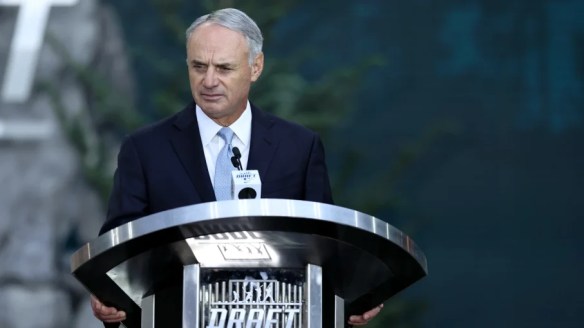
Rob Manfred at last month’s draft in Seattle—where the commissioner couldn’t quite understand why he was booed so lustily by the crowd.

I saw it first from Even Drellich, the Athletic writer whose Winning Fixes Everything proved the most in-depth exposure of Astrogate and what developed it. Commissioner Rob Manfred’s re-election for another term of office is all but a done deal when the owners vote next week. Manfred has said publicly he’d like another term in the job, which he considers “the best job in the world” to have.

A commissioner’s re-election window begins nine months prior to his term’s designated expiration date. Drellich says the owners’ vote will come smack dab at the opening of that window. If the owners have enough of a contingency among them who don’t have oatmeal for brains, Manfred should be denied. If.

He’s overseen a continuous climb in baseball’s revenues since he took the job in 2015, disrupted only by the coronavirus pan-damn-ic. That by itself may be enough to win him another five-year term. But it’s time to consider yet again an observation upon which I’ve leaned shamelessly that was first sketched by longtime New York Times writer George Vecsey: The common good of the game isn’t the same thing as making money for the owners.

The 2021-22 owners’ lockout said, guess again. When Manfred laughed during the first announcement of canceled games, assuredly he did not laugh like Figaro that he might not weep. I’ll say it again: When Manfred called it a “defensive lockout,” it sounded like Vladimir Putin pleading that he’s only defending Mother Russia from Ukraine’s “aggression.”

His handling of the Oakland/Las Vegas debacle as much as said, Oh, yes it is. He failed to school himself deeply enough on the core of that debacle, a capricious owner who tried and failed to strong-arm Oakland after reducing his team to compost, but discovered Las Vegas and its Nevada parent state didn’t have to be strong-armed to fall hook, line, and stinker into giving him a new ballpark.

The commissioner was caught pants down when he said mid-June that there was “no Oakland offer, OK? They never got to a point where they had a plan to build a stadium at any site.” Oakland mayor Sheng Thao said, that’s what you think. Last weekend she laid down the law to the commissioner in person. Oops.

Of course, John Fisher wanted Oakland to build him a big real estate development with a ballpark thrown in for good measure. Of course Oakland’s political (lack of) class finally said, not happening that way. Manfred has stood for continuing the nebulous push of municipalities building ballparks at taxpayers’ expense.

He has stood there even when it turns from a questionable proposition to a downright disaster. Atlanta’s Turner Field was only two decades old when the Braves decided the city limits were just too much and it was time to strike for the burbs. Double oops.

“[T]hey abandoned . . . Turner Field for suburban Cobb County in large measure because the county agreed to commit hundreds of millions of tax dollars to the project,” wrote CBS Sports’s Dayn Perry. “That tally is more than $350 million (and probably growing), which means Cobb taxpayers will never come close to getting that back.” Not even if the Braves own the National League East (again) for the foreseeable future.

Those are just too-obvious manifestations. Manfred has been baseball’s Professor Pepperwinkle, using the game as a lab and those who play and administer it as the experimental rats. For every one change he has ordered or shepherded that’s been good for the game, you can find several that have been worth either a laugh or a lament.

The universal designated hitter has been one of the good ones. Sorry, but I’m going to die on the hill that says however much fun it is to see the extreme outliers who can actually handle themselves at the plate, they were just that, outliers. When pitchers as a class hit a mere .162 from the end of the dead ball era through the end of the 2021 season, the universal DH was long overdue.

The ghost runner on second base to open extra half innings has been one of the terrible ones. So has the three-batter minimum for relief pitchers, especially when a manager is barred from lifting a pitcher right then and there who doesn’t have it and might be dangerously wild. So have the expanded wild cards and postseasons that dilute championship play even further.

The jury may still be out on the pitch clock. But it does present issues ranging from the sublime to the dangerous, especially concerning pitchers’ arms. Manfred’s inability thus far to commit to turning it off in the postseason’s late innings suggests he’d rather sacrifice the integrity of a championship round than one inch of his stubbornness.

We should also have noticed that the truest reason for lengthening games was never even a topic in Manfred’s mind: reducing the broadcast commercials between half innings to a single minute each. Smart negotiating could have brought that about without costing the owners money. They were no further endowed with vision on that than Manfred.

It’s also difficult to determine which has become more cringe-inspiring: the garish City Connect and All-Star Game uniforms; or, the presence of small advertising patches on uniform sleeves. It’s not impossible to say that the former are merely grotesque but the latter suggest the future baseball uniform might become the next best thing to a NASCAR jumpsuit.

Manfred has also shown far too much tendency to put his foot in his mouth and worry about the actualities after the screaming dissipates. Remember his dismissal of the World Series trophy as “a hunk of metal,” addressing questions of whether he would or could vacate the 2017 Astros’ World Series triumph once Astrogate erupted?

Fast forward to last month. Manfred now said he made a boo-boo giving 2017-18 Astros players immunity in return for spilling about the Astro Intelligence Agency. “Once we gave players immunity, it puts you in a box as to what exactly you were going to do in terms of punishment,” he told Time. “I might have gone about the investigative process without that grant of immunity and see where it takes us. Starting with, I’m not going to punish anybody, maybe not my best decision ever.”

But he did that to himself. The memo he sent down after the Red Sox and Yankee incidents of using AppleWatches and other devices in their dugouts to steal signs made clear he’d punish front offices, not players. He dropped a hammer on Astros owner Jim Crane and then-general manager Jeff Luhnow, but he let the cheaters in the dugout and on the field get away with murder.

Sort of. To this day, those 2017-18 Astros still playing major league baseball hear it from fans in the stands. Conversely, and unfairly, Astros second baseman Jose Altuve hears it despite it being shown authoritatively—and discussed in both Drellich’s book and Andy Martino’s previous Cheated: The Inside Story of the Astros Scandal and a Colorful History of Sign Stealing—that Altuve was “the one player that didn’t use” the stolen signs.

Now, back to the Oakland debacle. That fine day Nevada’s state legislature elected to spend $380 million of their citizens’ money on a Las Vegas ballpark for the A’s, A’s fans staged a “reverse boycott.” They poured into the decrepit RingCentral Coliseum to protest, among other things, Fisher’s gutting of the team while hiking ticket prices, doing squat to improve anything at the old dump, then all but saying it was all the fans’ fault.

Commissioner Pepperwinkle’s response? “It was great. It’s great to see what is this year almost an average major league baseball crowd in the facility for one night. That’s a great thing.” Ask him how a 27,759-strong crowd turned out to be a little over three times the average RingCentral Coliseum crowd for one particular event, and he was probably stuck for an answer.

Wait—no, he wasn’t. “The ballpark’s not in good shape,” he said. “The ballpark is not a major league facility. I’ve said it repeatedly.” Ask him how it was allowed to devolve in the first place. Now he might be stuck for an answer.

Someone should present these and more to the owners when they gather to vote upon whether Manfred gets another term. It may be asking them to think beyond their competence, and beyond their faith that the common good of the game is making money for them. But at least they won’t be able to plead ignorance.