The Shoh is on hiatus

Shohei Ohtani, Mike Trout

Ohtani (left) is done for the season, an oblique injury added to his elbow’s now-reinforced UCL tear. He can walk in free agency, but Trout (right) may be entertaining trade thoughts a lot more deeply now . . .

George F. Will once wrote (in Men at Work: The Craft of Baseball) that A. Bartlett Giamatti was to baseball’s commissionership what Sandy Koufax was to the pitcher’s mound, having “the greatest ratio of excellence to longevity.” The Athletic‘s Marc Carig wrote last Satuday of Shohei Ohtani, “singular excellence is no match for collective mediocrity.”

Last Friday, Ohtani’s Angel Stadium locker was empty, and a large duffel containing his equipment and other belongings sat in front of it, after he was placed in the injured list at last—with an oblique strain. “No ceremonial sendoff,” Carig wrote. “No expressions of gratitude. Just a tender oblique and a good old-fashioned Gen Z ghosting. How appropriate. Now the credits roll on a baseball travesty.”

Ohtani has also undergone surgery on his pitching elbow at last. His surgeon, Dr. Neal ElAttrache, the same surgeon who performed Ohtani’s prior Tommy John surgery—called the new procedure “reinforcement” of the torn ulnar collateral ligament, not full Tommy John surgery. It means Ohtani won’t pitch again until 2025, but he will suit up as a DH in 2024. For whom, only time and the off-season free agency market to be will tell.

“Thank you very much for everyone’s prayers and kind words,” Ohtani said on Instagram following the Tuesday procedure. “It was very unfortunate that I couldn’t finish out the year on the field, but I will be rooting on the boys until the end. I will work as hard as I can and do my best to come back on the diamond stronger than ever.”

Note that he didn’t say for whom he expects to come back after signing a new deal this winter.

A baseball travesty? The Angels had the two greatest players of their time together in their fatigues for six years, and they couldn’t support the two with a competent, competitive supporting cast who could pick it up when one or both was injured. It was as if the 1962-66 Dodgers had swapped in the ’62-’66 Mets for everyone except Hall of Famers Koufax and Don Drysdale.

Carig called it “sabotage.” You could think of far worse applications. “They did this through general mismanagement and their own brand of incompetence,” Carig continued. “Those sins endured despite their churn of managers and front-office regimes, only further reinforcing that the full credit for this failure falls at the feet of the constant throughout it all: the owner, Arte Moreno.”

It may be wasting breath and writing space to recycle that Moreno brought a marketer’s mentality to a baseball team, aiming once and forever at what George Steinbrenner used to call “name guys who put fannies in the seats,” without stopping first to ponder whether they’d equal a cohering team on the field and at the plate and whether his true baseball people had other such cohering parts in mind. And, whether it was always good for a player’s health.

Baseball people who did stop to ponder such things didn’t last long under Moreno’s command. Whether by way of the owner’s caprices or by way of their own mistakes turned into impossible-to-ignore disaster, Moreno’s Angels have been the Steinbrenner Yankees of the 1980s as you might have imagined them if The Boss hadn’t been so shamelessly public a nuisance.

Think about this: It took an oblique strain almost four weeks later for the Angels to do what should have been done when Ohtani’s ulnar collateral ligmanent tear took him off the mound but not out of the batter’s box. The adults in the room should have overruled Ohtani’s understandable desire to continue at least with his formidable bat, disabled him entirely, and placed his health at top priority.

You can only imagine the look when last Friday came with Ohtani’s packed duffel in front of his locker. Don’t be shocked at it. If he can’t play the rest of the season, he can come to the park in moral support without having to unpack it or bring it from home.

Someone had to find the adults in the Angel room in the first place. Apparently, there were none to be found. Whether draining the farm at the trade deadline for one more run at it that proved impossible, whether turning right around and waiving most of what they drained the farm for, whether managing the health of their two supermarquee presences, the Angels room remains bereft of adults.

Oft-injured third baseman Anthony Rendon, who’s had little but injury trouble since signing big with the Angels as a free agent, developed a habit of discussing his injuries with a wary sarcasm, until he finally cut the crap and said the shin injury incurred on the Fourth of July wasn’t the mere bone bruise the Angels said it was but, rather, a full-on tibia fracture—and that he only learned it was a fracture in mid-August.

Now, Rendon was asked whether he was actually considering retirement from the game. “I’ve been contemplating it for the last ten years,” he said. If he actually does it, it would give the Angels something other teams would love but might raise fresh alarms in Anaheim: financial flexibility. Just what they need, more room for fannies-in-the-seats guys assembled with no more rhyme, reason, or reality.

Mike Trout, the player of the decade of the 2010s and still formidable when healthy, has been injury riddled the past few seasons. He may not be jeopardising his Hall of Fame resume, but something is badly amiss when he feels compelled to return perhaps a little sooner than he should return, then ends up back in injury drydock yet again after one game.

Once upon a time it was impossible to think of Trout anywhere but Anaheim. But trade speculation and fantasies around him have sprung up now more than in the recent past. Trout himself has dropped hints that he’s exhausted of the team doing either too little or not enough (take your pick) to build a genuinely, sustainingly competitive team around himself and Ohtani.

That’s not what he signed up for when he signed that blockbuster ten-year, $370 million plus extension a year ahead of what would have been his first free agency. That’s not what he signed up for when he showed the world he wasn’t that anxious then to leave the team on which he fashioned and burnished a jaw-dropping Hall of Fame case.

It was Trout, too, who welcomed Ohtani to the Angels with open arms and personal charm, then had to find too many ways to grin and bear it as the pair—when healthy—performed transcendence while surrounded by unimportance. If Trout now questions the Angels’ commitment to competitiveness and their regard for the health of those in their fatigues, pondering himself as well as Ohtani, only fools would blame him.

Most major league teams would kill to have even one such king of kings on their roster. Two of this year’s affirmed division winners (the Braves, the Dodgers) have at least one each. (Ronald Acuna, Jr., Braves; Mookie Betts, Dodgers.) The Angels had the two most singular such kings of kings and blew it higher and wider than the Hiroshima mushroom cloud.

“What remains stunning in all of this,” Carig wrote, “is the level of waste. The Angels have succeeded like nobody else in doing so little with so much.”

Sound organizations create a plan and then follow it. These Angels, not so much. A throughline can be drawn from Albert Pujols to Anthony Rendon, with Ohtani and Trout’s extension in between. What’s clear is that all of these big-ticket transactions weren’t part of some grand plan. Rather, they were the product of a billionaire collecting baubles, just faces to slap on a billboard.

Ohtani’s free agency is still liable to become a bidding war of stakes once thought unfathomable. With or without his recovery time limiting him to a DH role, Ohtani’s going to have suitors unwilling to surrender until he does. Which one will convince him they know what they’re doing to fashion truly competitive teams around him? We’ll know soon enough.

But considering that baseball medicine can still be tried by jury for malpractise, whomever plans to out-romance the Angels for Ohtani and seduce them into a deal for Trout had better come with adults in the room to manage them and their health prudently. There’s no point telling the billionaire with his baubles and billboards to grow up otherwise.

The Bloom is off the Red Sox rose

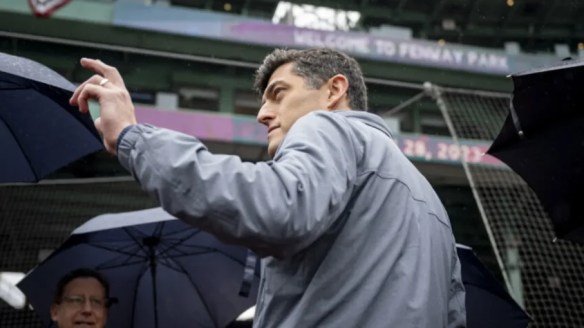
Chaim Bloom

Chaim Bloom standing in the rain in Fenway Park. The rain on the Red Sox’s 2023 parade has only begun its end with his firing as chief of baseball operations last Thursday.

When the Red Sox hired Chaim Bloom to run their baseball operations, he had the Right Stuff so far as they were concerned at the time. They decided it was time to play belt-tightening ball, rather against their nature. They figured the guy who’d learned how to play it during all those Tampa Bay years would be the ace of their front office staff.

They may also have figured he was Houdini enough to escape the shackle they imposed upon Bloom from the outset. He wasn’t. Maybe not even the savviest mind in baseball could have been.

Bloom may have been reared in the Rays’ frugal ways, but he wasn’t foolish enough to want to lose Mookie Betts, an absolute franchise player. Being all but forced to trade Betts rather than pay him his worth when he’d reach free agency the following season signed and sealed Bloom’s fate long before it was delivered last Thursday.

He probably didn’t want to lowball Xander Bogaerts, either. But it assured Bogaerts’s free agency departure. Then Bloom, under who knows whose persuasions, turned right around and handed Trevor Story Bogaerts money before Bogaerts was even out of town.

Not even rebuilding the farm his predecessor Dave Dombrowski drained in building their 2018 World Series winner could save Bloom with the Red Sox, after all. And Bloom walked into a situation in which there was a kind of elephant in the room due to be exposed not too long after he walked in.

That, of course, was the tainting of that ’18 Series winner. In due course the ’18 Red Sox were exposed as having operated a replay room reconnaissance ring for sign-stealing. They (and surely others) didn’t go even half as far as the 2017 Astros’ far more elaborate such intelligence agency. But it left the ’18 Series winner under a toxic cloud regardless.

Rebuilding the farm may be to Bloom’s credit, but managing trade deadlines isn’t. This July, the Red Sox had the best month in baseball. But in every August that Bloom ran the front office, the Olde Towne Team had losing records. This season put it into blaring microcosm. The Red Sox this July: 15-8. This August: 13-15.

Oh, they can still hit. As of Sunday morning the Red Sox were second in the American League in hits and in team batting average, fifth in runs scored and team on-base percentage, fourth in team OPS and team total bases, and top of the heap as doubles hitters.

But their pitching is a mess. They’re fifth from bottom in the league for team ERA, and the team’s fielding-independent pitching (FIP: sort of their ERA when the defense behind the pitching is removed from the equation) is a ghastly 4.44. No Red Sox starter has an ERA lower than Brayan Bello’s 3.71 but he has a 4.19 FIP.

And, after Bloom mostly stood pat on dealing pending free agent pitchers at the 2022 trade deadline, he could only watch when Bogaerts signed with the Padres and Story was lost for this season after elbow surgery. Saying this year’s Red Sox defense is porous is speaking politely.

Before this year’s trade deadline, third baseman Rafael Devers—whom Bloom did extend to keep in the Red Sox family—said flatly the team needed pitching help. They still need it. Everyone knows this year’s Red Sox can still hit, but opposing lineups prepare to face this year’s pitching model tabulating the hikes in their batting stats before the first pitch.

And was there any more embarrassing set of days this year than when Betts returned to Boston in Dodgers fatigues in late August, proceeding to treat the Red Sox like piñatas with a .467/.500/.800 slash line for the set including seven hits, two doubles, and a two-run homer over the Green Monster seats? In the middle of maybe the best season of his career, yet?

Bloom isn’t entirely to blame for the Red Sox mess. When the team’s ownership decided belt-tightening and falling below the luxury tax threshold was the preferred operating mode, they picked a guy who’d spent fifteen years learning how to maneuver and produce winners with a Rays team loaded with genius for building winning teams out of youth and  bargain parts.

Forcing Bloom to trade Betts a year ahead of his scheduled free agency equaled an airline board forcing the carrier to swap its 787s for commuter jets. Bloom built the Red Sox’s 2021 American League Championship Series entrant, but that series also exposed them as never missing opportunities to miss opportunities. (And, never stopping ALCS MVP Yordan Alvarez’s almost one-man demolition show.)

In a way, Bloom shouldn’t feel terrible about that. Getting that far in the postseason hasn’t always guaranteed Red Sox executive survival. Just ask Dombrowski, who lasted only ten months after that 2018 Series conquest, in large part because he drained the farm Ben Cherington rebuilt.

Just ask Cherington himself, now the Pirates’ baseball operations chief. He un-sunk the ship sunk by the Bobby Valentine nightmare of 2012 (a nightmare imposed on Cherington when he was overruled from the top in wanting someone else), turned it into the 2013 Series championship, but got shown the door when Dombrowski became available following his execution in Detroit.

Red Sox Nation doesn’t stay with their team expecting it to behave like a midmarket team when building or replenishing and then to perform like a team with one somewhat lopsided half but the other half looking half lost and half baked. The future may look bright with Bloom’s farm remaking, of course, but this year’s Red Sox are out of the AL East race officially, on the threshold of wild card elimination, and the bright future looks a little too distant for now.

It won’t do, either, to say, well, they’re playing .500 ball and even had a winning record while being dead last in the division. That’s not what Red Sox Nation expects. But it wasn’t really Bloom’s fault. When he walked into the job and was handed the immediate Betts trade mandate, the Red Sox ownership all but assured Bloom’s tenure equaled being hoisted for failure.

So who will have the honour of picking up where Bloom now leaves off? Excellent question. It only begins with a solid candidate named David Stearns getting picked off by the Mets to run their baseball operations. Already the Red Sox hunt for a new baseball ops chief has strike one in the count.

Which means nothing if the team’s ownership wants to continue playing the financial game like another poor relative. “They’re the Boston Bleeping Red Sox,” says Athletic analyst/Smart Baseball author Keith Law, “and it’s time they start acting like it again.” Perhaps a little past time.

A Stork hopes for delivery of pension redress

George Theodore

Just keeping this issue in the forefront is the best thing . . . Eventually, somebody who really has the power may say hey, I didn’t realise this was happening, let’s do something about it . . . Hopefully something can happen.”—George (The Stork) Theodore, a 1973 pennant-winning Met, shown here in 2016. (University of Utah photo.)

His major league playing career lasted 105 games, thanks largely to a 1973 outfield collision that resulted in a serious hip injury. But George (The Stork) Theodore remains a favourite among longtime Met fans and the organisation itself, invited to both the farewell of Shea Stadium and the opening of Citi Field, and invited to commemorations of the 1973 Mets’ pennant winner.

That was then: The 6’4″ Theodore endeared himself to fans with hustle when he got playing time, plus signing autographs amiably and talking to the sporting press with far more than mere boilerplate.

This is now: The Stork is a retired elementary school counselor, with a bachelor’s degree in psychology and master’s degree in social work, who’s been honoured for that work more than once, including an Educator of the Year award from the South Salt Lake Chamber of Commerce plus an Excel Teacher of the Year award.

“I was going to do that a few years. I was actually trained in medical social work,” said the 76-year-old former outfielder/first baseman, by phone from his Utah home, this week. “Then I found out that it was really my calling, and I enjoyed it, working with the young children in elementary school, and ended up with a career of 38 years there in the public schools.” About his awards as an educator, “I was honored at that, and humbled, because I didn’t feel I was any better than a lot of my compatriots.”

Drafted by the Mets in 1969, Theodore was a member of the ’73 pennant winner who had two World Series plate appearances, which he still calls “not bad” for a man who says he was on the Mets’ postseason roster mostly as a designated team cheerleader. But the Stork wishes only that the game he loved would favour himself and over five hundred more remaining players with short major league careers who played prior to 1980—and continue going without major league pensions.

He’s been interviewed often in the years since his playing career ended, but the pension issue isn’t always raised at those times. “It’s in a minor way,” he said of that subject, “but the interviews are basically about the ’73 team, though we try to sneak in something about the pension issue there.”

The issue, of course, is that when baseball’s owners and the Major League Baseball Players Association re-aligned the game’s player pension plan in 1980, they changed the vesting times to 43 days’ major league service time to qualify for full pensions and a single day’s service time to qualify for health benefits—but excluded such players as Theodore whose pre-1980 careers fell short of the former four-year vesting requirement.

Ask whether he could isolate whom among that year’s player representatives voted to exclude himself and his fellows—from each team’s player rep to then-league reps Steve Rogers (Expos pitcher, for the National League) and the late Sal Bando (Brewers third baseman, for the American League)—and Theodore isn’t entirely sure.

“I know they were kind of in a hurry to get [pension realignment] done to avoid a strike,” he said. “And I know that [original Players Association executive director] Marvin Miller—who was really the backbone of our union, getting all the wonderful things—was really disappointed that, as he looked back, that he didn’t pull in those people before and include them in that 1980 bargaining.”

The sole redress Theodore and the others have received since has been a stipend negotiated by the late Players Association executive director Michael Weiner with then-commissioner Bud Selig—$625 per 43-day service period, up to $10,000 a year before taxes. That amount was hiked fifteen percent as part of the 2021-22 owners’ lockout settlement. But the recipients still can’t pass those monies on to their families upon their deaths.

Had Weiner not died of brain cancer in 2013, would he have been able to go forward from the 2011 stipend deal to get something more? “That’s a good question,” Theodore  answered. “The whole system is not one of legality, but one of ethics. Baseball didn’t turn out to be what it is now just on it’s own. It’s been a slow, steady, building block process. And every player who played was a part of that.”

The Players Association formed originally to address pension issues in 1954. Its annual revenues now are believed to be $56.8 million. MLB’s annual revenues reached a reported $10.5 billion in 2022. Both the owners and the players kick into the players’ pension fund.

If those numbers are accurate, they add up to $10,556,800,000 per year. The union and the owners could agree to grant the remaining 500+ frozen-out, pre-1980 short-career players full pension status—based on their 43-day major league service periods—without going broke by a far longer shot than anything Shohei Ohtani can hit over the fence.

“I was just happy to be playing baseball and excited to get any opportunities,” Theodore said of his career. “I was one of the last people drafted.” [In 1969, round 31; one of the very few drafted out of the University of Utah.] “And so I knew my career was always in jeopardy. I knew many of my friends who signed at the same time, they’d have a bad week or two and they were gone.”

Because of that, he said, he wasn’t involved directly in Players Association actions, and credits A Bitter Cup of Coffee author Douglas Gladstone for helping to make him and numerous others of his short-term peers aware of the pension shortcoming.

Several pre-1980 short-termers have said they believe they were frozen out of the realignment because they were seen mostly as September callups. But most of the surviving 500+ either made teams out of spring training at least once or saw major league action in months prior to any September. Theodore himself made the Mets out of spring training in 1973.

The Stork was considered a strong defender with a good throwing arm and league-average range. “I was a fast runner, too,” he said. But the lack of game action didn’t bode well for his improvement as a major league hitter despite having recording solid batting marks in the minors. He had a splendid .817 OPS to show for his minor league seasons and posted a .972 OPS between A level and AA ball in 1971.

“I needed to play in order to be like that,” Theodore said. “Like many young players, playing once or twice a week, you don’t get your reflexes that you need.”

Deployed mostly as a left fielder in the majors, Theodore swears his better position was first base, where he played in eighteen major league games including twelve starts. “But we had John Milner there,” he said, “and Ed Kranepool, too. First base was really where I think I was the most effective because of my size and range. I could prevent bad throws just by stretching out.”

Still, Theodore became a fan favourite. “I always appreciated that,” he said. “I just know that I tried to give my best any time I played. Whether it would end up that way or not. And I responded to the fans, too. I enjoyed meeting fans and giving autographs. It was all new to me and I enjoyed every minute of it.”

His nickname didn’t hurt, either. Minor league teammate Jim Gosger—once with the Red Sox; an original Seattle Pilot;, and, very briefly, a 1969 Met when he completed an earlier trade (he didn’t make their postseason roster), before moving to two more teams and returning for brief spells with the ’73-’74 Mets—hung it on him. Theodore denies the longtime story that Gosger came up with the nickname when seeing the tall man holding a teammate’s baby.

“But he did call me the Stork, somehow” he said, chuckling. “I’m not sure why he decided on that nickname, but it stuck, and it endeared me to a lot of people.”

George Theodore

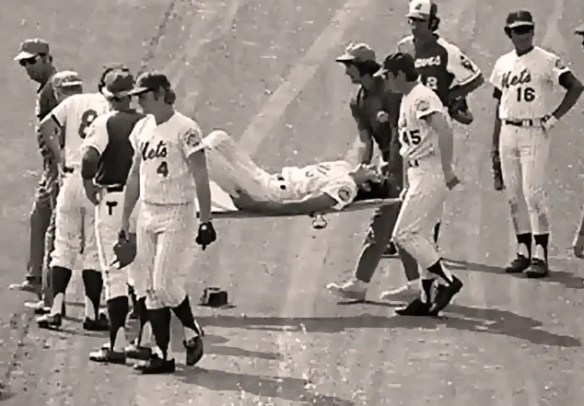
Theodore was carried off the field on a stretcher after a hip-dislocating collision with center fielder Don Hahn on 7 July 1973. Surrounding are (left to right) manager Yogi Berra (8), right fielder Rusty Staub (4), relief pitcher Tug McGraw (45), and second baseman Felix Millan (16). Braves center fielder Dusty Baker (12) looked on in concern.

But whatever further progress the Stork might have made ran into a thunderous obstruction on 7 July 1973. Atlanta’s Ralph Garr whacked a seventh-inning drive toward which Theodore and his close friend, Mets center fielder Don Hahn, converged in left center . . . and collided violently. Theodore suffered a dislocated hip while Garr ran out what proved an inside-the-park two-run homer, and missed most of the rest of the season.

Call it a classic Mets example of no good deed going unpunished. An inning earlier, Theodore led off with a walk, took second on a sacrifice bunt, and scored the game-tying run when Hahn doubled deep to left. The collision and Garr’s inside-the-parker in the seventh put the Braves up 5-3 (they’d scored on an RBI single just before Garr batted); the Braves eventually won, 9-8, in a game that changed leads twice more before it finished.

Theodore said he might have matured into a solid major leaguer had it not been for that injury, but he remains grateful that the Mets put him on their 1973 postseason roster. The ’73 Mets were an injury-riddled team until key regulars returned for the September drive that ended—under relief pitcher Tug McGraw’s rallying cry “You gotta believe!”—with them winning the National League East and then the National League Championship Series from the Reds.

George Theodore

The Stork, tall and happy as a Met.

In the World Series, which the Athletics won in seven games, Theodore pinch-hit for Mets pitcher Ray Sadecki in Game Two in Oakland and grounded out to shortstop. In Game Four in New York, with the Mets up 6-1 (it proved the final score), Theodore was sent out to play left field in Cleon Jones’s stead for the top of the eighth, but he popped out to third base to end the bottom of the inning. Those were his only appearances that postseason.

“They didn’t have to do that,” he said of being on the postseason roster. “I hadn’t played for three months and I was more or less a cheerleader and emotional support for the team, until the World Series. Then all of a sudden I’m called to pinch hit and went into the outfield in another game.

“It’s funny how fate works,” the Stork continued. “Not playing for that long, and I felt very comfortable there. And then I went in for Cleon Jones, who was sick most of the game and throwing up out in left field, and it’s 35 degrees, I think. And [A’s third baseman] Sal Bando, hits a line drive out to left center field, and somehow I reacted and went and snagged that ball. It’s just kind of a surreal, you wonder, just who’s helping you make these moves.”

His days as a major league Met ended in 1974 (he’d retire after a 1975 at their Tidewater AAA farm), but that year handed him another kind of gift: he met a Met fan from Queens named Sabrina, who eventually became his wife and a Salt Lake City elementary school teacher.

Theodore cherishes his memories with the Mets, especially having as a teammate Hall of Famer Willie Mays in his final major league season until nagging injuries and age finally wore him down for good. And he cherishes likewise that Met fans still remember and appreciate him. But like his fellow pre-1980, short-career players, the Stork wishes only that some way, somehow, baseball will redress their pension shortfall more fully.

“We’re now in our 70s and 80s and maybe 90s, some players,” he said. “Just keeping this issue in the forefront is the best thing . . . Eventually, somebody who really has the power may say hey, I didn’t realise this was happening, let’s do something about it . . . Hopefully something can happen. If nothing more, the [Weiner-Selig] annuities can be increased. It’s amazing that we got the annuity in many ways.”

It would be more amazing if baseball awakened wide enough to understand Theodore and his fellow pre-1980, short-career players were frozen out of proper pensions wrongly in that 1980 re-alignment. At least as amazing as Theodore’s 1973 Mets turned out to be.

Self-awareness as a vice

George Kirby

George Kirby, a second-year pitcher who inadvertently proved a little self-knowledge might be a dangerous thing—for his image, not for his particular line of work.

Maybe the only thing that brings Joe and Jane Fan to a boil faster than a baseball player speaking honestly about an injury is a pitcher who admits he didn’t do well with being kept in a game past his sell-by date for the day. George Kirby, second-year Mariners pitcher, may be learning the hard way.

After surrendering back-to-back first-inning runs to the Rays Friday, Kirby pitched five more spotless innings. In the bottom of the seventh, he threw one pitch for an unassisted ground out to first base, a second pitch Jose Siri drilled for a double, then three pitches to René Pinto. The third was lined down the left field line and into the seats to tie the game at four.

Mariners manager Scott Servais lifted Kirby for Isaiah Campbell. Campbell walked Yandy Díaz, induced Brandon Lowe to force Díaz at second base, but then fed Harold Ramirez a pitch meaty enough to feed the left field seats. An eight-inning leadoff bomb off another Mariners reliever secured the 7-4 Rays win.

But Kirby faced the media postgame and admitted he wasn’t exactly thrilled about pitching the seventh, which he entered having thrown 93 pitches or so already. “I didn’t think I really could go any more,” the boyish-looking righthander said. “But it is what it is.”

Come Saturday, Kirby apparently couldn’t wait to walk that back, the faster the better: “Skip’s always got to pry that ball out of my hands. Just super uncharacteristic of me as a player and who I am out on that mound. I love competing. Like I said, I just screwed up.”

The social media jerk brigades turned out in force with the customary charges of gutless, backbone-challenged, you name it. So did a few former players, for that matter. There seemed little room for charity, little thought that Kirby might have spoken Friday out of frustration over surrendering a game-tying bomb, and even less thought that Kirby might actually have a little self-awareness going for him.

Kirby had already faced Pinto twice earlier in the game when they met in the bottom of the seventh. Pinto flied out in the second and lined out in the fifth. Including the close of business Friday, all batters facing Kirby for the third time around, lifetime thus far, have a meaty enough .814 OPS against him, including what are now twelve home runs in 46 such games in which they got that third chance.

The first time through a lineup, Kirby’s batters have a .684 OPS against him, but the second time through they have a .602. Their batting average against him drops from .265  the first time to .221 the second. The third time they see him? They’re two points below .300.

This is also a pitcher who kept the Astros in check in Game Three of last year’s division series. You might remember that game: the eighteen-inning marathon in which neither side could even sneak a run home, with Kirby starting for the Mariners and going seven shutout innings, scattering six hits. With Jeremy Peña hitting Mariners reliever Penn Murfee’s full-count meatball over the left center field fence for the game’s only run and the eventual world champion Astros’s trip to the American League Championship Series.

Kirby also made his first All-Star team this season, and if he didn’t quite pitch like one during his fourth-inning appearance (a leadoff double, a one-out RBI single), you could attribute that to All-Star inexperience. On this season whole, including Friday night, Kirby leads the entire Show with a 9.44 strikeout-to-walk ratio and an 0.9 walks-per-nine rate, not to mention having a very respectable 3.31 fielding-independent pitching rate that suggests his 3.48 ERA means a little hard luck pitching in the bargain.

He pitched 131 major league innings last year and, after Friday, has pitched 165.2 innings this year. The most innings he’d pitched in the minors in any full season was 111.1 in 2019.

Backpedaling his Friday comments may indicate that someone told Kirby it wasn’t such a great look to admit his true sell-by date for the game expired after six innings. The jerk brigades were only too happy to pile that message on, including dredging up the usual outliers who could and did go long and (figuratively, most of the time) threaten murder and mayhem if their managers even thought about lifting them early.

Allow me to reference a decade that ended with the average innings pitched per start being 6.4. Care to guess? The 2010s? The Aughts? The 1990s? Strike three. The decade I referenced was the 1950s. Now would you care to stop saying they were all “tougher” in the allegedly Good Old Days—the days when baseball people thought injuries were half in a player’s head if not signs of quitting?

(Further ancient history: Paul Richards, once thought a genius when it came to pitching, also thought once that the way to fix injuries—especially among his once-vaunted and unconscionably overworked “Baby Birds” Orioles kids of the late 1950s/early 1960s—was to send them for . . . tonsillectomies. True story.)

Hell if you do, hell if you don’t. But I’m not going to be one of the ones telling Kirby he should have kept his big mouth shut Friday. A little more self-awareness such as his might actually mean longer and less physically-stressing careers for a lot of young pitchers. Not to mention better chances of postseason success, considering the Mariners lead the American League’s wild card chase.

How often have pitchers who’ve insisted on “gutting it out” despite fatigue or sensing their best stuff’s expired end up murdered on the mound and thus hurting their team as a reward for their “guts?” How often have fans, hanging the no-guts/no-backbone tags on pitchers who don’t “gut it out” past their game’s sell-by date, turned around and hung the no-brains/no-sense tags on managers who left their pitchers in one inning too many?

Ponder that foolishness before you join the fools who think Kirby needs a spine transplant.

“Extremely disappointing?” How about unacceptable?

Julio Urías

A second domestic violence case and administrative leave for the Dodgers’ lefthander.

Sitting thirteen games in first place would be heaven for any baseball team. Perhaps not so much now for the National League West’s Dodgers, who must feel since Labour Day weekend as though someone signed a deal with the devil and the devil came to collect with usurious interest.

A 24-5 August shot them that far ahead of the divisional pack. A 1-5 September beginning is usually the kind that such a team flicks away like a nuisance of a mosquito. It’s what they learned after beating the NL East ogres from Atlanta on Sunday, thwarting a sweep, that must have the Dodgers feeling as though no good deeds go unpunished.

On the same night they beat the Braves, Los Angeles Exposition Park police arrested the Dodgers’ lefthanded pitcher Julio Urías on “suspicion of felony corporal injury on a spouse.” Released on a $50,000 bond, Urías has a court date on 27 September. In the interim, his scheduled start against the Marlins in Miami Thursday is a non-starter.

“We are aware of an incident involving Julio Urías,” the Dodgers Xtweeted in a formal statement on Labour Day itself. “While we attempt to learn all the facts, he will not be traveling with the team. The organization has no further comment at this time.” It’s not the first time the Dodgers have been there with Urías, who was arrested four years ago over a physical incident with a woman in a shopping center parking lot.

But then, Urías faced no formal charges when the victim in question subsequently told authorities she had fallen, yet baseball’s government elected to suspend him twenty days while it investigated that incident.

This time, Urías could face a far longer suspension. And, the end of his days as a Dodger. And in that order. TMZ has reported “multiple sources” say Urías shoved “a woman” against a fence at BMO Stadium in Los Angeles, with stadium workers breaking it up, before the pair got into a car “where we’re told things once again got heated.”

“Which shows that he was, once again, content to be violent towards a woman in front of thousands of strangers,” wrote Craig Calcaterra in Cup of Coffee Thursday. “That says a lot, frankly. I mean, if you’re willing to be violent like that in front of others, imagine what you’re doing in private.”

Urías was placed on administrative leave by MLB Wednesday. He was due to hit the free agency market during the coming off-season. His 2023 season hasn’t exactly been top of the line, but he might still have commanded a handsome payday based on his overall track record. A record that includes leading the National League last year with his 2.16 earned run average. And, that he sealed the Dodgers’ first World Series triumph since the Reagan Administration, crowning two and a third innings’ spotless relief when he struck Tampa Bay’s Willy Adames out on three pitches to finish Game Six of the 2020 Series.

It’s difficult to picture the Dodgers wanting Urías back with what amounts to a spousal battery charge against him. It took long enough, of course, but the Dodgers cut ties with Trevor Bauer over his too-well-detailed sexual violence after his precedent-setting suspension was lifted last winter.

Maybe, just maybe, no MLB team will be willing to take the chance with a guy having two such cases on his resumé, unless Urías makes a truly contrite, above-and-beyond, verifiable commitment away from domestic violence.

But the further bad news has been the boilerplate language emitted in the immediate wake of the Urías arrest. “Obviously, extremely disappointing development,” said Dodgers general manager Andrew Friedman. “It’s just an extremely unfortunate circumstance for everyone,” said manager Dave Roberts.

Extremely disappointing? Extremely unfortunate? How about unacceptable? How about speaking unambiguous, plain language against treating women like punching bags?

How about the Dodgers remembering how they flinched over consummating a deal for Aroldis Chapman from the Reds after learning Chapman was involved in a domestic violence dispute, even one that didn’t end in his arrest?

How about remembering that, in his 2019 case and suspension, Urías’s formal statement was 169 words worth of nothingburger other than those which caused some to infer he was sorry-not sorry that he hadn’t actually bruised the woman in question when he shoved her to the ground?

How about remembering what Bauer put them through and proclaiming bluntly that physically abusing a woman can’t be tolerated in the Dodger organisation or anywhere else? How about the Dodgers reminding themselves that, both in 2019 and last Sunday, Urías was accused of attacking a woman in public places?

Then they could worry about what losing Urías does to their already-compromised starting rotation depth. (Tony Gonsolin and Dustin May: season-ending surgeries. Future Hall of Famer Clayton Kershaw: working his way back from shoulder issues, he surrendered a pair of home runs and three earned runs against the Marlins Tuesday, leaving Chris Taylor to re-tie the game at three with a homer before Dodger reliever Ryan Yarbrough surrendered three more on a pair of bombs for the 6-3 Dodger loss.)

They didn’t have to wait for the deeper details to come forth to take an unmistakeable stand. They didn’t even have to wait for MLB to put Urías under administrative leave Wednesday to say what their formal statement said thereupon: We do not condone or excuse any acts of domestic violence.

The Yankees are fabled among many things for a sign above the doorway from the Yankee Stadium clubhouse to the dugout, quoting Hall of Famer Joe DiMaggio’s speech on a day in his honour in the late 1940s: “I thank the Good Lord for making me a Yankee.” Maybe the Dodgers and all other teams in baseball should hang one saying, We will not condone or excuse domestic violence.

And mean it.