For those who’ve passed to the Elysian Fields . . .

Brooks Robinson

The Hoover, called up to beat, sweep, and clean the Elysian Fields.

Once upon a time, Hall of Famers Yogi Berra and Whitey Ford stood in Yankee Stadium on an Old-Timer’s Day and watched a video board presentation of former Yankees who’d gone to the Elysian Fields that year to date. Berra turned to his old battery mate and said, “Boy, I hope I never see my name up there.”

Mr. Yogi went there in 2015; the Chairman of the Board, three years ago. Their ranks now serene and happy in the presence of the Lord have swollen, as inevitably if sadly they must, by several this year, including a badly haunted former teammate, a Hall of Fame third baseman, an infamous umpire, and perhaps the rarest of baseball people—a likeable, even loveable owner. Among too many others.

Brooks Robinson (86) turned third base into a black hole for hundreds of hitters while maintaining such a sterling reputation as a person that his Day’s master of ceremonies told the crowd Baltimoreans didn’t name candy bars but their children after The Hoover. Frank Howard (87) was traded to the second Washington Senators for lefthanded pitcher Claude Osteen after the 1964 season, in the event the Dodgers’ Hall of Famer Sandy Koufax broke down into a once-a-week pitcher. The 6’7″ Howard became a Washington matinee idol who hit mammoth home runs (including a heartbreaker in the final Senators game before moving to Texas), and wore a nickname entirely contrary to his friendly, gentle-giant  personality. (Capital Punishment.) “By the time you learn to play this game properly,” he observed as his career ended, “you can’t play anymore.”

“No one,” George F. Will once observed, “has ever paid money to go to a major league baseball game in order to see the team’s owner.” The exception might have been Peter Seidler (63), who was so beloved in San Diego that Padres fans could be seen wearing team jerseys with his name on the back as often as with assorted Padres players. “He brought passion to that fan base,” Brewers owner Mark Attanasio said of him, “and that’s as loud a crowd as you will ever hear.”

Joe Pepitone (82) was the shakiest 1960s Yankee, a haunted, self-immolating young man produced by a ferociously abusive father, a talented first baseman (three Gold Gloves and All-Star teams) whose inner turmoil and outer taste for night life and carnal knowledge helped him trash marriages, friendships, and family ties, until he finally sought and acceped the proper help late enough in life to repair most of those family relationships. A later-generation Yankee, George Frazier (68), was the last pitcher to be saddled with three losses in the same World Series (1981) and the cleverest to defend himself against charges of chicanery on the mound: “I don’t use foreign substances. Everything I use is made in the U.S. of A.”

Jesús Alou (80) was a serviceable utility outfielder, one of the first three brothers to patrol the same outfield as Giants, and the answer to a San Francisco graffitist’s gospel trivia question. (Jesus is the Answer! What’s the question? Who’s Felipe and Matty’s kid brother?) His immediate contemporary Vic Davalillo (84) won one Gold Glove, two World Series rings (1971 Pirates, 1973 Athletics), turned up number 32 on my own survey of the 33 best pinch hitters of all time (300+ plate appearances in the role), and married his second wife over the telephone.

Jesus (left), Matty (center), and Felipe Alou: Jesus is The Answer! What’s the question? Who’s Felipe and Matty’s kid brother?

Albie Pearson (88) would tell you Jesus is the answer without being pushy or obnoxious about it, waiting until someone asked him before speaking of it. Known as “The Littlest Angel” during his tenure with the original Angels (“I think he’ll be an archaeological find,” Angels coach Rocky Bridges said of him), the 5’5″ outfielder looked good enough (he was a tough strikeout, a 1958 Rookie of the Year, and a 1963 All-Star) until back trouble shortened his career—and sent him to a second life as an ordained Baptist minister and, especially, the co-founder (with his wife) of Father’s Heart Ranch in southern California, devoted to abused and abandoned boys between six and twelve.

Vida Blue’s (73) reward for pitching his way onto a Time cover and into a Cy Young Award and a Most Valuable Player Award with 301 strikeouts and a league-leading 1.82 ERA 1971 was to be told by A’s owner Charlie Finley, during contract talks, I know all that. And if I was you, I would ask for the same thing. [A $100,000 salary—JK.] And you deserve it. But I ain’t gonna give it to you. It yanked Blue inside-out, nearly destroyed his love of the game (despite becoming the first pitcher to start All-Star Games for each league), and left him and too many to wonder what might have been before he kicked substance addiction in retirement and became a Bay Area philanthropist.

Blue’s teammate on the Swingin’ A’s of the early 1970s, third baseman Sal Bando (78) was considered the soul of those teams, a solid third baseman underrated for his fine defense and quick to defuse trouble whether from the front office or in his own clubhouse. (The godfather. Capo de capo, boss of all bosses . . . Sal was the leader and everyone knew it.—Hall of Famer Reggie Jackson.) The bad news was that, as the American League’s overall player rep in 1980, Bando—eventually the Brewers’ general manager—voted against including short-career, pre-1980 major leaguers in the pension plan realignment that meant full pensions after 43 days’ major league service time and full health benefits after one day’s service time.

Tim McCarver (81) let black Cardinals teammates (especially his eventual longtime friend Bob Gibson) teach him with wit as well as wisdom about race, became a personal favourite catcher to a pair of Hall of Fame pitchers (Gibson and, in St. Louis and Philadelphia, Steve Carlton), then became a Frick Award-winning Hall of Fame broadcaster whose own wit married to his deft analyses instructed as well as delighted several generations of fans. (Before he made his Hall of Fame speech, McCarver would remember, “I saw Frank Robinson at breakfast and said, ‘I’ll try to be brief.’ He said, ‘You?'”)

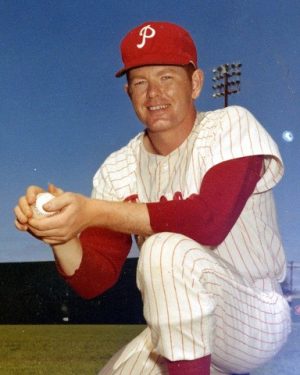
Jack Baldschun (86) was Gene Mauch’s favourite relief pitcher on the early 1960s Phillies, with a nasty screwball he’d learned to throw without arm stress and with excellent results . . . until he wasn’t, during the ill-fated 1964 season that saw the Phillies bring veteran Ed Roebuck aboard and both Mauch and general manager John Quinn lose confidence in him inexplicably. They traded Baldschun to the Orioles and he was an Oriole for 72 hours—long enough to be part of the package that brought the Orioles Frank Robinson from the Reds. His career never the same again (he suffered what he called “arm lock” while in Cincinnati and spent his final seasons in the minors except for a 1969 with the newborn Padres: “I felt like a man serving time for a crime he didn’t commit”), he retired to lumber sales and family life.

Jack Baldschun

“I felt like a man serving time for a crime he didn’t commmit.”—Jack Baldschun.

Nate Colbert (76) was plucked from the Astros organisation for the 1969 expansion draft and became the Padres’ first genuine star (he averaged 30+ home runs a season), tying one record and setting another with five bombs and thirteen steaks in a 1972 doubleheader, but saw his career curtailed by chronic back trouble after five years as a Padres then two years in three towns. (Detroit, Montreal, Oakland.) He remains the franchise’s career home run leader (173) and—after one dicey scrape involving fraudulent loan applications and six months in prison—reclaimed his post baseball life as a minister.

Dick Groat (92) was a slick shortstop, the National League’s Most Valuable Player as a member of the World Series-winning 1960 Pirates, and eventually held the same job without winning the same award for the World Series-winning 1964 Cardinals. Bob Garibaldi* (81) resisted the personal recruitment of Casey Stengel for the Mets to sign with the Giants, pitch in fifteen games over four seasons, then (after long years in the minors) become a college basketball referee. Pat Corrales (82) was a reserve catcher, major league manager (the first Mexican to have such a job), and well enough respected as a man that, when his first wife died giving birth to their fourth child in 1969, Frank Robinson ordered all the fines collected by his kangaroo court in the Baltimore clubhouse to be given to him instead of used for the usual season-ending party. (Corrales remarried happily soon enough.)

Wayne Comer* (79) was a 1968 Tiger (usually a late game replacement for outfield star Willie Horton; he got a base hit in his lone World Series plate appearance), a 1969 Seattle Pilot (his 3.2 wins above replacement tied for the team lead), a 1970 Brewer, and a respected high school baseball coach in his native Virginia. He was also the subject of a hilarious attempted game ejection in the minors: an umpire assumed Comer was giving him the business from the team bullpen and ordered him ejected, whereupon the team’s manager told the arbiter, “You’re going to have to yell louder. We sent Comer to Detroit this morning.”

Dennis Ribant (81) was the first Mets pitcher to finish in the National League’s ERA top ten (in 1966) and with a winning season’s record. (11-9, also 1966.) His reward was being traded after that season—to make room for a kid named Seaver. His ill fortune resumed in 1968, when—reduced to journeyman relief work by then—he was one of only three Tigers who was actually native to Detroit (catcher Bill Freehan and outfielder Lenny Green were the others) . . . but he got little enough work and was traded to the White Sox late that July. After several more seasons of being traded and put into the minors at once (he was once traded for legendary pitcher-playboy Bo Belinsky), the righthander who once admitted “experimenting” with a spitball despite learning a good changeup from Hall of Famer Warren Spahn retired to life insurance, living in Newport Beach, and (with his daughter, Tracy) winning the Equitable Family Tennis Championship at Forest Hills in 1983.

Tim Wakefield

Tim Wakefield: Knuckleball inspired a catcher to use a first baseman’s mitt. Narcissistic teammate denied his right to fight his illness privately.

Willie Hernández (69) won the American League’s 1984 Cy Young Award and MVP as the World Series-winning Tigers’ relief king with his 1.92 ERA. Two years later, he blew his popularity in Detroit during a struggling season when a critical Mitch Albom column provoked Hernández to dump a bucket of ice water over Albom’s head. Elbow trouble put paid to his pitching career before he had a second successful act as the owner of a steel construction business and cattle ranch in his native Puerto Rico, before his health (including multiple strokes) hit bottom.

Tim Wakefield (57) was a class act, a good knuckleball pitcher (his floater was tough enough to inspire one of his catchers to use a first baseman’s mitt behind the plate), who picked himself up, dusted himself off, started all over again after surrendering a pennant-losing home run (to Aaron Boone in 2003), and became a key to the Red Sox’s 2004 drought-busting triumph at last. Beloved in Boston, Wakefield and his wife were also done dirty by a 2004 Red Sox rotation mate who decided their choice to fight two insidious diseases together out of the public eye wasn’t their choice to make.

Ken MacKenzie (89) was the first Mets pitcher who could call himself a Yalie. An Original Met, the bespectacled MacKenzie was once brought into a deep jam with manager Stengel telling him, “Now, just pretend you’re pitching against Harvard.” (As a Yale pitcher, MacKenzie’s record against Harvard was 6-0.) Roger Craig (93) turned ignominy as an Original Met (an eighteen-game losing streak in 1963 despite often solid pitching) into a later life as a messenger of the split-fingered fastball and a World Series-winning manager. (The “Hum Baby” 1989 Giants.) Their Original Met battery mate (for a short while), Hobie Landrith (93) landed me two crates of oranges for winning a sports radio trivia contest long after he performed his greatest service to those Mets: being traded for Marvelous Marv Throneberry.

Ken MacKenzie

Ken MacKenzie: Yale Class of 1956; Original Mets Class of 1962-63: “Now just pretend you’re pitching against Harvard.”

Yet two more Original Mets—Frank (The Big Donkey) Thomas (93) and Joe Christopher (97) factored in a couple of classic Metsian mishaps: Christopher had to tell Hall of Famer Richie Ashburn how to holler “I got it!” in Spanish to keep shortstop Elio Chacon from plowing into him on short flies to the shallow outfield. The first time Ashburn hollered Yo la tengo, yo la tengo, Chacon backed away . . . but Thomas, the Mets’ first home run king (34 in 1962), running in from left field, plowed into Ashburn instead. The passings of Christopher, Craig, Landrith, MacKenzie, and Thomas leave only nine men standing at this writing who served sentences as Original Mets and still live to tell about it.

Don Denkinger (86) developed a sense of humour about his hour of infamy, blowing the call at first base in the top of the ninth of Game Six, 1985 World Series. (He called the Royals’ Jorge Orta safe when everyone in the ballpark and watching on television saw Orta was out by a full step plus.) He also proved a better man than most calling for his prompt execution: he not only owned the mistake but, in due course, advocated powerfully enough for the proper resolution: replay review in the postseason.

His umpiring career went forward with little enough controversy. And, with distinction: he was behind the plate for Hall of Famer Nolan Ryan’s sixth no-hitter, Hall of Famer Jack Morris’s 1991 World Series jewel, and Kenny Rogers’s 1994 perfect game. (Having also called Len Barker’s 1981 perfecto, he’s the only ump to call the pitches for two perfect games.)

But Denkinger showed baseball and the world the right way to atone for a grievous error. (And, no, it wasn’t his fault the Cardinals went from the Game Six loss to imploding completely in Game Seven, either.) It’s a lesson only too many umpires (and non-baseball people, for that matter) could stand to learn, and re-learn.

—————————————————————

* Garibaldi and Comer were two of the now 500+ short-career major leaguers denied pensions in the 1980 pension realignment.

Ohtani gets his lucre and his wish

Shohei Ohtani

Shohei Ohtani signs with the Dodgers for a decade, $700 million, and the thing he wants most—better chances to win. Angel fans mourn the absolute waste of the game’s most transcendent talent.

It was almost to laugh. Within an hour of the news breaking and confirmed that Shohei Ohtani signed at last, and with the Dodgers, yet, there also came the news that some Angel fans began holding burnings of one or another kind of Ohtani merchandise. It was to laugh that you wouldn’t weep, of course.

Set aside what Ohtani signed for for the moment. Yes, it’s ten years and $700 million. It’s also no opt-out clauses in the deal. It’s also Ohtani himself deferring a considerable pile of that guaranteed money the better to enable the Dodgers to continue sustaining excellence via the farm and the market.

Now, consider the abject stupidity of the Angels and some of their fans. You want to burn Ohtani merch because, as a legitimate, lawful free agent, he signed elsewhere at all? Never mind with the beasts just up the freeway? Be my guest—and stand exposed as the fools you are.

The fools who’d rather turn Ohtani merch into burnt ashes than demand better of the team that let him walk with nothing of value in return—while going for broke elsewhere at the trade deadline only to unload two of the pieces they did acquire by way of the waiver wire at September’s beginning . . . just after Ohtani’s elbow took him off the mound for the season without sitting him down as a designated hitter.

The fools who’d rather have kept Ohtani bound to a team whose administration seems clueless about the point that you need a viable team around them to enable Ohtani and whatever might be left of future Hall of Famer Mike Trout to play for chances at championships. The point that one or two players do not a championship contender make, no matter how overendowed in ability and execution they’ve been.

You want to make Ohtani an example instead of holding Angels owner Arte Moreno and his trained seals in the front office accountable for thinking the box office is the thing and if you just so happen to win it’s mere gravy? Be my guest again. And stand exposed further.

For so long as he’s owned the Angels Moreno’s marketing background, the business in which he earned his fortune, has dominated what the Angels put on the field. Whether what they put on the field could play competent or cohesive baseball up and down the lineup seemed secondary to having what George Steinbrenner used to call “name guys who put fannies in the seats.”

It was bad enough that the Angels unearthed the transcendent Trout and saw him build a jaw-dropping Hall of Fame case in his first nine seasons before the injury bug bit into him in too much earnest over the past four. It was worse that Trout showed his loyalty to the team that discovered him and turned him loose on the field by signing a glandular extension only to have too many people wondering if he hadn’t lost his marble for it.

It was worse that Trout got to play with Ohtani, himself an injury bug victim for a couple of years following his Rookie of the Year season, and formed a tandem of transcendence (when Trout could play) that proved nothing more than a two-man supershow in the middle of a sad-sack sideshow.

“Ohtani has said he wanted to win,” writes The Athletic‘s Andy McCullough.

The Dodgers have won their division in ten of the past eleven seasons and tallied more than one hundred victories in five of the past six full seasons . . . [Ohtani] has been never part of a team with a front office capable of regularly rebuilding a pitching staff with excellent results, as Andrew Friedman has often done. And he has never played for an ownership consortium like Mark Walter’s Guggenheim group, who have been willing to invest in facilities, infrastructure and ancillary considerations.

That’s putting things politely. The hottest item at last season’s trade deadline was whether the Angels would wake up, wise up, and trade him for legitimate return value on the field and in the organisation at last. No chance.

Now it’s possible that Trout will return healthy, play like something close enough to the Trout who punched his Cooperstown ticket, stir up speculation on whether the Angels finally deal him to a contender with rich return to offer, and find himself still bound and gagged to an owner who’s willing to invest in his box office alone.

Quit the hemming and hawing over Ohtani’s deal raising an unconscionable ceiling for the free agents to follow him in the current market. Instead of bellowing over the big bad Dodgers handing him what amounts to a Delta Quadrant kingdom plus safe passage through the Cardassian Empire and ownership of Ferengi Enterprises, try bellowing over other owners’ too-entrenched refusal to invest and build in the major league product and the organisation behind it.

The Red Sox unloading Babe Ruth to the Yankees was nothing like this. Then, believe it or not, the Red Sox thought they were unloading a problem child to help relieve their owner’s financial stresses, not all of which was tied to his concurrent theatrical production operation. The Ruth sale helped temporarily.

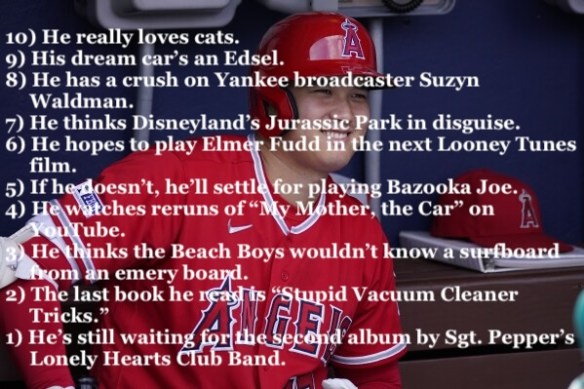
Ohtani, anything but a problem child, was allowed to walk into free agency eyes wide shut on the part of the Angels. It was perverse fun, too, watching the sports press get their proverbial panties into twists trying to figure out what was in Ohtani’s heart of hearts while he and his agent played things close enough to the vest. I couldn’t resist joining the fun for a moment, outlining a top ten list of what Ohtani was really thinking, feeling, wanting . . .

When Dodger manager Dave Roberts admitted the Dodgers talked to Ohtani and he’d have loved nothing more than to see Ohtani in Dodger silks, panties into twists turned nuclear, they thought Roberts’s honesty might have killed any deal in gestation. So much for that idea.

Too often with Trout injured Ohtani had to provide most of the Angels’ offense. Joining the Dodgers that burden is lifted. He can swing the bat comfortably and not believe every one of nine innings of baseball is on his shoulders. When he recovers from elbow surgery and takes the mound again in 2025, Ohtani has good reason to believe the Dodgers will have remodeled the starting rotation whose dissipation cost them this past postseason.

He didn’t have one millionth of a prayer of seeing that happen if he elected to re-sign with the Angels. Being a guy who makes baseball fun again is one thing. Coming home after yet another losing or short-of-the-postseason season proved something else.

So go ahead, some of you Angel fans. Burn his jerseys, blow up his bobbleheads, use his photos and posters for fish wrap if you must. You’re going to look almost as foolish for it as your team’s owner has looked for having resources unfettered and brains inoperable the entire time Ohtani wore Angels red. Almost.

Angel fans who don’t have coconut juice for brains began flocking to Angel Stadium to mourn within two hours of Ohtani himself scooping the world by announcing his Dodgers deal on Instagram. A crane already began stripping Ohtani’s mural from the side of the stadium. Fans slipped into the stadium’s team store to snap up Ohtani merch before it would disappear forever.

They came to mourn.

And one fan, Sebastian Romero, lifted a page from the books of long-suffering Athletics fans whose owner has stripped the team of credibility only to wrest approval for hijacking them to Las Vegas. Outside the stadium, Romero held up a sign before the Ohtani mural behind him was stripped, as photographed by Athletic writer Sam Blum:

As Blum noted so mournfully, Ohtani’s past three seasons have been three of the greatest the game has ever seen from a single player, on both sides of the ball, yet, with the Angels going 77-85, 73-89 and 73-89. What a waste of Ohtani hitting 124 home runs and striking out 542 batters worth two unanimous Most Valuable Player awards over that span.

A young man of few words for the press, Ohtani is on record as saying that, much as he loved the Angels, “More than that, I want to win. That’s the biggest thing for me. So, I’ll leave it at that.” Nobody can say the Angels weren’t warned. Nobody can say the Dodgers lack the resources or the brains to make that wish come true, either.

Now, I wonder. When Ohtani meets Clayton Kershaw as a Dodger for the first time, will he begin the conversation by saying, “About that All-Star Game pickoff, buddy . . . ?”

The Hawk wants to flip his lid

Andre Dawson

If Andre Dawson has his way, his Hall of Fame plaque will change from showing him as an Expo to showing him as a Cub.

Even before any new Hall of Famers are elected, the question (and controversy?) about hat logos on the plaque portraits has arisen. You can thank Hall of Famer Andre Dawson for that, now that his letter on the subject to the Hall’s chairman of the board Jane Forbes Clark was publicised by the Chicago Tribune.

Dawson asked Clark to compel her board to review his plaque and its hat logo. When he was elected to the Hall’s Class of 2010, the Hall elected to adorn him in a Montreal Expos hat. Dawson wasn’t exactly amused, since his own preference was to be shown in a Cubs hat.

“It’s hard for stuff to bother me, to a degree,” the Hawk told Tribune columnist Paul Sullivan. “But this has toyed with me over the years for the simple reason that I was approached with the (announcement) that was going to be released to the press that I was going to wear an Expos emblem.

“I didn’t agree with it at the time,” he continued. “But for me, getting into the Hall was the most important thing. Over time, I’ve thought about it more and came to the (conclusion) I should have had some say-so.”

No one should be surprised that Dawson would prefer being seen as a Cub. He was a victim of the first 1980s owners’ collusion, the Expos offering him a two-year deal that amounted to an annual pay cut from his 1986 salary of $1.2 million. That’s when his agent, Dick Moss, sold him on the blank-contract idea that drew the Cubs to him.

He went from the blank-contract fill-in of $500,000 from the Cubs for 1987 to win that year’s National League Most Valuable Player award, after leading the league with 49 home runs and 353 total bases. That was despite several players having arguable better seasons, including Hall of Famers Tony Gwynn, Tim Raines (Dawson’s longtime Montreal teammate), and Ozzie Smith, plus Cardinals bomber Jack (The Ripper) Clark.

Dawson parlayed that gambit into five years and $10.6 million, not to mention shaking out as a particular Wrigley Field fan favourite. After finishing his career with two seasons in Boston and two in Miami, Dawson needed nine tries to reach Cooperstown but reach it he did. It came with a price. The artificial turf in Montreal’s Olympic Stadium turned the Hawk’s knees into science experiments; he’d had as many as a reputed ten knee surgeries.

Even the president of Expos Fest, Terry Giannias, whose group celebrates the Expos’ history, gets it. “I’m not going to lie,” Giannias told MSN.com, “it sort of was like a shot in the gut.” But neither would Giannias lie about why he gets Dawson’s feelings:

I just know what everybody else knows, is the way he left the Expos. When you talk about the stars of the Montreal Expos, especially in the ’80s . . . and in the 35 years (of their existence) in general, it’s Andre Dawson, Tim Raines and Gary Carter, right? So, when Carter moved on, when they got rid of him, the prodigal son should have been Andre and the way they treated him during the collusion thing . . . that was really dirty. I don’t know if somebody forgets that. Obviously, that plays a role in it. But I don’t believe it’s got much to do about that anymore, but just his love for Chicago, because Chicago embraced him, like right away and he’s had a great relationship with the city ever since. So I think it’s less of a grudge and more of an appreciation for his adopted city, he’s an ambassador there.

Carter was vocal about his preference to enter the Hall of Fame as a Met; he’d often withstood unjust criticism in Montreal before being traded to the Mets in 1985 and becoming a key to their 1986 triumph while having his last great seasons there. The Hall said, no soap, you’re going in as an Expo.

When did the Hall become that picayune about cap logos on Hall of Famers’ plaques? Hark back to 1999, when then-future Hall of Famer Wade Boggs was winding up his career with the embryonic (Devil) Rays.

Boggs was going to get to Cooperstown on his first try, in 2005. Nobody but a cynic argued otherwise. But some time in 1999, there came reports that the Rays offered to compensate Boggs handsomely if he’d consent to enter the Hall with their logo on his plaque hat. Two years later, the Hall said, well, we’ll just see about that crap. Long since, with exceptions you may be able to count on one hand, the Hall has exercised the final say on who wears which hat on his plaque, even after “consulting” with the player.

Boggs, of course, reposes in bronze in Cooperstown with a Red Sox hat on his head. Appropriately, since he posted the bulk of his credentials with the Olde Towne Team. But he also debunked the reports about the Rays’ compensation offer six years ago. “I think it came from when Jose Canseco said, ‘If I get in the Hall of Fame, I’m going in as a Devil Ray’,” Boggs told WFAN. “And someone probably misconstrued that I said that and that [original Rays owner Vincent] Naimoli offered me a million dollars to be the first Devil Ray to go into the Hall of Fame, and that conversation never took place.”

Last year, the Hall “consulted” with Scott Rolen, then assented to his request to be shown as a Cardinal. Understandably, Rolen preferred to be shown as a member of the team that made him feel both at home and like the World Series champion he became with them in 2006. Not as a member of the Phillies, who’d too often let him become an undeserved fall guy for their organisational failures prior to his departure.

Last year, too, the Hall “consulted” with Fred McGriff, who elected with their blessing to have his hat left blank. He was a frequent-enough traveler, often for reasons not of his own making, and his longest single-team tenures were a dead heat between the Blue Jays (five years) and the Braves (five years). The Crime Dog decided that a man who played for six teams (seven if you include the Yankees who discovered but unloaded him in the first place) simply shouldn’t choose one above the other in the circumstances.

When Mike Mussina was elected at last, he had a pretty pickle to ponder: his career split almost dead even between the Orioles (ten seasons) and the Yankees (eight seasons). Perhaps diplomatically, Mussina, too, elected to be blank on his plaque.

Roy Halladay’s career split twelve seasons in Toronto and four in Philadelphia. He’d posted most of his Hall case with the Blue Jays, but he did win a second Cy Young Award with the Phillies (the fifth pitcher to win one in each league), not to mention pitching that no-hitter in Game One of the 2010 National League division series. The Hall talked to his widow. Brandy Halladay elected to leave her late husband’s hat blank, not wishing to offend either team or its fans.

The rare single-team players have never had an issue, of course. (How rare? 23 percent of 270 players elected to Cooperstown as of this writing have been single-team players.) It was no issue for such men as Luke (Old Aches and Pains) Appling, Jeff Bagwell, Johnny Bench, Craig Biggio, Roberto Clemente, George Brett, Joe DiMaggio, Roy Campanella, Lou Gehrig, Bob Gibson, Tony Gwynn, Derek Jeter, Walter Johnson, Chipper Jones, Al Kaline, Barry Larkin, Mickey Mantle, Edgar Martínez, Stan Musial, Pee Wee Reese, Mariano Rivera, Jackie Robinson, Jim Rice, Mike Schmidt, Ted Williams, and Carl Yastrzemski, among the Hall’s 54 single-team men.

If elected as they should be, Todd Helton and Joe Mauer are also single-team men who would go in as a Rockie and a Twin, respectively. The blank hat makes sense for players with multiple franchises on their resumés if they didn’t spend, say, 65 percent or more of their career with just one. Andruw Jones should go in as a Brave; Chase Utley, a Phillie; Billy Wagner, an Astro.

Adrián Beltré is trickier. He played seven season with the Dodgers and his final eight with the Rangers. (In between, there were five in Seattle and one in Boston.) Under Frank McCourt’s heavily mortgaged and controversial ownership, the Dodgers let him walk as a free agent in 2004, after he led the entire Show with 48 home runs. Considering his relationship with and in Texas, if he doesn’t enter Cooperstown with a Rangers hat on his plaque head there will (should) be protests up and down the Lone Star State.

A player who posted the bulk of his Hall case with one team has a better case to be shown with that team’s hat. Unless, of course, he went from mere Hall of Famer to triple superstar elsewhere. (Think, for example, of Vladimir Guerrero, Sr. as an Angel, Reggie Jackson as a Yankee, and Randy Johnson as a Diamondback.) But then there was Greg Maddux. Born and raised a Cub, but going from mere greatness to off-the-charts as a Brave. He put two more teams on his resumé and elected to be inducted with a blank lid.

The blank might have worked for Dawson, too, until you consider his actual feeling about it. He might have been a star in Montreal, but after the Expos colluded his way out of town he became more than than that in Wrigleyville. That daring blank-contract MVP season turned not just into further riches but a love affair. The North Side embraced him and he returned the embraces.

Even after leaving as a free agent, even though he participates occasionally in Expos-related events, Dawson’s heart probably never truly left Chicago. If the Hall reconsiders and gives the Hawk his heart’s desire here, it would be the first time the Hall ever flipped an inductee’s lid at his request. That assent would not come without complications.

Some complaints, far more gratitude

Willie Mays‘Tis the season to kvetch, complain, and fume. At least, on baseball social media. Spend enough time there and you’d think the glass can’t possibly be half empty because the water isn’t up that high in the first place.

Show me a team that makes a good or at least impressive move, I’ll show you half or more of their fan base predicting the End of Their World As They Wish They Knew It. You don’t want to know what those people think if their team makes a dubious move. (Though none have called for retroactive abortions or executions. Yet.)

Show me a team that hasn’t hoisted a World Series trophy since the second Reagan or the first Bush administrations, I’ll show you fans who think any success they’ve had since can only be mistakes—and the World Series trophies they did hoist were figments of their imagination.

(Of course, show me a Yankee fan who no longer believes his or her team is entitled to reach the postseason every season, and I’ll show you a million Yankee fans who think that individual needs to burn in effigy, boil in oil, cop a squat in the electric chair, and lose his or her head in the guillotine—all at the hands of the late George Steinbrenner.)

I get it. I’ve gotten it for a very long time. Some people can never be satisfied. Including and especially baseball’s incumbent commissioner who thinks that, when his mission isn’t making sure the good of the game means making money for its owners, his mission is making damn sure baseball appeals almost solely to those fans at the ballpark to whom a ballgame is just an occasional disruption to their cell phone lives.

Listen up, Commissioner Pepperwinkle. I didn’t mind the larger bases. I learned to live with the pitch clock as it was in 2023. But shortening the clock up even more? You didn’t see enough pitchers’ adjustments resulting in a few too many injuries in a time when throwing hard still supercedes throwing with brains and real strike zone knowledge a little too often?

And I’m long fed up with your incessant expansion of the postseason to the point where championship means applesauce. You’re thrilled that baseball’s eighth-best team of 2023 beat its twelfth-best in the World Series? I don’t mind the Washington Senators of Texas winning the Series at all. What I do mind is a system that tells baseball’s six best teams not so fast, you ain’t getting near the championship rounds until you prove yourself against the top also-rans all over again.

Sandy KoufaxI miss real pennant races. I don’t like watching stretch drives dominated by the thrills and chills of watching teams fighting to the last breath to finish a season . . . in second or third place. I hope against hope that you, Pepperwinkle, mean business about expansion with two more teams. I hope someone pounds into your skull that that should be followed by two major leagues with two eight-team conferences of two divisions each.

Then, I hope that same someone pounds into your head that regular-season interleague play has graduated from nuisance to horror. That the free cookie on second base to start each extra half-inning has graduated from bad joke to unacceptable. That the real problem with times of games was and remains excessive broadcast commercials. That all the above means you’re not off the hook just because you gave in to reality and made the designated hitter universal at long enough last.

And, the next time a witless team administration censors a broadcaster over a factoid the team itself provided him, you’d better have a lot more than a deafening silence with which to answer that.

Now, having unburdened myself of all the above, would anybody object to my showing more than a little gratitude? I’m 68 years old. I’ve been a baseball fan since the 1961 World Series and, especially, the 1962 Mets. And I can complain about a lot of what I’ve seen over those years.

I can complain about the disgraceful bids to stain Roger Maris’s and Henry Aaron’s pursuit and passings of the Sacred Babe (single season and career, respectively) as all-time home run hitters. The Yankee double switch that dumped Yogi Berra after managing them to a pennant in his first year trying. The disgrace of putting deceased Cub second baseman Ken Hubb’s photograph on living Cub pitcher Dick Ellsworth’s 1966 baseball card. The Year of the Pitcher.

The dessication of the Hall of Fame thanks to the cronyism of the old Veterans Commmittee when Frankie Frisch and Bill Terry ran it like an ongoing Old-Timers’ Day of their old Giants and Cardinals buds. The hijacking of the second Washington Senators to Texas. Ten Cent Beer Night. Disco Demolition Night.

Henry AaronBowie Kuhn’s insane blockage of Charlie Finley’s fire sale to include a hard cap on player sales that helped, not hindered salary inflation and hindered, not helped less-endowed teams from surviving while rebuilding. The 1980 pension realignment that froze all pre-1980 short-career major league players out of full pension and health benefits.

The drug scandals of the 1980s and the Wild West Era of actual/alleged performance-enhancing substances. Pete Rose vs. Rule 21(d). George Steinbrenner vs. a) common baseball sense and b) Dave Winfield. The Wave and the Tomahawk Chop. The mid-to-late 1980s collusion. The owners imposing one of their own as commissioner and pushing the players into the 1994 strike. Álex Rodríguez trying to sue his way out of discipline for his Biogenesis involvement—and baseball government’s parallel shenanigans tainting the probe anyway.

Underqualified Harold Baines and Jack Morris elected to the Hall of Fame while eminently qualified Dick Allen and Lou Whitaker still await their Era Committee review and overdue election, Allen posthumously. Tanking. Astrogate. Domestic violence cases. The pending hijack of the Athletics from Oakland to Las Vegas, eyes wide shut.

Yes, I have had a truckload to complain about in my baseball loving lifetime. But I also have about two planeloads about which to feel grateful for having seen.

I’ve seen Arriba, the Big Hurt, Big Papi, the Big Unit, the Bird, Blue Moon, two Bulldogs (Jim Bouton, Greg Maddux), Capital Punishment, two Cha-Chas (Orlando Cepeda, Keith Hernandez), one Choo Choo, the Chairman of the Board, the Commerce Comet, Crash, Ding Dong Bell, Dr. K, Dr. Strangeglove, El Tiante, the Express, the Franchise, the Greek God of Walks, Hoot, the Hoover, the Human Rain Delay, Jack the Ripper, the Kid, the Kingfish, Kitty, Knucksie, Kong, La Maquina, the Left Arm of God, the Man of Steal, Marvelous Marv, Mr. Cub, Mr. October, Mr. November, Mr. Padre, the Monster, Moose, Oil Can, Pops, the Rock, the Say Hey Kid, the Spaceman, Stretch, Sudden Sam, Sugar Bear, Sweet Music, Vincent Van Go, the Vulture, the Wild Thing, and the Wizard of Oz. Among others.

I’ve seen the Cinderella Red Sox, El Birdos, the Miracle Mets, the Swingin’ A’s, the Big Red Machine, the Pittsburgh Lumber Company, the Bronx Zoo, Harvey’s Wallbangers, the Hum Babies, the Nasty Boys, the Philthy Phillies, the Idiots, and the Baby Sharks.

I saw Mike Trout do things unseen since the Mantle-Mays era and secure a Hall of Fame berth before his body began to betray him little by little. I’ve seen Shohei Ohtani on the mound and at the plate, a one-man avatar of the old saying, “Good pitching beats good hitting—and vice versa.” (You wonder, once in awhile, what would happen if Ohtani the pitcher could ever face Ohtani the hitter.)

Ozzie SmithI saw Curt Flood fire the Second Shot Heard ‘Round the World one not-so-foggy Christmas Eve and Andy Messersmith finish what Flood started.

I saw Casey Stengel keep the heat off the infant Mets he managed while the organisation built itself into something beyond baseball’s greatest traveling comedy. I saw managers stolid (Walter Alston), smart (Bruce Bochy, Davey Johnson, Tony La Russa), snarky (Tommy Lasorda, Earl Weaver), self-defeatingly short-sighted (Billy Martin), and sadistic (Leo Durocher). I saw teams trying to win one for an ill-fated manager (the 1964 Reds, as Fred Hutchinson was dying of cancer) and teams actually winning one despite their manager. (The 1980 Phillies, under Dallas Green’s whiplash.) I saw courageous grace under the fire of insidious disease from Michael Weiner (executive director, Major League Baseball Players Association, refusing to let brain cancer dull his love of the game) and see it from Sarah Langs (ALS impacts her body, but not that acute, instructive, engaging mind).

I saw Jackie Robinson dream aloud of the day he might look to see a black manager in a major league dugout. I saw baseball’s first black manager (Frank Robinson) inserting himself into the lineup by popular demand in his first game managed—and hitting one out his first time up. I saw baseball’s third black manager to win a World Series (Dusty Baker) after taking over a scandal-shredded team of Astros and leading them straight, no chaser to the Promised Land.

World Series that transcended time and place and even history: the 1963 and 1965 Dodgers, the 1966 Orioles, the 1967 Cardinals, the 1968 Tigers, the 1969 Mets, the 1971 Pirates, the 1975 Reds and Red Sox, the 1979 “Fam-I-Lee” Pirates, the 1985 Royals, 1986 Mets, the 1990 Reds, the 2002 Angels, the 2004 Red Sox (the aforementioned Idiots), the 2011 Cardinals, the 2014 Giants, the 2016 Cubs and Indians, the 2019 Nationals.

Carlton Fisk’s body-English Game Six walkoff World Series home run. The pennant winners hit by Chris Chambliss (a walkoff), Aaron Boone (2003 ALCS), and José Altuve (2019 ALCS). David Freese sending a Series to a Game Seven with a leadoff eleventh-inning blast. Joe Carter winning the 1993 Series with a bomb.

Nolan Ryan, Rickey HendersonPoignant farewells. Sandy Koufax’s retirement press conference. (On my eleventh birthday, no less.) Mickey Mantle’s Yankee Stadium farewell. Willie Mays’s farewell at Shea Stadium. (Willie, say goodbye to America.) Brooks Robinson’s at old Memorial Stadium. (Around here, people don’t name candy bars after Brooks Robinson—they name their children after him.) Tom Seaver’s at Shea. (He ran from the microphone to the mound and took bows from all four possible sides of the park.) Mike Schmidt’s mid-season goodbye press conference.

Hall of Fame speeches admonitory (Ted Williams throwing the gauntlet down on recognising and honouring Negro Leagues greats “who are not here only because they weren’t given the chance”), amiable (Yogi Berra), appreciative (Ozzie Smith, living and self-reflecting the dream), appalling (Earl Averill zapping the Hall over how long it took for him to be elected), and athwart all precedent. (The invaluable Roger Angell, the first non-daily beat writer elected as a Spink  Award Hall of Famer.)

Voices of the game in the broadcast booths running the spread from shameless homers (Ken Harrelson, Bob Prince, Ron Santo, John Sterling) to smooth operators (Curt Gowdy, Tim McCarver, Lindsey Nelson), spiritual billy goats gruff (Harry Caray), and spirits beyond these dimensions. (Vin Scully.) Writers who gave it genuine literature: Angell, Dave Anderson, Ira Berkow, Thomas Boswell, Jim Bouton, Jim Brosnan, Alison Gordon, Bill James, Pat Jordan, Roger Kahn, Ring Lardner, Jane Leavy, Jim Murray, Joe Posnanski, Shirley Povich, Damon Runyon, Claire Smith, Red Smith, Jayson Stark, George Vecsey, George F. Will.

Mike PiazzaKoufax proving practise makes perfect. (His fourth no-hitter in each of four straight seasons: a perfect game.) Aaron yanking the Sacred Babe to one side while making chumps out of the racists who tried to intimidate him and of his own team trying to demean him by placing the box office ahead of proper competition.

The Express striking the Man of Steal out to reach 5,000 career punchouts. The long-since-tainted 1998 single-season home run chase. (We loved it, until we didn’t.) Aaron Judge nudging Maris to one side as the American League’s single-season home run king. Albert Pujols delivering the only farewell tour that matters: no pomp, circumstance, or conscious tributaries, just hitting 71 percent of his 24 homers that year in the season’s final two months.

Mike Piazza sending a 9/11 shocked and staggered New York and nation into a rip-roaring frenzy when, late in the Mets’ first home game after baseball resumed following a break, he sent one banging off a television camera scaffold behind Shea Stadium’s left center field fence.

Even this year’s World Series, for all the flawed foundation of the postseason that led to it. Scratching the Rangers off the list of franchises lacking even one World Series trophy, it’s possible to believe that, in my lifetime, I may yet see World Series trophies hoisted by teams from Colorado, Milwaukee, San Diego, Seattle, and Tampa Bay.

Ballparks in which I’ve sat watching games. The Polo Grounds and Shea Stadium. Old Rosenblatt Stadium in Omaha, when the team was the Royals’ Triple-A farm. Wrigley Field. Lackawanna County Stadium. (Pennsylvania, when the Triple-A team was the Scranton-Wilkes Barre Red Barons and a Phillies affiliate.) Tiger Stadium. Camden Yards. Angel Stadium. Dodger Stadium. Cashman Field. (When Las Vegas’s Triple-A team was a Dodgers, then Blue Jays, then Mets affiliate.) Las Vegas Ballpark. (For the Triple-A Aviators.)

If all the foregoing says nothing else, it ought to say the good still outweighs the bad by at least as far and wide a distance as that by which the Rangers once baked four and twenty  Orioles in a 30-3 pie, in August 2007. It also says, as I’ve said often enough in these pages, that in baseball anything can happen—and usually does.

Peter Seidler, RIP: “He saw the cup as three-quarters full”

Yu Darvish

Padres pitcher Yu Darvish arrives with flowers at the Petco Park memorial for Peter Seidler last Tuesday.

There have been exceptions to the axiom that no fan ever buys a ticket to a major league baseball game to see a team’s owner. One of them died last week, two days before his fellow owners voted foolishly to allow John Fisher’s hijack of the Athletics from Oakland to Las Vegas.

Fisher’s one of those owners whom fans would pay to demand he sell his team, in their more polite moments of fury. Yankee fans of the 1980s didn’t go that far but they didn’t mind having chances to let George Steinbrenner have it over his Mad Hatter-meets-the-King-of-Hearts style in that decade.

Conversely, fans loved seeking Bill Veeck out (and he, them) when he owned the Guardians (known as the Indians in his day), the St. Louis Browns, and the White Sox twice. So did Mets fans seeking out their original owner, Joan Payson; so have Met fans with current owner Steve Cohen. And so did Padres fans with Peter Seidler, who died last Tuesday at 63.

What Seidler had in common with Veeck, Payson, and Cohen was that he loved baseball genuinely and wasn’t afraid to wear it on his sleeve. He was known to walk around Petco Park with a baseball in his hand and a readiness to talk his love of the game at the slightest inspiration. Padres fans were known to wear team jerseys with his name on it as often as they wore those of various Padres players past and present.

Ground Floor Murals, a San Diego outfit known for having done mural tributes to various Padres players, wasted no time in hoisting one in Seidler’s memory last Tuesday evening on a wall in San Diego’s Little Italy section.

“Baseball is a social institution, and it always has been,” he said in a 2021 interview. “I believe to this day it’s America’s pastime, and the impact that the San Diego Padres can have on the city and county of San Diego is something like no other business can have. And that was important to me.”

He was talking about what provoked him to buy the Padres in the first place, in 2011, when by his own admission he was bored while undergoing treatment for non-Hodgkins lymphoma (a disease he’d beat twice) and discovering the team was for sale. He went to his first game at Petco Park. The simple allure of the ballpark joined his knowledge that San Diego had yet to party over a major sports championship.

Seidler was one of the grandchildren of legendary Dodgers owner Walter O’Malley but one who made his own way and fortune as a private equity investor. He joined his uncle, former Dodger successor owner Peter O’Malley, and his longtime friend Ron Fowler to buy the Padres, becoming its managing partner in 2020.

Peter Seidler

The Ground Floor Murals tribute to Seidler that first appeared last Tuesday night.

Seidler was known to be warm, gentle, and kind. Among other things, he was known equally around San Diego for his efforts on behalf of the homeless, which he believed was a problem that shouldn’t be left to government alone. He backed that belief by creating the Tuesday Group and getting involved with the Lucky Duck Foundation that reaches to homeless youth.

“Peter was probably the most positive person I knew,” Fowler told The Athletic‘s Dennis Lin after Seidler’s death.

To say he saw the cup as half-full is probably a misstatement. I think he saw it close to three-quarters full. He saw the possibilities, the upside in everything. He always said things could be fixed or “this will happen.” He just was extremely positive with how he looked at people, problems, everything. He always saw the good. I think that was the way he was in relationships, that’s the way he was in business, and obviously it served him well.

“How many baseball owners,” asked one owner, the Brewers’ Mark Attanasio, believed to be Seidler’s closest friend among the owners, “can you say are gentle?”

Like his counterpart in Philadelphia, John Middleton, Seidler had neither shame nor remorse in actually investing in his baseball team. Among a very dubious fraternity that seems more than ever to believe baseball’s common good equals making money for them, Seidler, like Middleton, really did believe there was honour in actually trying to win and keep winning.

“A lot of people thought that that San Diego would never be a baseball city,” Attanasio told USA Today‘s Bob Nightengale. “It’s a military town. It’s a beach town. He made baseball more than relevant. He brought passion to that fanbase, and that’s as loud a crowd as you will ever hear.”

Nobody pretends Seidler didn’t have a few trips and tumbles toward that goal. The Padres got as far as last year’s National League Championship Series but lost in five games to Middleton’s Phillies. They’ve gone to two postseasons in four seasons since Seidler became their managing partner.

He wasn’t afraid to take the big swing whether it delivered big or imploded big. For every Manny Machado to whom he showed the glandular dollars there was an Eric Hosmer to whom he showed the dollars but got an aged shell for his trouble. He committed big to shortstop Xander Bogaerts, pitchers Yu Darvish and Joe Musgrove, and infielder/outfielder Fernando Tatis, Jr.

But he didn’t deliver weekly fusillades demanding a World Series or bust like yesterday, either, before or after he ascended to the number one ownership slot. He didn’t demand summary executions monthly over bad spells or decisions on the field.

So James Shields turned out to be less than his old and overstated Big Game James reputation? So Hosmer turned out to be old before his time? No sweat. Seidler just picked himself up, dusted himself off, started all over again.

So the Padres faltered last June, recovered slightly in July, faltered again in August, then put on a September stretch to a) be proud of; and, b) miss the postseason by a few hairs? Nobody doubts that Seidler would have done whatever seemed needing to be done to fix that. Even if it meant potentially dealing rather than extending Juan Soto. Even if it meant letting Blake Snell, this year’s National League Cy Young Award winner, test his free agency market before possibly thinking of trying to re-up him for another tour.

When the owners locked the players out in 2021-22, the eventual five year collective bargaining renewal wasn’t good enough for Seidler: he actually wanted a ten-year deal.

Seidler’s death prompted an outpouring from Padres fans and from all around baseball, including a memorial set up at once outside Petco Park. Among the visitors to that memorial were several Padres players including Darvish, who probably spoke for most of Seidler’s players when he Xtweeted after the news broke:

My heart hurts with the unfortunate news of Peter Seidler’s passing. I’m sure everyone that knew him would agree with me when I say Peter was a truly wonderful human being, and being in his presence was always a blessing. He was a teacher of life, and taught me countless lessons form the all the interactions we had. May his beautiful soul rest in peace.

Would Seidler have voted against Fisher’s hijack of the A’s to Las Vegas after too many years of playing Oakland for fools? Would he have stood athwart his fellow owners (even Anastasio and Middleton) in standing athwart Fisher yelling “Stop!” while reminding them how they were forgetting baseball as a social institution and doing their level best to destroy what remained of that status?

We’ll never know now. Just as we don’t know why Middleton and Cohen—and maybe Attanasio, plus one or two other owners to whom the game’s good really does mean far more than just making money for it—threw their hands up, and let Fisher get away with gutting his team and without the usual relocation fee (waived by Commissioner Pepperwinkle) and with continuing to remain heavily enough on their revenue-sharing teat.

What we do know is that Seidler wanted his Padres to stand with and up to any of the other real or alleged big boys in baseball, and for his team and their fans not to back down to anyone for affection and achievement. The Padres didn’t win the World Series while he was alive and operating, but Seidler did whatever was needed to make sure it wasn’t for lack of trying.

As long as he ran the Padres, there was always the chance that somehow, some way, Seidler’s example might yet affect enough of his fellow owners that they might, maybe, begin to think of baseball once more as far more than just a moneycatcher, far more than just a rude interruption to turns on the cell phones. Might. Maybe.