“Ladies and gentlemen, your Orphan Athletics”

Oakland Coliseum

Vegas may beware more than abused A’s fans think . . .

The way things aren’t happening with John Fisher’s bid to hijack the Athletics out of Oakland and into Las Vegas, you shouldn’t be shocked if the Orphan Athletics becomes the team’s semi-official name for a spell or two.

At this writing I don’t know which thought is the more profound thought: A’s fans in Oakland desperate to see Fisher sell the team to someone willing to keep them in Oakland, or baseball fans in Las Vegas who don’t seem all that anxious to have them here.

Hear me out. Having their Triple-A team, the Aviators, playing in that lovely little ballpark up in the Summerlin area is one thing, and a very nice thing, too. But wanting major league baseball by Fisher’s ways and means is something else entirely.

You couldn’t ask for more proof of my suspicion that Las Vegas isn’t in as big of a hurry to welcome the A’s as first believed than its mayor’s own publicly expressed ambivalence.

Earlier this week, Mayor Carolyn Goodman said she thought the A’s should stay and work things out in Oakland. Until she didn’t. On Tuesday morning, she said, “You have the fan base there. We already have the Raiders. Each city needs to have that spirit of sports . . . I love the people from Oakland. I think they deserve to have their team.” On Tuesday afternoon, after the you-know-what hit the you-know-what, she said, whoops.

“I want to be clear that I am excited about the prospect of major league baseball in Las Vegas,” she began her backpedal, “and it very well may be that the Las Vegas A’s will be come a reality that we will welcome to our city.”

. . . [I]t is my belief that in their perfect world the ownership of the A’s would like to have a new ballpark on the water in Oakland and that the ownership and the government there should listen to their great fans and try to make that dream come true.

Should that fail, Las Vegas has shown that it is a spectacular market for major league sports franchises.

Translation, in part: Fisher should renew his oft-failed efforts to strong-arm Oakland into building him a new ballpark for which he’d have to pay little to nothing, but if he still can’t by all means he should continue putting the bite on Las Vegas and on Nevada whole to do it. For a team his ten-thumbed, toeless touch has reduced to what was once just their official emblem—a white elephant.

“Goodman was not speaking with any real authority on this matter,” writes The Athletic‘s chief of Bay Area coverage, Tim Kawakami. “But just take her skepticism—she literally said the A’s should figure out how to build in Oakland—as a representation of the Las Vegas demographic that never seemed too excited about the A’s relocating to Nevada.”

Just like with every other demographic, business or fan: The more you get to know Fisher’s operation, the less faith you have in anything good happening.

To me, the most telling point wasn’t Goodman’s comments. It was that her clear ambivalence about the A’s in Las Vegas was met with nearly total silence among powerbrokers in that region. Ambivalence on top of ambivalence. Where was the rallying cry from all those businesses and fans supposedly lining up to welcome the A’s? Where was the energy? Why didn’t anybody with clout step up to bellow that the mayor was wrong and the A’s will take this town by storm in 2028, which is the new theoretical finishing date?

Maybe Las Vegas won’t get really excited about possibly being the new home of the A’s until or unless Fisher sells the team. But Oakland’s going to insist that, if he does, he sell the A’s to Oakland interests who’d be more than happy to keep the A’s there and maybe build a ballpark for which they, not the local or county or even state taxpayers, will pay.

And the rest of MLB’s owners “don’t want to force Fisher to sell the team,” Kawakami writes. “But if anything’s going to get them thinking about it, or at least to suggest quite strongly to Fisher that it’s well past time to pass this team to someone else, it’ll be if he blows this Las Vegas situation.”

Don’t bet against that, either.

Fisher’s track record includes blowing two significant proposals back in the Bay Area, one at Laney College (with or without bothering to check with California’s Board of Regents to be sure property at the campus was available in the first place), one at Howard Terminal. (Where Fisher said, essentially, “Build me a delicious real estate complex and let’s throw a ballpark in for good measure.”) Not to mention blowing whatever chance the ancient and decrepit Coliseum had to be rebuilt.

Speaking of which, the A’s Coliseum lease experies after this season. Where will they go from there until, in theory, their intended Las Vegas ballpark gets built? In fact, there’s still no plan other than just plopping one onto the property of the soon-to-be-history Tropicana Hotel. There’s also no known, firm, secured plan coming from the Fisher camp to play A’s home games anywhere else, though speculation includes Sacramento, Salt Lake City, and the Aviators’ Las Vegas Ballpark.

Somehow, I just don’t think turning the A’s into what Kawakami describes as a barnstorming AAAA-level team is the best way to make friends, influence people, and turn Las Vegas ambivalence into Las Vegas popping champagne and partying hearty over the pending A’s relocation.

Remember, as Kawakami does: The A’s have lost 214 games over 2022-2023. Their television lucre by way of MLB is going to be cut short big enough if they end up playing their home games on the road, pardon the expression. That’s not exactly going to inspire Fisher to invest in improving the major league product or the farm system.

“I can’t imagine how the A’s will be any better than they’ve been the last two seasons, and they might be worse,” Kawakami writes. “Until 2029 or 2030.”

Meanwhile, the Nevada State Education Association, one of the state’s teachers’ unions, has filed suit to challenge how legal was and is that $380 million in taxpayer money state lawmakers voted and Gov. Joseph Lombardo signed to hand the A’s to build the ballpark that might never be. The suit argues the gift is illegal because it failed to undergo the required two-thirds majority vote in both state legislature houses, getting approved by simple majority instead.

The money’s actually contingent on building at the Trop prop. The NSEA suit follows their appeal after a court struck down a ballot initiative forcing the $380 million to a public vote of approval.

Meanwhile, Oakland fans continue their efforts to persuade someone, anyone to force Fisher to sell the A’s. Fan groups Last Dive Bar, the Oakland 68s, and others have called for boycotting Opening Day against the Guardians. The A’s answer is offering possibly-unprecedented buy one-get one tickets for the game.

That’s only slightly less absurd than the prospect of thinking about ballpark announcers hailing before first pitch time, “Ladies and gentlemen, your Orphan Athletics!”
Al McBean, RIP: Always leave ’em laughing

Elroy Face, Al McBean

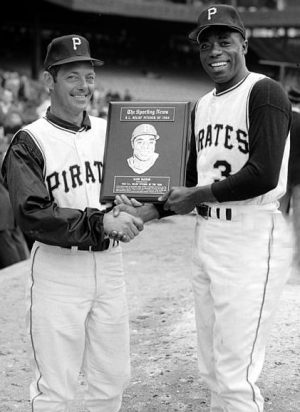
Stepping up when relief ace Elroy Face (left) struggled in 1964 earned Al McBean (right) the Sporting News Fireman of the Year (NL) Award he displays proudly with Face here.

Al McBean was both major league baseball’s first Virgin Islander by birth and a first class character. The righthander with the hard sinkerball who died at 85 at home Wednesday seems never to have met a situation he couldn’t clown his way through. Even opponents didn’t seem to mind.

He was “the funniest man I have ever seen in a baseball uniform,” Hall of Fame second baseman and manager Red Schoendienst once said of him.

Even the way McBean came into a game from the bullpen got laughs. “Whatever those walks mirrored,” wrote the Philadelphia Daily News‘s Sran Hochman in 1963, “concentration, determination, or intoxication, nobody walked into a game the way Alvin O’Neal McBean walks into a game.”

Writing McBean’s full name may have been drawn from longtime Pirates broadcast Bob Prince, who seemed to love referring to McBean that way. But about those walks in from the pen, McBean’s manager Danny Murtaugh said, “You’d have to say McBean saunters in.”

He never apologised for enjoying life and the game. “My thing was fun,” McBean told Society for American Baseball Research biographer Rory Costello in a 1999 interview.

I liked to do little crazy things, something different for the fans, they see the same thing over and over and over. Like crawling over the foul line and not touching it. Throwing the first pitch underhand, pulling on a big red bandana and wiping my face with it. Something the fan can feel a part of.

But the guy who went to a Pirates scout’s tryout in 1957 as a press photographer (he was goaded into trying out and ended up signing with the Pirates for a $100 bonus) also liked to learn as much about the game as he could. One of his teachers was Elroy Face, the Pirates’s star relief veteran.

“I used to go to his house, barbecue a lot, pal around with his family,” McBean told Costello. “And he would tell me intricacies of the game. You could get a guy on, walk a few guys once in a while, based on how you felt that particular day. Learn how to pitch in those situations.”

Though inconsistency dogged him much of his career, McBean actually got to step in for the main man when Face struggled in 1964. McBean had posted a brilliant 1963 (2.57 ERA, 2.81 fielding-independent pitching rate, over 122.1 relief innings pitched in 58 games), then went out and all but equaled it in ’64. (1.91 ERA, 2.97 FIP, 1.04 WHIP, 89.2 innings in 58 games.)

That earned him the Sporting News‘s 1964 National League Fireman of the Year award, placing McBean in some very distinguished company: the American League winner was Red Sox legend Dick (The Monster) Radatz. And Face himself won the NL award two years earlier.

Not that McBean’s prize win was simple. Four attempts to send McBean a commemorative trophy to his Virgin Islands home resulted in broken goods in shipment. When an unbroken trophy finally arrived, McBean “erupted in mock outrage,” Costello recorded—he’d wanted the head to have a fireman’s hat atop it.

That was the least of his problems. He went to Puerto Rico to play winter ball after the ’64 season and became the subject of rumoured death threats. Heavy bettors among fans were said to have suffered heavy losses in McBean’s games and were reported to be considering shooting the effervescent righthander.

McBean continued his stellar relief work in 1965 while Face missed much of the season with a knee injury. Then Face returned healthy for 1966 and McBean lost plenty of chances to nail down Pirate wins. He had three more decent seasons for the Pirates before they exposed him to the second National League expansion draft and the newborn Padres took him.

Oops. The Padres weren’t prepared for McBean’s freewheeling kind of fun. Costello records that he asked where to find the nearest spa—and worked out in a dance leotard. McBean ended up getting one start for those 1969 Padres . . . and traded almost promptly to the Dodgers for a pair of no-names. It was the only trade between those two teams for almost three decades.

But he got a return engagement with the Pirates when the Dodgers released him a year later and the Pirates picked him up. After looking nothing like the way he once was at age 32, McBean got what proved his final release. He played winter ball in Puerto Rico again in 1970-71 before the Phillies signed him and sent him to their Eugene, Oregon (AAA) affiliate with an apparent promise to bring him up if he did well.

He did well enough at Eugene, but the Phillies opted instead to bring up a far younger pitcher named Wayne Twitchell, about whom the most memorable thing (other than a nasty knee injury that compromised his career) was getting an All-Star appearance and a public compliment from Hall of Famer Steve Carlton before Carlton went completely silent to the press.

When the Phillies demoted him to AA-level ball for 1972, McBean retired and went home to the Virgin Islands permanently. He once claimed his sole regret was making the Pirates after one World Series championship and leaving them before another: “I have never seen myself pitch,” alluding to the broadcast highlights now ubiquitous on YouTube.

He joined St. Thomas’s department of housing, parks, and recreation, and co-founded the city’s Little League program, before becoming the housing, parks, and recreation department’s deputy commissioner. He never lost his zest for life or love for baseball even if he became critical of changes in the game in the years that followed his career.

He bemoaned guaranteed big contracts compromising players’ hunger for the game; he zinged the vaunted Braves starting rotation of the 1990s for their corner life (only Hall of Famer John Smoltz escaped his snark: “At least he comes after you”); he dismissed Hall of Famer Tony Gwynn as “a [fornicating] banjo hitter”; he swore Hall of Famer Frank Thomas would be putty in his sinkerballing hands. (“The Big Hurt, my ass. I would eat him up.”)

Well, nobody’s perfect. (Though it’s not unreasonable to think that maybe, just maybe, McBean might well have done well against the Big Hurt: Thomas’s lifetime slash line hitting ground balls that good sinkerballers normally get—.268/.268/.293/.561 OPS.)

The guy whose best man at his 1962 wedding to Olga Santos was Hall of Famer Roberto Clemente (McBean once posited that Clemente was a better all-around player than his fellow Hall of Famers Henry Aaron and Willie Mays) didn’t have to be perfect. He just had to be himself.

What I enjoyed most from baseball was the camaraderie that I had with the fans in Pittsburgh. The signing of autographs, then going to people’s homes for dinner. Mt. Lebanon was one of my areas, real nice–I used to wear the little black thing on my head, I didn’t know what it was for, but I wore it anyway! Up at St. Brigid’s Parish, I knew most of the nuns there, they’d come to Forbes Field, they’d come down to the bullpen and we’d talk. I’d go to church up in the Hill District. I would drink dago red. I had fun basically with everybody.

That was the man who is said to have had a run-in with segregated facilities during one spring training by drinking water from a fountain marked “white only” and crowing, “I just took a drink of that white water and it’s no damned different from ours!”

The man who pursued his future wife by showing up at the Puerto Rican drugstore where she worked while he played winter ball, buying soap from her daily until she agreed to go on a date with him. His love affair with Olga endured on earth far longer than his pitching career.

If you thought McBean left some side-splitting memories around baseball, you can only imagine what his Olga, his daughter Sarina, and his three grandsons have to hold until they meet again in the Elysian Fields.

Is the Orioles’ reign of error ending?

Is a new day really dawning at Camden Yards?

You thought the National League West ogres in Los Angeles had a long World Series title drought? The Orioles haven’t won a World Series since over a week following the premiere of the first Hooters restaurant. (In Florida.) And, since a decade before Peter Angelos bought the team out of bankruptcy court.

“Bankrupt” has been a polite way to describe the Angelos reign of error. Oriole fans celebrated, then cringed too often for comfort after Angelos bought the team from Eli Jacobs. Now they may have cause to celebrate something sweeter than the Orioles’ slightly unexpected return to competitiveness last year. May.

Once upon a time Angelos swore the Orioles would be pried from his literal cold, dead hands, as in upon his death. Now, his son John, who’s been running the Orioles since his father was diagnosed with dementia, plans to sell to two equity billionaires, David Rubenstein (the Carlyle Group) and Mike Arougheti (Ames Management Corp.). The price: $1.73 billion.

This, writes The Athletic’s Ken Rosenthal, whose career as a baseball writer began by covering the Orioles for the Baltimore Sun, could portend the turn toward a new direction.

The Rubenstein-Arougheti group won’t take complete control of the team right away. They’re beginning with a minority investment but intend to take complete control upon  Peter Angelos’s death, allowing the Angelos family a tax benefit by waiting to give the group full ownership. (Rosenthal observes they’d have faced a capital gains tax levy on the difference between the team’s 1993 and current valuations.)

Rubenstein is known to have Baltimore ties and to be a significan philanthropic presence in the region. His personal worth is said to be $3.8 billion, while Arougheti’s is said to be $1.8 billion. Rosenthal also cites a Baltimore Banner report saying Hall of Fame shortstop and Orioles icon Cal Ripken, Jr. is going to be part of the new ownership group. Could the future look any sunnier for Oriole fans?

Well, they once thought it was sunny days ahead when the elder Angelos bought the team, too.

Two years later, in the wake of (let’s call it as it really was) the owner-provoked and pushed players’ strike, Ripken made it safe to love baseball again when he passed Lou Gehrig for consecutive games played and marked the occasion with a hefty home run off Angels pitcher Shawn Boskie in the fourth inning.

The Orioles have been to a few postseasons and through a lot more losing in the Angelos era. The elder Angelos became too hands-on despite a lack of common baseball sense. Tom Verducci of Sports Illustrated once described his style as slash-and-burn management, as in burning eleven managers in eighteen seasons before the comparative stability of Buck Showalter (8.3 seasons) and incumbent Brandon Hyde (entering season six).

From 1998-2011 the Orioles endured what was once believed unfathomable for a franchise with a history proud enough: a fourteen-season losing streak. The elder Angelos also dithered on creating an international Orioles scouting operation and presence and let his already chaotic front office mistreat valued players.

Things once hit so far bottom that Verducci reported in 2001 that agents with Oriole clients found those clients telling other free agents, “You don’t want to come here.” That sentiment was inconceivable in the era between their first World Series title (1966) and their last.

Last year’s Orioles surprised the world by reaching the postseason at all. They saw enough of their young talent start coming of age, and they saw a farm system looking plenty good enough for the seasons to come. Right?

Oops. Along the way, John Angelos was stupid enough to suspend his lead television broadcaster Kevin Brown over information on a team-provided graphic comparing last year’s O’s against the Rays to previous seasons in which the Rays seemed to own them. Oriole fans can’t be blamed if enough of them think they can’t have nice things without something nasty along with them.

Barely had the news sunk in about the Rubenstein-Arougheti group agreeing to buy the Orioles when bing!the team swung a trade for former Cy Young Award-winning Brewers pitcher Corbin Burnes for a shortstop on the cusp of Show readiness but with a few warning signs, a pitcher who might project as a useful reliever, and the 34th pick in the 2024 draft.

Further warning signs, though: Burnes has lost some hop on his signature sinkerball, his strikeout-to-walk ratio has dipped, and big boppers had a finer time with him last year than two years earlier. (2021: seven homers allowed. Last year: 22 homers allowed.) But he’s still Corbin Burnes and he’s still formidable enough. For a season to come at least. They hope.

Thus far the apparently glandular adulation thrown the new ownership group seems to be precisely what NBC Sports-turned-independent Craig Calcaterra calls it: “he’s not John Angelos, therefore he’s perfect, and if you suggest otherwise, blogger boy, you’re a hater.”

But Oriole Nation has been there/done that in the past, a little too often. The Angelos Era may be over, but then Mets fans threw champagne parties over the end of the Wilpon Era and the advent of Steve Cohen, too.

Cohen has been through more than a few growing pains thus far. Met fans whose patience rivals that of the piranha at mealtime (they are legion) think one bad inning equals grounds for summary executions—in April. Oriole fans may be far more patient, but the Angelos reign of error wore that patience to the thickness of a sheet of paper.

The Rubenstein-Arougheti (-Ripken) Group has quite a job ahead, assuming the rest of baseball’s owners approve their advent and their purchase deal. It’s not simple being viewed en masse (and perhaps prematurely) as saviours. Once upon a time America thought (really) that even Richard Nixon had to be an improvement over Lyndon Johnson. How did that work out?

Oriole fans may (underline that) be wise to consider what investigative journalism giant Sidney Zion used to advise: Trust your mother, but cut the cards.

A trio grand for Cooperstown

Adrián Beltré, Todd Helton, Joe Mauer.

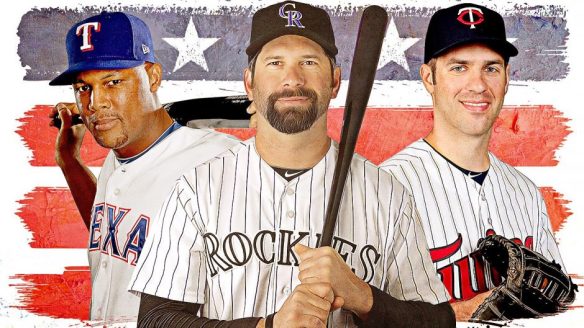
L to R: Newly-elected Hall of Famers Beltré, Helton, Mauer—They’ll join Contemporary Baseball Era Committee choice and longtime manager Jim Leyland on the Cooperstown stage come July.

The third baseman whose surname begins with “belt” and was way more than just a great belter. The first baseman who wasn’t just a Coors Canaveral product at the plate. The catcher forced to first base by concussion but who forged his case as the game’s number seven catcher all-time, defying his haters who still call him a thief.

Ladies and gentlemen, meet your newest Hall of Famers—Adrián Beltré, Todd Helton, and Joe Mauer. Beltré and Mauer deserved to be the first-ballot Hall of Famers they are now. Helton should have been, too, if only the voters his first time around on the Baseball Writers Association of America ballot had taken the dive that went deeper and deeper the longer Helton stayed on the ballot.

Beltré is probably in the most unique position of the trio. The number four third baseman of all (I’d rank him a touch higher for his combination of power hitting and off-the-charts defense) has something none of his peers can claim. Quick: name the only third baseman, ever, with 1) 3,000+ hits and 2) five or more Gold Gloves.

Hall of Famer Wade Boggs has two Gloves. Hall of Famer George Brett has one. Hall of Famer Paul Molitor (who probably got in more as a designated hitter than a third baseman) has none. Beltré, of course, has five. Now you can argue that a lot of Gold Glove award voting has been suspect over the years. You can’t argue with only two of the quartet being in the top twelve for run prevention at third base: Beltre (+168 total zone runs; 2nd) and Boggs (+95; 12th).

There’s only one other third baseman in the top twelve for run prevention who had anything like Beltré’s power in hand with it: Hall of Famer Mike Schmidt. Hall of Famer Eddie Mathews (512 home runs) was worth 40 defensive runs saved but that doesn’t get him quite to the levels of Beltré and Schmidt among the biggest bopping third basemen.

Here’s Beltré, among post-World War II/post-integration/night-ball era Hall of Fame third basemen, according to my Real Batting Average metric (RBA): total bases + walks + intentional walks + sacrifice flies + hit by pitches, divided by total plate appearances:

HOF 3B PA TB BB IBB SF HBP RBA
Mike Schmidt 10062 4404 1507 201 108 79 .626
Chipper Jones 10614 4755 1512 177 97 18 .618
Eddie Mathews 10100 4349 1444 142 58 26 .596
Scott Rolen 8518 3628 899 57 93 127 .564
George Brett 11625 5044 1096 229 120 33 .561
Ron Santo 9397 3779 1108 94 94 38 .544
Wade Boggs 10740 4064 1412 180 96 23 .538
Adrián Beltré 12130 5309 848 112 103 97 .533
Paul Molitor 12167 4854 1094 100 109 47 .510
Brooks Robinson 11782 4270 860 120 114 53 .458
HOF AVG .555

You see he was hurt most at the plate by taking a lot less unintentional walks than everyone else on the list. But he’s the number two most run-preventive third baseman ever behind Brooks Robinson. His combination of power and defense should nudge him up to the number three all-around third baseman who ever played. WARriors, take note: Beltré’s 93.5 is bested among Hall third basemen by two, in ascending order: Mathews (96.0) and Schmidt (106.8).

Among his group of Hall of Famers, Beltré was also the most fun Fun Guy of the game. Even if his career was an ascending trajectory to genuine greatness (people still wonder how the Dodgers could have let him take a hike into free agency), there was always a sense about him that he really did play more for the fun of it than the riches of it.

I’ve asked elsewhere: how often do you get to send one of the real Fun Guys to Cooperstown? Too many playing or managing greats were about as fun as open-heart surgery. Too many of the game’s Fun Guys weren’t all that much fun when they were actually on the field or at the plate. (Dick Stuart, for example, was one of the funnest of his time’s Fun Guys—but he earned his nickname Dr. Strangeglove at first base. He only got to play major league baseball because he could hit baseballs across city limits.)

Ernie Banks, Yogi Berra, Bert Blyleven, Roy Campanella, Dizzy Dean, Whitey Ford, Lefty Gomez, Rickey Henderson, Minnie Miñoso, David Ortíz, Satchel Paige, Babe Ruth, and Warren Spahn were bona-fide Hall of Famers and Fun Guys in the bargain as players. (And several of them had to do it through unconscionable bigotry.) Casey Stengel was both as a manager. Beltré will grace their company.

I did notice someone aboard social media ask aloud if someone could arrange for his old Texas teammate Elvis Andrus to come rub his head at his induction. Not a half bad idea. Barring that, maybe the Hall could arrange for Beltré head-touching bobbleheads to pass out come induction day? Barring that, maybe the Hall staff would let him drag the on-deck circle mat lonce more?

Helton may have finished what Hall of Famer Larry Walker started and fractured the idea that a career spent half or more with Coors Field as your home ballpark will kill or at least cast abundant doubt on your Hall credentials. Helton lacked what Walker had, enough time in another uniform to show that he was Hall of Fame good without the Coors factor. But Helton has this distinction: the first Rockie-for-life to go to Cooperstown.

Now, look deeper, once again, please. The Toddfather posted an .855 OPS on the road to his 1.048 at home. An .855 OPS across the board might mean a spot in the Hall of Fame for a lot of players. Helton’s road OPS is higher than the across-the-board OPSes of (in ascending order) live ball-era Hall of Famers Eddie Murray, Gil Hodges (who played most of his career in a bandbox home park), Orlando Cepeda, Ben Taylor (Negro Leagues), Sunny Jim Bottomley, Harmon Killebrew; and, one point below Fred McGriff. His across-the-board .953 is better than all but nine Hall of Fame first basemen.

Let me apply my RBA to Helton among post-World War II/post-integration/night-ball era Hall of Fame first basemen:

First Base PA TB BB IBB SF HBP RBA
Jim Thome 10313 4667 1747 173 74 69 .653
Jeff Bagwell 9431 4213 1401 155 102 128 .636
Todd Helton 9453 4292 1335 185 93 57 .631
Willie McCovey 9692 4219 1345 260 70 69 .615
Harmon Killebrew 9833 4143 1559 160 77 48 .609
Fred McGriff 10174 4458 1305 171 71 39 .594
Gil Hodges 8104 3422 943 109 82 25 .565
Orlando Cepeda 8698 3959 588 154 74 102 .561
Eddie Murray 12817 5397 1333 222 128 18 .554
Tony Pérez 10861 4532 925 150 106 43 .526
HOF AVG .594

Helton has the number three RBA among those Hall of Fame first basemen, he’s 37 points above the average RBA for those Hall first basemen, and it wasn’t all or purely a product of Coors Field. He also had a 144 OPS+ over his ten-year peak of 1997-2007. OPS+, of course, adjusts for ballpark factors. That peak OPS+ alone should disabuse you once and for all about whether the Toddfather was pure Coors.

By the way, for those of you obsessed with swinging strikeouts at the plate and the metastasis thereof, be reminded that Helton lifetime walked more than he struck out, especially as the leverage situation rose. He averaged eleven more walks (96) than strikeouts (85) per 162 games, and he walked 160 times more than he struck out. Would you like to know how many of the other aforelisted Hall of Fame first basemen walked more than they fanned? Z-e-r-o.

Mauer joins a unique Cooperstown group—one of the three field positions (catcher) that have resulted in only three first-ballot Hall of Famers. (It’s still impossible to believe that Yogi Berra wasn’t a first-ballot Hall of Famer.) Thus does Mauer join Johnny Bench and Ivan Rodríguez in the Cooperstown Trinity of the Tools of Ignorance. (The other two positions with only three first-time Hall of Famers: first base and second base.)

He also has a .569 RBA that puts him third among post-World War II/post-integration/night-ball Hall catchers. (Only Mike Piazza and Roy Campanella—who played in the same bandbox as Hodges when he made the Show in 1948—are ahead of him.) He wasn’t all bat as a backstop despite his gaudy batting averages, either; the pitchers who threw to Mauer posted an ERA almost a full run below his league average, he was worth +65 total zone runs behind the dish, and he threw out a respectable 33 percent of runners who tried to steal on him lifetime. (He led the American League twice: 53 percent in 2007; 43 percent in 2013.)

WARriors should remind themselves, too, that in the ten seasons Mauer played as the Twins’ regular catcher, he out-WARred the three other catchers active during all ten of those seasons by a wide margin: his 44.6 bested Victor Martinez (28.1), Yadier Molina (27.6), and Jorge Posada (20.0).

Well, now. A year ago, after Scott Rolen’s election to the Hall of Fame provoked the usual chatter about who’d be elected this year, Twins fans tried to smother social media with assaults and batteries of Mauer for “stealing” the money in that yummy contract extension he signed before his first concussion compelled the Twins to get him the hell out from behind the plate.

He suffered his second well into the extension, chasing a foul ball from first base. Those brain-dead fans either forgot, never knew, or didn’t care that injuries incurred in the line of duty don’t equal goldbricking or defrauding. I swore then that I wouldn’t say another word about their idiocies, but I can’t resist today.

Who has the last laugh now?

Bud Harrelson, RIP: Don’t back down

Bud Harrelson

Perhaps unfairly, Bud Harrelson is remembered less for solid shortstop play than for getting plowed into an NLCS brawl by Pete Rose.

God rest her soul, my paternal grandmother (herself a victim of Alzheimer’s) called her favourite Met “my little cream puff.” The reference was to Bud Harrelson’s not-so-tall or large dimensions, surely. Hall of Famer Yogi Berra, a longtime Mets coach and their manager for three and two-third seasons, merely called him Shorty.

The only Met in uniform for both their World Series triumphs (as their starting shortstop in 1969, as their third base coach in 1986) was anything but a cream puff on the field. “Buddy was 150 pounds soaking wet,” his Hall of Fame teammate and best friend Tom Seaver remembered three decades later, “but he wouldn’t back down from anyone.”

Not even from Pete Rose, who plowed him moments after Harrelson threw on to first to finish a 3-6-3 double play in Game Three of the 1973 National League Championship Series. Not even from umpire Augie Donatelli in the World Series to follow, Donatelli calling him out at home despite Oakland catcher Ray Fosse seeming to miss the tag and provoking a wild Met argument around the plate.

And not even from Alzheimer’s disease, with which Harrelson was diagnosed in 2016 and against which he fought a bold fight until his death at 79 Thursday morning. Some of the obituaries that followed lasted several paragraphs before mentioning the Rose play and the infamous bench-and-bullpen-clearing brawl that erupted. Some of them lasted only several syllables. It almost figured.

Rose entered Game Three of the set between the Mets and the Reds steaming over Harrelson’s post-mortem following Mets righthander Jon Matlack’s Game Two two-hit shutout. It wasn’t braggadoccio by any means. The .236-lifetime-hitting Harrelson’s grit was matched by his wit. He observed Matlack had “made the Reds look like me out there” at the plate, adding only that he thought, “It looked like they were swinging from their heels.”

That doesn’t seem normally to be an observation that would steam a team, not even a Big Red Machine. Indeed, as New York Post columnist Mike Vaccaro observes, most of the Reds weren’t interested when Rose tried to use Harrelson’s benign remarks as the equivalent of what we call today bulletin-board fodder.

The most “printable” of Rose’s post-mortem replies, in Vaccaro’s word, was, “What’s Harrelson, a [fornicating] batting coach?” Hall of Famer Joe Morgan even warned Harrelson during pre-Game Three practises that one more such remark would get him punched out, and Rose was going to get him at second if given the opportunity. Some of the Big Red Machine weren’t exactly renowned for a sense of humour about themselves.

So, come the Game Three top of the fifth, Morgan tapped one toward Mets first baseman John Milner, who threw to Harrelson to get Rose (a one-out single up the middle) by ten plus feet for one before Harrelson winged it back to Milner to get Morgan for the two. The next thing anyone knew, Rose had plowed and thrown an elbow at Harrelson and the pair were up and swinging.

“When he hit me after I had already thrown the ball I got mad,” Harrelson once remembered. “And we had a little match. He just kinda lifted me up and laid me down to sleep and it was all over.” It wasn’t all over that quickly, alas. To say all hell broke loose in Shea Stadium after Mets third baseman Wayne Garrett hustled over to try protecting Harrelson would be to call a prison riot a debate.

The less-than-willing Reds had little choice but to back their impetuous star. After order was restored at last, Rose took his position in left field and that portion of the Shea crowd let him have a shower of debris that included a glass bottle near his head. It got so out of hand that the Reds’ Hall of Fame manager Sparky Anderson pulled his team off the field. (“Pete Rose has done too much for baseball to die in left field,” the ever locquacious Anderson said postgame.)

A forfeit to the Reds was threatened. Under National League president Chub Feeney’s urging, Berra led Seaver plus Hall of Famer Willie Mays and outfielders Rusty Staub and Cleon Jones to plead for peace in the stands. Order was restored and the Mets finished what they started, a 9-2 Game Three win and a five-game triumph over the Reds for the pennant.

Rose didn’t hold a grudge for very long. Handed the Good Guy Award by the New York contingency of the Baseball Writers Association of America the following January—the long since disgraced and banished Rose was one of the game’s great notebook fillers during his playing days—Rose accepted it . . . from Harrelson himself.

“I want the world to know,” Harrelson cracked as he presented Rose the award, “that I hit him with my best punch. I hit him right in the fist with my eye.” In due course, Rose returned the favour, signing a photograph of the fight, “Thank you, Buddy, for making me famous.”

In some ways, Harrelson was responsible for the Mets making it to that postseason in the first place. He missed significant regular season time with an injury and the Mets slumped almost coincidentally. But when he returned to action the Mets—with or without a little firing up from relief pitcher Tug McGraw’s “You gotta believe!” holler, aimed sarcastically at first (at a pep talk by general manager M. Donald Grant)—ground their way from the basement to the National League East title that September.

“You had Seaver, who was the greatest pitcher I ever saw,” Rose told Vaccaro in 2008,  “and you had great hitters like Cleon Jones and Tommie Agee, and later Rusty [Staub] and Milner. But the heart and soul of that team—ask anyone who played against them—was Bud Harrelson.”

Harrelson’s weak bat was offset by his sure-handed play at shortstop; he averaged turning  57 double plays a season in his twelve prime seasons from 1967-1978, even missing significant time to injuries. He also retired being worth +34 defensive runs above his league average, retroactively leading the National League’s shortstops with a +17 1971.

He roomed with Seaver for the entire time they were Mets together, having first met in AAA-level ball in the Met system. “We were perfect roommates,” Harrelson remembered in his memoir, Turning Two. “Tom did all the reading and I did all the talking.”

After finishing his playing career with two seasons in Philadelphia (where Rose was a teammate) and one in Arlington, Harrelson returned to the Mets and soon became their third base coach. That was Harrelson giving Ray Knight a pat and running down the third base line with him as Knight scored, after Mookie Wilson’s grounder skipped through hapless Bill Buckner’s feet, to finish the Game Six comeback win that sent the Mets toward their 1986 World Series conquest.

Later, when Davey Johnson was finally cashiered as the Mets’ manager 42 games into the 1990 season, Harrelson took the bridge and helmed the Mets to a 71-49 record the rest of the way, good for a second-place NL East finish. The following season, enough of the 1980s Mets’ contending core players were gone and suspicions arose that Harrelson was just the dugout figurehead while bench coach Doc Edwards called the shots.

The Mets went 74-80 under Harrelson, toward a fifth-place NL East finish, before he executed before the season’s final week. There were those who thought Harrelson’s problem was trying to manage like a pal more than a leader. Harrelson himself said, candidly enough, “If the public wanted a manager with vast experience, I wasn’t it . . . If they wanted somebody who would grow with the organization, I think that was me.”

1969 Mets

Harrelson (far left) traveled with a few 1969 Mets teammates plus After the Miracle co-author Erik Sherman (center rear) for a final visit in California with Hall of Fame teammate Tom Seaver (front right). Joining them: pitcher Jerry Koosman (second from left), outfielder/After the Miracle author Art Shamsky (second from right, rear), and outfielder Ron Swoboda (far right rear). Seaver was stricken with Lewy Body dementia; Harrelson, with Alzheimer’s. (Photo posted to Xtwitter by Erik Sherman.)

In due course, Harrelson helped bring minor league baseball to Long Island as the co-owner, senior vice president, and first base coach of the Long Island Ducks. He even managed the Atlantic Leaguers to a first place tie in their maiden season. Then, come 2016, after a few incidents first attributed to aging’s mere memory lapses, Harrelson and his former wife, Kim Battaglia, got the fateful diagnosis.

Battaglia remained his close friend and primary caretaker. Harrelson was part of the contingent of 1969 Mets—organised by outfielder Art Shamsky, also including pitcher Jerry Koosman and outfielder Ron Swoboda—who trekked to California for a final visit with Lewy Body dementia-stricken Seaver at his vineyard a year later. The journey was recorded by Shamsky with Erik Sherman (who accompanied the group) in After the Miracle. (Seaver, alas, died in 2020.)

The former Mrs. Harrelson urged Shamsky to have voluminous photographs taken to help Harrelson remember the trip. Harrelson himself admitted to Sherman that he’d begun writing numerous notes to himself to help him fight the Alzheimer’s memory robbery. He also described co-owning and promoting the Ducks as “the best thing I’ve ever done in baseball,” indicating his displeasure that the now-former Wilpon ownership was not always kind to himself and too many other former Met stars.

Harrelson and his former wife even joined and became active with the Alzheimer’s Foundation after making his diagnosis public in 2018. “I want people to know you can live with this and that a lot of people have it,” he said. “It could be worse.”

When traveling with Koosman, Shamsky, Sherman, and Swoboda for that final Seaver visit, Harrelson had nothing but praise for his former wife (“She’s the best ex-wife I ever had”) who urged him on. “She’ll call me and go, ‘You know you have to go to the doctor. Our son T.J. can bring you’,” said the twice-divorced father of five. “Married, we just didn’t gel after awhile. But I still love her and give her hugs. Kim doesn’t have to do what she does, but I appreciate it.”

Perhaps not quite as deeply as she and his children appreciated Harrelson’s grace under fire as he fought the insidious disease that finally claimed him. The scrapper who didn’t let Pete Rose intimidate him became the elder who didn’t let a medical murderer intimidate him.

Now Harrelson can be serene and happy in the Elysian Fields with his old roomie pal Seaver, his old skippers Berra and Gil Hodges, and too many other 1969 and 1973 Mets who preceded him there. Maybe Grandma Gertie will elbow her way out there to shake his hand, and maybe Harrelson can give her a wink and a “Your little cream puff, huh?”