Fritz Peterson, RIP: The changeups

Fritz Peterson

Peterson on the mound in the original Yankee Stadium; his 2.52 ERA pitching there was the lowest by any Yankee pitcher at home in the original Stadium, including Hall of Famer Whitey Ford.

When the late Jim Bouton battled cerebral amyloid angiopathy, I wrote of Bouton’s battle and received a surprise: a note from Bouton’s Yankee teammate and fellow pitcher Fritz Peterson. The note read, simply, “If anyone can beat this, Jim can.” Bouton couldn’t in the long run, of course. And neither could Peterson beat Alzheimer’s disease in the long run.

Peterson got his diagnosis in September 2017. He died Friday at 82. Seven months after his diagnosis, the righthander who owns the lowest earned run average of any man who pitched in the original Yankee Stadium (2.52) told New York Post writer Kevin Kernan his condition “was a wacky disease.”

“It’s been happening like that for me all year,” he told Kernan. “So it’s confusing . . . It’s something so different. I don’t want to look into what comes next because I just want to enjoy every day.” Easier said than done, alas.

“I can’t go places,” Peterson continued then. “Unless something comes medically that can give me my mobility back . . . I can’t drive, so I’m depending on my wonderful wife. Whenever I get up I have to ask my wife, ‘What do we have today?’ As far as which doctors appointment. And when we do go somewhere. I have trouble walking, so I use a cane now. I feel like the old man from Scrooge.”

Fabled among fans for a sponge-like baseball memory, Peterson told Kernan his diagnosis would now keep him from attending Yankee Old-Timer’s Days, as he’d first planned to do during 2018. You can only guess the heartbreak that cause a man who loved engaging with fans on Facebook.

Peterson was a good lefthanded pitcher who grew up in the Chicago area (his favourite ballplayer was White Sox pitcher Billy Pierce) and arrived when the 1960s Yankees hit below bottom. His righthanded rotation mate Mel Stottlemyre arrived in time to help pitch those Yankees to their final pennant before the Lost Decade to come. The franchise’s first last place finish since 1912 happened in Peterson’s rookie 1966.

His roommate Bouton and Hall of Famer Whitey Ford were fading due to arm and shoulder issues. The remaining Yankee legends (Mickey Mantle, Roger Maris, Elston Howard) were reduced by age and injuries to box office appeal alone, what remained of it. Their few other good 1960s prospects proved journeyman major leaguers at best.

Peterson and Stottlemyre had a mutual admiration society, though Peterson was quick to name their pecking order.  “I always came in number two,” he cracked to Kernan. “Like Hertz and Avis, it was Stottlemyre and me.” That from a pitcher who led the American League in walks/hits per innings pitched back-to-back (1969-1970) and with the lowest walks per nine innings rate in five straight seasons (1968-72).

Prankish and fun-loving, Peterson found himself relieved of Bouton as a roommate before Bouton was plucked for the Seattle Pilots in the expansion draft for 1969. “They thought I was a bad influence on Fritz,” Bouton would write in Ball Four. “The Yankees had some funny ideas about bad influence . . . As for teaching Peterson the wrong things, the only thing I ever taught him was how to throw that changeup he uses so effectively. And he still enjoys giving me the credit.”

Peterson himself remembered best his 1 July 1966 game against the White Sox, when he took a perfect game to the eighthwith one out—and lost it when his own throwing error enabled the first White Sox baserunner before veteran White Sox catcher John Romano sent a base hit back up the middle. Peterson surrendered a run-scoring double and a sacrifice fly to follow, then made the inning-ending putout and pitched a scoreless ninth tio finish the 5-2 Yankee win.

“No immortality for me,” he’d remember in 2015.

That plus the changeup Bouton taught him were nothing compared to the changeup that came into Peterson’s wheelhouse in 1972.

Mike Kekich, Fritz Peterson

Left to right: Marilyn Peterson, Mike Kekich, Susanne Kekich, Fritz Peterson. Photographed here aboard a schooner on a summer 1972 outing, the two pitchers had already exchanged spouses, well before making it public the following spring. Fritz and Susanne eventually married and stayed that way; Mike and Marilyn proved a short-lived match, after all.

Exit Bouton, enter Mike Kekich, a lefthanded pitcher whom the Yankees acquired from the Dodgers in a December 1968 trade. Like Peterson, Kekich was fun-loving and a bit on the adventurous and flaky side. (Peterson pre-Alzheimer’s loved to remember watching Kekich dive in Florida waters chasing a giant manta ray.) They’d become linked forever publicly in a far more jaw-dropping way in spring 1973.

The two pitchers and their wives went to a July 1972 barbeque at sportswriter Maury Allen’s home and first made their plans for what Kekich called a “life swap” but both Peterson and his old pal Bouton called “a husband swap.”

According to Allen and others, Peterson had once found himself sharing transportation with Susanne Kekich, and the latter’s husband had found himself likewise with Marilyn Peterson. The partners-to-be each found common grounds they’d come to lack in their incumbent marriages. All stayed among them alone until, as Allen recalled it in his 2000 book, All Roads Lead to October, Peterson came to him in January 1973 to say he had a story for him:

Peterson unloaded the facts of the story he wanted me to write. On that evening back in July at our home, he and Kekich had made the original plans for exchanging wives. Also kids, houses, furniture, dogs, and cats. The new families had been in operation for several months, everything was still going well, and he wanted to share his wonderful news with the world. He had chosen me as the conduit.

“Are you crazy?” I asked.

“No, we’d been thinking about this for many months,” he said. “We wanted you to write it because you won’t make it sound dirty.”

Allen resisted at first because, he wrote, he thought the entire deal should have remained private. Perhaps it should have. Indeed, Allen told Peterson to hand the story to United Press sportswriter Milton Richman, instead. Peterson did. Richman wrote it straight, no chaser, no salaciousness, and it still exploded into a scandal that only began with New York Daily News columnist Dick Young tearing them apart.

“At least,” the ever-sensitive Young wrote, “they did it before the inter-family trading deadline.”

The timing for going public couldn’t have been more ticklish in hindsight: George Steinbrenner finalised his purchase of the Yankees from CBS in the same month Peterson and Kekich elected to go public with their life swap, and he’d announced Mike Burke (the CBS executive assigned to run the team for the network) would stay as the team’s president. (Temporarily, as things turned out.)

Allen ultimately wrote a long article for The Ladies Home Journal about the Peterson-Kekich swap, with full cooperation and participation of both husbands and wives. For him, perhaps the most telling comment about the entire matter came from the erstwhile Mrs. Kekich, who married Peterson and stayed that way until death did they part, and who told Allen her marriage to Kekich crumbled long before the two couples began swapping lives.

I never could seem to live up to Mike’s standards. No matter what I did, he wanted me to do it a little better. I always felt unsure about him, uncertain about myself, a little insecure. Fritz accepted me as I was.

Kekich himself told Allen he thought he was matched better with Marilyn Peterson until “things developed and we began to butt heads.” Possibly the most reluctant partner in the swap (and possibly the most stressed by it), Mrs. Peterson parted from Kekich soon enough, she to marry a doctor happily, according to Allen.

Peterson married the former Mrs. Kekich in 1974 and remained a father to his sons as well as a stepfather to his new wife’s daughters; the couple had a daughter together. Kekich, too, remained a father to his children while remarrying in due course. After several non-baseball ventures that failed, including in medicine and paramedicine, he moved to New Mexico before the turn of this century.

Kekich has been reported as comfortable out of the public eye as Peterson was in it when the occasions arrived, particularly at Yankee-related events and aboard social media, before his Alzheimer’s diagnosis.

The uproar may or may not have taken a toll on both men. Peterson pitched well below his top form in 1973, but he also came down with shoulder trouble. (Pre-1973: 3.10 fielding-independent pitching; 1974 through his retirement: 4.00.) Kekich had respected stuff but was prone to wildness before 1973; he finished his nine-season career with a 4.16 FIP and a 4.59 ERA.

Both pitchers would be traded away soon enough. Kekich was traded to the Indians during the 1973 season; Peterson was also traded there the following season, after Kekich had moved on from the team. His baseball career ended in 1976; Kekich’s, a year later. (A road accident caused Kekich his own shoulder issues.)

Bouton would remember Yankee manager Ralph Houk’s handling of the swap when compiling and editing “I Managed Good But, Boy, Did They Play Bad”, his anthology of writings about baseball managers.

As this book was going to press, Ralph Houk said one of the finest things I’ve ever heard him say . . . “The players’ lives are their own. We all have problems. You only go through this world once and everyone has a right to go through it happy.” This may indicate that Houk the manager is changing with the times, or it may be manager Houk’s way of minimizing the effect on his team while he waits to trade one of them. But it may also be a truer insight into Ralph Houk the person.
Fritz Peterson

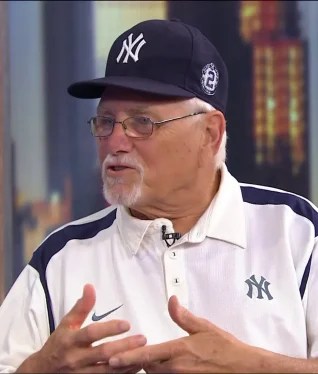
Peterson in 2015, during an interview on New York’s WPIX-TV, two years before his Alzheimer’s diagnosis.

The Peterson-Kekich scandal proved mild sauce compared to sports scandals past and future, of course. Peterson’s trade to Cleveland proved more beneficial to the Yankees: it brought them two mainstays of their pending championship revival, first baseman Chris Chambliss and relief pitcher Dick Tidrow.

He’d work in the insurance business, as a blackjack dealer, an eschatological monograph author, and even a play-by-play announcer in minor league hockey. He wrote three books including When the Yankees Were On the Fritz: Revisiting the Horace Clarke Era. He survived bankruptcy. Eventually, Peterson and his family moved to Iowa. (“We’re still on the honeymoon and it has been a real blessing,” he said of his once-controversial remarriage, in 2013.)

“I’m hanging on for my family—that’s the most important thing,” Peterson told the Post in 2018. “If it weren’t for that I wouldn’t care. Heaven is not a bad place to be. I think we are all saved and that we all are going to end up in heaven.” May heaven prove a far less judgmental place for him than earth did once upon a time.

Shoh, it wasn’t so

Shohei Ohtani

Ohtani conks one long distance against the Giants earlier this month. His former interpreter has all but taken him off the gambling hook—and is about to plead in a federal case.

Well, now. Shohei Ohtani’s former interpreter is ready to sing. And it won’t be “An Innocent Man,” either. Ippei Mizuhara is ready to serenade the Feds with a guilty plea over stealing millions from the Dodgers star to bet on sports with an illegal bookmaker.

The New York Times said Wednesday night Mizuhara’s ready to plead guilty. The Times and several other media outlets also say the Feds have found evidence that Mizuhara tried to cover his trail by changing Ohtani’s bank account settings to deny Ohtani alerts and notifications whenever his money moved one or another way.

The Athletic reports that Mizuhara swiped more than the originally speculated $4.5. million—about $16 million plus, adding that he’s facing charges of bank fraud emanating from the Fed investigation. For which the maximum sentence is thirty years in the calaboose, though a plea deal may give him less time.

In other words, faced with riot-running speculation that he was betting on sports illegally through a California bookie, Ohtani told the plain truth when he said it wasn’t Shoh last month. That was the simple part. The hard part was acknowledging and saying his longtime friend and interpreter Mizuhara robbed him blind.

This would be the perfect moment for all appropriate social and mainstream media apologies alike for jumping Ohtani out of the gate, demanding his purge, demanding the unraveling of the obvious coverup on behalf of protecting baseball’s arguable biggest star at the moment. It would also be the perfect moment for apologies out of any and every one who said—without a shred of logic, sense, or thought—that the Ohtani case should have been Pete Rose’s get-out-of-baseball-jail-free card.

It’s not the perfect moment, yet? OK, I can wait. But not for very long. Rush to judgment? How about a warp speed to judgment. All there had to be was even one published hint that someone in Ohtani’s circle was betting on sports illegally and crowds of social media troglodytes, plus enough of a pack of mainstream reporters who are supposed to know better, couldn’t decide on the design of the noose or gallows from which Ohtani should hang.

The first such hints, which weren’t exactly hints, emerged while the Dodgers were in South Korea to play the Padres in their regular season-opening series. That’s when Ohtani first learned there was a gambling probe and that his own longtime friend and interpreter was involved.

Days later came Ohtani’s March presser. The one in which he denied flatly that he bet on baseball or any other sport in any way, shape, or form. The one in which he admitted he was now very suspicious that Mizuhara wasn’t exactly straightforward in his original statements about his ties to southern California bookie Matthew Bowyer.

“According to the [federal] complaint,” The Athletic‘s Andy McCullough writes, “Mizuhara manipulated Ohtani’s bank accounts beginning in 2021, around the time Mizuhara began wagering on sports. Mizuhara controlled an account that collected Ohtani’s baseball salary. He shielded access to the account from others in Ohtani’s orbit saying the player wanted the account to be private.

“Mizuhara also impersonated Ohtani in conversations with bank officials, the complaint read.”

Not brilliant, especially since whenever you call a bank on any matter involving an account, the bank usually records such conversations. That’s whether you want to double-check a deposit, a withdrawal, a credit card matter, your checking account, your savings account, your car or home loan, anything.

Just how Mizuhara thought he could get away with portraying Ohtani to the bank long term hasn’t been determined. Yet. If I were him, I wouldn’t think about seeking work as a professional impressionist any time soon.

Unlike Rose’s longtime lies and his sycophancy’s continuing yeah, buts, Ohtani didn’t flinch at that March presser, even if he looked and sounded as though he’d been shot in the back. He could have delivered a mealymouth self-defense, he could have thrown this or that one under the proverbial bus. But he didn’t. He didn’t take questions at the presser, but he didn’t waver from his statement or his position.

The U.S. Attorney in California’s Central District, the IRS, and the Department of Homeland Security are investigating Mizuhara and Bowyer. There was no case against Ohtani. There still isn’t. Even though everything known until now pointed far more directly to Mizuhara than to Ohtani, it didn’t stop take after take from those willing to drink of the full he-must-be-guilty-somehow nectars.

Except that Ohtani himself wasn’t named in the legal probes into Mizuhara and Bowyer. Even Bowyer through his own attorneys said Ohtani never did business with him in one or another way but that Mizuhara did plenty. And we’re probably not done learning just how deeply Mizuhara inserted his siphon into Ohtani’s lucre.

“Ohtani on March 25 said he learned of the issue on March 20–the day the reports from the Los Angeles Times and ESPN would break–after the Dodgers’ first game in South Korea, when the team held a meeting in the clubhouse,” say CNN reporters Joe Sutton and Jason Hanna.

Ohtani said the team meeting was in English and he didn’t have a ‘translator on my side’ but he got a sense that something was wrong.

He said he met one-on-one after with Mizuhara at the club’s hotel. Ohtani said up until then he didn’t know Mizuhara had a gambling problem and was in debt.

“When we talked . . . that was when I found out he had a massive debt,” Ohtani said March 25. “Ippei admitted that he was sending money from my account to the bookmaker.”

The translator had told the media and Ohtani’s representatives the player had paid off gambling debts on behalf of a friend, according to the superstar. Ohtani said he was not aware of the media inquiries.

Mizuhara was fired after the Dodgers beat the Padres in that 20 March game, of course. Another spokesman for Ohtani said the two-way star was indeed the victim of theft. Those running rampant saying there was no way that could have happened betrayed ignorance, willful and otherwise, of how often athletes, entertainers, and others of vast wealth get  fleeced by those close to them, electronically or otherwise.

Just how and why Mizhuhara got in so deep with Bowyer (who’s been reported out of the bookmaking business since last October) despite his not-so-high salary and overall monetary value remains to be seen.

Presumably, too, MLB’s investigation into this mess will wrap up soon enough. It would have to, now that we can determine beyond reasonable doubt that Ohtani was telling the truth when he said he doesn’t bet on any sports, and that Mizuhara told anything but the truth when he first tried claiming he was betting on Ohtani’s behalf. U.S. Attorney Martin Estrada is quoted as saying Mizhuara’s sports betting didn’t involve baseball, anyway.

More important would be MLB’s other teams broadening their vetting processes regarding interpreters for foreign-born players who speak little to no English or who speak the language competently enough to get by at the market or meeting fans but not comfortably enough to speak it during formal press interviews. The next Mizuhara may already be lined up among them.

That’d be the second best outcome of this mess. (The best, of course, is Ohtani’s demonstrable innocence in the matter.) That’d be more important than any social media apologies for trying to find Ohtani’s needle in a mud haystack.

Strasburg: Retirement official, and should be a hard lesson

Stephen Strasburg

Let’s hope Stephen Strasburg’s often brilliant, often injured, postseason-deadly career helps start solving pitching injuries the right way.

Allow me to begin by reaching for a magazine article. It’s one I wish would be read by those on social media or elsewhere where baseball is discussed and debated, particularly those who continue to kvetch about today’s pitchers being “babied” or “unable and unwilling to go the distance,” the way the real men did in the Good Old Days.

“[I]t’s a sad truth,” the writer began, “that, in recent years, and with increasing (and alarming) frequency, big winners have stopped winning with the abruptness of a stalled motor.”

. . . The principal reason why baseball has a sore pitching arm is that pitchers work harder today than ever before. Years ago, the baseball was a muffin, and pitchers paced themselves without fear of the big home run. Only when a runner reached second did the pitcher have to throw his best. And when he threw his best he was throwing at a larger strike zone.

Today the accent in baseball is on the score, big and quick. The ball is built for distance. Bats have the streamlined look . . . Fences are, if anything, closer. Anybody can hit a home run. No lead is safe, for five-run innings appear in box scores almost every day. So today’s pitcher must bear down all the time.

“Get out there and throw as hard as you can as long as you can,” the manager tells his starter. “If you get tired, we’ll bring in Pete from the bullpen.”

This approach to the game is murder on good pitchers, for if they last the full game, as they so often do, their arms undergo a severe strain.

“The pitching motion is a peculiar muscular activity,” said a team doctor to the writer. “It places an abnormal strain on the arm. Every time a man pitches hard, tendon fibers in his shoulder tear apart. It takes about three days for them to repair. That’s why pitchers can only work every fourth day, as a rule. When a pitcher throws too hard, or if he throws awkwardly—for instance, if he slips on the mound—the tear is apt to be bigger, causing a sore arm.”

“. . . [P]itchers are wearing out faster than ever, at a time when more pitchers than ever are being used, the search for new talent never ends,” the writer went on to say. “There are some baseball men who think that eventually pitchers will work only three innings at a time . . . In that same vein, others feel sure that the use of the relief man will be explored to such an extent that 20-game winners . . .will become extinct.”

The writer’s name was Walter Bingham. The magazine was Sports Illustrated, with the Yankees’ 1958 World Series MVP (and baseball’s third one-across-the-board Cy Young Award winner) Bob Turley on the cover. The issue was 4 May 1959. The team doctor Bingham quoted was Turley’s on the Yankees, Dr. Sidney Gaynor. 

This weekend past, the Major League Baseball Players Association and MLB swapped barbs over the current crowd of pitcher injuries. The timing couldn’t have been more grave: Stephen Strasburg, brought down by thoracic outlet syndrome, finally formalised his long-enough-known retirement after ten full seasons and shards of three to come.

The MLBPA accused MLB of shoving and shortening the pitch clock to the detriment of pitchers’ health. MLB counter-accused the MLBPA of “ignor[ing] the empirical evidence and much more significant long-term trend, over multiple decades, of velocity and spin increases that are highly correlated with arm injuries.” MLBPA chief Tony Clark put his name on their statement. No name appeared on MLB’s.

Strasburg’s TOS may have been a direct result of his longtime inverted-W arm-and-elbow positioning, both elbows above the shoulders as he cocked to throw, position which strains elbows and shoulders at once. I noted when discussing his original retirement decision, by way of longtime baseball analyst Allen Barra, that the inverted W’s arrival coincided with the little-by-little disappearance of the full windup from the pitching repertoire.

The full windup, Barra wrote in 2011, “took advantage of the momentum of [a pitcher’s] whole body to give velocity to the pitch.”

In recent decades, with pitchers more concerned about holding runners on base, the windup has largely gone the way of the two-dollar hot dog. The Inverted W is the result of a pitcher trying to add speed or finesse on a pitch by forcing the delivery—in other words, his arm working against his body instead of with it.

Sixty-five years after Bingham observed a major league pitching injury epidemic, ESPN’s Jeff Passan writes that, yes, pitchers have and will always get hurt, “but at the highest levels the causes have morphed from longer-term overuse injuries to shorter-burst, higher-intensity, muscles-and-ligaments-can’t-handle-it ones.”

Teams incentivize pitchers to throw in a way that many experts believe is the root cause of the game’s injury issues. As much as velocity correlates with injuries, it does so similarly with productivity. Throw harder, perform better. It’s a fact. It’s also bad for the health of pitchers — and the game.

At the same time, it’s not the only factor. The fact that the union wants more information on the pitch clock should matter to MLB. Even if the league did bargain for unilateral control over on-field rules changes during negotiations with the MLBPA, it can’t ignore what players continue to begrudge. This isn’t idle bellyaching. Pitchers want to understand why the extra two seconds shaved off the clock this year were so imperative. And why they aren’t entitled to one or two timeouts a game when they feel discomfort—a nerve sending a shock of pain up their arm, a muscle spasming and in need of a break. And why there still isn’t an accepted grip agent to help with balls they believe remain inconsistently manufactured. All issues of health.

If MLB wants evidence on its side, it should hark back to Bingham and toward Passan. If the MLBPA really cares about the pitching department of its membership, so should they. If both sides want to see fewer pitching injuries and longer pitching careers, they should hark especially to Keith Law, writing in The Inside Game four years ago:

Nolan Ryan is the ultimate survivor, the survivor ne plus ultra, the übersurvivor when it comes to survivorship bias . . . He is, however, an outlier, a great exception—not one that proves the rule, but one that causes many people to discard the rule. Most pitchers can’t handle the workloads that Ryan did; they would break down and suffer a major injury to their elbow or shoulder, or they would simply become less effective as a result of the heavy usage, and thus receive fewer opportunities to pitch going forward. Teams did try to give pitchers more work for decades, well into the 2000s, but you don’t know the names of those pitchers because they didn’t survive: they broke down, or pitched worse, or some combination of the above.

[The] pitching deity known as Charles “Old Hoss” Radbourn started 73 games for the Providence Grays in 1884 and threw 678.2 innings, but survived to pitch another seven years beyond that. The game itself has changed dramatically in the last few decades, with pitchers throwing harder than ever, and hitters bigger and stronger than ever, but those outliers were even outliers in their own times—and they should not distract us from what we see from looking at all pitchers, not just the ones we remember.

. . . And stop saying “Nolan Ryan” like it’s some mic drop.

I saw one social media bonehead refer to Strasburg as “an orchid.” Charitably, that could be taken to refer to his early Tommy John surgery and to both cervical neck impingement and shoulder inflammation in 2018. Then, carpal tunnel syndrome in his pitching hand in 2020 followed by TOS surgery.

Maybe we should start saying “Stephen Strasburg” like it’s some mic drop.

He retires (as it should have been, no controversy) with no reduction in the annual average value of what’s left of that mammoth contract he signed not long after his 2019 World Series triumph. That Series MVP he won crowned a career in which he was so often brilliant and in which he was downright deadly come the postseason: 1.46 lifetime postseason ERA; 2.07 lifetime postseason fielding-independent pitching.

“Although I will always wish there were more games to be pitched,” Strasburg said in his formal announcement, “I find comfort knowing I left it all out there for the only team I’ve known.” He left more out there than even he might think.

Let’s hope he enjoys his second act of life while his career, among too many ended similarly, helps more than a few people start wising up. And, for further openers, maybe being allowed or encouraged to start winding up all over again.

The temporarily Sacramento Athletics

Sutter Health Park

Sutter Health Park in Sacramento, designated to be the temporary home of the Vegas-striking A’s. With apologies to Casey Stengel, the park is lovelier than Mr. Fisher’s team.

Losing in baseball provides reactions running the proverbial gamut from outrage to sarcasm with gallows humour somewhere in the middle. When Sacremento-to-be Athletics owner John Fisher suggests tiny Sutter Health Park to be so intimate he can’t wait to see the Show’s top stars (he mentioned Yankee bombardier Aaron Judge specifically) hit home runs there, we wonder.

It’s bad enough that Fisher tried and failed to strong-arm Oakland into handing him a big new real estate development with a ballpark thrown in by-the-way. Bad enough that he turned the A’s into the Gang Green That Couldn’t Pitch (Catch or Throw) Straight (Without Being Hustled Out of Town).

And bad enough his idea of playing nice with Oakland is to pick up and move to Las Vegas in due course, assuming Vegas or Nevada can’t thwart him yet, while deciding to leave Oakland after this season to spend three seasons at least in the fourteen-thousand seat Triple-A ballpark that hosts the Giants’ farm team, the River Cats.

All because the A’s and Oakland couldn’t agree yet again, this time on extending their lease to the rambling wreckage of the Oakland Coliseum.

“It appears,” posted ESPN’s Buster Olney, “that the difference between what Oakland offered and what the A’s wanted was about $35 million or so over three years. Or about the same that the Angels are paying reliever Robert Stephenson. Meanwhile, owners overseeing an industry worth many tens of billions of dollars stand by and watch their weakest franchise put on this cheap circus, and do nothing.”

So not only does Oakland still lose, but Fisher sounds as though he might revel in the A’s deeper downfall in front of . . . well, the Sutter Health capacity is only slightly larger than the A’s have been drawing while Fisher’s mirthless Coliseum comedy has played out.

Longtime Washington Senators owner Clark Griffith once said, “The fans enjoy home runs, and we have assembled a pitching staff that’s certainly pleasing them.” Griffith made the remark sardonically—after his Old Nats pitcher(s) got hammered for distance yet again. Fisher has the sense of humour of a barracuda deprived of its three squares for one day.

“Come an’ see my amazin’ Mets,” original expansion Mets manager Casey Stengel loved to tell fans who fell in love with their slapstick style. “I been in this game a hundred years but I see new ways to lose I never knew were invented yet.” Shown Shea Stadium for the first time, the Ol’ Perfesser cracked, “Lovely. Just lovely. The park is lovelier than my team.”

Rarely at a loss, anchoring most of Stengel’s Yankee winners full time, Hall of Famer Yogi Berra once observed, “The other teams could make trouble for us if they win.” Should I be surprised if Fisher should observe of his A’s in Sutter Health Park, “The other teams could make trouble for us if they lose.”

The Orioles survived a ghastly 0-21 beginning to 1988 with gallows humour. “Join the hostages,” Hall of Famer Cal Ripken, Jr. hailed a reporter new on the Orioles beat. Said a button manager Frank Robinson took to showing at the slightest provocation, “It’s been lovely, but I have to scream now.” A local DJ elected to stay on the air until the Orioles won. Before they did break the streak, Robinson mourned, “We’re gonna kill the poor guy.”

“We know we’re better than this,” said Hall of Famer Tony Gwynn during a time of Padres struggle. “We just can’t prove it.” Said Rocky Bridges after an arduous loss, during a two-decade life managing in the minors, “I managed good, but boy did they play bad.” (This is the same Rocky Bridges whom Stengel once named to an American League All-Star team as an infielder, saying of it, “They were close to launching an investigation.”)

It would figure if Fisher’s Sacramento A’s (ok, they’re not going to call themselves that, officially) say, “We know we’re worse than this, we just can’t prove it.” Manager Mark Kotsay may find himself saying, “I managed bad, but boy did they play worse.” All things considered, it might actually get him a raise.

Time was when the Yankees’ most notorious owner, George Steinbrenner, was about as gracious a loser as a crocodile is a dinner guest. Let his Yankees incur a losing streak as long as two, and the speculation began on when, not whether he’d throw out the first manager of the season. (Not to mention when the once-notorious Columbus Shuttle of slumping Yankees going back and forth between the Bronx and Triple-A would commence.)

OK, that’s a slight exaggeration. But he did once fire Berra after promising him a full season on the bridge—until the Yankees lapsed into a season-opening 6-10 record that included a pair of . . . three-game losing streaks. (“I didn’t fire Yogi, the players did,” the Boss purred.)

An owner who thinks nothing of either trading or letting walk any A’s players who show even a few degrees above replacement-level player talent, Fisher wouldn’t shock anyone if he thinks about firing his manager, coaches, and maybe two clubhouse stewards, before trading his entire pitching staff, after a season-opening winning streak.

(In case you wondered, as of Thursday morning, the A’s sandwiched two three-game losing streaks around their lone win to open this regular season. Thus far, the players haven’t fired Kotsay yet. Stay tuned Friday afternoon, when the A’s face the Tigers, coming home after splitting a weather-prompted doubleheader with today’s Mets in New York.)

Sutter Health Park is said to hold fourteen thousand seats. Fisher’s shenanigans may put the A’s into the record book under a dubious distinction: the only major league baseball team that couldn’t sell out a ballpark a third the size of Wrigley Field.

But A’s president David Kaval talks of increasing Sutter Health’s capacity. Seriously? They must be enthralled with acres of empty seats, which is what they’re going to have unless Fisher either sells the A’s (a consummation A’s fans devoutly wish) or decides he’d like to have something better than the American League West’s Washington Generals to offer.

Being saddled with a team run from Bizarro World and leaving a too-much-troubled Oakland further in the lurch might not make for Sutter Health becoming the friendliest of confines. Don’t tell Vivek Ranadivé, who owns the NBA’s Sacramento Kings and bought the River Cats two years ago. He may not believe it yet.

“Believe it or not,” he tells The Athletic‘s Evan Drellich, “this is going to be the best ticket in [MLB]. Because it’s a small, intimate stadium. It’s like being in the lower bowl in a basketball game. And so imagine that, (Shohei) Ohtani is there and it’s a small, intimate stadium. So it’s going to be the most sought-after ticket in America.”

Ranadivé has the slightly ulterior motive of using Fisher’s duplicity as a lever to hoist Sacramento as a major league showcase for whenever the Show elects to add two more teams. But he, too, seems to suggest everyone who loves a good trainwreck might even be willing to pay to see one.

The earliest no-hitter for his team’s first win

Ronel Blanco

The Blue Jays got Blancoed for the record books on Monday . . .

You know a man of my ability
he should be smokin’ on a big cigar.
But ’till I get myself straight
I guess I’ll just have to wait
in my rubber suit rubbin’ these cars.

–Jim Croce, “Workin’ at the Car Wash Blues”

I have no idea if Ronel Blanco knows who Jim Croce was, never mind if he’s heard the old troubador’s music. But the Dominican righthander who worked at a car wash in his homeland before the Astros handed him a $5,000 bonus when he was 22 can smoke all the big cigars he wants now.

You earn such spoils if you become only the fourth pitcher in Show history to throw a no-hitter for your team’s first win of the regular season, a club that includes Hall of Famer Bob Feller (who did it in 1940, on Opening Day) plus Burt Hooton (Cubs, 1972) and Hideo Nomo (Red Sox, 2001). You earn them when you break Nomo’s record for the earliest regular-season no-hitter in Show history by two days. (Nomo: 4 April; Blanco: 2 April.)

But you might care to share them with your catcher, Yanier Diaz, since he also became the first since 1901 to call a no-hit game from behind the plate and hit a pair out in the same game: solo blasts with two out in the second and one out in the seventh. And, with your left fielder Kyle Tucker, who joined Diaz going long in both innings, a solo in the second and a two-run shot in the seventh.

And pass one to your manager, Joe Espada, who’s become the first manager in Show history to be on the bridge when his first major league win comes with a no-hitter. You might have needed to wait until age 28 to get to the Show at all but Espada ground away a very long time as a minor league infielder turned minor and major league coach before becoming the Astros’ bench coach after 2017.

All that plus a changeup described politely as nasty kept the Blue Jays’s bats from hitting anything past Astro fielders when not striking out while the Astros dropped a ten-run, twelve-hit assault upon last year’s AL wild card victims. (They lost two straight to the Twins in that set.)

All the Astros wanted in Minute Maid Park was to shake off the season-opening sweep the Yankees dropped on them that included three comeback wins for the latter. They couldn’t have gotten a better shake-off if they’d hired a scriptwriter and his number-one script doctor at once.

Fairly enough, the Jays exacted a little revenge the following day. José Altuve wants to open the proceedings with a leadoff bomb against José Berríos in the top of the fourth? We’ll just see about that, said Davis Schneider, with two out in the top of the ninth and Daulton Varsho pinch-running for Justin Turner, hammering Josh Hader’s slightly hanging slider more than slightely beyond the center field fence. Thus the 2-1 Jays final.

But it wasn’t enough to dull or diminish Blanco’s blanking Monday. Nobody can take that from him.

MEANWHILE, ELSEWHERE IN THE RECORD BOOKS

Slumpbusting Thumps Dept.—Bryce Harper opened the season 0-for-11 with only a pair of walks placing him on base. Then he took it out on Reds started Graham Ashcraft on Tuesday for openers, hitting a 1-2 service over the Citizens Bank Park center field fence in the bottom of the first. He abused Ashcraft opening the bottom of the fourth, too, hitting the first pitch into the lower right field seats.

Harper wasn’t even close to finished, either. With the bases loaded, one out, and Brent Suter, the second Reds reliever of the night, on the mound, Harper unloaded on a full count and sent one two-thirds of the way up the lower right center field seats. Making the score 8-1, Phillies. They needed all that insurance plus Brandon Marsh’s solo bomb in the top of the ninth, after all, since the Reds pried three more runs out before expiring on the wrong end of a 9-4 Phillies win.

Harper became the 56th player and third Phillie to hit three home runs including a salami slice in the same game. The previous two such Phillie phloggers: Should-be Hall of Famer Dick Allen (29 September 1968) and Jayson Werth (16 May 2008). All three such games have something else in common: thirteen runs scored total, though Allen’s and Werth’s resulted in 10-3 Phillie wins.

OH, BY THE WAY . . .

Place Your Betts Dept.—Mookie Betts has now played eight regular-season games this year. He has five home runs, fifteen hits in 38 plate appearances, and eight walks. The only problem there is that four of the five times he hit them out there wasn’t a Dodger to be found on base ahead of him, and the Dodgers have been 3-2 in the games he’s dialed the Delta Quadrant so far.

But the Mookie Monster has also scored fourteen times, and other than by himself it seems Freddie Freeman has shown him the most love after he’s reached base: Freeman has sent him home five times over those first eight.

Did I mention that, as of Wednesday morning, Betts leads the National League in hits, bombs, walks, and total bases? That he leads the NL with a .605 on-base percentage thus far? That he leads the entire Show with his 1.772 OPS?