The survival of the unfittest

2019-09-19 NewYorkYankees

To the best of anyone’s knowledge, no Yankee was injured during the making of this division-clinching celebration.

Future baseball trivia contests should feature this question: “Name the team that won the 2019 American League East despite making a M*A*S*H triage seem like a day camp’s first aid station.” Then, they should add, “P.S. Name the American League’s 2019 Manager of the Year—according to major league baseball and the American Red Cross.”

Aaron Boone must have days when he thinks he’s not a major league manager but the hapless chief administrator of an overworked urgent care clinic. The Broken Bombers  must have days when they think the umpire isn’t going to start a game hollering “Play ball!” but pulling out a bugle to sound sick call.

They locked down the American League East Thursday night with their 100th win, beating the hapless, Mike Trout-less Angels 9-1 at home in St. Elsewhere, Yankee Stadium. And they still had twelve players—not including the apparently terminally hapless Jacoby Ellsbury—either on the injured list or listed day-to-day with one or another ailment.

“Nothing has got in their way,” said Boone after the game. “Whatever has come adversity-wise, they faced it and powered right through it.” As almost usual, Boone deflected most attention toward his players, rather modestly for the first manager to win 100 games in each of his first two seasons on the job.

Nobody else has done that. Not John McGraw. Not Connie Mack. Not Miller Huggins, Joe McCarthy, or Casey Stengel. Not Walter Alston, Earl Weaver, Sparky Anderson, Davey Johnson, Tony LaRussa, Bobby Cox, or Terry Francona. The man who once broke Boston hearts by nailing the 2003 American League pennant with an eleventh-inning home run in the old Yankee Stadium sits alone with those C-notes.

Boone may not be one of the game’s premier tacticians or strategists, but maybe he doesn’t have to be for now. Just sending a Yankee team to the field every day in spite of the ceaseless call of calamity was probably enough for the 46-year-old skipper. That and a few tranquilisers.

There’s no truth to any speculation that Johns Hopkins is negotiating for the rights to present the Yankees as medical school exhibits yet. But don’t be shocked if the talks begin any time soon.

Only the Astros among the American League’s powerhouses had an injury overload anywhere near the one that accompanied the Yankees this year. They were episodes of Bones, House, Private Practise, Grey’s Anatomy, E.R., Chicago Hope, Medical Center, and Marcus Welby, M.D. on any given day of the week. Their bangs, bruises, and batterings got so profound so often that Yankee fans could have been forgiven if they felt compelled to claim the New England Journal of Medicine as this year’s Yankee yearbook.

There may not be a baseball team alive that figured out ways to win 100 regular season games and counting despite putting every New York area emergency room on double red alert. And it didn’t seem like any single Yankee faction becoming so injury prone. The 2019 injury bug did the equal-opportunity Yankee panky.

About the only Yankees on or near the field who didn’t have dates with the doctors were the bat and ball boys and girls. Boone was probably ready more than once a week to decide whether he needed an internist on call—or Frasier.

And when the Yankees closed out the Angels Thursday night they didn’t dare dogpile, chest bump, forearm bump, fist bump, jersey strip, or anything else to which celebrating baseball players take these days when celebrating arduous wins or even divisional clinches. With their luck, five Yankees might have ended up in traction.

“We’re just trying to avoid injuries,” deadpanned second baseman D.J. LaMahieu, whose three-run homer with two out in the bottom of the third began the Thursday night thrashing. All things considered, it’s a wonder making that comment didn’t instigate a case of lockjaw.

“There’s a couple guys that are irreplaceable here,” said catcher Austin Romine in April, little knowing he’d have to step in bigger for Gary Sanchez who just went down with a tight groin and could be gone until the postseason rounds, “but we’ve got to find a way to do it. We’re still winning games. We’ve got guys stepping up left and right.” Careful. With the Yankees’ luck, one of them is liable to twist an ankle on the landing.

Guys stepping up left and right? The Yankees practically led the league in reaching down and finding help on the farm, lots of it, enough to make you wonder—even allowing their seemingly infinite financial resources—why other teams who aren’t as financially strapped as they let you believe can’t figure out as well as the Yankees how to re-tool on the fly without tanking and within in far less extreme circumstances.

That should be good enough to earn longtime general manager Brian Cashman consideration as baseball’s Executive of the Year. Whether he gets it from the game or from the American Medical Association probably doesn’t matter.

They’ve used 53 different players and sent thirty to the injured list this year, the latter being the most for any team since 2004. And they couldn’t even win Thursday night without more medical emergencies preceding it.

Relief pitcher Dellin Betances was barely back from shoulder and lat muscle issues that kept him drydocked until Sunday—when he faced two Blue Jays in the bottom of the fourth and struck them both out . . . then somehow incurred a partial Achilles tendon tear doing the happy dance after the second punchout.  Surgery he won’t need. But his season ended before it began even partially.

And Aaron Judge is being watched day-to-day after Hizzoner landed hard on his right shoulder Wednesday night trying for a diving catch.

The Yankees already had to live a lot of the season without Judge, Betances, Sanchez, Luis Severino, Aaron Hicks, Miguel Andjuar, Didi Gregorius, Giancarlo Stanton, Jake Barrett, and Greg Bird. Among others. They’ll have to live the rest of the season and postseason without David Hale, Jonathan Holder, and Mike Tauchman. Possibly among others. Tauchman went from an obscure spring acquisition from the Rockies to a co-household name with Gio Urshela—until he, too, pulled up injured with a likely season-ending calf strain.

They’ve managed to comport themselves like overly seasoned professionals in spite of the still-preponderant youth of the team. (Their average age: 28.) But it wasn’t easy this year. Even the most stoic professional can get frazzled when reporting to work the next day to discover yet another colleague in need of major repairs.

And you’d have to be either ignorant or a pure Yankee hater not to appreciate an irony in this year’s AL East conquest. The last time the Yankees won the division, Hall of Famer in waiting Derek Jeter wrecked his ankle in the twelfth inning of what turned into a sweep out of their 2012 division series by the Tigers. They wouldn’t be human if they didn’t have even a tiny similar fear of even a hint of similar calamity awaiting them this time.

It may rankle Yankee fans that their heroes have only one 21st Century World Series ring to the rival Red Sox’s four. But they shouldn’t be too hard on the Yankees if they don’t quite make it back to the Promised Land this time around. If baseball’s cliches include that great or even persevering teams become the forgotten men once they don’t reach the Promised Land, these Yankees have a chance to stand it on its own head.

Just pray, while you toast the Yankees’ season long witness to survival of the unfittest, that doing it doesn’t tear another Yankee muscle, fracture another Yankee bone, tear another Yankee Achilles, strain another Yankee lat. Or, send even their uncannily resilient manager to the E.R. If not the psychiatrist’s couch.

Funeral to frat party and back in a Wrigley blink

2019-09-19 MattCarpenter

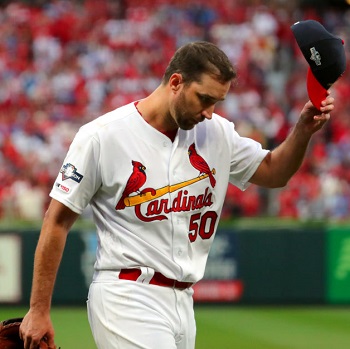
Matt Carpenter runs out the bomb that proved the difference maker in the tenth Thursday.

You knew it was just round one of total weekend war when a throw to first to catch Kolten Wong in the act was challenged, the safe call upheld, and the Wrigley Field boos rained louder than a heavy mental concert Thursday night. In the top of the first.

And, as Cubs starting pitcher Kyle Hendricks and catcher Willson Contreras ended the half inning with a strike-’em-out (Paul Goldschmidt)/throw-’em-out (Wong) double play,  the cheering from the Confines would have drowned the earlier booing out if both could have happened at once.

Then, for the following seven innings, Wrigley Field resembled a funeral home with Cardinals starting pitcher Jack Flaherty the chief undertaker. Until the Cubs tied things at four in the bottom of the ninth, turned the funeral home into a frat party and sent it to extra innings.

With Craig Kimbrel—returning from elbow inflammation, not having pitched since the beginning of the month—taking the mound for the top of the tenth. Cardiac Craig, about whom it was written snidely that every time he nailed a postseason save for last season’s Red Sox his high-wire act still made it feel like losing.

He struck out former Cub Dexter Fowler on a full count. Then Matt Carpenter—who’d lost his third base job to rookie Tommy Edman, who came into the game late when it looked like the Cardinals had it in the bank, and who hadn’t gone long since late August—hit Kimbrel’s first pitch over the center field wall. That’s what a quick trip back to the minors to fix your swing can do for you.

It also knocked Wrigley back into funeral mode for the moment, until Kimbrel settled enough to get rid of Goldschmidt and Steve Cishek came in to get rid of Marcell Ozuna and get the Cubs one more chance. Which Giovanny Gallegos—the guy the Cardinals surrendered Luke Voit to the Yankees to obtain—had no intention of giving them in his first-ever Cardinals save situation.

Late game Cub insertions Ian Happ (fly out to center) and David Bote (swinging strikeout) were dispatched almost in a blink. And Nicholas Castellanos, the Cubs’ midseason acquisition from the Tigers, who’d been nothing but solid and beyond for the Cubs since, flied out to center to end it.

The 5-4 win pushed the Cubs four behind the Cardinals in the National League Central and one behind the Brewers for the league’s second wild card, the Brewers having flattened the Padres earlier in the day. The Cubs have to win a mere three straight against the Cardinals this weekend to keep pace with them and maybe re-claim their second card grip.

Flaherty’s evening ended after a 1-2-3 bottom of the eighth, 118 pitches, eight strikeouts, a lone walk, three hits overall, and one rudely-interrupting home run, keeping the Cubs otherwise unbalanced with a blend of breakers, changeups, and fastballs a barista would have envied for its smooth richness.

He walked off the mound for the final time of the game so collected he could have been forgiven for saying, quietly, “Well, I guess I’d better be shoveling off.” Even if he knows about as much about the old friendly radio undertaker Digger O’Dell, whose catch phrase it was, as this year’s American League East-and-100 game-winning Yankees know about avoiding the injured list.

And he got a nice respectful hand from even enough Cub fans and he’d earned every finger of it. Even that was just respectful, low-keyed applause and cheering. The real noise came after the Cardinals brought in former starter Carlos Martinez to open the bottom of the ninth, and Martinez opened with a walk to Nicholas Castellanos before Kris Bryant, who’d been kept quiet by Flaherty all night, smacked a single up the pipe.

With Kyle Schwarber and his 37 home runs so far checking in at the plate with the potential tying run. With Martinez falling behind to him 3-0 before striking him out, but with Ben Zobrist doubling home Castellanos, putting the tying runs into perfect position, and with Javier Baez—whose thumb is still balky but who can still run swiftly—pinch running for Zobrist.

It took eight and a half for Wrigley to come back to life. And when Contreras flicked a squirty grounder up the short third base line with Bryant tearing home as if it was supposed to be an unintentionally intentional suicide squeeze, only with all hands safe and first and third, the Confines became as unconfined as you imagine when the Cubs re-awaken from the dead.

Then Cardinals manager Mike Schildt brought in Andrew Miller, whose formidability as an Indian the Cubs remembered only too well from 2016, but who’s been worn down since by health issues stemming from his former bullpen overwork, to face the lefthanded Jason Heyward. Heyward smashed a grounder to second that pushed home Baez to tie things at four.

You got the idea early that even with the Flaherty factor hitting was going to be a challenge thanks to the notorious Wrigley winds, when Nicholas Castellanos skied one that might have flown out elsewhere but hung up for a right field catch in the first, and Jason Heyward hit a cannon shot liner that died a shuttlecock into Wong’s glove playing second ending the second.

And you also got the idea early and often that both sides weren’t exactly going to be in a big hurry to blow plate umpire Bill Welke to a steak dinner any time soon. Welke called so many pitches strikes that didn’t even graze the floor or the outside edges of the zone it’s a wonder neither Cardinal nor Cub decided to serenade him whistling the ancient television theme from The Outer Limits.

But you also knew the delight Cub Country took in Anthony Rizzo deciding to test his recently-sprained ankle by playing first base would be matched only by a sense that it would do a bigger favour to the Cardinals. And in the top of the third, it was.

Flaherty batted with first and second with Rizzo ambling down the line, a la Keith Hernandez, slowly but surely, and practically in front of the mound, aiming as has become a Cubs mainstay to choke off the bunt even if it went near the third base line. Flaherty dropped the bunt, all right. Right up the short third base line. And on his still-balky wheel Rizzo couldn’t get the ball in time to keep the bases from loading.

The pillows stayed stuffed long enough for Dexter Fowler to dial Area Code 4-6-3 with Edman (a leadoff walk) scoring on the play. And Rizzo atoned for his ankle’s betrayal in the bottom of the inning, sending Flaherty’s first pitch to him the other way into the left center field bleachers to tie things at one. Smartly, Rizzo he didn’t run it out any faster than he absolutely had to or could.

The tie held up long enough for Edman to open the top of the fifth with a triple into the right field corner and for Harrison Bader, who’s been as much a struggler at the plate as reliable in the outfield this season, to smack a single up the pipe to break the tie.

The Cardinals got a scare when Wong had to leave the game after ending the top of the fifth with a ground out to first. He fumed over leaving the game and the Cardinals may have fumed quietly with him, since he’s their best player this season by wins above replacement-level.

Then they sent Carpenter out to play third and moved Edman to second. And Flaherty went back to work as though nothing short of an undetected tornado could interrupt his quiet pleasure in his work. You might feel that kind of quiet surety, too, if you took the fifth-best post All-Star break earned run average (1.07) of all time out to the mound to start your evening’s work of play.

Flaherty was so composed and efficient that the Cardinals didn’t even think about getting a reliever up until Martinez got up to throw in the bottom of the eighth, after Flaherty reached 108 pitches on the night. Don’t even think about it: Flaherty doesn’t look like a pure hard, grunting, thrusting thrower; he relies on mechanical soundness to provide the fastball’s power and the command of the breakers.

He nailed the Cubs’ impressive rookie call-up Kyle Hoerner (eleven runs batted in in his first ten games worth of impressive) on a called third strike that looked under and not on the floor, and while Hoerner objected mildly to the call Flaherty simply walked around the mound and went back to work.

Then he struck out his counterpart Hendricks swinging, and Hendricks to that point was working with equivalent composure, not letting the quirky Wrigley elements get as far into his head as a two-run deficit ordinarily might, though he engaged a long yet civilised-appearing discussion with Welke after that swishout before returning to the mound.

He was probably a little more miffed when Goldsmidt opened the St. Louis sixth with a sharp double down the left field line. The Cardinals must have wondered about his ump conversation when Ozuna was rung up on a pitch that didn’t even graze the outer strike zone before Hendricks nicked Paul DeJong on a runaway inside pitch.

But Yadier Molina, the Cardinals’ wise old man behind the plate, lined a single to left that Schwarber played on the carom off the heel of his glove before throwing home. Goldschmidt waved home from second should have been a Deadbird, except that he eluded Cubs catcher Willson Contreras, abetted by Contreras inside the baseline seemingly unable to get the handle on the tag.

Which ended Hendricks’s evening and gave the Cubs more reason to be miffed, when Bader stroked a liner to left center off Hendricks’s relief Rowan Wick, right after Wick turned Edman aside on a swinging strikeout. Then Schwarber opened the bottom of the seventh with a single up the pipe. And Flaherty in a momentary lapse of soundness wild pitched Schwarber to second while working to Ben Zobrist, before Zobrist grounded to second to push Schwarber to third.

And the Cubs’ basepath issues reared up and bit them flush on the fanny, when Contreras bounced one right back to Flaherty and Flaherty bagged the Schwarbinator in a 1-2-5-6 rundown out before Heyward grounded out for the side.

The Cardinals didn’t really look all that much better going 4-14 with men in scoring position in the first seven innings, but what matters is how you make it count when you do it and how you hang in there when the other guys decide it’s party time at the ninth hour. And Carpenter spoiled the party in the top of the tenth.

Leaving the Cubs to resist the temptation toward counting the days and accept the temptation to counting the ways they might keep both feet from their seasonal graves. They’d rather not be shoveling off just yet.

Want a blood feud this weekend? You may get one in Chicago

2019-09-19 WrigleyFieldSignForget the wild card races for a few moments. Have a good gander at the National League Central. Where the Cardinals and the Cubs entered Thursday’s play numeros uno and two-o in the division.

With a measly three games between them in the standings. And, count them, seven games yet to play against each other including three to end the regular season. You wanted an honest-to-goodness rivalry to take the season to the wire? You’ve got it now in the NL Central.

The Red Sox’s dissipation thanks mostly to their starting pitching means no Yankee-Red Sox duel to the death to finish. The American League Central is down to the Twins and the Indians with four games between them in the standings, but such as it is their rivalry seems more like a Friday night bowling league. There’s no blood feud there. Yet.

The western divisions in both leagues are so locked up that both champions-in-waiting (the Astros and the Dodgers) left their age-old or mere territorial rivals behind as far as New York City’s D train leaves 205th Street in the north Bronx when it arrives near Coney Island.

The eastern divisions are sewn up snugly enough, though there’s a vague potential for all-out war if, somehow, by some heretofore unseen alchemy, the Nationals and the Mets end up in the wild card game with one of them getting to deal with the Braves in a division series.

And the wild card rumbles are enough fun, even if you think there’s something just a little out of whack with sitting on the edge biting your nails to the nubs over the thrills, spills, and chills of seeing who’s going to end up . . . in second or even third place but with a postseason ticket regardless.

No, the real blood feuding resumes Thursday night in Wrigley Field. Which will be the Friendless Confines if you’re a Cardinals fan.

Where there’s about as much love or respect for the Cardinals as there was between Frank Hamer and Bonnie & Clyde. Where the legend may still hold that one season’s antics so enraged Hall of Famer Bob Gibson that he begged his manager to pitch him out of turn just for the pleasure of using the Cubs for target practise an extra time or two.

Bad enough the Cardinals’ Thursday starter Jack Flaherty entered as one of the National League’s hottest second-half pitchers. Worse: the Cubs only hit .168 against him with a .297 on-base percentage. Their best swinger against Flaherty, Anthony Rizzo, is down for the count with an ankle injury. Without the only Cub who hits higher than .250 against him—and Rizzo’s hit .533—Flaherty can start the game like a man sinking into a delicious hot tub.

Especially because his Cubs starting opponent, Kyle Hendricks, is a Cardinals pinata by comparison. The Redbirds have hit .249 with a .309 on-base percentage against Hendricks lifetime. The big swinger? Marcell Ozuna, who brings a 1.124 OPS against Hendricks lifetime into the game. Hendricks can’t exactly think about starting in a hot tub. He might have an early shower in which to think afterward if a) he’s not careful and b) his changeup betrays him.

But all September long the Cubs are a game over .500 and the Cardinals, two. But the Cubs just dropped a pair to the lowly but feisty Reds and woke up Thursday morning the winners of six out of their last ten compared to the Cardinals winning five of their last ten.

What a difference a few years makes. As ESPN reporter Jesse Rogers observes, not so long ago the Cardinals had issues on the basepaths, in the field, and out of the bullpen, but that was then and this is now: it’s the Cubs who now lead the league in outs on the bases, sit second in the league in errors (losing Rizzo doesn’t hurt at the plate alone), and haven’t converted more than 58 percent of their bullpen save opportunities.

And his colleague Bradford Doolittle observes that this year’s Cardinals do all the little things right but seem to think the big things are too big, while this year’s Cubs do the big things right while the little things seem not beyond but unknown to them by comparison. Tonight they’re going to test Rizzo’s ankle by letting him play first base. Think the Cardinals might test him the hard way with a few bunts?

There’s also that pesky location factor. The Cubs finish the home portion of their regular season this weekend before playing six on the road to finish, and their 31-44 road record to this point doesn’t exactly bode for getting their kicks on Route 66 or anywhere else. The Cardinals aren’t exactly road hogs, either, but their 36-38 road record when they woke up Thursday morning could turn just as easily into a 40-38 road record when they go to bed Sunday night.

Doolittle thinks Cardinal fans, despite their long standing reputation as being among baseball’s best, suddenly have “a sense of impending doom . . . A lot of people I talk to seem raw that the team didn’t trade for another starter at the deadline, even though their rotation has been lights-out ever since . . . They want to believe, but they aren’t all the way there yet. If the Cards flop against the Cubs, it could get a little ugly in St. Louis.”

Since 2017 the Cubs have actually been 20-5 against the Cardinals in the Confines. What does he think it’s going to get in Chicago if the Cubs flop against the Cardinals this weekend—pretty?

A one-time Cub broadcaster who devolved to become an American president once proclaimed morning in America. Just because it’s still only three years, just about, since their last World Series conquest doesn’t mean Cub Country would proclaim morning in America if the Cubs plotz this weekend.


A date with an Angell

2019-09-19 RogerAngell

Roger Angell, accepting his J. G. Taylor Spink Award at the Hall of Fame in 2014.

Nine days before Eddie Cicotte confessed his membership in the Black Sox, the literary-minded wife of a New York attorney bore a son. Mother and son would each have a long term impact on The New Yorker; the son would have a concurrent and more enduring impact on baseball.

Katharine Sergeant Angell was five years from becoming The New Yorker‘s fiction editor and nine from divorcing her first husband and marrying a writer she’d previously recommended The New Yorker‘s legendary mastermind Harold Ross hire, E.B. White. Her son would assume her job in due course. While he was at it, he’d become baseball’s prose poet laureate.

Just don’t say that to Roger Angell if you should have the honour of meeting him, never mind wishing him a happy 99th birthday in person today.

“I’ve been accused once in a while of being a poet laureate, which has always sort of pissed me off,” Angell once told Salon writer Steve Kettman, coincidentally the author of the splendid One Day at Fenway and editor of Angell’s own anthology Game Time. “That’s not what I was trying to do. I think people who said that really haven’t read me, because what I’ve been doing a lot of times is reporting. It’s not exactly like everybody else’s reporting. I’m reporting about myself, as a fan as well as a baseball writer.”

Just like any average everyday American literary editor who goes to spring training, assorted ballparks, or the World Series, intending nothing but spot reporting, delivering observations the rest of us can only fantasise about delivering. Consider what he delivered in “The Web of the Game” (1981), after watching Ron Darling (then pitching for Yale University) and Frank Viola (then pitching for St. John’s University) tangled in Darling’s 11 no-hit innings, in a game during the 1981 players’ strike, with Smokey Joe Wood (a 34-5/1.91 ERA pitcher for the 1912 Red Sox, then 91 himself) in the audience and, coincidentally, as Angell’s seat companion:

The two pitchers held us — each as intent and calm and purposeful as the other. Ron Darling, never deviating from the purity of his stylish body-lean and leg-crook and his riding, down-thrusting delivery, poured fastballs through the diminishing daylight . . . Viola was dominant in his own fashion, also setting down the Yale hitters one, two, three in the ninth and 10th, with a handful of pitches. His rhythm — the constant variety of speeds and location on his pitches—had the enemy batters leaning and swaying with his motion, and, as antistrophic, was almost as exciting to watch as Darling’s flair and flame.

With two out in the top of the 11th, a St. John’s batter nudged a soft little roller up the first base line—such an easy, waiting, schoolboy sort of chance that the Yale first baseman, O’Connor, allowed the ball to carom off his mitt: a miserable little butchery, except that the second baseman, seeing his pitcher sprinting for the bag, now snatched up the ball and flipped it toward him almost despairingly. Darling took the toss while diving full-length at the bag and, rolling in the dirt, beat the runner by a hair.

“Oh, my!” said Joe Wood. “Oh, my, oh, my!”

A movement instigated by San Francisco Chronicle baseball writer Susan Slusser, which ought to have brought her a Pulitzer Prize for Distinguished Service on the spot, brought Angell his due (many thought overdue, including myself) in naming him the first non-daily beat writer to be elected to the Hall of Fame as its J.G. Taylor Spink award winner.

Daily beat writing has yielded its lyricists. Ring Lardner, Red Smith, Jim Murray (whose wit could have designated him baseball’s hybrid of Byron and James Thurber), Damon Runyon, Shirley Povich, Ira Berkow, to name a few who are very well anthologised and should not be absent from any serious fan and reader’s baseball libraries. Angell has been the thinking person’s epic observer and recorder of the thinking person’s epic game.

He has never been merely sound-bite quotable, which is his virtue and perhaps a key reason beyond his lack of employment by daily newspapers or Websites why it took as long as it did to bring him to Cooperstown as an honouree and not an observer. Which would you prefer—the customary clanking strain of sound-bite-angling, search-engine-optimising writing; or, something like this, concluding a remarkable study of the late and delightful relief pitcher Dan Quisenberry:

We want our favorites to be great out there, and when that stops we feel betrayed a little. They have not only failed but failed us. Maybe this is the real dividing line between pros and bystanders, between the players and the fans. All the players know that at any moment things can go horribly wrong for them in their line of work — they’ll stop hitting, or, if they’re pitchers, suddenly find that for some reason they can no longer fling the ball through that invisible sliver of air where it will do their best work for them — and they will have to live with that diminishment, that failure, for a time or even for good. It’s part of the game. They are prepared to lose out there in plain sight, while the rest of us do it in private and then pretend it hasn’t happened.

This stepson of one of America’s most treasured essayists, a New York Giants fan in his youth, knew how to appreciate the ties that bind baseball’s generations without caring to flog them with nostalgia’s buggy whip.

The stuff about the connection between baseball and American life, the Field of Dreams thing, gives me a pain. I hated that movie. It’s mostly fake. You look back into the meaning of old-time baseball, and really in the early days it was full of roughnecks and drunks. They beat up the umpires and played near saloons. In Field of Dreams there’s a line at the end that says the game of baseball was good when America was good, and they’re talking about the time of the biggest race riots in the country and Prohibition. What is that? That dreaminess, I really hated that.

He wasn’t quite prepared to acquit the contemporary game, its accoutrements in particular, either, as he made very clear writing around the turn of the current century: “The modern game is all bangs and effects: it’s summer-movie fare, awesome and forgettable—and extremely popular with the ticket-buyers.” He was thus kindred to the late commissioner A. Bartlett Giamatti, who lamented likewise the game’s embrace of theatrical ballpark gimmicks.

But Angell has also been an empath obeying particular boundaries of reason with assorted fans of assorted teams, even if his eye burrows deeper than theirs. Even among Red Sox fans in St. Louis watching generations of extraterrestrial deflation come to a surprising 2004 finish:

The Redbird collapse can probably be laid to weak pitching, unless you decide that the baseball gods, a little surfeited by the cruel jokes and disappointments they have inflicted on the Boston team and its followers down the years, and perhaps as sick of the Curse of the Bambino as the rest of us, decided to try a little tenderness.

This notion came to me in the sixth game of the scarifying American League Championship, when Gary Sheffield, swinging violently against Schilling with a teammate at first, topped a little nubber that rolled gently toward Sox third baseman Bill Mueller, then unexpectedly bumped into the bag and hopped up over his glove: base hit. Nothing ensued, as [Curt] Schilling quickly dismissed the next three Yankee hitters, but the tiny bank shot, which is not all that rare in the sport, was the sort of wrinkle that once could have invited a larger, grossly unfair complication and perhaps even a new vitrine next to [Bill] Buckner’s muff or [Aaron] Boone’s shot in the ghastly Sox gallery. You could almost envision the grin upstairs.

Instead, looking back at the action up till now — the Yankees’ daunting three-game lead after the first three meetings of this championship elimination; their nineteen runs in the Game Three blowout; and then the Sox’ two comeback wins achieved across the next two games or twenty-six innings or 10 hours and 51 minutes of consuming, astounding baseball—the old god feels an unfamiliar coal of pity within. “Ah, well,” he murmurs, turning away. “Let it go.”

Angell was never a member of the Baseball Writers Association of America. “The main requirement for membership,” says the BBWAA’s Website, “is still that a writer works for a newspaper or news outlet that covers major league baseball on a regular basis.” That may also be why it took so long to think of Angell as Hall of Fame material in consecrated fact as well as an article of faith. Working for a literary magazine instead of a sporting journal, too, allowed him a freedom of the soul most baseball writers don’t dare imagine.

Another legendary New Yorker editor, William Shawn, instigated Angell’s journey when sending him to spring training in 1962 with one instruction: “See what you find.” Little did Shawn know what he wreaked. Angell subsequently found the Original Mets and their equally surrealistic fans.

“[T]hat was very lucky for me when I thought it out,” Angell told Kettman. “It occurred to me fairly early on that nobody was writing about the fans. “I was a fan, and I felt more like a fan than a sportswriter. I spent a lot of time in the stands, and I was sort of nervous in the clubhouse or the press box. And that was a great fan story, the first year of the Mets. They were these terrific losers that New York took to its heart.”

He would go forth to write with comparable eloquence on such things as the dominance of Sandy Koufax; the miscomprehended “Distance” (his title) of Bob Gibson; the unfathomable collapse of Steve Blass (a Pirates pitching stalwart and World Series hero one moment, unable to reach the strike zone without disaster the next, so it seemed); the trans-dimensional 1975 World Series; the labor disputes in the free agency era; the pride of such men as Tom Seaver and Reggie Jackson; the foolishness of such men as Pete Rose; and the jagged contrast between two Bay Area owners, Charles Finley (Athletics) and Horace Stoneham (Giants):

Baseball as occasion — the enjoyment and company of the game — apparently means nothing to him. Finley is generally reputed to be without friends, and his treatment of his players has been characterized by habitual suspicion, truculence, inconsistency, public abasement, impatience, flattery, parsimony, and ingratitude. He also wins.

Horace Stoneham is — well, most of all he is not Charlie Finley … He is shy, self-effacing, and apparently incapable of public attitudinizing. He attends every home game but is seldom recognizable even by the hoariest Giants fans . . . In 1972, when his dwindling financial resources forced him at last to trade away Willie Mays, perhaps the greatest Giant of them all, he arranged a deal that permitted Mays to move along to the Mets with a salary and a subsequent retirement plan that would guarantee his comfort for the rest of his life…

. . . [W]hen I read that the San Francisco Giants were up for sale, it suddenly came to me that the baseball magnate I really wanted to spend an afternoon with was Horace Stoneham. I got on the telephone to some friends of mine and his (I had never met him), and explained that I did not want to discuss attendance figures or sales prices with him but just wanted to talk baseball. Stoneham called me back in less than an hour. “Come on out,” he said in a cheerful, gravelly Polo Grounds sort of voice. “Come out, and we’ll go to the game together.”

That was part of “The Companions of the Game,” published in The New Yorker in 1975 and republished in two subsequent Angell anthologies, Five Seasons and Game Time. Angell’s baseball anthologies have been subtitled, invariably, A Baseball Companion. He has been that through his reporting and writing, which has been in turn that and more to those who’ve had the pleasure and good taste to read it.

He accepted his Spink Award with grace at the Hall of Fame in July 2014, the kind that makes you think you’d love nothing better than to have him as your company at a game, any game, whether watching the Astros’, the Yankees’, the Dodgers’, the Braves’, the Twins’ dominance; whether agonising over the wrestling match between the Nationals, the Cubs, the Brewers, the Mets, and the Phillies for second place and thus the National League’s wild cards; or, whether suffering along with those unable to release the Orioles, the Tigers, the Mariners, the Marlins, or the Pirates from their hearts no matter how those teams have released competitive sense.

It’s not that life has been a ceaseless pleasure for him. He’s been widowed twice; his eldest daughter was a suicide at 62. He has written (and been honoured for, with the 2015 National Magazine Award for Essays and Criticism) of mortality with the same reality-tempered lyricism as he’s written about our game:

“Most of the people my age is dead. You could look it up” was the way Casey Stengel put it. He was seventy-five at the time, and contemporary social scientists might prefer Casey’s line delivered at eighty-five now, for accuracy, but the point remains. We geezers carry about a bulging directory of dead husbands or wives, children, parents, lovers, brothers and sisters, dentists and shrinks, office sidekicks, summer neighbors, classmates, and bosses, all once entirely familiar to us and seen as part of the safe landscape of the day. It’s no wonder we’re a bit bent. The surprise, for me, is that the accruing weight of these departures doesn’t bury us, and that even the pain of an almost unbearable loss gives way quite quickly to something more distant but still stubbornly gleaming. The dead have departed, but gestures and glances and tones of voice of theirs, even scraps of clothing—that pale-yellow Saks scarf—reappear unexpectedly, along with accompanying touches of sweetness or irritation.

That from the man who once wrote, “Since baseball time is measured only in outs, all you have to do is succeed utterly: keep hitting, keep the rally alive, and you have defeated time. You remain forever young.” And, sometimes, it takes nothing more than a leisurely walk with the bases loaded to keep a rally going, as happened to Pete Alonso Wednesday night, as the Mets opened up in the top of the ninth to overtake and beat the Rockies, 7-4.

Angell’s meditation on mortality is the title essay of his last known anthology, This Old Man: All in Pieces. A man who endures such slings and arrows with the same affectionate wit through which he endured the Original Mets, engaged the owner of the team that engaged his boyhood, or gazed with perspective upon the end of generations of surrealistic Red Sox calamity and the Astros’ first entry into the Promised Land, is a man about whom you can say safely that only the years he’s lived make him ancient.

One year shy of a centenarian, Angell on his birthday today is 144 years younger than his country—which should count its blessings in numerous ways, including that he still lives and writes among us—and he may be twice as wise, too. Happy birthday to the gentleman about whom I refuse to surrender my belief, based upon a lifetime in the company of his writing, that Peter Golenbock was wrong to call him baseball’s Homer—because Homer was ancient Greece’s Roger Angell.

(Portions of this essay were published previously.)

The sordid case of Felipe Vasquez

2019-09-18 FelipeVasquez

Pirates relief pitcher Felipe Vasquez. His ubiquitous tattoos helped identify him as a sex predator with at least one underage girl.

Let’s see. Either the Astros or the Braves will be the next team to clinch their division titles, and in theory they could do it on the same day, since they both awoke this morning with magic numbers of three. In theory.

The Astros have a better shot at doing it first since their remaining schedule is just a trifle easier than the Braves’. But remember Andujar’s Law: In baseball, there’s just one word—you never know. And the Astros’ main 2019 rivals for the best ratio of excellence to injury compromise or depletion, the Yankees, are a game from clinching their division.

I was wrong so far about the loss of Christian Yelich to the Brewers and their general manager David Stearns was right so far. I thought losing their by-far best player for the season last week meant a gut punch to their season. Stearns thought it was just a gut punch for the night. Stearns wins that argument.

Even if they did it against bottom feeders mostly, the Brewers are 6-1 since Yelich went down after fracturing his knee cap on his own foul off the plate. And they’re tied with the Cubs, who have their own issues, for the second National League wild card.

And I’m still rubbing my eyes over the fact that this year, too, as seems to happen too often in baseball’s wild card era, we’re watching all the thrills, chills, and spills of at least eight teams fighting to the last breaths to finish . . . in second or even third place.

As of this morning it’s still possible mathematically that the National League’s second wild card could be won by a team finishing third in its own division, and two teams (the Mets in the NL East; the Brewers in the NL Central) still have a shot at that. Which means, in theory, a third-place team could heat up enough to go to, if not win the World Series.

And even if the Giants and the Red Sox are out of the races, it was still a thrill Tuesday night when Mike Yastrzemski of the Giants—the grandson of the Red Sox’s Hall of Fame legend Carl Yastrzemski—confabbed with Grandpa on the field before the game at Fenway Park, then blasted one into the center field seats with two out in the top of the fourth.

But all the above gets knocked to one side upon the news that the best pitcher on major league baseball’s possible most fractured and fractuous team this year may be a sex criminal.

Bad enough that the Pirates’ clubhouse became a well known mess this season. Enough of a mess that two of the key culprits, relief pitchers Kyle Crick and Felipe Vasquez, had a clubhouse fight over Vasquez’s music that caused Crick a season-ending finger injury. Way worse is Vasquez arrested Tuesday in Pittsburgh, on Florida and Pennsylvania charges involving sexual misconduct with underage girls.

According to KDKA, CBS Pittsburgh, Vasquez is charged with “computer pornography–solicitation of a child and one count of providing obscene material to minors,” out of Lee County, Florida. Denied bail at his arraignment in Pittsburgh Tuesday—senior district judge Eilenn Conroy considered him a flight risk—he faces an extradition hearing a week from today.

Far more grave is what Pennsylvania State Police announced Tuesday evening, according to The Athletic: charges of statutory sexual assault, unlawful contact with a minor, corruption of a minor by a suspect eighteen or older, and indecent assault of a victim under sixteen.

Yardbarker reported this girl told officers she met Vasquez when she was thirteen and they kept in touch via text messages and other computer/phone apps. USA Today‘s Chris Bumbaca reported the girl’s mother “discovered the messages, two pictures and a video one week after they were sent to the victim on July 16. At that point, the mother told the suspect he was communicating with a minor. Police began an investigation on Aug. 8.”

Bumbaca added that Vasquez’s face wasn’t visible in the images but authorities identified him by way of his numerous and too-distinctive tattoos, and by the girl addressing him as Felipe during their text message exchanges.

“These allegations are very, very serious,” said Pirates pitcher Chris Archer, whose own season ended officially Sunday thanks to shoulder issues keeping him on the injured list since late August. “One term that was used earlier was heinous. Right now, as far as we know, they’re just allegations. There’s not a lot more we can say.”

There wasn’t? The Pirates wasted practically no time wiping Vasquez off the face of their earth before the Pirates hosted the Mariners at PNC Park Tuesday evening, The Athletic‘s Rob Biertempfel writes.

By game time, looking around the stadium, it was as if Vázquez had never played for the Pirates. His clubhouse locker was empty. His banner outside PNC Park had been taken down. His image was scrubbed from the scoreboard videos. His name was deleted from the list of National League save leaders that flashes on concourse monitors before the game. The scorebook magazines with Vázquez on the cover, which normally are handed out to fans as they enter the stadium, were stashed out of sight.

The Pirates informed the commissioner’s office almost at once and Vasquez was put on administrative leave and baseball’s restricted list. He’ll face worse if he’s tried and convicted. And that would still be nothing compared to what his victims and their loved ones have to come to terms with. They deserve your compassion and your prayers.

This isn’t just an athlete accused of and disciplined for domestic violence. This is one accused of having or seeking actual sexual activity with underage girls. ESPN’s Jeff Passan tweeted even more grating news this morning: “Police said . . . Vazquez admitted that he drove nearly an hour in 2017 to meet a 13-year-old girl and tried to have sex with her, according to a criminal complaint released today. After a failed attempt, Vazquez, then 26, left to go to a game, per the complaint.”

Only after 1980’s-1990s Cubs/Indians/Yankees/Giants outfielder Mel Hall’s career ended did we learn he spent much of his off-field career maneuvering 12- and 13-year-old girls into sexual activity. Those grotesque maneuverings continued after his career ended. Hall was finally arrested for rape in 2007 and sentenced to 45 years in prison in 2009.

Until now the worst thing that ever happened to the Pirates in legal terms (the absolute worst at all, of course, was Hall of Famer Roberto Clemente’s death in a 1972 plane crash) was probably six players testifying and facing discipline from then-commissioner Peter Ueberroth as part of the 1985 Pittsburgh drug trials.  Analysts observing the dissipation of this year’s Pirates and suggesting a housecleaning should come may want to amend that suggestion to a fumigation.

One of life’s saddest realities is that there are times, indeed, when a man can be accused falsely and wrongly of such sordid crimes as those with which Vasquez is charged. The evidence known thus far suggests he isn’t even close to one of those men.