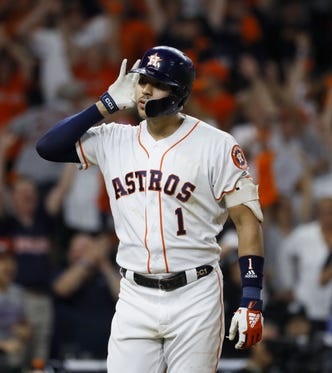
Yes, way, Jose

2019-10-04 JoseAltuveJoshReddick

Jose Altuve (right) and Josh Reddick on the cusp of a forearm bump after Altuve hammered his fifth-inning Game One two-run homer . . .

Whenever I get to watch the Astros play, whether in the moment or aboard repeat broadcasts such as Game One of their American League division series, I’m hard pressed. There’s more than enough to enjoy about the team, but all bets are off if not only Jose Altuve is at his appointed station at the plate and at second base but Justin Verlander is on the mound.

Especially Altuve. Especially the sense I once had of him that’s confirmed in a striking profile by ESPN’s Jeff Passan the morning after the Astros, with Altuve firing the first shot at last, dispatched the Rays, 6-2, Friday afternoon.

I always sensed somehow that there was a warehouse of insecurities inside Altuve, that no matter what he could and did do at the plate or in the field he’d never quite believe it wouldn’t be the last time he’d do either, that he could win a game singlehandedly and think it was a huge mistake, somehow.

Passan confirms that sense. He writes that first basemen greeting Altuve after base hits this year were surprised to hear him say, without being facetious, that he was only too glad to be there and, as he told one, “I’m getting old, Papi.”

“[H]e wasn’t sandbagging,” Passan wrote of the 29-year-old who still plays baseball like a sandlot kid who’d do anything to keep his parents from announcing dinnertime while he’s still in the middle of a game. “This is how he thinks. Perpetually pessimistic, professionally defeatist, Altuve believed—truly, honestly, earnestly believed—that even in the midst of another brilliant year, he was ever teetering, on the cusp of losing his swing.”

The brilliant year didn’t start that way. It took Altuve over a month to shake completely away the weakness he felt after off-season knee surgery, then a hamstring injury took him out for five more weeks. He wasn’t even close to the only Astro on the injured list—like the Yankees, their depth could make you forget they were a traveling edition of Grey’s Anatomy this year—but something always seemed missing no matter how potent the team was when he wasn’t there.

On a team full of players who don’t disguise their fun quotient, Altuve makes the rest of them seem like basket cases in comparison. This is a guy who could light the entire ballpark up with one flash of that half-boyish, half-mischievous grin if there was ever a power failure in the joint. And yet he’s still the most self-lacerating Astro, the guy who thinks every hit, every smart play at second base, is going to be the last.

That was no cursory joy Altuve let show when he vaporised Rays starter Tyler Glasnow in the bottom of the fifth—after Glasnow to that point matched shutouts with Verlander, the ancient craftsman, the old man who works with brains as well as a still-deadly repertoire—and, with Josh Reddick aboard from a leadoff walk, turned on a third straight fastball and sent it into Minute Maid Park’s Crawford Boxes.

It’s become a habit for Altuve. Friday night’s blast was the fifth time he’s cleared the fences in opening division series games and the ninth time he’s done it in the postseason any time. At the rate he’s going, they’ll start hanging signs on the outside of Minute Maid saying “Jose Altuve Opening Tonight!”

“It’s like clockwork,” said Astros manager A.J. Hinch of his compact second baseman who’s six parts walking power plant and half a dozen parts a psychological study. “Every ALDS it seems like he busts out with a really good game.”

Altuve had a glandular second half of the season once he found himself back in synch: he had a .995 OPS in the second half with almost twice as many total bases as he’d had in the interrupted first half. Measure him by the concept of the real batting average—total bases (which treats all your hits the right way, because all hits are not equal), walks, intentional walks, and sacrifices, all divided by plate appearances—and Altuve’s second-half .638 is +131 over his career RBA.

But the little big man’s achievements, regular or postseason, including vacuuming the final out of the Astros’ 2017 World Series conquest, come wrapped in a package dominated by a guy so hammered with self doubt that if you met him at a party he’d be tucked in a corner praying for the courage to ask the prettiest woman to dance and oblivious to ten of the ladies praying for him to do likewise.

“He could be player of the week, ten for his last twelve, go 0-for-3 in a game, get an infield single in the eighth and look at me and go, ‘Papi, I needed that’,” Reddick told Passan of Altuve. “No, you didn’t. You didn’t need that. I mean, we need every one of ’em, but you? You don’t need that.”

The Astros added a pair of runs in the fifth after Altuve’s launch and after Glasnow’s relief Brendan McKay was lifted for Chaz Roe, when Alex Bregman and Michael Brantley scored on Yuli Gurriel’s behind-the-infield popup since it ended up bounding off Rays second baseman Brandon Lowe’s glove. Back-to-back doubles provided the rest of the Astro runs in the seventh; the Rays had only an RBI single and RBI double back to back to answer at last in the eighth.

And Glasnow’s gutsy start—including escaping a ducks-on-the-pond jam in the third—until Altuve hammered him in the fifth, was hardly a match for Verlander’s methodical carving, the Hall of Famer in waiting striking out eight in seven innings and surrendering nothing otherwise except three almost generous walks and a leadoff single to Lowe in the top of the fifth.

The righthander who surrealistically nailed his 300th strikeout of the year and the 3,000th of his career to the same Angels hitter (Kole Calhoun) on the same night last weekend could have pitched Game One with his arm in a cast and still manhandled these game, gutsy, but overmatched Rays.

Small wonder Rays manager Kevin Cash’s postmortem may yet enter future collections of baseball quotations: “We got Verlandered.” Verlander couldn’t suppress a laugh when told of that one. “It’s a pretty great compliment,” he finally said. “I don’t know what else to say, other than that.”

He could have said the Rays also got Altuved.

That’d be the easy part. The hard part, as often as not, is getting Altuve himself to believe it. Passan is one of the most acute baseball writers and students of baseball psychology around the game today. Reading his profile is to gather that it would take a jury’s verdict to convince Altuve he isn’t even close to losing it.

Don’t be shocked if Altuve pulls into any base with another hit short of a home run and tells the opposition fielder standing by, meaning every word of it, that he thought he’d never get it, that he thought his very life depended on it, that it was a relief to know he’d gotten through another plate appearance without disappearing.

A lot of the greats never quite seem to believe what they can still do. But few of them live on such a self-imposed edge as this still young man does. It makes him one of the game’s genuine greats, and it may help to keep him somewhat underrated, somehow.

The second part disappoints. The first, for Astros fans and anyone who loves the game, couldn’t possibly disappoint. All you have to do now is convince Altuve. Ladies and gentlemen of the jury, good luck with that.


Mickey’s monkey is off the Mets backs

2019-10-04 MickeyCallaway

Now the former Mets manager . . .

The least unpredictable fact when the regular season ended was Mickey Callaway’s job status. Never mind the Mets’ little comedy of an organizational meeting without him; the question was when, not whether Callaway had a date with the executioner.

Thursday proved the when. Mickey’s monkey is off the Mets’ backs.

At least Mets chief Jeff Wilpon and general manager Brodie Van Wagenen had the decency to fly to Callaway’s Florida home and tell him to his face. They didn’t send a flunky to do the firing for them, the way George Steinbrenner once did with Clyde King when he decided he wouldn’t fire Yogi Berra because the players did.

Even the Mets’ deceptive second-half self-resurrection, pulling them as close as two games from at least a wild card game entry but not quite close enough, wasn’t enough to save Callaway’s job. Or, for that matter, bench coach Jim Riggleman’s.

They brought Riggleman in to help shepherd Callaway through game situations. Riggleman doesn’t exactly have a sterling managerial record himself. And based on a lot of the Mets’ results this season, whether in the first half nightmare or the deceptive second half revival, it didn’t seem as though Riggleman was the best bridge lieutenant.

It’s a shame after a year during which the Mets yielded up the likely no-questions-asked National League Rookie of the Year (Pete Alonso) and possible second-straight National League Cy Young Award winner. (Jacob deGrom.) It’s no surprise, though, after the Mets played thrilling baseball one minute and looked like crisis junkies the next.

But time and again in the diciest moments Callaway’s moves blew up in his face, sometimes because that’s the way of the game and oftentimes because he wasn’t exactly the most in-tune observer of the moment.

One of them almost cost him his job in June. Against the Cubs in Wrigley Field, Callaway let Seth Lugo go out for a second inning’s relief work on a day Lugo didn’t exactly have his A game in his first inning’s work but Callaway had a fresh (and as yet uninjured) Robert Gsellman and his closer Edwin Diaz ready in the pen.

So Lugo went out for the eighth, fed Kyle Schwarber a hanger he was lucky didn’t disappear across the street but went up the middle for a shallow hit, walked Anthony Rizzo a fly out later, and served Javier Baez a meaty slider to serve into the right field bleachers, turning the game into a 5-3 Cub lead that held up through the ninth.

There wasn’t a reporter in the room who wouldn’t ask why Callaway stayed with a faltering Lugo who’d struggled to survive the seventh, or why he didn’t think to bring in Diaz to try for a five-out save after Schwarber’s single. Callaway snapped at Newsday writer Timothy Healey in particular, and so did then-Mets pitcher Jason Vargas, who threatened to “knock you the [fornicate] out.”

Right then and there another team’s general manager would have dumped Callaway and shuttled Vargas right the hell out of town. Right then and there nothing of the sort happened. It wasn’t Callaway’s first head-scratcher from the bridge and it sure as hell wouldn’t be the last:

* He often pulled his starting pitchers when they were more or less cruising and at extreme minimal pitch counts only to be caught by not having allowed his relievers enough warmup time. And this was from a manager who probably knew in his heart of guts that he could trust most of his bullpen the way a cobra would trust a mongoose on a dinner date.

* He never quite clued in to the idea that a lot of his pitchers were more comfortable throwing to Tomas Nido behind the plate—with the numbers to back them up—than Wilson Ramos. This is probably on general manager Brodie Van Wagenen as well, but it merely amplified a key Mets dilemna: choosing between a catcher who could hit but didn’t always get the best out of his pitchers, or a catcher who usually got his pitchers’ best but couldn’t hit with the Washington Monument.

* Granted he had a bullpen of 98 percent arsonists, but he sometimes over-used his better bulls and never really defined who’d be doing what, particularly with his high-priced closer Edwin Diaz, who turned into a season-long mess wondering who’d burglarised him and made off with his once-deadly slider.

* In early September, with the Mets down 9-6 in the seventh, Callaway ordered an intentional walk to the Phillies’ number eight hitter to load the bases, even knowing Bryce Harper, who hadn’t started that day, loomed as a pinch hitter for Phillies reliever Mike Morin, merely because Callaway wanted Morin out of the game—which Morin was liable to be, anyway, after the inning ended.

Then Mets reliever Taylor Bashlor walked Harper unintentionally to bring home the tenth Phillies run. Be careful what you wish for.

Well respected as a pitching coach with the Indians, from whence the Mets hired him, Callaway—according to several published reports since his execution—rarely if ever drew on his pitching knowledge to give his pitchers more than cursory counsel. About the only thing he may have done, the reports say, was fume when pitching coach Dave Eiland was canned in favour of octogenarian Phil (The Vulture) Regan, who actually proved a lot more effective with Mets pitchers.

Callaway may also have helped cook himself by contravening earlier promises to open wider communication lines with his players. He’s said instead to have isolated himself in his office far more often and delegated far too many more responsibilities to his coaches.

And Mets players weren’t the only ones tempted to believe Callaway was really a front office plant who didn’t always call the shots. Nobody seemed to know whether his marching orders and in-game maneuvers came from Callaway himself, or from Van Wagenen, or even from chief operating officer Jeff Wilpon.

The only thing anyone knew was that, whether the Mets looked falling apart or looked like they’d really sneak into even the wild card picture, Callaway resembled a ship’s captain who couldn’t really believe torpedoes were striking for the hull and wouldn’t give the appropriate orders to cut them off.

So the question becomes whom the Mets will bring aboard to succeed Callaway. The answer may not be simple. And some of the options a lot of fans seem to favour may end up being worse.

One rumour has it that the Mets have eyes on former Cardinal manager Mike Matheny. Because he has postseason experience. Never mind that Matheny blew a couple of postseasons with his own head scratchers and refusal to contravene The Book, and blew up his own clubhouse in early 2018 (hence the advent of Mike Schildt) when he turned out to have a taste for engaging veteran snitches to play fun police with his young team.

Another suggests former Yankee manager Joe Girardi. Postseason experience. World Series ring. Itching to get back on the bridge. Except that Girardi is better suited, really, to a mostly veteran club, not a largely youthful club such as the Mets are now, something he may have proven when he had the vaunted Yankee youth in their first true season together but may have lacked for real communication with them.

A third suggests former Yankee, Diamondback, and Oriole manager Buck Showalter. Nice idea until he gets you to the postseason, refuses just like Matheny to throw The Book to one side despite the game situation demanding it, leaves his best relief pitcher in the bullpen because it’s just not a proper “save” situation, and watches a three-run homer fly into the left field seats with the other guys’ division series ticket attached.

A fourth suggests freshly deposed Cub manager Joe Maddon. Wonderful with youth and vets alike. Actual or alleged cursebuster. World Series winner. Postseason entrant. And probably more likely to have his eyes on southern California, where the Angels for whom he worked eons need to replace freshly executed Brad Ausmus and the Padres need to replace last-minute in-season execution Andy Green.

But a fifth pair presents a little intrigue. One involves Edgardo Alfonso, once a fine third baseman for the Mets and lately a winning manager for their Brooklyn Cyclones farm. The other involves Luis Rojas, currently the Mets’ quality control coach, who also managed a lot of the younger Mets in the minors and who’s said to have enormous respect from most Mets players.

Rojas comes by his baseball knowledge more than honestly: he’s also the son of longtime player and respected former manager Felipe Alou. (No, there was no extramarital hanky panky: The family name is Rojas, actually, and reads properly as Rojas-Alou, in the Spanish custom of the paternal family name coming first. The Giants scout who first signed Felipe Alou mistook the matronymous “Alou” for the proper family surname.)

Other candidates? Depending on where you look, they include current Astros bench coach Joe Espada (whose boss A.J. Hinch is a Van Wagenen friend), current Nationals first base coach Tim Bogar (once a Met player), former Mets bench coach Bob Geren (now Dave Roberts’s consigliere with the Dodgers), current Pirates third base coach Joey Cora (brother of Red Sox manager Alex and former Mets minor league manager), and former Mets infielder Joe McEwing. (Now White Sox manager Rick Renteria’s consigliere, but was a finalist for the job Callaway got with the Mets.)

But if Callaway really was just an errand boy for Van Wagenen as often as not, maybe the Mets need to re-think Van Wagenen, too. It seems strange to say about a team that finished third in the National League East and ten games over .500, but the Mets are probably due for the overhaul few seem to think they’re ready to deliver. Third and .531 look a lot better on paper than the Mets really looked this year.

NLDS Game One: Fun cops vs. fun cops

2019-10-04 YadierMolinaCarlosMartinez

Was Yadier Molina (left) reminding Carlos Martinez about throwing stones in glass houses Thursday afternoon?

Oh, brother. You knew going in that things between the Braves and the Cardinals in a division series would be interesting, to say the very least. Especially knowing the set pits one precinct of fun police against another. Then you got reminded soon enough about being very careful what you wish for.

The Cardinals and the Braves put on a few shows for the price of one, before the Cardinals hung in to finish a 7-6 win Thursday afternoon. The Comedy of Errors, starring one of this season’s most vaunted defenses. The Late Show, starring both sides’ bombardiers Paul Goldschmidt, Freddie Freeman, and Ronald Acuna, Jr. And Get Off My Lawn, starring Cardinals pitcher Carlos Martinez out of the ninth inning bullpen.

When the Show’s number three team for defense in terms of runs saved (95), the number five team for turning batted balls into outs (.705), and the number thirty team for allowing errors (a mere 66) allows three Game One runs on extremely playable grounders, you try to remind yourself the Elysian Field demigods do have a sense of humour, if you’re a Cardinals fan.

When your franchise youth settles for a long single in the seventh, after taking a leisurely stroll out of the batter’s box, and barely arrives at first when he might have pulled into second when the right fielder turned to throw in after playing the ball off the height of the fence, you try to see it from the youth’s perspective, if you’re a Braves fan.

When Cardinal fan’s relief ace—who’s renowned for making like Tarzan when he nails strikeouts or induces critical outs—calls out the same youth for having a ball when he does hit one that’s no questions asked out in the bottom of the ninth and has a blast running it out, demanding the boy wonder respect him, Cardinal fan has to remind himself or herself that Mama said there’d be moments and brain farts like that.

When Braves fan has to listen to venerable veteran Freddie Freeman call out Ronald Acuna, Jr.’s earlier stroll, he or she needs every ounce of restraint to keep from reminding Freeman—and any other Brave sharing Freeman’s thinking—that, all things considered, being at second where he belonged in the seventh might not have gotten them more in the end.

With all the foregoing and more it almost felt as though the Cardinals hanging tough, coming back, yanking far ahead with a four-run top of the ninth, and still beating the Braves, was a tough loss. And weren’t things weird enough without Braves reliever Chris Martin going down for the rest of the series after straining his oblique . . . while coming in from the pen assigned to work the eighth? Without throwing a single pitch?

“Every out, every pitch is important,” said the Cardinals’ Matt Carpenter, who didn’t start but who pinch hit in the eighth and dumped the quail off Braves reliever Mark Melancon in the eighth to tie things up at three. “There’s a lot of adrenaline involved, but that’s what you play for, that’s why you’re here.”

“We’ve played all season expecting to win those type games. You give up that kind of lead, it’s tough to swallow,” said Freeman, who shot one over the center field wall one out after Acuna yanked a two-run homer into the same real estate in the ninth, then watched Josh Donaldson ground out and Nick Markakis look at strike three to end the Braves’ afternoon a day late and a dollar short.

Those two homers were joined by Golschmidt in the top of the eighth. Off Luke Jackson, who had to go in after Martin’s in-from-the-pen oblique tweak and watch Goldschmidt send his second pitch over the left field wall. They were the only bombs on a day both teams seemed hell bent on proving small ball hadn’t yet gone the way of the Yugo. If you didn’t know better, you’d have sworn some things were supposed to have been outlawed in recent times.

Things like Cardinals center fielder Harrison Bader not just beating out an infield single in the fifth and moving to second on—the horror!—a sacrifice bunt by Cardinals starting pitcher Miles Mikolas, but stealing third for the first such theft in a measly two tries off Braves starter Dallas Keuchel all year long. Not to mention Bader tying the game at one when he scored on Dexter Fowler’s ground out to second.

Things like Donaldson pushing the first run of the game home on what should have been dialing Area Code 4-6-3 in the bottom of the first but for usually easy-handed Cardinals second baseman Kolten Wong blowing his backhand toss to first leaving all hands safe and enabling his Braves counterpart Ozzie Albies—who reached on a walk in the first place—to score.

Things like the Braves taking a 3-1 lead in the bottom of the sixth with only one hit—with Donaldson plunked with one out, Markakis doubling him to third, pinch hitter Adam Duvall handed first on the house, and, a pitching change and a strikeout later, Dansby Swanson motoring to beat an infield RBI single that turned into an extra run home when Cardinals shortstop Paul DeJong’s throw to second bounced off Wong’s glove.

Except that most of the conversation turned around Acuna’s eighth-inning trot. Some of it came from Freeman, who knew how frustrating it was to lose a potential run in a one-run loss with a mistake that wasn’t the first such.

“But I think you have that conversation once,” the well-respected first baseman continued. “It’s kind of beating a dead horse after that if you keep having the same conversation over and over again. You have to know that was a mistake.”

“It could have been a double, but things happen,” was Acuna’s way of explaining it. “I didn’t speak with the manager about it. I just went out to enjoy the game. I always try to give my best, but these are things that sometimes get away from me. They are not things I want to do. As players, we always try to give our best effort, but we make mistakes, we are human.”

He’s right about players being human and making mistakes, of course; in this instance, he’d been there before this year and been benched briefly for it. So is Braves manager Brian Snitker right when he says, “He should have been on second. And we’re kind of shorthanded to do anything about it right there. You hate to see that happen.”

But it’s open to debate whether Alibes is right saying, “He probably scores in that inning if he’s on second base. It’s a big deal. He knows he needs to do better there.” Albies is probably right in his second and third sentences there. About scoring from second, not quite.

Because Albies followed Acuna immediately with a grounder that pushed Acuna to third, but Freeman got hit by a pitch immediately to follow and Donaldson’s immediate bullet liner—with Acuna likely to run on contact—would have been the double play it became regardless.

Then Martinez had to make all that look like the mere warmup for the main attraction, when Acuna had what Martinez believed a little too much of a ball around the bases after depositing a meatball practically down the pipe over the center field wall. “I wanted him to respect the game and respect me as a veteran player,” Martinez fumed afterward. “Just play the game.”

Martinez even had ideas about chirping a lecture or three toward the Braves dugout before his veteran catcher Yadier Molina interceded and nudged him gently but firmly back to the mound. This was almost too rich for words in a game featuring a pair of teams only too notorious around the sport for being fun police units.

You almost can’t wait for the Braves to fume the next time Martinez goes into his Tarzan act if he ends a dicey inning with a nasty strikeout: “We want him to respect us as the National League East champions and not just a bunch of plug-ins who needed all 162 games to get here.”

If that’s the way the Cardinals and the Braves are going to be—as if playing a delicious Game One division series thriller and spiller just wasn’t quite enough—then let them suit up for Game Two in business suits, for crying out loud. Huffing “just play the game” after demanding “respect” tells me (and should tell you) that someone forgot about the “game” part. And, about throwing meatballs to power hitters.

The Rays win the battle of the unwanteds

2019-10-03 YandyDiaz

When you survive Castro’s Cuba and gun-toting Venezuelan fans, hitting two bombs in an American League wild card game is child’s play.

Yandy Diaz probably has a different view of pressure than Joe and Jane Fan watching postseason baseball. He’s native to Cuba, from which he required a second escape to freedom by raft after being caught once. And, he’s played winter baseball in Venezuela, where fans are believed to behave the way some American fans merely threaten.

“In Cuba, they probably had knives and machetes,” Diaz through an interpreter told a post-American League wild card game reporter in the middle of the Rays’ celebration. “In Venezuela, if you made an error you’d probably get shot.”

Take a moment of relief for hapless Brewers rookie Trent Grisham that his eighth-inning National League wild card mishap happened even in today’s over-polarised Washington, and not in Caracas. Now, marvel at what Diaz and his Rays did in the Oakland Coliseum (sometimes referenced as Rickey Henderson Field) Wednesday night.

These Rays weren’t supposed to be sluggers; they entered the postseason with the lowest total of home runs among the entrants. In the apparent Year of the Home Run the Rays hit 217. (Their pitching staff also surrendered 181.) These Athletics, by comparison, were the old Strategic Air Command: 257 home runs. (Their pitchers surrendered 201.)

Beyond that, the two had too much in common. Each team plays home games in ballparks described charitably as toxic waste dumps. Each team is run on two of baseball’s tightest and least flexible budgets. And each team could be called baseball’s version of your friendly neighbourhood animal rescue foundation. Send them your unwanted, abused, unappreciated. They’ll get love, support, three squares, and chances to play even minimally championship baseball.

And somehow, some way, their managers get away with the kind of moves that defy logic, sets, numbers, and anything else they can think of defying. Including opening the game with a guy who’d barely received his medical re-clearance a few days earlier.

A corner infielder for whom the Indians had no room figured out early enough what A’s manager Bob Melvin lamented after the Rays bombed their way, 5-1, to a division series date with the juggernaut Astros: “They kind of beat us at our own game.”

Without even pondering the prospect that Rays starting pitcher Charlie Morton—formerly a valued postseason arm including and especially Game Seven of the Astros’ 2017 World Series conquest—would have little enough command, Diaz checked in to lead off the top of the first.

He’d only returned Sunday from the injured list on which he was a prominent member for almost the entire regular season second half. He figured A’s starter Sean Manea out somewhere along the way of seeing two fastballs, a changeup, and another fastball for a 3-1 count. Then, another fastball came in right down the pipe, and Diaz hit it the other way into the right field bleachers.

The game wasn’t ten minutes old and the Rays had the earliest lead possible. Then Manaea struck out the side. But one inning later Matt Duffy led off with a single made possible by A’s shortstop Marcus Semien playing so deep he could only field it at the outer edge of the hole and throw off-balance and on the bounce to first. And Avisail Garcia followed by hitting a 2-1 fastball over the center field fence.

The early lead was crucial for Morton scuffling his way through five innings. The A’s helped make his life simpler, though. They loaded the bases on a single and two walks in the first and stranded them. They put a man on first with one out in the second only to have the next man dial Area Code 5-4-3.

And Diaz led off the top of the third, this time seeing Manaea change the plot with a diet of sliders sandwiching a pair of changeups. Then after opening 0-2 but coming back to an even count, Manaea decided the sandwich needed mustard. Diaz decided it needed to be served into the right field bleachers. Again. To the same spot, just about. For all anybody knew, to the same fan who snagged the opening blast.

Diaz is the kind of muscularly stocky fellow that puts you in mind of a middle linebacker if you meet him wearing something besides his royal blue Rays jersey. But name one middle linebacker who comes back from two months’ medical leave and launches incendiaries out of errant fastballs as if he hadn’t missed even an hour.

“[J]ust one of those guys, he just wakes up out of bed and rakes,” said Rays center fielder Kevin Kiermaier, one of the team’s few lifers-so-far. “Everyone knows him for his muscles and what he can do in the weight room and stuff like that, but the guy finds the barrel so much throughout this whole season, and any time we’re able to have him available, we’re happy.”

But the Rays didn’t have to gift the A’s what proved their only run of the game in the third. With early pinch hitter Brandon Lowe staying in the game to play second, moving Michael Brosseau to third, Semien grounded one to third which Brousseau picked moving to his right.

The long throw across bounced past Diaz playing first, the excess of Coliseum foul territory enabling Semien to go all the way to third and score when Ramon Laureano lofted a sacrifice fly down the right field line. The A’s ended up stranding first and second this time. But they stranded first and second in the fourth, a man on first in the sixth through the eighth, and went almost unobtrusively in order in the bottom of the ninth.

A team made up of enough of the abandoned could now be tried by jury for abandonment themselves. The fifth, you say? The noisiest event of that inning was  former Cardinal Tommy Pham facing A’s reliever Yusmeiro Petit, a veteran who’d been part of the Giants’ last World Series conquest (2014), and who’d kept the Rays quiet since relieving Manaea after Diaz’s second blast.

Petit threw Pham a cutter that didn’t cut down enough, and Pham cut the air sending it over the center field fence with the fifth and final Rays run attached. Things got almost too quiet from there, with both bullpens pitching up admirably enough. A team who hadn’t seen the postseason even knocking on the door since 2013, the Rays finished what they started as if they were trying to sneak home past curfew.

They even took a big risk handing the game to 29-year-old rookie Nick Anderson to close out, since manager Kevin Cash foolishly warmed him up and sat him down four previous times before getting him up and throwing again a fifth time and finally bringing him in.

Normally, that portends disaster with a gassed arm going in at last. For all anyone knew, Anderson—an independent league product who’d somehow clawed his way to the Show after all—threw the equivalent pitch volume of a quality start in those warmups.

But Anderson struck out Robbie Grossman on five pitches to open. He got Jurickson Profar on a second-pitch ground out to shortstop. He opened with ball one on Semien before throwing a called strike and two swinging strikes to finish the game.

And Morton managed somehow to prevent disaster despite the lack of command and the seeming abundance of A’s basepath occupants. “Charlie, been there, done that, his veteran, his experience, I think allowed that,” said Cash after the game. “And I would still say, I don’t think Charlie was at his best today, but he certainly made his best pitches when they counted the most.”

Manaea earned the start with a dazzling September’s 1.21 ERA after he’d missed almost a year thanks to shoulder surgery. That, if you take the hint from San Jose Mercury-News writer Kerry Crowley, may not have been Melvin’s but the front office’s idea. Ride the hot hand. The eighteen earned Fiers surrendered in 20.2 September innings probably factored, too.

Made perfect sense. And on Wednesday night Manaea generally pitched well enough. Except for three mistakes. Two of which he made to a man who’s lived to tell about escaping the Cuban nightmare and surviving armed fans in Caracas and was only too ready to exact Manaea’s penalty.

But now the A’s have lost back-to-back wild card games. Mastermind Billy Beane says, perhaps too often, that his ways and means are good enough to get them to the big ballroom but can’t get them too far through the door. Except for three straight dead-last AL West finishes (2015-2017) the Elephants have competed. Since the turn of the century they’ve lost six division series and (a sweep by the former Tigers) an American League Championship Series.

They went out this time almost too quietly for their own good. It’s easy to say the A’s will be back next season. It’s as impossible to predict the net result as it was to predict the Rays would turn their own game against them and keep them quiet and stranded Wednesday night. Not that it fazed the Rays any.

“You can put pressure on yourself,” Diaz said after it ended. “But you have to act like this is a normal game, just another game.” Against the Astros—whom they edged by one in their regular season series—that’s an attitude devoutly to be taken and sustained.


Dear Joe and Jane Cyberjerk

2019-10-02 TrentGrisham

Not even facing questions squarely after Tuesday night’s disaster prevented Trent Grisham from Joe and Jane Cyberjerk’s vulgar and witless wrath.

Now that I think about it, it’s a bloody good thing Fred Merkle, Freddie Lindstrom, Ernie Lombardi, Mickey Owen, Ralph Branca, Gene Mauch, Leon Durham, Don Denkinger, Donnie Moore, Bill Buckner, and Mitch Williams didn’t live in the cyberspace era. Not to mention too many Cubs, Red Sox, Phillies, and St. Louis Browns.

At least they had to wait for the next newspaper editions to suffer the sewage thrown their way for committing their immortal sins. They didn’t have Twitter feeds or Internet forums to explode with the sort of insults that would have been considered obscene in Larry Flynt’s playroom.

Trent Grisham doesn’t have their temporary luxury. And if Joe and Jane Cyberjerk had their way, the only luxury he’d have would be a coffin, the sooner the better. Just look him up on Twitter. At the minute I sat down to write the cyberjerks didn’t quite out-number those looking to give the Brewers’ rookie a hug, but they were as nasty as the year is long and Grisham’s off-season will be longer.

The goat business still does booming business even though it should have long, long gone the way of the buggy whip, the stove iron, and the autogyro. Maybe there’s no point asking when they’ll ever learn. Two more laws of sports remain impervious to sense: 1) Somebody has to lose. 2) Too many people think losing a game equals moral failure, if not terpitude.

All Grisham did with the Nats having the bases loaded and two out in the bottom of the eighth was scamper in from deep positioning in right field, get his glove down to cut off Juan Soto’s frozen rope single, and watch the ball skip to his right unexpectedly and behind him, ending any prayer he had of keeping the Nats from doing anything worse than tying the National League wild card game.

He didn’t start the Civil War or leave Mrs. Lincoln to answer questions about the play. He didn’t lead the Sand Creek massacre, sink the Titanic, assassinate Archduke Ferdinand, start the Chicago Fire, order the St. Valentine’s Day massacre, or found the Soviet Empire. He didn’t bomb Pearl Harbour, plot the Holocaust, or build the Edsel. He didn’t assassinate two Kennedys, a King, or a Beatle, blow up the Challenger, shoot down Korean Air Lines Flight 007, level the World Trade Center, or create New Coke, either.

So tell us, Joe and Jane Cyberjerk. Be honest for once. And can it with the “my five year old would have come up with that ball!” crapola, while you’re at it. That theme’s been beaten to death and back more than a bazillion times. Even the simplest plays turn rotten through no fault of a human’s own. And you don’t know whether your five year old would have come up with Soto’s single.

Now tell us: Would you have been willing to go to work in front of 55,000 people right there in your office, and a few million more watching you on the flat screen, or listening on the radio, and take the risk that one errant baseball skipping away from your properly positioned glove in right field would ruin your day? If not your team’s? Your year? And several more to come?

I didn’t think so.

There isn’t a baseball team alive or dead that failed to understand that nothing’s guaranteed even when you’re strong enough to guarantee it. The biggest braggarts the game’s ever known know in their heart of guts that the minute the umpire hollers “Play ball!” all bets are off, all boasts are void, and from the first pitch to the final out nothing’s given except that someone wins, someone loses, and anything can happen in between—and often does.

Bigger game than Merkle, Lindstrom, Lombardi, Owen, Branca, Mauch, Durham, Denkinger, Moore, Buckner, and Williams have come up fatefully short on the game’s biggest days and nights.

Or did you forget Babe Ruth being foolish enough to try stealing second with the Yankees down to their final out of the 1926 World Series but with Bob Meusel at the plate and Lou Gehrig on deck?

Did you forget Robin Roberts missing a pickoff sign and throwing right down the pipe to Duke Snider, his kishkes saved when Richie Ashburn playing shallow nailed Cal Abrams at the plate, letting the Phillies’ 1950 Whiz Kids live long enough for Dick Sisler to hit the pennant-winning home run?

Did you forget Willie McCovey hitting a speeding bullet of a line drive that would have blown anyone else’s brains out but somehow caught Bobby Richardson with a bulletproof vest (well, glove) ending the 1962 World Series?

Did you forget Carl Yastrzemski popping out against Goose Gossage with two on despite the chance to yank the Red Sox back from the dead instead of ending the 1978 American League East tiebreaker game?

Did you forget Tommy Lasorda thought it was secure to let a relief pitcher pitch to Jack (The Ripper) Clark with first base open and the Dodgers one out from the 1985 World Series, only to watch Clark hit a glandular three-run homer and the Dodgers have no answer in the bottom of the last?

Did you forget Dennis Eckersley hanging a slider to Kirk Gibson to end Game One of the 1988 World Series?

Did you forget Mariano Rivera throwing Luis Gonzalez the one cutter that didn’t cut but did cut the Yankees down for keeps in the 2001 World Series? Or having no answer when Dave Roberts broke for second with the Red Sox three outs from being swept out of the 2004 American League Championship Series?

Maybe only Hall of Famers have any business coming up short in the biggest hours. One and all of the foregoing errant Hall of Famers were allowed to go forward with their Cooperstown careers. Except that they weren’t yet Hall of Famers when those horrors beset them.

Or maybe Ruth, Yastrzemski, Lasorda, Eckersley, and Rivera had a license to shake it off because they’d been there, done that on the big stages.

Maybe rookie outfielders who enter a wild card game after committing no errors in 70 outfield chances during 42 regular-season games don’t have any business getting a glove down only to see the ball behave like a Super Ball for a split second and escape like Bugs Bunny outwitting the witless Elmer Fudd yet again.

Maybe they make it too easy to forget relief pitchers brought in to shoot for six-out saves but having enough less of their usual command to load the pillows for the Sotos in the first place. Lucky for Josh Hader. His pleading Tuesday night’s disaster was on him wasn’t half as much fun as sending Grisham to the stockade.

Or maybe Thomas Boswell was right thirty years ago, lamenting Donnie Moore’s suicide, when he wrote, “The reason we don’t forgive you is that there’s nothing to forgive.” And maybe Joe and Jane Cyberjerk picked the wrong day to miss their second grade teacher’s having that in her lesson plan.

Almost to a one, Grisham’s Brewers teammates got to him as fast as they could in the Nationals Park visitors’ clubhouse and let him know they had his back. Grisham himself made it even easier. He didn’t flinch from even the most ridiculous questions after the game. He answered honestly, candidly, making no attempt to blame anyone else or anything else. Obviously he wasn’t raised to become an American politician.

For that his Wikipedia page got vandalised, too. It only began with inserting parenthetically, next to his name, “AKA ‘Bill Buckner’ and ‘Helen Keller Player of the Year’.” How about awarding Joe and Jane Cyberjerk the Howitzer Prize for Extinguished Commentary?