One vote samba

2019-11-23 DerekJeterFlip

Derek Jeter performing The Flip. A few Hall of Fame-voting writers seem to have flipped, too.

There’s a rather troublesome trend brewing among Hall of Fame voters in the Baseball Writers Association of America. Since the group now allows public Hall vote disclosure, some early voters are disclosing, all right. They’re disclosing one-vote ballots and the votes are going to Derek Jeter.

Jeter’s Cooperstown enshrinement was a given from the moment he doffed his Yankee pinstripes for the last time. There’s a swelling sense that, as Newsday writer/voter Anthony Rieber puts it, Jeter “deserves to stand alone at the podium as the entire Hall of Fame Class of 2020 on July 26 in Cooperstown.”

And, a parallel sense enunciated by another Newsday writer, Steve Marcus, that the Hall of Fame is getting a little too crowded, which he emphasises with his #keeptheHallsmall hashtag. Marcus also declared, a la the headline attached to a 2019 column in question, “Legends are my baseline for baseball Hall of Fame ballot.”

I’ll take the first argument first. It’s a relative to the old discredited argument that, if so-and-sos didn’t get elected on their first tries, then so-and-sos to come shouldn’t be elected first ballot, either.

Try this one on for size: How would you like someone arguing that if Ty Cobb, Walter Johnson, Christy Mathewson, Babe Ruth, and Cy Young Babe Ruth, Walter Johnson, Christy Mathewson, and Honus Wagner didn’t get to stand alone when inducted into Cooperstown, then nobody else should, either? Didn’t think so.

As it happens, only 22 players in the history of the Hall of Fame were the only ones to be elected by the BBWAA in the years they got the call. That’s less than ten percent of all major league players in the Hall, whether elected by the writers or the assorted Veterans Committees:

Rogers Hornsby (1942)
Charlie Gehringer (1949)
Luke Appling (1964)
Ted Williams (1966)
Red Ruffing (1967)
Joe Medwick (1968)
Lou Boudreau (1970)
Ralph Kiner (1975)
Ernie Banks (1977)
Eddie Mathews (1978)
Willie Mays (1979)
Bob Gibson (1981)
Willie McCovey (1986)
Willie Stargell (1988)
Reggie Jackson (1993)
Steve Carlton (1994)
Mike Schmidt (1995)
Phil Niekro (1997)
Ozzie Smith (2002)
Bruce Sutter (2006)
Goose Gossage (2008)
Barry Larkin (2012)

You might have thought a few of those men deserved to stand alone among BBWAA choices, of course. Who’d argue against Ted Williams, Willie Mays, Bob Gibson, Steve Carlton, Mike Schmidt, and Ozzie Smith? Not I, said the fly. Maybe Reggie Jackson, too. The man was one of a kind, even if some of his critics might follow saying so with “Thank God!”

Now, would you like to know whom among those BBWAA winners really stood alone? As in, standing at the induction podium with nobody else—not a Veterans Committee selection, not an executive, not a pioneer, not a Negro Leagues inductee, nobody—on their big day? Four—Hornsby, Stargell, Jackson, and Smith.

Rieber and Marcus and probably a few more writers, not necessarily confined to the BBWAA’s New York contingent, think Jeter belongs to that set and maybe even subset. Set aside for the moment that he was actually an overrated shortstop, overall, and you can still find the plausible argument that Jeter wasn’t quite in league with such position players as Williams, Mays, Schmidt, and Smith.

Come to think of it, there’s a better case that Jeter’s longtime “Core Five” Yankee teammate, Mariano Rivera, deserved the stand-alone BBWAA vote more if the circumstances granted it. Rivera was the absolute best in the business at what he did. Jeter wasn’t, quite.

Don’t go there about the postseasons just yet. Yes, like The Mariano, Jeter and the postseason were a long, happy marriage. His postseason OPS is comparable to Hall of Famer Rickey Henderson’s lifetime OPS per 162 games. Think about that for a moment: Jeter as a number two hitter in the postseason was equal to a Hall of Fame leadoff hitter on the regular season, even if the Man of Steal could beat Captain Clutch in a footrace with one leg amputated.

The player who makes the absolute difference between his team getting to or missing the postseason is extremely rare. Jeter’s Yankees getting there in the first place, never mind winning five rings, were total team efforts. (Jeter did win one World Series MVP, in 2000.) Just as Williams’s Red Sox getting to only one World Series, Mays’s Giants getting to only three (winning one), Schmidt’s Phillies getting to only two (and winning one), and Smith’s Cardinals getting to three (winning once) were total team shortfalls.

But Jeter did shine in the postseason. And made it look so simple a child of five could have done it. (Thanks, Groucho.) If you thought he was already built to act as though the New York heat met its match in his charisma and his ability to duck every controversy that swarmed his Yankees, come the postseason Jeter played as if the big moment was just another day on the job, just another chance to play the game he loved.

(Just for the record: Lifetime, Jeter’s best performance was in medium-leverage situations, with a .321/.380/.464 slash line. His high-leverage performance was almost even with it: .311/.391/.418. Medium-leverage OPS: .844; high-leverage OPS: .809. When the stakes were lowest, so was Jeter: .299/.371/.426, with a Boeing OPS: .797. It’s no crime that a man saves his best for when it matters just that much more toward winning.)

Reggie Jackson once talked about “the magnitude of being me,” and for all his once-outsized ego he didn’t necessarily mean it as self-congratulation. Jeter lived the magnitude of being him as though it was as natural as coffee at the breakfast table and worth just as much discussion—none.

Jeter’s Hall of Fame election would make him the tenth Hall of Fame shortstop of the post-World War II/post-integration/night baseball era. The longer I watched him, especially in all those postseasons, the more I now wanted to see how he stacks against the nine others according to my real batting average concept.

In traditional BA terms, the terms I prefer to call the hitting average, he’s a lifetime .310 hitter. And he does have those 3,465 career hits. But there’s a problem there: the hitting average is an incomplete picture of a man at the plate, and 3,000+ lifetime hits by themselves tell you nothing about what they were actually worth.

Stop snarling, grumpy old giddoff-mah-lawners. Ask yourself how proper it is to declare all hits are created equal and divide them purely by official at-bats. And ask yourself whether 3,465 career hits are really better than 3,184 hits. Yes, that’s a ringer. The 3,184 belong to Cal Ripken, Jr., whose lifetime hitting average (sorry, I’m sticking with the program again) was .276. And as I’m about to show you, Ripken was actually a better man at the plate than Jeter was, without once suggesting that it means Jeter doesn’t belong in Cooperstown.

We should ask why we don’t account for everything a man does at the plate. We should ask why we don’t add his total bases (which do treat all hits the way they should be treated: unequal, unless you really think a single’s equal to a double’s equal to a triple’s equal to a home run), his walks, his intentional walks (why aren’t we crediting a guy when the other team would rather he take his base than their pitchers’ heads off?), his sacrifices, and the times he got plunked? (They want to put you on the hard way, let it be on their heads.) And, we should ask why we don’t divide that total by his total plate appearances.

And then, we should do just that. TB + BB + IBB + SAC + HBP / PA. That’s your real batting average. And this is how Derek Jeter stacks up with the nine incumbent postwar/post-integration/night ball Hall of Fame shortstops:

Shortstop PA TB BB IBB SAC HBP RBA
Luis Aparicio 11230 3504 736 22 177 27 .398
Ozzie Smith 10778 3084 1072 79 277 33 .422
Phil Rizzuto 6719 2065 651 35 195 49 .446
Pee Wee Reese 9470 3038 1210 67 176 26 .477
Alan Trammell 9376 3442 850 48 200 37 .488
Robin Yount 12249 4730 966 95 227 48 .495
Derek Jeter 12602 4921 1082 39 155 170 .505
Barry Larkin 9057 3527 939 66 126 55 .520
Cal Ripken 12883 5168 1129 107 137 66 .539
Ernie Banks 10395 4706 763 202 141 70 .565
HOF SS AVG .486

Jeter’s .505 is the fourth best among the group. It’s nineteen points above the average for the Hall of Fame shortstops, and only Barry Larkin, Cal Ripken, and Ernie Banks are ahead of him. He’s third in walks behind Ripken and Reese; he’s second only to Ripken for total bases; he’s third to last (ahead of only Rizzuto and Aparicio) for intentional walks; he’s fourth to last in sacrifices (Larkin, Ripken, and Banks are behind him), but boy did he take more for the team getting plunked. (Nobody else among the shortstops has more than 70.)

In other words, Jeter’s a bona fide, above the average, Hall of Fame shortstop, and collecting more hits than any Hall of Fame infielder counts even if the total picture offensive picture lines him up fourth among postwar/post-integration/night-ball shortstops.

It’s his defense that leaves Jeter a little overrated. He was Ozzie Smith-acrobatic at his best. His gymnastics happened often enough, even if the Wizard of Oz makes The Captain resemble an aspirant. Maybe the signature defensive play of Jeter’s career, among several highlight-filmers, was that barehand grab of a throw home from right that missed two cutoff men, Jeter running down the infield from shortstop, hitting the middle of the first base line as he grabbed the ball, and the backward shovel pass home as he stepped into foul ground, to nail Jeremy Giambi at the plate in the 2001 American League division series.

But Jeter did have more limited range at the position than you remember, and he wasn’t as good at saving runs as you expected him to be when you remembered all the dazzlers he performed, despite having a strong throwing arm and steady hands. Lifetime, Jeter at shortstop was 155 defensive runs saved below average, and he was 13 runs saved below average a year.

There’s the difference. Watching Jeter and Smith their entire careers was as entertaining as it got. They were both shortstop acrobats. But that’s where the comparison ends. The Wizard of Oz was a Flying Wallenda  and the greatest defender at the position. Jeter’s no less a Hall of Famer because for all his own flying he wasn’t even close to Ozzie Smith-great at shortstop. Nobody else really was, either.

Which returns me to Steve Marcus and his legend measurement. Jeter is one of eighteen Hall of Fame ballot premieres, with fourteen more making return engagements. Never mind the controversies attached to the following players, for now (including the one his one-time general manager described as “a horse every fifth day and a horse’s ass the other four”), but the ballot includes a few other legends: Barry Bonds, Roger Clemens, Curt Schilling, and Sammy Sosa.

Of course, not every legend is a Hall of Famer (hello, Roger Maris, for openers) and not every Hall of Famer is a legend, either. (Nice to meet you, Bobby Wallace.) If Marcus and others of his like think only bona fide legends belong in Cooperstown, then Bonds, Clemens, Schilling, and Sosa are as overqualified as Jeter. If they think those guys aren’t legends, they’ve been sleeping longer than Rip Van Winkle.
The pangs of the Yankee reaper

2019-11-21 JacobyEllsburyRundown

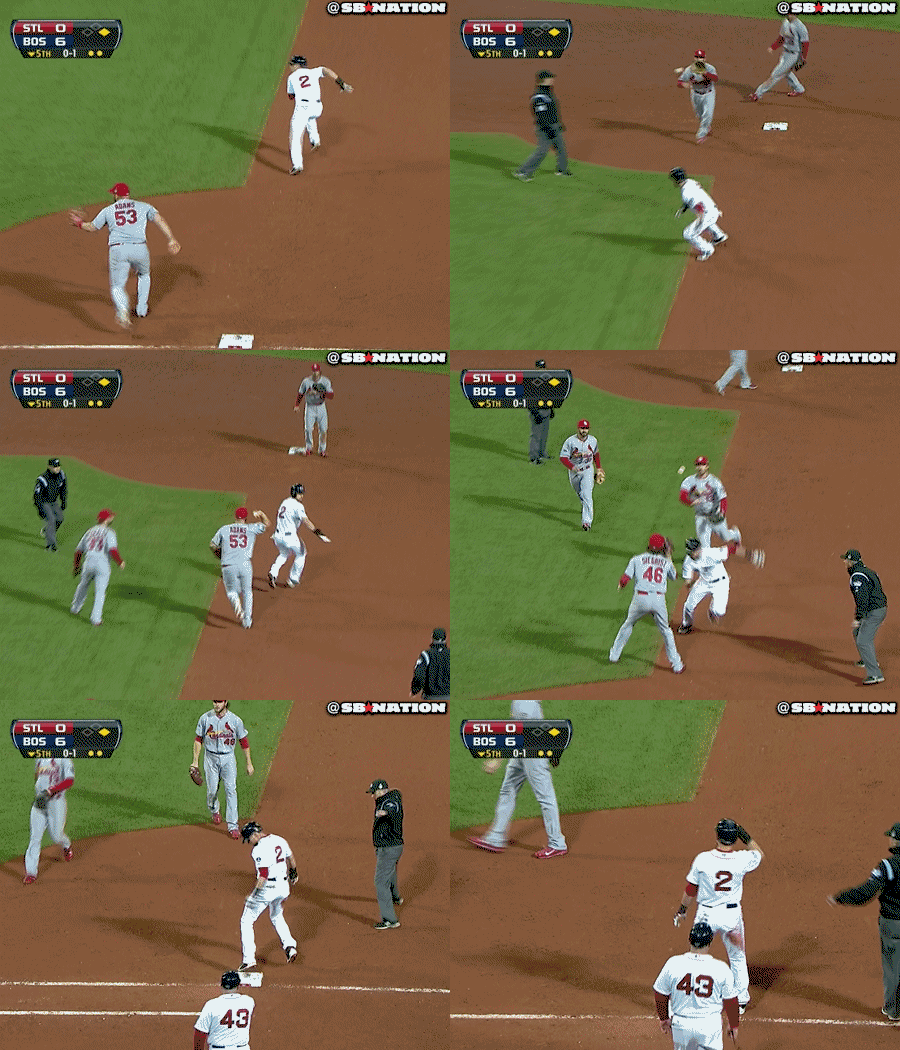
Jacoby Ellsbury (2), here Houdini-ing a rundown in the 2013 World Series, before the injuries finally started sapping the talent. (SBNation gif.)

Things got this bad for Jacoby Ellsbury: when he announced his daughter’s birth on the Fourth of July, on Instagram, he got hammered by Yankee fans indignant over the big contract to the too-often-injured outfielder. Well, nobody said Joe and Jane Fan were immunised completely against the stupid virus.

Such Yankee fans can breathe now. Ellsbury is still the first of Navajo descent (courtesy of his mother) to play major league baseball, but  he isn’t a Yankee anymore. The Yankees finally decided to cut him loose and eat the remaining $26 million Ellsbury’s owed on his original seven-year, $153 million deal. Contrary to what too-popular belief still says, neither side is to blame for Ellsbury’s none-too-fantastic voyage.

What does it do to a man to know that not only could he not perform his duties at his line of work because his body kept telling him “not so fast, dude,” but that people observing his particular company made him a hate object for no crime worse than the injuries he incurred on the job?

It’s as if being injured on the job at all equals a character flaw, especially if you happen to be paid a phenomenally handsome salary. On the flip side, it’s as if being paid a phenomenally handsome salary equals some sort of immunity to earthly harm. Here’s a bulletin for you: Handing Clark Kent a nine-figure payday doesn’t make him Superman.

And one of the reasons Ellsbury wouldn’t even think about listening to the Red Sox about staying in the family when he reached free agency after the 2013 World Series conquest was because he was alienated in the clubhouse after he heard one too many whisperings that he wasn’t exactly in a hurry to get back on the field after previous injuries.

It’s hell if you do and hell if you don’t for a professional athlete. Return too soon from an injury and you risk re-injury; return not soon enough (in whose medical opinion?) and you risk being dismissed as a fragile goldbrick.

The 2019 Yankees were so injury riddled that it was easy to joke that their yearbook was probably The New England Journal of Medicine, but Ellsbury was probably one Yankee who wasn’t laughing. Not even like Figaro that he might not weep. He’d been so often injured for so long that he might be tempted to name his memoir, should he write one, The Pangs of the Yankee Reaper.

Sooner or later, too, you suspected injuries would sap Ellsbury’s baseball talents even before he became a Yankee. Red Sox Nation at least had the pleasures of Ellsbury’s talents helping them noticeably enough to a pair of World Series rings including in his rookie season. Including but not limited to his magnificent Game Six rundown dodge in the 2013 Series.

Maybe that’s why Yankee fans showed as much empathy for his on-the-job slings, arrows, and whatever other medicals he had to bear as the empathy a barracuda shows for its prey. But now, let me count the ways Ellsbury didn’t get injured on the job.

He didn’t get a bite in the ass sliding into second thanks to having left the false teeth he doesn’t have in his back pocket. (An otherwise nondescript pitcher, Clarence Bethen, thought of that in 1923.)

He didn’t turn his knee into bone meal chasing Jill St. John down the ski slopes. (Freshly-crowned Cy Young Award winner and chairman of baseball’s Future Dentists of America, Jim Lonborg, was rumoured to have done just that when he tore his knee apart in a winter skiing accident after the 1967 season.)

He didn’t get the brilliant idea to demonstrate his slam-dunk technique on a storefront awning, catch his ring in the mechanism, and cost himself a season with shredded hand ligaments for his trouble. (Braves relief pitcher Cecil Upshaw slam dunked his way out of the 1970 season that way.)

He didn’t adopt an exercise routine that included running backwards and thus running into a gopher hole causing himself a back injury. (Pitcher Jamie Easterly did, however, in the 1980s.)

He didn’t break a toe running from his kitchen back to his living room because he couldn’t bear to miss watching a buddy at the plate on television. (Hall of Famer George Brett was so desperate not to miss a Bill Buckner at-bat that he ran from his kitchen and busted his toe.)

He didn’t strain or shred his back pulling his cowboy boots up. (Hall of Famer Wade Boggs once did.)

He didn’t fall asleep with a bitter-cold ice bag on his foot and awaken with a case of frostbite causing him to miss a few games—in August. (Hall of Famer Rickey Henderson stone cold did.)

He didn’t get his face badly sunburned on a tanning bed. (Marty Cordova was the genius who forgot the Coppertone.)

He isn’t known to have attended motivational speeches, necessarily, but if he did he probably had too much sense not to think after hearing one that he could tear the world’s thickest telephone book in half without dislocating his shoulder. (Relief pitcher Steve Sparks had to learn the hard way.)

He never once thought, we think, that he could haul a full heavy side of deer meat up a flight of stairs until the venison-to-be won the weight division by sending him flying downstairs and into a broken collarbone. (Clint Barmes, alas, lost that fight in 2010.)

He was part of no few on-field celebrations, we’re sure, but he never tore his left meniscus by smooshing a pie in a teammate’s face during a postgame interview. (Not the way Marlins utilityman Chris Coghlan did nailing Wes Helms in 2010.)

He’s not the genius who forgot to look all ways while reaching for a fallen sock before the suitcase his wife fiddled with fell over and landed on his hand, causing the injury he tried to hide until even the blind saw he couldn’t grip his bat right. (Jonathan Lucroy was such a genius, in 2012.)

And, he didn’t dislocate his ankle while trampolining with one of his children. (Joba Chamberlain jumped into that while with his then five-year-old son in 2012.)

Ellsbury once broke the Red Sox’s consecutive-game errorless streak record. He also once scored on a wild pitch—from second base. He was once so swift on the bases and in the outfield that he could have challenged the Road Runner to a foot race and won by a neck. He hit four doubles and stole a base in the 2007 World Series; he looked like he’d secure himself as one of the Red Sox’s all-time greats.

At least, he did until he ran into a human earth mover named Adrian Beltre at third base in an April 2010 game. He came back too soon from four hairline rib fractures, felt enough soreness to see a thoracic specialist who recommended more rest and rehab, rejoined the Red Sox early that August, and re-injured the ribs on a play against the Rangers later that month.

Then Ellsbury won the American League’s Comeback Player of the Year for 2011, not to mention both a Gold Glove and a Silver Slugger and a second-place Most Valuable Player finish, while being practically the only Red Sox player who didn’t collapse during that September and thus invite the Bobby Valentine nightmare of 2012.

Ellsbury smashed his shoulder up trying to break up a double play early in the nightmare. He returned in July, then almost made it injury free through 2013. Oops. Compression fracture in his right foot from fouling a ball off the hoof in late August. Returned in time to shine in that run to and through the World Series.

Fed up enough with the false whispering that he just didn’t like to rehab his injuries fast enough (for whom, folks?) that when the Yankees reached out to him with a yummy contract he couldn’t possibly say no.

In Year One of his Yankee tenure he performed, well, the way Jacoby Ellsbury was supposed to perform, including leading the American League with his 22.7 power/speed number. And it was the last season in which being injury free enabled him to perform that well.

Injuries, unfortunately, sap and catch up to players little by little. The Ellsbury Dough Boy had more than his share before becoming a Yankee. And then . . . and then . . . and then . . . and then along came:

2015—Right knee sprain on 20 May; out two months, rest of the season nothing to brag about, unfortunately.

2016—Uninjured but production falling further, including his lowest total stolen bases to that point during a healthy season.

2017—Smashed his head against the center field wall while making a highlight-reel catch. Concussion. Missed 29 games and lost his center field job to Aaron Hicks, but somehow managed to break Pete Rose’s career record for reaching base on catcher’s interference, doing it for the thirtieth time on 11 September, which also happened to be his 34th birthday.

2018—Strained his right oblique at spring training’s beginning. Turned up in April’s beginning with a torn hip labrum. Missed the entire season (and underwent surgery in August) because of it.

2019—Started the season on the injured list with a foot injury; also turned up with plantar fasciitis in the foot (the same injury plus knee issues that reduced Albert Pujols as an Angel to a barely replacement-level designated hitter) and another shoulder injury. Took until September for the Yankees to admit Ellsbury was lost for the year.

Not one of those injuries was caused by anything other than playing the game or performing other baseball-related activity. Remember that before you continue condemning Ellsbury the man or the Yankees as a team over him. He didn’t come to the Yankees believing his previous injuries began draining the talent that was once so electrifying, and he didn’t put on the pinstripes expecting to become an orthopedic experiment, either.

The 36-year-old is said to be finishing rehab and preparing to play in 2020 if there’s a team willing to have him. Ignore the jerk brigades and wish him well. Maybe even wish that he decides at last that his spirit may still be willing but his body’s already had notarised, “Don’t even think about it.”

It’s not easy for baseball players to get the game out of their systems, but if Ellsburry chooses to retire at last, instead of offering up any further sacrifices to the Elysian Field gods, who can blame him?

“Some people give their bodies to science. I gave mine to baseball,” Ron Hunt once said after a career in which his most notable accomplishment was teaching himself to be hit by pitches and taking every one of his 243 plunks. (Hunt led the Show in such plunks six straight during his twelve seasons.)

Ellsbury gave a lot more of his body to baseball than even Hunt did. He has three stolen base championships (two of which led the Show), one total bases championship (364 in 2011), one triples championship (ten in 2010), and a few million dollars in the bank for it. It’s the least he could have gotten for his sacrifices.

But if they ever come up with a surefire immunity to the stupid virus, fans who think on-the-job baseball injuries equal character flaws or teams whose brain trusts have suffered aneurysms should be first to get the shots.

Mr. Crane, Astrogate IS about baseball

2019-11-21 JimCrane

Astros owner Jim Crane talking to the press, presumably without police protection, on another occasion.

“If you want to talk about baseball, I’ll talk about baseball,” said Astros owner Jim Crane to an inquiring reporter at this week’s owners’ meetings at Arlington’s Live! By Loew’s luxury hotel. “What else do you want to talk about?” And then two police officers shepherded Crane away.

If Crane was trying to say he wasn’t going to talk about Astrogate, here’s a bulletin for him: Astrogate is about baseball. It’s about cheating in baseball, it’s about the Astros rigging an off-field camera tied to a clubhouse television set for stealing signs, it’s about violating baseball’s specific rules against that kind of sign stealing, it’s about the likelihood that they weren’t the only such extralegal reconnaissance operation.

It’s about playing the game the right way, as former Astros pitcher Mike Fiers said outright when he blew the whistle on and the covers off the Astros Intelligence Agency last week.

If none of that is baseball, we should love knowing what Crane thinks is baseball. Or what he thinks baseball is. Either way Crane offered as bad a look as the police presence at the owners’ meetings, part of which moved him away from legitimate questioning about something that is very much baseball.

Early during the Watergate scandal, Barry Goldwater said it started to smell like Teapot Dome. Early during Astrogate, I said it started to smell like the Black Sox scandal. The references weren’t just to those scandals’ gravity but to their attempted coverups. Richard Nixon in 1973 tried to get away with saying, “One year of Watergate is enough.” Crane seems to believe almost two weeks of Astrogate are enough.

Nixon’s mistake was not demanding names, places, and heads on platters from the moment he learned about the Watergate break-in. Crane’s making a mistake if he isn’t demanding names, places, and heads on platters over Astrogate. If Manfred needed any more ammunition to take after the Astros, whom he has in his specific sights for now, Crane just handed the commissioner a loaded Uzi.

Trying to say Astrogate isn’t about baseball is like trying to say Teapot Dome—in which Warren Harding’s interior secretary Albert Fall (talk about the perfect name for the job!) sold Navy oil reserves to oil baron Harry Sinclair without formal sanction or competitive bidding—was much ado about Lipton’s Tea.

Crane would do himself and Astroworld alike a phenomenal favour if he shies away from stonewalling legitimately inquiring journalists. They’re trying only to get the answers fans who support his team and the game itself want very badly. Other teams want those answers too, even those who operated similar reconnaissance to counter the Astros or otherwise.

And if Crane wants to, he can look at it this way: They’re trying to get the answers he himself should want as the owner of a team whose game-changing success run was compromised by who knows yet how many people that couldn’t resist the temptation to just that little extra edge, whatever good it did or didn’t do, extra-legally.

The questions out of Crane’s mouth to his organisation should be, “What did you know? When did you know? And who are the wisenheimers whose brainchild this was in the first place? I want names. I want places. I want heads. And I want them five minutes ago.”

He needs to be the Astro Hoover, beating, sweeping, and cleaning. Baseball observers ask what his general manager Jeff Luhnow knew and when he knew it. Manfred already has former assistant GM Brandon Taubman under questioning for taunting women reporters over domestic violence, and don’t think for a minute Manfred won’t ask Taubman what he knew and when he knew about the AIA, too.

Another Luhnow aide, Kevin Goldstein, is liable to face interrogation over his 2017 e-mail suggestion that Astro advance scouts—enough of whom seem to have quaked at the idea—use video cameras in the stands to help develop other ways of high-tech sign stealing.

Just before Astrogate began, Crane moved his son, Jared, into the Astros’ executive suite, which meant he had to move Reid Ryan out into a lesser role. Which meant Ryan’s father, Hall of Fame pitcher Nolan Ryan, leaving the Astros and saying, perhaps tellingly, “I will not be back with the club and will leave it at that.”

It’s not impossible that Manfred or his Astrogate bloodhounds have thoughts about asking Ryan if there was just a little more than a father angry about a son’s demotion prompting his departure. Especially since it happened five days before Fiers’s revelations hit the fan.

Crane doesn’t need to tell even one reporter that he’s only going to talk about baseball as if Astrogate is much ado about a spacecraft hatch. And he doesn’t need the cops to hustle him away as if he needs to be in the witness protection program.

He’s a businessman one of whose companies is involved in playing a game that millions love, in Astroworld and all over, but which has a serious enough issue that strikes at the very integrity of the game, the idea that everybody plays by prescribed rules and shouldn’t be trying extra-legal tactics to prevail in or profit from a contest or even a championship series.

That’s why the hoo-has over the Black Sox scandal (and the decade of rampant gambling/game throwing that nourished it in the first place), All-Star ballot-box stuffing (1957, on behalf of the Reds; 2015, on behalf of the Royals; others), Pete Rose’s Rule 21(d) violations, actual or alleged performance-enhancing substances (and the Selig era’s foot-dragging over it), and the ultimate confirmation (first in 2001) that The Giants stole the pennant! The Giants stole the pennant! in 1951.

If Crane doesn’t want to look at things that way, he can look at at it as a businessman: Astrogate stands to cost his baseball organisation millions—in fines, international bonus room, draft pick losses, whatever Manfred decides.

Any businessman cares about the health of his industry, no matter that he loves to one-up the competition at every legitimate chance. Crane should be very alarmed that similar hits could be laid upon other baseball teams running their own extra-legal espionage and compromising theirs and maybe, just maybe, the entire game’s credibility, too.

He should be alarmed likewise at Astrogate’s impact on his team’s credibility. It’s compromised. The Astros’ front office may have developed something of a reputation for ruthless lacking in people skills, but the team on the field built a reputation for dominant play by high character people, including some who were characters in the best ways. Astrogate now makes them look like shameless cheaters.

“When players discuss (off-field high-tech sign stealing) accusations,” Thomas Boswell wrote about the 1951 Giants and similar espionage, “it is with contempt in their voices, not amusement.”

A spitballer or corker can be caught by an umpire, who has the right to examine or confiscate equipment. Both teams play on the same damp base paths and inclined foul lines, even if they’ve been doctored a bit for home-field advantage.

But an elaborate system of sign stealing—with an old pro in the art of signs in a hidden space—is almost impossible to catch. Umps and foes are defenseless. The game becomes fundamentally unfair because knowing what’s coming is a big deal.

(Damp base paths? The 1962 Giants’ grounds crew turned the dirt around Candlestick Park’s first base into a swamp in a bid to slow down Maury Wills’s road running. Inclined foul lines? The 1950s Phillies’ grounds crews sculpted the third base line in Shibe Park into a ridge to keep Hall of Famer Richie Ashburn’s deft little bunts up the line from rolling foul so Mr. Putt Putt could beat them out for hits.)

Once or twice someone caught onto the Astroplot. Notably enough then-White Sox pitcher Danny Farquhar, a year before his tragic in-dugout brain hemorrhage, smelling enough of a rat—when he heard the boom! boom! of the clubhouse trash can being banged, sending the stolen sign deciphered on a live TV screen to an Astro hitter—that he called his catcher to the mound to switch the signs up.

“There was a banging from the dugout, almost like a bat hitting the bat rack every time a changeup signal got put down,” said Farquhar, now the pitching coach for the White Sox’s Winston-Salem (A-advanced) affiliate. “After the third one, I stepped off. I was throwing some really good changeups and they were getting fouled off. After the third bang, I stepped off.”

Crane saying he’ll talk baseball but not Astrogate, which is about baseball whether he likes it or not, makes him look further out of touch if not completely indifferent. A police presence at the owners’ meetings looks strange enough by itself without a couple of the gendarmes shielding Crane from valid questions about a rot in his team.

Try to picture the look of police shielding NBC chieftain David Sarnoff or CBS emperor Bill Paley from questioning about the quiz show chiselings of the mid-to-late 1950s. Sarnoff and Paley may not have wanted to own the fixings on Twenty-One or The $64,000 Question, since they weren’t exactly the masterminds, but neither did they call the cops when the press and Congressional investigators finally came a-calling.

Better yet, try to picture the look of the fuzz shielding American presidents, from the incumbent on back, way back, from legitimate questioning about why they forgot there was a crazy little thing called the Constitution that doesn’t, as the somewhat notorious incumbent prefers to believe otherwise, let them just do whatever they damn well please in office.

Those looks would be terrible. And it’s a terrible look for a baseball owner whose team has won, in three seasons, three American League Wests and one World Series, got to within eight outs of winning a Second series, but now looks as though the rules against off-the-field electronic video sign stealing either didn’t apply or didn’t exist.

Astrogate’s gut check for Manfred and baseball

2019-11-20 RobManfred

Rob Manfred must broaden the Astrogate probe, even if it means he’s a dead duck with the owners who’ve extended him only through 2024.

Baseball commissioner Robert Manfred says he’s going to throw the book, drop the hammer, lower the boom, and call curtains on the Astros if his investigators find they really did rig a real-time, beyond-center-field camera to a clubhouse television set to steal opponents’ pitch signs in 2017 and beyond. And then he’s really going to get mad.

Except for one little detail. “I’m not going to speculate on whether other people are going to be involved,” the commissioner said as the owners’ meetings began in Arlington, Texas Tuesday. “We’ll deal with that if it happens, but I’m not going to speculate about that. I have no reason to believe it extends beyond the Astros at this point in time.”

Not so fast, warns The Athletic‘s Ken Rosenthal, who first exposed Astrogate with Evan Dillich a week before the owners’ meetings, when through them former Astros pitcher Mike Fiers blew the whistle on and the covers off the Astros’ illegal 2017 surveillance theft.

For one thing, Rosenthal and Dillich wrote in their first story, “Electronic sign stealing is not a single-team issue.” And that, Rosenthal reminds us now, was before they even mentioned the Astros.

I’ve made the point of saying that the Astros may be just the most flagrant about it but they’re hardly the only ones trying it. Last week, I wrote, “Reality check: The Astros—or whomever among them created their [Astros Intelligence Agency]—aren’t the only such electronic thieves, merely the latest to be caught red Octobered.” The Red Sox tried it with an AppleWatch, also in 2017, and got fined for their trouble.

Manfred then said in no uncertain terms that “future violations of [that] type will be subject to more serious sanctions, including the possible loss of draft picks.” And last February Manfred announced augmented rules clarifying: no off-field electronic camera sign stealing, which was already against the rules in the first place.

Apparently, that part still needs to be made clear to a lot of people. I’ve said it before, I’ll say it again. Stealing signs while running the bases or on the coaching lines or in the shallow outfield* is old-fashioned gamesmanship. Stealing them by way of off-the-field devices was long against the rules and amounted to genuine baseball crime. And that was before anyone though of technology beyond binoculars or spy glasses.

The new rules this year also meant no monitors in clubhouses and tunnels, and every team required to audit every in-house camera, its purpose, its wiring, and where it can be viewed. Rosenthal and Dillich exposed the Astros’ 2017 techno-shenanigans. Manfred’s investigation may well turn up 2018 and even 2019 electro-chicanery.

Astrogate shouldn’t stop with the Astros no matter how brazen their operation or how unapologetic their Twitterpated. Or, no matter how risky it might actually be for Manfred to expand the probe, discover more franchises actually doing something close to the AIA, but make enemies enough among the owners who employ him that he could be dumped in due course.

The commissioner’s official powers to act in the best interest of baseball, installed from the creation of the job in the wake of the Black Sox scandal, aren’t exactly the same as getting away with it when he does act that way. It only began when Happy Chandler’s employers cashiered him in 1950.

You never quite know which unnerved that generation of owners more, Chandler allowing the Dodgers to sign Jackie Robinson and break baseball’s colour line or Chandler inadvertently screwing up baseball’s first big television deal two years later: he sold World Series rights to the Gillette shaving products company for $1 million a year over six years, but Gillette in turn sold the rights to NBC for $4 million a year.

Fay Vincent eventually learned the hard way that acting in baseball’s best interest still meant his head on a plate, or at least resigning before he could be executed. The owners weren’t thrilled over his intervention in the 1990 spring lockout, his direct involvement in labour issues, and (perhaps especially) his bid to strong-arm three Yankee officials including manager Buck Showalter out of baseball over standing up for drug-troubled relief pitcher Steve Howe despite Howe’s seventh such violation.

The owners in Chander’s, Vincent’s, and Manfred’s times still share one trait: the commissioner’s powers to enforce the good of the game won’t always get past the idea that the good of the game means making money for the owners. Or not costing them serious money, if Manfred’s serious about heavy Astrogate fines for now.

There’ve been times Manfred appeared to be in somewhat over his head. He’s cracked down impressively enough on domestic violence involving baseball people, but he hasn’t exactly been a tower of strength when it comes to things like umpire accountability. But if he finds his surety enough to go all the way in finding extra-legal espionage is more rampant than just the Astros or even just one or two other teams, Manfred risks skipping lame duck status (he’s been extended through 2024) and going right to dead duck. Do not pass Go, do not collect $200.

“To do the job without angering an owner is impossible,” Vincent said as he left office and Brewers owner Bud Selig became “interim” commissioner. “I can’t make all twenty-eight of my bosses happy. People have told me I’m the last commissioner. If so, it’s a sad thing. I hope [the owners] learn this lesson before too much damage is done.”

Another problem is that Manfred’s bloodhounds probably can’t expose every last extra-legal sign stealing operation by every last major league team, as Rosenthal notes. “Is it possible the Astros were the most flagrant violators? Of course,” Rosenthal writes. “But the risk in making an example of the Astros is that other franchises almost certainly stole signs illegally. Baseball potentially would face accusations of selective punishment.”

Why focus so hard on the Astros in the first place, then? “[B]ecause the information we had was on the Astros,” Rosenthal continues. “We also heard—and continue to hear—about possible violations by a number of other clubs. But hearing is one thing; confirming is another. We do not report gossip. We report only what we confirm, from multiple sources with first-hand knowledge.”

To revisit questions I asked early in Astrogate, which players will come to expose which teams’ extralegal sign intelligence in Fiers’s wake? Who’ll be the Astros’ or any other teams’ Alexander Butterfield, the man who installed but subsequently exposed the Nixon White House’s taping system?

Reported whisperings from the Astros’ circles indicate a belief that any Astro espionage was nothing more than countering what the other guys were doing. If that’s why the Astros did it, Rosenthal writes, “their people need to tell baseball’s investigators what they know, or else hold their peace.”

Does it matter, as some Astro defenders suggest in various social media places, that the AIA didn’t produce a better 2017 home record than road record? That they won five less at home than on the road in ’17? That they scored only 61 more runs at home in 2017 than in 2016 against 111 more runs on the road? Actually, it doesn’t matter. Rifle through volumes of history and discover some of its most notorious crimes were committed on behalf of goals that weren’t achieved but weren’t considered crimes any the less.

The Watergate burglaries didn’t deliver the desired results, but that didn’t legalise burglary or obstruction of justice, either. Whatever the Astros wanted to accomplish as they became the powerhouse they’ve become, the rules then and now say they did it not with old-fashioned, on-the-field gamesmanship but old-fashioned, off-the-field high-tech cheating. Remember—baseball’s history is littered with teams attempting off-the-field cheating with binoculars, rifle sights, hand-held telescopes, and hidden-wire buzzers. The 1951 National League pennant race was only the most notorious until now.

Some think Manfred wouldn’t dare discipline other marquee franchises if he and his investigators discover they, too, tried more than a little applied advanced electronic theft. Except that he did just that to the Red Sox and the Yankees in August 2017 over Applegate, even if it was just a wrist slap. And, to the Cardinals a year earlier, over then-scouting director Chris Correa’s hacking into the Astros’ scouting computer database. Manfred banned Correa from baseball for life and ordered the Cardinals to hand the Astros $2 million and two choice draft picks over Correa’s hacking. (It wasn’t just a baseball violation, either: Correa also went to the calaboose for 46 months for his trouble.)

Manfred may have to walk a fine tightrope investigating Astrogate, but when he wants to be he’s not afraid to throw the book, drop the hammer, lower the boom, and call curtains on baseball’s marquee or legacy franchises if need be. The key is, “when he wants to be.” Whether it’s the Astros alone, or several more teams operating their own versions of the AIA, the punishments can’t be mere wrist slaps this time. Even at the risk of Manfred’s long-term job survival.

And there’s that not so little matter of baseball’s integrity. “People want the game played consistent with our rules,” Manfred said Tuesday, “and feel it’s important that we figure out exactly what happened here and take steps to make sure that it doesn’t happen in the future by imposing appropriate discipline.” Not exactly as eloquent as A. Bartlett Giamatti was about cheating, but certainly to the point.

Manfred’s suggested heavy fines as well as taking away choice draft positions and picks and suspending offenders from international scouting. He’s done it before, and in 2017 to boot. That’s when he slapped the Braves by stripping them of thirteen international prospects (a $16.48 million loss) and banning freshly resigned general manager John Coppolella for life, over illegal signing bonus arrangements and trying to sign an underage player.

So, what if Manfred and his Astrogate bloodhounds do turn up unlawful electronic sign espionage from far more than just the Astros? What if it is more than just one, two, or three other teams? What if the hounds find those culprits and learn they did it because they really thought everyone else did it? Since when does everybody doing it make it right, for the Astros or anyone else?

Talk about a gut check. Astrogate’s giving one hell of a gut check to Manfred. And, to baseball itself.

—————————————————————–

* Sign stealing or relaying isn’t just for hitters, sometimes. Once in awhile it isn’t even for the opposing team. Just ask former Red Sox right fielder Dwight Evans—now a Modern Era Committee candidate for the Hall of Fame—and former Red Sox second baseman Marty Barrett . . . who were sort of stealing their own signs once upon a time.

Evans once wanted a little extra field positioning help, so he and Barrett had a brilliant idea: Barrett would relay the Red Sox’s pitch signs behind his back to Evans from second base, and Evans, knowing which way the pitch was liable to be hit, would adjust his positioning accordingly.

Except that one fine day the Blue Jays’ bullpen caught onto the Evans/Barrett positioning signals . . . and started stealing Barrett’s signs and relaying them to their hitters! This is comparable to the bank robber discovering the bank empty but the vault wide open.

Minor league contraction loses home

20190411_193442

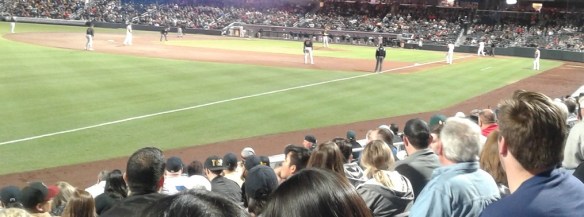
Las Vegas Ballpark, 11 April 2019, taken by the author while watching a game between the Sacramento River Cats and the Las Vegas Aviators.

Minor league baseball is an apprenticeship rough as often as ready for professional baseball players, coaches, and managers alike. But for fans it’s a pleasure that still evokes simplicity and the absence of the country’s and the world’s cacophonies and calamities.

I’ve had that pleasure numerous times in my sixty-four years. I’ve had it seeing the Omaha Royals (long since re-named the Storm Chasers) in the 1980s; the Scranton/Wilkes-Barre Red Barons (known since 2007 as the SWB Yankees) in the early 1990s; the now-defunct Fullerton Flyers (in Goodwin Field, on the campus of Cal State Fullerton) in the Aughts; and, since 2009, the Las Vegas 51s-turned-Aviators, first in creaky Cashman Field and, as of this year, in spanking new Las Vegas Ballpark.

You watch a game and its pleasures and pangs and remind yourself now and then that you’re seeing guys do something that afternoon or evening that mean the fateful phone call bringing them up to the Show. You think to yourself that, God and His servant Stengel willing, there just might be a future Hall of Famer on that field, on that mound, at that plate.

You think that a win for your team would be wonderful fun but it won’t grant them a place in the Elysian Fields’ honour roll of eternal grand champions. But neither do you think that, when your team loses, it means what it meant to too many a Phillie, a Cub, or a Red Sox fan for too many generations—“They came for our fathers, and now the sons of bitches are coming for us.”

Chattanooga, Tennessee baseball fans have had those pleasures since the year (1909) the Hudson Motor Car Company was born. A fan contest named the team the Lookouts, after adjacent Lookout Mountain. Hudson died in 1957. The Lookouts and 41 more of minor league baseball’s 160 teams may die like Hudson (the Cars film series notwithstanding) after next season if the Show has its way.

If you saw or heard about plans to exterminate those teams and you were unamused by the prospect, as many are, you may not be happy knowing the plot was another Astros brainchild. I didn’t know that, either, until I had a gander at Bill Madden in the New York Daily News, who wrote of it last Friday morning with the same lack of amusement.

Baseball commissioner Rob Manfred showed major league owners the plan “a few months ago,” Madden wrote, with the approving vote unanimous. Madden wrote that  the idea was conceived by Astros general manager Jeff Luhnow and supported swiftly enough by two teams whose general managers once worked under Luhnow in Houston: the Brewers (Mike Elias) and the Orioles (David Stearns).

Brilliant. Not only are the Astros at the core of a scandal involving unlawful high-tech, electronic, from-off-the-field cheating, they’re at the bottom of a plan to vaporise 26 percent of grass roots baseball in four short-season rookie- and A-level leagues (the New York-Penn League, the Appalachian League, the Northwest League, and the Pioneer League) and several more at the A and AA levels.

“The rest of the [major league] teams,” Madden wrote, “apparently just said ‘OK’ without any discussion of the ramifications of such a drastic attack on the minor leagues and all these communities across the country.”

The Astros themselves stepped ahead of that particular curve after their 2017 World Series triumph, cutting their minor league affliated teams from nine to seven with the elimination of one of two Dominican Summer League affiliates and their Greenville (Tennessee) Astros in the Appalachian League.

Aside from those mentioned, these are the teams on the hit list:

Appalachian League (Rookie, advanced)—Bluefield Blue Jays, Bristol Pirates, Burlington Royals, Danville Braves, Elizabethton Twins, Greeneville Reds, Johnson City Cardinals, Kingsport Mets, Princeton Rays.

California League (A, advanced)—Lancaster Jethawks.

Carolina League (advanced A)—Frederick Keys.

Florida State League (advanced A)—Daytona Tortugas, Florida Fire Frogs.

Midwest League (A, full season)—Burlington Bees, Clinton LumberKings, Quad Cities River Bandits.

New York-Penn League (A, short season)—Auburn Doubledays, Batavia Muckdogs, Connecticut Tigers, Lowell Spinners, Mahoning Valley Scrappers, State College Spikes, Staten Island Yankees, Vermont Lake Monsters, Williamsport Crosscutters.

Northwest League (A, short season)—Salem-Keizer Volcanoes, Tri-City Dust Devils.

Pioneer League (Rookie, advances)—Billings Mustangs, Grand Junction Rockies, Great Falls Voyagers, Idaho Falls Chukars, Missoula PaddleHeads, Ogden Raptors, Orem Owlz, Rocky Mountain Vibes.

Southern League (AA)—Jackson Generals.

South Atlantic League (A, full season)—Hagerstown Suns, Lexington Legends, West Virginia Power.

Madden wrote that that, according to calculations from minor league baseball itself, would amount to disappearing over two thousand combined years of minor league baseball history. Peabody and Sherman never bypassed that much of the world’s doings and undoings on their Waybac Machine travels.

What made the Astros think about it in the first place? Analytics. The very thing that helped turn them from also-rans to the powerhouse they are. They’ve exposed the side of analytics that its critics abhor and makes even supporters of sabermetrics (like me) cringe. I can find no better description than that from Field of Schemes writer Neil deMause:

As the Astros execs’ thinking went, advanced analytics (i.e., grading players based on such things as using high-speed cameras to measure body mechanics) could replace watching young players play actual baseball, saving the trouble of having to pay so many of them to do so. (Not that this is a huge expense — an entire single-A roster can be had for about $600,000 a year—but again, the Astros are all about exploiting every advantage.) And . . . why should they have to compete against teams like the New York Yankees whose owners were willing to keep minor league teams stacked up like cordwood?

The common good of the game is seen too often as making money for it. Now comes a curlicue once the reserve of science fiction, the common good of the game reduced to applied science and reducing the volume of actual baseball games. This isn’t exactly what Hall of Fame manager John McGraw had in mind when he rhapsodised about “scientific baseball.”

Applying advanced analysis toward helping players improve their games and thus teams improve their competitive standings is one thing. So is applying it sabermetrically toward giving you, Joe and Jane Fan, the most complete possible view of players and games you didn’t get to see. (Ponder: 2,430 major league baseball games are played every season. Maybe five times that many are played in the minors now.)

But they won’t tell you about the people playing those games. They won’t tell you why baseball isn’t really a game of seventy percent failure (seek and ye shall find, I promise you) and, most important, why some baseball players know how to shake away their shortfalls and others don’t. Lessons learned or re-learned in the minor leagues, most of the time.

Minor league crowds are a far more accepting, far less judgmental lot than Show audiences tend to be. And you may also think, above and beyond the game you watch on the field, that the guys on those teams are learning things other than the play itself. Things like why some minor league teachers miss when it comes to teaching players what minor league fans usually understand, that failure isn’t mortal sin.

A minor league team that doesn’t teach those things in hand with the play of the game is a minor league team that gets overhauled, not contracted. And when they don’t teach those things, it means disaster in the Show, where to err is human but to forgive isn’t always Joe and Jane Fan’s (or Journalist’s) policy.

Do you remember Calvin Schiraldi? Once a Met, then a Red Sox. Promising relief pitcher. Came back up late 1986 as the Sox’s bullpen stopper. Imploded fatefully in the World Series. Hung with the no-heart label.

When Mike Sowell wrote One Pitch Away: The Players’ Stories of the 1986 LCS and World Series, one of the players Schiraldi, as textbook a case of self-punishment for failure as you can find from his time. Sowell probably should have won some sort of prize for getting Schiraldi to talk at all, considering the former righthander liked reporters as much as Donald Trump likes criticism.

Sowell got Schiraldi to own up to his wounding flaw, the one flaw above all that kept him from sustained pitching success: “I liked it when I did well. But when I did bad, I took more things to heart than just blowing games off. I mean, if you lose, I took it to heart. Or, if I blew a save for a starter, I took it to heart. That’s probably what hurt me the most.”

That wasn’t exactly uncommon knowledge before Sowell. But it came second hand, so far as I knew. Months after that 1986 Series ended, Thomas Boswell ultimately revealed there was one Red Sox determined not to let Schiraldi sink himself after an earlier playoff loss. “It’s Schiraldi who got so down on himself that it worried me,” said fellow Red Sox (and fellow ex-Met) reliever Joe Sambito. “After he lost . . . I told him, ‘Calvin, you’re the best we have. Put it out of your mind. You can be the hero tomorrow.’ And he was.”

Sambito referred to Schiraldi’s blown save in Game Four of the ’86 ALCS against the Angels. The following night, Schiraldi nailed the extra-inning save set up when ill-fated Donnie Moore—whose eventual suicide came from far more than just one unforgiven (by Angel fans or himself) game failure—surrendered a tying two-run homer to Dave Henderson when the Angels were a strike away from going to the Series.

With the Red Sox an out from winning Game Six and the ’86 Series, Schiraldi gave up three softly-hit Mets singles in a row, the third of which brought the Mets to within a run of tying. Schiraldi was lifted for Bob Stanley. Stanley threw the wild pitch that should have been ruled a passed ball to let the tying run score. And then came the grounder heard ’round the world, skipping through Bill Buckner’s ankle-ruined legs to score the winning Met run. “So what happened after Schiraldi’s defeat in [World Series] Game Six?” Boswell wrote the following February in spring training.

He came back the next day ready to redeem himself. And it rained. He had a day to sit in a New York hotel room and think. When Schiraldi took the mound in the seventh inning of the seventh game, score tied, he was a wreck. Ray Knight, the first batter, hit a home run.

Things like that usually get tended, treated, and re-tended and re-treated in the minors, before you get to the Show—if you get there. Bad enough that Schiraldi’s minor league coaches may have missed them. Things like that are beyond the pay grade of the most deft analyst, technician, or applied scientist, on the Astros’ or any other baseball organisation staff. If the ’86 Red Sox were that advanced, they still couldn’t have saved Schiraldi from himself.

Maybe that’s why Ken Giles went from outstanding closer to 2017 World Series failure to wreck and to Toronto during the following season. The Astros could and probably did give him every analytical edge possible to take to the mound. When Corey Seager, Justin Turner, and Cody Bellinger ruined him in World Series Game Four to break a one-all tie in the ninth, Giles was shattered.

And, maybe alone, no matter that no less than George Springer sprang to his defense after the game. “This game’s hard. They’re not out there trying to fail,” Springer said after that game. “I hope [manager A.J. Hinch] keeps giving ’em the ball. I have the utmost confidence in them, and I’m glad they’re on my team.” Springer might have but Hinch didn’t. Giles was never seen again in that Series.

The following season, a couple of bad outings turned into a couple of bad meltdowns and Giles’s trade to the Blue Jays (for, controversially, Roberto Osuna), where he regrouped and posted an enviable 2019 despite a couple of injuries.

Don’t make the mistake of saying the pressure of the games or the postseason themselves got to either Giles or Schiraldi. Young men who don’t get taught or re-taught that failing in a game isn’t a mortal sin beat themselves no matter whether it’s a season opening series or the World Series.

Maybe Henderson was onto something when he once said, “This is a game. It’s not life and death. It should be fun.” Hell, he’d had to remind himself in that very ALCS Game Six: earlier, before his dramatic bomb, he tried snagging Bobby Grich’s fly with a flying leap, but the ball tipped off his glove and over the center field fence for a two-run homer.

Henderson wasn’t really the superstar he appeared for brief moments in that postseason; he was a useful journeyman in a respectable fourteen-season major league career. But he endured precisely because he knew failure didn’t have to be the end of the world as he knew it. And just maybe the easygoing Hendu got the proper reinforcement on that approach in the minors.

If you think that’s just a voice from the grave (Henderson died of a heart attack two months after a kidney transplant in 2015), maybe you’ll listen to Casey Mize, 2018’s number one draft pick overall. “I think failure is part of it and needs to be part of it,” said Mize—after throwing eight shutout innings at the Bowie Bay Sox for the Erie Sea Wolves (AA, Tigers affiliate)—about player development. “I see positives in being forced to fail.”

The minors aren’t anywhere near perfect. There’ll always be those players who don’t advance for assorted reasons and those reasons don’t all include analytic failure. There are injuries that curtail careers, there are boundless external issues, and there are mindsets that let the sense of fun die too soon when they realise professional baseball is the serious work of play.

One of the issues believed to be animating the contraction plan is ballpark conditions. As in, ballparks not up to major league standards. As in, the distinct whiff of potential litigation from minor league towns where taxpayers got the bill for upgrading the parks or building new ones entirely. But as Madden observed, if so many minor league parks aren’t up to snuff, why did the Show let the Cubs and the Pirates play a regular-season game in Williamsport last year? And why would they let the Red Sox and the Orioles do likewise next year?

Another may well be minor league conditions. The Show’s spinning, as Madden calls it, includes that the contraction plan is also aimed at “improv[ing] ‘wellness’ for the minor leaguers in terms of travel and living conditions,” though noticeably not in terms of their salaries, which should be redressed.

Many of the teams targeted for contraction, Madden added, “are grass roots baseball towns where most of baseball’s biggest stars passed through (and developed a forever fan base) on their way to the majors.”

An official from one of the teams in the Pioneer League, where most of the teams are in Montana, Idaho, and Wyoming, put it to me this way: “This is the only way people in these towns can see baseball. They can’t afford to drive a thousand miles to Seattle. And you’re talking about young fans . . . You take their teams away and baseball has lost them forever.

Dodger pitcher Walker Buehler thinks one key minor league issue is too many players there. “At any affiliate, there are three players who have a chance to play in the majors,” he told FiveThirtyEight. “The rest of the players are there so they so they can play. I don’t think that’s fair. You are preying on their dreams.”

It may not be as simple a scenario as Buehler seems to think, that minor league teams and their major league overseers prey on too many dreams unlikely to come true. And speaking of dreams, the Show has a plan for those minor league owners who lose their teams if the contraction plan flies: what it calls a Dream League, an independent league operated by the Show at minimal cost.

Madden, however, noticed a big problem with that idea:

In addition to stadium maintenance and taxes which they’re already paying, the cost of players, managers, coaches, trainers, and equipment people’s salaries and workers comp insurance would now all fall on the owners—between $350,000-$450,000 per year. When it was pointed out by minor league negotiators there was no way these minor league owners, after losing all the equity in their teams, could then afford to own a “Dream League” team, the MLB response was: “Well, they didn’t pay all that much for their teams in the first place, so it’s only paper money.” Tell that to David Glass, who bought the Kansas City Royals in 2000 for $96 million and recently sold them for $1 billion. Or as one minor league negotiator told me: “I guess that means it’s OK they should be punished for being good business operators.”

They and their fans will be punished just by losing their teams at all. Bristol, Tennessee has been in business in the minors since the sinking of the Lusitania. (1918.) Assorted South Atlantic Leagues (known colloquially as the Sally Leagues) have existed since Hoover Dam. (1936, though the dam was born as Boulder Dam.)

The Jackson Generals were once known as the Memphis Chicks—born with the Southern Association in the year (1901) New York became first in the nation to mandate license plates and the American League declared itself a major league; producing the Southern Association’s one-armed league Most Valuable Player, Pete Gray, in 1944.

That’s just a peek at the history that stands to be lost, in hand with the pleasures of baseball itself on the field, for millions of fans who can’t reach the Show except on television or radio or the Internet.

“Baseball is quintessentially American,” wrote A. Bartlett Giamatti before he became a baseball official himself,

in the way it tells us that much as you travel and far as you go, out to the green frontier, the purpose is to get home, back to where the others are, the pioneer ever striving to come back to the common place. A nation of migrants always, for all their wandering, remembers what every immigrant never forgets: that you may leave home but if you forget where home is, you are truly lost and without hope.

The Show’s minor league contraction can be taken, then, as evidence that those who run it forget where home is for millions of fans, and that it takes more than scoring runs to come home.